• WL100/8: Musique funèbre, 10 January 1958

On this day in 1958, Lutosławski put the finishing touches to a score on which he had been working for four years.  In 1998, I wrote a brief commentary on the opening pages of the autograph short score, for a publication about pieces whose manuscripts had been deposited in the Paul Sacher Stiftung in Basel.*

I have always called the piece Funeral Music – except in this little article, where I followed the title that Lutosławski inscribed on his short score: Musique funèbre.  There’s also the Polish version, Muzyka żałobna, which has been common parlance in Poland since the beginning (Lutosławski used it freely).  According to Stanisław Będkowski (A Bio-Biography, 2001), who interviewed the composer in 1988, Lutosławski preferred Mourning Music as the English translation.  This last version has never caught on, even though it is a more accurate translation of the Polish and French alternatives than Funeral Music.  Stucky (Lutosławski and his Music, 1981) and Będkowski stick to the Polish. Rae (The Music of Lutosławski, 1994) prefers the French, as does Skowron (taking Stucky, me and others along with him in his edited Lutosławski Studies, 2001).  My linguistic laziness is shared only by Varga (Lutosławski Profile, 1976) and Nikolska (Conversations with Witold Lutosławski, 1994), each having been translated into English (from Hungarian and Russian, respectively).  CD companies also seem to prefer Funeral Music over the alternatives.  I think I’d better mend my ways and return to the French.

WL Funeral Music article:1

WL Funeral Music article:2

WL Funeral Music article:3

Postscript

Like many writers, I see shortcomings in my past efforts.  This little piece is no exception.  Most particularly, I should have either ignored or dismissed Tarnawska-Kaczorowska’s initial flight of fancy for want of real evidence.  Danuta Gwizdalanka and Krzysztof Meyer (Lutosławski. Droga do dojrzałości, 2003) are more grounded and forthright. Among other rightly dismissive observations (mainly about Tarnawska-Kaczorowska’s attempt at numerological symbolism, which at least I could see straight away were rubbish), they revealed that the Prologue with the F natural – B natural motif was written in the first half of 1955 (over a year before the Hungarian revolution) and that the working title of the piece in 1957 (after the revolution) was the much simpler Etiuda na orkiestrę smyczkową [Study for string orchestra] – Pro memoria Béla Bartók.  

* Settling New Scores. Music Manuscripts from the Paul Sacher Foundation, ed. Felix Meyer (Mainz: Schott, 1998)
• WL100/7: Lutosławski info online

Looking for substantial information online on Lutosławski?  You will find more in this ‘timeline’ pdf than elsewhere:

The Diary of the Life, Works and Activity of Witold Lutosławski

Published in 2007, Stanisław Będkowski’s annotated chronology is the best source that I’ve yet found online. It includes many quotes from the composer’s own recollections, interviews and writings.  I wouldn’t be surprised if an updated version appears this year.

WL_Studies_1_2007_oklAlong with Stanisław Hrabia, Będkowski has also published Witold Lutosławski. Discography in the same source, the English-language Witold Lutosławski Studies (Kraków: Witold Lutosławski Center, Institute of Musicology, Jagiellonian University).  This discography is an updated version from 2008 of the discography in their massively informative Witold Lutosławski. A Bio-Biography (Westport CT: Greenwood Press, 2001).  Again, I wouldn’t be surprised if a further updated version appears this year.
Three volumes of Witold Lutosławski Studies have appeared (2007, 2008, 2009).  I’m not sure what plans there are for further issues.  All three volumes are well-worth investigating (among other items, Będkowski provides an index of Lutosławski’s correspondence in the third volume, while the 2008 issue includes a penetrating article on musical plot by Nicholas Reyland).  The full contents may be accessed online at:

http://www2.muzykologia.uj.edu.pl/lutoslawski/Witold_Lutoslawski_Studies.html.

• WL100/5: Notebook, 2 January 1963

Cymer the carpenter

Lutosławski’s sketches have many worded sections exploring compositional ideas, often connected to a particular work.  He also jotted down ideas intermittently in a notebook.  He did this most intensively between 1959 and 1966, with further entries in 1969-74, half a dozen in 1979 and one in 1984.  Since his death in 1994, the notebook has become known as both Zeszyt mysłi (Notebook of Ideas) and Zapiski (Notes).  Excerpts have appeared in several publications, but the first complete publication was in English, in Zbigniew Skowron’s Lutosławski on Music (Lanham MD: Scarecrow Press, 2007), pp.291-329.  The Polish version was published as a separate volume, again edited by Zbigniew Skowron: Zapiski (Warsaw: University of Warsaw Press, 2008).

From time to time, as part of the WL100 series, I’m going to post both pithy and discursive entries from the notebook, on the day and month that he wrote them.  Here’s the first, which seems a quite random jotting.

Cymer the carpenter said: a man learns all his life but still dies stupid. 

Stolarz Cymer powiedzał: człowiek uczy się całe życie i jeszcze głupi umiera.

Witold Lutosławski, 2 January 1963  [my translation]

Who was Cymer the carpenter?  I’ve come to the simple conclusion that perhaps he came to do some woodwork in Lutosławski’s flat, fifty years ago today.

• WL100/4: Lutosławski Likenesses

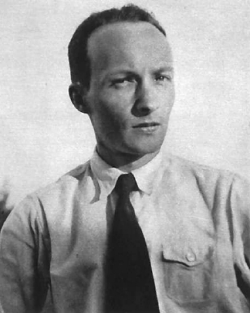
If you haven’t already twigged whose eyes are fixing you from above as you read onpolishmusic, here’s the answer:

WL_photo_1937

The photo was taken in 1937, when Lutosławski was 24, and this profile and penetrating gaze would be repeated in many subsequent photos.  He’s the spitting image of his father Józef, pictured below in 1900 when he was 19, with his mother Maria (they were to marry in 1904; Witold was their fourth and last child).  Józef was executed by the Bolsheviks in Russia in 1918; Maria died in 1967.

Maria & Józef Lutosławscy, 1900

I’ve often wondered if Lutosławski was deliberately emulating his father’s pose in the photo from 1937.  The likeness is uncanny.  Aside from such measured photos, Lutosławski could be full of laughter.  Fifty years on, during his visit to Belfast in 1987, when he was 74, he was captured from a less usual angle, showing his right profile.  It’s one of my favourite images of Lutosławski and one which has not been shown publicly until now.

WL, Belfast, 17.12.87

On the eve of his centenary year, here’s to the musical celebrations of 2013!

• WL100/3: Lutosławski in Belfast (gallery)

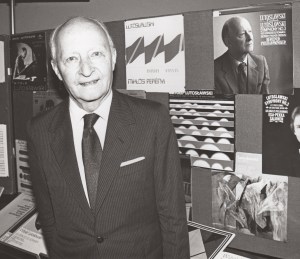
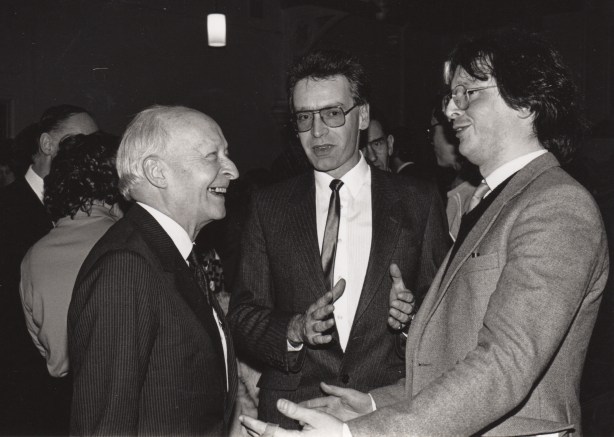
Here are a few more pictures from Lutosławski’s visit to Queen’s University, Belfast, twenty five years ago in December 1987 (see the two preceding WL100 posts).  After a concert of his chamber music on 17 December, Lutosławski spent some time looking at an exhibition of his scores and LP covers.  Lutosławski and I also had an evidently jolly discussion with my friend and colleague, the composer Piers Hellawell.

WL at QUB exhibition 17.12.87WL at QUB exhibition, with Adrian Thomas 17.12.87

WL at QUB, with Adrian Thomas and Piers Hellawell 17.12.87

• WL100/2: Lutosławski in Belfast (DMus)

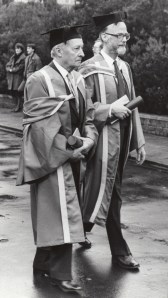
WL concert 17.12.8718 December 1987 was a grey wet day, but then it was a week before Christmas. It was, however, a special day at Queen’s University, Belfast.  My colleagues, our students and I could not have been prouder when Lutosławski stepped onto the platform of the Whitla Hall to receive an honorary DMus.  I read the citation and afterwards Lutosławski walked the short distance to the Main Building for a jovial lunch with university dignitaries.
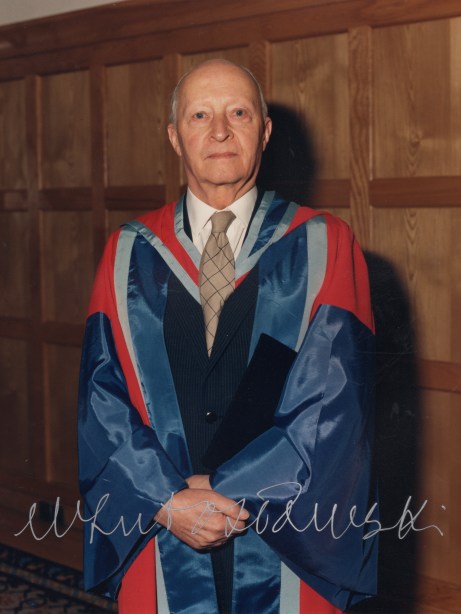
Lutosławski charmed everyone whom he met, as he always did.  The night before, he’d been present at a concert of his chamber music where relaxation and informality had been the key.  On this day, he was all robed up and solemnly posed for the camera in his doctoral garb.

When I saw him in Warsaw the following year, I took with me a host of photos from his visit which he signed for the performers and others.  I like the way he used a silver-ink pen. His was a special and distinctive handwriting, as I hope to show in other posts in 2013.

WL Hon DMus:2 18.12.87

Witold Lutosławski, Hon DMus
The Queen’s University of Belfast, 18 December 1987

• WL100/1: Lutosławski in Belfast

Twenty five years ago today, on 17 December 1987, Lutosławski paid his one and only visit to Northern Ireland.  He had come for the Winter graduation at The Queen’s University of Belfast where he was to be awarded an Honorary DMus on 18 December.  I was teaching at Queen’s at that time and the proposal that the University should recognise Lutosławski came from my colleague, the innovative social anthropologist and ethnomusicologist, John Blacking.

On the night before the degree ceremony, the Department of Music mounted a short concert of Lutosławski’s chamber music in his honour: Dance Preludes, Five Songs, Sacher Variation, Epitaph, Grave and Partita.  The performers were graduands of the University, joined by György Pauk and Roger Vignoles.  Lutosławski seemed very pleased with the occasion, and afterwards he inspected an exhibition of his scores and record sleeves (LPs in those days!) and mingled happily with the audience at a post-concert reception in his honour.

I’ll post some more pictures from the occasion in the coming days.

Witold Lutosławski at a concert of his chamber music in the Harty Room of Queen's University, Belfast, on 17 December 1987.From left to right: György Pauk (violin), Donal McCrisken (piano), Damian Frame (clarinet), Francis King (piano), Lutosławski, Colin Stark (oboe), Jacqueline Horner (mezzo-soprano), John O'Kane (cello) and Roger Vignoles (piano)

From left to right: György Pauk (violin), Donal McCrisken (piano), Damian Frame (clarinet), Francis King (piano), Lutosławski, Colin Stark (oboe), Jacqueline Horner (mezzo-soprano), John O’Kane (cello), Roger Vignoles (piano)

The programme notes for the concert may be accessed here.