I have just realised that there are no entries at all in Lutosławski’s creative Notebook (1959-84) for the months of June and July. Good man – he knew that holidays were important, although there were some years when he was working hard in these months. He finished the Cello Concerto on 27 July 1970 and completed the Concerto for Orchestra on 1 August 1954. The images of him sailing as a way of relaxing are well-known, but this creased photo from the Witold Lutosławski Society in Warsaw shows him in another craft. My guess is that it dates from the 1950s or early 60s, but if anyone has better information it would be good to know.
I am playing catch-up with these WL100 posts (there are a few more to follow before I am up-to-date) – my apologies. I have been writing about Lutosławski’s Cello Concerto all summer. I could do with a kayak trip myself.
It hardly seems possible that on this day 44 years ago I was about to conduct the UK premiere of Lutosławski’s Trois poèmes d’Henri Michaux (1963). I shared the platform with the Nottingham University Chamber Choir and Orchestra and a fellow student conductor, Donald Goodhew. Ever since I’d been introduced to this work in print and on LP in the autumn of 1968, I’d been totally captivated by it and its composer. The rest, as they say, is history. Less than a year later, I published a little article on the piece (possibly the first English-language journal article on Lutosławski’s music), focusing on its pitch organisation and our choral preparation. Today I’ve posted this article – ‘A Deep Resonance’ (1970) – elsewhere on this site.
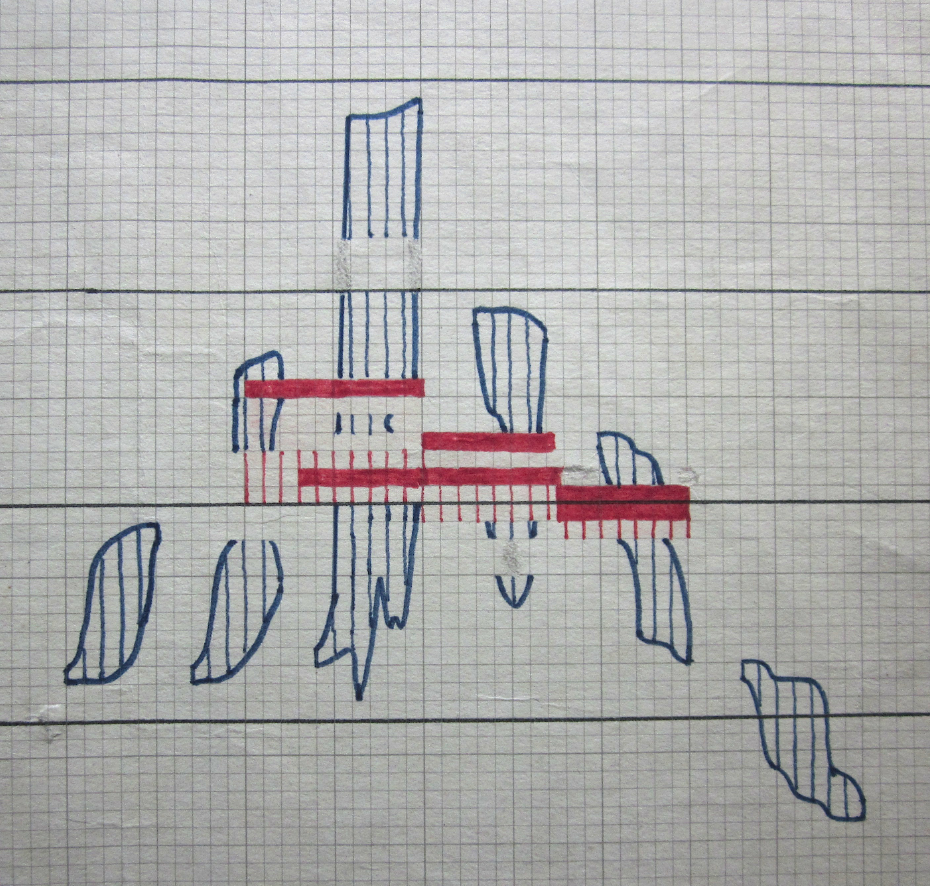
One of the tools that I used to demonstrate how the choir (me) and the orchestra (Goodhew) interacted was by drawing up a graphic representation of the music as there was no combined score or ‘piano part’. In order to do this, I had to carry out a detailed harmonic analysis. The overall chart that I did in 1969 for the first movement, ‘Pensées’ (above), shows clearly the registral design of the music, the different forces (blue=wind, red=choir, green=pitched percussion), and symbolic graphic textures to indicate the changing musical textures. While the harmonic dimension is regularly calibrated (one vertical mini-square on the graph represents a semitone), the temporal dimension is not to scale. Middle C is the first horizontal band of mini-squares underlined by the next-to-lowest black line running left to right across the graph. These five lines indicate the octave Cs.
One of the most intriguing sections runs from fig.35 to fig.84 (1’58”-3’19” in the recording above). It is scored initially for seven woodwind instruments (3 flutes, 3 clarinets, 1 bassoon), a pared down echo of the ensemble of seven woodwinds that Lutosławski used in sections ACEG in the first movement of his previous work, Jeux vénitiens (this is far from being the only connection between the two pieces). Characteristically, he changes the instrumentation almost by stealth over the course of the subsequent five iterations (the full complement of woodwind is 3 flutes, 2 oboes, 3 clarinets, 2 bassoons):
Each of the six short pp ‘clouds’ on the woodwind (blue) moves from one fixed point, usually a brief unison, to another in a different register – echoes here of the designs in the string sections BD(F)H in the first movement of Jeux vénitiens. Interwoven are short contributions by the choral sopranos (red), with their own discrete pitch content. It is a magical, quasi-stochastic texture. These tail-less note heads seem completely free.
Yet that, of course, would be alien to Lutosławski’s way of thinking, let alone working. He habitually worked up detailed maquettes of his ideas, and often in his music one senses its progress as a sequence of carefully matched sketches. So it is here, not least in the range of different notational devices that he uses to create these clouds of sounds. This second section from fig.35 to fig.84 is one of the most intriguing ‘sketches’. I remember looking at it and realising that something was going on behind the apparent impressionism. In the score, Lutosławski gives the advice: ‘Notes without tails indicate the shortest sounds possible. The horizontal distances between the notes correspond approximately to the intervals of time (between the notes concerned)’. This is a diversionary tactic. In fact, these six textures are based on a single template, precisely worked out – it would seem – on graph paper. At least, each of the one-second ‘bars’ can be matched up with the divisions of standard graph paper: 1 second = one large square of 1-inch graph paper subdivided into tenths (1″=1″, though obviously Lutosławski was not working with imperial measurements).
I worked out that there are two rhythmic strands at work, both of them mirror structures and both based on the principle of elasticity – the increase and decrease of rhythmic activity. The distinction between the two strands may characterised this way: the flow of ‘A’ is akin to accelerando-decelerando, while the flow of ‘B’ is regulated by addition-subtraction. Both of these patterns relate to woodwind motifs in the first movement of Jeux vénitiens(sections ACEG).
‘A’ accelerando-decelerando
• the pattern is enunciated by fl.1 at fig.35: in intervals of 1/10th of a graph square, the acceleration moves from an initial gap of 12 down to 1 and back again, at which point it starts again: 12-8-4-2-1-1-2-4-8-12-8- etc..
• fl.2 begins with the second note of this accelerando, fl.3 with note 3, bassoon with note 4, each of them starting 1/10th of a graph square after its predecessor. This way, the pattern is never discernible, not least because the pitch component is also different in each case.
‘B’ addition-subtraction
• the pattern is begun by cl.1, starting 1/10th of a graph square after the bassoon in pattern ‘A’. It too has an accelerando-decelerando component, but is differentiated from ‘A’ by its additive-subtractive pattern: 1 note (a gap of 12/10ths), 2 notes (a gap of 9/10ths), 3 notes (a gap of 6/10ths), 4 notes (a gap of 5/10ths), 3 notes (a gap of 8/10ths), 2 notes (a gap of 11/10ths), 1 note (a gap of 12/10ths), etc.. In sum: 1-(12)-2-(9)-3-(6)-4-(5)-3-(8)-2(11)-1 (12)-2- etc..
• as with ‘A’, subsequent entries start 1/10th of a graph square after the preceding one: cl.1 (1 note) is followed by cl.2 starting with the group of 2 notes, cl.3 starting with the group of 3 notes.
All together now
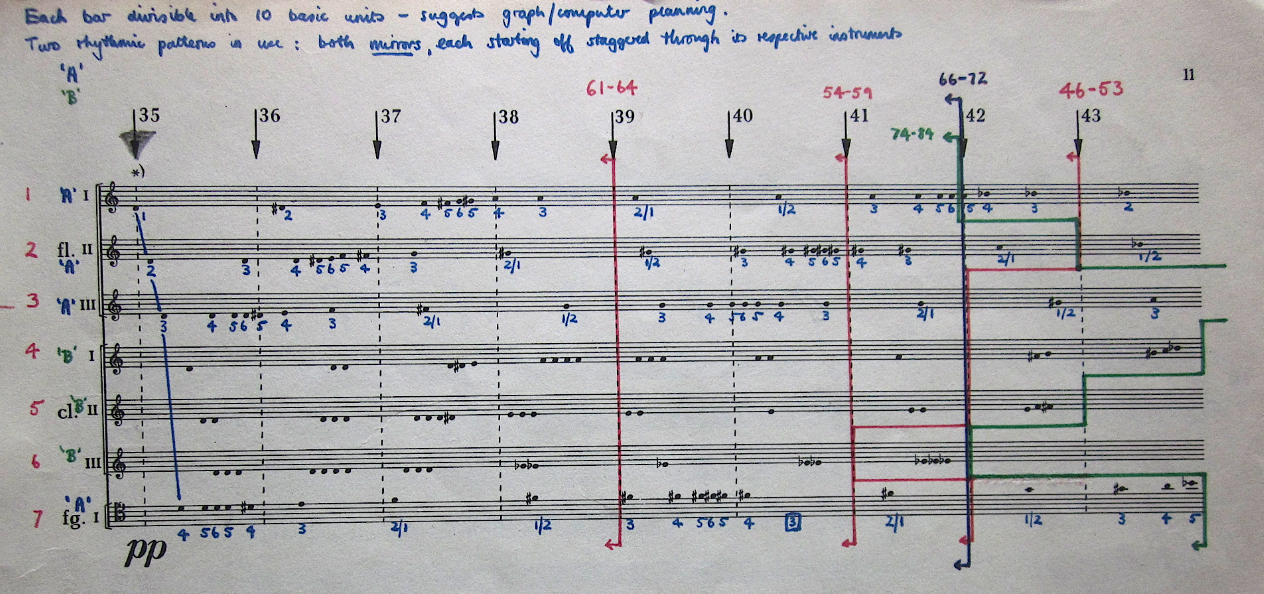
Here is my marked-up score from 1969 of the first ‘cloud’ (figs 35-43; figs 44-45 are on the next system), with each note of the ‘A’ pattern marked as the 1st, 2nd, etc. up to ‘6’. You can also see the cut-off points for subsequent ‘clouds’.
The first of the six ‘clouds’ provides the fullest statement (lengthwise) of the combined rhythmic templates of ‘A’ and ‘B’, though a fourth contribution to ‘B’, starting with the group of 4 notes, is introduced in the second ‘cloud’ (ob.2). All the other five ‘clouds’ may be understood as excerpts from the first one, with Lutosławski ringing the changes in the sequence of instrumental entries:
As the indication ‘incomplete’ above reveals, Lutosławski does not follow this canonic layering slavishly. The sixth ‘cloud’ not only omits some of the final notes but also inserts the ones missing from the first ‘cloud’ (compare figs 81-84 with 42-45). Elsewhere, there are quite a few places where Lutosławski has missed out notes (or occasionally added them), for no apparent compositional reason. Might one dare to suggest that creative hurry was the cause? The list includes 46 (cl.1), 51 (ob.1); 54 (cl.3), 55 (ob.1), 56-57 (fl.2), 59 (fl.1-2, ob.2, cl.3); 71 (ob.1); 74 (fl.2), 81 (fl.1, cl.3), 82 (fl.1-2, cl.2-3), 83 (fl.1-2, cl.1-3, fg.1-2).
Lutosławski did not use this notation again. But many of the ideas he explored here and elsewhere in ‘Pensées’ resurface in related forms in subsequent pieces, not least the principle that a texture that sounds uncomplicated should in fact have quite a rigorous underpinning, however disguised that may be.
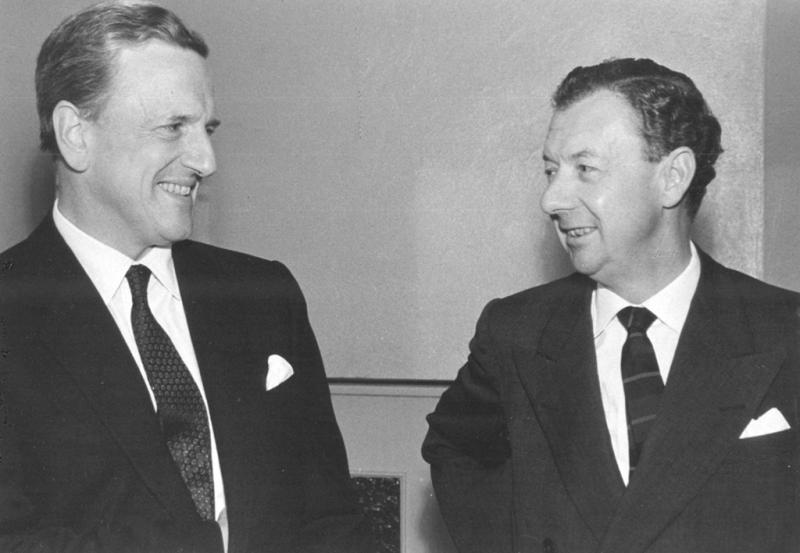
Lutosławski probably met Benjamin Britten and Peter Pears for the first time in 1961, when they came to perform at the 5th ‘Warsaw Autumn’. Their programme included three of Berg’s Seven Early Songs (‘Nacht’, ‘Im Zimmer’ and ‘Die Nachtigall’), Britten’s Seven Sonnets of Michelangelo and Sechs Hölderlin-Fragmente, Poulenc’s Tel jour, telle nuit and Tippett’s Boyhood’s End. This photo from their Warsaw visit was taken by Andrzej Zborski.
A commission from Aldeburgh soon followed, but Lutosławski missed the deadline for the 1963 Festival. Instead, Britten conducted the first concert performance of Lutosławski’s Dance Preludes in the version for clarinet and chamber orchestra (with Gervase de Peyer and the English CO). Lutosławski later recalled that Britten hadn’t realised how difficult this version was because of the polymetric divisions between soloist and orchestra. He apparently had an attack of nerves during the performance and stopped for a moment in order to find out where he was in the score.
Lutosławski eventually produced the score of Paroles tissées in time for the 1965 Aldeburgh Festival, and he conducted the piece there on 20 June, with its dedicatee Peter Pears and the Philomusica of London. It is quite likely that Lutosławski stayed on in the UK for a few more days to hear Colin Davis conduct the Concerto for Orchestra on 25 June, with the London SO at the Royal Festival Hall. This was possibly the work’s first UK concert performance, though it had been recorded for the BBC in 1958.
Here’s a video of Pears and Lutosławski reprising their partnership ten years later, this time with the Chamber Ensemble of the Warsaw National Philharmonic, on 25 September 1975, during the 19th ‘Warsaw Autumn’. Check out Lutosławski’s natty get-up!
The Institute of Music and Dance in Warsaw has today issued a Report on the presence of Witold Lutosławski’s music in the musical life of Poland and the world. Its author is Ewa Cichoń. It covers mainly the years since Lutosławski’s death in 1994, up to the end of 2012. The report, which exists in English and Polish pdfs (links below), contains a wide range of data:
• Performances in Poland and abroad
• Selected festivals in Poland
• CD recordings
• Literature
• Literature – list of publications
• Films and DVDs
• Programmes broadcast on TVP (Polish TV)
• Websites devoted to Lutosławski
• Researchers and promoters
• Institutions
• Institutions, festivals, competitions bearing Lutosławski’s name
• Others connected with Lutosławski
• Musical works dedicated to Lutosławski
• A public survey on Lutosławski
• Appendix: Publication of Lutosławski’s works
• Appendix: Broadcasts on Polish Radio
There was a time not so long ago in Kraków when you could find a really good antykwariat (second-hand bookshop) in several of the city’s central streets. Those days are long gone, but in the 1990s I was able to build up my collection of library of books on Polish culture by delving into such emporia. My most unexpected find was a bundle of old concert programmes. These were mainly from the Kraków Philharmonic’s concerts between 1945 and 1952. And in amongst these fascinating documents were a couple of other items, of which this one-off programme is the earlier. It is notable now for marking the concert premiere of Lutosławski’s Symphonic Variations (1936-38).
Lutosławski’s completed this, his first proper orchestral work, in mid-December 1938 and it was given a live broadcast on Polish Radio in April the following year. Its first public performance, however, took place on Saturday 17 June 1939. In the programme, it’s called simply ‘Variations’; whether ‘Symphonic’ was mistakenly omitted or added later I cannot tell. While it has never really made a huge impact in the broadly held canon of Lutosławski’s music, it is evidence of his early maturity, his ear for orchestral colour, and his symphonic instincts. (It’s been programmed in this year’s BBC Proms, on Wednesday 7 August. The performers are the BBC SO under Edward Gardner, reprising, along with the Piano Concerto and Louis Lortie, two of the pieces on their scintillating Chandos CD ‘Witold Lutosławski. Orchestral Works II’, CHSA 5098‘.)
The premiere was given by the Polish Radio [Symphony] Orchestra, conducted by its founder and music director Grzegorz Fitelberg. It was the opening concert of the Kraków Arts Days Festival, which ran from 17-20 June 1939. Three of the five concerts, including this one, were given in the arcaded Renaissance courtyard of Wawel Castle in Kraków (in Lutosławski literature, the festival has normally been called the Wawel Festival). All three Wawel concerts began at 21.00 hours – I hope the weather was balmy! That’s more than could be said for what happened two and a half months later.
This programme is printed on cream card measuring 27 x 21 cms, printed in dark blue ink and folded to provide four sides (among the obvious misprints are E. Edgar, Bethoven, and con fucco). The second side gives the programme for the first of the three symphonic concerts. For this ‘Concert of Polish Music’, the Polish Radio SO was joined by the singer Ewa Bandrowska-Turska (1894-1979), one of Poland’s most distinguished sopranos, and the pianist Józef Śmidowicz (1888-1962), who had been Lutosławski’s piano teacher in 1924-25.
Even though Kurpiński was a key figure in the development of opera in nineteenth-century Poland, his music today clings onto public awareness only through the overtures, such as this one to his opera Jadwiga, Queen of Poland (1814). Melcer’s folk-infused Piano Concerto no.2 in C minor (1897) has maintained a certain place in the Polish repertoire. Modern recordings by Jonathan Plowright (Hyperion, 2007) and Joanna Ławrynowicz (Acte Préalable, 2008) have been joined by an archive recording by Melcer himself (Selene, 2012).
The selection of four songs by Szymanowski includes two from his cycle Songs of a Fairytale Princess (1915), three songs from which he orchestrated in 1933 and were premiered by Bandrowska-Turska (there’s another mistake: the op. no. for the third song should be op.26). Szymanowski had died in 1937, and Fitelberg was his ardent champion, so it was fitting that the programme included Fitelberg’s orchestral arrangement of Szymanowski’s Nocturne and Tarantella for violin and piano (1915). The final work in this first programme was the now long-forgotten First Symphony by Woytowicz, who went on to run one of the artists’ cafes where Lutosławski and Andrzej Panufnik played their two-piano arrangements in war-torn Warsaw.
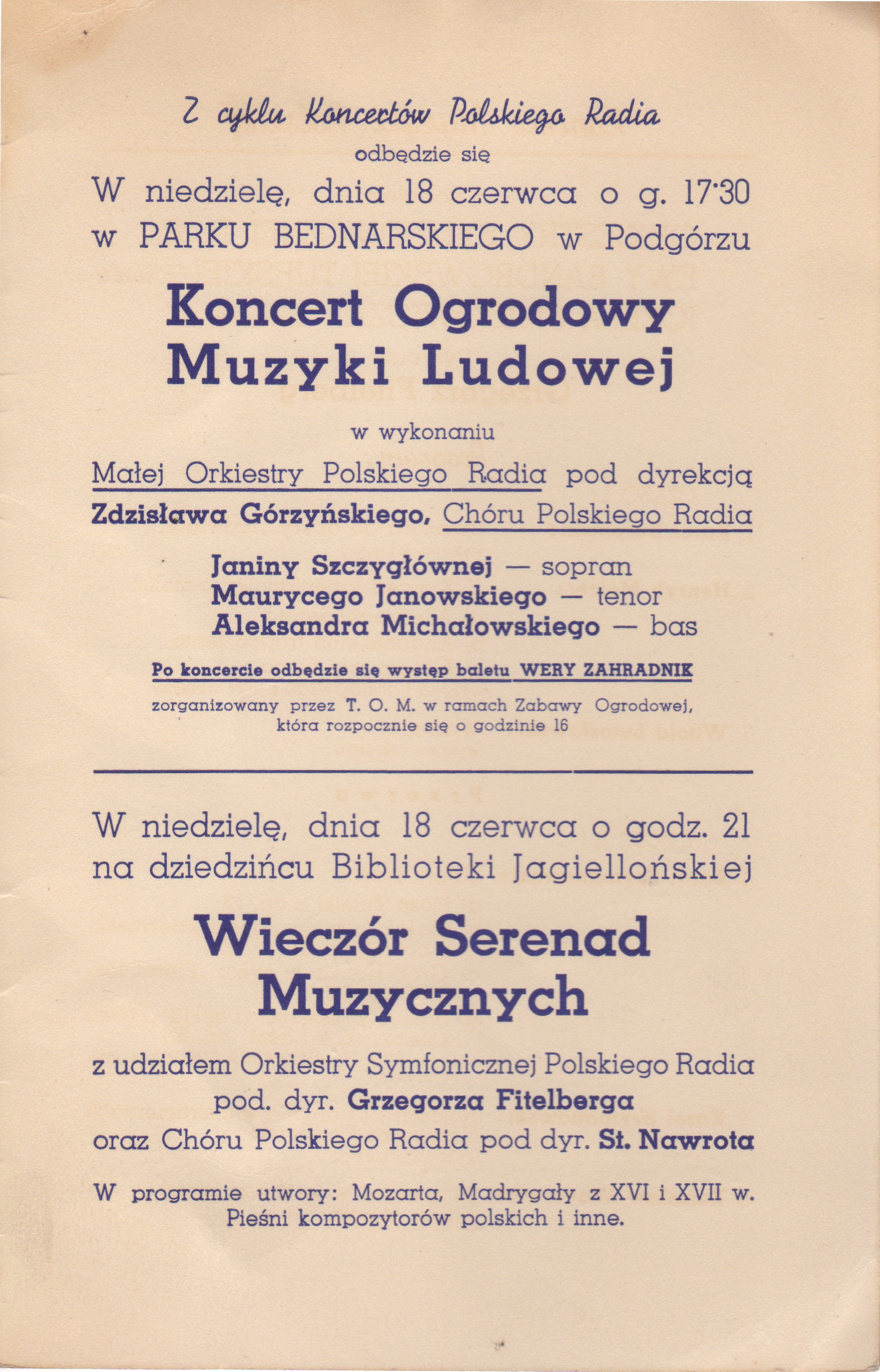
Side 3 of the programme announces the two non-symphonic concerts in the Kraków Arts Days Festival. The first, on Sunday 18 June, in the Bednarski Park south of the River Vistula, was of folk music played by Polish Radio’s Small Orchestra, Chorus and vocal soloists. This was followed by the second, an ‘Evening of Musical Serenades’, which was given in the courtyard of the Jagiellonian University near Wawel. This mixed programme included Mozart, 16th and 17th-century madrigals, songs by unnamed Polish composers, etc.
Side 4 outlines the details of the last two symphonic concerts. The first, on Monday 19 June, included two works by Mieczysław Karłowicz, his tone poem Stanisław i Anna Oświecimowie (1907) and the Violin Concerto (1902). Pieces by three lesser-known composers followed: the symphonic poem Anhelli (1909) by Ludomir Różycki, the Cello Concerto (1928, on Gregorian themes) by Jan Maklakiewicz and the overture Swaty polskie (Polish Courtship, 1903) by Feliks Nowowiejski. The soloists were Irena Dubiska (1899-1989), a noted violinist who in 1930 founded the Polish Quartet of which the other soloist, the cellist and composer Kazimierz Wiłkomirski (1900-95), was also a member. Dubiska went on, like many other distinguished players, to perform in Woytowicz’s cafe during the Second World War.
The final concert, on Tuesday 20 June, cast its net outside Poland (muzyka obca = foreign music), including Elgar’s tribute to the stateless Polish nation during the Great War, Polonia, and Beethoven’s Sixth Symphony. Of more interest is the repertoire by Ravel, Debussy and de Falla: Daphnis et Chloé (Second Suite), Nocturnes and the Suite from The Three-Cornered Hat.
In the eighteen months since I posted a review of (then) existing videos of Witold Lutosławski’s Cello Concerto (4 December 2011), there has been a flurry of further activity, especially in 2013. The latest to come to my attention is a recording by Kian Soltani (born in 1992), who played the concerto to win the final of this year’s Paulo Cello Competition in Helsinki. This competition takes place every five or six years and several exponents of the Lutosławski have been prizewinners on previous occasions, including Oren Shevlin (1996), whose YouTube recording from 2011 I thought very highly of in my earlier post, Rafał Kwiatkowski (2002), who went on to record the concerto for DUX in 2005, and Nicolas Altstaedt (2007), who has been one of quite a few cellists to have included it in this centenary year (Warsaw and Stavanger).
As I’m currently deep in the final stages of my book on the Cello Concerto, I’m afraid I don’t have the time to review all the recent uploads, so here is just a list of what’s newly available.
Promotional videos
2013 marks two anniversaries: Lutosławski’s centenary and the bicentenary of the Royal Philharmonic Society. The RPS commissioned Lutosławski’s Cello Concerto in 1966 and to mark these events Tom Hutchinson from the RPS made a short video to coincide with a performance of the work on 7 March by Truls Mørk and the Philharmonia Orchestra under Esa-Pekka Salonen. Hutchinson discusses some of the correspondence and press reviews of the premiere by Rostropovich, the Bournemouth SO and Edward Downes at the Royal Festival Hall on 14 October 1970.
The British cellist Alexander Baillie talks about the piece in advance of his performance of it with the Boston PO under Benjamin Zander on 23, 25 and 26 February 2012.
The conductor of the Boston PO performances, Benjamin Zander, gave a pre-concert talk on the concerto (with the orchestra) on 26 February 2012. He has some perceptive observations to make about the orchestration but unfortunately is occasionally loose with the historical facts. It’s posted in two sections.
Miklós Perényi was the second cellist to record the Lutosławski (with the Budapest SO under György Lehel on Hungaroton), but his version from 1975 has never been transferred to CD. It is a fascinating approach (the opening D naturals are 2/3rds of the suggested speed – c.40 crotchets/fourth notes per second instead of c.60), yet overall the performance is one of the shortest. Perényi has also been playing the work for longer than most – he performed it in Katowice on 25 January this year, the 100th anniversary of Lutosławski’s birth.
There’s also an audio of the first half of the concerto by young Polish musicians: Michał Zieliński (cello), the Orchestra of the Fredyryk Chopin University of Music in Warsaw, conducted by Michał Smigielski. Bizarrely, it stops partway through the Cantilena (just before fig. 74).
Alexander Baillie (see above for his promotional video) played the concerto as part of the Boston PO’s 2011-12 season, under Benjamin Zander (see above for the vimeo of his pre-concert talk). It’s a shame that the titles are presented over the opening of the concerto, so that it’s more than a minute before we get a sight of Baillie. The vimeo is in three parts. Part 1: up to fig.38 (the Introduction, the first two Episodes and almost, but not quite, to the end of Episode 3); Part 2: from fig. 38 (through the Cantilena and on into the Finale) up to fig.88 (just before the cello’s ‘sigh’); Part 3: from the ‘sigh’ to the end.
There are three performances from the Paulo Cello Competition:
Nicolas Altstaedt‘s performance of the concerto was uploaded in three sections in 2010, but as I discussed on 4 December 2011 there was a frustrating visual-audio time-lapse in the second and third instalments. These have now been taken down, though the first instalment is still there (it covers the solo introduction and the first two Episodes). Now the same uploader has posted the performance in a single video, technical problems sorted. It comes from Altstaedt’s participation in the 2007 Paulo Cello Competition, with the Finnish Radio SO, conducted by Dmitri (Dima) Slobodeniouk. It is fiery and passionate and must have been absolutely electrifying in concert.
Silver Ainomäe, who was also a prizewinner at the Paulo Cello Competition in 2007, also played the Lutosławski concerto, likewise with the Finnish Radio SO under Slobodeniouk.
Kian Soltani‘s performance at this year’s Paulo Cello Competition was given on 27 April, with the Helsinki PO conducted by John Storgårds. The video is available on this site only until 24 October 2013.
A much earlier concert took place in Madrid on 18 January 2002, when Felix Fan performed the Lutosławski concerto with the Spanish Radio and Television Orchestra, conducted by Adrian Leaper.
There are also two video performances by young American musicians now on YouTube:
Tyler Borden, University of Buffalo SO, conducted by Daniel Bassin, on 1 March 2013. There is also an unrevealing ‘conductor cam’ version from stage left … (second url below).
The Swiss cellist, Frédéric Rosselet, joined the University of Southern California SO, conducted by Carl St Clair, for this performance on 14 March 2013.
The Polish Music Publisher PWM has just issued a press release about its two new volumes of songs by Lutosławski that he wrote under the closely guarded pseudonym ‘Derwid’. He composed these popular dance songs – foxtrots, tangos, waltzes, etc. – in 1957-63, although the band arrangements were done in-house at Polish Radio. Many of the songs’ melodies were published in Polish Radio’s weekly listings magazine Radio i Świat (Radio and the World) at the time. PWM published five of Lutosławski’s piano versions as separate numbers in 1957-60 and over twenty through its fortnightly light-music imprint Śpiewamy i Tańczymy (Let’s Sing and Dance) in 1957-64.
When I first came across this little treasure trove of largely forgotten music in 1994, I was the only person who had any interest in it. The songs were regarded by the Polish musical establishment as of negligible interest musically or historically. Moreover, I was told on several occasions by Polish colleagues that it would be unseemly for anyone in Poland to do even the most basic research into them or into Lutosławski’s other songs, especially his mass songs of the early 1950s. Fortunately, that situation has long been superseded by a more curious attitude, to the extent that in a month or so’s time a new CD will be released of some of the Derwid songs in edgy and humorous interpretations by Agata Zubel, Andrzej Bauer and Cezary Duchnowski (see my post from 26 March 2013, Zubel Zings!).
Here is a list of the contents of the two volumes, which seem to present the songs in roughly chronological order. There are corrections and both additions to and omissions from the list I made in 1994 (this may be found at the end of my article, ‘Your Song is Mine’, The Musical Times, 1830 (August 1995), 403-10). I had erroneously equated Zakochać się w wietrze (To fall in love with the wind) with Serce na wietrze (Heart on the wind). But I also named two songs which are not in this new collection, even though they were published by PWM at the time: Kiosk na Powiślu (Kiosk by the Vistula) / Kiosk inwalidy (Kiosk of the invalid) and Wędrowny jubiler (The wandering jeweller). Three further, unpublished songs were subsequently found amongst Lutosławski’s manuscripts at the Paul Sacher Stiftung in Basle – Dom rodzinny (Family home), which is not in this new collection, and two which are – Podlotek (Flapper) and Twoje imieniny (Your name-day).
In Poland, each volume costs 35 złoty (= c. £7); outside Poland the price rises to 19.95 euros (c. £17). It’s not obvious why there should be such a huge difference in price. Here is the link to the relevant English-language page of PWM’s online shop. You might try going on to the Polish page by clicking on the Polish flag and seeing if you can pay by ordering in złoty!
Volume 1 (19 songs)
• Milczące serce (Silent heart)
• Czarownica (The witch)
• Daleka podróż (Distant journey)
• Cyrk jedzie (The circus is coming)
• Zielony berecik (The little green beret)
• Szczęśliwy traf (Good fortune)
• Zakochać się w wietrze (To fall in love with the wind)
• Miłość i świat (Love and the world)
• Tabu (Taboo)
• Kapitańska ballada (The captain’s ballad)
• W lunaparku (At the funfair) / Nie kupiłeś mnie na własność (You do not own me)
• Telimena (Telimena)
• Warszawski dorożkarz (The Warsaw cabman)
• Nie oczekuję dziś nikogo (I am not expecting anyone today)
• Serce na wietrze (Heart on the wind)
• Filipince nudno (The bored Filipina)
• Złote pantofelki (Golden shoes)
• Po co śpiewać piosenki (Why song songs)
• Moje ptaki (My birds)
Volume 2 (14 songs)
• Rupiecie (Odds and ends) / Wędrowny czas (Wandering time)
• Na co czekasz (What are you waiting for)
• I cóż to teraz będzie (What is going to happen now)
• Z lat dziecinnych (From childhood)
• Jeden przystanek dalej (One stop further)
• Znajdziesz mnie wszędzie (You will find me everywhere)
• Nie dla nas już (No longer for us)
• Nie chcę z tobą się umawiać (I do not want to date you anymore)
• Podlotek (Flapper)
• Twoje imieniny (Your name-day)
• Plamy na słońcu (Sunspots)
• Tylko to słowo (Only this word)
• Jak zdobywać serduszka (How to win hearts)
• W pustym pokoju (In the empty room)
Just time to give advance notice that you can catch a performance of Lutosławski’s Third Symphony, live from the Salle Pleyel in Paris tonight (7 June, starting at 20.00hrs, local time). It’s one of four pieces being played as part of IRCAM’s ‘ManiFeste 2013’ by the French Radio PO under Jukka-Pekka Saraste. The other pieces are Dutilleux’s Métaboles and two world premieres: Carmine Emanuele Cella’s Reflets de l’ombre and Philippe Schoeller’s Songs from Esstal I, II et III. It looks really interesting.
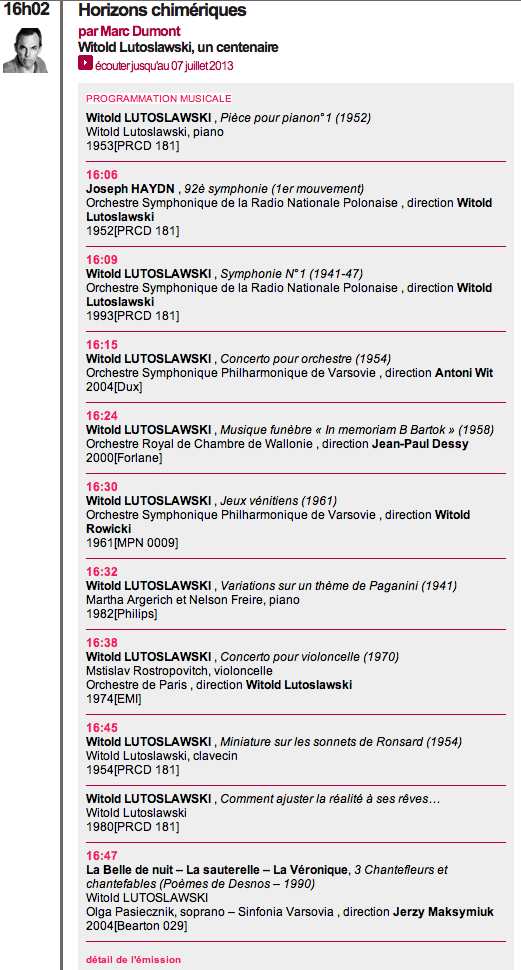
Earlier this afternoon, Radio France put out an hour-long tribute to Lutosławski in Horizons chimériques (you can ‘listen again’ for the next month). It managed to sample ten pieces, plus an excerpt from a radio interview that Lutosławski gave (in Polish) in 1980. One of the pieces was the first movement of Haydn’s Symphony no.92, conducted by Lutosławski in 1952, plus other archive recordings of that period from the 2-CD set Witold Lutosławski in the Polish Radio (PRCD 181-182, 2004). It’s a fascinating document, so if you ever come across it, snap it up.
This time twenty years ago, Lutosławski was dashing around Europe. On 18 May 1993, he received the Polar Music Prize in Stockholm. Four days later, on 22 May, he conducted the London Sinfonietta in the Queen Elizabeth Hall. And the following night he was back in Warsaw for the Polish premiere of his Fourth Symphony. On this occasion, he was in the audience at the Studio Koncertowe S1 at Polish Radio – it would be named after him three years later.
I too had dashed in May 1993 from the QEH to S1. There was a last-minute change of programme (Novelette replaced Chantefleurs et Chantefables) and, yes, the tickets did cost 50,000zł each!
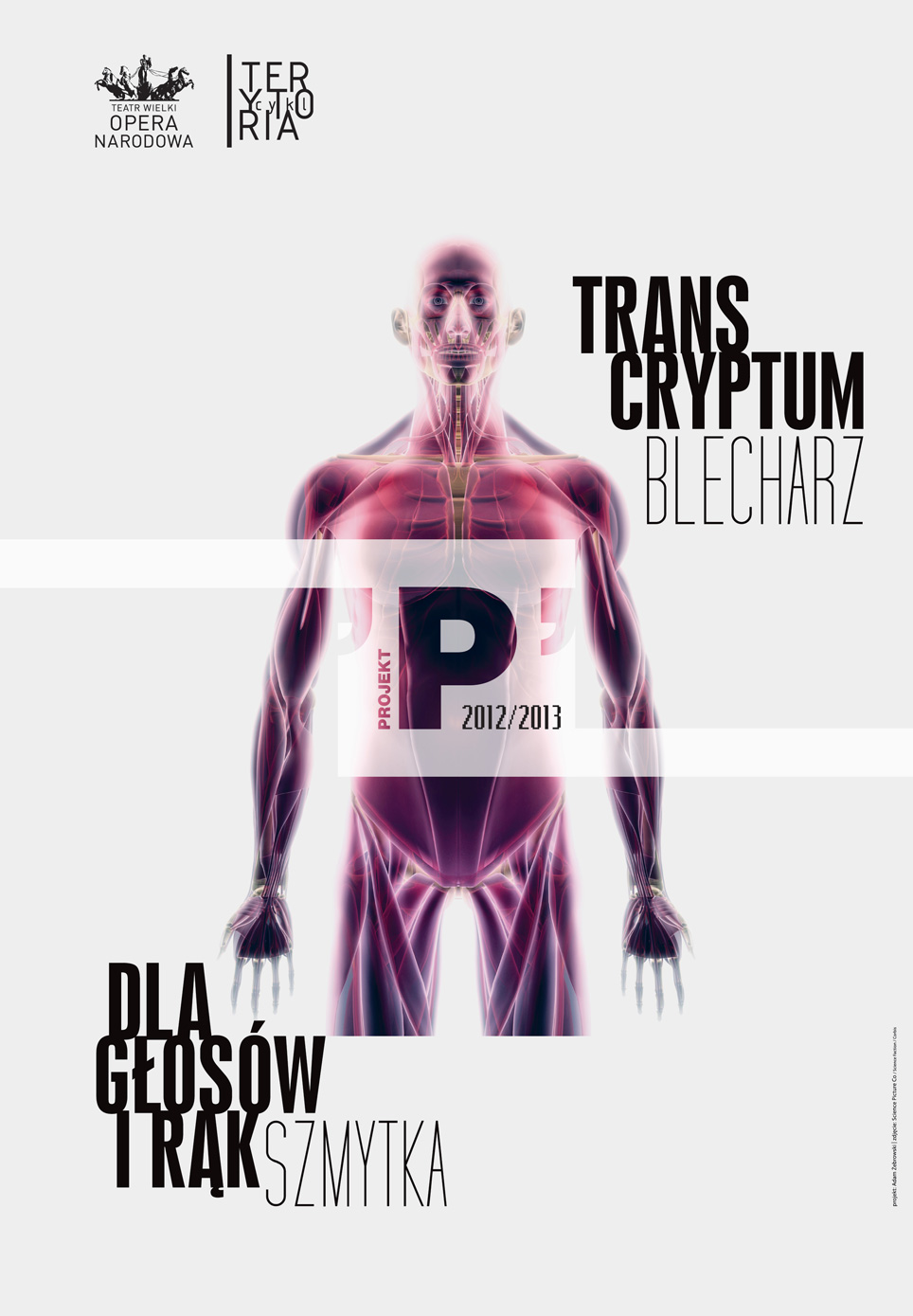
Twenty years later, I’m again in Warsaw on 23 May, this time for the premiere at Teatr Wielki of a double-bill of works by composers two generations younger than Lutosławski: Dla głosów i rąk (For Voices and Hands) by Jagoda Szmytka (b.1982) and Transcryptum by Wojciech Blecharz (b.1981). The excitement is still there!
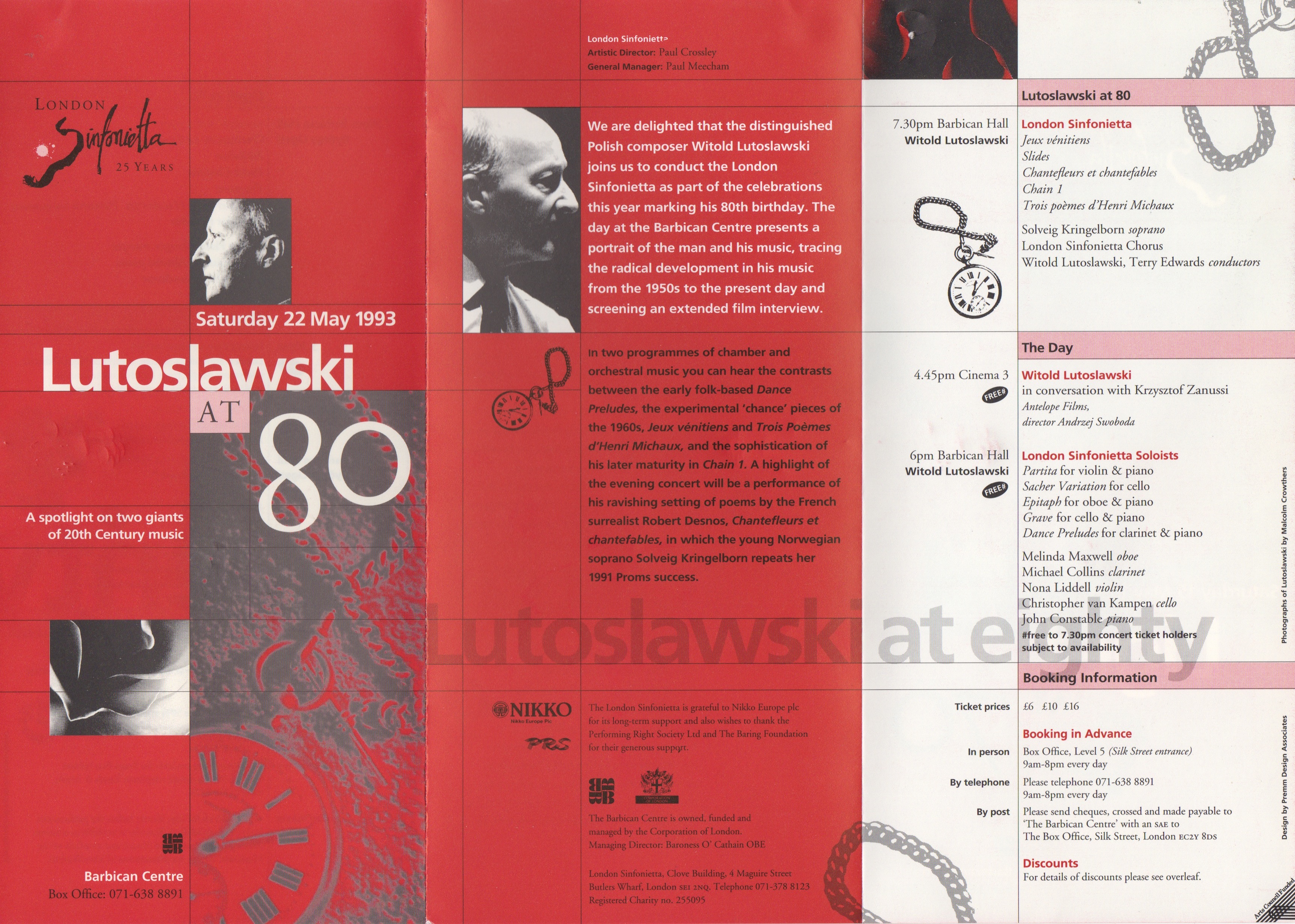
A belated but heartfelt tribute for Lutosławski’s 80th birthday was given by the London Sinfonietta on 22 May 1993. The composer joined the Sinfonietta for two concerts at the Barbican Hall, conducting the evening event and sitting in the audience for the chamber concert that preceded it. Krzysztof Zanussi’s recent film on Lutosławski was also shown (see post of 13 April).
Lutosławski had a long and fruitful connection with the London Sinfonietta. He first conducted it on 25 September 1972 in a recording of Paroles tissées with Peter Pears (Decca HEAD 3) and on 20 January 1973 he conducted the Sinfonietta at the QEH in London in a programme entirely of his own music: Musique funèbre, Paroles tissées (with Pears), Jeux vénitiens and Preludes and Fugue (UK premiere; its second performance). A matter of days later he sprang to the Sinfonietta’s defence having learned of its parlous financial state. Not only did he send a letter to The Times (published on 16 February 1973) but he also wrote a longer testimonial, reproduced below.
The words ‘London Sinfonietta’ associate in my mind with two unforgettable experiences. The first was my first contact with the ensemble at the occasion of a gramophone recording of one of my pieces with Peter Pears as soloist. It was last September at Maltings Snape. The second was a concert at the Queen Elizabeth Hall in London in January this year, when I had the privilege of conducting the London Sinfonietta in a programme of my works.
To appear for the first time in front of an orchestra one has never conducted before is very often an embarrassing situation for a composer. It is certainly a most valuable opportunity to convey the composer’s interpretation of a work to the performers. But, on the other hand, it is rather a troublesome necessity to have to insist on the precise execution of the details of one’s own work, and to have to introduce some new ways of making music, which need to be explained exactly.
From the first rehearsal with the London Sinfonietta, all my misgivings disappeared entirely. I felt very strongly that the only goal of those wonderful musicians was to achieve the best possible results; to respond as accurately as possible to the composer’s suggestions; in other words – to help to realise his sound vision in the most faithful way.
A group of experienced first-class musicians, some of whom are really virtuoso players, who have such an interest and devotion for contemporary music, is an invaluable treasure for us – for contemporary composers. Arthur Honegger once wrote that a contemporary composer whose work was played in a subscription concert felt like a man sitting at a table to which he had not been invited. The London Sinfonietta’s series of twentieth-century music concerts offers the participating composers just the contrary: the rare and incomparable feeling of being the right man in the right place.
The very existence of such a group and its pioneer mission of promoting the music of our time is a beautiful example to follow in other countries all over the world.







 On Polish Music