• WL100/11: ‘The Hidden Composer’

The Hidden Composer: Witold Lutosławski and Polish Radio

An exhibition first shown as part of the Breaking Chains festival,
Barbican Centre, London, 13-19 January 1997

I put this exhibition together in order to illuminate an area of Lutosławski’s life and work that had been obscured by history and largely ignored by commentators.  Lutosławski himself consistently drew a veil over it.  Yet it reveals much about the creative artist’s dilemmas at an extraordinarily difficult time.  Since 1997, other facets have come to light (I will return to them later in the series), but I have reproduced the exhibition faithfully rather than update it.  I have, however, added a few sound files which I could not incorporate at the time.  The illustrations were never of top quality, having been photocopied in Poland, but I hope that they give a flavour of the period and the publication from which they come.

Accompanying brochure

In these days of the Internet, it is hard to imagine how limited were the means of communication in Poland in the aftermath of World War II.  It took, for example, until the 1950s for a full network of radio stations and masts to be established (this was, of course, before television).  Each and every technical development was celebrated in Polish Radio’s listings magazine, Radio i Świat (‘Radio and the World’).

Radio i Świat logo3Like The Radio Times in the UK, Radio i Świat was intended as a printed information service for its listeners, primarily for its broadcast programmes.  But it was much more than that.  It first appeared in 1945 and for several years included technical diagrams for those wishing to build their own wirelesses.  Its listings, at least in the early years, also included details of foreign radio programmes, such as those on the BBC Home and Light Services.

When, however, the political situation began to change in 1948, Radio i Świat changed with it.  Whereas newspapers and journals promulgated the main shifts in Party policy, a magazine like Radio i Świat reflected them in ways which have not generally been regarded as quite so significant.  Its pages, however, are often more vividly revealing and surprising than other sources in the musical detailing of this momentous post-war period.

The Hidden Composer looks at Lutosławski’s musical profile and his cultural-political context from the end of the war until the early 1960s, as through the eyes of a reader of Radio i Świat.  It is not the whole story, but it is an important part of it.

[The following summaries accompanied the six panels of the original exhibition.
You will find the full texts, images and sound files for each of these panels
either by clicking on the relevant heading below
or by scrolling the ARTICLES tab above.]

PANEL 1: 1945-48  RADIO i ŚWIAT

In the early years after the war, Radio i Świat had a generously international outlook.  Photographs from the UK, for example, included Princess Elizabeth at a BBC microphone.  But increasingly the magazine looked inwards, as did Poland as a whole.  Photographs included one of Lenin, but more frequently the front covers featured the country’s most outstanding classical musicians – Fitelberg, Palester, Bacewicz and Panufnik – as well as popular singers like Godlewska and the male vocal quartet ‘Czejanda’.  Polish Radio’s Festival of Slavonic Music in November 1947 was a signal of the post-war grouping into Eastern and Western European spheres of influence.

PANEL 2: 1946-49  MUSIC FOR RADIO
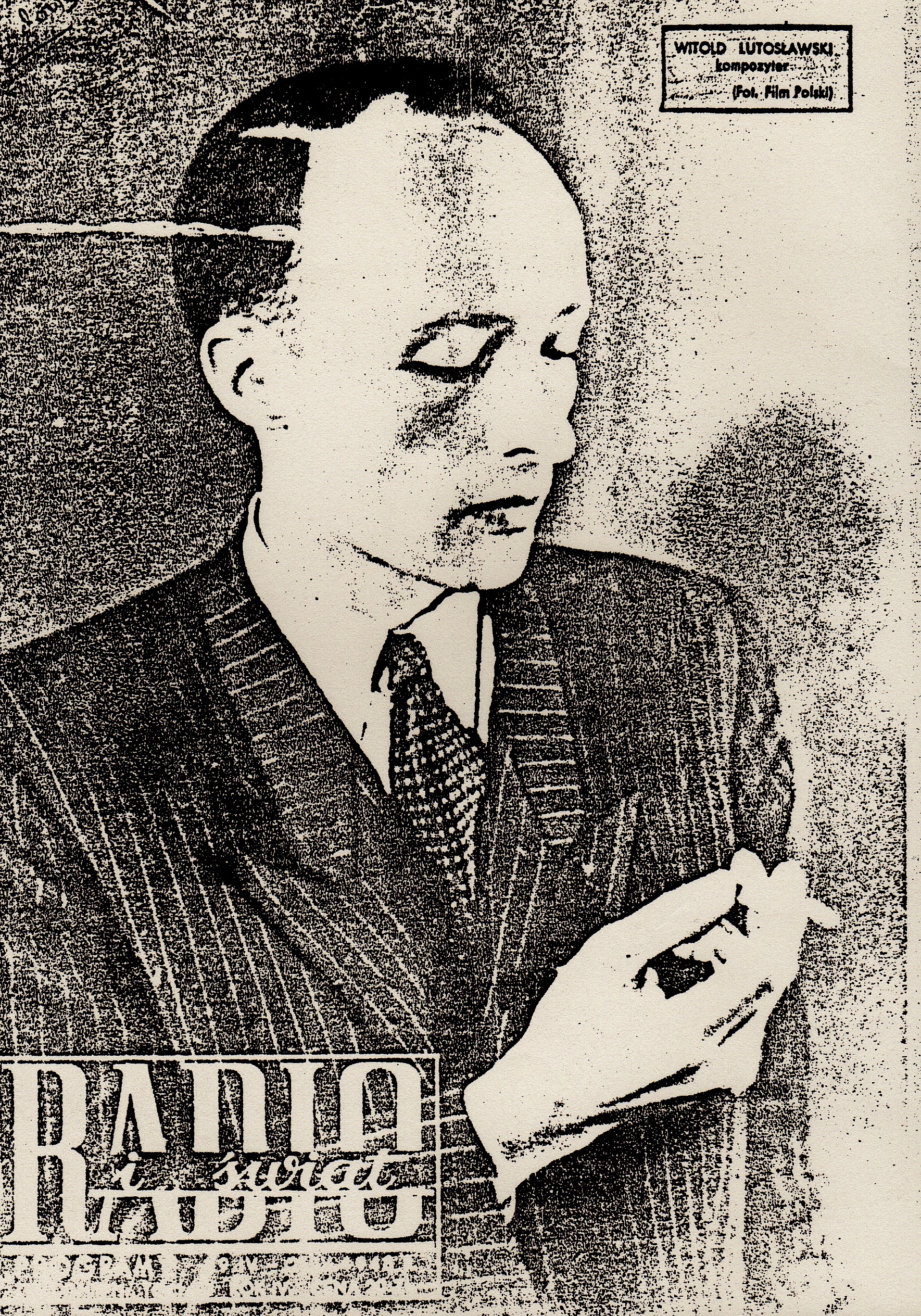
RiŚ 48:16Lutosławski reached the front cover of Radio i Świat in April 1948, shortly after the premiere of his First Symphony (it was banned a year later).  During the 1940s and 1950s, his most secure source of income was his work for Polish Radio.  He wrote incidental music for poetry programmes and for radio drama (some forty productions).  Early titles included Hemingway’s For Whom the Bell Tolls and a children’s programme based on Kipling’s The Cat that Walked by Himself.  Prawda o Syrenach (The Truth about the Sirens, 1947) exhibits the use of jazz, while Fletnia chińska (The Chinese Flute, 1949) shows the increasing politicisation of radio broadcasting.  Lutosławski’s short cantata Warszawie-sława! (Glory to Warsaw!) is a tribute to the post-war rebuilding of the Polish capital, an undertaking that was frequently praised on the covers of Radio i Świat.

PANEL 3: 1949-53  SOCREALIZM

The politicisation of all public bodies came to a head culturally with the import of socialist realism (socrealizm) from Stalin’s Soviet Union.  Composers were cajoled to write for the mass of the people.  Music was subject to peer review at Polish Radio and the Composers’ Union, and Lutosławski had little choice but to accede to ‘requests’ for mass songs.  Most of these were published in Radio i Świat and broadcast on Polish Radio, where tapes of some still exist.  His least political song – Wyszłabym ja (I Would Marry) – was his most popular, and he even recorded it himself in 1950 (the tape is no longer extant).

PANEL 4: 1953-56  TRANSITION

After Stalin died, in March 1953, there was a protracted period of transition towards greater artistic freedom.  Radio i Świat reflected many of these changes.  Mass songs became less political, although two of Lutosławski’s soldiers’ songs appeared and arguable his best song – Towarzysz (Comrade) – was included in a special programme ‘Songs of the Fatherland and the Party’ as late as July 1955.  Radio i Świat also indicates that the ban on Lutosławski’s First Symphony was not as watertight nor as long-lasting as has been previously assumed (it was bropadcast in August 1954).  And, gradually, music from the ‘decadent’ West was published in the magazine, beginning with Mississippi (Ol’ Man River) in March 1954.

PANEL 5: 1956-59  NEW MUSIC

The arts played a significant part in the cultural renaissance of Poland in the mid-1950s.  Music advanced on the popular front and in the appearance of the first ‘Warsaw Autumn’ International Festival of Contemporary Music on 1956.  Radio i Świat maintained its educational tone by publishing articles, with musical examples, on twelve-note music by Berg and Webern.  Has any other radio listings magazine ever provided such a service to its readers?  Lutosławski kept a fairly low public profile while he developed a new musical language in Five Songs (1957), Funeral Music (1958) and Jeux vénitiens (1961), works which would launch his international career.

PANEL 6: 1957-63  ‘DERWID’

Lutosławski’s compositional ties with Polish Radio continued into the 1960s, partly providing incidental music for radio dramas (such as Słowacki’s tragedy Lilla Weneda), partly writing some three dozen popular songs – foxtrots, waltzes, tangos – under the pseudonym ‘Derwid.  ‘Derwid’ is the harp-playing king in Lilla Weneda, although a different pseudonym appears on the manuscripts of the first six songs.  Lutosławski-Derwid had an evident affinity with popular idioms if the quality of these songs is anything to go by.  Among the most memorable are the Gershwinesque Zielony berecik (The Little Green Beret) and the tango Daleka podróż (Distant Journey), with its quote from Debussy’s La Mer.  Nie oczekuję dziś nikogo (I’m Not Expecting Anyone Today) was his most popular song and the only one to win ‘Radio Song of the Month’.  It was also one of some ten Derwid songs printed in the ever-informative Radio i Świat and its 1958 successor, Radio i Telewizja.

Acknowledgments

This exhibition was funded by Cardiff University of Wales and the Guildhall School of Music and Drama in London.  Valuable assistance was also given by Polish Radio and the National Library in Warsaw and the Paul Sacher Foundation in Basel.  Sincere thanks are due to a number of people without whose help and advice the exhibition would not have been possible: Urszula Kubicka, Michał Kubicki, Elżbieta Markowska and Bohdan Mazurek in Warsaw, Martina Homma in Köln, Alasdair Nicolson, Alessandro Timossi and Tomasz Walkiewicz in London, and David Hopkins, Sue House and Sue Sheridan in Cardiff.

© 1997 Adrian Thomas

• WL100/10: ‘Breaking Chains’, GSMD 1997

Possibly the most intense and wide-ranging survey of the life and works of Witold Lutosławski that has ever taken place was that at the Barbican, London, in January 1997.  The climax was three days of concerts, organised by the BBC under the banner Breaking Chains on 17-19 January.  I’ll return to these events in a future post.

Preparatory to these concerts, the Guildhall School of Music and Drama, in a different part of the Barbican complex, organised five days of complementary events under the Breaking Chains umbrella, 13-17 January 1997. These included concerts, workshops, talks and discussions, as well as an exhibition.  The participants included the GSMD SO and CO, student chamber ensembles and soloists, and several speakers: Steven Stucky, Józef Patkowski, Charles Bodman Rae, John Casken and myself.

WL Breaking Chains, GSMD 13-17.01.97

The GSMD Breaking Chains repertoire included: Symphonic Variations (1938), Symphony no.1 (1947),  Little Suite (1950/51), Straw Chain (1951), Silesian Triptych (1951), children’s song cycles Autumn and Spring (1951) and four other children’s songs (1953-54), Jeux vénitiens (1961), String Quartet (1964), Symphony no.2 (1967), Livre pour orchestre (1968), Variations on a Theme by Paganini for piano and orchestra (1941/78), Novelette (1979), Chain 1 (1983), Fanfare for Louisville (1986), Prelude for GSMD (1989).  In pre-concert and afternoon events during the BBC part of Breaking Chains, GSMD students also performed Overture for Strings (1949), Five Folk Melodies (1945/52), Preludes and Fugue (1972), Partita for violin and piano (1984), songs and music for piano, as well as Chain 1 for the second time.

There were some fantastic student performances during this GSMD week.  Indeed, Symphony no.2, Novelette and Fanfare for Louisville were issued on the SOMM label (SOMMCD 219) in 1999, alongside performances of two works conducted by the composer on his visit to GSMD on 11 May 1989: Prelude for GSMD and the Cello Concerto (1970), in which the soloist was Louise Hopkins.  My strongest recollection is of the performance of the Second Symphony under the dynamic direction of Wojciech Michniewski.

Lutosławski: Symphony no.2

• Movement 1: ‘Hésitant’  

• Movement 2: ‘Direct’ (the track begins c.15″ too early with two brief events for trombones/tuba and bassoons from the end of ‘Hésitant’; ‘Direct’ begins with ppp double basses, partly masked by a final bassoon utterance)  

My own involvement also included directing a workshop performance of Jeux vénitiens and putting together an exhibition called The Hidden Composer: Witold Lutosławski and Polish Radio, of which more anon.

• WL100/9: Lutosławski’s carpet

Did you know that all of Lutosławski’s works from 1971 onwards were composed as he paced to and fro on a carpet made and sold in the British Isles?  And that his grand piano and writing desk stood on it too?  You didn’t?  Read on!

Below is an undated photo of Lutosławski’s studio.  The state of the rucked carpet, the style of the curtains and the blank walls, where subsequently there were bookshelves, allow us to date the photo (first published in 2007) to 1968-70.  How can we tell?

IMG_7140 copy

In 1968, the Lutosławskis moved from their cramped flat in East Warsaw, where they’d lived since the Second World War, to a spacious detached house in North Warsaw.  The first work that Lutosławski composed in his L-shaped first-floor studio was his Cello Concerto.  The concerto was premiered in London on 14 October 1970.  I discovered the following correspondence at the Paul Sacher Stifting in Basle in 2003:

From Faith Crook (Chester Music) to Lutosławski, 26 October 1970
“Mr Rizza [then MD of Chester Music, London] has passed on to me your note about the carpet you wish to order and get sent to you from Gamages.  […]  I note that what you require is ‘Tintawn’ No.526 (“White Heather” shade) and you asked for the 108 inch (9 feet) width, but the length you gave of 13 yards 7 inches we find rather puzzling.”

From Lutosławski to Faith Crook, 4 November 1970
“I am very sorry to bother you with that carpet for me.  The only excuse to offer is, that it will be a part of the equipment of my working room and thus – serve in a way the purposes of the firm!  […]  It may seem puzzling, but the room is not a straightforward rectangular one.  It is an “L”-form and that is why two strips of different length will have to be pieced together.”

From Faith Crook to Lutosławski, 11 November 1970
Gamage invoice, Holborn, E.C.1
Cost of carpet  £65 16s 0d
Carriage  £12 15s 0d
Packing  £1 10s 0d
Insurance  £1 6s 0d
Total  £81 7s 0d

Evidently, Lutosławski had gone to London not only for the premiere of the Cello Concerto but also with the measurements of his studio, intent on purchasing a good quality carpet.  Wall-to-wall carpets are unusual in Poland, where wooden flooring is usual, so part of his reasoning must have been to do with the room’s acoustics.  Gamage’s, which closed in 1972 and was subsequently knocked down, was a huge department store famous for its unusual diversity, from its toy department and Christmas bazaar to a specialist section for motor parts.  It evidently had a good carpet showroom too.  More particularly, it was in Holborn, barely ten minutes’ walk from Chester Music’s then offices at Eagle Court in E.C.1.  Did Lutosławski pass it by accident or was he directed to it by his publishers?

Fast forward to 2002 when, during the ‘Warsaw Autumn’ festival, I was privileged to spend several days, with Nicholas Reyland, examining Lutosławski materials at his house.  I had been downstairs in 1981, but I had never seen the ‘working room’ upstairs.  We were given extraordinary freedom to research and document what we found. It was exciting, as always, to see where a composer composed.  The grand piano had been moved out, but the general layout of the rest of the room was as it had been from the beginning.  The photo below was taken from the double doors leading onto the first-floor balcony (compare the 1968-70 photo pointing in the opposite direction).

134-3416_IMG

What was different was the increased shelf-space, the elongated desk area to accommodate the hifi and CDs, and the absence of curtains.  The coffee table and flower vase were where they had been in the late 60s, as were the leather easy chairs and sofa, but in a more modern guise.

At the time (2002), I hadn’t found out about the carpet, so took no special photos of it.  But here are a couple of clips from other photos.  The lower one, taken close to the desk, shows signs of wear and tear, but after over 20 years of Lutosławski’s pacing (he habitually composed standing at the piano, but evidently worked a great deal at his desk also), and a further decade since his death, such signs were hardly surprising.

WL's carpet

WL's carpet:2

Yet what was remarkable was how few such patches there were.  This must have been a good-quality carpet that Lutosławski chose in London.  As soon as I got back from my research to Basle in 2003, I investigated further.  And I received this prompt reply from Axminster:

Maria & Józef Lutosławscy, 1900 2

What I didn’t pick up, until it was pointed out today by my friend Colin Stark (who played Epitaph for Lutosławski in Belfast in 1987), is that this carpet was not made at Axminster but in Newbridge, Co. Kildare in Ireland.

It’s nice – if perhaps irrelevant – to think that the music of Lutosławski’s last 23 years (Preludes and FugueLes Espaces du sommeilMi-partiEpitaphGrave, Symphonies 3 and 4, Chains 1-3, Piano Concerto, Chantefleurs et Chantefables, among others) was created as he pondered his next compositional move on a carpet that he bought in London, a creative investment and a material reward, if you like, for one of his greatest artistic achievements.

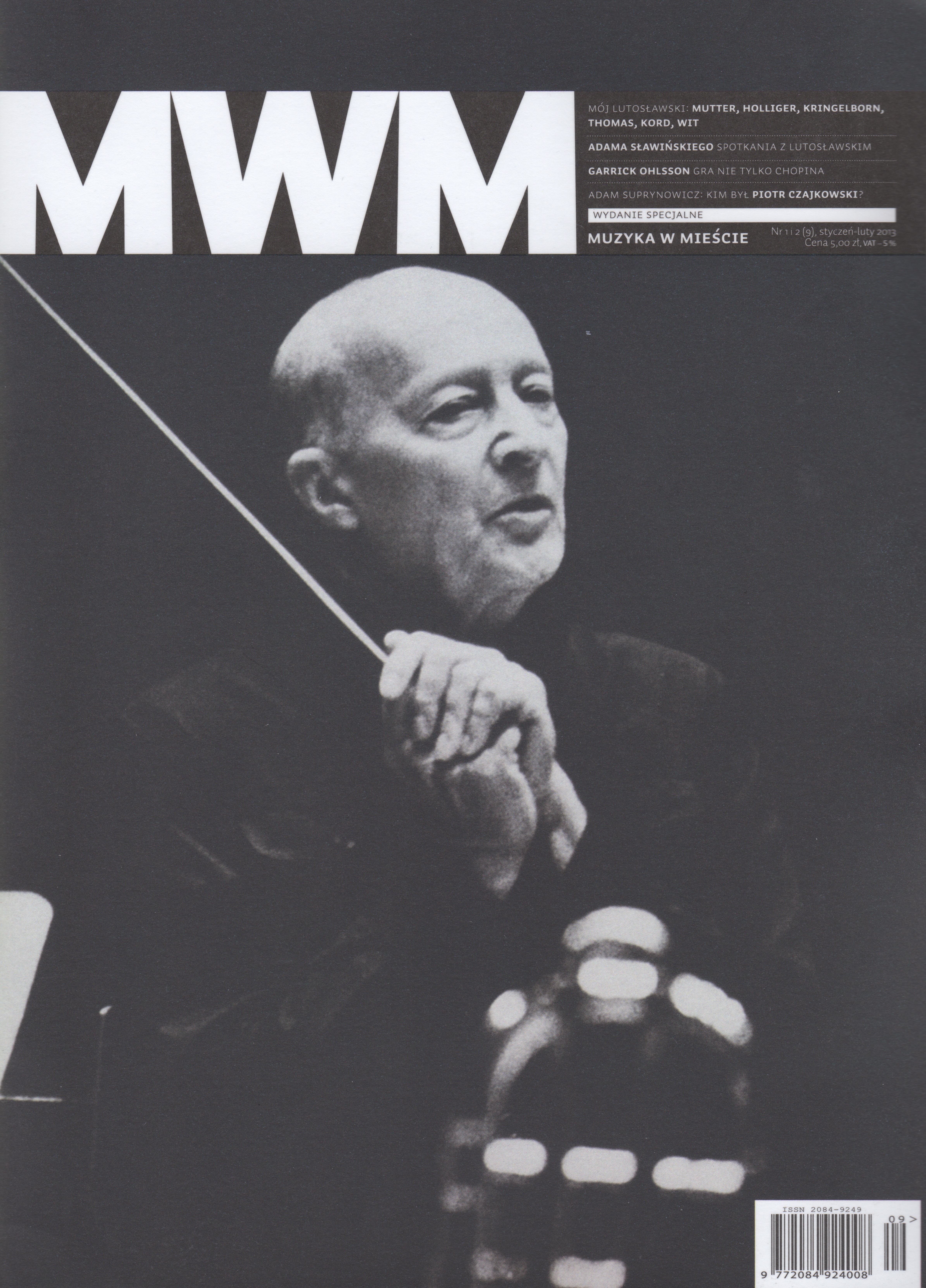
• Lutosławski issue of MWM

MWM WL issue cover 01.13The Wrocław Philharmonic, named after Witold Lutosławski, has just published a special issue of its house magazine MWM – Muzyka w Mieście (Music in the City).  This centenary edition comprises mainly interviews.  Although it is in Polish, there is a detachable insert with English and German excerpts from three of its eight items (marked *).

• Paweł Hendrich: ‘W roku Lutosławskiego o nim samym i jego muzyce’
• Adrian Thomas: ‘Gry brytyjskie’ *
• Adam Sławiński: ‘Spotkania z Mistrzem’ *
• Kazimierz Kord: ‘Harmonia naturalności’
• Esa-Pekka Salonen: ‘Lutosławski według Salonena’ *
• Heinz Holliger: ‘Tyle nut, ile trzeba’
• Aleksander Laskowski: ‘W poszukiwaniu nagraniowej inicjacji’
• Anne-Sophie Mutter, David Harrington, Solveig Kringleborn, Antoni Wit, Cezary Duchnowski, Agata Zubel: ‘Mój Lutosławski’

• WL100/8: Musique funèbre, 10 January 1958

On this day in 1958, Lutosławski put the finishing touches to a score on which he had been working for four years.  In 1998, I wrote a brief commentary on the opening pages of the autograph short score, for a publication about pieces whose manuscripts had been deposited in the Paul Sacher Stiftung in Basel.*

I have always called the piece Funeral Music – except in this little article, where I followed the title that Lutosławski inscribed on his short score: Musique funèbre.  There’s also the Polish version, Muzyka żałobna, which has been common parlance in Poland since the beginning (Lutosławski used it freely).  According to Stanisław Będkowski (A Bio-Biography, 2001), who interviewed the composer in 1988, Lutosławski preferred Mourning Music as the English translation.  This last version has never caught on, even though it is a more accurate translation of the Polish and French alternatives than Funeral Music.  Stucky (Lutosławski and his Music, 1981) and Będkowski stick to the Polish. Rae (The Music of Lutosławski, 1994) prefers the French, as does Skowron (taking Stucky, me and others along with him in his edited Lutosławski Studies, 2001).  My linguistic laziness is shared only by Varga (Lutosławski Profile, 1976) and Nikolska (Conversations with Witold Lutosławski, 1994), each having been translated into English (from Hungarian and Russian, respectively).  CD companies also seem to prefer Funeral Music over the alternatives.  I think I’d better mend my ways and return to the French.

WL Funeral Music article:1

WL Funeral Music article:2

WL Funeral Music article:3

Postscript

Like many writers, I see shortcomings in my past efforts.  This little piece is no exception.  Most particularly, I should have either ignored or dismissed Tarnawska-Kaczorowska’s initial flight of fancy for want of real evidence.  Danuta Gwizdalanka and Krzysztof Meyer (Lutosławski. Droga do dojrzałości, 2003) are more grounded and forthright. Among other rightly dismissive observations (mainly about Tarnawska-Kaczorowska’s attempt at numerological symbolism, which at least I could see straight away were rubbish), they revealed that the Prologue with the F natural – B natural motif was written in the first half of 1955 (over a year before the Hungarian revolution) and that the working title of the piece in 1957 (after the revolution) was the much simpler Etiuda na orkiestrę smyczkową [Study for string orchestra] – Pro memoria Béla Bartók.  

* Settling New Scores. Music Manuscripts from the Paul Sacher Foundation, ed. Felix Meyer (Mainz: Schott, 1998)

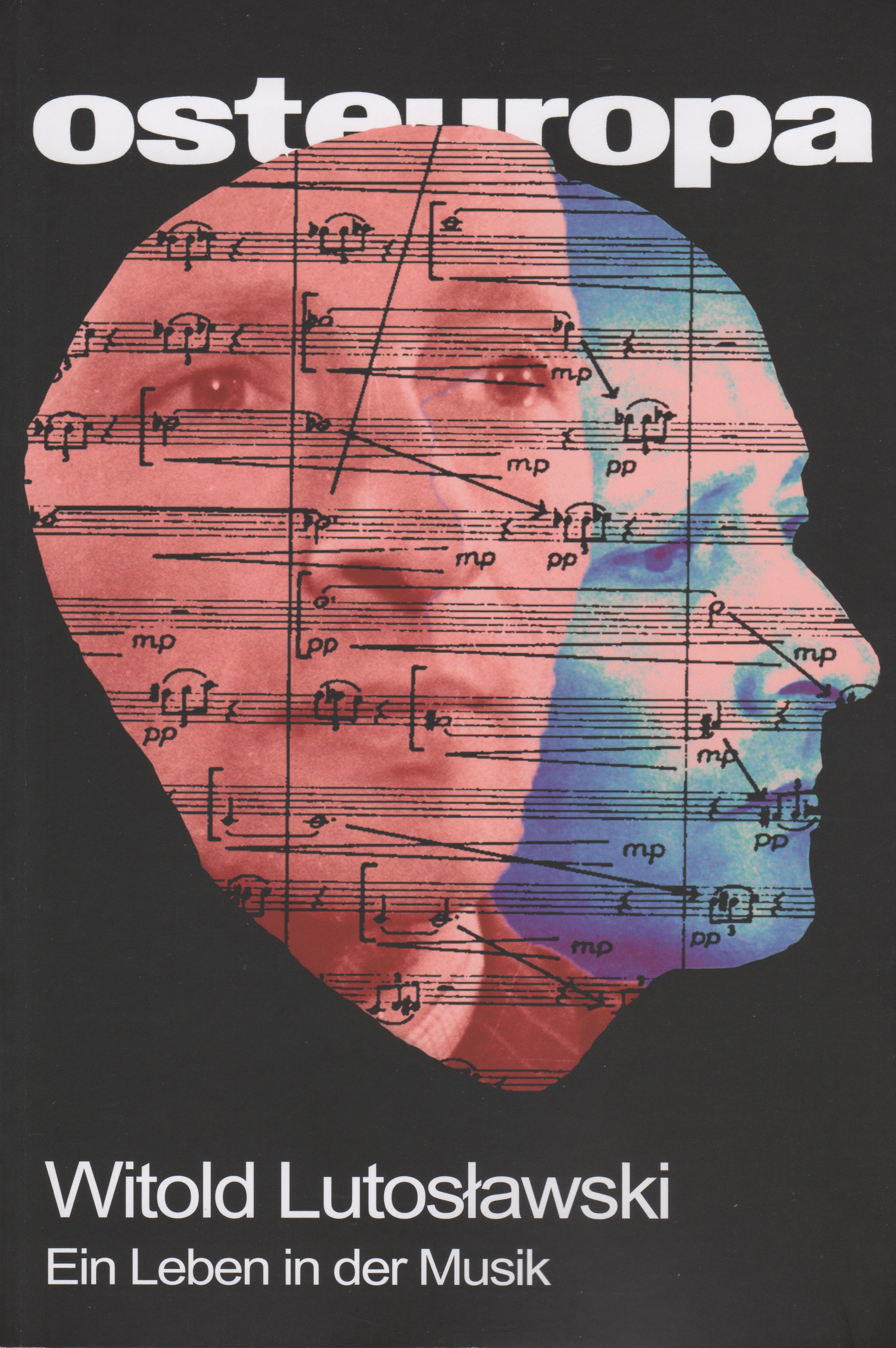
• Lutosławski: Ein Leben in der Musik

WL OsteuropaKickstarting the Lutosławski centenary in print is this volume which has just appeared in the osteuropa series (I received my copy today).  It contains thirteen items from Germany, Poland, Russia and the UK:

• Danuta Gwizdalanka: ‘Klassiker der Avantgarde. Witold Lutosławski: Leben und Werk’
• Anne-Sophie Mutter: ‘ “Ein neuer musikalischer Kosmos”. Über Witold Lutosławski’
• Dorota Szwarcman: ‘Auf den Schultern von Riesen. Lutosławski und seine Vorgänger’
• Dorota Kozińska: ‘Gründe und Abgründe. Lutosławski und der Sozialistische Realismus’
• Maciej Gołąb: ‘Lutosławski auf der Suche. Elemente und Ursprünge des Frühwerks’
• Krzysztof Meyer: ‘Pan Lutosławski. Erinnerungen an meinen Lehrer und Freund’
• Sebastian Borchers: ‘Von Warschau nach Darmstadt und zurück. Lutosławski, Penderecki und Górecki’
• Rüdiger Ritter: ‘Heißhunger auf Neue Musik. Das Ende des Stalinismus und der Warschauer Herbst
• Wojciech Kuczok: ‘Unsortierte Bemerkungen. Von Lutosławski zur schlesischen Komponistenschule’
• Adrian Thomas: ‘Das Cello-Konzert lesen. Lutosławski und die Literatur’*
• Izabela Antulov: ‘Wütender Antagonismus. Lutosławskis Cello-Konzert’
• Vladimir Tarnopol’skij: ‘ “Ein Symbol der Freiheit”. Lutosławskis Einfluss auf der Sowjetunion’
• Adam Wiedemann: ‘Heiliger Witold, bitte für uns’

This issue also includes a CD with two pieces: Lutosławski’s Cello Concerto (the Naxos recording by Andrzej Bauer with the Polish National Radio SO under Antoni Wit) and Krzysztof Meyer’s Farewell Music (1997), written in tribute to Lutosławski.  The abstracts are also given in English and may be accessed online here.  The volume may be ordered online here (22 euros).

* This is a translation of my paper ‘Lutosławski and Literature’ (2010).

• WL100/7: Lutosławski info online

Looking for substantial information online on Lutosławski?  You will find more in this ‘timeline’ pdf than elsewhere:

The Diary of the Life, Works and Activity of Witold Lutosławski

Published in 2007, Stanisław Będkowski’s annotated chronology is the best source that I’ve yet found online. It includes many quotes from the composer’s own recollections, interviews and writings.  I wouldn’t be surprised if an updated version appears this year.

WL_Studies_1_2007_oklAlong with Stanisław Hrabia, Będkowski has also published Witold Lutosławski. Discography in the same source, the English-language Witold Lutosławski Studies (Kraków: Witold Lutosławski Center, Institute of Musicology, Jagiellonian University).  This discography is an updated version from 2008 of the discography in their massively informative Witold Lutosławski. A Bio-Biography (Westport CT: Greenwood Press, 2001).  Again, I wouldn’t be surprised if a further updated version appears this year.

Three volumes of Witold Lutosławski Studies have appeared (2007, 2008, 2009).  I’m not sure what plans there are for further issues.  All three volumes are well-worth investigating (among other items, Będkowski provides an index of Lutosławski’s correspondence in the third volume, while the 2008 issue includes a penetrating article on musical plot by Nicholas Reyland).  The full contents may be accessed online at:

http://www2.muzykologia.uj.edu.pl/lutoslawski/Witold_Lutoslawski_Studies.html.

• WL100/6: Epitaph, **3 January 1980

Epitaph (1979) is virtually alone in Lutosławski’s output in being a duet that he never orchestrated.  There are orchestral versions of Dance PreludesGrave and Partita, and through these arrangements his chamber music has reached a wider audience in the concert hall and on disc.  Epitaph has not been so lucky, and there has been less than a handful of CD recordings.

Craxton_JanetYet Epitaph was the work which spurred Lutosławski’s late flowering of small chamber compositions, which included other duets with piano: Grave for cello (1981), Partita for violin (1984) and Subito for violin (1992), whose material was intended for an unfinished violin concerto for Anne-Sophie Mutter.  Lutosławski wrote Epitaph when he was 66, at the request of the British oboist Janet Craxton to commemorate her late husband, Alan Richardson.  With the pianist Ian Brown, Craxton premiered Epitaph at the Wigmore Hall in London on 3 January 1980.
At the time, Epitaph had a huge impact for its small size.  The musical world had become used to Lutosławski the composer of impressive works for orchestra (Second Symphony, LivreMi-partiNovelette) or for soloist with orchestra (Cello Concerto, Les espaces du sommeil).  Here all of a sudden was this melodic and gutsy gem of a duet, and his music was within reach of chamber musicians (to add to the  String Quartet of 1964).

It is more than likely that Lutosławski wrote Epitaph as a trial run en route to the Double Concerto (1979-80), which was premiered eight months later by the oboist Heinz Holliger and his wife, the harpist Ursula Holliger, with the Collegium Musicum conducted by Paul Sacher.  There is no specific material shared between the two pieces, but Sacher had been asking Lutosławski for something for Heinz Holliger for over a decade, so it is quite possible that the two works were interlinked in Lutosławski’s creative processes at some stage.

…….

In May 1968, and again in a chasing letter dated 19 March 1969, Sacher pressed Lutosławski for a concerto for Holliger.  Lutosławski, who by then was engrossed in writing a cello concerto for Rostropovich, replied on 2 April in conciliatory tone, but his projected timescale was to be dislodged by a further nine years:

‘Une telle oeuvre est toujours dans mes plans, mais, comme cela arrive bien souvent, les dates où je m’attendais de terminer les compositions sur lesquelles je travaille maintenant se déplacent et je serais très vraisemblablement en retard.  J’envisage, que je serais prêt de commencer le travail sur l’oeuvre en question seulement en 1971.’

…….

It is perhaps appropriate that Holliger (with the pianist Szabolcs Esztényi) gave the Polish premiere of Epitaph on 24 September 1980 at the 24th ‘Warsaw Autumn’, exactly a month after he had premiered the Double Concerto:

• WL100/5: Notebook, 2 January 1963

Cymer the carpenter

Lutosławski’s sketches have many worded sections exploring compositional ideas, often connected to a particular work.  He also jotted down ideas intermittently in a notebook.  He did this most intensively between 1959 and 1966, with further entries in 1969-74, half a dozen in 1979 and one in 1984.  Since his death in 1994, the notebook has become known as both Zeszyt mysłi (Notebook of Ideas) and Zapiski (Notes).  Excerpts have appeared in several publications, but the first complete publication was in English, in Zbigniew Skowron’s Lutosławski on Music (Lanham MD: Scarecrow Press, 2007), pp.291-329.  The Polish version was published as a separate volume, again edited by Zbigniew Skowron: Zapiski (Warsaw: University of Warsaw Press, 2008).

From time to time, as part of the WL100 series, I’m going to post both pithy and discursive entries from the notebook, on the day and month that he wrote them.  Here’s the first, which seems a quite random jotting.

Cymer the carpenter said: a man learns all his life but still dies stupid. 

Stolarz Cymer powiedzał: człowiek uczy się całe życie i jeszcze głupi umiera.

Witold Lutosławski, 2 January 1963  [my translation]

Who was Cymer the carpenter?  I’ve come to the simple conclusion that perhaps he came to do some woodwork in Lutosławski’s flat, fifty years ago today.

• WL100/4: Lutosławski Likenesses

If you haven’t already twigged whose eyes are fixing you from above as you read onpolishmusic, here’s the answer:

WL_photo_1937

The photo was taken in 1937, when Lutosławski was 24, and this profile and penetrating gaze would be repeated in many subsequent photos.  He’s the spitting image of his father Józef, pictured below in 1900 when he was 19, with his mother Maria (they were to marry in 1904; Witold was their fourth and last child).  Józef was executed by the Bolsheviks in Russia in 1918; Maria died in 1967.

Maria & Józef Lutosławscy, 1900

I’ve often wondered if Lutosławski was deliberately emulating his father’s pose in the photo from 1937.  The likeness is uncanny.  Aside from such measured photos, Lutosławski could be full of laughter.  Fifty years on, during his visit to Belfast in 1987, when he was 74, he was captured from a less usual angle, showing his right profile.  It’s one of my favourite images of Lutosławski and one which has not been shown publicly until now.

WL, Belfast, 17.12.87

On the eve of his centenary year, here’s to the musical celebrations of 2013!