• WL100/39: Polar Music Prize, 18 May 1993
Saturday, 18 May 2013 Leave a comment
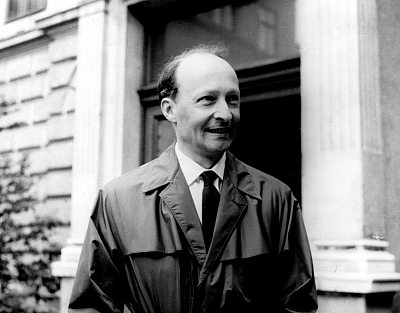
In Stockholm twenty years ago today, Lutosławski received the Polar Music Prize (1 million Swedish kronor). The other laureate in 1993 was Dizzy Gillespie (Wynton Marsalis accepted the award on Gillespie’s behalf).
The citation (with an interesting selection of named works) was read by the Swedish soprano Elisabeth Söderström and the award was presented by King Carl Gustav XVI.
The Polish composer and conductor Witold Lutosławski is awarded The Polar Music Prize, 1993. The Award Committee’s motivation is as follows:
In Witold Lutosławski, the Committee’s choice has fallen upon one of the pioneers of contemporary European art music. Starting with the trail-blazing orchestral composition Jeux vénitiens in 1961, he has contributed, through a large number of significant works, such as Trois poèmes d’Henri Michaux (1961-63), his String Quartet (1964) and his Third Symphony (1986 [sic]), towards a renewal of the contemporary orchestral vocabulary which, through its consistency and its artistic sincerity, has made his music an indispensable part of the central present-day orchestral and chamber music repertoire.
As a pathfinder and spiritual leader of his fellow countrymen in times of severe intellectual repression, he helped, through his uncompromising stance and his moral courage, to keep Polish music open for a long time to international contacts of every kind, and in this way played an outstanding part in creating for Eastern European music interests an air-hole of vital importance.
His personal combination of great artist, eminent organiser, campaigner for liberty and national conscience has earned Witold Lutosławski a high-ranking position in the cultural history of 20th century Europe.
Here is Lutosławski’s brief response, written in English:
The great British writer Joseph Conrad, who – by the way – was a Pole, wrote in the preface to his novel The Nigger of the ‘Narcissus’ of ‘the magic suggestiveness of music, which is the art of arts’. But we all know how low is the percentage of people for whom the so-called serious music is necessary, in spite of its being ‘the art of arts’. In the light of this, the decision of the founder of the Polar Music Prize to create such an award for so-called serious composers deserves the highest appreciation.
The fact that I have been chosen to be awarded this prize makes me proud and happy. It is also an encouragement for my possible future work. I beg the founder of the Polar Music Prize and the members of its Committee to accept this expression of my most profound gratitude.
Lutosławski’s phrase about ‘my possible future work” is especially poignant, as he completed no further compositions. His reference to Conrad is one of several that he made over the years. His most frequent point of reference was, as here, to the Preface to The Nigger of the ‘Narcissus’ (1897). This Preface, which is equally applicable to Conrad’s other writings as an artistic manifesto, provided Lutosławski with various points of reference. He didn’t always agree with Conrad, distancing himself from the sentiment of the opening paragraph later that year (in a talk given when he received the Kyoto Prize in October 1993):
The great writer Joseph Conrad says even that the duty of the artist is to do justice to the visible world. I am definitely against such a view. I think the visible world, the world in which we live, has no difficulty in expressing itself without our help. We are not predestined to express the real world in the art. The ideal world, the world of our dreams, of our wishes, of our vision of perfection is the domain of the arts.
This stance would by no means meet with universal approval today. But Lutosławski’s own life experience undoubtedly led to his views on the connections or otherwise between life and creativity. He had already made the same point and reference in the statement that he prepared for the public relay on 26 August 1984 in Gdańsk, during Martial Law, of a recording of his Third Symphony, which had yet to be performed in Poland.
Lutosławski was more in tune with Conrad’s second (single-sentence) and third paragraphs (the complete Preface is reproduced at the very end of this post).
The paragraph to which Lutosławski referred in Stockholm comes in the middle of the Preface. It is primarily about fiction and how its ideal realisation may be achieved only within the context of other, less literal art forms:
Fiction — if it at all aspires to be art — appeals to temperament. And in truth it must be, like painting, like music, like all art, the appeal of one temperament to all the other innumerable temperaments whose subtle and resistless power endows passing events with their true meaning, and creates the moral, the emotional atmosphere of the place and time. Such an appeal, to be effective, must be an impression conveyed through the senses; and, in fact, it cannot be made in any other way, because temperament, whether individual or collective, is not amenable to persuasion. All art, therefore, appeals primarily to the senses, and the artistic aim when expressing itself in written words must also make its appeal through the senses, if its high desire is to reach the secret spring of responsive emotions. It must strenuously aspire to the plasticity of sculpture, to the colour of painting, and to the magic suggestiveness of music — which is the art of arts. And it is only through complete, unswerving devotion to the perfect blending of form and substance; it is only through an unremitting, never-discouraged care for the shape and ring of sentences that an approach can be made to plasticity, to colour; and the light of magic suggestiveness may be brought to play for an evanescent instant over the commonplace surface of words: of the old, old words, worn thin, defaced by ages of careless usage.
Lutosławski had referred to the second sentence in this paragraph as far back as 1955, in an essay on Sibelius. And this was at a time when, as far as he was concerned, folk-based pieces under strict artistic surveillance by the State were what lay compositionally before him.
The reference to ‘magic’ occurs first in an article for Polityka (2 January, 1971), where Lutosławski used the phrase ‘magic insight’ (‘czarodziejskiej wnikliwości’). Five months later, on 2 June 1971, when he received an Hon. DMus. from the Cleveland Institute of Music, he used the phrase ‘magic suggestiveness’, as in Conrad’s Preface. And it is this same phrase that Lutosławski recalled at the end of his life, both in Stockholm and in Kyoto. Evidently, the Preface to The Nigger of the ‘Narcissus’ – and this central paragraph in particular – held a significant place in Lutosławski’s credo for most of his creative life.
………..
Conrad’s Preface to The Nigger of the ‘Narcissus’
A work that aspires, however humbly, to the condition of art should carry its justification in every line. And art itself may be defined as a single-minded attempt to render the highest kind of justice to the visible universe, by bringing to light the truth, manifold and one, underlying its every aspect. It is an attempt to find in its forms, in its colours, in its light, in its shadows, in the aspects of matter and in the facts of life, what of each is fundamental, what is enduring and essential – their one illuminating and convincing quality – the very truth of their existence. The artist, then, like the thinker or the scientist, seeks the truth and makes his appeal. Impressed by the aspect of the world the thinker plunges into ideas, the scientist into facts – whence, presently, emerging they make their appeal to those qualities of our being that fit us best for the hazardous enterprise of living. They speak authoritatively to our common-sense, to our intelligence, to our desire of peace or to our desire of unrest; not seldom to our prejudices, sometimes to our fears, often to our egoism – but always to our credulity. And their words are heard with reverence, for their concern is with weighty matters: with the cultivation of our minds and the proper care of our bodies; with the attainment of our ambitions; with the perfection of the means and the glorification of our precious aims.
It is otherwise with the artist.
Confronted by the same enigmatical spectacle the artist descends within himself, and in that lonely region of stress and strife, if he be deserving and fortunate, he finds the terms of his appeal. His appeal is made to our less obvious capacities: to that part of our nature which, because of the warlike conditions of existence, is necessarily kept out of sight within the more resisting and hard qualities – like the vulnerable body within the steel armour. His appeal is less loud, more profound, less distinct, more stirring – and sooner forgotten. Yet its effect endures for ever. The changing wisdom of successive generations discards ideas, questions facts, demolishes theories. But the artist appeals to that part of our being which is not dependent on wisdom: to that in us which is a gift and not an acquisition – and, therefore, more permanently enduring. He speaks to our capacity for delight and wonder, to the sense of mystery surrounding our lives; to our sense of pity, and beauty, and pain; to the latent feeling of fellowship with all creation – and to the subtle but invincible, conviction of solidarity that knits together the loneliness of innumerable hearts: to the solidarity in dreams, in joy, in sorrow, in aspirations, in illusions, in hope, in fear, which binds men to each other, which binds together all humanity – the dead to the living and the living to the unborn.
It is only some such train of thought, or rather of feeling, that can in a measure explain the aim of the attempt, made in the tale which follows, to present an unrestful episode in the obscure lives of a few individuals out of all the disregarded multitude of the bewildered, the simple and the voiceless. For, if there is any part of truth in the belief confessed above, it becomes evident that there is not a place of splendour or a dark corner of the earth that does not deserve, if only a passing glance of wonder and pity. The motive, then, may be held to justify the matter of the work; but this preface, which is simply an avowal of endeavour, cannot end here – for the avowal is not yet complete.
Fiction – if it at all aspires to be art – appeals to temperament. And in truth it must be, like painting, like music, like all art, the appeal of one temperament to all the other innumerable temperaments whose subtle and resistless power endows passing events with their true meaning, and creates the moral, the emotional atmosphere of the place and time. Such an appeal, to be effective, must be an impression conveyed through the senses; and, in fact, it cannot be made in any other way, because temperament, whether individual or collective, is not amenable to persuasion. All art, therefore, appeals primarily to the senses, and the artistic aim when expressing itself in written words must also make its appeal through the senses, if its high desire is to reach the secret spring of responsive emotions. It must strenuously aspire to the plasticity of sculpture, to the colour of painting, and to the magic suggestiveness of music – which is the art of arts. And it is only through complete, unswerving devotion to the perfect blending of form and substance; it is only through an unremitting, never-discouraged care for the shape and ring of sentences that an approach can be made to plasticity, to colour; and the light of magic suggestiveness may be brought to play for an evanescent instant over the commonplace surface of words: of the old, old words, worn thin, defaced by ages of careless usage.
The sincere endeavour to accomplish that creative task, to go as far on that road as his strength will carry him, to go undeterred by faltering, weariness or reproach, is the only valid justification for the worker in prose. And if his conscience is clear, his answer to those who, in the fulness of a wisdom which looks for immediate profit, demand specifically to be edified, consoled, amused; who demand to be promptly improved, or encouraged, or frightened, or shocked, or charmed, must run thus: – My task which I am trying to achieve is, by the power of the written word, to make you hear, to make you feel – it is, before all, to make you see. That – and no more, and it is everything. If I succeed, you shall find there according to your deserts: encouragement, consolation, fear, charm – all you demand; and, perhaps, also that glimpse of truth for which you have forgotten to ask.
To snatch in a moment of courage, from the remorseless rush of time, a sapping phase of life is only the beginning of the task. The task approached in tenderness and faith is to hold up unquestioningly, without choice and without fear, the rescued fragment before all eyes and in the light of a sincere mood. It is to show its vibration, its colour, its form; and through its movement, its form, and its colour, reveal the substance of its truth – disclose its inspiring secret: the stress and passion within the core of each convincing moment. In a single-minded attempt of that kind, if one be deserving and fortunate, one may perchance attain to such clearness of sincerity that at last the presented vision of regret or pity, of terror or mirth, shall awaken in the hearts of the beholders that feeling of unavoidable solidarity; of the solidarity in mysterious origin, in toil, in joy, in hope, in uncertain fate, which binds men to each other and all mankind to the visible world.
It is evident that he who, rightly or wrongly, holds by the convictions expressed above cannot be faithful to any one of the temporary formulas of his craft. The enduring part of them – the truth which each only imperfectly veils – should abide with him as the most precious of his possessions, but they all: Realism, Romanticism, Naturalism, even the unofficial sentimentalism (which, like the poor, is exceedingly difficult to get rid of); all these gods must, after a short period of fellowship, abandon him – even on the very threshold of the temple – to the stammerings of his conscience and to the outspoken consciousness of the difficulties of his work. In that uneasy solitude the supreme cry of Art for Art, even, loses the exciting ring of its apparent immorality. It sounds far off. It has ceased to be a cry, and is heard only as a whisper, often incomprehensible, but at times, and faintly, encouraging.
Sometimes, stretched at ease in the shade of a roadside tree, we watch the motions of a labourer in a distant field, and after a time, begin to wonder languidly as to what the fellow may be at. We watch the movements of his body, the waving of his arms, we see him bend down, stand up, hesitate, begin again. It may add to the charm of an idle hour to be told the purpose of his exertions. If we know he is trying to lift a stone, to dig a ditch, to uproot a stump, we look with a more real interest at his efforts; we are disposed to condone the jar of his agitation upon the restfulness of the landscape; and even, if in a brotherly frame of mind, we may bring ourselves to forgive his failure. We understood his object, and, after all, the fellow has tried, and perhaps he had not the strength, and perhaps he had not the knowledge. We forgive, go on our way – and forget.
And so it is with the workman of art. Art is long and life is short, and success is very far off. And thus, doubtful of strength to travel so far, we talk a little about the aim – the aim of art, which, like life itself, is inspiring, difficult – obscured by mists. It is not in the clear logic of a triumphant conclusion; it is not in the unveiling of one of those heartless secrets which are called the Laws of Nature. It is not less great, but only more difficult.
To arrest, for the space of a breath, the hands busy about the work of the earth, and compel men entranced by the sight of distant goals to glance for a moment at the surrounding vision of form and colour, of sunshine and shadows; to make them pause for a look, for a sigh, for a smile – such is the aim, difficult and evanescent, and reserved only for a very few to achieve. But sometimes, by the deserving and the fortunate, even that task is accomplished. And when it is accomplished – behold! – all the truth of life is there: a moment of vision, a sigh, a smile – and the return to an eternal rest.
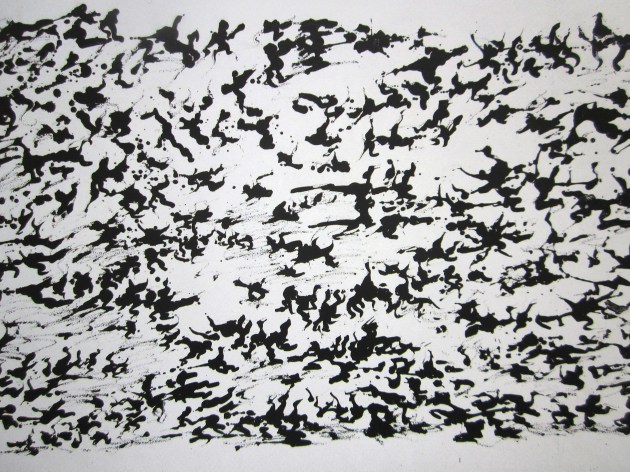
 (Untitled, 1952, 28x36cm)


 The 2013 BBC Proms have been launched today. It is great to see Polish music taking a prominent role, instigated by the centenary this year of the birth of Witold Lutosławski. This is no mean feat, given that 2013 also marks the centenary of the birth of Benjamin Britten and the bicentenaries of Verdi and Wagner. And this is not to mention other anniversaries, like the 50th anniversary of the death of Francis Poulenc.



 If you haven’t noticed them already, check out Michael McManus’s blogs celebrating the Lutosławski centenary. He blends personal reminiscence with insights into the works and their performances. He has some intriguing observations, not least on Perényi’s recent Berlin performance of the Cello Concerto under Simon Rattle (4.03.13) and on Stanisław Skrowaczewski’s interpretation of the Concerto for Orchestra in a rehearsal with the Hallé Orchestra (20.03.13). The blogs are available in the
 On Polish Music