• WL100/43: Variations, **17 June 1939

There was a time not so long ago in Kraków when you could find a really good antykwariat (second-hand bookshop) in several of the city’s central streets.  Those days are long gone, but in the 1990s I was able to build up my collection of library of books on Polish culture by delving into such emporia.  My most unexpected find was a bundle of old concert programmes.  These were mainly from the Kraków Philharmonic’s concerts between 1945 and 1952.  And in amongst these fascinating documents were a couple of other items, of which this one-off programme is the earlier. It is notable now for marking the concert premiere of Lutosławski’s Symphonic Variations (1936-38).

Lutosławski’s completed this, his first proper orchestral work, in mid-December 1938 and it was given a live broadcast on Polish Radio in April the following year.  Its first public performance, however, took place on Saturday 17 June 1939.  In the programme, it’s called simply ‘Variations’; whether ‘Symphonic’ was mistakenly omitted  or added later I cannot tell.  While it has never really made a huge impact in the broadly held canon of Lutosławski’s music, it is evidence of his early maturity, his ear for orchestral colour, and his symphonic instincts.  (It’s been programmed in this year’s BBC Proms, on Wednesday 7 August.  The performers are the BBC SO under Edward Gardner, reprising, along with the Piano Concerto and Louis Lortie, two of the pieces on their scintillating Chandos CD ‘Witold Lutosławski. Orchestral Works II’, CHSA 5098‘.)

Krakøw concerts 17-20.06.39 cover

The premiere was given by the Polish Radio [Symphony] Orchestra, conducted by its founder and music director Grzegorz Fitelberg.  It was the opening concert of the Kraków Arts Days Festival, which ran from 17-20 June 1939. Three of the five concerts, including this one, were given in the arcaded Renaissance courtyard of Wawel Castle in Kraków (in Lutosławski literature, the festival has normally been called the Wawel Festival).  All three Wawel concerts began at 21.00 hours – I hope the weather was balmy!  That’s more than could be said for what happened two and a half months later.

This programme is printed on cream card measuring 27 x 21 cms, printed in dark blue ink and folded to provide four sides (among the obvious misprints are E. Edgar, Bethoven, and con fucco).  The second side gives the programme for the first of the three symphonic concerts. For this ‘Concert of Polish Music’, the Polish Radio SO was joined by the singer Ewa Bandrowska-Turska (1894-1979), one of Poland’s most distinguished sopranos, and the pianist Józef Śmidowicz (1888-1962), who had been Lutosławski’s piano teacher in 1924-25.

Krakøw concert 17.06.39

Even though Kurpiński was a key figure in the development of opera in nineteenth-century Poland, his music today clings onto public awareness only through the overtures, such as this one to his opera Jadwiga, Queen of Poland (1814).  Melcer’s folk-infused Piano Concerto no.2 in C minor (1897) has maintained a certain place in the Polish repertoire.  Modern recordings by Jonathan Plowright (Hyperion, 2007) and Joanna Ławrynowicz (Acte Préalable, 2008) have been joined by an archive recording by Melcer himself (Selene, 2012).

The selection of four songs by Szymanowski includes two from his cycle Songs of a Fairytale Princess (1915), three songs from which he orchestrated in 1933 and were premiered by Bandrowska-Turska (there’s another mistake: the op. no. for the third song should be op.26).  Szymanowski had died in 1937, and Fitelberg was his ardent champion, so it was fitting that the programme included Fitelberg’s orchestral arrangement of Szymanowski’s Nocturne and Tarantella for violin and piano (1915).  The final work in this first programme was the now long-forgotten First Symphony by Woytowicz, who went on to run one of the artists’ cafes where Lutosławski and Andrzej Panufnik played their two-piano arrangements in war-torn Warsaw.
Krakøw concerts 18.06.39

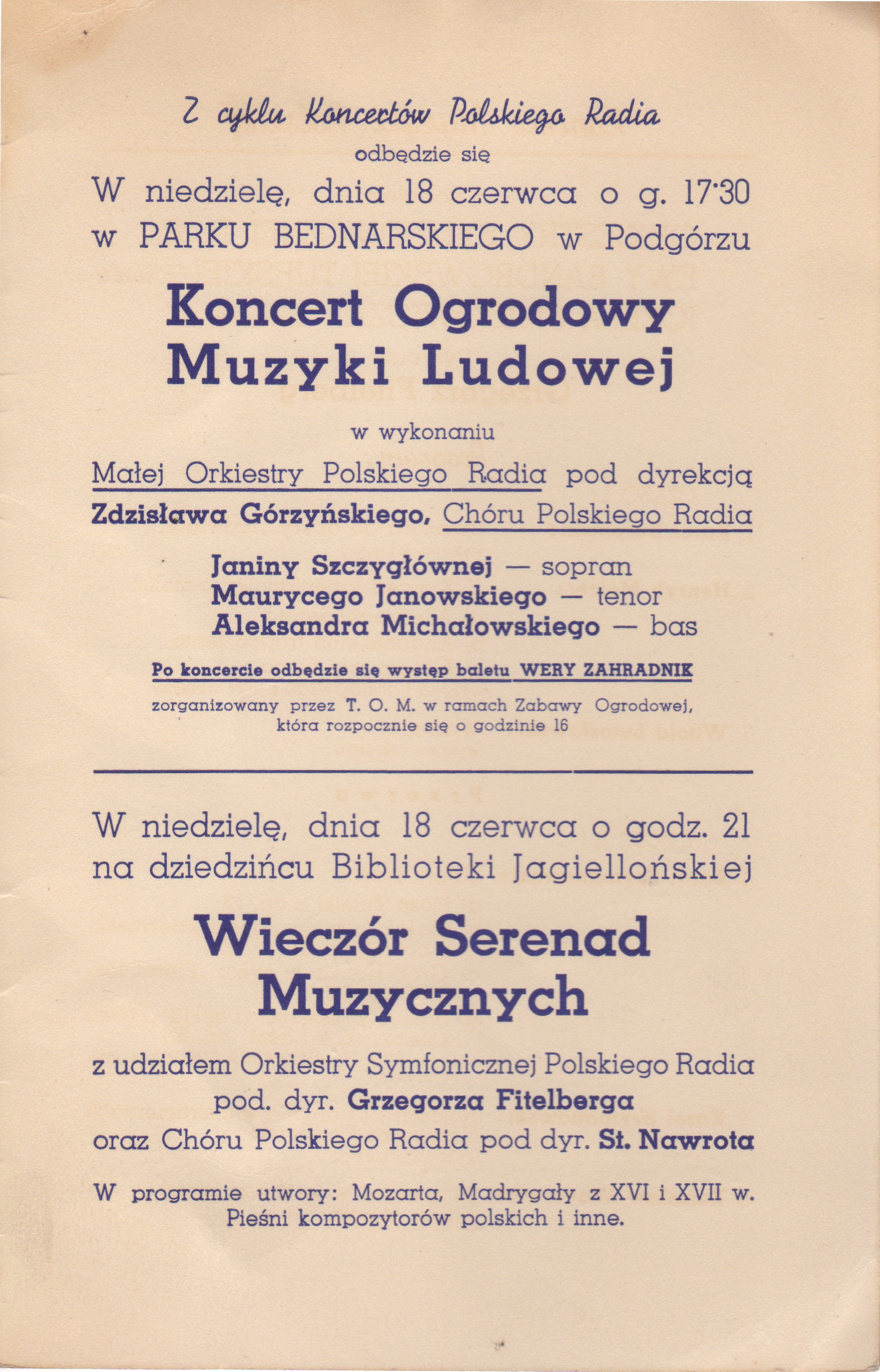
Side 3 of the programme announces the two non-symphonic concerts in the Kraków Arts Days Festival.  The first, on Sunday 18 June, in the Bednarski Park south of the River Vistula, was of folk music played by Polish Radio’s Small Orchestra, Chorus and vocal soloists.  This was followed by the second, an ‘Evening of Musical Serenades’, which was given in the courtyard of the Jagiellonian University near Wawel.  This mixed programme included Mozart, 16th and 17th-century madrigals, songs by unnamed Polish composers, etc.

Krakow cncerts 19-20.06.39

Side 4 outlines the details of the last two symphonic concerts.  The first, on Monday 19 June, included two works by Mieczysław Karłowicz, his tone poem Stanisław i Anna Oświecimowie (1907) and the Violin Concerto (1902). Pieces by three lesser-known composers followed: the symphonic poem Anhelli (1909) by Ludomir Różycki, the Cello Concerto (1928, on Gregorian themes) by Jan Maklakiewicz and the overture Swaty polskie (Polish Courtship, 1903) by Feliks Nowowiejski.  The soloists were Irena Dubiska (1899-1989), a noted violinist who in 1930 founded the Polish Quartet of which the other soloist, the cellist and composer Kazimierz Wiłkomirski (1900-95), was also a member.  Dubiska went on, like many other distinguished players, to perform in Woytowicz’s cafe during the Second World War.

The final concert, on Tuesday 20 June, cast its net outside Poland (muzyka obca = foreign music), including Elgar’s tribute to the stateless Polish nation during the Great War, Polonia, and Beethoven’s Sixth Symphony.  Of more interest is the repertoire by Ravel, Debussy and de Falla: Daphnis et Chloé (Second Suite), Nocturnes and the Suite from The Three-Cornered Hat.

• Lutosławski+ in Paris, 7.06.13

Just time to give advance notice that you can catch a performance of Lutosławski’s Third Symphony, live from the Salle Pleyel in Paris tonight (7 June, starting at 20.00hrs, local time).  It’s one of four pieces being played as part of IRCAM’s ‘ManiFeste 2013’ by the French Radio PO under Jukka-Pekka Saraste.  The other pieces are Dutilleux’s Métaboles and two world premieres: Carmine Emanuele Cella’s Reflets de l’ombre and Philippe Schoeller’s Songs from Esstal I, II et III.  It looks really interesting.

Screen Shot 2013-06-07 at 18.30.10

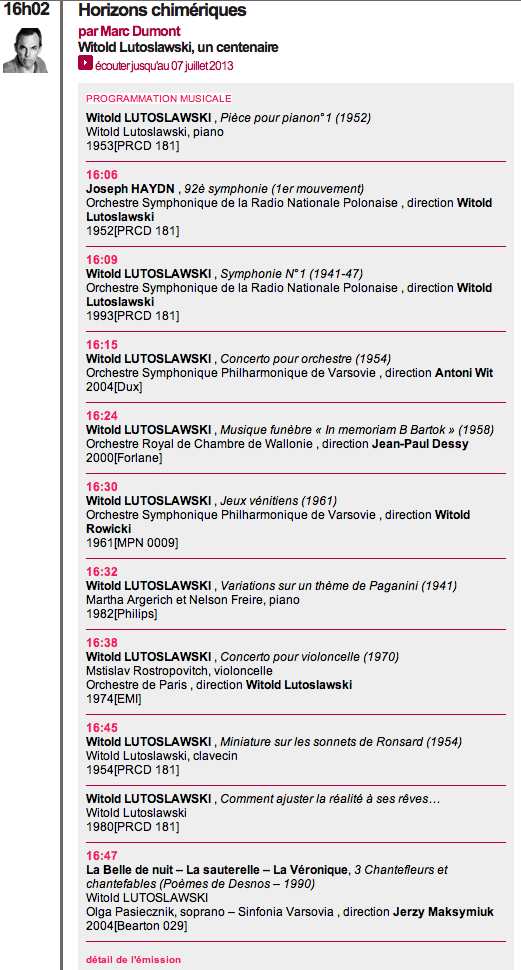
Earlier this afternoon, Radio France put out an hour-long tribute to Lutosławski in Horizons chimériques (you can ‘listen again’ for the next month).  It managed to sample ten pieces, plus an excerpt from a radio interview that Lutosławski gave (in Polish) in 1980.  One of the pieces was the first movement of Haydn’s Symphony no.92, conducted by Lutosławski in 1952, plus other archive recordings of that period from the 2-CD set Witold Lutosławski in the Polish Radio (PRCD 181-182, 2004).  It’s a fascinating document, so if you ever come across it, snap it up.

Screen Shot 2013-06-07 at 17.44.39

• WL100/40: London Sinfonietta, 22 May 1993

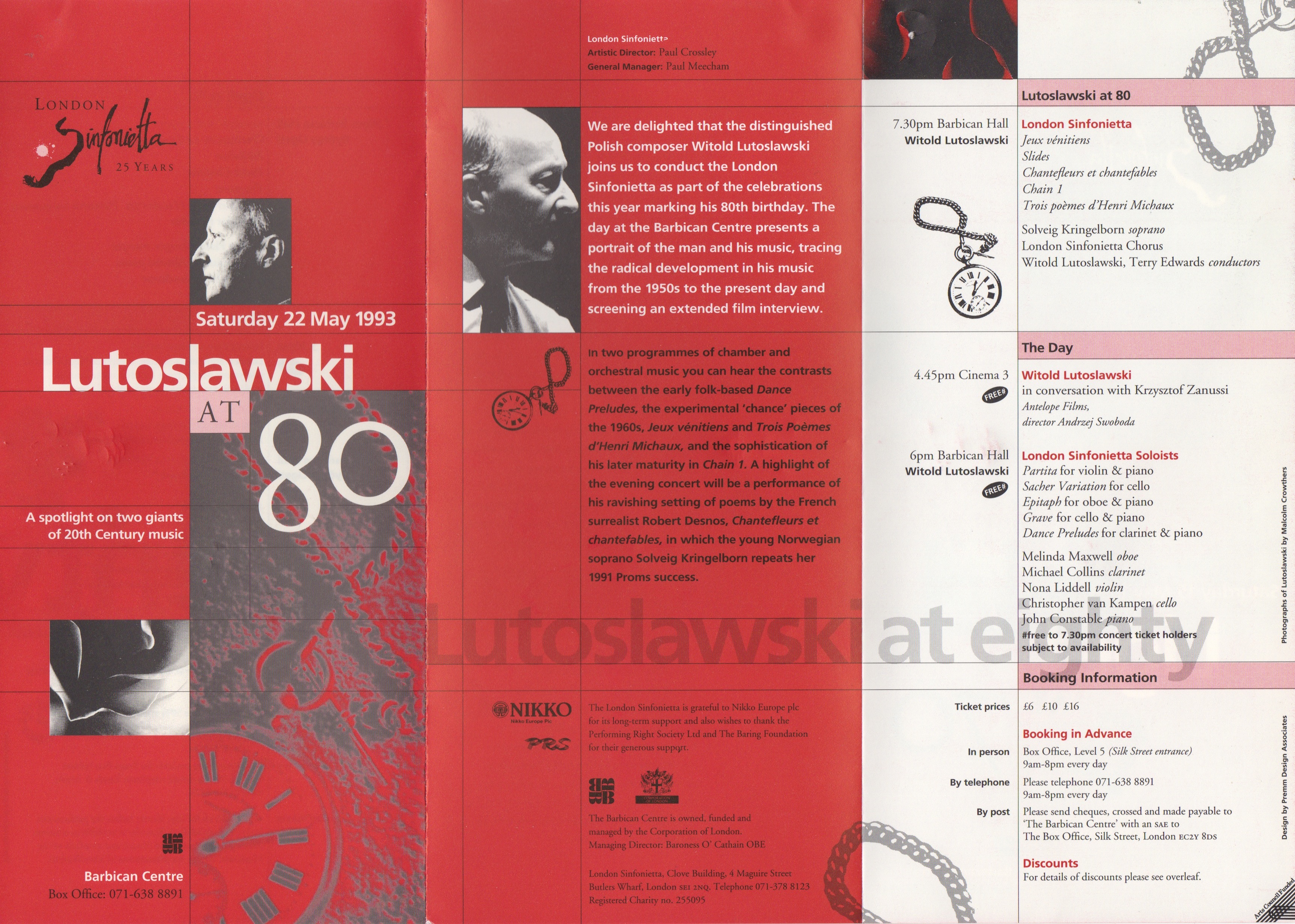
A belated but heartfelt tribute for Lutosławski’s 80th birthday was given by the London Sinfonietta on 22 May 1993. The composer joined the Sinfonietta for two concerts at the Barbican Hall, conducting the evening event and sitting in the audience for the chamber concert that preceded it.  Krzysztof Zanussi’s recent film on Lutosławski was also shown (see post of 13 April).

London Sinfonietta, 22.05.93

Lutosławski had a long and fruitful connection with the London Sinfonietta.  He first conducted it on 25 September 1972 in a recording of Paroles tissées with Peter Pears (Decca HEAD 3) and on 20 January 1973 he conducted the Sinfonietta at the QEH in London in a programme entirely of his own music: Musique funèbreParoles tissées (with Pears), Jeux vénitiens and Preludes and Fugue (UK premiere; its second performance).  A matter of days later he sprang to the Sinfonietta’s defence having learned of its parlous financial state.  Not only did he send a letter to The Times (published on 16 February 1973) but he also wrote a longer testimonial, reproduced below.

The words ‘London Sinfonietta’ associate in my mind with two unforgettable experiences.  The first was my first contact with the ensemble at the occasion of a gramophone recording of one of my pieces with Peter Pears as soloist.  It was last September at Maltings Snape.  The second was a concert at the Queen Elizabeth Hall in London in January this year, when I had the privilege of conducting the London Sinfonietta in a programme of my works.

To appear for the first time in front of an orchestra one has never conducted before is very often an embarrassing situation for a composer.  It is certainly a most valuable opportunity to convey the composer’s interpretation of a work to the performers.  But, on the other hand, it is rather a troublesome necessity to have to insist on the precise execution of the details of one’s own work, and to have to introduce some new ways of making music, which need to be explained exactly.

From the first rehearsal with the London Sinfonietta, all my misgivings disappeared entirely.  I felt very strongly that the only goal of those wonderful musicians was to achieve the best possible results; to respond as accurately as possible to the composer’s suggestions; in other words – to help to realise his sound vision in the most faithful way.

A group of experienced first-class musicians, some of whom are really virtuoso players, who have such an interest and devotion for contemporary music, is an invaluable treasure for us – for contemporary composers. Arthur Honegger once wrote that a contemporary composer whose work was played in a subscription concert felt like a man sitting at a table to which he had not been invited.  The London Sinfonietta’s series of twentieth-century music concerts offers the participating composers just the contrary: the rare and incomparable feeling of being the right man in the right place.

The very existence of such a group and its pioneer mission of promoting the music of our time is a beautiful example to follow in other countries all over the world.

• WL100/37: Trois poèmes, **9 May 1963

50 years ago today – 9 May 1963 – Lutosławski conducted in the first performance of Trois poèmes d’Henri Michaux (1961-63).  It was his first foreign commission and premiere (albeit behind the Iron Curtain) and it was the first time he had appeared on the concert platform to conduct his own music (the work requires two conductors, one for the choir, the other for the orchestra).  He was not a young man – he had turned 50 in January that year – so this breakthrough was late in coming.  It proved to be significant, as major commissions from Western Europe and performances abroad soon materialised.

Over the next few years, Trois poèmes was performed in Warsaw (1963), Venice and Paris (1964), Prague and Heidelberg (1965), Buffalo, Boston, Copenhagen and Munich (1966), Rome, Katowice and Copenhagen (1968) and Uppsala, Amsterdam, Nottingham and Wrocław (1969).  It was first recorded at the ‘Warsaw Autumn’ on 22 September 1963 by the Great SO of Polish Radio (WOSPR) and the Kraków Radio Choir, conducted by Jan Krenz (orchestra) and Lutosławski (choir).  It won the UNESCO Tribune Internationale des Compositeurs (1964) and was published in 1965 by PWM (strangely, it’s never been separately published outside Poland).  Below is a photo of the cover of my well-worn copy, dating back to when I organised and was one of the two conductors of the UK premiere (Nottingham, 25 June 1969).

Screen Shot 2013-05-09 at 14.22.40

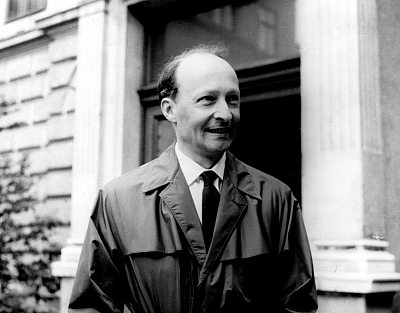
The world premiere took place at the Zagreb Biennale, with the Zagreb Radio Choir conducted by Slavko Zlatić and the Zagreb Radio Orchestra by Lutosławski.  Here’s a photo from his time in Zagreb (like the raincoat!):

6308

And here he is, speaking briefly about the piece (appropriately enough, in French), with a closing shot of the choir under Slavko Zlatić, who had commissioned it for his choir (ignore the bizarre overlay of music from the coda of the Third Symphony, written twenty years later!):

At the bottom of this post are three videos, one for each of the three movements of Trois poèmes.  You will see that the visuals for these postings contain photos from Lutosławski’s sketches for the piece.  These come from an enthralling essay by Martina Homma, the most knowledgeable of all experts on the Lutosławski sketches.  It was originally published to accompany an exhibition of the sketches for Trois poèmes, mounted in Warsaw on 27 September 1996, to mark the inauguration of the newly-named Witold Lutosławski Studio at Polish Radio.  Here’s a link to the online version, published in Polish Music Journal vol.3 no.2 (Winter 2000).

• Polish Music at the 2013 BBC Proms

Polish Music at the 2013 BBC Proms

p0179z7mThe 2013 BBC Proms have been launched today.  It is great to see Polish music taking a prominent role, instigated by the centenary this year of the birth of Witold Lutosławski.  This is no mean feat, given that 2013 also marks the centenary of the birth of Benjamin Britten and the bicentenaries of Verdi and Wagner.  And this is not to mention other anniversaries, like the 50th anniversary of the death of Francis Poulenc.

There are seven pieces by Lutosławski in this year’s programme.  There are also two by both Andrzej Panufnik (his centenary falls next year) and Karol Szymanowski.  And there is one each by Henryk Mikołaj Górecki and Krzysztof Penderecki, who were born 80 years ago.  There is also a concert including music of the Polish Renaissance.  An outline calendar of Polish music at the 2013 Proms is given below.

My essay for the BBC Proms Guide may be read here.

Prom 1 • 12 July
• Lutosławski: Variations on a Theme by Paganini

PCM 1 • 15 July
• Lutosławski: Partita

Prom 8 • 17 July
• Lutosławski: Cello Concerto

Prom 9 • 18 July
• Szymanowski: Symphony no.3 ‘Song of the Night’

PCM 2 • 22 July
• Polish and other European Renaissance Music

Prom 32 • 7 August
• Lutosławski: Symphonic Variations
• Lutosławski: Piano Concerto

Prom 44 • 15 August
• Penderecki: Concerto Grosso

Prom 55 • 23 August
• Lutosławski: Concerto for Orchestra
• Panufnik: Tragic Overture
• Panufnik: Lullaby

PSM 4 • 24 August
• Lutosławski: Paroles tissées

Prom 68 • 2 September
• Szymanowski: Violin Concerto no.1

Prom 71 • 4 September
• Górecki: Symphony no.3 ‘Symphony of Sorrowful Songs’

• Lutosławski @sacrum+profanum, 22.09.13

sacrum_logotypecmyk_jasnetlHot on the heels of my recent posts about the re-imagining of Lutosławski’s music by Polish musicians, news has come through of a potentially more far-reaching project involving non-Polish musicians at the 2013 sacrum+profanum festival in Kraków.

On 22 September, the AUKSO orchestra, under Marek Moś, will play Lutosławski’s Musique funèbre and Preludes and Fugue.  Their by-the-book performances will then be responded to by four composers known for their electronic work: Clark (Chris Clark, UK), Emika (UK, of Czech parentage), Mira Calix (UK) and Oneohtrix Point Never (Daniel Lopatin, USA).  The event – ‘Polish Icons 2’ – starts at 18.00, at the ArcelorMittal Hala Ocynowni.  Tickets (bilety) are 79zł (c. £20) until the end of May, thereafter 99zł (c. £25).  The Polish announcement is available here (the English-language pages have not yet caught up with the Polish news release).

894361.3

• Gramophone blogs on Lutosławski

picture-3830If you haven’t noticed them already, check out Michael McManus’s blogs celebrating the Lutosławski centenary.  He blends personal reminiscence with insights into the works and their performances.  He has some intriguing observations, not least on Perényi’s recent Berlin performance of the Cello Concerto under Simon Rattle (4.03.13) and on Stanisław Skrowaczewski’s interpretation of the Concerto for Orchestra in a rehearsal with the Hallé Orchestra (20.03.13).  The blogs are available in the Gramophone online edition.  There have been five so far.

• 20.03.13  Keeping the Lutosławski tradition alive
• 4.03.13  Lutosławski’s Cello Concerto
• 13.02.13  Woven Words
• 30.01.13  Warsaw in the winter
• 29.01.13  Lutosławski at 100

• WL100/28: Jazz Conversations (Lutosphere)

Having heard Agata Zubel, Andrzej Bauer and Cezary Duchnowski in conversation with Lutosławski’s alter ego ‘Derwid’ at the end of the Philharmonia’s Woven Words festival last month (Zubel Zings!), I’ve revisited an earlier set of ‘conversations with Lutosławski’.  These took place in the project Lutosphere, when Bauer teamed up with the pianist Leszek Możdżer and the DJ M.Bunio.S to explore Lutosławski’s concert music.  Among the pieces which they reference are the Intrada and Passacaglia from the Concerto for Orchestra (1954) and the Cello Concerto (1970). As I’ve written before, there’s quite a tradition of Polish jazz musicians reworking the music of major Polish composers (Chopin, Szymanowski), but this is the first time that the composer’s own voice has been included in the process!

There are currently a handful of uploads on YouTube, some with live video footage.  Here are five (two of them are short extracts), dating from 2008-10.

OFF festival, Mysłowice (8.08.2008)


Polish Radio (pre 6.11.2008, with partly English-language intro by Możdżer)


(pre 17.05.2009)


Kraków Philharmonic (31.10.2009)


Theatre on the 6th Floor, Warsaw (26.08.2010)


• Zubel Zings!

series_page_image_c_kopia tarasin jan_w238The Philharmonia’s Orchestra’s Woven Words celebration of the centenary of the birth of Witold Lutosławski has come to its end in London, although it is taking some of its repertoire abroad from time to time until September.  It has been an undeniable success, with great performances of Lutosławski’s music under Esa-Pekka Salonen.  I went to all three London concerts in the Royal Festival Hall, and the clear highlight for me was Krystian Zimerman’s superlative interpretation of the Piano Concerto in the first concert (30 January).  Jennifer Koh brought an exceptional intensity and drive to Chain 2 in the final concert (21 March) and Truls Mørk’s performance of the Cello Concerto in the second concert (7 March) was also very fine.  I wish I could be as enthusiastic about Mathias Goerne in Les espaces du sommeil, but his weak diction and exceedingly nervous manner were severe distractions.  The programming of Debussy and Ravel was inspired, especially the placing of Ma mère l’oye at the start of the third concert.  The performances of the French repertoire were, however, hit and miss: the complete Daphnis et Chlöe was riveting, La mer rather matter-of-fact, while La valse – the last piece in the series – went for absolutely nothing because of Salonen’s expression-denying, helter-skelter speed.

Less trumpeted were the complementary concerts.  Students from the Royal College of Music played a sterling role in this regard, in concerts on 4, 6 and 27 February and on 6 March.    There were also three events by young Polish musicians playing music of their contemporaries, though these events were barely evident in either the Philharmonia’s online publicity, which failed to keep up-to-date with some programme changes, or within the RFH signage itself.  This was a pity, and something of a discourtesy to the Polish side of the partnership (the Adam Mickiewicz Institute), which had brought fresh imagination to these supporting recitals.  (A full list of the Lutosławski and other Polish repertoire in the London concerts is given at the foot of this post.)

Kwartludium

The first supporting event in the RFH came before the second concert (7 March) and was given by the Polish ensemble Kwartludium (clarinet/bass clarinet, violin, percussion, piano).  The advertised repertoire of music by Wojciech Blecharz (b.1981) and Jagoda Szmytka (b.1982) was replaced by pieces by other Polish composers: Sławomir Wojciechowski (b.1971), Wojciech Ziemowit Zych (b.1976) and Dariusz Przybylski (b.1984).  Dagna Sadkowska and Piotr Nowicki began the recital with a performance of Lutosławski’s Subito, which the full ensemble followed with a ghostly ‘impression’ of the piece.  All three of the other works had great dynamism and instrumental imagination.  A fragment of Zych’s piece (in Polish: Stale obecna tęsknota) is available on the Kwartludium website: http://www.kwartludium.com/Zych.mp3.   This recital was an extremely rare opportunity in this country to hear Polish music written since 2000, and that in itself should give us pause for thought.  We are too wedded to the triumvirate of Lutosławski, Penderecki and Górecki.  There are not only many other Polish composers born before 1945 who are totally neglected in the UK, but also four decades of composers who now range in age from their mid-60s to their mid-20s and whose names are barely known, let alone their music.  Our concert repertoire – and not only with regard to Poland – remains more insular than we (are prepared to) recognise.

Cellotronicum and Cellonet

The second supporting event took place before the third concert (21 March).  The first part was given by Cellotronikum, comprising the cellist Andrzej Bauer with computer input by the composer Cezary Duchnowski (b.1971).  They gave the world premiere of For A.B. by Ryszard Osada (b.1972), followed by Duchnowski’s Broda.  In the second part, given by the Cellonet ensemble, Bauer conducted eight of his own students in Penderecki’s own arrangement of his Agnus Dei and in Octagon by the Ukrainian composer Lubawa Sydorenko (b.1979).  In both pieces, Cellonet was absolutely stunning, and you can hear the Sydorenko on the Cellonet MySpace site: http://www.myspace.com/cellonet/music/songs/lubawa-sydorenko-octagon-58524337.  This was music-making of an unusual order, and it is a measure of its quality that two of the eight cellists – Bartosz Koziak and Marcin Zdunik – have won the Lutosławski Cello Competition (in 2001 and 2007 respectively).  I heard Zdunik give an inspired performance of Lutosławski’s Grave in Warsaw in January and he told me after the RFH recital that he’s about to record the Lutosławski Cello Concerto, so that is definitely something to look out for.

El Derwid

The final supporting event, and the most neglected, came after the third Philharmonia concert and was held in the distinctly unsuitable Clore Ballroom (diabolical acoustics, nil atmosphere).  It was a reworking of eight of over thirty dance songs that Lutosławski wrote in the late 1950s and early 60s under the pseudonym ‘Derwid’.  For some unfathomable reason, the evening’s concert sheet failed to mention this rather crucial connection.  I’ve known the Derwid songs in their original recordings for over twenty years, but even I was flummoxed by the unexplained heading ‘EL DERWID’.  Had someone been reading Doctorow?  Was there some unknown Venezuelan bandit connection?  Subsequent research revealed that the ‘El’ comes from ‘Elettrovoce’, a duet comprising the composer and singer Agata Zubel (b.1978) and Duchnowski.  Somebody might have thought to explain this.  Zubel and Duchnowski (on piano as well as computer) teamed up several years ago with Bauer to perform their realisations of a selection of Derwid songs; a recording of this ‘El Derwid’ repertoire is due out on CD Accord this autumn.

Even though I caught only five of the songs (their performance must have started the minute the concert ended, as they were on song no.3 by the time I got downstairs), they were sufficient to whet my appetite for the CD.  Zubel has great stage presence and a wonderfully flexible voice.  In Czarownica (Witch), she and Bauer seemed to be having a domestic tit-for-tat, to humorous effect, while in Daleka podróż (Distant Journey) the trio brought a grating darkness to this tale of dreaming of distant, sunny climes.  In this bitterly cold March weather, I knew how they felt.  The title song for their set, Plamy na słońcu (Sunspots), delightfully and unexpectedly interlaced Derwid’s music with the Passacaglia theme from Lutosławski’s Concerto for Orchestra.  Woven works.  This fringe event brought a smile to the lips of those who had found it, and it gave the festival a properly fizzing conclusion.

Postscript

Two further aspects of Woven Words are worth mentioning.  Firstly, and more importantly, the detail and skill that have gone into the woven-words.co.uk website.  It is a model of its kind: launched well in advance of the festival (three months), it contains links to several specially commissioned films and a series of essays on Lutosławski.  This is a very valuable resource, not just for the festival but for future readers and viewers.  Secondly, there was a Lutosławski Study Day – ‘Lutosławski and the Interior Drama: The Spaces of Dream’ – held at the RFH on 16 March. There were five sessions: talks by Steven Stucky (‘Glimpsing an Ideal World’), myself (‘The Spaces of Dream: Lutosławski and Surrealism’) and Nicholas Reyland (‘The Sense of an Ending: Late Music, Enduring Concerns’), plus a workshop on the String Quartet with Steven Stucky and the Jubilee String Quartet, who then played the work complete.  The day concluded with a panel discussion by the three speakers.

Woven Words: 20th- and 21st-Century Polish Repertoire

Lutosławski/Philharmonia: Concerto for Orchestra (1954), Musique funèbre (1958), Cello Concerto (1970), Les espaces du sommeil (1975), Chain 2 (1985), Piano Concerto (1988), Symphony no.4 (1992)

• Lutosławski/RCM: Two Studies (1941), Bucolics (1952), Dance Preludes (1954), Jeux vénitiens (1961), String Quartet (1964), Epitaph (1979), Grave (1981), Mini-Overture (1982), Symphony no.3 (1983), Partita (1984), Fanfare for CUBE (1987), Subito (1992)

• Lutosławski/Kwartludium: Subito (1992)

• Lutosławski/Jubilee String Quartet: String Quartet (1964)

• ‘Derwid’/El Derwid: Cyrk jedzie (The Circus is Coming), Jeden przystanek dalej (One Stop Further), Z lat dziecinnych (From Childhood), Czarownica (Witch), Złote pantofelki (Golden Shoes), Daleka podróż (Distant Journey), W lunaparku (At the Funfair), Plamy na słońcu (Sunspots)

• Other 
Cezary Duchnowski: Broda (2005)
Ryszard Osada: For A.B. (2013?) world premiere
Krzysztof Penderecki: Agnus Dei (1981), arr. eight cellos (2007)
Dariusz Przybylski: Medeas Träume (2008)
Sławomir Wojciechowski: Rope of Sands (2009)
Wojciech Zimowit Zych: Ever-Present Longing (2005)

• 5th Festival of Premieres, Katowice

Unknown

Festiwal Prawykonań (Festival of Premieres) is a biennial celebration of new pieces by Polish composers of all generations.  This year’s event runs over the last weekend of next month, 26-28 April 2013 (the Polish website is complete but the English is still under construction).  It’s organised in Katowice by NOSPR (Narodowa Orkiestra Symfoniczna Polskiego Radia – National Symphony Orchestra of Polish Radio; or as NOSPR bizarrely prefers to translate it – Polish National Radio Symphony Orchestra).  The festival started in 2005 and a full list of previous festival concerts is available under its Archiwum tab.

There’s a mix of chamber and orchestral concerts (seven in all).  Some are free, the others have a one-price tag of 10zł (c. £2).  How’s that for a bargain?  I’m sure that most if not all of these concerts will be broadcast online by Polish Radio Dwójka (PR2), either live or delayed.  Here’s this year’s repertoire, in alphabetical order by composer:

** World premiere   * Polish premiere
• Marcin Bortnowski: Miserere for chamber choir and percussion ensemble**
• Michał Dobrzyński: Three Songs to words by Rilke**
• Ryszard Gabryś: Voyelles de Arthur Rimbaud**
• Mikołaj Górecki: Symphony no.2**
• Aleksandra Gryka: 10, 12, 13, -31 for string quartet**
• Paweł Hendrich: Ertytre for cello ensemble**?
• Rafał Janiak: Symphony no.2**
• Dobromiła Jaskot: Elferiae for string quartet**
• Krzysztof Knittel: Partita for saxophone, orchestra and electronic media**
• Benedykt Konowalski: Nowa pieśń chwały for clarinet and mixed chamber choir**
• Włodzimierz Kotoński: Arietta e i fiori for trombone and synthesized sounds**
• Justyna Kowalska-Lasoń: String Quartet no.3**
• Zygmunt Krauze: Canzona for instrumental ensemble*
• Stanisław Krupowicz: Piano Concerto**
• Hanna Kulenty: String Quartet no.5*
• Andrzej Kwieciński: Canzon de’ baci for tenor and orchestra**
• Mikołaj Majkusiak: Pulsaciones for accordion, classical guitar and string orchestra**
• Maciej Małecki: Concertino for cello and orchestra**
• Krzysztof Meyer: Piano Quartet op.112 (new version)**
• Piotr Moss: Cavafy Verses for baritone and orchestra**
• Aleksander Nowak: Z górnego piętra for violin and percussion**
• Tomasz Opałka: L.A. Concerto for violin and orchestra**
• Ryszard Osada: Double Reflection for cello octet**
• Bronisław Kazimierz Przybylski: Lofoten, Concerto-Symphony for viola and orchestra**
• Dariusz Przybylski: Cello Concerto**
• Marta Ptaszyńska: Of Time & Space, concerto for percussion, electronics and orchestra**
• Adrian Robak: Vocal Concerto ‘Camerata’**
• Marcin Rupociński: Non possumus for choir, chamber ensemble and electronics**
• Wojciech Widłak: Festivalente for orchestra**
• Sławomir Wojciechowski: Fingertrips for eight prepared cellos**
• Agata Zubel: Pomiędzy odpływem myśli a przypływem snu for voice and string orchestra**