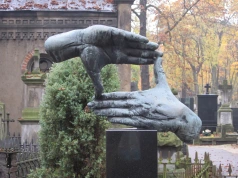
• On What Would Have Been His 78th Birthday

On what would have been Henryk Mikołaj Górecki’s 78th birthday, his daughter Anna has sent me a photograph of his newly installed gravestone (nagrobek).  One of the words which I have long used to describe his music is ‘granitic’, so I am fascinated by the sculptural use of this material above what looks like a smooth, dark-slate grave cover.  It conveys the character of the man and his creative outlook brilliantly: rugged, imposing and unconventional, yet warm-hearted, touching and touchable.

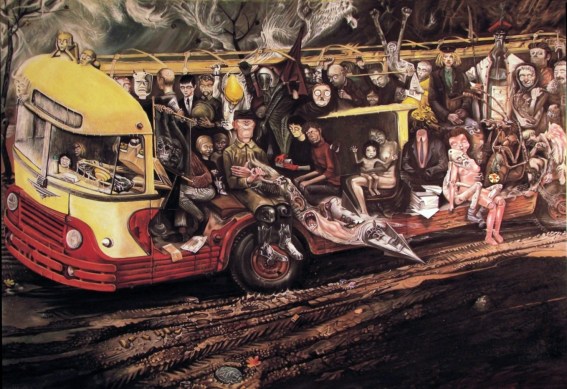
• The Painter and his Bus (1961)

Only after I posted yesterday about Szpilman and his cheerful 1952 song The Red Bus did I remember a quite different ‘bus’ altogether.  When I was a student in Poland 40 years ago, I went to the National Museum in Warsaw and was bowled over by one particular painting, completed ten years earlier.  I bought a glossy black-and-white photo of it and put it up on the wall of my room.  I still have it.  It’s pretty gruesome and certainly intended to disturb, so why did I want to look at it every day?  It was because its subject matter still resonated and illuminated my first experiences of Poland.

Szpilman’s music and Kazimierz Winkler’s lyrics had painted a sunny picture of Warsaw under reconstruction in the early 1950s.  Such songs were intended to encourage Poles to look to a bright socialist future under the ‘benign’ gaze of Poland’s eastern neighbour, the USSR, and its leader, Comrade Józef Stalin.  The following year, Stalin died and the later 50s were witness to upheavals in East Germany, Poland and, bloodiest of all, Hungary.  Even the Soviet Union changed somewhat.

Creative artists felt that there were now possibilities for greater freedom (this varied wildly from country to country behind the ‘Iron Curtain’) as well as for criticism and satire of the authorities and their dogmas about the ‘bright future’. One of these artists was the Polish painter, Bronisław Wojciech Linke (1906-62).  Towards the end of his life, 50 years ago, he created his masterpiece, Autobus (1959-61).

Polish buses were still crowded and rickety in the early 1970s, but I never encountered one quite like this.  Linke’s pessimistic, dehumanised vision may seem nightmarish to us, but to its contemporary viewers its metaphors were all too real.  They knew these characters, these distortions, this life.

Within this cut-away red bus are symbols of a broken and divided society. From left to right, they include:

• the Driver, a mannequin made of wood grasping a cobwebbed driving wheel
• the Jew, facing away
• the Polish Army Soldier, helmet in his hands, standing next to a figure with a giant lemon for a head
• the gormless Worker making a common and rude gesture
• the Cosmonaut
• the trendy (= scruffy) Young Man with his gloved girl and her silver handbag, sitting on a missile
• the greedy Priest, with coins for eyes
• a naked Young Girl on her naked mother’s lap
• the faceless (in fact, bodiless) Bureaucrat, sitting neatly on a pile of paper
• the lecherous Old Man with the naked doll
• the Drunk in his czapka krakuska (Kraków cap) and white overcoat, his body a giant bottle of spiritus
• the queuing Woman, clutching a large loaf and bags of shopping
• and, last but not least, Generalissimus Stalin himself, with a prison window for a heart.

Most of them have their eyes shut.  And among them are ghoulish faces, a newspaper that screams with raised arms and clenched fists, pierced by the passengers’ handrail, and a gigantic beetle.  I can’t claim to have picked up all the references (any further observations gratefully received!), but its imagery remains as powerful as it did for me in 1971.

There is not much on this penetrating artist on the web, but the following links may be helpful:

• http://polish-art.info/linke.html (some further images)
• http://englishwarsaw.blogspot.com/2011/02/on-bus-bronisaw-wojciech-linke.html  This is a blog entry (25.02.11) by ‘Pan Steeva’, with more Linke images interlacing his translation of the Polish Wikipedia article on the painter.
• http://www.youtube.com/watch?v=Ms5Y0cDJ-3A  This is a strange concoction uploaded only last week.  It’s a freeze-frame download from a Polish TV ‘Kultura’ profile of Autobus made in 1998.  The commentary by the distinguished painter and graphic artist Franciszek Starowieyski (whose art has clear connections with Linke and whose posters had an even stronger impact on me in the early 70s) is discarded in favour of a performance of a Scarlatti sonata …  But this YouTube video, ‘Autobus.wmv’ (3’32”), does give some valuable close-ups of the picture.

See also my subsequent post about Jacek Kaczmarski’s powerful song Czerwony autobus (7.12.11) and another giving its Polish lyrics and an English translation (13.12.11), both with a YouTube audio link.

• and a Bench for Tuwim too

It was only as I was researching my preceding post – on Henryk Górecki and his attachment to Julian Tuwim’s poem Song of Joy and Rhythm – that I came across what looks like a remarkable parallel between memorials to these two giants of 20th-century Polish culture.

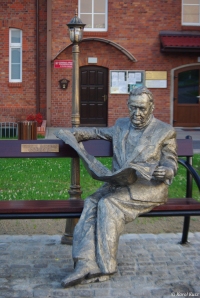
In another post twelve days ago – A Conversation with Henryk Górecki – I reported on a whimsical yet thoughtful monument to him that had been unveiled on 10 September in Rydułtowy, the town in Silesia where he lived from the age of 2 until he was 22.  As you’ll see or have seen, Górecki is sitting on the right-hand end of a bench, reading a musical score.

Well, blow me down, Tuwim too has been honoured with a bench, in his home town, Łódź, in central Poland.  This is the work of Wojciech Gryniewicz and was unveiled in 1999.  Like Górecki, Tuwim is seated on the right-hand end of a bench that in his case is also sculpted.  The key difference here is the posture.  Tuwim is looking out, not down, possibly above and beyond the eyeline of any companion.  Maybe he’s ‘lying in wait for God’ (Czyhanie na Bogu, the title of the collection that included Song of Joy and Rhythm).

I must say that I’m rather taken by the modest, down-to-earth approach of these sculpture-installations.  Does anyone know of other examples in addition to Maggi Hambling’s A Conversation with Oscar Wilde in London?

• A Conversation with Henryk Górecki

Exactly one year ago I flew to Poland for what turned out to be my last meetings with Henryk Mikołaj Górecki.  When I had learned a few days earlier that he had been awarded Poland’s highest honour, the Order of the White Eagle, and that the presentation had taken place at his hospital bedside, I sensed that the end was near.  His fellow composer Witold Lutosławski (1913-94) had been honoured in the same way just before his death, although he was too ill to receive it in person.

Staying once again with members of Górecki’s family, I was taken on three occasions to see Henryk in his hospital on the outskirts of Katowice.  It is never easy to see a close friend in such circumstances, when their vivacity, robustness and combativeness have seemingly vanished.  He was able to communicate only through those still-penetrating eyes.  I showed him pictures of the moorland where I live and reminisced about the often hilarious holiday that I had with him and the family at Chochołów in the Tatra Mountains in August 1987 and about our many walks and talks together.  I recounted my recent visit to the St Magnus Festival in Orkney, where the Royal Quartet from Poland had given an unforgettable account of his Third String Quartet ‘… songs are sung’ and where I’d been mesmerised by the pianism and imagination of the jazz interpretations by Leszek Możdżer.  Even though all he could do was to look me straight in the eye, as he always did, I knew that he’d been listening and had understood.  There were to be no more moments like this.  I wish now that I had had the forethought to bring along some poetry or other texts to read to him, just as depicted in the film The Diving Bell and the Butterfly.

I may yet write about the day of his death (12 November 2010) and his funeral five days later, but for now I’m going to fast-forward to 10 September 2011.  I’ve been rather tardy in writing about a touching and somewhat whimsical tribute that was paid to him on that day in Poland.

Photo by Karol Kusz

Between the ages of two and twenty two, before he went to study composition in Katowice, Górecki lived some 50km to the south west, in a small town called Rydułtowy. There he went to school and subsequently taught primary school children a range of subjects, including Polish history, maths, biology, natural history and art.  Earlier this year, the town recognised its most famous son by renaming the Public Library in his honour.  On 10 September, ceremonies were held to mark the occasion, including the customary speeches and musical performances.  Górecki’s widow, Jadwiga, unveiled a plaque inside the library and also unveiled a sculpture outside.  But this sculpture – or is it a statue, or perhaps an installation? – is not a run-of-the-mill representation of the composer, nor an abstract concept inspired by his music.  It’s more in the line of Maggi Hambling’s A Conversation with Oscar Wilde (1998), which has been placed in London at the bottom of the pedestrian Adelaide St, behind the church of St Martin’s in the Fields and close to Charing Cross station.

Whereas Hambling (left) gives passers-by the opportunity to sit on Wilde’s all-too-solid ‘coffin’ and have a face-to-face exchange of witty one-liners (or sit in the opposite direction and ignore him), Henryk Fojcik’s sculpture (above) encourages side-by-side contemplation.  Górecki sits on the right-hand side of a posher-than-normal park bench, a lamp-post placed centrally behind (plenty of openings here on a rainy day for Gene Kelly impersonators).  He’s reading what looks like a newspaper, although I never knew him as an avid reader of newsprint.

In the picture below, in which his widow Jadwiga was persuaded to sit next to him on the bench, it seems that Górecki is looking instead at a piece of music, even though it’s oversize and much bigger than his largest score, Scontri.  He wasn’t one for looking at his existing compositions, either.  He preferred to work on new pieces.  It’s a good likeness, however: the head and face are pretty faithful and characteristic (much more so than the relief image on the plaque inside the library) and his body posture is very well captured.  And there is something wonderfully relaxed, quietly alive and of good humour about Fojcik’s sculpture.  It invites participation and companionship.
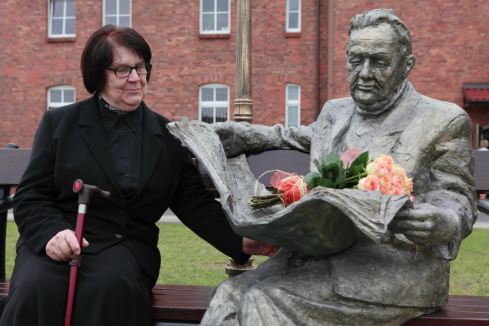
For myself, I think a chance has been missed by having his eyes downcast.  How more engaging it would be if his head had been facing towards the other person on the bench, fixing him or her with his searching eyes as if to say: “What are you doing now? … Well, get up and do it!”.

Further information may be found online at

• < http://www.biblioteka.rydultowy.pl/archiwum.php?id=263> – a report by the Rydułtowy Public Library of the event on 10 September 2011, with 27 photographs.

• < http://www.telewizjatvt.pl/raport/2011-09-13/5103> – a short news video by the local television station of the events on 10 September 2011.

• The Cello in Art (5) – Jacek Malczewski

[This post is part of a series, which may be viewed complete on my other website cornishadrian.wordpress.com]

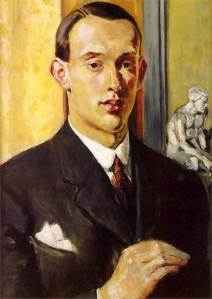
This is probably a less familiar image than the previous one by Augustus John, and there’s less evidence of a cello!  In Portrait of a Man with Cello (1923), the Polish painter Jacek Malczewski (1854-1929) depicts the young man strumming the instrument like an upright guitar or a lowered violin.  His languorous manner, slicked-back hair and exaggeratedly broad shirt collar, combined with the landscape, suggest nothing less than a weekend in the country along with a spot of music-making, don’t-ya-know.  To my untrained eye, the man bears a striking resemblance to a previous portrait that Malczewski had made of his son Rafał (below).  (Rafał also made a career as a painter, but he is best remembered as one of Poland’s most distinguished skiers and mountain-climbers.  In 1917, he narrowly escaped death in the Polish Tatras.  This portrait dates from that year.)

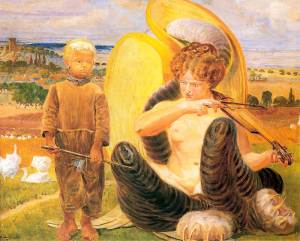
Earlier in his career, Jacek Malczewski had taken up Symbolism with a vengeance, and it is in this period that his most famous paintings were created.  He was best known for his forthright portraits, but rare are those without other allegorical ‘presences’ counterpointing, peering over the shoulder of or threatening the subject.  The most common ‘onlookers’ are chimeras (in Malczewski’s case, winged females with huge-thighed limbs and a lion’s claws), fauns and muses.

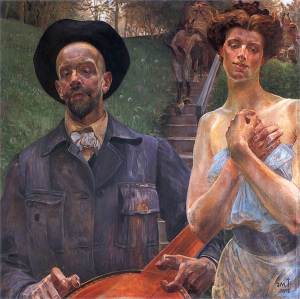
There is a number of portraits with musical themes and several of these reveal their folk origins by the inclusion of the narrow fiddle known as a gęśl.  Below are three such paintings: Self-Portrait with Fiddle (c.1908), Music (1908) and Shepherd Boy and Chimera (1905).