• Lutosławski: Ein Leben in der Musik

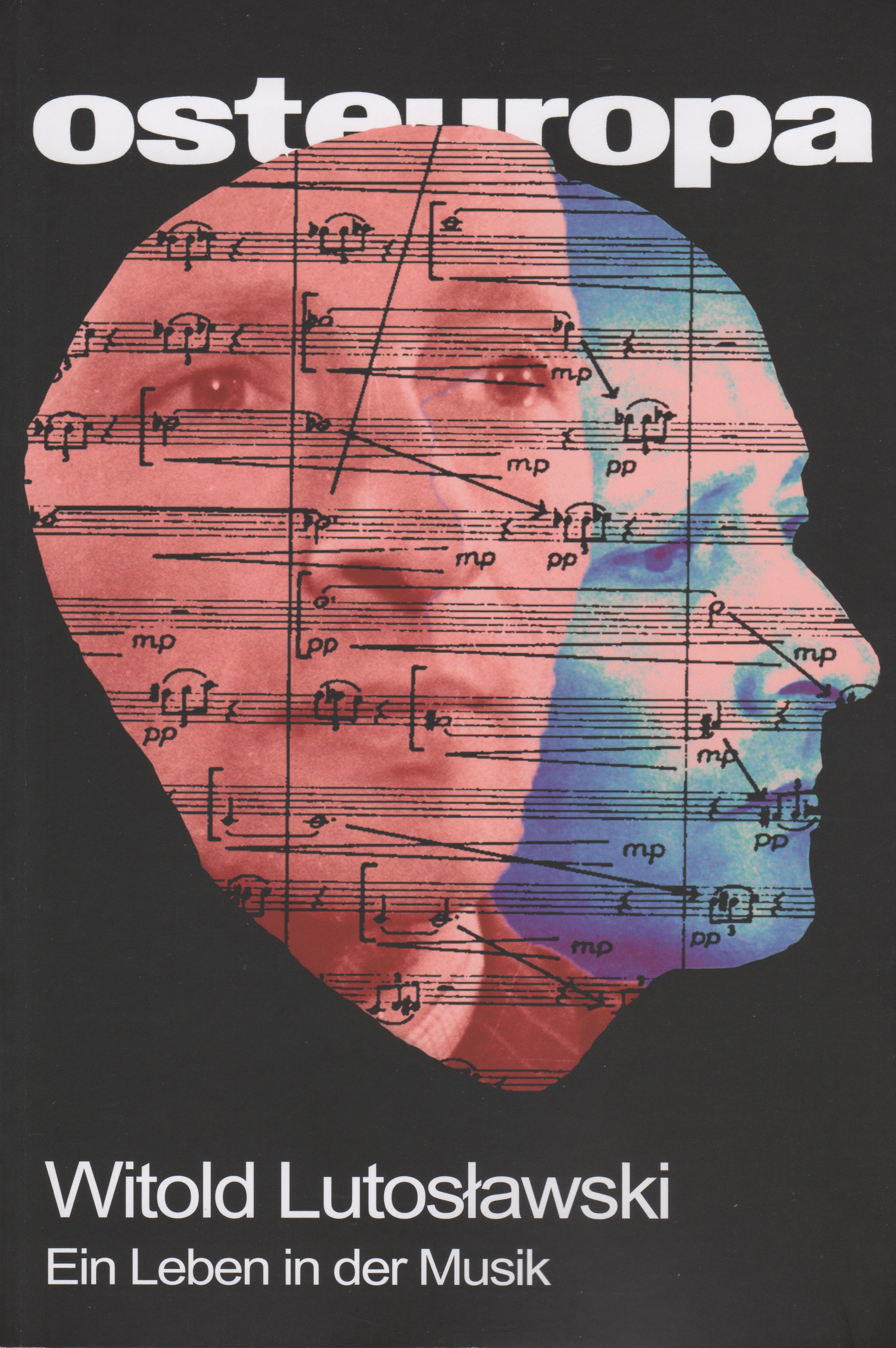
WL OsteuropaKickstarting the Lutosławski centenary in print is this volume which has just appeared in the osteuropa series (I received my copy today).  It contains thirteen items from Germany, Poland, Russia and the UK:

• Danuta Gwizdalanka: ‘Klassiker der Avantgarde. Witold Lutosławski: Leben und Werk’
• Anne-Sophie Mutter: ‘ “Ein neuer musikalischer Kosmos”. Über Witold Lutosławski’
• Dorota Szwarcman: ‘Auf den Schultern von Riesen. Lutosławski und seine Vorgänger’
• Dorota Kozińska: ‘Gründe und Abgründe. Lutosławski und der Sozialistische Realismus’
• Maciej Gołąb: ‘Lutosławski auf der Suche. Elemente und Ursprünge des Frühwerks’
• Krzysztof Meyer: ‘Pan Lutosławski. Erinnerungen an meinen Lehrer und Freund’
• Sebastian Borchers: ‘Von Warschau nach Darmstadt und zurück. Lutosławski, Penderecki und Górecki’
• Rüdiger Ritter: ‘Heißhunger auf Neue Musik. Das Ende des Stalinismus und der Warschauer Herbst
• Wojciech Kuczok: ‘Unsortierte Bemerkungen. Von Lutosławski zur schlesischen Komponistenschule’
• Adrian Thomas: ‘Das Cello-Konzert lesen. Lutosławski und die Literatur’*
• Izabela Antulov: ‘Wütender Antagonismus. Lutosławskis Cello-Konzert’
• Vladimir Tarnopol’skij: ‘ “Ein Symbol der Freiheit”. Lutosławskis Einfluss auf der Sowjetunion’
• Adam Wiedemann: ‘Heiliger Witold, bitte für uns’

This issue also includes a CD with two pieces: Lutosławski’s Cello Concerto (the Naxos recording by Andrzej Bauer with the Polish National Radio SO under Antoni Wit) and Krzysztof Meyer’s Farewell Music (1997), written in tribute to Lutosławski.  The abstracts are also given in English and may be accessed online here.  The volume may be ordered online here (22 euros).

* This is a translation of my paper ‘Lutosławski and Literature’ (2010).
• WL100/7: Lutosławski info online

Looking for substantial information online on Lutosławski?  You will find more in this ‘timeline’ pdf than elsewhere:

The Diary of the Life, Works and Activity of Witold Lutosławski

Published in 2007, Stanisław Będkowski’s annotated chronology is the best source that I’ve yet found online. It includes many quotes from the composer’s own recollections, interviews and writings.  I wouldn’t be surprised if an updated version appears this year.

WL_Studies_1_2007_oklAlong with Stanisław Hrabia, Będkowski has also published Witold Lutosławski. Discography in the same source, the English-language Witold Lutosławski Studies (Kraków: Witold Lutosławski Center, Institute of Musicology, Jagiellonian University).  This discography is an updated version from 2008 of the discography in their massively informative Witold Lutosławski. A Bio-Biography (Westport CT: Greenwood Press, 2001).  Again, I wouldn’t be surprised if a further updated version appears this year.

Three volumes of Witold Lutosławski Studies have appeared (2007, 2008, 2009).  I’m not sure what plans there are for further issues.  All three volumes are well-worth investigating (among other items, Będkowski provides an index of Lutosławski’s correspondence in the third volume, while the 2008 issue includes a penetrating article on musical plot by Nicholas Reyland).  The full contents may be accessed online at:

http://www2.muzykologia.uj.edu.pl/lutoslawski/Witold_Lutoslawski_Studies.html.

• WL100/6: Epitaph, **3 January 1980

Epitaph (1979) is virtually alone in Lutosławski’s output in being a duet that he never orchestrated.  There are orchestral versions of Dance PreludesGrave and Partita, and through these arrangements his chamber music has reached a wider audience in the concert hall and on disc.  Epitaph has not been so lucky, and there has been less than a handful of CD recordings.

Craxton_JanetYet Epitaph was the work which spurred Lutosławski’s late flowering of small chamber compositions, which included other duets with piano: Grave for cello (1981), Partita for violin (1984) and Subito for violin (1992), whose material was intended for an unfinished violin concerto for Anne-Sophie Mutter.  Lutosławski wrote Epitaph when he was 66, at the request of the British oboist Janet Craxton to commemorate her late husband, Alan Richardson.  With the pianist Ian Brown, Craxton premiered Epitaph at the Wigmore Hall in London on 3 January 1980.
At the time, Epitaph had a huge impact for its small size.  The musical world had become used to Lutosławski the composer of impressive works for orchestra (Second Symphony, LivreMi-partiNovelette) or for soloist with orchestra (Cello Concerto, Les espaces du sommeil).  Here all of a sudden was this melodic and gutsy gem of a duet, and his music was within reach of chamber musicians (to add to the  String Quartet of 1964).

It is more than likely that Lutosławski wrote Epitaph as a trial run en route to the Double Concerto (1979-80), which was premiered eight months later by the oboist Heinz Holliger and his wife, the harpist Ursula Holliger, with the Collegium Musicum conducted by Paul Sacher.  There is no specific material shared between the two pieces, but Sacher had been asking Lutosławski for something for Heinz Holliger for over a decade, so it is quite possible that the two works were interlinked in Lutosławski’s creative processes at some stage.

…….

In May 1968, and again in a chasing letter dated 19 March 1969, Sacher pressed Lutosławski for a concerto for Holliger.  Lutosławski, who by then was engrossed in writing a cello concerto for Rostropovich, replied on 2 April in conciliatory tone, but his projected timescale was to be dislodged by a further nine years:

‘Une telle oeuvre est toujours dans mes plans, mais, comme cela arrive bien souvent, les dates où je m’attendais de terminer les compositions sur lesquelles je travaille maintenant se déplacent et je serais très vraisemblablement en retard.  J’envisage, que je serais prêt de commencer le travail sur l’oeuvre en question seulement en 1971.’

…….

It is perhaps appropriate that Holliger (with the pianist Szabolcs Esztényi) gave the Polish premiere of Epitaph on 24 September 1980 at the 24th ‘Warsaw Autumn’, exactly a month after he had premiered the Double Concerto:

• WL100/5: Notebook, 2 January 1963

Cymer the carpenter

Lutosławski’s sketches have many worded sections exploring compositional ideas, often connected to a particular work.  He also jotted down ideas intermittently in a notebook.  He did this most intensively between 1959 and 1966, with further entries in 1969-74, half a dozen in 1979 and one in 1984.  Since his death in 1994, the notebook has become known as both Zeszyt mysłi (Notebook of Ideas) and Zapiski (Notes).  Excerpts have appeared in several publications, but the first complete publication was in English, in Zbigniew Skowron’s Lutosławski on Music (Lanham MD: Scarecrow Press, 2007), pp.291-329.  The Polish version was published as a separate volume, again edited by Zbigniew Skowron: Zapiski (Warsaw: University of Warsaw Press, 2008).

From time to time, as part of the WL100 series, I’m going to post both pithy and discursive entries from the notebook, on the day and month that he wrote them.  Here’s the first, which seems a quite random jotting.

Cymer the carpenter said: a man learns all his life but still dies stupid. 

Stolarz Cymer powiedzał: człowiek uczy się całe życie i jeszcze głupi umiera.

Witold Lutosławski, 2 January 1963  [my translation]

Who was Cymer the carpenter?  I’ve come to the simple conclusion that perhaps he came to do some woodwork in Lutosławski’s flat, fifty years ago today.

• WL100/4: Lutosławski Likenesses

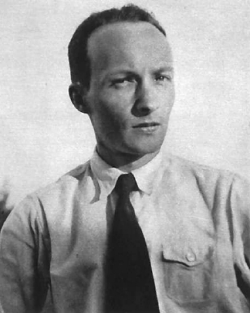
If you haven’t already twigged whose eyes are fixing you from above as you read onpolishmusic, here’s the answer:

WL_photo_1937

The photo was taken in 1937, when Lutosławski was 24, and this profile and penetrating gaze would be repeated in many subsequent photos.  He’s the spitting image of his father Józef, pictured below in 1900 when he was 19, with his mother Maria (they were to marry in 1904; Witold was their fourth and last child).  Józef was executed by the Bolsheviks in Russia in 1918; Maria died in 1967.

Maria & Józef Lutosławscy, 1900

I’ve often wondered if Lutosławski was deliberately emulating his father’s pose in the photo from 1937.  The likeness is uncanny.  Aside from such measured photos, Lutosławski could be full of laughter.  Fifty years on, during his visit to Belfast in 1987, when he was 74, he was captured from a less usual angle, showing his right profile.  It’s one of my favourite images of Lutosławski and one which has not been shown publicly until now.

WL, Belfast, 17.12.87

On the eve of his centenary year, here’s to the musical celebrations of 2013!

• Lutosławski in the January pipeline

I have just been invited by the Polish Minister of Culture to join the Honorary Committee for Witold Lutosławski Year in 2013, which is an honour in itself.  I’m never quite sure what honorary committees do or are expected to do, but I promise to knuckle down and contribute as best I can.

Having just spent a few weeks preparing for last Saturday’s CD Review round-up of Lutosławski CDs on BBC Radio 3 – an hour’s discussion, live-on-air, with Andrew McGregor – I thought I’d have a few days off.  But Lutosławski continues to beckon.  So here are a few things that are coming up in the next month or so, not all of them yet accomplished.

• Around now, a German translation by Andrea Huterer of my paper ‘Lutosławski and Literature‘ (2010) will appear in ‘Witold Lutosławski. Ein Leben in der Musik’, Osteuropa 11-12 (Berlin, 2012).  This issue is being supported by the Polish Institute in Berlin.

• I’ve just written a very brief essay on ‘Lutosławski and his Performers‘ for the Polish Institute in Brussels.  It is for a Lutosławski tribute to be published in Dutch and French in January 2013 (all three versions should also be available online via www.culturepolonaise.eu).

• Also in January 2013, an interview I did a couple of months ago will appear in a centenary tribute to Lutosławski being published (in Polish) by the Wrocław Philharmonic.  The orchestra is not only named after Lutosławski but is the driving force behind the Opera Omnia series of Lutosławski CDs on the Accord label.

• On 23 January I am discussing Lutosławski’s Cello Concerto with Johannes Moser, in a pre-concert event for the Bournemouth SO, which gave the world premiere in October 1970.  This is part of the bicentenary celebrations of the Royal Philharmonic Society, which commissioned the concerto.  (The actual RPS anniversary is the next day, 24 January.)  I’m really looking forward to this encounter, at the Poole Lighthouse, between a music historian and one of the many young cellists who have taken this concerto into their repertoire.  The Lutosławski centenary falls two days later, on 25 January, when I might just pop over to Warsaw for the Polish inauguration of Witold Lutosławski Year.

• The Philharmonia Orchestra begins its Lutosławski series Woven Words on 30 January at the Royal Festival Hall in London.  Accompanying the series will be a substantial celebratory programme which includes several essays.  My ‘Parallel Lives of a Captive Muse‘ is one of them.  It’s already been published on the Woven Words website.

• Watch out for the fifth Lutosławski CD, with the BBC SO and Edward Gardner, which Chandos is releasing early in 2013 in its ‘Muzyka Polska’ series (First Symphony, Dance Preludes, Partita and Chain 2).  I’ve thoroughly enjoyed writing the booklet notes for these outstanding recordings and it’s been an(other) honour to be associated with it.

• I am currently writing a substantial profile of Lutosławski and his music for publication in late Spring 2013 (watch this space, and others!).

Well, I think those seven items are more than enough to be going on with!

• WL100/3: Lutosławski in Belfast (gallery)

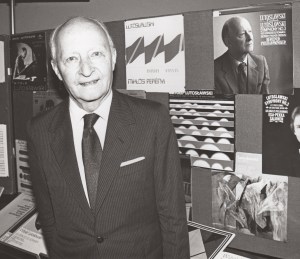
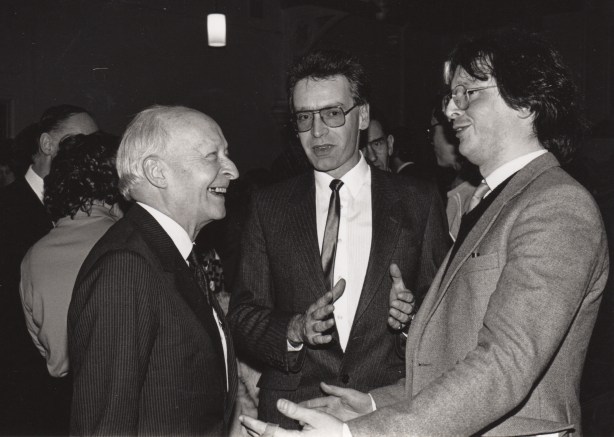
Here are a few more pictures from Lutosławski’s visit to Queen’s University, Belfast, twenty five years ago in December 1987 (see the two preceding WL100 posts).  After a concert of his chamber music on 17 December, Lutosławski spent some time looking at an exhibition of his scores and LP covers.  Lutosławski and I also had an evidently jolly discussion with my friend and colleague, the composer Piers Hellawell.

WL at QUB exhibition 17.12.87WL at QUB exhibition, with Adrian Thomas 17.12.87

WL at QUB, with Adrian Thomas and Piers Hellawell 17.12.87

• WL100/2: Lutosławski in Belfast (DMus)

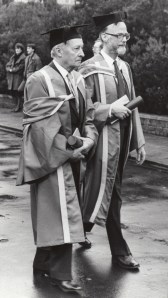
WL concert 17.12.8718 December 1987 was a grey wet day, but then it was a week before Christmas. It was, however, a special day at Queen’s University, Belfast.  My colleagues, our students and I could not have been prouder when Lutosławski stepped onto the platform of the Whitla Hall to receive an honorary DMus.  I read the citation and afterwards Lutosławski walked the short distance to the Main Building for a jovial lunch with university dignitaries.
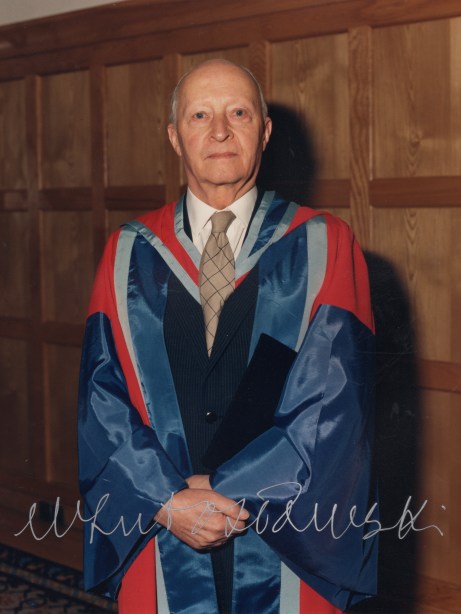
Lutosławski charmed everyone whom he met, as he always did.  The night before, he’d been present at a concert of his chamber music where relaxation and informality had been the key.  On this day, he was all robed up and solemnly posed for the camera in his doctoral garb.

When I saw him in Warsaw the following year, I took with me a host of photos from his visit which he signed for the performers and others.  I like the way he used a silver-ink pen. His was a special and distinctive handwriting, as I hope to show in other posts in 2013.

WL Hon DMus:2 18.12.87

Witold Lutosławski, Hon DMus
The Queen’s University of Belfast, 18 December 1987

• WL100/1: Lutosławski in Belfast

Twenty five years ago today, on 17 December 1987, Lutosławski paid his one and only visit to Northern Ireland.  He had come for the Winter graduation at The Queen’s University of Belfast where he was to be awarded an Honorary DMus on 18 December.  I was teaching at Queen’s at that time and the proposal that the University should recognise Lutosławski came from my colleague, the innovative social anthropologist and ethnomusicologist, John Blacking.

On the night before the degree ceremony, the Department of Music mounted a short concert of Lutosławski’s chamber music in his honour: Dance Preludes, Five Songs, Sacher Variation, Epitaph, Grave and Partita.  The performers were graduands of the University, joined by György Pauk and Roger Vignoles.  Lutosławski seemed very pleased with the occasion, and afterwards he inspected an exhibition of his scores and record sleeves (LPs in those days!) and mingled happily with the audience at a post-concert reception in his honour.

I’ll post some more pictures from the occasion in the coming days.

Witold Lutosławski at a concert of his chamber music in the Harty Room of Queen's University, Belfast, on 17 December 1987.From left to right: György Pauk (violin), Donal McCrisken (piano), Damian Frame (clarinet), Francis King (piano), Lutosławski, Colin Stark (oboe), Jacqueline Horner (mezzo-soprano), John O'Kane (cello) and Roger Vignoles (piano)

From left to right: György Pauk (violin), Donal McCrisken (piano), Damian Frame (clarinet), Francis King (piano), Lutosławski, Colin Stark (oboe), Jacqueline Horner (mezzo-soprano), John O’Kane (cello), Roger Vignoles (piano)

The programme notes for the concert may be accessed here.

• WL100

WL 17.12.87 copyToday, I’m starting a series of occasional posts to mark the centenary of the birth of Witold Lutosławski (1913-94).  These posts (also linked to a new public Facebook page Lutosławski WL100) will be an informal sequence of memories, observations and photos.  The series is intended to be both celebratory and reflective in nature, drawing together recollections, documents and images that are little known or perhaps just forgotten.
Contributions welcome – do get in touch if you have a suggestion.