• WL100/39: Polar Music Prize, 18 May 1993

In Stockholm twenty years ago today, Lutosławski received the Polar Music Prize (1 million Swedish kronor).  The other laureate in 1993 was Dizzy Gillespie (Wynton Marsalis accepted the award on Gillespie’s behalf).

The citation (with an interesting selection of named works) was read by the Swedish soprano Elisabeth Söderström and the award was presented by King Carl Gustav XVI.

The Polish composer and conductor Witold Lutosławski is awarded The Polar Music Prize, 1993.  The Award Committee’s motivation is as follows:

In Witold Lutosławski, the Committee’s choice has fallen upon one of the pioneers of contemporary European art music.  Starting with the trail-blazing orchestral composition Jeux vénitiens in 1961, he has contributed, through a large number of significant works, such as Trois poèmes d’Henri Michaux (1961-63), his String Quartet (1964) and his Third Symphony (1986 [sic]), towards a renewal of the contemporary orchestral vocabulary which, through its consistency and its artistic sincerity, has made his music an indispensable part of the central present-day orchestral and chamber music repertoire.

As a pathfinder and spiritual leader of his fellow countrymen in times of severe intellectual repression, he helped, through his uncompromising stance and his moral courage, to keep Polish music open for a long time to international contacts of every kind, and in this way played an outstanding part in creating for Eastern European music interests an air-hole of vital importance.

His personal combination of great artist, eminent organiser, campaigner for liberty and national conscience has earned Witold Lutosławski a high-ranking position in the cultural history of 20th century Europe.

Here is Lutosławski’s brief response, written in English:

The great British writer Joseph Conrad, who – by the way – was a Pole, wrote in the preface to his novel The Nigger of the ‘Narcissus’ of ‘the magic suggestiveness of music, which is the art of arts’.  But we all know how low is the percentage of people for whom the so-called serious music is necessary, in spite of its being ‘the art of arts’.  In the light of this, the decision of the founder of the Polar Music Prize to create such an award for so-called serious composers deserves the highest appreciation.

The fact that I have been chosen to be awarded this prize makes me proud and happy.  It is also an encouragement for my possible future work.  I beg the founder of the Polar Music Prize and the members of its Committee to accept this expression of my most profound gratitude.

Lutosławski’s phrase about ‘my possible future work” is especially poignant, as he completed no further compositions.  His reference to Conrad is one of several that he made over the years.  His most frequent point of reference was, as here, to the Preface to The Nigger of the ‘Narcissus’ (1897).  This Preface, which is equally applicable to Conrad’s other writings as an artistic manifesto, provided Lutosławski with various points of reference.  He didn’t always agree with Conrad, distancing himself from the sentiment of the opening paragraph later that year (in a talk given when he received the Kyoto Prize in October 1993):

The great writer Joseph Conrad says even that the duty of the artist is to do justice to the visible world.  I am definitely against such a view.  I think the visible world, the world in which we live, has no difficulty in expressing itself without our help.  We are not predestined to express the real world in the art.  The ideal world, the world of our dreams, of our wishes, of our vision of perfection is the domain of the arts.

This stance would by no means meet with universal approval today.  But Lutosławski’s own life experience undoubtedly led to his views on the connections or otherwise between life and creativity.  He had already made the same point and reference in the statement that he prepared for the public relay on 26 August 1984 in Gdańsk, during Martial Law, of a recording of his Third Symphony, which had yet to be performed in Poland.

Lutosławski was more in tune with Conrad’s second (single-sentence) and third paragraphs (the complete Preface is reproduced at the very end of this post).

The paragraph to which Lutosławski referred in Stockholm comes in the middle of the Preface.  It is primarily about fiction and how its ideal realisation may be achieved only within the context of other, less literal art forms:

Fiction — if it at all aspires to be art — appeals to temperament. And in truth it must be, like painting, like music, like all art, the appeal of one temperament to all the other innumerable temperaments whose subtle and resistless power endows passing events with their true meaning, and creates the moral, the emotional atmosphere of the place and time. Such an appeal, to be effective, must be an impression conveyed through the senses; and, in fact, it cannot be made in any other way, because temperament, whether individual or collective, is not amenable to persuasion. All art, therefore, appeals primarily to the senses, and the artistic aim when expressing itself in written words must also make its appeal through the senses, if its high desire is to reach the secret spring of responsive emotions. It must strenuously aspire to the plasticity of sculpture, to the colour of painting, and to the magic suggestiveness of music — which is the art of arts. And it is only through complete, unswerving devotion to the perfect blending of form and substance; it is only through an unremitting, never-discouraged care for the shape and ring of sentences that an approach can be made to plasticity, to colour; and the light of magic suggestiveness may be brought to play for an evanescent instant over the commonplace surface of words: of the old, old words, worn thin, defaced by ages of careless usage.

Lutosławski had referred to the second sentence in this paragraph as far back as 1955, in an essay on Sibelius.  And this was at a time when, as far as he was concerned, folk-based pieces under strict artistic surveillance by the State were what lay compositionally before him.

The reference to ‘magic’ occurs first in an article for Polityka (2 January, 1971), where Lutosławski used the phrase ‘magic insight’ (‘czarodziejskiej wnikliwości’).  Five months later, on 2 June 1971, when he received an Hon. DMus. from the Cleveland Institute of Music, he used the phrase ‘magic suggestiveness’, as in Conrad’s Preface.  And it is this same phrase that Lutosławski recalled at the end of his life, both in Stockholm and in Kyoto.  Evidently, the Preface to The Nigger of the ‘Narcissus’ – and this central paragraph in particular – held a significant place in Lutosławski’s credo for most of his creative life.

………..

Conrad’s Preface to The Nigger of the ‘Narcissus’

A work that aspires, however humbly, to the condition of art should carry its justification in every line.  And art itself may be defined as a single-minded attempt to render the highest kind of justice to the visible universe, by bringing to light the truth, manifold and one, underlying its every aspect.  It is an attempt to find in its forms, in its colours, in its light, in its shadows, in the aspects of matter and in the facts of life, what of each is fundamental, what is enduring and essential – their one illuminating and convincing quality – the very truth of their existence.  The artist, then, like the thinker or the scientist, seeks the truth and makes his appeal.  Impressed by the aspect of the world the thinker plunges into ideas, the scientist into facts – whence, presently, emerging they make their appeal to those qualities of our being that fit us best for the hazardous enterprise of living.  They speak authoritatively to our common-sense, to our intelligence, to our desire of peace or to our desire of unrest; not seldom to our prejudices, sometimes to our fears, often to our egoism – but always to our credulity.  And their words are heard with reverence, for their concern is with weighty matters: with the cultivation of our minds and the proper care of our bodies; with the attainment of our ambitions; with the perfection of the means and the glorification of our precious aims.

It is otherwise with the artist.

Confronted by the same enigmatical spectacle the artist descends within himself, and in that lonely region of stress and strife, if he be deserving and fortunate, he finds the terms of his appeal.  His appeal is made to our less obvious capacities: to that part of our nature which, because of the warlike conditions of existence, is necessarily kept out of sight within the more resisting and hard qualities – like the vulnerable body within the steel armour.  His appeal is less loud, more profound, less distinct, more stirring – and sooner forgotten.  Yet its effect endures for ever.  The changing wisdom of successive generations discards ideas, questions facts, demolishes theories.  But the artist appeals to that part of our being which is not dependent on wisdom: to that in us which is a gift and not an acquisition – and, therefore, more permanently enduring.  He speaks to our capacity for delight and wonder, to the sense of mystery surrounding our lives; to our sense of pity, and beauty, and pain; to the latent feeling of fellowship with all creation – and to the subtle but invincible, conviction of solidarity that knits together the loneliness of innumerable hearts: to the solidarity in dreams, in joy, in sorrow, in aspirations, in illusions, in hope, in fear, which binds men to each other, which binds together all humanity – the dead to the living and the living to the unborn.

It is only some such train of thought, or rather of feeling, that can in a measure explain the aim of the attempt, made in the tale which follows, to present an unrestful episode in the obscure lives of a few individuals out of all the disregarded multitude of the bewildered, the simple and the voiceless.  For, if there is any part of truth in the belief confessed above, it becomes evident that there is not a place of splendour or a dark corner of the earth that does not deserve, if only a passing glance of wonder and pity.  The motive, then, may be held to justify the matter of the work; but this preface, which is simply an avowal of endeavour, cannot end here – for the avowal is not yet complete.

Fiction – if it at all aspires to be art – appeals to temperament.  And in truth it must be, like painting, like music, like all art, the appeal of one temperament to all the other innumerable temperaments whose subtle and resistless power endows passing events with their true meaning, and creates the moral, the emotional atmosphere of the place and time.  Such an appeal, to be effective, must be an impression conveyed through the senses; and, in fact, it cannot be made in any other way, because temperament, whether individual or collective, is not amenable to persuasion.  All art, therefore, appeals primarily to the senses, and the artistic aim when expressing itself in written words must also make its appeal through the senses, if its high desire is to reach the secret spring of responsive emotions.  It must strenuously aspire to the plasticity of sculpture, to the colour of painting, and to the magic suggestiveness of music – which is the art of arts.  And it is only through complete, unswerving devotion to the perfect blending of form and substance; it is only through an unremitting, never-discouraged care for the shape and ring of sentences that an approach can be made to plasticity, to colour; and the light of magic suggestiveness may be brought to play for an evanescent instant over the commonplace surface of words: of the old, old words, worn thin, defaced by ages of careless usage.

The sincere endeavour to accomplish that creative task, to go as far on that road as his strength will carry him, to go undeterred by faltering, weariness or reproach, is the only valid justification for the worker in prose.  And if his conscience is clear, his answer to those who, in the fulness of a wisdom which looks for immediate profit, demand specifically to be edified, consoled, amused; who demand to be promptly improved, or encouraged, or frightened, or shocked, or charmed, must run thus: – My task which I am trying to achieve is, by the power of the written word, to make you hear, to make you feel – it is, before all, to make you see.  That – and no more, and it is everything.  If I succeed, you shall find there according to your deserts: encouragement, consolation, fear, charm – all you demand; and, perhaps, also that glimpse of truth for which you have forgotten to ask.

To snatch in a moment of courage, from the remorseless rush of time, a sapping phase of life is only the beginning of the task.  The task approached in tenderness and faith is to hold up unquestioningly, without choice and without fear, the rescued fragment before all eyes and in the light of a sincere mood.  It is to show its vibration, its colour, its form; and through its movement, its form, and its colour, reveal the substance of its truth – disclose its inspiring secret: the stress and passion within the core of each convincing moment.  In a single-minded attempt of that kind, if one be deserving and fortunate, one may perchance attain to such clearness of sincerity that at last the presented vision of regret or pity, of terror or mirth, shall awaken in the hearts of the beholders that feeling of unavoidable solidarity; of the solidarity in mysterious origin, in toil, in joy, in hope, in uncertain fate, which binds men to each other and all mankind to the visible world.

It is evident that he who, rightly or wrongly, holds by the convictions expressed above cannot be faithful to any one of the temporary formulas of his craft.  The enduring part of them – the truth which each only imperfectly veils – should abide with him as the most precious of his possessions, but they all: Realism, Romanticism, Naturalism, even the unofficial sentimentalism (which, like the poor, is exceedingly difficult to get rid of); all these gods must, after a short period of fellowship, abandon him – even on the very threshold of the temple – to the stammerings of his conscience and to the outspoken consciousness of the difficulties of his work.  In that uneasy solitude the supreme cry of Art for Art, even, loses the exciting ring of its apparent immorality.  It sounds far off. It has ceased to be a cry, and is heard only as a whisper, often incomprehensible, but at times, and faintly, encouraging.

Sometimes, stretched at ease in the shade of a roadside tree, we watch the motions of a labourer in a distant field, and after a time, begin to wonder languidly as to what the fellow may be at.  We watch the movements of his body, the waving of his arms, we see him bend down, stand up, hesitate, begin again.  It may add to the charm of an idle hour to be told the purpose of his exertions.  If we know he is trying to lift a stone, to dig a ditch, to uproot a stump, we look with a more real interest at his efforts; we are disposed to condone the jar of his agitation upon the restfulness of the landscape; and even, if in a brotherly frame of mind, we may bring ourselves to forgive his failure.  We understood his object, and, after all, the fellow has tried, and perhaps he had not the strength, and perhaps he had not the knowledge.  We forgive, go on our way – and forget.

And so it is with the workman of art.  Art is long and life is short, and success is very far off. And thus, doubtful of strength to travel so far, we talk a little about the aim – the aim of art, which, like life itself, is inspiring, difficult – obscured by mists.  It is not in the clear logic of a triumphant conclusion; it is not in the unveiling of one of those heartless secrets which are called the Laws of Nature.  It is not less great, but only more difficult.

To arrest, for the space of a breath, the hands busy about the work of the earth, and compel men entranced by the sight of distant goals to glance for a moment at the surrounding vision of form and colour, of sunshine and shadows; to make them pause for a look, for a sigh, for a smile – such is the aim, difficult and evanescent, and reserved only for a very few to achieve.  But sometimes, by the deserving and the fortunate, even that task is accomplished.  And when it is accomplished – behold! – all the truth of life is there: a moment of vision, a sigh, a smile – and the return to an eternal rest.

• WL100/38: Les dessins de Michaux

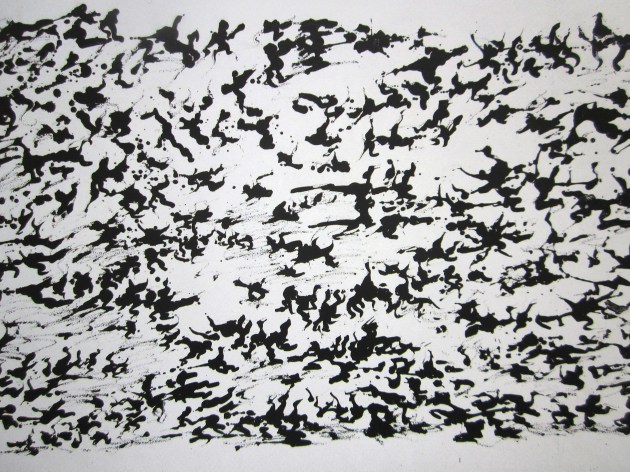
Lutosławski fans know the name of Henri Michaux through his three poems which Lutosławski used in his Trois poèmes (1961-63).  Perhaps less well-known are Michaux’s paintings and drawings.  I remember making a connection, when I first came across Lutosławski’s piece, between the scurrying figuration of the first movement (‘Pensées’) and the figurative movement in much of Michaux’s visual work.  So here’s a 1964 recording of that movement plus a selection of Michaux’s dessins.  I have no idea if Lutosławski knew them in the early 60s (or whether Michaux heard Trois poèmes or any of Lutosławski’s other music), but the parallels are still striking.

According to his own dates, Michaux started writing on 9 March 1922 and painting on 1 January 1936.  In the 1930s he travelled to India, China and Japan, whose calligraphy and ideograms had a profound influence.  In the mid-1950s, he worked under the influence of mescaline, although the direction of his art was already firmly established.

IMG_3224 copy(Untitled, 1952, 28x36cm)

‘Their movement became my movement.  The more there were of them, the more I existed.  The more of them I wanted.  Creating them, I became quite other.’  (1951, of his Mouvements series; transl. Michael Fineberg)

Screen Shot 2013-05-09 at 10.55.22

(Untitled [Vitesse], 1954, 75x105cm)

IMG_3226 copy

(Untitled, 1960, 70x140cm)

‘I was possessed by movements, on edge with these forms which came to me rhythmically.  Often one rhythm ruled the page, sometimes several pages in succession, and the more numerous were the signs that appeared (one day there were close on five thousand), the more alive they were.’  (ibid.)

Screen Shot 2013-05-09 at 10.54.34

(Untitled, 1962, 71.5x104cm)

IMG_3229 copy

(Untitled, 1968, 75x108cm)

• WL100/37: Trois poèmes, **9 May 1963

50 years ago today – 9 May 1963 – Lutosławski conducted in the first performance of Trois poèmes d’Henri Michaux (1961-63).  It was his first foreign commission and premiere (albeit behind the Iron Curtain) and it was the first time he had appeared on the concert platform to conduct his own music (the work requires two conductors, one for the choir, the other for the orchestra).  He was not a young man – he had turned 50 in January that year – so this breakthrough was late in coming.  It proved to be significant, as major commissions from Western Europe and performances abroad soon materialised.

Over the next few years, Trois poèmes was performed in Warsaw (1963), Venice and Paris (1964), Prague and Heidelberg (1965), Buffalo, Boston, Copenhagen and Munich (1966), Rome, Katowice and Copenhagen (1968) and Uppsala, Amsterdam, Nottingham and Wrocław (1969).  It was first recorded at the ‘Warsaw Autumn’ on 22 September 1963 by the Great SO of Polish Radio (WOSPR) and the Kraków Radio Choir, conducted by Jan Krenz (orchestra) and Lutosławski (choir).  It won the UNESCO Tribune Internationale des Compositeurs (1964) and was published in 1965 by PWM (strangely, it’s never been separately published outside Poland).  Below is a photo of the cover of my well-worn copy, dating back to when I organised and was one of the two conductors of the UK premiere (Nottingham, 25 June 1969).

Screen Shot 2013-05-09 at 14.22.40

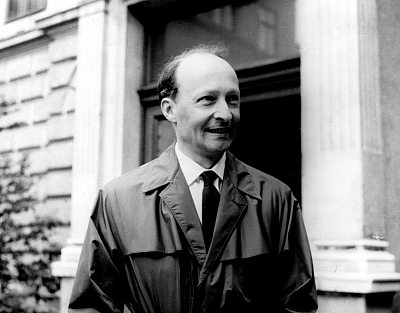
The world premiere took place at the Zagreb Biennale, with the Zagreb Radio Choir conducted by Slavko Zlatić and the Zagreb Radio Orchestra by Lutosławski.  Here’s a photo from his time in Zagreb (like the raincoat!):

6308

And here he is, speaking briefly about the piece (appropriately enough, in French), with a closing shot of the choir under Slavko Zlatić, who had commissioned it for his choir (ignore the bizarre overlay of music from the coda of the Third Symphony, written twenty years later!):

At the bottom of this post are three videos, one for each of the three movements of Trois poèmes.  You will see that the visuals for these postings contain photos from Lutosławski’s sketches for the piece.  These come from an enthralling essay by Martina Homma, the most knowledgeable of all experts on the Lutosławski sketches.  It was originally published to accompany an exhibition of the sketches for Trois poèmes, mounted in Warsaw on 27 September 1996, to mark the inauguration of the newly-named Witold Lutosławski Studio at Polish Radio.  Here’s a link to the online version, published in Polish Music Journal vol.3 no.2 (Winter 2000).

• WL100/36: Le songe de Desnos (1938)

When I was preparing for a talk on Lutosławski and French poetry for a Woven Words study day in March, I came across a recording of the voice of the surrealist poet, Robert Desnos (1900-45).  Lutosławski turned to Desnos’s poetry on two occasions: for Chantefleurs et Chantefables (1990) and for Les espaces du sommeil (1975) (see also WL100/32: Les espaces, **12 April 1978).  But I’d been unaware of Desnos’s passion for the medium of radio and for a series of programmes – La clef des songes (The Key of Dreams/The Dream Book) – in which he was closely involved in 1938-39.

Image

Here’s a surviving excerpt from a radio programme of 1938 in which Desnos himself narrates a dream.  It seems uncannily prescient of tape experiments that would be carried out by French composers just ten years later.  The transcript is mine (I am very grateful to Michèle Laouenan for helping with the less audible fragments, although a few are still quite difficult to make out.  She also identified the opening song as Sur la route de Dijon.  Merci Michèle!).

[wind machine]
Desnos: “I find myself suddenly in a strange country where the wind is blowing violently. [music: ‘Sur la route de Dijon’*]  We were all in a group, walking and singing.  The others were walking very fast.  I couldn’t manage to keep up with them, despite my efforts.”
[another male voice] “Wait for me! Wait for me!”
Desnos: “Suddenly…” [animal roar, followed by music (unidentified)]  “In front of  us, there was…”
[two voices] “But what is that dirty beast [?], a hippopotamus?” “It’s a hippopotamus.  Gosh, that’s extraordinary.”
Desnos: “They begin to run away.  I couldn’t move my legs any more.”
[another voice] “And, all of a sudden…”  [human howling]
Desnos: “I was in the process of stepping on Max Rénier**, who was stretched out on the ground and who was thirty metres long and covered with spots like the body of a giraffe.”  [more roaring]  “The two hippopotamuses were rushing straight at us and, just as they were going to flatten us, …”.  [continued roaring]  “I saw from behind my tree a surprising parade. All the wild animals in the world, a real menagerie.”
[more roaring]
“But at that moment a gale blew up.  The wind, the rain, the storm, made the wild animals run away.”  [wind, followed by music: an excerpt from Wagner’s ‘Tannhäuser’ overture (Venusberg music)]  “But the gale had become a gale of music.  The forest had become a bathroom.”  [‘Tannhäuser’ continues, followed by applause]  “People were clapping and yet there was no-one in the room.  The applause became deafening.  It was like a fusillade.”
[female voice] “Help!  Help!”
[male voice] “Help!”
[second female voice]  “Come in here, you’re safe.  Come here.  But come in.
Desnos: “It was the usher at the concert hall, who shoved us into a padded loge.  The loge was a concrete shelter where all the spectators found themselves again, packed like sardines.  Above us, the concert hall was collapsing, the firing continued.”  [crowd noises]  “In the shelter, everyone was complaining that they were suffocating.”
[female and male voices] “Help!”  “Air!”  “To me!”  “Help!  Help!” [?]
Desnos: “I myself was about to suffocate, when I woke up gasping, my pillow over my head.”

Sur la route de Dijon is a soldier’s marching song dating perhaps as far back as the 18th century.  It became popular as a drinking song in late 19th-century France.  I discovered that this recording was made by a tenor called Stello, who sang at the famous Cabaret au lapin agile in Montmartre between the wars.  Desnos probably heard him there.  The full track is available on Spotify under the title Aux oiseaux.
** Max Rénier (b.1916): French journalist, deported to Auschwitz in 1944, along with Desnos.  Rénier survived, but Desnos died of typhus in Theresienstadt.

• WL100/35: Lutosławski in Riga

This photograph was taken in Riga on 4 May 1935.  Lutosławski was part of a group of music students from Warsaw who were on a little concert tour.  He played his new Piano Sonata, which he’d finished at the end of December 1934 and played on Polish Radio in 1935.  It then disappeared from view and was not published until after his death.

img_2340-copy1

The photograph is interesting for a particular reason.  Karol Szymanowski was also in Riga on what turned out to be his last major concert tour (with his sister, the soprano Stanisława Szymanowska-Korwin and the violinist Wacław Niemczyk) and the two parties met.  Szymanowski is on the left (looking in), Lutosławski on the far right (looking to camera).  It was their one and only meeting.  Lutosławski recalled: ‘Szymanowski was extremely kind to our small group.  He came to our concert, we walked around town together and accompanied him to Radio Riga. […] After our concert, Wacław Niemczyk told me: “Karol liked your Sonata very much; however, he wouldn’t say it to you.”‘

• WL100/34: Jeux vénitiens, **24 April 1961

Today is the 52nd anniversary of the premiere of the first version of Lutosławski’s Jeux vénitiens (1960-61).  It was performed at the Venice Biennale on 24 April 1961 in the Teatro Fenice, Venice, by the Kraków Philharmonic CO, conducted by Andrzej Markowski.  Jeux vénitiens was a crucial turning point in Lutosławski’s music, notably for his first use of aleatory counterpoint.  This feature became one of the main characteristics of his music on which he and commentators placed considerable emphasis.  What is less explored is the range of ways in which Lutosławski realised this feature by melodic-rhythmic means.  He refined this aspect in subsequent works (Trois poèmes, String Quartet, Paroles tissées, etc.), but his first attempts were unsatisfactory insofar as he subsequently revised key passages in the outer movements of Jeux vénitiens.

I have written about these changes and the whole gestation of Jeux vénitiens elsewhere.*  But to mark this anniversary, I’m posting below – for the first time in public – the complete woodwind texture that occurs at the start of the piece (the lower image runs on from the first).  There are other aspects of this autograph manuscript that Lutosławski would change after Venice – here he simply crosses out the passage with a wavy line – and I will return to them in the future.  But anyone interested in comparing the motivic content in these two images with the woodwind parts in the printed score of the revised version will find much on which to ponder.

The somewhat enigmatic comment at the top of the first image reads: ‘ew. rozbicie na składowe różnej budowy’ – ‘poss. to be split into components of different construction’.

WL JV:1 1st vers ww 1:2

WL JV:I 1st vers ww 2:2* ‘Jeux vénitiens: Working Methods at the Start of Lutosławski’s Mature Period’, Lutosławski Studies, ed. Zbigniew Skowron (Oxford: OUP, 2001), pp.211-43.

• Polish Music at the 2013 BBC Proms

Polish Music at the 2013 BBC Proms

p0179z7mThe 2013 BBC Proms have been launched today.  It is great to see Polish music taking a prominent role, instigated by the centenary this year of the birth of Witold Lutosławski.  This is no mean feat, given that 2013 also marks the centenary of the birth of Benjamin Britten and the bicentenaries of Verdi and Wagner.  And this is not to mention other anniversaries, like the 50th anniversary of the death of Francis Poulenc.
There are seven pieces by Lutosławski in this year’s programme.  There are also two by both Andrzej Panufnik (his centenary falls next year) and Karol Szymanowski.  And there is one each by Henryk Mikołaj Górecki and Krzysztof Penderecki, who were born 80 years ago.  There is also a concert including music of the Polish Renaissance.  An outline calendar of Polish music at the 2013 Proms is given below.

My essay for the BBC Proms Guide may be read here.

Prom 1 • 12 July
• Lutosławski: Variations on a Theme by Paganini

PCM 1 • 15 July
• Lutosławski: Partita

Prom 8 • 17 July
• Lutosławski: Cello Concerto

Prom 9 • 18 July
• Szymanowski: Symphony no.3 ‘Song of the Night’

PCM 2 • 22 July
• Polish and other European Renaissance Music

Prom 32 • 7 August
• Lutosławski: Symphonic Variations
• Lutosławski: Piano Concerto

Prom 44 • 15 August
• Penderecki: Concerto Grosso

Prom 55 • 23 August
• Lutosławski: Concerto for Orchestra
• Panufnik: Tragic Overture
• Panufnik: Lullaby

PSM 4 • 24 August
• Lutosławski: Paroles tissées

Prom 68 • 2 September
• Szymanowski: Violin Concerto no.1

Prom 71 • 4 September
• Górecki: Symphony no.3 ‘Symphony of Sorrowful Songs’

• WL100/33: Zanussi documentary (complete)

Krzysztof Zanussi’s 1991 documentary on Lutosławski has just appeared on YouTube, complete.  I wrote almost three months ago about two excerpts that became available there in mid-January (WL100/13) and I’ve reproduced that post’s opening paragraphs below.

“On 19 January 1991, BBC 2 showed a one-hour documentary on Lutosławski.  It was made by the distinguished Polish film director Krzysztof Zanussi.  Witold Lutosławski in Conversation with Krzysztof Zanussi (1990) utilises excerpts from a BBC Omnibus documentary Warsaw Autumn (1978)filmed by Dennis Marks in 1977, as starting points.  Zanussi steers Lutosławski through key moments of his life, interspersed with the composer conducting rehearsals or special recordings of excerpts of his music.

The results are mixed.  At times, the premise is realised archly, as at the beginning, when the interview set-up seems rather self-conscious.  At other times, Zanussi’s probing produces some interesting responses.  Lutosławski recollection of his father is rather touching, for example, and his recollection of life in the 1980s (during Solidarity and then under Martial Law) fascinating.  As always, he can be alternately open and guarded.

The interiors were filmed either in his downstairs sitting area (it’s open-plan) or in his first floor, L-shaped study (see my earlier post Lutosławski’s Carpet).  The major musical extracts are from Musique funèbrePreludes and FugueChain 2 (with Krzysztof Jakowicz) and the Third Symphony.”


• WL100/32: Les espaces, **12 April 1978

If you dip into any study of Lutosławski’s music that includes Les espaces du sommeil (1975, premiered by Dietrich Fischer-Dieskau and the Berlin PO under the composer’s baton on 12 April 1978), you will read that the text is by Robert Desnos (1900-45) and probably also that it comes from his volume of poetry Corps et Biens (Paris, 1930).  In fact, it had been published four years earlier in La révolution Surréaliste (June 1926), where his new collection of poems was printed under the title ‘À la mystérieuse’, a reference to Desnos’s lover, the singer Yvonne George.

Lutosławski’s source was actually a much later volume, a copy of which he owned and in which he also bookmarked poems by four other writers.  How do I know this?  In September 2002, I spent several days in Lutosławski’s house with permission to explore the contents of his study and attic store-room.  One particular book leaped off the shelves at me, figuratively speaking.

It was La poésie Surréaliste (Paris: Editions Seghers, 1964, repr. 1970), selected by Jean-Louis Bedouin.  The cover featured a drawing by Yves Tanguy.*

141-4164_IMGDesnos’s poem was the first that Lutosławski bookmarked (with paper strips torn, as was his wont, from an old notebook or diary).  The second was Météores by the Croatian Radovan Ivšić (1921-2009).  The third was a group of eleven short verses by the Anglo-Egyptian Joyce Mansour (1928-86).  The fourth was De tout repos by Pierre de Massot (1900-69).  And the fifth was Pierre de soleil (Piedra de sol) by the Mexican Octavio Paz (1914-98).
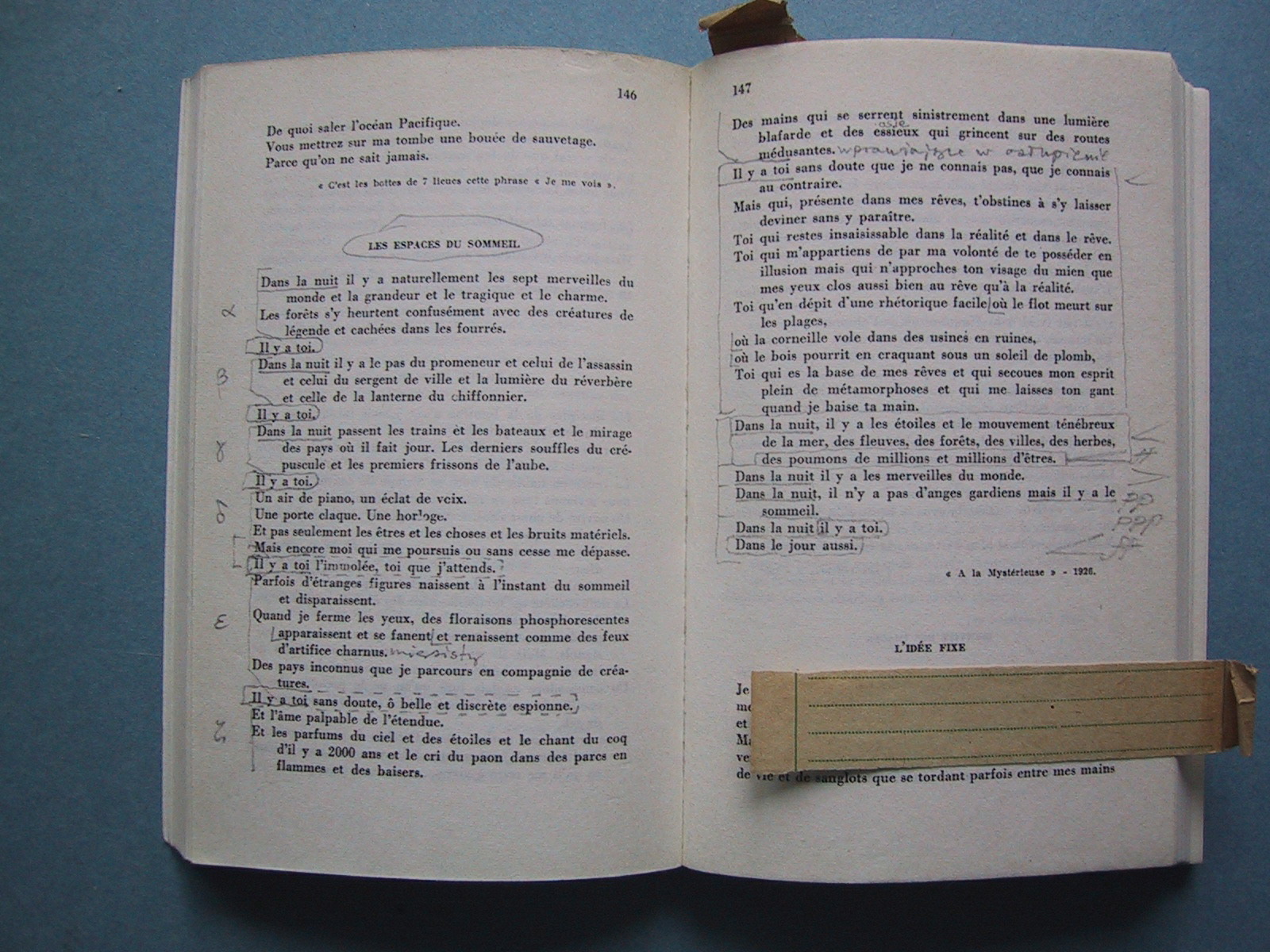
What immediately grabbed my attention and thrilled me was that the only poem that Lutosławski had marked up was Desnos’s Les espaces du sommeil.  Here was Lutosławski’s structural analysis of the text, complete with brackets, underlinings, circlings, Greek letters, a few translations into Polish and even some key dynamic markings at the very end.  He underlines or circles the two dominant refrains ‘Dans la nuit’ and ‘Il y a toi’.  He gives Greek letters α-ζ (another characteristic habit) to the subsections of the first two of the work’s three main sections.  He translates three words that he doesn’t know (‘charnus’, ‘essieux’ and ‘médusantes’).

15. La poésie Surréaliste 146-7 Desnos

Above all, Lutosławski is clearly captivated on these two pages by the text’s musical possibilities in terms of verse and refrain and the final climax.  How excited he must have been to find a poem which dovetailed so neatly with his symphonic preoccupations of the 1960s and 70s.

…….

* When I was in Warsaw in January this year, I was invited to Lutosławski’s house.  I learned from the wife of Lutosławski’s stepson that unfortunately this volume seems since to have disappeared.  If this is so, then these photographs, taken against a piece of Lutosławski’s blotting paper on his desk, are quite possibly the only record of this particular background to Les espaces du sommeil.

…….

I have written in a little more detail about Lutosławski and his approach to text setting in ‘One Last Meeting: Lutosławski, Szymanowski and the Fantasia’ (2007).

• WL100/31: Notebook, 9 April 1969

Lutosławski on Conducting (and Boulez)


If I accept a proposal to conduct my own works, this is not out of conceit.  On the contrary, it is out of modesty.  I do not have enough confidence that the most prominent conductors will ever take on the works of my last period (after Musique fun.) or, even if they do, I do not imagine that they will have enough time, inclination and independence from their habits to conduct them well.  Of course the exception here is Janek Krenz.  But he rarely has the opportunity to conduct my pcs now.  The surprise, however, contrary to what I wrote at the beginning, is that serious conductors have interested themselves so quickly in my Symphony 2 (Skrowaczewski, Bour).  So perhaps there really is no need for me to conduct?  I am tempted, however, to experience it for myself and prove to others that, e.g., Symphony 2 can and should be conducted as the notation stipulates, and not, e.g., as Boulez did in some bits. 

Jeśli przyjmuję propozycje dyrygowania własnymi utworami, to nie przez zarozumiałość.  Przeciwnie, przez skromność.  Nie mam dość wiary w to, że najwybitniejsi dyrygenci zabiorą się kiedykolwiek do utworów mego ostatniego okresu (po Muzyce żał.), albo jeśli nawet się zabiorą, to nie wyobrażam sobie, że będą mieć dość czasu, chęci i – niezależności od swych przyzwyczajeń – aby je dyrygować dobrze.  Naturalnie wyjątkiem tutaj jest Janek Krenz.  Ale on rzadko ma okazję dyrygowania moich utw. teraz.  Niespodzianką jest natomiast to, że wbrew temu, co napisałem na początku, poważni dyrygenci zainteresowali się tak szybko moją II Symfonią (Skrowaczewski, Bour).  Może więc rzeczywiście nie ma potrzeby, abym sam dyrygował?  Korci mnie jednak, aby samemu doświadzyć i innym udowodnić, że np. II Symfonią można i należy tak dyrygować, jak przewiduje jej zapis, a nie np. tak, jak to zrobił w niektórych fragmentach Boulez.

Witold Lutosławski, 9 April 1969 [my translation]

Screen Shot 2013-04-08 at 21.44.44When he wrote this, Lutosławski had been conducting his own music on the international stage for almost six years. He had shared the podium with Slavko Zlatić for the premiere of Trois poèmes d’Henri Michaux (Zagreb, 9 May 1963) and with Jan Krenz for the work’s first recording (1964).  He gradually increased his profile as a conductor during the 1960s (it was, after all, a useful way of increasing his hard-currency income).  He conducted the premiere of Paroles tissées with Peter Pears (Aldeburgh Festival, 20 June 1965) as well as of the Second Symphony (Katowice, 9 June 1967), followed by the second and third performances of the Second Symphony at the ‘Warsaw Autumn’ Festival (24 September, 1967) and again in Warsaw (16 February, 1968).

Screen Shot 2013-04-08 at 21.58.24The references to Stanisław Skrowaczewski and Ernest Bour refer to the facts that Bour gave the first performance of the Second Symphony outside Poland (Baden-Baden, summer 1968), followed by Skrowaczewski (Minnesota, 21 February 1969; New York, 3 March 1969).  Lutosławski conducted the seventh performance less than a fortnight before this diary entry (Uppsala, 28 March 1969).  Four more performances followed in 1969 (making a total of seven that year), two in 1970, four in 1971, and one in 1972.  The work seems to have fallen by the wayside for several years, reappearing once in 1978 and again in 1979, once in each of 1981, 1982, 1983 and 1984, and then languishing until single performances in 1989 and 1993.  That amounts to 26 performances during Lutosławski’s lifetime, one for each year since 1967.  It was long regarded as a weaker cousin to Livre pour orchestre (1968), although in recent years their fortunes seem to have been reversed and it is now Livre which is on the sidelines.  But that is a topic for a further discussion.

Screen Shot 2013-04-08 at 22.00.37Lutosławski’s confidence that other conductors would take up the Second Symphony went largely unrealised. Neither Bour nor Skrowaczewski touched it again during his lifetime.  The other conductors were Charles Groves (twice) and Paul Huppert (1969), Andrzej Markowski (1970), Konstantin Iliev (1971) and Matthias Bamert (1993). Jan Krenz’s name is not on the list.  All the other performances (bar one whose details are incomplete) were conducted by Lutosławski (data from Stanisław Będkowski & Stanisław Hrabia, Witold Lutosławski. A Bio-Biography, Westport CT, 2001).  His initial premonition proved correct, as he ended up conducting 15 of the 26 performances.

Screen Shot 2013-04-08 at 22.02.04The Boulez story is one of the oddities in Lutosławski’s career.  He had not finished the first movement of the Second Symphony in time for the scheduled premiere (Hamburg, 15 October 1966), in which the Sinfonie Orchester der Norddeutschen Rundfunk was conducted by Pierre Boulez.  The performance therefore consisted only of the second movement.  I’ve never heard a recording of this concert, so I cannot comment on Lutosławski’s little sideswipe at Boulez.  What is certain, however, is that Boulez has not since conducted any of Lutosławski’s music.  By any measure, given that Boulez has recently performed and recorded music by Szymanowski (not someone with whom I would ever have linked him), this is a strange not to say glaring omission.

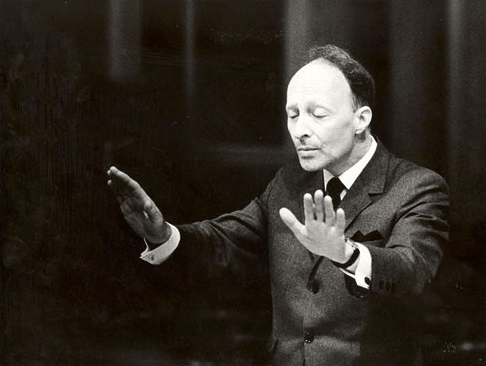
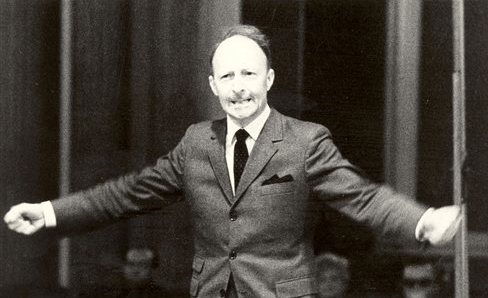
The images of Lutosławski were taken by Jan Zegalski in Katowice during rehearsals for the premiere of the Second Symphony in Katowice in June 1967.  They come from Witold Lutosławski w Polskim Radiu (I posted on this fascinating web resource in WL100/14 on 21.01.13).  In one shot, Lutosławski is in conversation with Krenz, who had been his conducting mentor since the early 1950s.

Screen Shot 2013-04-08 at 22.03.28