• WL100/75: Lutosławski’s Bookshelves

I took the opportunity when spending three days researching in Lutosławski’s house in September 2002 of taking shots (with permission) of his bookcases: in his studio, the attic room, the upper hallway and the lounge.  It now turns out that in the intervening years many of the volumes on these shelves have been dispersed and so these photos – which I believe were little touched since the composer’s death and that of his wife in 1994 – are perhaps the only surviving survey of Lutosławski’s collection.

Studio

The first floor studio is L-shaped, or, more accurately, reversed L-shaped.  The entrance was along the inside wall of the short limb of the L and the first sight that greeted visitors was Lutosławski’s much photographed grand piano.  His wife Danuta moved it out after his death and replaced it with her bed.  Neither piano nor bed was there in 2002.  I took two photographs of the long limb of the room.  The first looks from the patio doors towards the desk (the piano would have been on the immediate left).

134-3416_IMG

The bookcase beyond the desk contained reference volumes, mainly dictionaries; handy for when Lutosławski was writing letters or programme notes.

133-3395_IMG

Behind him, along the wall hidden from view on the main photograph, were shelves and cupboards, with a number of souvenir items, awards etc. on display.  Here there were more reference volumes (such as a Grove dictionaries), other books (including two copies of Steven Stucky’s monograph and my own little volume on Bacewicz) plus his collection of scores by other composers (of which more anon).  It had three divisions; here they are reading from left to right.

133-3398_IMG

133-3397_IMG

133-3396_IMG

The second location photo looks from the entrance to the corner behind the coffee table, with the patio windows onto the veranda just out of shot to the right.  The desk and other shelving are over the left shoulder.

134-3417_IMGThis corner shelving contained quite a miscellany, with Lutosławski’s books of and on foreign literature, especially French poetry, plus other volumes on composers plus his (incomplete) run of ‘Warsaw Autumn’ programme books. Among the items that I found here, but which has sadly now disappeared according to his daughter-in-law, was the one containing his annotation of Desnos’s poem Les espaces du soleil (it can be seen in the second of the next group of photographs, bottom shelf, sixth from the right). In order to try and capture as much of the detail as I could, I split each of the bookcases into top and bottom, so the following sequence runs top right, bottom right, top left, bottom left.

133-3400_IMG

134-3401_IMG

134-3403_IMG

134-3402_IMG

Attic

It was in the attic that I discovered the folder containing Lutosławski’s collected folk materials (1950-54) which I have written and talked on several times since.  Also here were two cupboards containing spare copies of his published scores.  Other bookshelves contained a wide range of books for which there was no room downstairs.

134-3423_IMG

134-3422_IMG

134-3424_IMG

134-3425_IMG

Landing

On the first-floor landing was a single bookcase, holding a non-musical selection of books, notably volumes by Stanisław Dygat, the brother of Lutosławski wife.  The top shelf contains Hedrick Smith’s The Russians, which spends a couple of paragraphs reporting the reception of the Russian premiere of Lutosławski’s Cello Concerto in 1972.

134-3419_IMG

134-3420_IMG
Lounge

As a low-level partition, there was a double-sided bookcase containing primarily Polish literature, plays (Genet, Ibsen and Shaw among them) and philosophical volumes.  My apologies that the second photo is poorly focused.

134-3491_IMG

134-3490_IMG

• Panufnik: One Song or Three?

343px-POL_PZPR_logo.svgLast month I spent a few days researching Panufnik manuscripts in Kraków’s Jagiellonian Library.  I was interested mainly in his working versions of major pieces from the 1940s and 50s; I will write on these shortly.  Another set of manuscripts also caught my eye.  These were of three songs written for a competition celebrating the imminent formation in December 1948 of the Polish United Workers’ Party (PZPR).  Although Panufnik professed in his autobiography to writing just one song, and that under duress, it has been known for a while, from other archives, that like five of his colleagues he wrote music to all three set texts.  But the existence of these fair copies in his own hand has not been so well-known.  I have written a short article exploring these manuscripts and their history.

• Reviews in translation (Górecki-Gibbons)

Penderecki_Gorecki_LutoslawskiFacebook friends will know that I posted last week about an unusual event at Warsaw’s Grand Theatre that was taking place on Saturday 29 November.  Here are my translations of two reviews that have since reached me (apologies for any linguistic infelicities).  I don’t usually occupy myself with reviews, as others are better placed to do them.  But the nature of the event is such that I think these opinions from Sunday 30 November may be of interest. They were written for well-regarded newspaper outlets, polityka.pl and wyborcza.pl.

I’m not going to develop the arguments here, but I may well return, in another post, to the trend of not leaving composers’ works alone.  Chopin is one thing, and his music has been used a creative resource for many years.  But in recent years in Poland it has been the music of lately deceased or living composers that has come in for treatment that ranges from ‘dressing-up’ to something more materially radical.  But that is for another day.

The first of the reviews comes from Dorota Szwarcman’s online blog for Polityka.

Three People, Two People and Spotlights (Trzech, dwóch i reflektory)

Dorota Szwarcman

The purpose of the concert at the Grand Theatre was to record it for DVD, but the audience had to endure aggressive noise emanating from antediluvian spotlights.  It was impossible to convince the organisers to do something about it.  In fact, ‘noise’ is an understatement.  It was a din.  It impeded hearing the performances, was superimposed on them and distorted them, especially in the quiet moments. I understand that it will be filtered out in the recording, but why then invite an audience?  They could have recorded it in rehearsal.  And so we felt simply as if we’d been given a kicking.

OK, but we must consider the pieces.  The ‘Three People’ are Penderecki, Lutosławski and Górecki.  As the only surviving member of this trio, it fell to Penderecki to conduct the works of all of them.  There was a continuation of the Penderecki-Greenwood project (48 Responses to Polymorphia was performed again), extended by the new Réponse Lutosławski by Bryce Dessner; plus works by the members of Radiohead and The National (the ‘Two People’), conducted by Bassem Akiki.  And NOSPR [National Symphony Orchestra of Polish Radio] played.

What can one say about these pieces?  My reflection is that people who play music every day which is completely different, sharper, become awfully polite when they suddenly enter the classical world.  Isolated timid clusters are lost in a sea of wistful tonal fragments, this tonality being slightly disturbed, so that everything is not just repeated literally, but is still all very discreet. While the relationship between Greenwood’s piece and Penderecki’s is very obvious – its successive fragments originate in Polymorphia‘s famous final C-major chord – it is hard to see what links Dessner’s composition with Lutosławski’s Funeral Music, perhaps two notes, not more.  It is easier to hear connections with Philip Glass, who has nothing in common with Lutosławski.  The responses therefore do not constitute in either case a counterbalance to the ‘questions’, i.e. the works by Penderecki and Lutosławski.

Another thing: the visuals were terribly distracting, supposedly attractive and interesting (made by the same people who have been in charge of the staging of concerts at Wrocław’s Centenary Hall), but here too expressive and riveting.  It was hard to take in the music at the same time.  There may be some for whom it was easier…

The second half was another story.  Starting with the visuals themselves, which were the work of John Milton, who is in charge of the packaging and staging for Portishead concerts, and ending with the introduction of Beth Gibbons in Symphony of Sorrowful Songs.  In an “excuse me for living” position (I thought that, in her situation, she was being unusually shy, but it turns out that she is always like this), she sat on a chair and sang into a microphone.  It has to be said that she had been really well coached by an expert – after all, she does not read music, knows no Polish and, moreover, has never sung in any language other than English, and furthermore has never sung with an orchestra [AT: although she and Portishead have performed with a backing orchestra]. Somehow she made it happen, even if in some places she had to sing down an octave; she sang in her own way, just as she does with Portishead, the voice slightly murmuring, slightly whining, but clear for all that…  The greatest advantage of this singing was its sincerity and directness – she knew what she was singing about and tried to express it; one may say that her singing was ‘sorrowful’ in reference to the work’s title, though this term is ambiguous.  The visuals underlined the claustrophobic-despressive mood, showing a wall of lichens, murky corridors without end, guttering candles.  All in all, I don’t know the reason for this experiment, because Górecki’s Third Symphony has just no need of popularisation, but apparently foreign concert halls are already interested in this concert.  Well, let’s see.

The second review, also dated 30 November 2014, is by Anna S. Dębowska for Wyborcza.

Anglo-Saxons from the World of Pop in a Concert with Music from the Polish Classics (Anglosasi ze świata popu na jednym koncercie z muzyką polskich klasyków)

Anna S. Dębowska

Radiohead, The National and Portishead connected with Polish music in a National Audiovisual Institute project.  The result was at least debatable, but what kind of art is without controversy?  A review of Saturday’s concert in the Grand Theatre – National Opera in Warsaw.

Commissioned by the National Audiovisual Institute, Jonny Greenwood and Bryce Dessner composed short pieces for string orchestra inspired by Krzysztof Penderecki’s Polymorphia from 1961 (Greenwood) and by Witold Lutosławski’s Funeral Music from 1958 (Dessner).  Beth Gibbons sang the soprano part in Henryk Mikołaj Górecki’s Third Symphony ‘Symphony of Sorrowful Songs’ (1976).  The performances of the Polish music were conducted by Krzysztof Penderecki and the new pieces by Bassem Akiki, the young Lebanese-Polish conductor who made his debut at Wrocław Opera a few years ago.  The National Symphony Orchestra of Polish Radio played.

That about sums it up.  The idea came from Michał Merczyński, head of the National Audiovisual Institute, the artistic selections made by Filip Berkowiczm director of the Kraków festival Sacrum Profanum. “I’m very interested in bringing together the worlds of serious music and ambitious entertainment”, he told Wyborcza. “Such collaborations provide an extraordinary boost to the participants, for their work reaches a whole new audience.  I am glad that Michał Merczyński has once more invited me to collaborate and again allowed me to stir it.”

Water and Fire One Year Later

Indeed, Berkowicz has stirred things up.  He’s already done it many times.  It is sufficient to recall projects like ‘Penderecki Reloaded’ – initiated jointly with Merczyński, processing the classics through performances by Greenwood and Aphex Twin – or ‘Polish Icons’ – with Skalpel remixing Penderecki, Górecki and Lutosławski at Sacrum Profanum [AT: 2014].  But this is nothing compared with Beth Gibbons, the vocalist with the trip-hop group Portishead, cast in the oratorio-cantata soprano role in Górecki’s Third Symphony.

Saturday’s concert was due to happen a year ago during the jubilees of the three great Polish composers.  I do not think that the change of date influenced its reception.  For some it was from start to finish a proposition that was hard to take, while others saw in it an interesting attempt to link different worlds, for which the blurring of boundaries is a trump card.  For others it is an alarming attempt to tamper with copyrighted musical texts.

That is why Gibbons fans reacted enthusiastically, in contrast to classical music connoisseurs, who took the thing with chilly scepticism (the family of Henryk Mikołaj Górecki disassociated themselves from the project). This attempt to reconcile fire with water convinced me more, however, than the compositional proposals of Greenwood and Dessner, who entered too willingly into the role of imitators.

Simple and Authentic Beth Gibbons

Accepting Gibbons in the Górecki demanded openness and a reorientation to a different kind of vocal expression.  It is difficult to measure the star of Portishead as a classical singer and compare her to Stefania Woytowicz, Dawn Upshaw or Zofia Kilanowicz, great performers of the Third Symphony.  Not that vocal strength, that range or that technique.  That is not what it is about.  Despite obvious vocal shortcomings, she found herself surprisingly at home in the atmosphere of Górecki’s music, inspired by the lament of a mother in pain at the death of her son.  The trump card was the musicality, simplicity and authenticity of a non-professional.  She was herself – she sang sitting at the microphone, sheltering behind her hair like an introvert. She must have put in a great deal of work on her Polish, because it sounded impeccable at times.  The high notes were evidently problematic for her, but the amplification helped in producing them.

It was an interesting experiment, but one hopes even so that Gibbons does not spawn imitators (Bjork once turned down an invitation to sing the Third Symphony).  Górecki is only superficially simple and wistful, not suitable for the stage.  Rather he did not approve the use of his music for other purposes, as when he did not permit the Polish distribution of the film in which the director Tony Palmer illustrated the Third Symphony with images of war.

Rockers Write in a Twentieth-Century Fashion

In the case of Greenwood’s and Dessner’s meeting with the classics there was nothing new.  The commissioning of orchestral works from them was the result of compositional try-outs by both musicians. Dessner has had a classical training and has written for the Kronos Quartet.  It is great that someone suggested Lutosławski to him, although Philip Glass was a greater influence in his piece (Réponse Lutosławski) than the great Pole, except maybe for the cluster from Funeral Music.  Even so, the Dessner seems a more interesting, more independent composer that Greenwood with his 48 Responses to Polymorphia, in which he drew liberally from the arsenal of avant-garde and sonoristic devices from the second half of the twentieth century.

Time will tell whether Dessner’s piece will be an encouragement to fans of The National to reach for Lutosławski.  If that happens, there awaits them a meeting with unusually complicated musical material of outstanding expressive qualities.  Saturday’s performance of Funeral Music once again showed that it is a masterpiece.  Likewise, Polymorphia under the baton of its creator, Krzysztof Penderecki, has lost nothing of its freshness and acuity.

It was moving that these pillars of Polish music (Polymorphia, Funeral Music, Symphony of Sorrowful Songs) sounded out under the baton of Krzysztof Penderecki, the only performer who had been a witness and co-originator of the era in which these works were created.  He naturally became the keystone of all of the concert’s themes.  Recruiting him for this project was Michał Merczyński’s and Filip Berkowicz’s unquestionable success.

The concert will be released on DVD by NiNA.


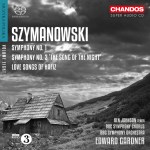
• New CD Note (Szymanowski vol.3/Chandos)

CHSA 5143

It’s ‘You’, not ‘I’.

The third volume of Edward Gardner’s Szymanowski CD series on Chandos has just been released.  It contains one of Szymanowski’s best-known compositions – the Third Symphony, The Song of the Night – alongside two earlier and lesser-known works, the First Symphony and the orchestral version of Love Songs of Hafiz.  It’s been a great privilege to have written the booklet notes for this and the preceding Lutosławski series.

This time, however, I received an additional request: would I make a new translation of the poem, by Jalal al-Din al-Rumi, that Szymanowski used in the Third Symphony?  The translation was not to be from the original Persian (fortunately!), but from Tadeusz Miciński’s Polish version, which was itself preceded by a German paraphrase. Chandos wanted an English translation that was as faithful as possible to the Polish.

This was quite a task for a non-poet and non-professional translator.  Occasionally, Miciński’s vocabulary can be prosaic.  The translation in the published score of The Song of the Night is by Ann and Adam Czerniawscy (1970). Their version of the two lines:

Targowiska już ucichły.
Patrz na rynek gwiezdanych dróg nocy tej!

reads as follows:

Thorough-fares on earth are silent.
There behold the starry roads of this night.

But even Czerniawski (a distinguished poet and translator) and his wife have had to draw a veil over the fact that targowiska and rynek are virtually synonymous and mean ‘marketplace’.  My version, for what it’s worth, stays as close as possible to Miciński:

The marketplaces have now stilled.
Look at the market square of starry trails this night!

The 1970 translation is beautifully poetic, but it has another curiosity.  As Miciński proceeds to name stars and constellations, he writes:

Andromeda i Merkury krwawo lśni nocy tej!

The Czerniawscy, again presumably to fit the scansion of Szymanowski’s vocal line, change this to:

Sagittarius and the Virgin blood-red gleam through this night.

I have restored the original names:

Andromeda and Mercury glisten blood-red this night!

The most surprising thing was to realise that no-one (including myself) has previously observed – at least in books or CD booklets – that Szymanowski made a change to the end of al-Rumi’s poem and Miciński’s translation.  (The Szymanowski authority, Teresa Chylińska, has included the change in her transcription, but apparently without comment.)  What Szymanowski did was to add a final extra line that had already appeared in the Symphony, early in the central section:

Ja i Bóg jesteśmy sami tej nocy!
I and God are alone together this night!

Szymanowski’s repetition is not all that it seems.  Crucially, he has changed the poet’s focus from himself to his Beloved.  ‘I’ becomes ‘You’.

Ty i Bóg jesteście sami tej nocy!
You and God are alone together this night!

I’m no literary analyst or philosopher, but it seems to me that this refocusing is radical.  It gives the final moments a quite different profundity than that of Miciński’s original.  This needs to be acknowledged, both in the scholarly and the wider public understanding of Szymanowski intentions in The Song of the Night.

Here’s the link to my booklet note for this new Szymanowski CDor you can scroll the CD NOTES tab above.

• The Indefatigable William Hughes

It is two and a half years since I first posted on the extraordinary translating odyssey on which William Hughes had embarked early in 2012.  It has been his mission to translate into English a host of Polish articles and documents relating to Karol Szymanowski.  There has been a crying need for this, and you won’t find a finer English-language source than Hughes’s translations.  In earlier posts (20 March 2012, 13 May 2012 and 18 August 2012), I posted links to the growing list on his website http://drwilliamhughes.blogspot.co.uk.  Then on 11 January 2013 I put up a short post marking the completion of his project.

Today I realised my great sin of omission.  I totally failed to write a post celebrating the publication in June 2013, in hard copy, of many of these translations.  My apologies – I had intended to (I did celebrate it on Facebook!), but other work got in the way and I forgot.

ScanKarol Szymanowski. Posthumous Tributes (1937-38) is published by Moon Arrow Press in Norwood, South Australia. It contains over 80 items, ranging from reminiscences, eulogies and letters of condolence to over a dozen photographs from the funeral ceremonies in Warsaw and Kraków.  Hughes’s sources include Muzyka, Muzyka Polska, Prosto z Mostu, Śpiewak and Wiadomości Literackie.  The paperback, which is cleanly and handsomely produced, runs to over 350 pages.  The list of contents is reproduced below.

Scan 3

Scan 2

I had imagined that this enormous labour of love would end here.  Not a bit of it.  In the eighteen months since the volume went to press, William Hughes has taken his project much further.  I have lost count of the new translations, but they must come to over 120, making some 250 in all.  This is truly staggering.  The ‘new’ translations come from a variety of sources: Szymanowski himself, his sister Zofia, his cousin and co-author of the libretto of King Roger (which is the subject of a number of entries) Jarosław Iwaszkiewicz, as well as friends, composers and critics.  There is surely a second or third volume ready and waiting in amongst these treasures.

Although the items in Hughes’s first volume are still available on his website, I do urge you to support his notable – and noble – achievements by purchasing Karol Szymanowski. Posthumous Tributes (1937-38) in hard copy.

Meantime, here’s the link to today’s post, marking the exact 90th anniversary of the publication in Kurier Warszawski of Szymanowski tribute to his lifelong friend, the pianist Artur Rubinstein, who was in Warsaw after an absence of twelve years.  When Rubinstein had last been there, in 1912, Poland was still partitioned.  By 1924, Poland had achieved independence and relative peace after the Great War and several difficult post-war years.  Szymanowski writes eloquently and passionately, and William Hughes – characteristically – brings his article to life as if we were reading it ‘live’ on 8 October 1924.

• Sustained Glissando

Screen Shot 2014-10-02 at 15.44.312014 marks the tenth anniversary of one of the most remarkable publishing ventures in Polish music.
Glissando magazine has ploughed its own furrow determinedly since 2004, despite a few rocky moments around 2008.  It has produced an average of two issues per year, in an A4 format, on no-nonsense matt paper and eschewing colour temptations except everything on the chart between black to white.  Its design is quirky (characteristically Polish) and often reminds me of a cross between underground literature (but of a much higher print quality) and art movements of decades ago.  The most recent issue (no.24) has gone glossy without losing its character.  The contents are listed at the end of this post.

The intent of Glissando has been clear from the start: to provide an alternative to mainstream music journalism and musicology.  It has done so by stressing what is going on in the work of composers and writers in their 20s and 30s and by giving a main focus to each issue (but not to the exclusion of all else).  As you can see from the banner headings given below, there was an early emphasis on music in other countries, on broader issues and concepts, and on digging into the past.  This has been nuanced over the years, with certain themes recurring, notably the exploration of sound and space.  The next issue (no.25, edited by Antoni Michnik) is called ‘Manifestos’ while the one after that (no.26, edited by Krzysztof B. Marciniak) returns to a familiar topic, ‘Soundscape’.

Since the start of 2014, Glissando has gone for guest editors (from within and without its regular team) and this gives great scope for diversity and depth.  But one must acknowledge that there have been, and still are, key figures in Glissando‘s history, among them Jan Topolski and Michał Mendyk.  Topolski is still at the centre of things and, in addition, has written a wonderful study of Gérard Grisey – Widma i Czasy (Spectra and Time; Warsaw, 2012).  Michał Mendyk has moved sideways to develop the independent record company, Bôlt, which has likewise pursued a distinct identity and now has a unique repertoire of archival and new recordings from Poland and elsewhere in Eastern Europe.

Other important contributors to the success of Glissando include Agata Kwiecińska and Eliza Orzechowska, who were part of the team from the beginning, and others, more recently, including Jacek Plewicki and Filip Lech.  The roster of writers includes notable names, of which I will mention only two here – Monica Pasiecznik and Michał Libera, partly because, like Jan Topolski writing on Grisey, they have gone on to publish major studies in the music series published by Wydawnictwo Krytyki Politycznej.  There are two books by Pasiecznik – Rytuał superformuły. Stockhausen Licht (The Ritual of Superformulae. Stockhausen’s Licht; Warsaw, 2011) and  Po zmierzchu. Eseje o współczesnych operachco-authored with Tomasz Bierniacki (After Twilight. Essays on Contemporary Opera; Warsaw, 2013) – and one by Libera (who is also the guest editor of Glissando 24) – Doskonale zwyczajna rzeczywistość. Socjologia, geografia albo metafizyka muzyki (A Perfectly Ordinary Reality. The Sociology, Geography or Metaphysics of Music; Warsaw, 2013).

(In parenthesis, it is worth noting that it was Topolski, Mendyk and Libera who set up the 4.99 Foundation that runs Glissando, Bôłt Records and other projects.)

There has been an important strategic decision made this year at Glissando, and that is to switch to English rather than stay in Polish.  The primary intention is to attract contributors and readers from elsewhere in Eastern Europe rather than from ‘The West’.  This focus on new music in Eastern Europe matches Bôłt’s existing strategy.

The printed edition of no.23 is half-and-half Polish-English, no.24 completely in English.  Both languages are represented online.  The English online choice currently consists of just six articles (up from four last week): one from no.17, one from no.22, three from no.23 and one from no.24.  (A glance at this last item indicates that there may be textual and illustrative differences between the printed and online versions.)  The Polish online choice is much wider; it may even be comprehensive – I can’t tell (it stretches right back to no.1).  The plan for future issues is to have all articles in both languages, one in print and the other online.  It would be a tall task to translate all the past Polish articles into English, but one lives in hope that some of them will be singled out.

The Glissando website is well worth a visit, even if it may take a while to work out how to navigate the differently constructed English and Polish sections.  Long may it and its team challenge and provoke!

242014
• 24   Avant-Avantgarde
• 23   The Cassette Tape (with audio cassette)
2013
• 22   Noise
• 21   Performance/Performativity
2012
• 20  Swiss Music
2011
• 19   Polish Music (German-language issue)
• 18   Sound in Public Space
• 17   Hip-hop – Microtones
2010
• 16   Space – Italy – Mykietyn
2009
• 15   Lithuania
1-214x3002007
• 13-14   Rock
• 12   Wrocław
• 10-11   Benelux – Music and Cinema
2006
• 09   Austria
• 08   Scandinavia
2005
• 07   The 60s and 70s
• 05-06   Darmstadt School +
• 04   Electronic Music
• 03   Free Improvisation – Young Composers
2004
• 02   New York
• 01   Spectral Music – Japanese Avantgarde

Glissando no.24, ‘Avant Avantgarde’

• Michał Libera, Introducing Avant Avantgarde (p.4)
• Michał Libera, Amplifying the Sound: Technology of delivery – early amplifiers, mutes and the politics of volume (p.10)
• Pamela Granatowski, Projecting the Sound: Listening to Axis Mundi (p.28)
• Ewa Kozik, Processing the Sound: On more or less natural sound alterations (p.40)
• Antoni Michnik, Visualizing the Sound: Pre-phonographic analysis and reproduction of sound (p.50)
• Jan Topolski, Generating the Tone: Stay tuned, keep temper (p.66)
• Barbara Bogunia, Automating the Sound: Ars combinatoria and mystical automata (p.82)
• Maciej Śledziecki & Marion Wörle, Avant Avantgarde Instruments: We wonder why (p.98)

• The Spoils of Warsaw

One of the many joys of visiting Poland over the decades has been searching out scores, books and recordings (not to mention classic posters and dark spadziowy honey).  This year was no different.  I’d not been in Warsaw since last November, so there was plenty to catch up on and to indulge my hunter-gatherer tendencies.

There are two major music shops in Warsaw.  One is SAWART (online Polish-language link here) on Moliera at Plac Teatralny near Teatr Wielki.  The other is the shop in what used to be the Akademia Muzyczna Fryderyka Chopina and what is now the Uniwersytet Muzyczny Fryderyka Chopina.  You can also find CDs and DVDs in branches of EMPIK and at Teatr Wielki’s own shop.

Books

Screen Shot 2014-09-30 at 16.00.45Two Panufnik volumes have appeared in Poland in his centenary year.  The first is a reissue of his autobiography Composing Myself (1987), translated in 1990 as Panufnik o Sobie (Panufnik on Himself), although this paperback omitted the photographs from the UK edition.  It has been republished in hardback as Panufnik. Autobiografia with a supplementary section by his widow Camilla covering the final years of his life.  An English-language reprint, likewise updated and with additional documentation, is in press … watch this space.

The next Panufnik publication is the third in a sequence of interview recollections published by Polish Music Publishers PWM.  Scan 3First was Górecki. Portret w pamięci (Górecki. A Portrait in Memory, 2013), consisting of 42 interviews carried out by Beata Bolesławska-Lewandowska. The second, slimmer volume inaugurated a new series ‘Rozmowy o kompozytorach’ (Conversations on Composers) and heralded a new design.  The interviews for Lutosławski. Skrywany wulkan (Lutosławski. A Hidden Volcano, 2013) were carried out by Aleksander Laskowski and focused on just four conductors: Edward Gardner, Simon Rattle, Esa-Pekka Salonen and Antoni Wit.  Both of these publications won major book prizes in Poland this year. Laskowski’s interviews will be published in English by Chester Music.

Scan 4Now comes Panufnik. Architekt emocji (Panufnik. Architect of Emotion, 2014), with a preface by the poet Adam Zagajewski.  It was launched during this year’s ‘Warsaw Autumn’ in the presence of Panufnik’s widow Camilla.  The author is again Beata Bolesławska-Lewandowska, whose authoritative biography (PWM, 2001) will be published in English by Ashgate in the coming months.  She spoke to twelve people:

Łukasz Borowicz, the conductor of the comprehensive cpo series of eight CDs of Panufnik’s orchestral music
Roxanna Panufnik, Panufnik’s daughter and composer
Andrzej Dzierżyński, the painter and family friend, whose images adorn the covers of all but one (no.2) of the eight cpo CDs
Gerard Schwarz, conductor-laureate of the Seattle SO with whom he made a CD of Panufnik’s music in 1996
Stanisław Skrowaczewski, the conductor and composer, still active on the podium aged 91, who knew Panufnik early in their lives
Wanda Wiłkomirska, the violinist whose 1980 performance of Panufnik’s Violin Concerto can be heard on the new ninateka.pl site
Camilla Panufnik, the composer’s widow and tireless supporter since they met in England in the early 1960s
Ewa Pobłocka, who has made two commercial recordings of Panufnik’s Piano Concerto, one of them under the composer’s baton
Mark Stephenson, the British conductor who worked closely with the composer in his later years
Wojciech Michniewski, an insightful interpreter of contemporary Polish music who shared the podium with Panufnik during the concert when the composer conducted his Tenth Symphony in Warsaw in September 1990
Jem Panufnik, Panufnik’s son and graphic designer and musician
Julian Anderson, composer

I’ve not had time to read the interviews properly, but one observation by Julian Anderson caught my attention.  He concludes (p.243) that ‘one of the main things that Panufnik bequeathed to Polish music after his escape was the Polish experimental creativity that developed after 1956’ (I am translating from the Polish; these may not have been Anderson’s exact words).  This demands more scrutiny than this post allows, so I will return to this anon.

Scan 5Another book just hitting the shops is a compilation of writings by the music critic and broadcaster Andrzej Chłopecki, who died in 2012 in his early fifties: Dziennik Ucha. Słuchane na ostro (Ear Diary. Sharp Listening).  Chłopecki’s loss is still keenly felt, because he was unafraid to speak his mind, was not fazed by the establishment and quizzed everyone and everything.  His writings and charismatic radio broadcasts brought zest and intelligent prickliness to musical and philosophical debate.  This collection, running to over 500 pages,  brings together Chłopecki’s columns for Res Publica Nowa – ‘Dziennik Ucha’ (Ear Diary, 1993-98) and Gazeta Wyborcza – ‘Słuchane na ostro’ (Sharp Listening, 2001-11).  His range was astonishing.  His essays give pause for thought as well as huge enjoyment.  Sadly, they are unlikely to be translated into English.

However, there is good news on a related front.  The collection of Chłopecki’s essays on Lutosławski’s compositions, published as Andrzej Chłopecki. PostSłowie (Andrzej Chłopecki. AfterWord) in 2012, is a testament to his ability to look at – and to enable listeners to hear – music afresh.  And in the case of a composer as much discussed and analysed as Lutosławski, that was a very special gift.  The book, which he oversaw in the smallest detail and signed off just before his death, has now been translated into English by John Comber and may be out by the end of this year.

Encyklopedia Muzyczna

Finally, I have completed the set.  EM’s first volume ‘ab’ was published 35 years ago.  The series was completed by vol.12 ‘w-ż’ in two years ago.  There have also been supplements, necessary given the protracted timespan of the encyclopaedia – ‘ab’ (1998) and cd (2001) – although this process has stalled.  Instead, PWM has brought out special composer supplements: Chopin (2010), Górecki (2011), Szymanowski (2012) and Wieniawski (2011).  The Górecki volume is quite slight.  It runs to just 18 pages and was issued to commemorate the composer after his death in 2010.  It has an updated work list (but does not include posthumously released works like the Fourth Symphony), bibliography and a brand-new essay by Maciej Jabłoński.  The others supplements are more substantive: the Wieniawski has over 70 pages, the Szymanowski over 130 and the Chopin 180.Scan 2

This time I picked up a copy of the Lutosławski supplement (77 pages), published in 2013. In addition to an essay written by the late Jadwiga Paja-Stach and by Zbigniew Skowron, there are individual entries on over 60 performers, composers, poets, publishers and authors closely associated with him.  It is an honour to have been included in this distinguished gathering.

Recordings

Scan 7Various CDs have come my way in recent months, not least a range of discs from the ever-productive DUX company.  I also received a smart boxed set from Sinfonia Varsovia issued to mark the 70th anniversary of the Warsaw Uprising and the end of Word War II.  This non-commercial 3-CD set is called (a little loosely) Anthology of Polish Contemporary Music 1939-1945 and it contains much music that is hard to find elsewhere on disc.  The conducting duties for the twelve pieces are shared between Renato Rivolta (6), Jerzy Maksymiuk (5) and Jacek Kaspszyk (1).  There is an excellent booklet essay by Katarzyna Naliwajek-Mazurek.  The complete repertoire is:

Grażyna Bacewicz, Overture (1943)
Andrzej Czajkowski, Piano Concerto no.2 (1966-71), with Maciej Grabowski
Tadeusz Zygfryd Kassern, Concerto for String Orchestra (1943)
Stefan Kisielewski, Concerto for Chamber Orchestra (1944, 1949)
Witold Lutosławski, Symphonic Variations (1938)
Andrzej PanufnikTragic Overture (1942)
Andrzej Panufnik, Sinfonia elegiaca (1957, 1966)
Karol Rathaus, Music for Strings (1941)
Ludomir RóżyckiPietà. On Smouldering Ruins of Warsaw (1942, 1944)
Antoni Szałowski, Overture (1936)
Aleksander Tansman, Rapsodia polska (1940)
Mieczysław Weinberg, Cello Concerto (1948), with Marcel Markowski

Contemporary composers in Poland have as difficult time as anywhere getting their music heard and recorded, but there have been some initiatives in recent years to plug some of the gaps.  The ‘Warsaw Autumn’ annual chronicle of seven or more CDs provides a permanent reminder of live performances.  The chronicle is non-commercial, but libraries, institutes and interested individuals may request to be put on the distribution list.  The recordings come with either the Polish or English programme book for the year.  Enquiries may be made via this link.

In 2009, DUX launched an initiative called Young Polish Composers in Homage/Tribute to Frederic Chopin, in honour of the composer’s bicentenary in 2010.  The eleven CDs in the series introduced ten Polish composers and one Czech to the wider public:

Stanisław Bromboszcz (b.1980): Chamber Music, DUX 0746
Michał Dobrzyński (b.1980): Expression DUX 0752
Marcin Gumiela (b.1980): Sacred Works DUX 0753
Paweł Hendrich (b.1979): Chamber Works DUX 0754
Michał Moc (b.1977): Emotions DUX 0756
Dariusz Przybylski (b.1984): Works for Orchestra DUX 0721
• Weronika Ratusińska (b.1977): Works for Orchestra DUX 0723
Agnieszka Stulgińska (b.1978): Chamber Works DUX 0759
Sławomir Zamuszko (b.1973): Works for Orchestra DUX 0724
Wojciech Ziemowit Zych (b.1976): Works for Orchestra DUX 0722
+ the Czech composer
• Kryštof Mařatka (b.1972): Chamber Works DUX 0784

DUX prefaced the series in 2008 with a double sampler CD DUX 0635/0636, with mostly different pieces plus works by two other composers who did not go on to have had their own individual CDs: Marcin Stańczyk (b.1977) and Marcin Tomasz Strzelecki (b.1975).

On my visit to Warsaw last week I came across a more recent series devoted mostly to an older generation of Polish composers.  Under the heading Polish Music Today. Portraits of Contemporary Polish Composers, Polish Radio and the Polish Music Information Centre launched ten CDs earlier this year.  They are available via the Polish Radio online shop (click on links below), where you will also find information on each composer and tracks, but only in Polish.  The intention is to develop the project further.  The ten lucky composers so far are:

Magdalena Długosz (b.1954): PRCD 1743
Jacek Grudzień (b.1961): PRCD 1746
Aleksander Kościów (b.1974): PRCD 1750
Zbigniew Penherski (b.1935): PRCD 1741
Jarosław Siwiński (b.1964): PRCD 1747
Michał Talma-Sutt (1969): PRCD 1748
Ewa Trębacz (1973): PRCD 1749
Tadeusz Wielecki (b.1954): PRCD 1744
Anna Zawadzka-Gołosz (1955): PRCD 1745
Lidia Zielińska (b.1953): PRCD 1742

Now I must get down to some serious reading and listening…

• Panufnik’s Mushrooms (1991)

I met Panufnik only once, and that was in odd circumstances.  Although I had been at the ‘Warsaw Autumn’ in 1990 when he made his one and only return to Poland, I didn’t meet him then.  It was not until the following year that fate intervened, a month before he died.

At the end of September 1991, I called in at the ‘Warsaw Autumn’ temporary office on the first floor of the Europejski Hotel to thank the staff for once again hosting me as a guest of the festival.  There was a lady standing there, tenderly holding a package: “Do you know of anyone going to London after the festival?”, she was asking.  I replied that I was leaving at that moment.  “Ah, could you do me a great favour?  Andrzej Panufnik has expressed a wish to have wild mushroom soup, so I have been to the forest and picked these for him.  Do you think you could take them to Twickenham?”  I was only to happy to oblige.

I was living in London then, working at BBC Radio 3, so once I landed at Heathrow I hopped into a taxi and arrived at the Panufnik home mid-evening.  I knocked on the door.  Camilla Panufnik opened it and was puzzled by this stranger standing there, holding a dubious package.  “I’ve brought mushrooms for you from Warsaw”, I spluttered. “Oh, thank you!  You must come in and meet Andrzej.”

I was led upstairs to meet the composer, who was in a quietly cheery mood and thrilled to receive these fungal goodies from Poland.  Not wishing to tire him with any prolonged conversation, I quickly bid my farewells and got back into the taxi.  I gathered later that the soup was delicious and much appreciated.  I was just glad to have been one link in a chain that brought him some contentment in his last weeks.

• Toasting Pianophonie

One of the highlights of this year’s Warsaw Autumn was the performance of Kazimierz Serocki’s Pianophonie (1976-78) for piano, electronics and orchestra at the closing concert two days ago.  I was gutted not to able to get to the concert, so I had to make do with listening online just a few miles away.  Its impact was still startling.  Serocki was an original, a composer who kept his avant-garde head while many around him were losing theirs.

Today I saw a link to a review by Tadeusz Deszkiewicz, who had a family connection with Stanisław Wisłocki, the conductor of the Polish premiere at the 1979 Warsaw Autumn.  I’ve taken the liberty of translating (I hope faithfully) Deszkiewicz’s recollections and thoughts.

You can hear the 1979 recording here: http://www.youtube.com/watch?v=eJt5zotNk10.

___________

Kazimierz Serocki’s Pianophonie, under the baton of Jacek Kaspszyk, dominated the final concert.  I was curious to see how this work would sound today, 35 years after its Polish premiere during the 23rd Warsaw Autumn in 1979.  I was in the Philharmonic then not only because I was a radio journalist at Polish Radio 2 but also because it was my uncle, Stanisław Wisłocki, who was conducting.

The work was recorded before the Warsaw Autumn, and Wisłocki later described the event:

On 13 September (1979) we were in Warsaw, in the National Philharmonic Hall, for two rehearsals and a recording for LP of Kazimierz Serocki’s composition, Pianophonie.  For its performance it was necessary to import special electronic sound-processing equipment from Germany. […]  The soloist was the pianist Szabolcs Esztényi, who thanks to a special console placed next to the piano drew out of it a variety of sound effects.  He and the natural sound of the orchestra created a soundscape hitherto not used in music.  Serocki wrote this interesting composition in 1976-1978 on the initiative and at the request of Radio Südwestfunk in Baden-Baden and the Freiburg Experimental Studio.  It was the first performance in Poland and probably the last, because it is unlikely that any Polish orchestra can again afford to bring this incredibly complicated, unique and vast apparatus from the Federal Republic of Germany.

Wisłocki could not have imagined that, 35 years later, miniaturisation would have eliminated the vast apparatus and the group of technicians to support it.  And so today, for the first time, we heard an absolutely new electronic version of Pianophonie, which gave Serocki’s piece a fresh, excellent sound.  The creation of new software and the digital processing of the analog recording was created from ​​Kamil Kęska’s original.  The effect was revelatory, and the audience’s cries of delight and long applause greeted the work.  The excellent pianist Adam Kosmieja also aroused admiration.  He had the task of simultaneously playing the piano at breakneck speed, extracting sounds directly from the strings and using the computer placed next to him.  It takes a great musician to realise this difficult music so excellently, keeping in mind the phrasing, dynamic range and technical perfection required.

In 1979, the Warsaw audience also received the work very warmly. Wisłocki wrote:

After the interval, we performed Kazimierz Serocki’s Pianophonię (c.30′), in which the role of the sound engineer Hans Peter Haller was as important as that of the other performers.  The audience gave Serocki an ovation. After the concert, Kazimierz hosted a party at his home.  There was a great deal of vodka.  Kazio drank continuously to one and all and by the end of the party he was just reeling.  I did not even try to reason with him, because it would not have helped. […]  A few days later, I received the news that Kazio had been taken to hospital with symptoms of a cerebral haemorrhage.

After returning home from convalescence, Kazimierz Serocki tried to write with his left hand (his right hand was incapacitated after the stroke), but Pianophonie was to be his last piece.  This great composer – a co-founder of the ‘Warsaw Autumn’ – died in January 1981.

Tadeusz Deszkiewicz, 28 September 2014

• New Sikorski & Panufnik websites

During this year’s Warsaw Autumn festival two new composer websites were launched.  This brings the roster of such Polish sites to eight over the past three years and they are an invaluable source for anyone wanting to learn more about Polish music.

Tomasz Sikorski‘s life and career were sadly short – he died in 1988 aged 49, and his decline is poignantly described in the biographical section of http://www.sikorski.polmic.pl/.  His music speaks of personal angst translated into obsessive repetition and an uncompromising approach to musical material, which is characteristically stark.  But it is by the same token compelling.  The focus piece is Music in Twilight, presented in video from the 2006 Warsaw Autumn.  There are a few pieces on YouTube and I wrote a post on 13 November 2013 in which I give these YouTube items (as they were available then) plus details of two recent CD issues of Sikorski’s music.

panufnik-kolekcja595

Andrzej Panufnik needs no introduction, one might think, but his centenary year has not been as comprehensively covered in concert as one would wish.  Earlier this year, the POLMIC (Polish Music Information Centre) series in which Sikorski’s site is the latest, set up a site devoted to Panufnik.  Now, NINATEKA, hosted by Narodowy Instytut Audiowizualny (National Audiovisual Institute), has added him to its collection alongside Górecki, Lutosławski and Penderecki, whose ‘Three Composers‘ site went live at the end of 2013.  These sites are primarily audiovisual but there are also highly informative notes on each piece.   You may choose English or Polish pathways.

Almost all of Panufnik’s compositions are available on http://ninateka.pl/kolekcje/en/panufnik/ in audio format (sometimes in two performances) and there are a dozen video files. The most interesting of the latter are two fairly recent films on Panufnik: Errata do biografii (Grzegorz Braun, 2008, in English/Polish) in which Panufnik’s life is explored, especially the Polish years, and My Father, the Iron Curtain and Me (Krzysztof Rzączyński, 2009, in English/Polish), in which his son Jeremy travels to Poland to explore his relationship with his father.