• RSQ +1

Following its acclaimed CD of the Górecki quartets for Hyperion in 2011, the Royal String Quartet is riding high with its new Hyperion release of the quartets by Penderecki and Lutosławski.  Since its inception 15 years ago, when its members were students at the (then) Academy of Music in Warsaw, its concerts and recordings have received worldwide praise.  The RSQ has had a particularly fruitful career in the UK.  In 2004-06 it was chosen as one of the participants in BBC Radio 3’s renowned New Generation Artists scheme, and since 2012 it has been Quartet in Residence at The Queen’s University of Belfast, where I worked for the first 23 years of my own career.  I want to draw your attention, however, to the other music-making that the RSQ carries out in its native Poland which may not be so familiar to listeners elsewhere.

First and foremost are the RSQ’s ‘Kwartesencja’ festivals that it has mounted in Warsaw every year bar one since 2004.  These are designed not only to feature the RSQ but also to explore a huge range of collaborative possibilities with one or more other musicians.  Its two concerts from last year alone are excellent pointers to the versatility and imagination that the RSQ brings to its programming.

Kwartesencja 2012

I wish that I had been at the two concerts on 7 and 8 December 2012 (the programmes for this and previous Kwartesencja festivals are still online, but only in Polish).  Fortunately, the RSQ is media-savvy and excerpts from the 2012 events and follow-up recordings are now available on YouTube.

The first +1 was the actress Stanisława Celińska, well-known in Poland on stage and screen.  She performed ‘Songs about Warsaw’ with the RSQ, in arrangements by Bartek Wąsik (piano).  The concert on 7 December 2012 was a huge success and the project was encored on 4-5 January 2013.  It’s being repeated tomorrow night (19 March) in Wrocław.  Several of the songs have since appeared on YouTube and the collection has been issued on the CD Nowa Warszawa (New Warsaw).

These songs are but the most recent in a long Polish tradition of part-sung, part-declaimed lyrics with a mix of melancholic and nostalgic texts (my favourite in this regard is still the magical collaboration between Ewa Demarczyk and Zygmunt Konieczny in the 1960s).  Whether Nowa Warszawa has wider appeal outside Poland – Polish lyrics might be the sticking point – remains to be seen, but I hope it does.  Here’s the video of  ‘Warszawa’ from Kwartesencja 2012.  (It was originally recorded by the Polish ’80s band, T[eenage]. Love, whose own version is quite a contrast: http://www.youtube.com/watch?v=DCfDEusHaDw.)


Here’s a track from the Nowa Warszawa CD: Stanisław Sojka/Soyka’s ‘Tango Warszawa’:
http://www.youtube.com/watch?v=O8WeRk4wDt8

herdzinThe second +1, on 8 December 2012, was the young Polish jazz violinist, Adam Baldych.  In a move which might come across as sacrilegious, the RSQ and Baldych created a far-reaching improvisation on Lutosławski’s String Quartet.  Such an approach to their musical heritage is not entirely unknown among Polish musicians. Chopin has been the subject of attention from the Jagodziński Trio and Leszek Możdżer.  And the RSQ previously worked with the Polish jazz pianist Krzysztof Herdzin and his quartet, in Herdzin’s Fantasy on Themes from Grażyna Bacewicz’s Fourth String Quartet (CD issued in 2008, right).

See and hear for yourself what Baldych and the RSQ made of the Lutosławski quartet.  In this studio recording for Polish TV Kultura, there are some odd things going on in the background (the changing number of people sitting around the table in the shadows), plus two editing blips (at 12’31” and 16’02”), which make it hard to determine what the full performance was like.  Nevertheless, it makes an intriguing counterpart to the RSQ’s riveting performance of Lutosławski’s original quartet on its new Hyperion CD.


• WL100/19: ‘Lutosławski live’, 12-19.02.93

Twenty years ago today, ‘Lutosławski live‘ took over the concert halls of Manchester in celebration of the Polish composer’s 80th birthday two weeks earlier.  The festival was the brainchild of the British composer, John Casken, who had known Lutosławski since the early 1970s.  ‘Lutosławski live‘ placed his music within the context of composers old and new, with Casken and James Macmillan featuring as both composers and speakers and, in the case of MacMillan, as conductor too.  Lutosławski had hotfooted it back from Los Angeles, where he had just conducted the world premiere of his Fourth Symphony (5 February 1993).

The Lutosławski works performed in Manchester were: Variations on a Theme of Paganini (1941), Recitative e Arioso (1951), Concerto for Orchestra (1954), Dance Preludes (1954), Dance Preludes (1954/59), Jeux vénitiens (1961), String Quartet (1964), Preludes and Fugue (1972), Mi-parti (1976), Grave (1981), Mini-Overture (1982), Symphony no.3 (1983), Chain 1 (1983), Partita (1984), Chain 3 (1986), Piano Concerto (1988) and Slides (1988).

My recollection is of a wonderfully friendly event, with musicians drawn from the RNCM, the Allegri and Lindsay string quartets, the London Sinfonietta, the BBC PO and the Hallé.  Lutosławski himself conducted in two of the concerts.  I also have very fond memories of a relaxed post-concert supper with him, John Casken and others in a downtown Italian restaurant.  Good times.  Oh, I’ve only just noticed that I was quoted on the leaflet.  There’s observation for you.

WL live, Manchester 1993 front

WL live, Manchester 1993 inside

• Different and Indifferent

I was not going to write anything today, the anniversary of Witold Lutosławski’s death nineteen years ago.  That evening, I recall going into a BBC studio in London and taking part in a quite substantial (45-minute?) tribute along with John Casken and Charles Bodman Rae.  The following day, I was already scheduled to fly to Warsaw, where I was able to attend Lutosławski’s funeral just over a week later.

I have just experienced, however, a bizarre acoustic phenomenon, courtesy of Polish Radio 2 (counterpart to BBC Radio 3).  It was a live performance from its Witold Lutosławski Studio, as part of the Lańcuch X (Chain 10) festival, of his Cello Concerto.  Nothing strange in that, you might think.  But this was an experimental rethinking by a group of seven Polish musicians in which the orchestral parts were shared between two pianists, two percussionists and two people involved with live electronics, and  the cello soloist Andrzej Bauer.  Bauer has long been a powerful advocate of the Cello Concerto (he performed it under the composer’s baton and his later interpretation on the Naxos label is among the best).  Bauer has also been at the forefront of reinterpreting Lutosławski, notably in his Lutosphere project with the jazz pianist Leszek Możdzer and the DJ m.bunio.s.  Here’s a sample of Lutosphere, based on the theme from the first movement of Lutosławski’s Concerto for Orchestra.


On this occasion, Bauer played the straight man to the other five musicians.  He played the solo part ‘as is’. Borrowing the titles of the two movements from the Second Symphony, the ensemble prefaced the ‘Direct’ Cello Concerto with a ‘Hésitant’ improvisation that excluded the soloist.  This raised all sorts of questions regarding the meaning of the cello’s repeated indifferente D naturals with which the concerto begins.  Instead, here there was a back story, as it were, in the shape of some 25 minutes of largely unrelated material.

‘Hésitant’ began with a sustained D, which disappeared after a few minutes.  In a series of waves, with two main climaxes, the ensemble gathered pace, volume and density, then evaporated, plunged the registral depths and regained the heights some 20 minutes later in cloudbursts of excited activity.  Much of this was treated electronically, along with prepared piano sounds and other percussive effects.  On air, it wasn’t always clear where the boundaries lay between acoustic and electronic sound sources.  The improvisation was imaginative and exploratory.

The soloist’s open repeated Ds emerged from the dying embers of ‘Hésitant’ and ‘Direct’ had begun – four minutes of solo cello.  I was interested to hear how the ‘arrangement’ of the orchestral parts would work.  This had been done by the composer Cezary Duchnowski, who had also prepared the ‘electroacoustic sound layer’.  Sadly, at least over the internet, the experiment failed more than it succeeded.  The main problematical area was how to match the precision and sonic impact of live orchestral instruments.  Maybe it was better in the hall, but the ‘wind’ textures were often muggy and the ‘brass’ timbres consistently feeble.

The trumpet intervention at Fig.1 was anything but the ‘angry’ intervention of Lutosławski’s original.  Subsequent brass interruptions, especially those at the end of the four Episodes, were plain limp, so Lutosławski’s concept of drama through music never properly materialised.  Even the highly expressive coming together of cello and strings for the concluding passage of the Cantilena was timbrally mismatched.  The fiercest interruption of all, at the beginning of the Finale, was without any bite, volume or density whatsoever.  You can imagine, therefore, that there was no real confrontation as the Finale progressed, no rhythmic edge.  I already feared that the hammering orchestral chords at Fig.133 would not do the job of crushing the soloist.  They didn’t even come close.

I wish that I could report otherwise, as I was looking forward to this with great excitement.  As I said, it may have been different in the hall, where the sound diffusion may well have created a much stronger impression of the arrangement.  But it is surely not beyond the bounds of technological potential to reconfigure the orchestral parts – but not necessarily to ape them – so that the cellist has a real sonic opponent, something to play with and against. As it was, he was far more alone than the composer intended.  Whether Lutosławski would have approved of this revised sound-world I’m not sure.  In any event, I think he would have wanted it to have had more ‘orchestral’ impact and immediacy than was evident on air tonight.

• WL100/16: Philharmonia Festival, 2-12.02.89

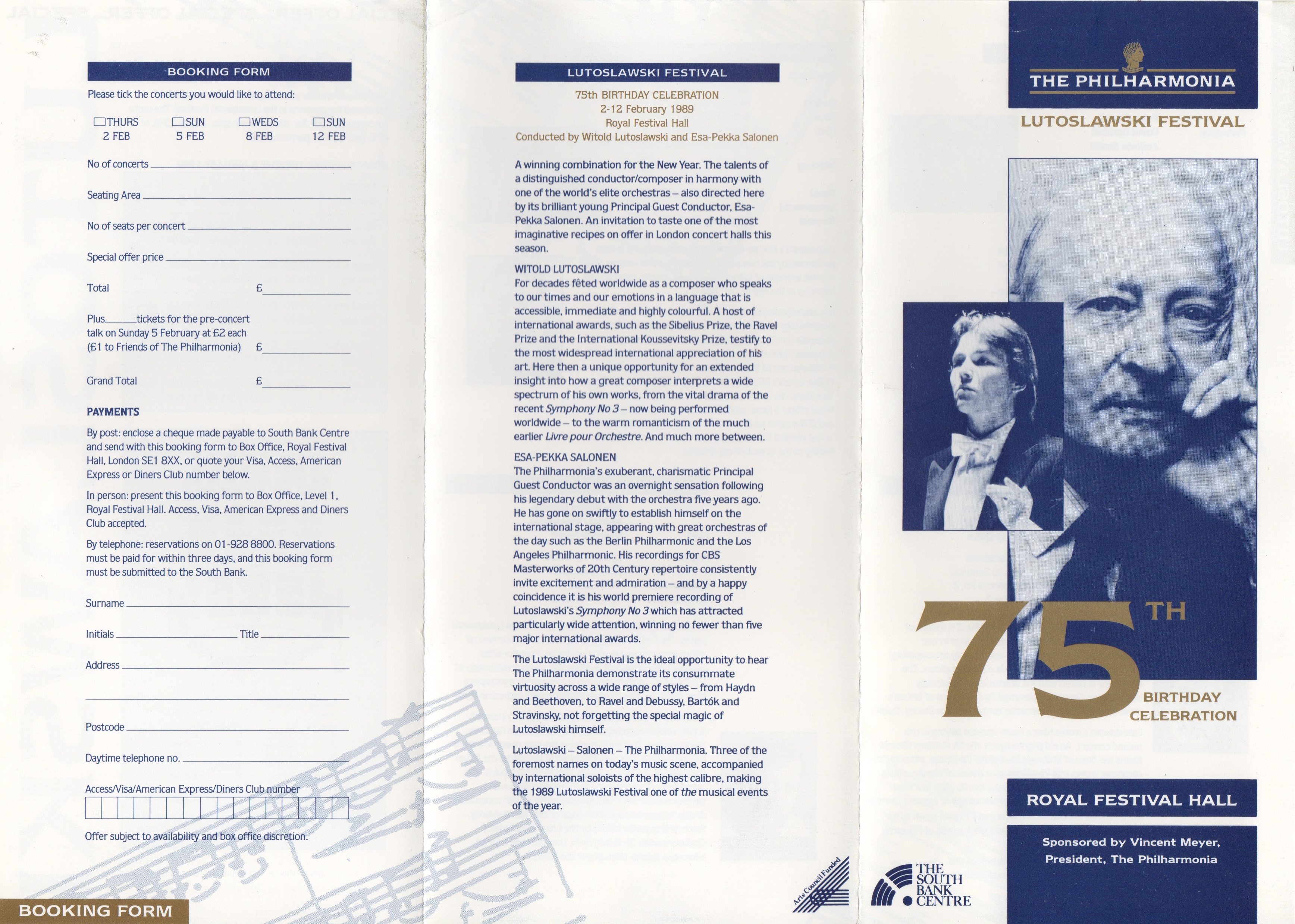
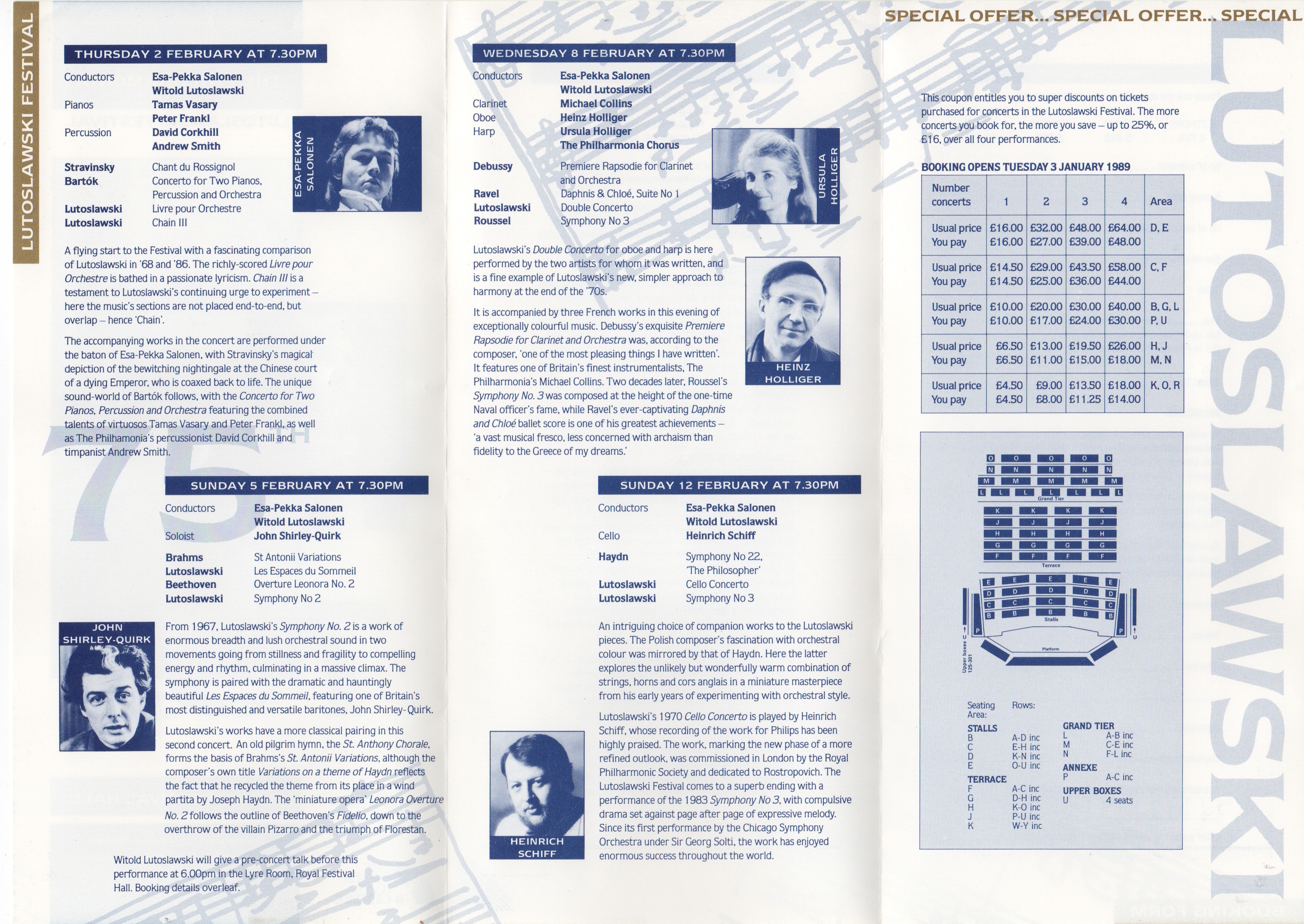
The Philharmonia’s festival to mark the centenary of the birth of Witold Lutosławski (http://woven-words.co.uk) is not the first time that the orchestra and Esa-Pekka Salonen have celebrated his music.  They also marked his 75th birthday with a series of four concerts, although for some reason these were given shortly after Lutosławski’s 76th birthday, starting on this date, 2 February, in 1989.  Very curious.

Lutosławski shared the conducting with Salonen and also gave a pre-concert talk.  His works were Symphony no.2 (1967), Livre pour orchestre (1968), Cello Concerto (1970), Les Espaces du sommeil (1975), Double Concerto (1980), Symphony no.3 (1983) and Chain 3 (1986).  Again, his music was partnered by that of 20th-century composers with whom he felt an affinity – Bartók, Debussy, Ravel, Roussel and Stravinsky – alongside works by Beethoven, Brahms and Haydn.

WL:Philharmonia 1989 front

WL:Philharmonia 1989 inside

• A Brush with Lutosławski

18619_437344239663934_545288166_nI’ve just been to Warsaw to celebrate Lutosławski’s centenary.  I’ve returned with commemorative books, CDs, a pencil, a medal and a brush, with the promise of an IoS app to follow.  More importantly, I’ve experienced an enlightening and inspiring five days with friends old and new, all gathered together by the music and memories of one man.  It was a bit surreal: we were there, but he wasn’t, except in his music.  I felt his absence keenly, even though it’s almost 19 years since he died.

Day 1 (Thursday, 24 January)

It had all been a bit hairy getting from Cornwall to Warsaw.  Yesterday, I made it to Poole for a performance by Johannes Moser, the Bournemouth SO and Kirill Karabits of Lutosławski’s Cello Concerto.  Moser is playing it a dozen times or so this year and his was a vibrant and alert reading.  We also had a great discussion in a pre-concert event with Tom Hutchinson of the RPS (who had commissioned the work and was on the eve of its own 200th-anniversary celebrations) and I’m looking forward to poring over the score with Moser in the near future.  But neither threats of snow and ice nor broken-down trains got in the way of my safe arrival in Poland today to snow and minus temperatures that back home would be regarded as a national catastrophe.

4230738-1The pre-centenary concert was given mainly by the young generation of Polish and visiting artists in the Royal Palace, as the opening concert of this year’s Łańcuch X (Chain 10) festival built around Lutosławski’s music.  There were fine readings of Musique funèbre, Grave (with Marcin Zdunik) and Paroles tissées (with the Dutch tenor Marcel Beekman) by the AUKSO CO under Marek Moś.  A special treat were the readings from Paul Valéry, Henri Michaux and Cyprian Kamil Norwid by one of Poland’s most famous actresses, Maja Komorowska.  She was in the very first Polish film that I ever saw, Zanussi’s Zycie rodzinne (Family Life).

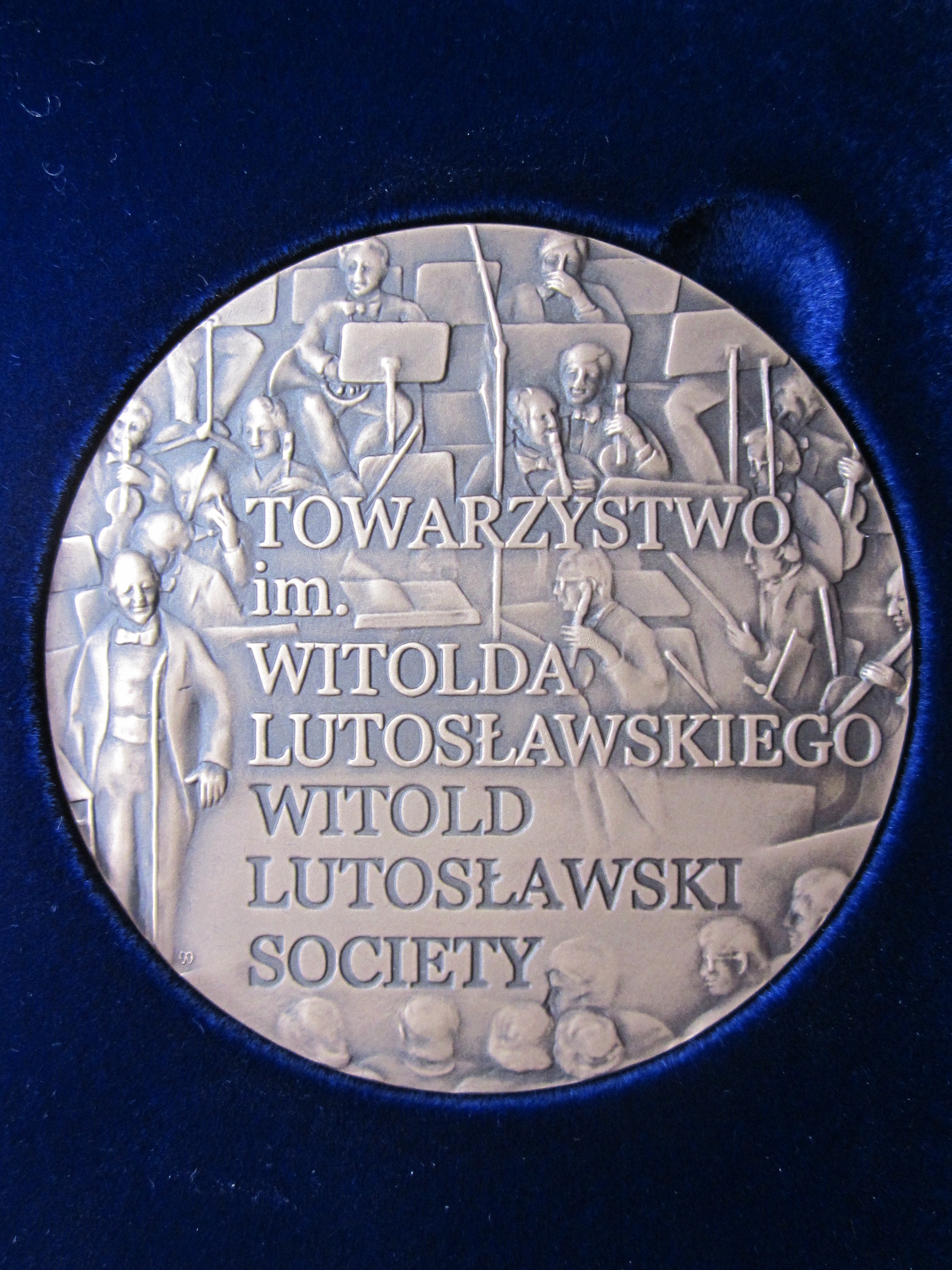
An unexpected part of the evening was the presentation of a specially minted medal by the Witold Lutosławski Society not only to Lutosławski’s stepson and wife, Marcin and Gabriela Bogusławski, but also to about a dozen other guests.  These included the Polish conductor Jan Krenz, long a champion of Lutosławski’s music, Polish writers such as Mieczysław Tomaszewski (who was at the PWM publishers when Lutosławski’s career really took off in the early 1950s) and Michał Bristiger.  Both Tomaszewski and Bristiger are in their 90s and as sprightly in body and spirit as ever.  Younger Polish writers also honoured included Danuta Gwizdalanka and the composer Krzysztof Meyer, whose joint two-volume study of Lutosławski’s life and music is being issued in a single, German-language volume later this year, and Zbigniew Skowron, whose editorial and archival work has done much to bring Lutosławski’s music and thought to non-Polish readers.
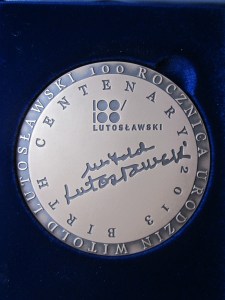
IMG_7475 copy IMG_7473 copy

Non-Polish recipients included the German musicologist Martina Homma, the Russian musicologist Irina Nikolska, the American composer and author of the first major study of Lutosławski’s life and work, Steven Stucky, and two British writers: Charles Bodman Rae and myself.  James Rushton of Chester Music accepted the medal as Managing Director of Lutosławski’s publishers, Chester Music.  The following day, Anne-Sophie Mutter and Antoni Wit also received the medal on the stage of the Philharmonic Hall at the end of the opening centenary concert.  The Poles are good at this type of recognition and we were all honoured and touched by the generosity of the gesture.

Day 2 (Friday, 25 January)

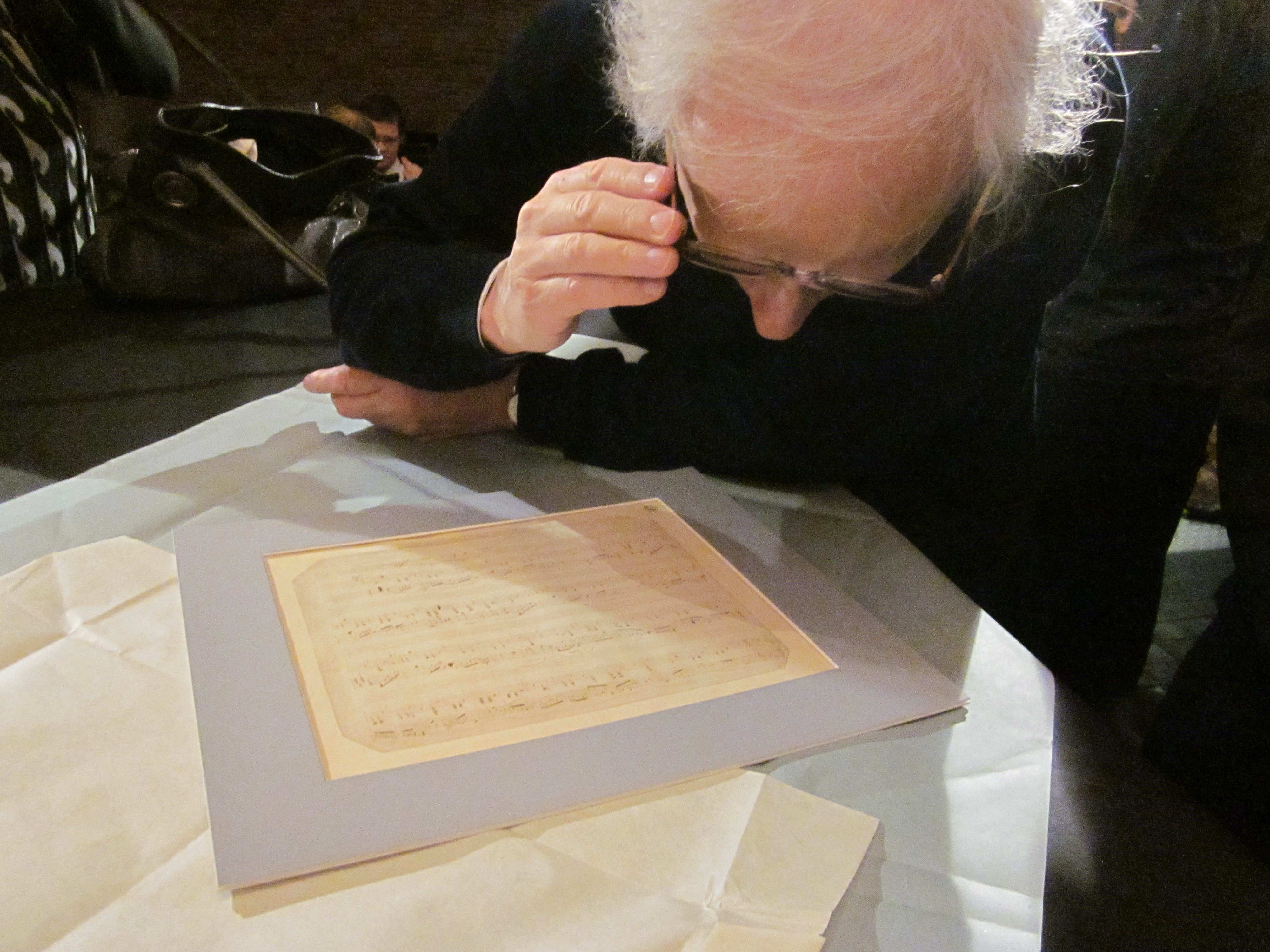
Today was the big day and a packed programme for the visiting guests.  First stop was the Chopin Museum, where we were shown a recently purchased autograph of Chopin’s Waltz in F minor.  Krzysztof Meyer inspected it closely.

IMG_7426 copy

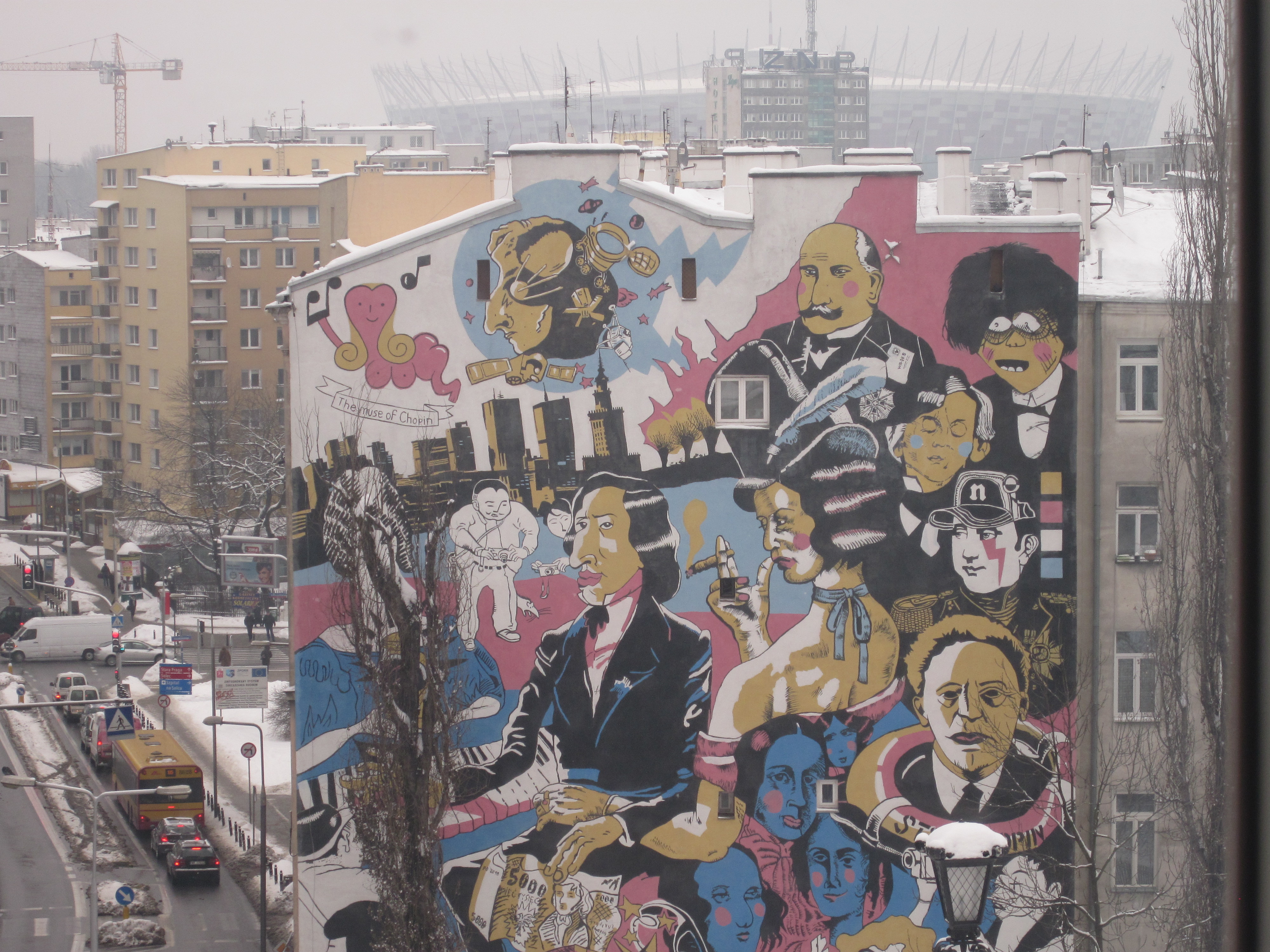
The Director of the Chopin Institute Artur Szklener and the Senior Curator of the Chopin Museum Maciej Janicki were our expert guides. Janicki then took us through the interactive displays and artefacts installed in the museum. We could also glimpse a more recent tribute to Chopin in the shape of a giant mural on a nearby building.  You can see the even more giant and infinitely less prepossessing national stadium on the other side of the River Vistula.

IMG_7430 copy

At lunchtime we moved across from the reconstructed Ostrogski Palace that houses the Chopin Museum to the ultra-modern facilities of the National Frederic Chopin Institute.  We weren’t there for Chopin, but for a press conference to launch a smartphone app: Witold Lutosławski: Guide to Warsaw.  As I write, it’s available only on Android; the IoS version is awaiting approval from Apple.

4027574

I was impressed, not only by the way in which the creators outlined their intentions – principal among the people involved were (from left to right above) Grzegorz Michalski, President of the Lutosławski Society, Danuta Gwizdalanka, Kamila Stępień-Kutera and Artur Szklener – but also how good the application looked.  It’s been designed by the Kraków-based company NETIGEN and project-managed by a former music student Kamil Ściseł.

7149506The app has English and Polish versions, numerous photos, spoken and written texts, and it guides the user through Lutosławski’s Warsaw, visiting over fifty locations.  The team decided early on not to include music so as to keep the app manageable.  It seemed from the demonstration to be both handsome and user-friendly and should prove to be a major source of interest to a wide spectrum of people around the world.  It will be much cheaper for those with foreign SIM cards to use at home than on the streets of Warsaw, but it is designed to inform users who are following Lutosławski’s footsteps either on the ground or virtually.

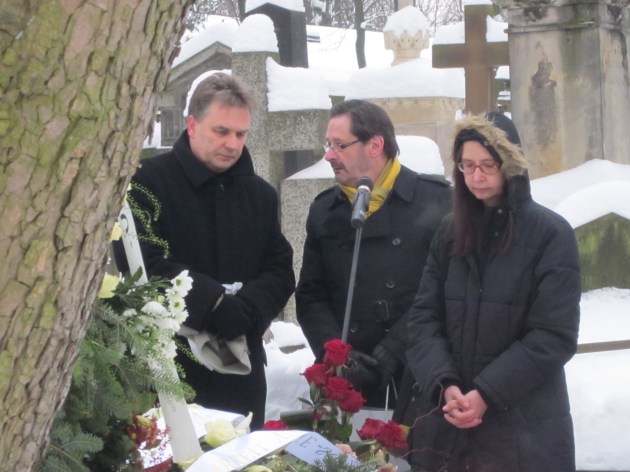
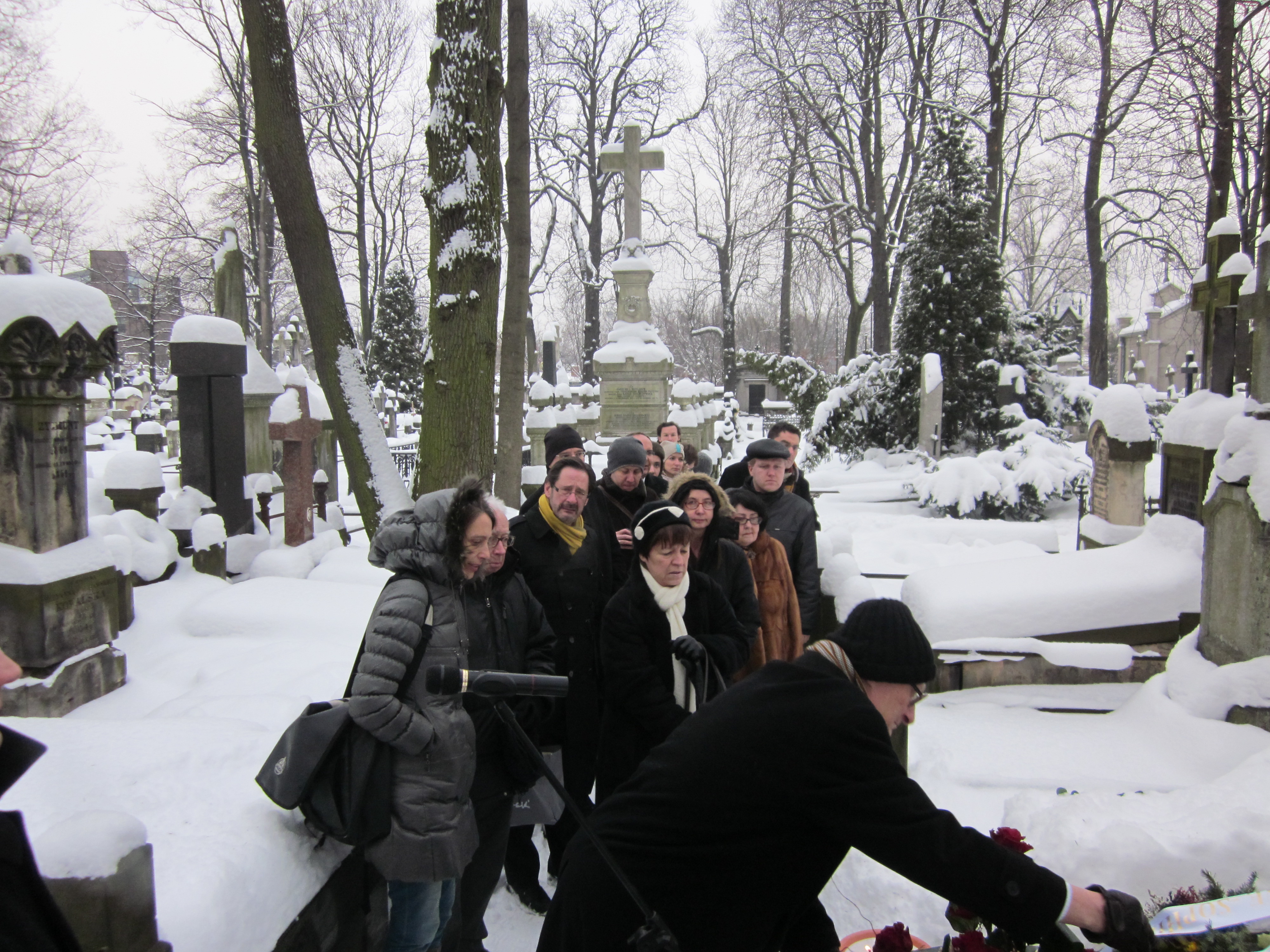
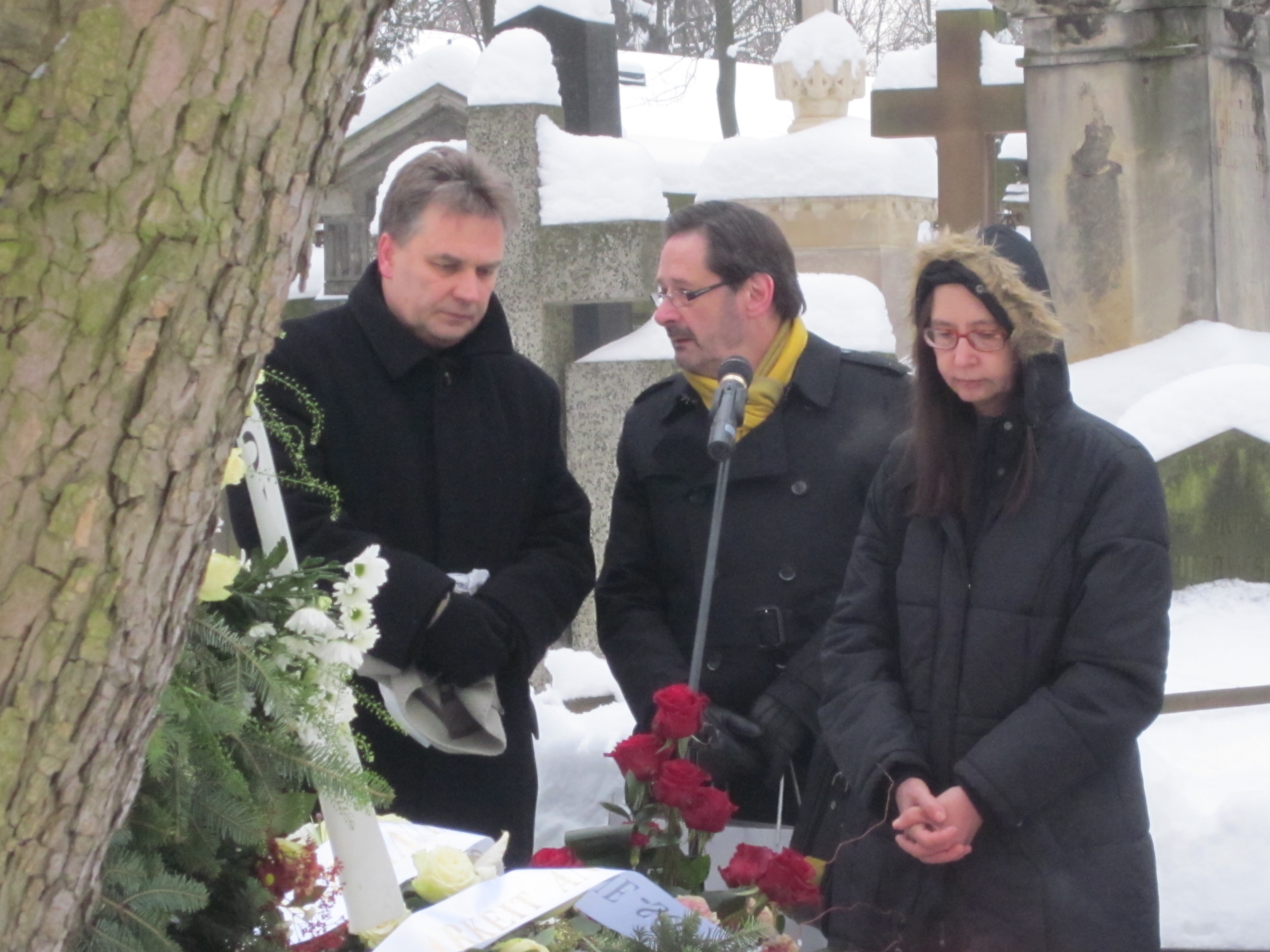
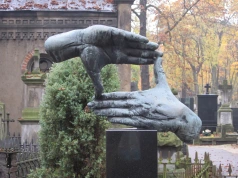
From the press confeence it was on to Warsaw’s Powązki Cemetery, where Lutosławski was buried on 16 February 1994.  Most of us had been there many times before, not least because there are the graves of so many famous creative artists in its grounds.  Lutosławski’s grave is close by those of many other musicians.  It was getting pretty cold by mid-afternoon and the snow had piled up.  Earlier visitors had, however, cleared the gravestone of Lutosławski and his wife Danuta and it was already covered in huge wreaths.
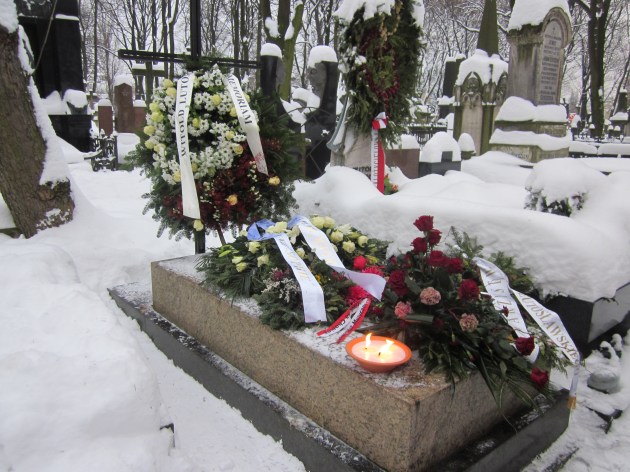
IMG_7458 copy

There was little room in the space between the rows of graves to fit everyone in.  Krzysztof Meyer adjusted the wreath ribbons.

IMG_7442 copy

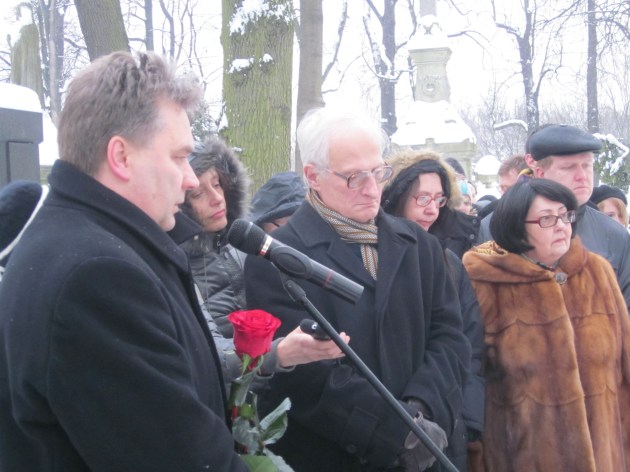
Speeches were made by the President of the Polish Composers’ Union Jerzy Kornowicz and by Steven Stucky.
IMG_7446 copy

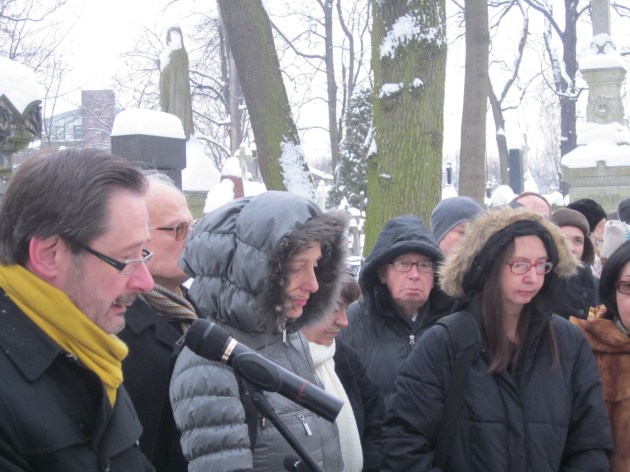
In the photo above, you can see (from left to right) Jerzy Kornowicz, Krzysztof Meyer, Martina Homma and Irina Nikolska.  Below, Steven Stucky, Krzysztof Meyer and Danuta Gwizdalanka partly hidden, Mieczysław Tomaszewski, Martina Homma and Irina Nikolska (also partly hidden).
IMG_7448 copy

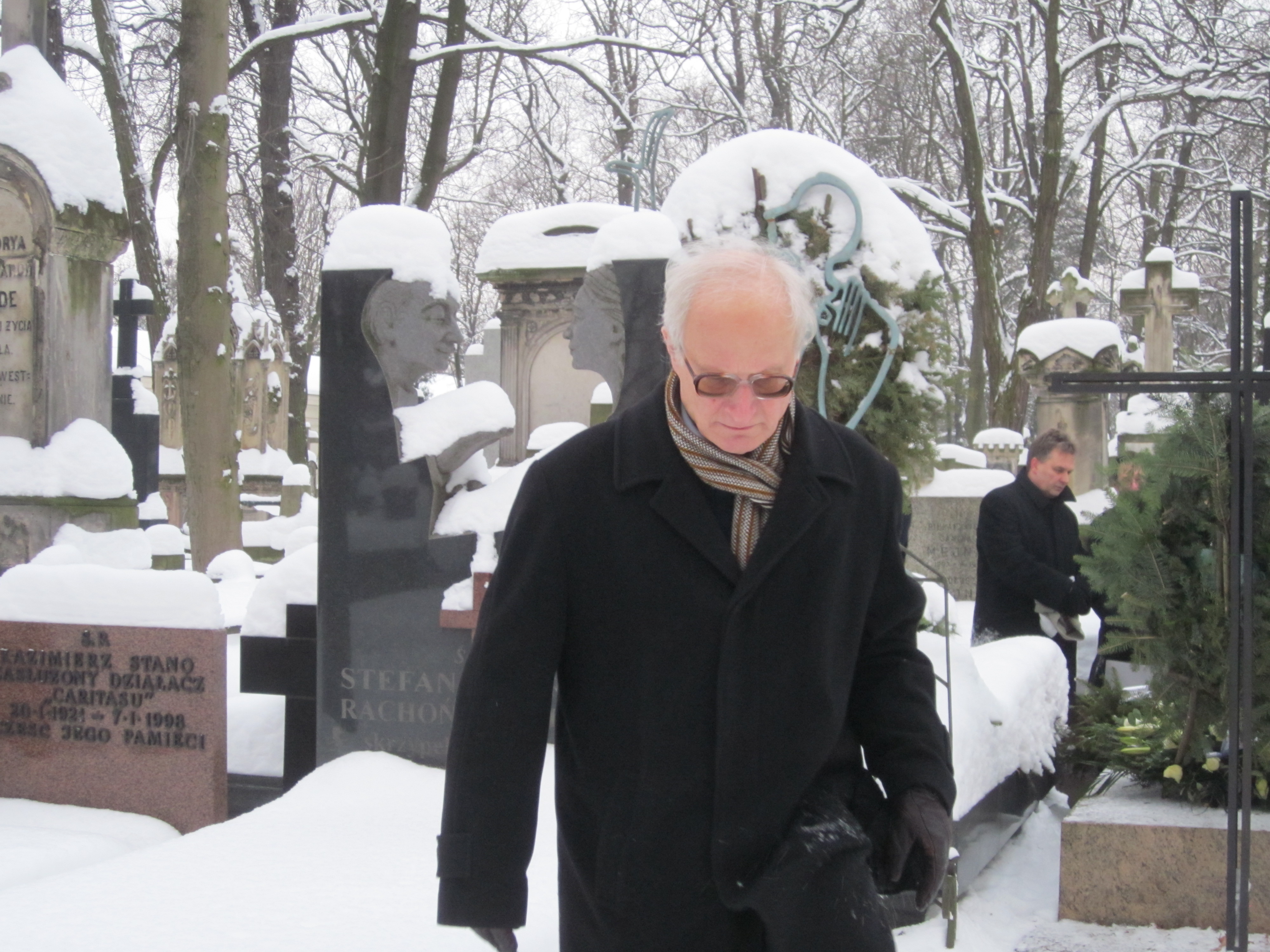
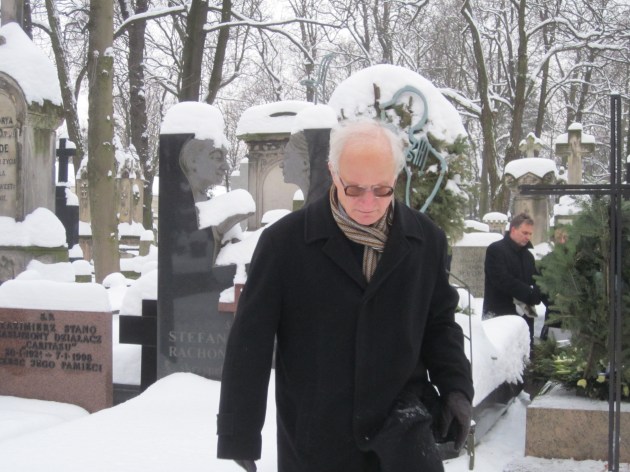
Being a little frivolous by nature, I couldn’t help noticing that the profile of the conductor Stefan Rachoń behind Lutosławski’s grave had been lent a certain Victorian air by the accumulation of snow.

IMG_7440 copy

I stepped the other side and was followed by Meyer through the snow drifts between the graves.  I then took a final photo of Kornowicz, Stucky and Homma.
IMG_7456 copy

IMG_7455 copyThe major event on the centenary of Lutosławski birth was the evening’s concert by the Warsaw Philharmonic under Antoni Wit.  It was an interesting and in the event a brave choice to open with a piece not by Lutosławski but by one of the younger generation whom Lutosławski helped with scholarships and other funding.  Pawel Szymański (b.1954) is arguably the best-known Polish composer of his generation, but he’s been out of the limelight for some time, mainly finishing his opera Qudsja Zaher (premiere, Teatr Wielki, Warsaw, 20 April 2013).  His new orchestral piece, Sostenuto, is characteristically oblique, slow-moving (initially) and demanding of concentration.  Its main climax approached Lutosławski’s in intensity and it subsided in a similar fashion.  Szymański dedicated Sostenuto to Lutosławski, including a brief reference to the latter’s Partita (which I missed) and ended with a veiled reference, also missed, to Brahms’s Piano Concerto no.1.  Szymański remains as enigmatic as ever.

Wit’s performance of Lutosławski’s Third Symphony was solid and well-paced, even if it didn’t fully catch fire.  The fireworks came with Anne-Sophie Mutter’s performance of Partita-Interlude-Chain 2 in the second half.  This is her piece (These are her pieces?) and she gave them all the subtlety and passion that they deserve.  The hall was packed and it was great to meet up again with friends like the conductor Wojciech Michniewski (who’s conducting the premiere of Szymański’s opera) and the pianist and composer Zygmunt Krauze.

Day 3 (Saturday, 26 January)

The official celebrations are over for the time being.  I decided to stay on for a few days, and today I had two events. The first was completely unrelated to Lutosławski.  It was a piano recital by the Hungarian-born, Polish-domiciled Szábolsc Esztényi of music by his friend Tomasz Sikorski (1939-88).  Sikorski, a contemporary of Krauze, was one of the most original voices in Polish music, and his strong, repetitive minimalist idiom is as challenging today as it was back in the 60s, 70s and 80s.

This recital was being given in the old Królikarnia palace in south Warsaw, which looked picturesque under lamplight, surrounded by deep snow, but was pretty cold inside too.  The cause was the launch of two CDs – issued by Bôłt records in association with DUX and Polish Radio among others – of music by Sikorski.  Esztényi’s double CD also includes two of his own works (Creative Music no.3 in memoriam Tomasz Sikorski, 1989, and Concerto, 1971).  There’s also Presence (2007) by Kasia Głowacka.  The other pieces, by Sikorski, are mainly archival – Echoes II (1963), Antiphones (1963), Diario 87 – as well as his Solitude of Sounds (1975).  The second CD is by John Tilbury, who plays his own Improvisation for Tomasz Sikorski (2011) alongside Sikorski’s Autograph (1980), Rondo (1984) and Zertstreutes Hinausschauen (1971).

The Bôłt series is a fascinating and inventive mix of archival performances and new interpretations and I’ll be doing a substantial survey of some of its repertoire – around ten CDs – in the near future.

Unfortunately, I was double-booked that night and had the chance to hear only two of the Sikorski pieces in Esztényi’s recital, including Sikorski’s Sonant (1967).  I was immediately struck by the correlation between Sikorski’s remorseless, expressionless repetitions and the opening of Lutosławski’s Cello Concerto.  I wonder…

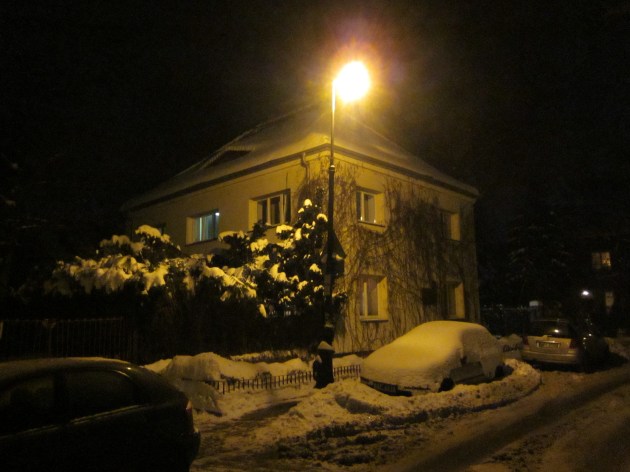
I rushed from south to north Warsaw via the magic of the metro, which offered relief from the temperatures which were plummeting towards -21C.  I was on my way to an informal supper party at Lutosławski’s house.  Unfortunately, I got lost on the way from the Plac Wilsona station and was lucky to find other souls out on the streets who could direct me towards Śmiała 39.  I recognised it immediately, although I’d not seen it in the snow before.
IMG_7470 copy

The giveaway was the relief plaque on the wall.

IMG_7468 copy

The house is now occupied by Lutosławski’s stepson and his wife, who welcomed us all inside with whiskey, wine and good food.  It was nice to relax and to be back in this special place.  At one point, we were led up to Lutosławski’s studio on the first floor (the lit window on the exterior photograph above), where I had spent three days exploring his books, sketches and scores in September 2002.  The arm of the studio containing his desk and main bookshelves (by the lit window) is much as I remember it, whle some of the other bookshelves have been removed or replaced.  Sadly, Lutosławski’s 1970 carpet that he bought in London is no more, revealing the clunky parquet flooring which he had covered over for acoustic purposes.

Day 4 (Sunday, 27 January)

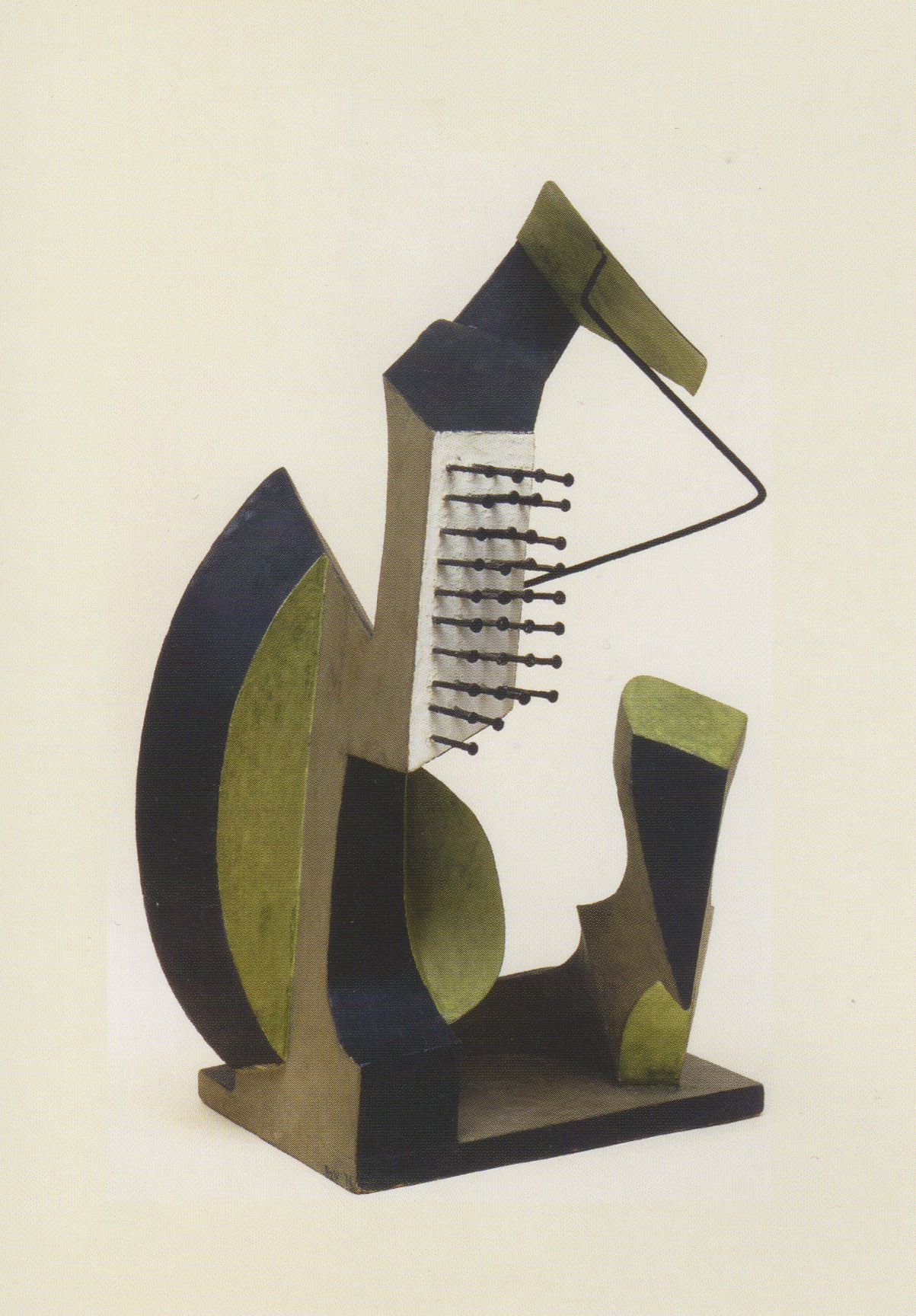
Bitterly cold again.  A morning trip to visit the newly opened gallery at the National Museum devoted to 20th-century and 21st-century Polish art.  It’s really good.  The Poles have developed such an extraordinary visual acuity, teamed with a range of symbolism (much of it socio-political), that every item has something intriguing and stimulating to offer.  There was Leopold Lewicki’s sculpture Musical Composition (1935), which offered multiple cubist viewpoints.

Leopold Lewicki Musical Composition 1935

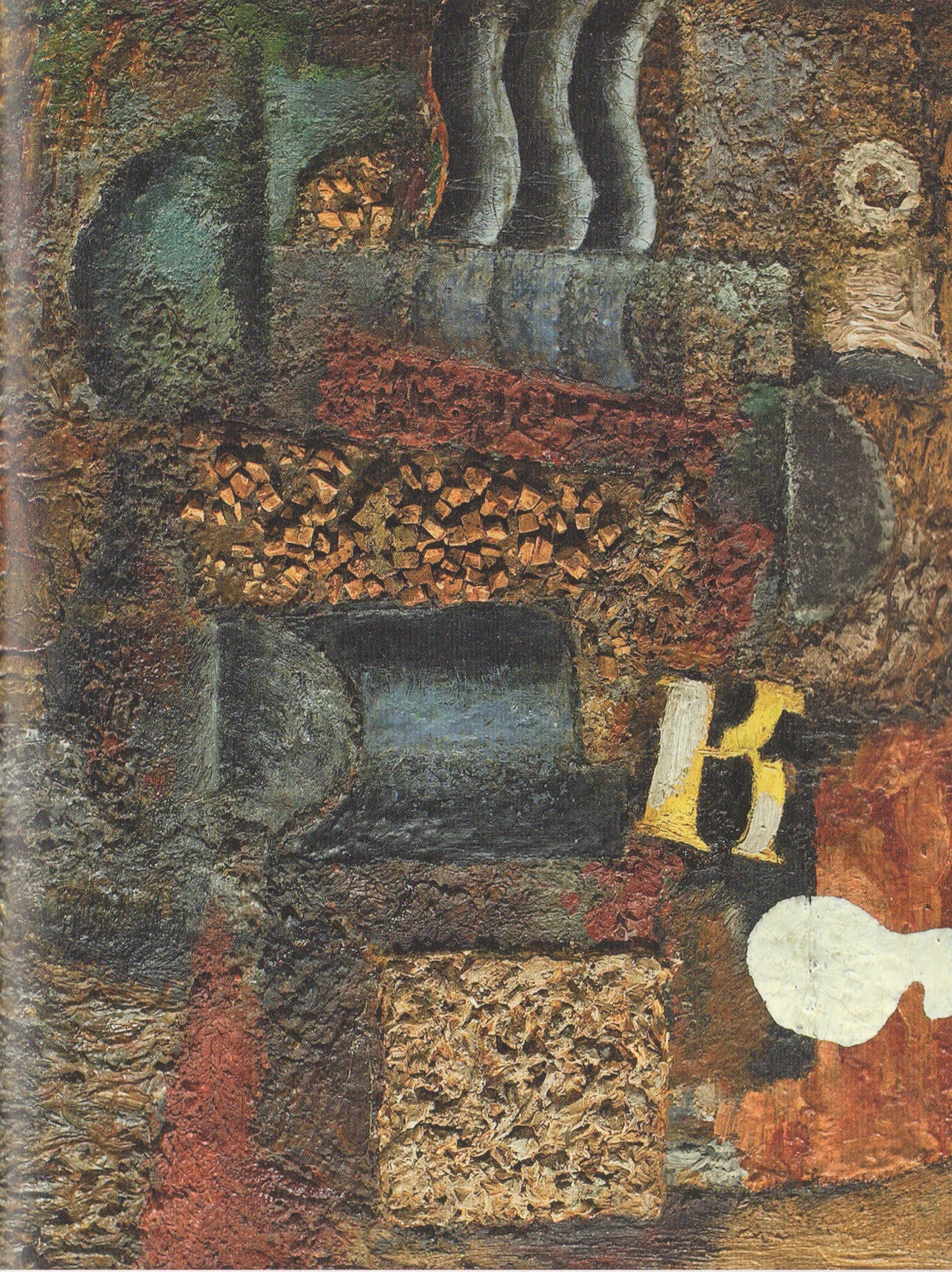
There were several pieces by Władysław Strzemiński, whose unistic paintings so inspired Krauze’s music in the 1960s.  His little piece Cubism – tensions of material structure (1921) was particularly striking.
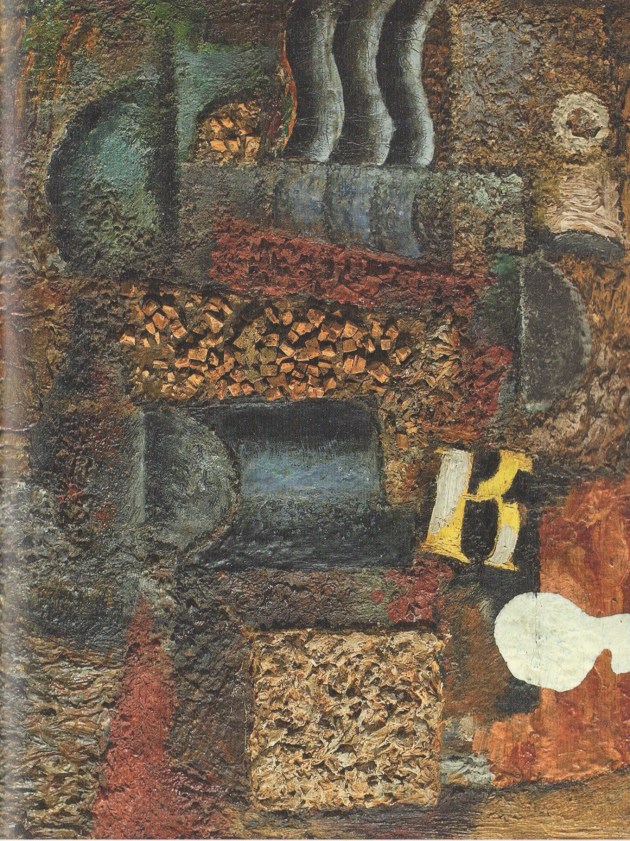
Strzemiński Cubism (1921)

The period since 1945 was represented by some socialist-realist pieces through to contemporary film and video.  If you are going to Warsaw, do visit.  I was most thrilled to see in the flesh again Bronisław Linke’s Autobus, about which I have enthused previously in these pages.  Close-up (and you can get much closer to the artwork here than in most of the other galleries I go to), this is a stunning, visceral work that has lost none of its power to shock since it was painted just over 50 years ago.

After a family lunch with my friends, it was off to the Lutosławski Studio at Polish Radio for a concert by the Polish Radio SO conducted by Łukasz Borowicz: Lutosławski’s Little Suite in its original version for chamber orchestra, Penderecki’s Piano Concerto in its revised version, and Stravinsky’s Symphony in C.  This is a lively orchestra, giving its all to two relatively minor pieces by the Polish composers (I’m afraid that Penderecki’s Piano Concerto is as vacuous and overscored a piece as it was when I heard its Polish premiere in the original version in 2002; others disagree).

Day 5 (Monday, 28 January)

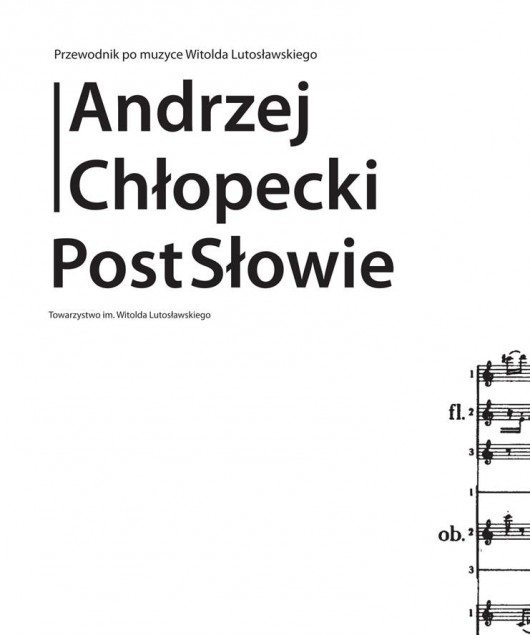
andrzej-chlopecki-przewodnik-po-muzyce-witolda-lutoslawskiego-postslowie-okladka-2013-01-29-530x635I was back at Polish Radio this afternoon for the press launch of a book on Lutosławski by Andrzej Chłopecki, who died last autumn.  It is subtitled ‘Przewodnik po muzyce Witolda Lutosławskiego’ and is available only in Polish.  I’ll return in a future post to this rather special guide, to a new photo album and an 8-CD box set of archival recordings also published to mark Lutosławski’s centenary.

My final Lutosławski experience was in the evening’s concert by the Wrocław PO under its conductor Jacek Kaspszyk.  The main item was Lutosławski’s Piano Concerto, played by Garrick Ohlsson, who won the Chopin Competition in Warsaw in 1970.  He was still feeling his way into the piece (he’d played it for the first time just two days earlier, but every performer has to start somewhere!) and frankly there was no comparison with Krystian Zimerman’s magical performance in London with the Philharmonia under Esa-Pekka Salonen two days later.  In the same way that the Philharmonia celebrations for Lutosławski are pairing him with two of his favourite composers (Debussy and Ravel), the Wrocław PO completed its concert with dynamic performances of Stravinsky’s Firebird suite and Ravel’s La Valse.

And so, as the temperature rose on Tuesday to a balmy 0C, I left Warsaw for London, thoroughly invigorated and grateful to friends old and new for five days of celebration for a composer who has been hugely important to me since I was a student.

Oh, the brush!

The Poles are so imaginative.  The Adam Mickiewicz Institute, which along with the Institute of Music and Dance and the Witold Lutosławski Society has brought these events to fruition, decided to give a special present to its guests on Friday evening at the Philharmonic.  It looked at first glance like an old-fashioned pencil box.

IMG_7477 copy

On opening it, there was a familiar, early photo of Lutosławski working at his piano.

IMG_7478 copy

Underneath, inside the box, was a pencil and a mini version of the brush in the photo.
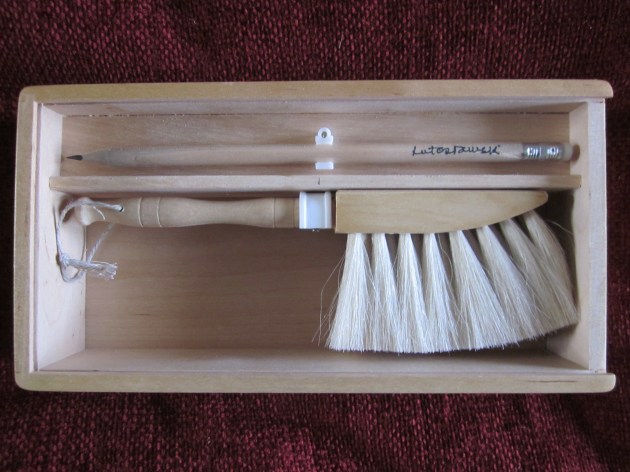
IMG_7480 copy

What was it for, you may ask?  Clue: Lutosławski worked in pencil, frequently rubbing out and correcting his sketches and scores.  And he was a naturally tidy man and disliked mess…  I remember seeing a brush on his desk when I was in his studio in 2002, so this resonated with me.  What a brilliant gift to bring back home!
• Lutosławski Centenary Week in Poland

image_galleryI thought it might be of interest to show how Poland is celebrating Lutosławski’s centenary in its concerts over the coming seven days.  I’ve drawn my information mainly from the official Lutosławski Year website, 100/100 Lutosławski.  The site is now much more populated with events and information than it was when it was launched a month ago, so it’s well worth a visit.

Monday, 21 January 2013

Łódż 
The Łódż PO’s January with Lutosławski festival begins with a talk by the President of the Witold Lutosławski Society, Grzegorz Michalski.

Tuesday, 22 January 2013

Łódż 
January with Lutosławski continues with events around the String Quartet and the composer’s approach to the psychology of listening.

Warsaw
Concert by the National Philharmonic CO, conducted by Jakub Chrenowicz: Lutosławski Preludes and Fugue, Panufnik Violin Concerto (Isabelle van Keulen) and Beethoven Grosse Fuge (orch. Weingartner)

Thursday, 24 January 2013

Łódż 
‘Sunspots’, a contemporary realisation of popular songs that Lutosławski wrote in 1957-63 under the pseudonym ‘Derwid’, by the composer and singer Agata Zubel and the cellist Andrzej Bauer, with electronics by Cezary Duchnowski and Ewa Guziołek-Tubelewicz.  This looks absolutely fascinating, and if I weren’t scheduled to be in Warsaw I’d certainly want to be at this concert and the post-concert discussion.

Warsaw
Chain X festival (24 January – 9 February)
Opening concert by AUKSO CO, conducted by Marek Moś: Lutosławski Funeral Music, ‘The Sea’ from Five Songs (Roksana Wardenga), Grave (Marcin Zdunik) and Paroles tissées (Marcel Beekman), plus poetry by Valéry, Michaux and Nowid (Maja Komorowska).
Streamed live at 18.30 GMT on http://www.worldconcerthall.com via Polish Radio Dwójka.

Wrocław
Concert by the Lutosławski Quartet of Wrocław with Garrick Ohlsson: Lutosławski String Quartet and Bartók Piano Quintet.

Friday, 25 January 2013 – Centenary Day

Katowice
Concert by National SO of Polish Radio, conducted by Alexander Liebreich: Lutosławski Symphony no.4, Cello Concerto (Miklós Perényi) and Concerto for Orchestra.
Streamed live at 18.30 GMT on http://www.worldconcerthall.com via Polish Radio Dwójka.

Łódż
A lunchtime discussion on the Cello Concerto between the cellists Tomasz Daroch and Andrzej Bauer and the conductor Joshua Dos Santos.
Evening concert: Gershwin Cuban Overture, Lutosławski Cello Concerto (Tomasz Daroch) and Brahms Symphony no.2.

Warsaw
Inaugural concert of Lutosławski Year
National PO, conducted by Antoni Wit: Szymański Sostenuto (premiere), Lutosławski Symphony no.3 and Partita-Interlude-Chain 2 (Anne-Sophie Mutter).

Wrocław
Concert by the Lutosławski PO of Wrocław, conducted by Jacek Kaspszyk: Lutosławski Fanfare for Louisville, Piano Concerto (Garrick Ohlsson), Stravinsky Firebird Suite and Ravel La Valse.  This concert will be repeated in Warsaw on Monday 28 January.

Saturday, 26 January 2013

Katowice
Concert by Silesian PO, conducted by Wojciech Michniewski: Lutosławski Funeral Music, Piano Concerto (Beata Bilińska) and Symphony no.3.

Łódż
Concert by the Lublin PO: Lutosławski Partita-Interlude-Chain 2 (Krzysztof Jakowicz) and Rachmaninov Symphonic Dances, with post-concert reminiscences of Lutosławski by Jakowicz.

Sunday, 27 January 2013

Warsaw
Concert by Polish Radio SO, conducted by Łukasz Borowicz: Lutosławski Little Suite (original version for chamber orchestra), Penderecki Piano Concerto (Florian Uhlig) and Stravinsky Symphony in C.  In all the flurry of Lutosławski activity, we mustn’t forget that 2013 marks the 80th anniversary of the births of Krzysztof Penderecki (23 November) and Henryk Mikołaj Górecki (6 December).
Streamed live at 18.30 GMT on http://www.worldconcerthall.com via Polish Radio Dwójka.

• WL100/12: ‘Breaking Chains’, BBC 1997

On 17 January 1997 the BBC began the second part of its Lutosławski festival, Breaking Chains, with three days of events at the Barbican Centre in London.  It had been preceded by five days of complementary events at the GSMD. Altogether, this was one of the most concentrated celebrations of Lutosławski’s life and music.

WL Breaking Chains, coverThe repertoire covered on 17-19 January 1997 included: Twenty Polish Christmas Carols (1946/1989), Straw Chain (1951), Concerto for Orchestra (1954), Five Songs (1957), Funeral Music (1958), Jeux vénitiens (1961), Trois poèmes d’Henri Michaux (1963), String Quartet (1964), Paroles tissées (1965), Cello Concerto (1970), Les espaces du sommeil (1975), Mi-parti (1976), Grave (1981/82), Symphony no.3 (1983), Chain 1 (1983), Partita (1984/88), Chain 2 (1985), Chain 3 (1986), Piano Concerto (1988), Interlude (1989), Chantefleurs et Chantefables (1990), Symphony no.4 (1992) and Subito (1992).  When combined with the pieces performed by GSMD students, this list is remarkably comprehensive (of the orchestral works, only the Double Concerto was missing).

It was a tremendous week.  I count myself lucky to have been there, and all praise to the BBC and GSMD for putting so many resources and such imagination into the project.  We’ll probably not see the like again.  The relevant pages of the programme are reproduced below.

WL Breaking Chains, BBC. 17-19.01.97:1

WL Breaking Chains, BBC, 17-19.01.97:2

WL Breaking Chains, BBC, 17-19.01.97:3

WL Breaking Chains, BBC, 17-19.01.97:4

• WL100/11: ‘The Hidden Composer’

The Hidden Composer: Witold Lutosławski and Polish Radio

An exhibition first shown as part of the Breaking Chains festival,
Barbican Centre, London, 13-19 January 1997

I put this exhibition together in order to illuminate an area of Lutosławski’s life and work that had been obscured by history and largely ignored by commentators.  Lutosławski himself consistently drew a veil over it.  Yet it reveals much about the creative artist’s dilemmas at an extraordinarily difficult time.  Since 1997, other facets have come to light (I will return to them later in the series), but I have reproduced the exhibition faithfully rather than update it.  I have, however, added a few sound files which I could not incorporate at the time.  The illustrations were never of top quality, having been photocopied in Poland, but I hope that they give a flavour of the period and the publication from which they come.

Accompanying brochure

In these days of the Internet, it is hard to imagine how limited were the means of communication in Poland in the aftermath of World War II.  It took, for example, until the 1950s for a full network of radio stations and masts to be established (this was, of course, before television).  Each and every technical development was celebrated in Polish Radio’s listings magazine, Radio i Świat (‘Radio and the World’).

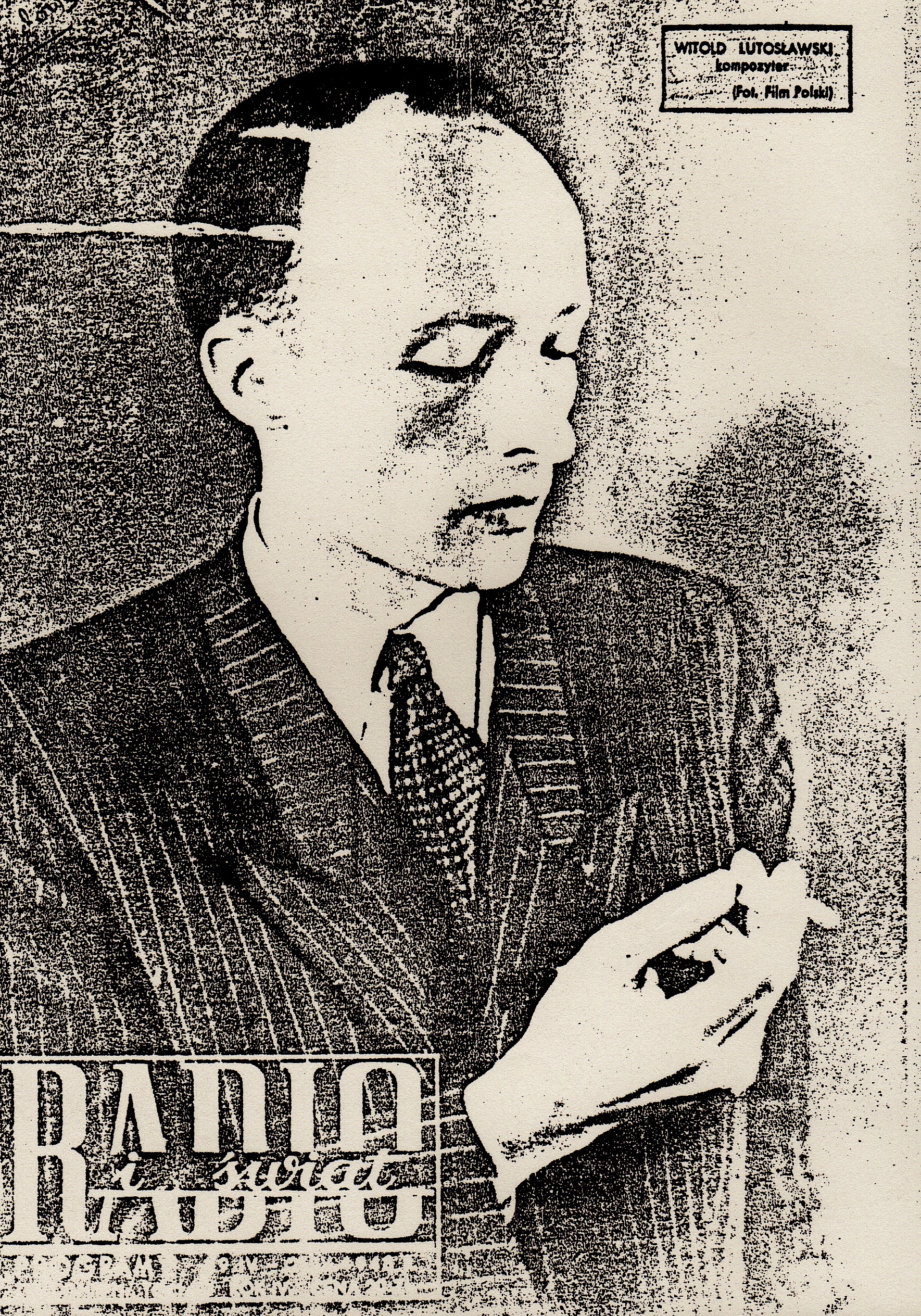
Radio i Świat logo3Like The Radio Times in the UK, Radio i Świat was intended as a printed information service for its listeners, primarily for its broadcast programmes.  But it was much more than that.  It first appeared in 1945 and for several years included technical diagrams for those wishing to build their own wirelesses.  Its listings, at least in the early years, also included details of foreign radio programmes, such as those on the BBC Home and Light Services.

When, however, the political situation began to change in 1948, Radio i Świat changed with it.  Whereas newspapers and journals promulgated the main shifts in Party policy, a magazine like Radio i Świat reflected them in ways which have not generally been regarded as quite so significant.  Its pages, however, are often more vividly revealing and surprising than other sources in the musical detailing of this momentous post-war period.

The Hidden Composer looks at Lutosławski’s musical profile and his cultural-political context from the end of the war until the early 1960s, as through the eyes of a reader of Radio i Świat.  It is not the whole story, but it is an important part of it.

[The following summaries accompanied the six panels of the original exhibition.
You will find the full texts, images and sound files for each of these panels
either by clicking on the relevant heading below
or by scrolling the ARTICLES tab above.]

PANEL 1: 1945-48  RADIO i ŚWIAT

In the early years after the war, Radio i Świat had a generously international outlook.  Photographs from the UK, for example, included Princess Elizabeth at a BBC microphone.  But increasingly the magazine looked inwards, as did Poland as a whole.  Photographs included one of Lenin, but more frequently the front covers featured the country’s most outstanding classical musicians – Fitelberg, Palester, Bacewicz and Panufnik – as well as popular singers like Godlewska and the male vocal quartet ‘Czejanda’.  Polish Radio’s Festival of Slavonic Music in November 1947 was a signal of the post-war grouping into Eastern and Western European spheres of influence.

PANEL 2: 1946-49  MUSIC FOR RADIO

RiŚ 48:16Lutosławski reached the front cover of Radio i Świat in April 1948, shortly after the premiere of his First Symphony (it was banned a year later).  During the 1940s and 1950s, his most secure source of income was his work for Polish Radio.  He wrote incidental music for poetry programmes and for radio drama (some forty productions).  Early titles included Hemingway’s For Whom the Bell Tolls and a children’s programme based on Kipling’s The Cat that Walked by Himself.  Prawda o Syrenach (The Truth about the Sirens, 1947) exhibits the use of jazz, while Fletnia chińska (The Chinese Flute, 1949) shows the increasing politicisation of radio broadcasting.  Lutosławski’s short cantata Warszawie-sława! (Glory to Warsaw!) is a tribute to the post-war rebuilding of the Polish capital, an undertaking that was frequently praised on the covers of Radio i Świat.

PANEL 3: 1949-53  SOCREALIZM

The politicisation of all public bodies came to a head culturally with the import of socialist realism (socrealizm) from Stalin’s Soviet Union.  Composers were cajoled to write for the mass of the people.  Music was subject to peer review at Polish Radio and the Composers’ Union, and Lutosławski had little choice but to accede to ‘requests’ for mass songs.  Most of these were published in Radio i Świat and broadcast on Polish Radio, where tapes of some still exist.  His least political song – Wyszłabym ja (I Would Marry) – was his most popular, and he even recorded it himself in 1950 (the tape is no longer extant).

PANEL 4: 1953-56  TRANSITION

After Stalin died, in March 1953, there was a protracted period of transition towards greater artistic freedom.  Radio i Świat reflected many of these changes.  Mass songs became less political, although two of Lutosławski’s soldiers’ songs appeared and arguable his best song – Towarzysz (Comrade) – was included in a special programme ‘Songs of the Fatherland and the Party’ as late as July 1955.  Radio i Świat also indicates that the ban on Lutosławski’s First Symphony was not as watertight nor as long-lasting as has been previously assumed (it was bropadcast in August 1954).  And, gradually, music from the ‘decadent’ West was published in the magazine, beginning with Mississippi (Ol’ Man River) in March 1954.

PANEL 5: 1956-59  NEW MUSIC

The arts played a significant part in the cultural renaissance of Poland in the mid-1950s.  Music advanced on the popular front and in the appearance of the first ‘Warsaw Autumn’ International Festival of Contemporary Music on 1956.  Radio i Świat maintained its educational tone by publishing articles, with musical examples, on twelve-note music by Berg and Webern.  Has any other radio listings magazine ever provided such a service to its readers?  Lutosławski kept a fairly low public profile while he developed a new musical language in Five Songs (1957), Funeral Music (1958) and Jeux vénitiens (1961), works which would launch his international career.

PANEL 6: 1957-63  ‘DERWID’

Lutosławski’s compositional ties with Polish Radio continued into the 1960s, partly providing incidental music for radio dramas (such as Słowacki’s tragedy Lilla Weneda), partly writing some three dozen popular songs – foxtrots, waltzes, tangos – under the pseudonym ‘Derwid.  ‘Derwid’ is the harp-playing king in Lilla Weneda, although a different pseudonym appears on the manuscripts of the first six songs.  Lutosławski-Derwid had an evident affinity with popular idioms if the quality of these songs is anything to go by.  Among the most memorable are the Gershwinesque Zielony berecik (The Little Green Beret) and the tango Daleka podróż (Distant Journey), with its quote from Debussy’s La Mer.  Nie oczekuję dziś nikogo (I’m Not Expecting Anyone Today) was his most popular song and the only one to win ‘Radio Song of the Month’.  It was also one of some ten Derwid songs printed in the ever-informative Radio i Świat and its 1958 successor, Radio i Telewizja.

Acknowledgments

This exhibition was funded by Cardiff University of Wales and the Guildhall School of Music and Drama in London.  Valuable assistance was also given by Polish Radio and the National Library in Warsaw and the Paul Sacher Foundation in Basel.  Sincere thanks are due to a number of people without whose help and advice the exhibition would not have been possible: Urszula Kubicka, Michał Kubicki, Elżbieta Markowska and Bohdan Mazurek in Warsaw, Martina Homma in Köln, Alasdair Nicolson, Alessandro Timossi and Tomasz Walkiewicz in London, and David Hopkins, Sue House and Sue Sheridan in Cardiff.

© 1997 Adrian Thomas

• WL100/10: ‘Breaking Chains’, GSMD 1997

Possibly the most intense and wide-ranging survey of the life and works of Witold Lutosławski that has ever taken place was that at the Barbican, London, in January 1997.  The climax was three days of concerts, organised by the BBC under the banner Breaking Chains on 17-19 January.  I’ll return to these events in a future post.

Preparatory to these concerts, the Guildhall School of Music and Drama, in a different part of the Barbican complex, organised five days of complementary events under the Breaking Chains umbrella, 13-17 January 1997. These included concerts, workshops, talks and discussions, as well as an exhibition.  The participants included the GSMD SO and CO, student chamber ensembles and soloists, and several speakers: Steven Stucky, Józef Patkowski, Charles Bodman Rae, John Casken and myself.

WL Breaking Chains, GSMD 13-17.01.97

The GSMD Breaking Chains repertoire included: Symphonic Variations (1938), Symphony no.1 (1947),  Little Suite (1950/51), Straw Chain (1951), Silesian Triptych (1951), children’s song cycles Autumn and Spring (1951) and four other children’s songs (1953-54), Jeux vénitiens (1961), String Quartet (1964), Symphony no.2 (1967), Livre pour orchestre (1968), Variations on a Theme by Paganini for piano and orchestra (1941/78), Novelette (1979), Chain 1 (1983), Fanfare for Louisville (1986), Prelude for GSMD (1989).  In pre-concert and afternoon events during the BBC part of Breaking Chains, GSMD students also performed Overture for Strings (1949), Five Folk Melodies (1945/52), Preludes and Fugue (1972), Partita for violin and piano (1984), songs and music for piano, as well as Chain 1 for the second time.

There were some fantastic student performances during this GSMD week.  Indeed, Symphony no.2, Novelette and Fanfare for Louisville were issued on the SOMM label (SOMMCD 219) in 1999, alongside performances of two works conducted by the composer on his visit to GSMD on 11 May 1989: Prelude for GSMD and the Cello Concerto (1970), in which the soloist was Louise Hopkins.  My strongest recollection is of the performance of the Second Symphony under the dynamic direction of Wojciech Michniewski.

Lutosławski: Symphony no.2

• Movement 1: ‘Hésitant’  

• Movement 2: ‘Direct’ (the track begins c.15″ too early with two brief events for trombones/tuba and bassoons from the end of ‘Hésitant’; ‘Direct’ begins with ppp double basses, partly masked by a final bassoon utterance)  

My own involvement also included directing a workshop performance of Jeux vénitiens and putting together an exhibition called The Hidden Composer: Witold Lutosławski and Polish Radio, of which more anon.

• Lutosławski in the January pipeline

I have just been invited by the Polish Minister of Culture to join the Honorary Committee for Witold Lutosławski Year in 2013, which is an honour in itself.  I’m never quite sure what honorary committees do or are expected to do, but I promise to knuckle down and contribute as best I can.

Having just spent a few weeks preparing for last Saturday’s CD Review round-up of Lutosławski CDs on BBC Radio 3 – an hour’s discussion, live-on-air, with Andrew McGregor – I thought I’d have a few days off.  But Lutosławski continues to beckon.  So here are a few things that are coming up in the next month or so, not all of them yet accomplished.

• Around now, a German translation by Andrea Huterer of my paper ‘Lutosławski and Literature‘ (2010) will appear in ‘Witold Lutosławski. Ein Leben in der Musik’, Osteuropa 11-12 (Berlin, 2012).  This issue is being supported by the Polish Institute in Berlin.

• I’ve just written a very brief essay on ‘Lutosławski and his Performers‘ for the Polish Institute in Brussels.  It is for a Lutosławski tribute to be published in Dutch and French in January 2013 (all three versions should also be available online via www.culturepolonaise.eu).

• Also in January 2013, an interview I did a couple of months ago will appear in a centenary tribute to Lutosławski being published (in Polish) by the Wrocław Philharmonic.  The orchestra is not only named after Lutosławski but is the driving force behind the Opera Omnia series of Lutosławski CDs on the Accord label.

• On 23 January I am discussing Lutosławski’s Cello Concerto with Johannes Moser, in a pre-concert event for the Bournemouth SO, which gave the world premiere in October 1970.  This is part of the bicentenary celebrations of the Royal Philharmonic Society, which commissioned the concerto.  (The actual RPS anniversary is the next day, 24 January.)  I’m really looking forward to this encounter, at the Poole Lighthouse, between a music historian and one of the many young cellists who have taken this concerto into their repertoire.  The Lutosławski centenary falls two days later, on 25 January, when I might just pop over to Warsaw for the Polish inauguration of Witold Lutosławski Year.

• The Philharmonia Orchestra begins its Lutosławski series Woven Words on 30 January at the Royal Festival Hall in London.  Accompanying the series will be a substantial celebratory programme which includes several essays.  My ‘Parallel Lives of a Captive Muse‘ is one of them.  It’s already been published on the Woven Words website.

• Watch out for the fifth Lutosławski CD, with the BBC SO and Edward Gardner, which Chandos is releasing early in 2013 in its ‘Muzyka Polska’ series (First Symphony, Dance Preludes, Partita and Chain 2).  I’ve thoroughly enjoyed writing the booklet notes for these outstanding recordings and it’s been an(other) honour to be associated with it.

• I am currently writing a substantial profile of Lutosławski and his music for publication in late Spring 2013 (watch this space, and others!).

Well, I think those seven items are more than enough to be going on with!