• WL100/57: ‘el Derwid’ CD

It’s out!  Here’s something special for the Lutosławski centenary: a CD of eleven of his popular songs written under the pseudonym ‘Derwid’ in 1957-63.  Expect to be intrigued (the ‘el’ dimension) and blown away!  It’s just been released on CD Accord (ACD1922).  Here’s the track list, plus a little background in earlier posts: Zubel Zings! and WL100/42: 33 ‘Derwid’ songs published.

Derwid-obwoluta

• Sto lat! Jan Ekier (and Lutosławski)

Jan Ekier (2010)Happy Birthday to the Polish pianist Jan Ekier, whose 100th birthday today is being celebrated by a ten-hour marathon of Chopin performances (by younger pianists!) as part of the Chopin and His Europe festival in Warsaw.  This is entirely appropriate, because Ekier was the editor-in-chief of the National  Edition of Chopin’s music which followed Paderewski’s long-standing Complete Edition.  Chopin scholarship has moved on again since Ekier started his edition, but I’m surprised that he has no entry in the New Grove dictionaries, neither in 1980 nor in 2001.  His role within Poland as a pianist, teacher as well as editor is significant. He received Poland’s highest honour, the Order of the White Eagle (above) in 2010, at the same time as Henryk Mikołaj Górecki.  For a time he was also a composer – Kolorowe melodie for piano (1948) is his best-known work.

Ekier was a good friend of Lutosławski and his wife.  In Danuta Gwizdalanka’s fascinating texts for the mobile app. Witold Lutosławski. Guide to Warsaw, she quotes Ekier’s recollections of when he and Lutosławski shared a flat immediately after the end of World War II:

Aleja Waszyngtona [Washington Avenue] 22

Screen Shot 2013-08-28 at 19.37.08Witold Lutosławski lived here for just under a year in 1945-1946.  He was taken in by one of his school friends, the pianist and composer Jan Ekier, who was one of the first musicians to return to the ruins of Warsaw.  “Witold was looking for somewhere to stay for a while till things fell into place for him.  He lived in my apartment.  At first it was just us, but later we were joined by his wife, his housekeeper Bronia and a black cat,” Ekier later recalled.
In this apartment Lutosławski mainly composed programme music for radio and for two documentary films, By the Oder to the Baltic (directed by Stanisław Możdżeński) and Warsaw Suite (directed by Tadeusz Makarzyński).  On a commission from the Polish Music Publishing House [PWM], he also composed a cycle of 12 easy works for piano – Folk Melodies.  The conditions in that flat were such that Lutosławski and Ekier couldn’t help but overhearing each other working.  “We were in neigbouring rooms, I guess we each had our own instrument, because I still had an extra borrowed piano,” explained Ekier, “As we were both fascinated by Polish folk music, when he was writing his Folk Melodies, I was writing my Colourful Melodies
[…]
The hard winter of 1945/46 made life difficult for residents of Warsaw, who had to shelter somehow in unheated apartments, but it also made things easier for those needing to cross the Vistula [the bridges had not yet been rebuilt].  You simply walked across the ice.  “We took it as a gift of Providence,” was Jan Ekier’s recollection of the frozen river.
“In our bachelor days we had plenty of culinary adventures, because we were left to fend for ourselves,” said Ekier.  “There were plenty of surprises resulting from the fact that neither of us had any particular talent for cooking.  Sometimes the neighbours helped out, because if we wanted to cook up something hot, it never turned out right.  Later on, a measure of normality was achieved when Witold lived at my place together with his wife…”

Ekier was a fine pianist, and came eighth in the third International Chopin Competition in Warsaw in 1937.  I first heard him when he played in the concert that inaugurated the Chopin Competition in 1970.  On that occasion, he introduced me to the orchestral music of Szymanowski in a scintillating performance of the Symphonie Concertante. It was great to relive that moment this morning: Petroc Trelawny programmed the finale (with the Warsaw PO under Witold Rowicki) on BBC Radio 3’s Breakfast at 07.20, following my tip-off to him on Twitter yesterday.  Nice work, Petroc, and thanks for the mention!

Here is Ekier in a recording of Chopin’s Polonaise in A flat, recorded in the late 1950s and released on the Muza label.

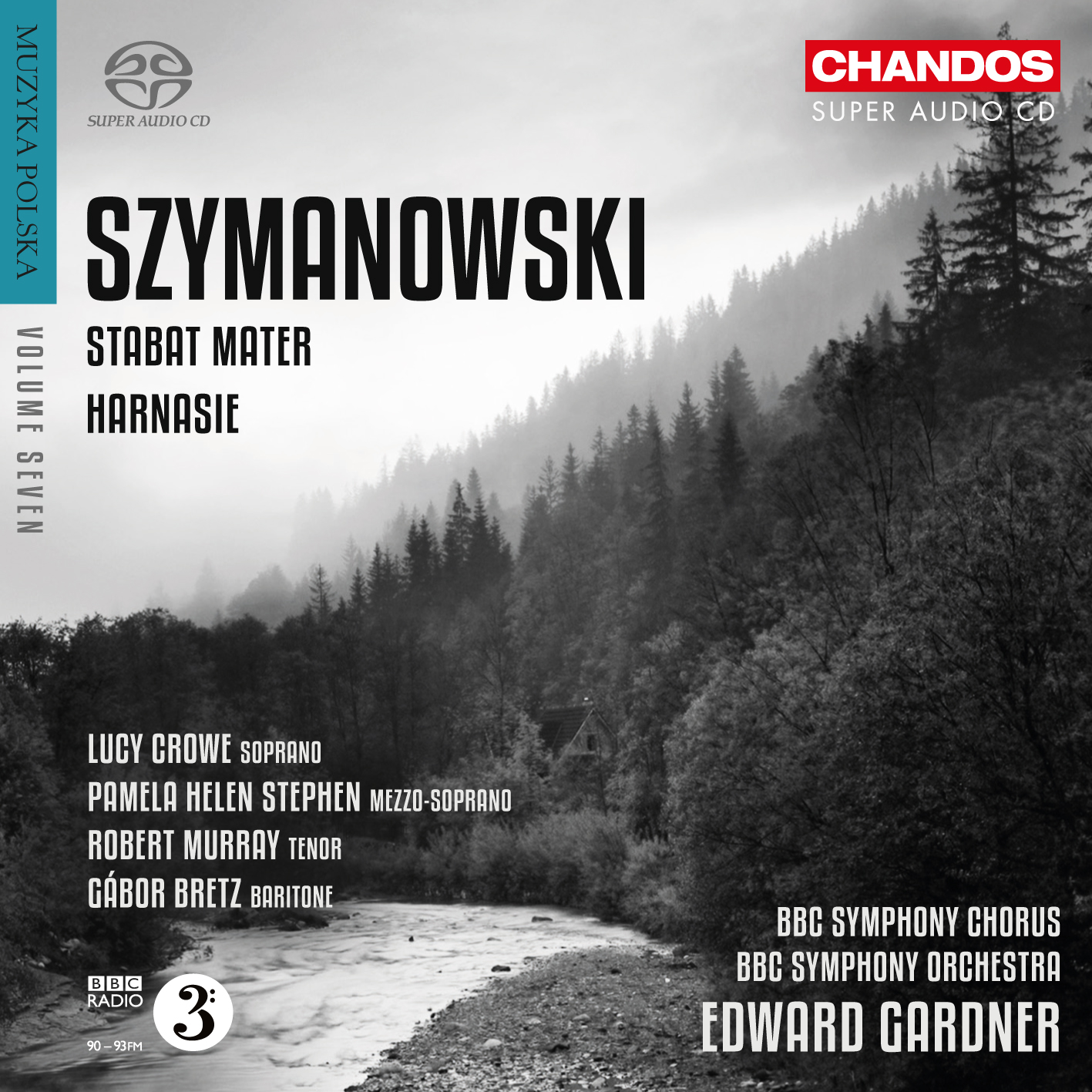
• New CD Note (Szymanowski vol.2/Chandos)

CHSA 5123Eight months after its first Szymanowski CD with the BBC SO under Edward Gardner, Chandos has issued the second volume, combining two works from the composer’s ‘Polish’ period to go along with Louis Lortie’s brilliant recording of the Symphonie Concertante on vol.1.  Although I’ve not heard the new CD yet, I’m expecting equally fresh and vivid accounts of the Stabat Mater (1925-26) and the ballet Harnasie (1923-31), not least because of the addition of the BBC Symphony Chorus and an excellent raft of singers.  These include Lucy Crowe, who sings so beautifully on Chandos’s CD of Lutosławski’s vocal works (2011).

Here’s the link to my booklet note for this new Szymanowski CDor you can scroll the CD NOTES tab above.

• Lutosławski Report (Warsaw, 2013)

The Institute of Music and Dance in Warsaw has today issued a Report on the presence of Witold Lutosławski’s music in the musical life of Poland and the world.  Its author is Ewa Cichoń.  It covers mainly the years since Lutosławski’s death in 1994, up to the end of 2012.  The report, which exists in English and Polish pdfs (links below), contains a wide range of data:

• Performances in Poland and abroad
• Selected festivals in Poland
• CD recordings
• Literature
• Literature – list of publications
• Films and DVDs
• Programmes broadcast on TVP (Polish TV)
• Websites devoted to Lutosławski
• Researchers and promoters
• Institutions
• Institutions, festivals, competitions bearing Lutosławski’s name
• Others connected with Lutosławski
• Musical works dedicated to Lutosławski
• A public survey on Lutosławski
• Appendix: Publication of Lutosławski’s works
• Appendix: Broadcasts on Polish Radio

• English-language version of the report
• Polish-language version of the report

• Lutosławski Cello Concerto: more videos

In the eighteen months since I posted a review of (then) existing videos of Witold Lutosławski’s Cello Concerto (4 December 2011), there has been a flurry of further activity, especially in 2013.  The latest to come to my attention is a recording by Kian Soltani (born in 1992), who played the concerto to win the final of this year’s Paulo Cello Competition in Helsinki.  This competition takes place every five or six years and several exponents of the Lutosławski have been prizewinners on previous occasions, including Oren Shevlin (1996), whose YouTube recording from 2011 I thought very highly of in my earlier post, Rafał Kwiatkowski (2002), who went on to record the concerto for DUX in 2005, and Nicolas Altstaedt (2007), who has been one of quite a few cellists to have included it in this centenary year (Warsaw and Stavanger).

As I’m currently deep in the final stages of my book on the Cello Concerto, I’m afraid I don’t have the time to review all the recent uploads, so here is just a list of what’s newly available.

Promotional videos

2013 marks two anniversaries: Lutosławski’s centenary and the bicentenary of the Royal Philharmonic Society.  The RPS commissioned Lutosławski’s Cello Concerto in 1966 and to mark these events Tom Hutchinson from the RPS made a short video to coincide with a performance of the work on 7 March by Truls Mørk and the Philharmonia Orchestra under Esa-Pekka Salonen.  Hutchinson discusses some of the correspondence and press reviews of the premiere by Rostropovich, the Bournemouth SO and Edward Downes at the Royal Festival Hall on 14 October 1970.

http://www.youtube.com/watch?v=hg1YQDFTFMY  (uploaded 7 March 2013)

The British cellist Alexander Baillie talks about the piece in advance of his performance of it with the Boston PO under Benjamin Zander on 23, 25 and 26 February 2012.

http://www.youtube.com/watch?v=zHP-VMrR0zs  (uploaded 23 February 2012)   
see below for url for vimeo of Baillie’s performance on 26 February 2012

The conductor of the Boston PO performances, Benjamin Zander, gave a pre-concert talk on the concerto (with the orchestra) on 26 February 2012.  He has some perceptive observations to make about the orchestration but unfortunately is occasionally loose with the historical facts.  It’s posted in two sections.

http://www.bostonphil.org/BPOBlog/2012/04/04/lutoslawski-concerto-for-orchestra-and-cello-pre-concert-talk/#more-943

Audio recordings

Miklós Perényi was the second cellist to record the Lutosławski (with the Budapest SO under György Lehel on Hungaroton), but his version from 1975 has never been transferred to CD.  It is a fascinating approach (the opening D naturals are 2/3rds of the suggested speed – c.40 crotchets/fourth notes per second instead of c.60), yet overall the performance is one of the shortest.  Perényi has also been playing the work for longer than most – he performed it in Katowice on 25 January this year, the 100th anniversary of Lutosławski’s birth.

http://www.youtube.com/watch?v=h4xlRmhNXJI  (uploaded 26 December 2012)

There’s also an audio of the first half of the concerto by young Polish musicians: Michał Zieliński (cello), the Orchestra of the Fredyryk Chopin University of Music in Warsaw, conducted by Michał Smigielski.  Bizarrely, it stops partway through the Cantilena (just before fig. 74).

http://www.youtube.com/watch?v=Pil13C2RpiQ  (uploaded 4 November 2011)

Videos

Alexander Baillie (see above for his promotional video) played the concerto as part of the Boston PO’s 2011-12 season, under Benjamin Zander (see above for the vimeo of his pre-concert talk).  It’s a shame that the titles are presented over the opening of the concerto, so that it’s more than a minute before we get a sight of Baillie.  The vimeo is in three parts.  Part 1: up to fig.38 (the Introduction, the first two Episodes and almost, but not quite, to the end of Episode 3); Part 2: from fig. 38 (through the Cantilena and on into the Finale) up to fig.88 (just before the cello’s ‘sigh’); Part 3: from the ‘sigh’ to the end.

http://www.bostonphil.org/BPOBlog/2012/04/11/lutoslawski-concerto-for-orchestra-and-cello/#more-948

There are three performances from the Paulo Cello Competition:

Nicolas Altstaedt‘s performance of the concerto was uploaded in three sections in 2010, but as I discussed on 4 December 2011 there was a frustrating visual-audio time-lapse in the second and third instalments.  These have now been taken down, though the first instalment is still there (it covers the solo introduction and the first two Episodes).  Now the same uploader has posted the performance in a single video, technical problems sorted.  It comes from Altstaedt’s participation in the 2007 Paulo Cello Competition, with the Finnish Radio SO, conducted by Dmitri (Dima) Slobodeniouk.  It is fiery and passionate and must have been absolutely electrifying in concert.

http://www.youtube.com/watch?v=pIxvBjP7ld8  (uploaded 9 March 2013)

Silver Ainomäe, who was also a prizewinner at the Paulo Cello Competition in 2007, also played the Lutosławski concerto, likewise with the Finnish Radio SO under Slobodeniouk.

http://www.youtube.com/watch?v=ZVqx2uUls54  (uploaded 4 February 2013)

Kian Soltani‘s performance at this year’s Paulo Cello Competition was given on 27 April, with the Helsinki PO conducted by John Storgårds.  The video is available on this site only until 24 October 2013.

http://areena.yle.fi/tv/1907455

A much earlier concert took place in Madrid on 18 January 2002, when Felix Fan performed the Lutosławski concerto with the Spanish Radio and Television Orchestra, conducted by Adrian Leaper.

http://www.youtube.com/watch?v=qdoW0q81F24  (uploaded 12 January 2013)

There are also two video performances by young American musicians now on YouTube:

Tyler Borden, University of Buffalo SO, conducted by Daniel Bassin, on 1 March 2013.  There is also an unrevealing ‘conductor cam’ version from stage left … (second url below).

http://www.youtube.com/watch?v=_rs1XklVcJI  (uploaded 1 March 2013)
http://www.youtube.com/watch?v=1DVEksYh2PQ  (uploaded 13 April 2013)

The Swiss cellist, Frédéric Rosselet, joined the University of Southern California SO, conducted by Carl St Clair, for this performance on 14 March 2013.

http://www.youtube.com/watch?v=qVEsCl9hb18  (uploaded 28 April 2013)

• New CD of Górecki Church Songs

It emerged last week that twenty church songs by Henryk Mikołaj Górecki will be released on CD later this year.  So far, 2013 has been dominated in Poland by celebrations of the centenary of the birth of Witold Lutosławski.  As the year progresses, attention will no doubt turn also to events marking the birth 80 years ago of not only Górecki (who died in 2010) but also Krzysztof Penderecki (who is still very much alive).  In October, for example, the festival that Górecki oversaw in Bielsko-Biała will acknowledge all three composers with a concert devoted to each (I am looking forward to hearing Górecki’s Second Symphony ‘Copernican’ and Lutosławski’s Cello Concerto – with Marcin Zdunik – and Trois poèmes d’Henri Michaux).

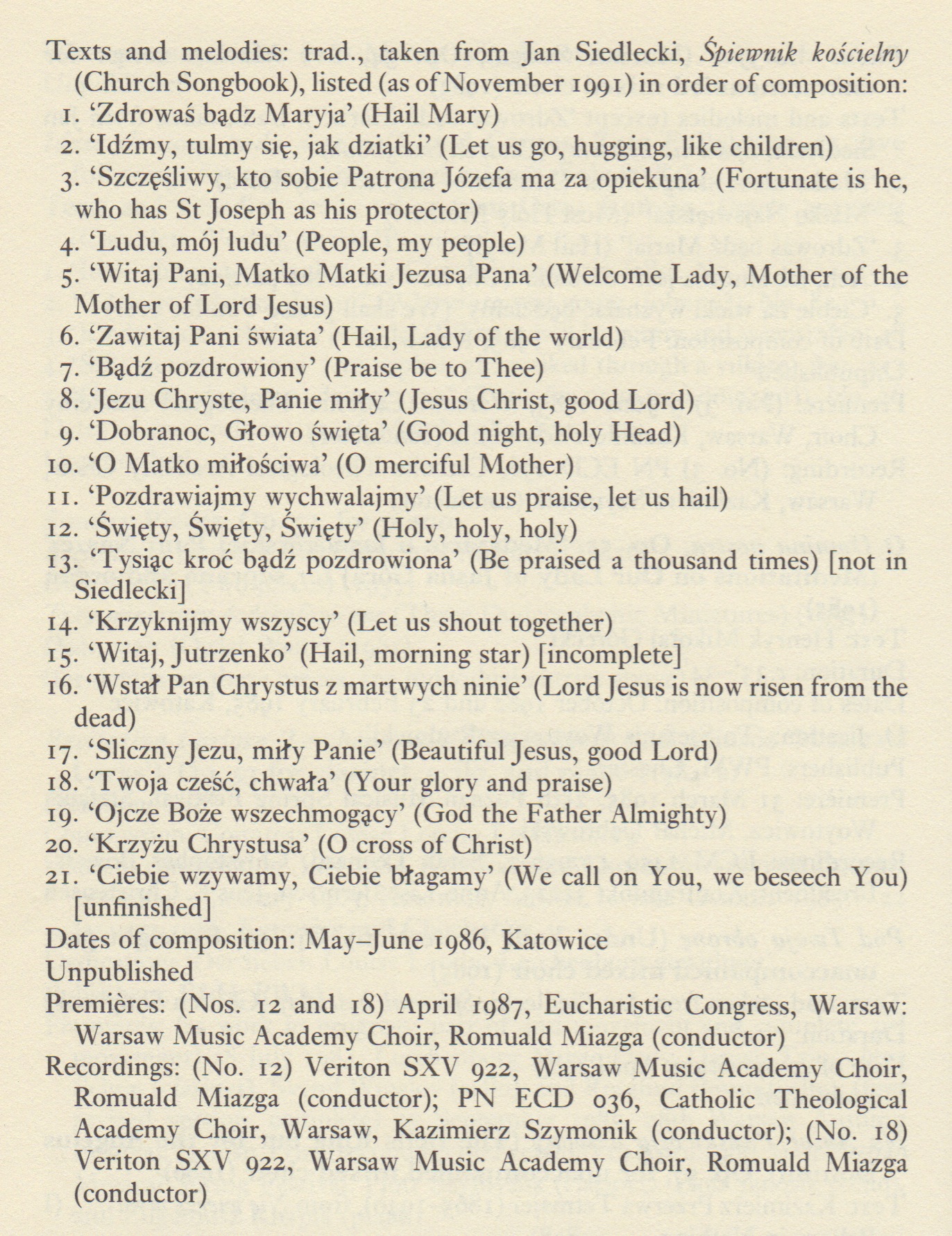
When I was researching my book on Górecki, I stayed with him in Katowice on two occasions in 1993 and 1994. During these visits, he sat at the piano and played through all of his completed but unpublished pieces.  When it came to his vocal music, he would also sing along lustily.  Among the pieces that he showed me were his Church Songs, which he had arranged in May-June 1986.  They are beautifully moulded miniatures, one- or two-voice hymns whose melodies he had harmonised simply but tellingly.  I published a list of the nineteen hymns that he said that he had completed, plus two others that he wanted to work on further.

HMG Church Songs (as of Nov. 1991)

What is interesting about the new CD – whose full list of contents has not yet been revealed – is that it consists of twenty Church Songs.  However, in naming five of them, an article in Dziennik Polski (21 May 2013) raises questions of whether my list is now inaccurate (it was copied from Górecki’s own list of November 1991), whether some titles have been changed or whether there are a few different songs that have replaced some on my chronological list or been added to it.  The article mentions hymns nos. 1, 11 and 14, but also names two that are not on my list nor can I find in my copy of the source hymn-book, first published in 1878: Pieśń o św. Mikołaja (Song about St Nicholas) and Idźmy do miłosierdzia (Let us go to mercy).  Intriguing.  Time will tell.  The CD should be ready by the end of June.

• WL100/38: Les dessins de Michaux

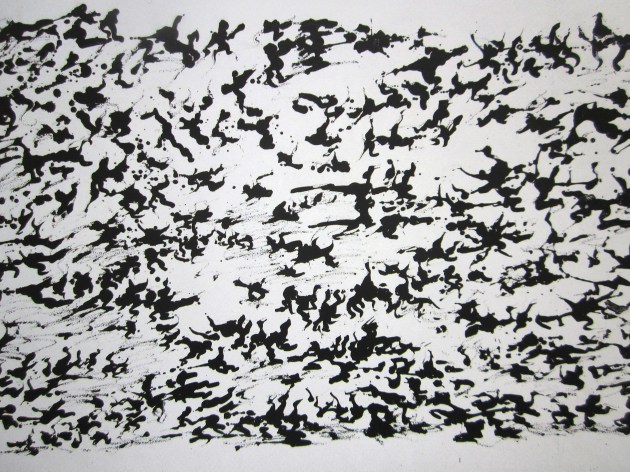
Lutosławski fans know the name of Henri Michaux through his three poems which Lutosławski used in his Trois poèmes (1961-63).  Perhaps less well-known are Michaux’s paintings and drawings.  I remember making a connection, when I first came across Lutosławski’s piece, between the scurrying figuration of the first movement (‘Pensées’) and the figurative movement in much of Michaux’s visual work.  So here’s a 1964 recording of that movement plus a selection of Michaux’s dessins.  I have no idea if Lutosławski knew them in the early 60s (or whether Michaux heard Trois poèmes or any of Lutosławski’s other music), but the parallels are still striking.

According to his own dates, Michaux started writing on 9 March 1922 and painting on 1 January 1936.  In the 1930s he travelled to India, China and Japan, whose calligraphy and ideograms had a profound influence.  In the mid-1950s, he worked under the influence of mescaline, although the direction of his art was already firmly established.

IMG_3224 copy(Untitled, 1952, 28x36cm)

‘Their movement became my movement.  The more there were of them, the more I existed.  The more of them I wanted.  Creating them, I became quite other.’  (1951, of his Mouvements series; transl. Michael Fineberg)

Screen Shot 2013-05-09 at 10.55.22

(Untitled [Vitesse], 1954, 75x105cm)

IMG_3226 copy

(Untitled, 1960, 70x140cm)

‘I was possessed by movements, on edge with these forms which came to me rhythmically.  Often one rhythm ruled the page, sometimes several pages in succession, and the more numerous were the signs that appeared (one day there were close on five thousand), the more alive they were.’  (ibid.)

Screen Shot 2013-05-09 at 10.54.34

(Untitled, 1962, 71.5x104cm)

IMG_3229 copy

(Untitled, 1968, 75x108cm)

• New CD Note (Dobrzyński/Chandos)

CHAN 10778Here is music, by a Polish contemporary of Chopin, which is barely known even in Poland.  Ignacy Feliks Dobrzyński was a couple of years older than Chopin and they both studied in Warsaw under the same teacher, Józef Elsner.  Whereas Chopin spent most of his adult life outside Poland, Dobrzyński remained in Warsaw.  This double CD includes an operatic overture, Monbar (the setting is Haiti!), alongside Dobrzyński’s Piano Concerto (written when he was 17) and his Characteristic Symphony in the spirit of Polish Music. The CD also includes the original first movement of the Symphony.

Here’s the link to my booklet note for this Dobrzyński CD, or you can scroll the CD NOTES tab above.

• WL100/28: Jazz Conversations (Lutosphere)

Having heard Agata Zubel, Andrzej Bauer and Cezary Duchnowski in conversation with Lutosławski’s alter ego ‘Derwid’ at the end of the Philharmonia’s Woven Words festival last month (Zubel Zings!), I’ve revisited an earlier set of ‘conversations with Lutosławski’.  These took place in the project Lutosphere, when Bauer teamed up with the pianist Leszek Możdżer and the DJ M.Bunio.S to explore Lutosławski’s concert music.  Among the pieces which they reference are the Intrada and Passacaglia from the Concerto for Orchestra (1954) and the Cello Concerto (1970). As I’ve written before, there’s quite a tradition of Polish jazz musicians reworking the music of major Polish composers (Chopin, Szymanowski), but this is the first time that the composer’s own voice has been included in the process!

There are currently a handful of uploads on YouTube, some with live video footage.  Here are five (two of them are short extracts), dating from 2008-10.

OFF festival, Mysłowice (8.08.2008)


Polish Radio (pre 6.11.2008, with partly English-language intro by Możdżer)


(pre 17.05.2009)


Kraków Philharmonic (31.10.2009)


Theatre on the 6th Floor, Warsaw (26.08.2010)


• New CD Note (Żeleński & Zarzycki/Hyperion)

034571179582I’ve recently been drawn into writing about nineteenth-century Polish music, mainly about composers whose surnames begin with Z or Ż.  Here are two of them: Władysław Żeleński and Aleksander Zarzycki.  Following his highly acclaimed 2012 recording of Zarębski and Żeleński chamber music with the Szymanowski Quartet on Hyperion, Jonathan Plowright performs music for piano and orchestra by Żeleński and Zarzycki on his new Hyperion CD.  It’s the 59th CD in Hyperion’s ‘Romantic Piano Concerto’ series.  Plowright’s partners on this occasion are the BBC Scottish SO and the Polish conductor Łukasz Borowicz.
Here’s the link to my booklet note for Żeleński and Zarzycki, or you can scroll the CD NOTES tab above.

NEWSFLASH!  MusicWeb-International has awarded this CD ‘Discovery of the Month’ (May, 2013).  En passant, the review by Dan Morgan comments on my ‘admirably succinct liner-notes’ (3 May 2013).  In his review in Gramophone (June, 2013, p.69), Jeremy Nicholas refers to ‘Adrian Thomas’s informative booklet’.