• WL100/20: Dance Preludes, **15.02.55

Here are a couple of previously unrevealed facts about this popular piece for clarinet and piano.  The premiere of Lutosławski’s five Dance Preludes took place on 15 February 1955, although one of the set (unidentified) had already been played at a Polish Composers’ Union concert on 24 April 1954.

• In May 2002, I was doing some research in Poland when I came across some interesting information about the background of Dance Preludes which widens the chronology of its composition.  Here’s a sample:

Lutosławski evidently wrote a single Preludium taneczne in 1953.  In a letter to him dated 5 December 1953, his publisher wrote:

‘… we ask a kind favour of you: either agree to the publication of your one “Dance Prelude for clarinet and piano”, or write to us by the N. Year as to how things are with your plans for another two preludes – we would be very pleased with that.’
‘… zwracamy się do Ciebie z gorącą prośbą: Albo zgódź się na wydanie Twojego jednego “Preludium tanecznego na klarnet et fortepian”, albo napisz nam do N. Roku, tak, jak to jest w Twoich zamierzeniach jeszcze dwa preludia, z czego bardzo cieszylibyśmy się.’

Lutosławski replied by sending just the one prelude on 31 January 1954; this was almost certainly the one played in April 1954.  It eventually became the last in the set.  I have found no further correspondence about preludes in the plural until after the premiere in 1955.

• When exploring the musical and bibliographical contents of his house in September 2002 (with permission of the family), I discovered a folder marked ‘Mat. ludowe’ (Folk Mat[erials].), tucked away in a cupboard in the attic room. Among a wealth of MS examples in Lutosławski’s handwriting, there were several headed ‘Preludia tan.’ (Dan. Preludes), with tunes copied from another source.  Here’s the tune at the top of the list (it’s not been seen before; photograph taken in poor light on site), and it provided him with the initial theme for the first of the Dance Preludes.

Wl Dance Preludes:I folk tune

The insertion of differently-metred bars is characteristic of many Polish folksongs.  The connection between the source and the prelude is clear (the tempo is greatly increased), but the straightforward yet imaginative way in which Lutosławski makes a paragraph out of a (relatively) simple tune through extension, repetition and a varied underpinning is a stroke of genius.

Wl PT:1a

• WL100/19: ‘Lutosławski live’, 12-19.02.93

Twenty years ago today, ‘Lutosławski live‘ took over the concert halls of Manchester in celebration of the Polish composer’s 80th birthday two weeks earlier.  The festival was the brainchild of the British composer, John Casken, who had known Lutosławski since the early 1970s.  ‘Lutosławski live‘ placed his music within the context of composers old and new, with Casken and James Macmillan featuring as both composers and speakers and, in the case of MacMillan, as conductor too.  Lutosławski had hotfooted it back from Los Angeles, where he had just conducted the world premiere of his Fourth Symphony (5 February 1993).

The Lutosławski works performed in Manchester were: Variations on a Theme of Paganini (1941), Recitative e Arioso (1951), Concerto for Orchestra (1954), Dance Preludes (1954), Dance Preludes (1954/59), Jeux vénitiens (1961), String Quartet (1964), Preludes and Fugue (1972), Mi-parti (1976), Grave (1981), Mini-Overture (1982), Symphony no.3 (1983), Chain 1 (1983), Partita (1984), Chain 3 (1986), Piano Concerto (1988) and Slides (1988).

My recollection is of a wonderfully friendly event, with musicians drawn from the RNCM, the Allegri and Lindsay string quartets, the London Sinfonietta, the BBC PO and the Hallé.  Lutosławski himself conducted in two of the concerts.  I also have very fond memories of a relaxed post-concert supper with him, John Casken and others in a downtown Italian restaurant.  Good times.  Oh, I’ve only just noticed that I was quoted on the leaflet.  There’s observation for you.

WL live, Manchester 1993 front

WL live, Manchester 1993 inside

• WL100/18: Notebook, 12 February 1961

Lutosławski on the brink

The period which I have been going through for a long time already (a few years) has been uninteresting. It has been a period of intensive explorations into expressive devices that suit me.  This has inevitably led to a state where, for the most part, these work in poorly mastered, unfamiliar ways.  In this state, one loses one’s sure hand, loses accuracy, loses balance, loses authoritativeness and full responsibility for the outcome.   To this must be added that these investigations proceed slowly, that they bring few lasting gains.  The result of this state of affairs is the fact that the works of this period (orchestral wks from 59/60, and also a work for chamb. orch. from 1961), if going by their own intrinsic value, stand certainly lower than some of my previous pieces (Conc[erto for orchestra]., M[usique]. F[unèbre]., [Five] Songs to Iłł[akowicz].).   For me personally they still have greater value than those works because they are leading to something, are preparing something, are facilitating something which will be much more my own.  I will be able to write these pieces when the devices now being developed are to me as mastered, familiar and malleable as was the ‘late tonality’ in the Concerto for Orch.

Okres, który od dłuższego już czasu przeżywam (parę lat) jest nieciekawy.  Jest to okres wzmożonych poszukiwań odpowiednich dla mnie środków wyrazu.  Prowadzi to nieuchronnie do stanu, w którym operuje się w dużym procencie środkami źle opanowanymi, mało znanymi.  Gubi się w tym stanie pewność ręki, gubi się celność, gubi się równowagę, gubi się autorytatywność i pelnię odpowiedzialności za dzieło.  Do tego dodać należy, że te poszukiwania postępują wolno, że niewiele przynoszą trwałych zdobyczy.  Rezultatem tego stanu rzeczy jest fakt, że utwory tego okresu (utw. orkiestrowe z lat 59/60, a także utwór na ork. kam. z 1961), jeśli wziąć pod uwagę ich oderwaną od wszystkiego innego wartość, stoją na pewno niżej od niektórych poprzednich moich utworów (Konc., M. ż., Pieśni do Iłł.).  Dla mnie osobiście mają jednak wartość większą niż tamte, ponieważ prowadzą do czegoś, przygotowują coś, ułatwiają coś, co będzie o wiele bardziej moje własne.  Będę mógł te utwory napisać wtedy, kiedy opracowywane teraz środki staną się dla mnie tak opanowane, znane, podatne, jak to było z “późna tonalnością” w Koncercie na ork.

Witold Lutosławski, 12 February 1961  [my translation]

This entry in Lutosławski’s creative notebook is fascinating.  Firstly, it shows that he is still battling to find his own voice on a technical level.  With the benefit of hindsight, it seems obvious that he was tussling with the practicalities of the aleatory (chance) procedures that he had first encountered in John Cage’s Concert for Piano (1958) in a radio broadcast.  This life-changing moment occurred, by his own account, sometime in 1960.

The orchestral pieces that Lutosławski mentions from 1959-60 are what he subsequently called Three Postludes. He completed them as follows, but not in the order in which they were published (my primary source here is the German musicologist, Martina Homma):

No.1  (14 September 1958)
No.3  (4 April 1959)
No.2  (27 August 1960)

There is no record of any other work being completed during the next six months, until he started to finalise three movements from Jeux vénitiens, the chamber orchestra piece from 1961 mentioned above.  These three movements were premiered in Venice on 24 April 1961.  Two of them were then radically overhauled and a third movement added in time for the full premiere in Warsaw on 16 September 1961.  The Jeux vénitiens chronology works out as follows:

Mvt.4  (7 March 1961; rev. 11 August 1961)
Mvt.2  (28 March 1961)
Mvt.1  (5 April 1961; rev. 29 August 1961)
Mvt.3  (21 August 1961)

wl-jv-sketches-folderOne may only conjecture what was happening in Lutosławski’s head and in his studio between 27 August 1960 and 7 March 1961.  It seems probable that it was during September-December 1960 that he heard Cage’s Concert for Piano.  Evidently, on 12 February 1961 he was still nowhere near a satisfactory solution to his quest for new expressive devices.  His search almost certainly revolved around how to animate his twelve-note harmonic language (already evident in Five Songs, Musique funèbre and the ‘orchestral wks from 59/60’) with ‘unmastered, unfamiliar’ rhythmic aleatorism.  His first public attempts, aired in Venice, were quickly revised for the Warsaw premiere (I explored these issues in detail in 2001).

What is fascinating about the diary extract above is the clarity of Lutosławski’s mind about the value of this experimentation, even though his technical efforts were still in some disarray and he was far from finding the solutions that suited him.  But he knew that the direction in which he was heading was the right one, and he was determined to follow his instincts through.

• WL100/17: Notebook, 6 February 1959

Lutosławski as parachutist

‘Emulating’ [lit. ‘Repeating’ after someone] is only worth it when what one does is even better than the model.  There are obvious examples: Mozart and the Mannheimers, Bach and Pachelbel, Vivaldi etc..  One has to have great self-confidence to ’emulate’.  If one does not have this, it is necessary to find things that have not yet been discovered.  Today there are no great ‘synthesizers’, ‘blenders’, no material to emulate. What scouts, ‘advance troops’, ‘parachutists’ discover is slight material with which little can be done. Each must seek his own nourishment, condemned to ‘the poverty of avant-gardism’.  He must be his own ‘parachutist’, and then also ‘occupy the ground’ himself.

‘Powtarzać’ po kimś warto tylko wtedy, kiedy robi się to samo lepiej niż model.  Przykłady oczywiste: Mozart i mannheimczycy, Bach – Pachelbel, Vivaldi etc.  Trzeba dużej pewności siebie, żeby ‘powtarzać’.  Jeśli się jej nie ma, trzeba wynajdywać rzeczy jeszcze niewynalezione.  Dziś nie ma wielkich ‘syntetyków, ‘zlewaczy’, nie ma materiału do powtarzania.  To, co wynajdują szperacze, ‘szpica’, ‘spadochroniarze’ – to jest wiotka materia, z której niewiele da się zrobić.  Każdy musi sam sobie szukać pokarmu, skazany jest na ‘nędzę awangardowości’.  Musi sam być ‘spadochroniarzem’, a później również sam ‘obsadzać teren’.

Witold Lutosławski, 6 February 1959  [my translation]

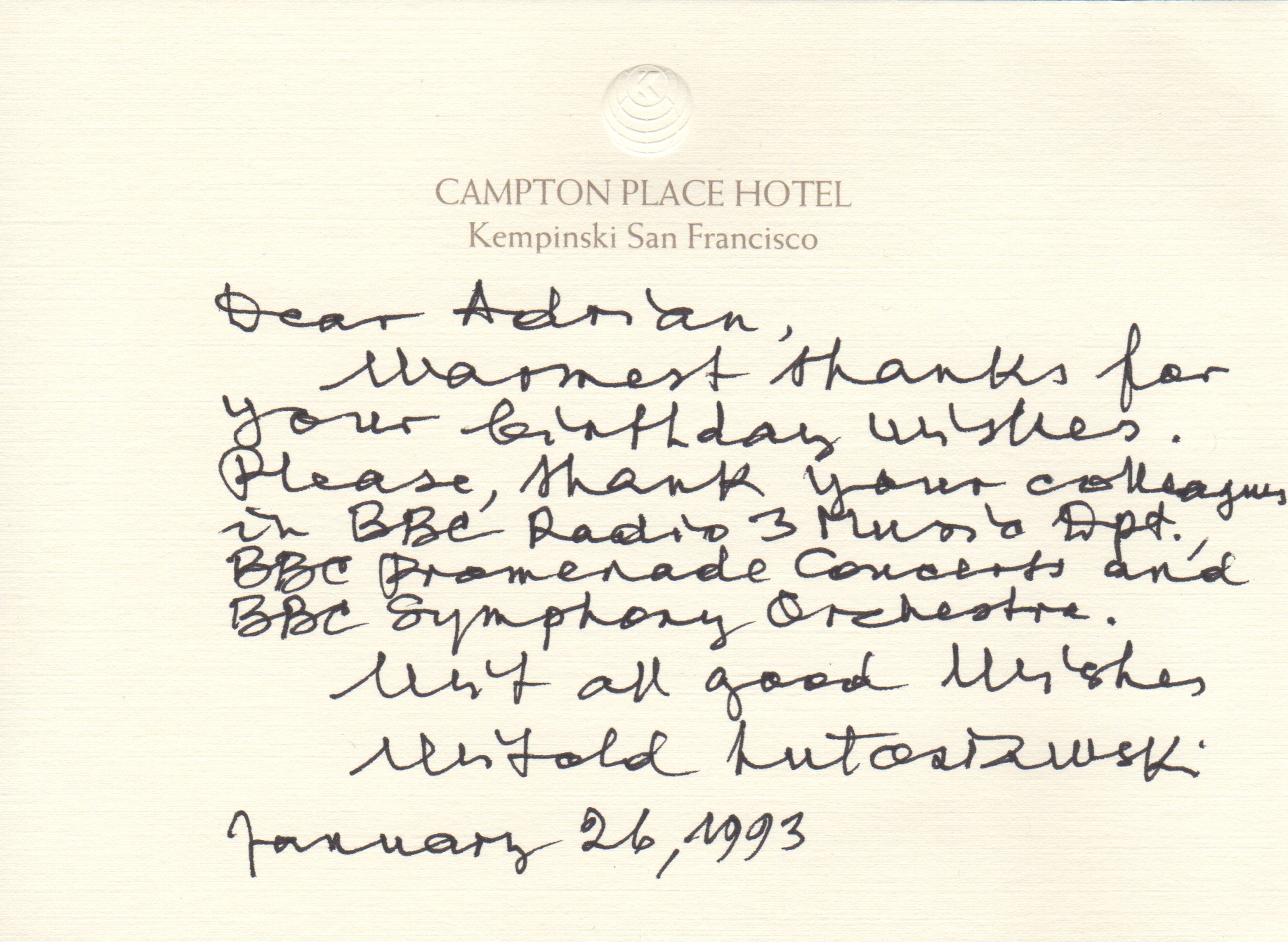
• WL100/15: Thank-you note, 26 January 1993

When I was working at BBC Radio 3, I sent Lutosławski greetings for his 8oth birthday.  In his characteristically courteous and meticulous fashion, he replied the following day.  He was in San Francisco, en route to Los Angeles, where he conducted the LAPO in the premiere of his Fourth Symphony on 5 February 1993.

Note from WL, 26.01.93

• WL100/14: Lutosławski at Polish Radio

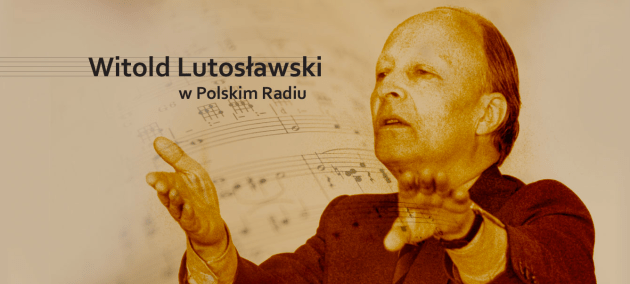
WL w Polskim RadiuPolish Radio’s new website Witold Lutosławski w Polskim Radiu looks like being one of the most interesting archival sources on the composer so far.  There are audio files and photo galleries connected with Lutosławski’s work at Polish Radio in the 1940s and 50s as well as a host of radio interviews made with and about him over the years. The initial on-screen teething problems have now been sorted, although the promised English-language transcripts of some of the items have yet to materialise.

The contents are already of considerable interest, and I hope they will be added to in the coming weeks and months. Currently the contents include:

• over thirty radio reminiscences and interviews
• two examples of incidental music for Polish Radio Theatre unheard since the mid-1950s
• three photo galleries: Witold Lutosławski and His Time (52 items), From the Family Album (22) and Documents from Polish Radio (17)

For those who don’t understand Polish, the second and third groups above may be of the greatest interest.

Incidental Music

Polish Radio has unearthed two sequences of Lutosławski’s incidental music for Polish Radio Theatre.  This activity was one which he pursued from the late 1940s until 1960.  Little has been written on his incidental music because it was thought that it existed, if at all, almost exclusively in score form.  Polish Radio has now released these two audio compilations from its sound archives.

The earlier of the two is called Anccasin ef Nocolette on the PR website.  I must admit that I cannot rationalise the language nor find any source for this title.  Martina Homma has identified the item as Okassen i Mikołajka, which seems linguistically more reliable.  She dates the broadcast of this authorless text to 8 November 1954 (eighteen days before the premiere of the Concerto for Orchestra).  Although the PR site gives the duration of the music as 5’39”, it lasts for 11’17”.  The music is Baroque pastiche, the fragments up until 08’50” for harpsichord alone. Thereafter, a flute and violin join in.  I wonder if Lutosławski was himself playing the keyboard.  The recording is rather basic and the performance is not without the occasional fluff.

The second of the two sequences was broadcast almost three months later, on 30 January 1955.  It was composed for one of the Arabic folk tales from Klechdy sezamowe (Tales of Sesame, 1913) by Stanisław Leśmian, who is better known by his first forename, Bolesław.  The music for Zeklęty rumak (PR site), or O zaklętym rumaku (Homma), is more fantastic and richly scored, for chamber ensemble, than the frankly boring music for the earlier piece.  It lasts for 10’27” (the PR site says 5’14”).  Let’s hope there are more riches in the sound archives from Lutosławski’s prolific period as a composer of incidental music.

Photo Galleries

There are many unfamiliar items here, so these three sections present new windows into the past.  The third section of documents is perhaps the least interesting as it draws on administrative paperwork from the post-war decade. The second section of family photographs consists almost entirely of old images of the Lutosławski family rather than of the composer.  His likeness to his brother Jerzy and his father Józef is very striking.

It is the first section that brings Lutosławski really to life, with photographs dating from after the Second World War up until 1993.  I was thrilled to see the sequence of photos from the rehearsals and concert for the full premiere of the Second Symphony, which Lutosławski conducted in Katowice in 1967.  There are also black and white stills from the documentary film made by Krzysztof Zanussi in 1990 for the BBC (see my post WL100/13: In Conversation with Zanussi).

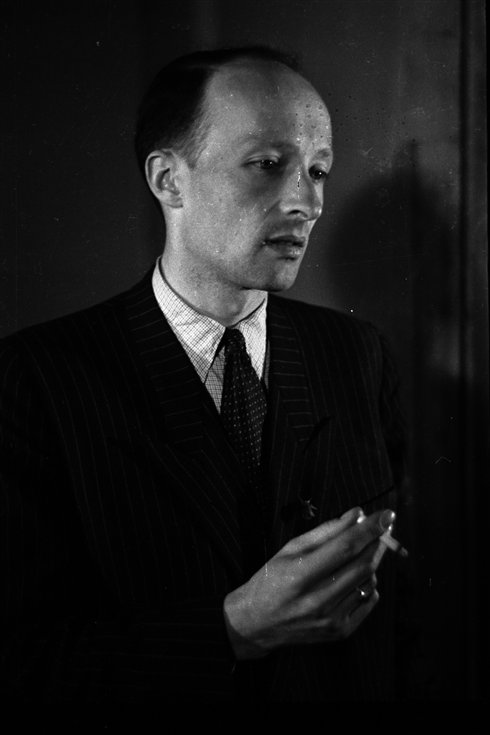
But for me it’s the first two photographs which I find utterly compelling.  They were evidently taken during the same photo shoot (PR indicates that this was in January 1946) as another image used on the front cover of Polish Radio’s listings magazine Radio i Świat in April 1948 (see the top illustration in Panel 2: 1946-49 Music for Radio from my exhibition ‘The Hidden Composer’).  Of these two new images, which are technically much better than the one reproduction that I found, it is the first which I find almost unbearably haunting.

WL, January 1946

• WL100/13: In Conversation with Zanussi

On 19 January 1991, BBC 2 showed a one-hour documentary on Lutosławski.  It was made by the distinguished Polish film director Krzysztof Zanussi.  Witold Lutosławski in Conversation with Krzysztof Zanussi (1990) utilises excerpts from a BBC Omnibus documentary Warsaw Autumn (1978)filmed by Dennis Marks in 1977, as starting points.  Zanussi steers Lutosławski through key moments of his life, interspersed with the composer conducting rehearsals or special recordings of excerpts of his music.

The results are mixed.  At times, the premise is realised archly, as at the beginning, when the interview set-up seems rather self-conscious.  At other times, Zanussi’s probing produces some interesting responses.  Lutosławski recollection of his father is rather touching, for example, and his recollection of life in the 1980s (during Solidarity and then under Martial Law) fascinating.  As always, he can be alternately open and guarded.

The interiors were filmed either in his downstairs sitting area (it’s open-plan) or in his first floor, L-shaped study (see my earlier post Lutosławski’s Carpet).  The major musical extracts are from Musique FunèbrePreludes and FugueChain 2 (with Krzysztof Jakowicz) and the Third Symphony.  Two excerpts from Witold Lutosławski in Conversation with Krzysztof Zanussi (amounting to the second and fourth quarters of the documentary) were uploaded to YouTube yesterday, so here are the links with a little commentary to each.

Excerpt 1

This section is concerned firstly with the post-war decade and socialist realism.  Habitually, Lutosławski was extremely guarded about this period, as he is here, especially in the excerpt from the Omnibus film.  The three-day conference to which Lutosławski refers took place in western Poland, at a place called Łagów, in August 1949.  (Less than half of the members of the Polish Composers’ Union attended, rather than the ‘all’ that Lutosławski mentions.)  Secondly (c. 7’45” in), the film shows Lutosławski accompanying a group of young children singing one of his children’s songs, Rzeczka (River, 1947).  The final section (c. 11’20” in) moves the questioning of the relationship between the music and social-political contexts to the 1980s.  It shows a fragment of Lutosławski’s speech on the first day of the Congress of Polish Culture in Warsaw on 12 December 1981.  Overnight, Poland found itself under Martial Law.


Excerpt 2

This section concludes the documentary with a brief discussion of the return to democracy in the late 1980s and then focuses on the Third Symphony.  There are two musical passages here, from figs 84 to 89 and from fig. 93 (Coda), in what appears to be a specially recorded session with Lutosławski conducting the Great Polish Radio SO (WOSPR) in Katowice.


• WL100/10: ‘Breaking Chains’, GSMD 1997

Possibly the most intense and wide-ranging survey of the life and works of Witold Lutosławski that has ever taken place was that at the Barbican, London, in January 1997.  The climax was three days of concerts, organised by the BBC under the banner Breaking Chains on 17-19 January.  I’ll return to these events in a future post.

Preparatory to these concerts, the Guildhall School of Music and Drama, in a different part of the Barbican complex, organised five days of complementary events under the Breaking Chains umbrella, 13-17 January 1997. These included concerts, workshops, talks and discussions, as well as an exhibition.  The participants included the GSMD SO and CO, student chamber ensembles and soloists, and several speakers: Steven Stucky, Józef Patkowski, Charles Bodman Rae, John Casken and myself.

WL Breaking Chains, GSMD 13-17.01.97

The GSMD Breaking Chains repertoire included: Symphonic Variations (1938), Symphony no.1 (1947),  Little Suite (1950/51), Straw Chain (1951), Silesian Triptych (1951), children’s song cycles Autumn and Spring (1951) and four other children’s songs (1953-54), Jeux vénitiens (1961), String Quartet (1964), Symphony no.2 (1967), Livre pour orchestre (1968), Variations on a Theme by Paganini for piano and orchestra (1941/78), Novelette (1979), Chain 1 (1983), Fanfare for Louisville (1986), Prelude for GSMD (1989).  In pre-concert and afternoon events during the BBC part of Breaking Chains, GSMD students also performed Overture for Strings (1949), Five Folk Melodies (1945/52), Preludes and Fugue (1972), Partita for violin and piano (1984), songs and music for piano, as well as Chain 1 for the second time.

There were some fantastic student performances during this GSMD week.  Indeed, Symphony no.2, Novelette and Fanfare for Louisville were issued on the SOMM label (SOMMCD 219) in 1999, alongside performances of two works conducted by the composer on his visit to GSMD on 11 May 1989: Prelude for GSMD and the Cello Concerto (1970), in which the soloist was Louise Hopkins.  My strongest recollection is of the performance of the Second Symphony under the dynamic direction of Wojciech Michniewski.

Lutosławski: Symphony no.2

• Movement 1: ‘Hésitant’  

• Movement 2: ‘Direct’ (the track begins c.15″ too early with two brief events for trombones/tuba and bassoons from the end of ‘Hésitant’; ‘Direct’ begins with ppp double basses, partly masked by a final bassoon utterance)  

My own involvement also included directing a workshop performance of Jeux vénitiens and putting together an exhibition called The Hidden Composer: Witold Lutosławski and Polish Radio, of which more anon.

• WL100/9: Lutosławski’s carpet

Did you know that all of Lutosławski’s works from 1971 onwards were composed as he paced to and fro on a carpet made and sold in the British Isles?  And that his grand piano and writing desk stood on it too?  You didn’t?  Read on!

Below is an undated photo of Lutosławski’s studio.  The state of the rucked carpet, the style of the curtains and the blank walls, where subsequently there were bookshelves, allow us to date the photo (first published in 2007) to 1968-70.  How can we tell?

IMG_7140 copy

In 1968, the Lutosławskis moved from their cramped flat in East Warsaw, where they’d lived since the Second World War, to a spacious detached house in North Warsaw.  The first work that Lutosławski composed in his L-shaped first-floor studio was his Cello Concerto.  The concerto was premiered in London on 14 October 1970.  I discovered the following correspondence at the Paul Sacher Stifting in Basle in 2003:

From Faith Crook (Chester Music) to Lutosławski, 26 October 1970
“Mr Rizza [then MD of Chester Music, London] has passed on to me your note about the carpet you wish to order and get sent to you from Gamages.  […]  I note that what you require is ‘Tintawn’ No.526 (“White Heather” shade) and you asked for the 108 inch (9 feet) width, but the length you gave of 13 yards 7 inches we find rather puzzling.”

From Lutosławski to Faith Crook, 4 November 1970
“I am very sorry to bother you with that carpet for me.  The only excuse to offer is, that it will be a part of the equipment of my working room and thus – serve in a way the purposes of the firm!  […]  It may seem puzzling, but the room is not a straightforward rectangular one.  It is an “L”-form and that is why two strips of different length will have to be pieced together.”

From Faith Crook to Lutosławski, 11 November 1970
Gamage invoice, Holborn, E.C.1
Cost of carpet  £65 16s 0d
Carriage  £12 15s 0d
Packing  £1 10s 0d
Insurance  £1 6s 0d
Total  £81 7s 0d

Evidently, Lutosławski had gone to London not only for the premiere of the Cello Concerto but also with the measurements of his studio, intent on purchasing a good quality carpet.  Wall-to-wall carpets are unusual in Poland, where wooden flooring is usual, so part of his reasoning must have been to do with the room’s acoustics.  Gamage’s, which closed in 1972 and was subsequently knocked down, was a huge department store famous for its unusual diversity, from its toy department and Christmas bazaar to a specialist section for motor parts.  It evidently had a good carpet showroom too.  More particularly, it was in Holborn, barely ten minutes’ walk from Chester Music’s then offices at Eagle Court in E.C.1.  Did Lutosławski pass it by accident or was he directed to it by his publishers?

Fast forward to 2002 when, during the ‘Warsaw Autumn’ festival, I was privileged to spend several days, with Nicholas Reyland, examining Lutosławski materials at his house.  I had been downstairs in 1981, but I had never seen the ‘working room’ upstairs.  We were given extraordinary freedom to research and document what we found. It was exciting, as always, to see where a composer composed.  The grand piano had been moved out, but the general layout of the rest of the room was as it had been from the beginning.  The photo below was taken from the double doors leading onto the first-floor balcony (compare the 1968-70 photo pointing in the opposite direction).

134-3416_IMG

What was different was the increased shelf-space, the elongated desk area to accommodate the hifi and CDs, and the absence of curtains.  The coffee table and flower vase were where they had been in the late 60s, as were the leather easy chairs and sofa, but in a more modern guise.

At the time (2002), I hadn’t found out about the carpet, so took no special photos of it.  But here are a couple of clips from other photos.  The lower one, taken close to the desk, shows signs of wear and tear, but after over 20 years of Lutosławski’s pacing (he habitually composed standing at the piano, but evidently worked a great deal at his desk also), and a further decade since his death, such signs were hardly surprising.

WL's carpet

WL's carpet:2

Yet what was remarkable was how few such patches there were.  This must have been a good-quality carpet that Lutosławski chose in London.  As soon as I got back from my research to Basle in 2003, I investigated further.  And I received this prompt reply from Axminster:
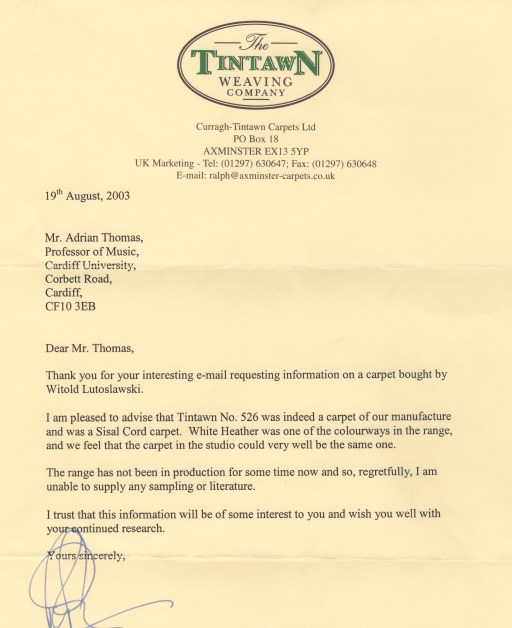
Maria & Józef Lutosławscy, 1900 2

What I didn’t pick up, until it was pointed out today by my friend Colin Stark (who played Epitaph for Lutosławski in Belfast in 1987), is that this carpet was not made at Axminster but in Newbridge, Co. Kildare in Ireland.

It’s nice – if perhaps irrelevant – to think that the music of Lutosławski’s last 23 years (Preludes and FugueLes Espaces du sommeilMi-partiEpitaphGrave, Symphonies 3 and 4, Chains 1-3, Piano Concerto, Chantefleurs et Chantefables, among others) was created as he pondered his next compositional move on a carpet that he bought in London, a creative investment and a material reward, if you like, for one of his greatest artistic achievements.

• Lutosławski issue of MWM

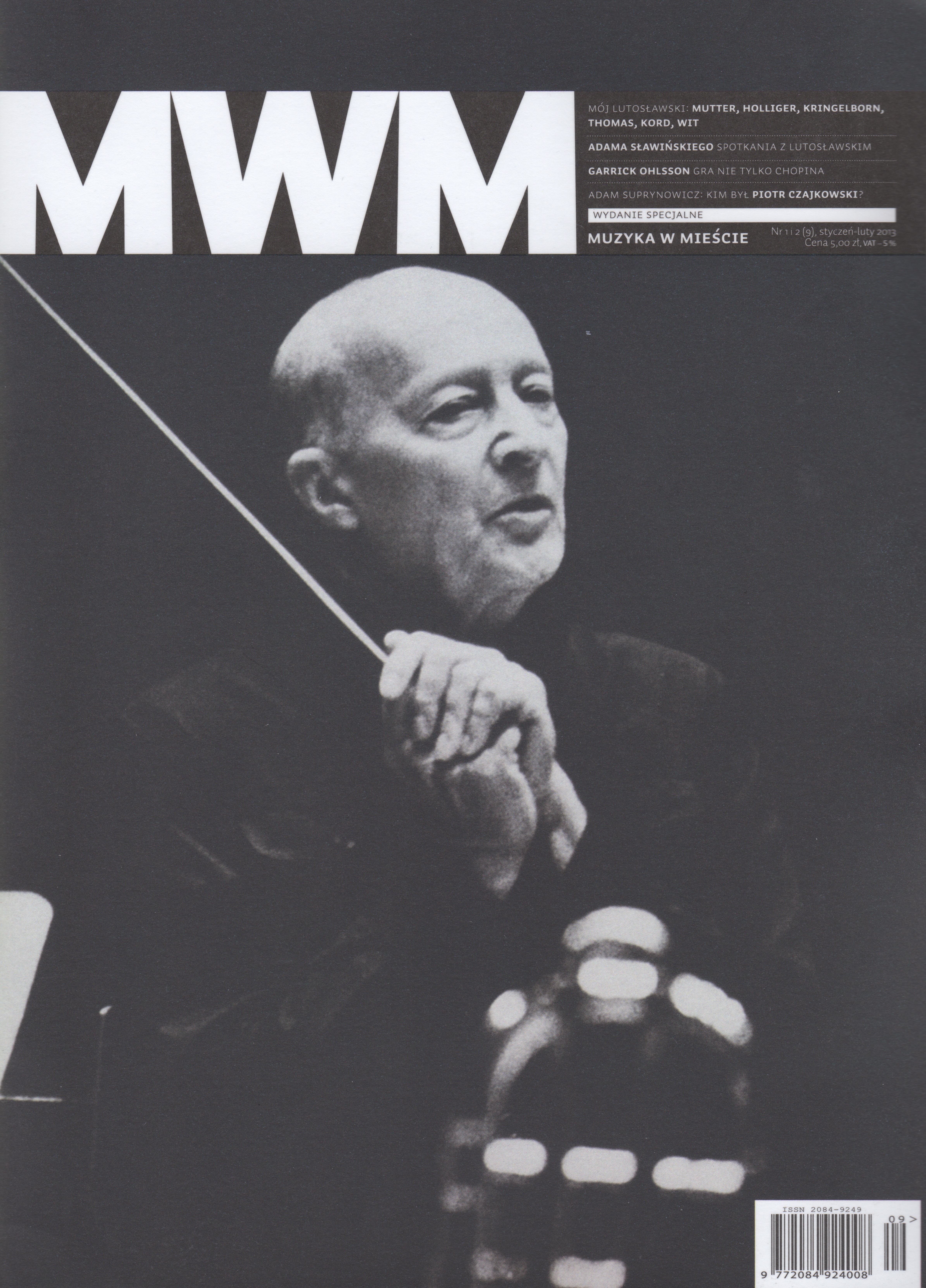
MWM WL issue cover 01.13The Wrocław Philharmonic, named after Witold Lutosławski, has just published a special issue of its house magazine MWM – Muzyka w Mieście (Music in the City).  This centenary edition comprises mainly interviews.  Although it is in Polish, there is a detachable insert with English and German excerpts from three of its eight items (marked *).

• Paweł Hendrich: ‘W roku Lutosławskiego o nim samym i jego muzyce’
• Adrian Thomas: ‘Gry brytyjskie’ *
• Adam Sławiński: ‘Spotkania z Mistrzem’ *
• Kazimierz Kord: ‘Harmonia naturalności’
• Esa-Pekka Salonen: ‘Lutosławski według Salonena’ *
• Heinz Holliger: ‘Tyle nut, ile trzeba’
• Aleksander Laskowski: ‘W poszukiwaniu nagraniowej inicjacji’
• Anne-Sophie Mutter, David Harrington, Solveig Kringleborn, Antoni Wit, Cezary Duchnowski, Agata Zubel: ‘Mój Lutosławski’