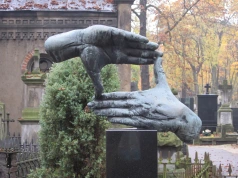
• WL100/55: Death of Lutosławski’s Father

It is 95 years since Lutosławski’s father Józef and uncle Marian were shot dead in Russia: ‘In April 1918 they were arrested in Murmansk by the Bolsheviks, taken to Moscow and there charged with counter-revolutionary activities and the alleged forgery of secret diplomatic documents.  On 5 September of the same year, without a trial, the brothers were killed in a mass execution in Vshekh-Shvyatskoye, a village outside Moscow.  Five-year-old Witold visited his father in the Butyrki Prison just before the execution.’ (Witold Lutosławski. A Bio-Bibliography, 2001, 1-2).

A few days later, the news reached Warsaw.  The twice-daily Nowa Gazeta printed three items on Wednesday 11 September 1918, and I am very grateful to Elżbieta Szczepańska-Lange for sending me the front pages of both the morning and afternoon editions from that day.  The morning edition included a prominent funeral notice:

WL Nowa Gazeta 11.09.18 no.363

WL Nowa Gazeta obituary notice

The official communication of the loss in Moscow of our two distinguished countrymen, the brothers Marjan and Józef Lutosławski, has undoubtedly filled the whole of Polish society with absolute indignation, horror and grief.  Giving voice to this sentiment, the Office of the Civil Regency Council extends an invitation to the requiem mass for the repose of their souls, on Thursday 12 September at the Church of the Holy Cross at 11.30 a.m..

In the afternoon edition, there were two front-page items, the longer of which focused on the lives and careers of Marian and Józef, with a concluding paragraph on what was then known of the the circumstances of their deaths:

WL Nowa Gazeta account of lives+                                                          deaths

Obituary.  The Lutosławski brothers, who have died such a tragic death, were known in circles across our city. The late Marjan was born in 1871 in Drozdowo, in the Łomża district.  By profession an engineer, and settled in Warsaw, he developed energetic activities as both an engineer and an inventor, as well as in the field of social welfare.  From 1904, he played an active part in the work of the  National Democratic Party.  After the outbreak of war, he was a member of the Cent[ral] Cit[izens’] Com[mittee] and with it he went to Minsk and then to Moscow.  In 1916 he went to London, Paris and Italy, after which he returned to St Petersburg.
The late Marjan Lutosławski leaves a wife Marja (née Zielińska) and four children.
From his writings dedicated mostly to industrial-economic issues should be mentioned his major work, “Electric Current”.  He was also the author of the comprehensive handbook, “The Art of Conducting Debates”.
The late Józef Lutosławski was born to the same Drozdowo family in 1882.  After completing his agricultural studies in Zurich, and his socio-economic studies in London, he returned to this country and founded and edited for two years the political weekly “Polish Thought”.  He subsequently lived in Drozdowo, where he took over the management of local industrial plants.  In 1915, he was forced by the retreating Russian army to leave Drozdowo and found himself in Moscow.  There he became the plenipotentiary of the CCC [Central Citizens’ Committee] for the Ryazansky region and during his brother Marjan’s visit to the West he became his proxy for the central district.  In 1917 he took an active part as a working journalist in the columns of “Gazeta Polska” and also contributed to the creation of Polish army units.  He leaves a widow, a doctor of medicine (née Olszewska), and 3 children.
The Lutosławski brothers were arrested half a year ago in connection with the disbandment by the Bolshevik authorities in Moscow of the Bartosz Głowacki regiment.  The commander of the regiment, Colonel Kazimierz Majewski, was arrested along with the Lutosławskis.  A few weeks ago, rumours began to circulate that Colonel Majewski had been shot.  Faced with the execution of the Lutosławskis, this is seems highly probable.

The third item is dedicated principally to the memory of Marian Lutosławski:

WL Nowa Gazeta city tribute

Commemoration.  Opening yesterday’s sitting of the city council, the President, Eng[ineer] P. Drzewiecki, in brief words full of gravity, informed those present of the news that had reached Warsaw of the crimes committed on the persons of the brothers Marjan and Józef Lutosławski in Moscow.  Paying tribute to the victims of this bloody terror, the speaker highlighted the merits of the late Marjan Lutosławski, who, in his position as a member of the former citizens’ committee in the first period of its existence, had been of great service to the city. The council commemorated the late Marjan Lutosławski by rising.

• WL100/54: Lutosławski and Panufnik (1945)

Here are two forgotten assessments of Lutosławski and Panufnik from 1945.  I think that this is the first time that this material has been seen in modern times.  On one of my rummages in second-hand bookshops in Kraków, back in the 1990s, I came across a bundle of concert programme, one of which I featured in an earlier Lutosławski post: WL100/43: Variations, **17 June 1939.  This second programme, which I explored in the preceding post WL100/53: Trio, **2 September 1945, has the biographies of the five composers on the back page.  In fact, the biographical elements on Lutosławski and Panufnik take second place to assessments of the composers’ creative personae.  It is not indicated who wrote them.  I’ve translated the two for Lutosławski and Panufnik below.

WL program 2.09.45 4

WITOLD LUTOSŁAWSKI b. 1913 represents the youngest generation of Polish composers and, among them, the direction of the “extreme left”.  This avant-gardism expresses itself in Lutoslawski in the openly fanatical pursuit of logic and rigour in the design of his prevailing use of polyphony as a means towards these goals, searching absolutely for his own sound world, as far removed as possible from that used by previous generations of composers.  It is especially interesting to find that this avant-gardism appeared in Lutoslawski independently, as an expression of his own internal needs.  During his studies he found no external stimulus in this direction, nor did the environment in which he grew up and was educated have the slightest intrusive impact.  He completed his music studies at the Warsaw Conservatory in the class of Witold Maliszewski, one of the representatives of the most conservative tendency among our composers and teachers.
Among the most important works by Lutoslawski we may mention: Piano Sonatas (which he has performed several times), Symphonic Variations (performed at the Wawel Festival in 1939), Variations on a Theme of Paganini for two pianos, fragments of a Requiem, piano pieces and songs.  Currently he is working on a symphony, of which the first movement is already fully completed, the rest in sketches.

This biography is fascinating for several reasons: (1) the placing of Lutosławski as a radical “extreme left” composer on the basis, presumably, of his main composition so far, the Symphonic Variations, (2) the early indication of his life-long desire for logic and rigour, (3) the emphasis on polyphonic writing (with only a few pieces as evidence) as distinct from the later emphasis on harmony, (4) the strong statement about Lutosławski’s independence from external sources and events (something which he reiterated over and again until the end of his life), and (5) the deliberate distancing from his teacher Maliszewski, whom later he often cited as a key influence on his structural thinking while recognising Maliszewski’s disapproval of the Symphonic Variations.  Given the strength of opinion expressed in this paragraph, it wouldn’t surprise me at least if it was written by the unknown author on the basis of a detailed briefing from the composer.  I don’t have the feeling that Lutosławski penned it himself (see the error mentioned in the paragraph below).

The list of works curiously multiplies the Piano Sonata.  This is the only time that I have read any suggestion that there might be more than one!  It also reveals where Lutosławski was in the composition of the First Symphony (1941-47).  We may now date the completion of the first movement as by August 1945 at the latest, with the other three movements being finished over the following two years.

ANDRZEJ PANUFNIK, whose “Tragic Overture” was such a success in Kraków’s last concert season*, is the second strong supporter – alongside Lutosławski – of radical trends among our youngest composers. And with him at the forefront, the quest for the greatest formal logic is advancing, and for the most part he experiments with clearly positive results in the pursuit of a new musical language.  At the same time, a very specific note of lyricism is revealed in his music, which gives his pieces the most distinctive physiognomy.
Panufnik is the author of: Variations for piano, Trio for violin, cello and piano, Folk Songs with wind instr. accomp., Songs with chamber orchestra, “Tragic Overture”, Orchestral Variations, Symphonic Image and two symphonies.
As an outstandingly gifted conductor himself, he is the best performer of his symphonic works.  In recent times, he has worked regularly with the Polish Film Unit in Łódż.

Panufnik’s biography is interesting for largely different reasons.  He has long been regarded as the most experimental Polish composer of the second half of the 1940s, so it is fascinating to see that he already bore this mantle in 1945 with a work like Tragic Overture (1942, reconstructed 1945) and that the lyrical side of his music achieves prominent notice at a moment when he was focusing on tight motivic cells.  The list of works includes some that had been lost during the Second World War and have generally been left out of his list of works since, including his early student Variations for piano, the Symphonic Variations – which Panufnik had conducted in the graduation concert – and Symphonic Image (both works were composed during Panufnik’s last year at the Warsaw Conservatoire, 1935-36) as well as the two symphonies (1940, 1941).**  The Songs with chamber orchestra are unidentifiable.

…….

* The dates of the wartime premiere in Warsaw of Tragic Overture vary according to the source: the Polish Encyklopedia Muzyczna and Panufnik’s autobiography Composing Myself give 1943, while the monographs by Beata Bolesławska and Ewa Siemdaj give 19 March 1944.  As to the premiere in Kraków of the reconstructed score, Siemdaj gives 10 January 1946, but this leaflet indicates that it was given sometime during the 1944-45 season.
** In his autobiography, Panufnik noted: ‘I then decided to try to rescue my Symphony no.1.  But here my memory faltered and the results were disappointing.  I performed it in one of our symphony concerts, but afterwards destroyed the score.  With that I renounced further reconstruction work…’.  Concert programmes from Kraków indicate that Panufnik conducted the premiere of his reconstructed First Symphony on 30 November 1945, and again on 6 December.

• WL100/53: Trio, **2 September 1945

With this programme leaflet, the precise date of the premiere of Lutosławski’s Trio for oboe, clarinet and bassoon (1944-45) can be determined.  It has long been known that it was given its first performance in Kraków during the Festival of Contemporary Polish Music (1-4 September 1945).  This leaflet indicates that the premiere was on Sunday 2 September, which was also the final day of the Congress of the Union of Composers (subsequently known as the Union of Polish Composers, ZKP), held 29 August – 2 September to galvanise Poland’s musical life in the immediate post-war months.  Lutosławski was appointed Secretary-Treasurer of the new union during the congress.

WL program 2.09.45 1

The programme of this Chamber Concert does not specify that this was the premiere of the Trio, but then it also fails to do the same for at least one of the other pieces.  The previously understood details of the premiere of Andrzej Panufnik’s Five Folk Songs (later known in English as Five Polish Peasant Songs, 1940, reconstructed 1945) were only that the piece was premiered during this festival under the young conductor and composer Stanisław Skrowaczewski (b.1923).  The details here give not only the date, but also the full complement of players, under a different conductor and composer, Artur Malawski (1904-57).

WL program 2.09.45 2

Also in the first half of the programme were several piano pieces by Jan Ekier (who celebrated his 100th birthday four days ago), most of them written before the war.

The second half of the programme focused on Roman Padlewski (1915-44) , whose death in valour during the Warsaw Uprising in August 1944 was one of the greatest losses to Polish music during the Second World War. Padlewski’s first and third string quartets were destroyed during the Uprising, but the Second Quartet (1940-42) survived.  I don’t know if it was performed in one of Warsaw’s secret concerts during the war or whether this was its premiere.  It was preceded here by Tryptyk żałobny (Mourning Triptych), by Tadeusz Kassern (1904-57), which was based on melodies from a 16th-century hymnal and dedicated to Padlewski’s memory.

WL program 2.09.45 3

• WL100/52: His Last BBC Prom

Twenty years ago today, on Friday 27 August 1993, Lutosławski was in London to conduct the BBC SO in the UK premiere of his Fourth Symphony.  It was to be his last visit to this country, as he died on 7 February the following year.  Before the concert, looking fit and fired up for the performance, he talked to me about the new piece and answered questions from members of the Proms audience.

WL&AT, Proms, 27.08.93

And here’s an article/interview by Stephen Johnson published the same day in The Independent.

Johnson:WL article 27.08.93

• WL100/51: July Garland (1949) – the music

Following up the leads offered by Lutosławski in his letter of 27 March 1950 (WL100/49), the music of July Garland was found where he said it would be: at the House of the Polish Army (DWP).  (Here I must thank again my friend Michał Kubicki, who did the enquiries there in 2000.)  But not everything has been preserved.  All that remains are the orchestral parts, which, as one would expect, are in copyists’ hands.  There is no sign of the full score, no sign of the vocal parts for the solo baritone or male-voice chorus.  My guess is that, at some undetermined date (see below), Lutosławski or someone on his behalf retrieved the full and vocal scores and had them destroyed, but that the instrumental parts were mistakenly forgotten.  The result is that there is no trace of Gałczyński’s lyrics.  What do remain, however, are the titles of the three movements, as mentioned at the end of the previous post: ‘Walka’ (Struggle), ‘Odbudowa’ (Reconstruction) and ‘Pieśń obrońców pokoju’ (Song of the Defenders of Peace).

Some years ago, I transcribed all three movements of Lutosławski’s triptych.  Don’t get your hopes up.  The music is largely short-breathed and eminently forgettable.  Its perfunctory quality is understandable, given the nature of this Lutosławski-Gałczyński project, but it stands in contrast to Lutosławski’s subsequent contributions to the mass song and cantata literature (1950-52), all of which show imagination and professional care.  But July Garland does offer some opportunities for detective work.  Here, first, are some plain facts about the material at DWP:

• The parts are mostly in one hand, though some of the string parts are in a different one.
• The quality of the copying by the first scribe is often sloppy: missing accidentals and ties, wrong notes, bars left out or, in the case of the viola part in the second song, there are three bars in the middle of a passage where the copyist forgets that the part should still be in the viola clef and writes them out as if for the violins which are playing the same material.  None of these errors has been corrected.
• The only movement that has any additional, player-written information is the third, where most of the wind players and a few of the strings have written in two cue numbers at the start of the two 8-bar repeat sections. The first bassoon has also written in marcato at cue 2, even though the instrument is silent – that marking belongs to the brass.  The horn has inserted rit. at a point where there is a missing poco rit. that is in the other parts.  This all suggests that only the third movement was rehearsed and performed (more on this later).
• The orchestration is for a standard orchestra: 2.2.2.2; 4.3.3.1; timpani. side drum; strings.
• The three movements have the following basic features:

1. ‘Walka’: Allegro moderato, 4/4, C major.  Dur.: 50 bars.
2. ‘Odbudowa’: Con moto, 3/4, E flat major.  Dur.:  61 bars, including 9 repeat bars.
3. ‘Pieśń obrońców pokoju’: Allegro maestoso, 4/4, G major.  Dur.: 50 bars, including 13 repeat bars.

Walka

It is hard to summon up any enthusiasm for something as crudely fashioned as this movement (and much the same goes for the other two).  Its structure stumbles over itself in short bursts, its often irregular phrasing and gaunt language presumably intended to evoke the struggle of the title.  In fact, the music shows little care and attention, though there are a few flashes of what one might call Lutosławski’s hand.  The harmony of the opening bars (alternating first inversion chords of B flat major and B minor, both rooted on D natural) has a certain presence, and the rising double-bass/tuba idea B flat to D (bb.8-9) becomes a periodic leitmotif.
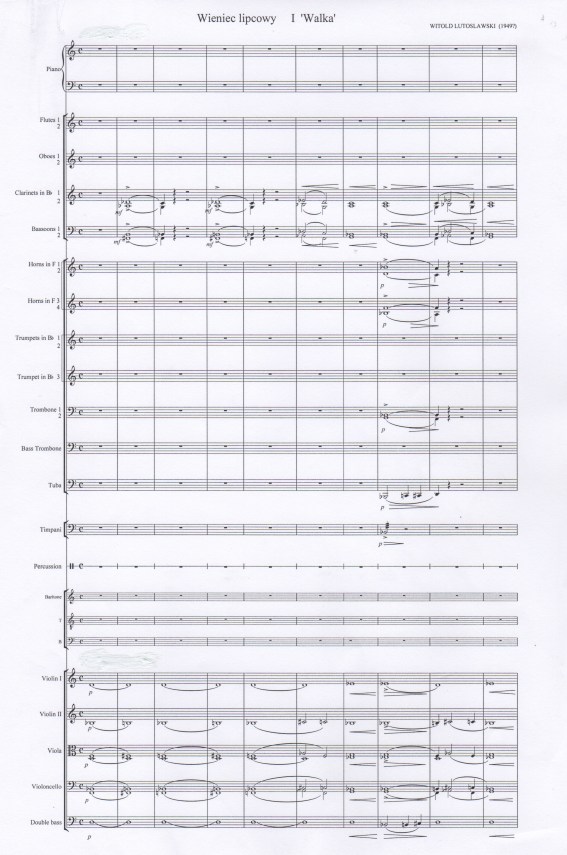
Walka, full score, opening

There are a couple of interesting cross-metre phrases.  The clarinets and bassoons outline a 7/4 pattern (bb.12-16), although there are copying errors in the clarinet parts (which double the bassoons’).

Walka, cl+fg, bb.12-16

The strings later chug away in a 5/4 idea (bb.30-32), though again there is a copying error (the double-basses should be doubling the cellos in b.30).
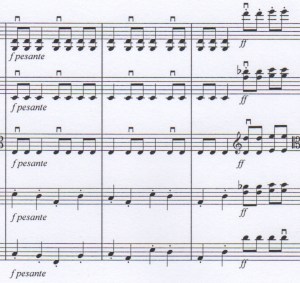
Walka, str, bb.30-32

There is virtually no melodic interest, save for an isolated two-bar fragment on strings, doubled by horns (bb.38-41).
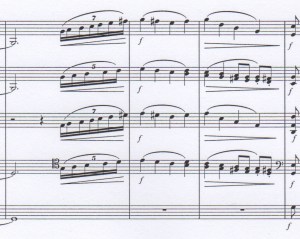
Walka, str, bb.38-41

Odbudowa

This movement is cast as a mazurka, with its principal theme evidencing a mock antiquity in its parallel fifths and peculiar chromaticism.
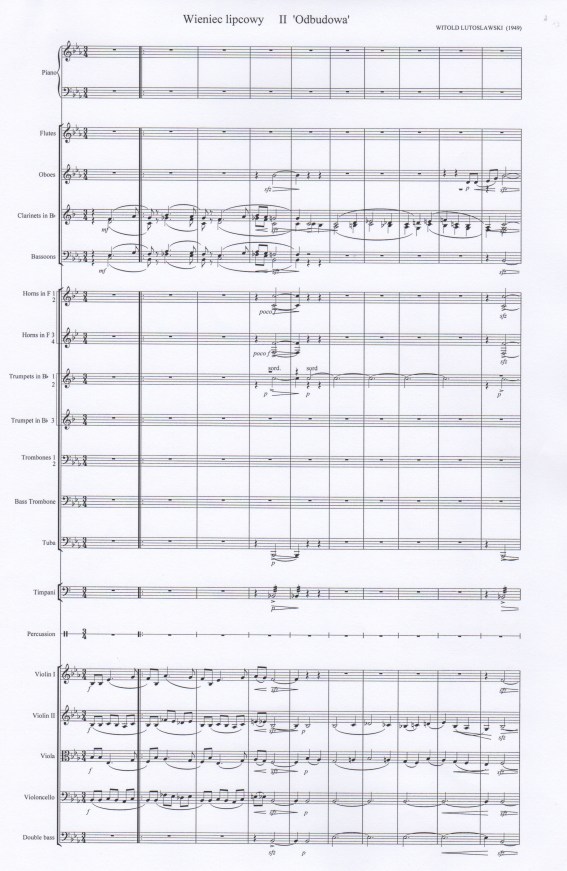
Odbudowa, full score, opening

The diabolical awfulness of the movement’s material and its inability to sustain or develop itself fail both the composer and the uplifting concept of ‘reconstruction’.  Only at the end of the piece, as the ‘climax’ falls away, is there a moment of comparative quality, when a new melody enters.
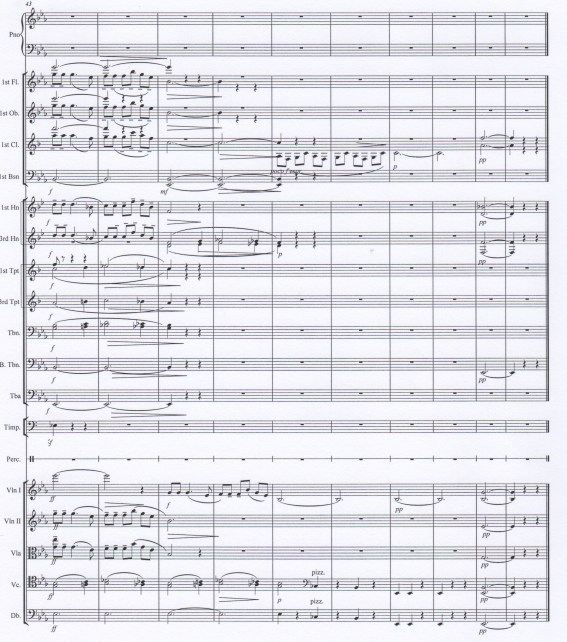
Odbudowa, full score, bb.43-end

Pieśń obrońców pokoju

In an attempt to tie this ‘triptych’ together, this movement begins with the harmonic idea that opens ‘Walka’, at its original pitch.  It soon cadences brightly (as befits the journey from struggle to peace) in G major, though the tonal sequence of C major – E flat major – G major has no particular merit in a work that lasts less than Lutosławski’s timing of c.10′.  At cue 1 (see above) the first tune proper is announced.  It lasts for only four bars, however, before puzzlingly disappearing in repeated chords.

Pieśń obrońców pokoju, full score, opening

The second 8-bar repeated section (cue 2) is almost totally devoid of melodic content.  The first theme does return later, but the movement rapidly come to a full stop shortly after.

Some thoughts

There is no doubting the authenticity of Lutosławski ‘s letter in which he announced the presence of

A triptych for solo baritone, male-voice choir and symphony orchestra ent[itled] “JULY GARLAND” (a piece written to words by K. I. Gałczyński, on the occasion of the fifth anniversary of the July Manifesto), dur. c.10′.  The score is to be found at the House of the Polish Army.

He calls it ‘a triptych’, which implies three balanced sections.  This is true, but the surviving parts indicate that these are separate movements, with only one linking element, as outlined above.  Lutosławski does not call it ‘a triptych of songs’, however.  My initial assumption had been that each of these movements was a mass song, as the titles might be thought to imply.  But the reconstructed score gives no indication of melody or melodic orchestral support in the first movement, and the same applies for much of the second.  Only the final movement contains anything (clear melody and simply harmony, repeat 8-bar sections) that is normally associated with a mass song.  But even here there is a gulf of quality with Lutosławski’s other mass songs and the cantata Warszawie – Sława!.

My hunch goes as follows.  The first movement (‘Walka’) is purely instrumental.  The second (‘Odbudowa’) may also be instrumental, but it may also have given the spotlight to the solo baritone, who might not need full orchestral support melodically.  Only the final movement (‘Pieśń obrońców pokoju’) is choral, possibly including the solo baritone (see also Warszawie – Sława!), because in key places it has the hallmarks of the genre, as outlined above.

Yet the greatest enigma is the music itself.  It is desultory hack-work and it is hard to believe that Lutosławski would compose it let alone subsequently advertise its presence in his letter to the Polish Composers’ Union.  Could the surviving parts in fact be by someone else, malevolently substituted for the real thing?  This would be going to extraordinary lengths to besmirch Lutosławski, especially as the piece had no currency whatsoever at any time. Such a scenario seems unlikely, which leaves no alternative to the assumption that this music is indeed by Lutosławski, music that was rushed through almost as a ‘do your worst’ to whomsoever it was destined.

Fast-forward to 1981

The handwriting of the main copyist, at the head of the parts, is certainly sufficiently old-fashioned to date from the late 1940s, but there is a further curiosity which raises questions that need to be aired.  And this is the catalogue stamp on the parts.  On all but one of them it is smudged and illegible.  But the hand-written date is clear on most. The part for Flute I is clearest of all:
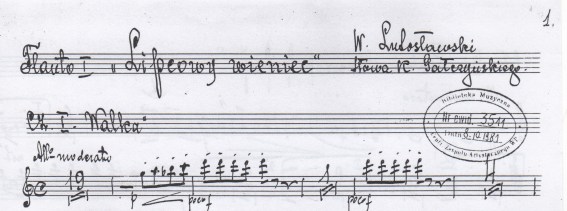
Walka, fl.I part

Biblioteka Muzyczna Centr. Zespołu Artystycznego WP.  Data 8.10.1981
(Music Library of the Centr[al] Artistic Ensemble of the Polish Army.  Date 8.10.1981)

Two conclusions may be jumped to, but neither is watertight: (1) the Music Library at the House of the Polish Army got round to cataloguing the parts only in 1981, over thirty years after the piece and parts were written; (2) the parts were written out (again?) in 1981.  While (1) makes some sense and is at least a logical possibility, (2) would have required the score to have survived until 1981 too.  And (2) raises the burning question: why would anyone want to undertake such a labour in 1981?  What purpose would it serve?

Lutosławski recollects

At this point, it is worth recounting a story told by Lutosławski to the Russian musicologist Irina Nikolska.  On pp.41-43 in Nikolska’s Conversations with Witold Lutosławski (Stockholm: Melos, 1994), Lutosławski tells how he came to write his mass songs and how one of them surfaced twice subsequently with a substituted text in praise of Stalin.  (As the translation of Nikolska’s book is less than perfect, I have translated the following passage from a more recent edition of these conversations published in Polish: Muzyka to nie tylko dźwięki (Music is not just sound) (Kraków: PWM, 2003), pp.23-25.  Not only is this likely to be a more accurate transcription of the actual conversation, which was conducted in Polish, but it also differs in small but telling ways from the version of 1994.)

Meanwhile – really, I say this with all sincerity – the only thing for which I can reproach myself, and which I regret that I did, is that I wrote a few mass songs.  I wrote them because, being the sole breadwinner of the family, I thought that I must be very careful with what was happening to me, because I belonged not only to myself but also to my family.  Meanwhile, when I was an employee of the radio – I was there on salary as a composer of music for radio plays and children’s programmes – Henryk Swolkień [a senior colleague at Polish Radio] said to me, “Listen, write a few mass songs, because at the board it is said that you wrote songs for the Home Army and now you do not want to.  Be careful, because this could end badly”.  So I took various innocent lyrics – the only ones that one could take to avoid anything nasty – and I wrote these mass songs.  Actually, that was stupid of me.  Anyway, I think that Swolkień also showed undue fear.

I also wrote songs for the army.  They were all very innocent texts, there was no politics there.  Well, I wrote Song of the Armoured Tank [lit. Song about the Armoured Weapon, Pieśń o broni pancernej, which in Polish refers to armoured vehicles, i.e. tanks].  The House of the Polish Army organized a display of the songs. Duplicates were distributed to the audience …

[Nikolska] … when was this?

It was the fifties – maybe 1951.  So it was my music to Song of the Armoured Tank, but with planted words about Stalin – without my knowledge!  I went to Major Żytyński – the head of the House of the Polish Army – and protested very vigorously, which went with a certain risk, of course, but I thought that in this situation I had no choice.  I had to respond and categorically demand the withdrawal of the text.  And this was done.  And so, practically, the matter seemed to be over.  Yet it returned many years later.

During martial law, that is, after 1981 and before the changes in Poland, there was a boycott of television by actors, and a general boycott of government circles.  […] … it was in a period when a proportion of the artistic world very strongly manifested its disapproval of the government and ostentatiously sympathised with opposition movements.  […]  In a word, an atmosphere was created around many people, and around me among others, that here is someone who behaves decently.  And the UB [Secret Police] was set on ruining this.

One day I learned that, behind the scenes in a certain theatre, actors were having a conversation during a break in rehearsal, and someone mentioned my name and added that I conducted myself well, that it is necessary to behave in this way.  One of the actresses objected: “You don’t know what you’re saying. Lutoslawski wrote a cantata about Stalin”. Two people bridled at this and said: “This is impossible.  We know this man well, this is absolutely impossible”.  I did not really know what had gone on there.  I even phoned [Andrzej] Łapicki, who was rector of the National Theatre School, to check if the school library had this song with the text about Stalin.  But the actress who said this must have seen it.  She caught sight of my name, the words about Stalin and called it a cantata, obviously having no idea what a cantata was.  It turned out that the song was in the library.  How did it get there?  I wondered for a long time how this woman, who was not yet in this world when it happened, could have seen it.  I came to the conclusion – of course I did not check it – that the Secret Police did it.  They took a photocopy off the shelf and began to distribute it to people to damage my reputation.  In a word, I would not be a person whose conduct was exemplary.

This conversation with Nikolska is intriguing for several reasons.  Firstly, Lutosławski mentions a song – Song of the Armoured Tank (Pieśń o broni pancernej) – that appears nowhere else in the literature or in the archives.  Secondly, it bears some resemblance in Polish to the title of the third movement of July Garland: ‘Pieśń obrońców pokoju’, although the meaning is quite different.  Is it possible that they are one and the same piece, and that Lutosławski misremembered its title?  Perhaps these ‘defenders of peace’ were indeed armoured tanks, perhaps even mentioned in Gałczyński’s lost text.

Thirdly, in an email exchange with the Lutosławski authority Martina Homma in December 2003, she sent me excerpts from interviews that she had carried out with him in 1986.  He stated to her that it was apparently Tadeusz Urgacz, a prolific lyricist of mass songs (he wrote the texts to two of Lutosławski’s published mass songs), who wrote the substituted text about Stalin.

When it comes to the 1980s, if Lutosławski’s chronology is accurate, it is clear that the story of the actress postdates the cataloguing of July Garland (her story dates from after the imposition of martial law on 13 December 1981, whereas the cataloguing had taken place on 8 October that year).  It seems unlikely that someone was plotting against Lutosławski during the Solidarity period.  I think, therefore, that the catalogue dating is more likely to be part of some house tidying.  Besides, it was not the full score or the orchestral parts that were found after 1981, but photocopies of the probably cyclostyled duplicates circulated, as Lutosławski said, in the early 1950s (the photocopier had not yet been invented).

This all points to a performance, or at the very least, a rehearsal of the final movement of July Garland before the unfortunate incident of the substituted text, if, indeed, these two songs are one and the same.  If not, then Pieśń o broni pancernej remains a mystery.  Perhaps one day someone will come across one of the UB’s photocopies that lies forgotten on a dusty shelf.  No-one, I think, is sorry that Lutosławski’s July Garland triptych was consigned to a footnote in history, but its own history is a compelling example of the extramusical forces at work in a truly dark period of post-war Poland.

…….

Original Polish text extracted from Nikolska’s second version of her conversations with Lutosławski (2003).

Tymczasem – naprawdę mówię to z całą szczerością – jedyną rzeczą, którą mogę sobie zarzucić i której żałuję, że zrobiłem, jest to, że napisałem kilka pieśni masowych.  Napisałem je dlatego, że będąc jedynym żywicielem rodziny sądziłem, że muszę dobrze uważać na to, co się ze mną dzieje, bo nie należę tylko do siebie, ale również do swojej rodziny.  Tymczasem, kiedy byłem pracownikiem radia – byłem tam na pensji jako kompozytor muzyki do słuchowisk i audycji dla dzieci – Henryk Swolkień powiedzał mi: “Słuchaj, napisz kilka pieśni masowych, bi już na kolegium mówiono, że dla Armii Krajowej toś pisał pieśni, a teraz nie chcesz. Uważaj, bo to się może źle skończyć”.  Wziąłem więc różne niewinne teksty, jakie tylko można było wziąć – żeby nie było tam nic paskudnego – i napisałem te pieśni masowe.  Właściwie głupio zrobiłem.  Zresztą uważam, że Swolkień też wykazał zbytnią strachliwość.

Pisałem również pieśni dla wojska.  Wszystko to było bardzo niewinne teksty, żadnej polityki tam nie było.  No i napisałem pieśń o broni pancernej.  Dom Wojska Polskiego zorganizował pokaz tych pieśni.  Fotokopie były rozdawane publiczności…

[Nikolska] … kiedy to było?

To było lata pięćdziesiąte – chyba 1951 rok.  Była więc ta moja muzyka do pieśni o broni pancernej, ale z podłożonymi słowami o Stalinie – bez mojej wiedzy!  Poszedłem do majora Żytyńskiego – kierownika Domu Wojska Polskiego – i bardzo energicznie zaprotestowałem, co było połączone oczywiście z pewnym ryzykiem, ale uważałem, że w tej sytuacji nie miałem wyboru.  Musiałem zareagować i zażądać kategorycznie wycofania tekstu.  I tak zrobiono.  Na tym właściwie sprawa wydawała się skończona.  Tymczasem powróciła wiele lat póżniej.

W czasie stanu wojennego, to znaczy po 1981 roku, a jeszcze przed zmianami w Polsce, był bojkot telewizji przez aktorów, i w ogóle bojkot sfer rządzących.  […]  … było to w okresie, w którym pewna część świata artystycznego bardzo zdecydowanie manifestowała swoją dezaprobatę dla władzy i ostentacyjnie solidaryzowała się z ruchami opozycyjnymi.  […]  Jednym słowem, wytworzyła się taka atmosfera dookoła wielu ludzi, a między innymi dookoła mnie, że jest to człowiek, który się przyzwoicie zachowuje.  I ubecja chciała to popsuć.

Któregos dnie dowiaduję się, że za kulisami pewnego teatru aktorzy dyskutowali podczas przerwy w próbie, i ktos wymienił moje nazwisko i powiedzał, że dobrze się zachowuję, że należy w ten sposób postępować. Jedna z aktorek zaoponowała: “Nic nie mówcie, Lutosławski napisał kantatę o Stalinie”.  Dwie osoby bardzo się żachnęły i powiedziały: “To jest niemożliwe.  Znamy doskonale tego człowieka, to jest absolutnie niemożliwe”.  Nie bardzo wiedziałem, co tam się stało.  Nawet zatelefonowałem do Łapickiego, który był rektorem Państwowej Wyższej Szkoły Teatralnej, żeby sprawdził, czy w bibliotece szkoły nie ma tej pieśni z tekstem o Stalinie.  Przecież aktorka, która to powiedziała, musiała ją widzieć.  Zobaczyła moje nazwisko, słowa o Stalinie i nazwała to kantata, nie mając oczywiście pojęcia, co to jest kantata.  Okazało się, że pieśń jest w bibliotece.  Skąd się tam wzięła?  Zastanawiałem się długo, skąd ta kobieta, której jeszcze na świecie nie było, kiedy to się stało, mogła to widzieć.  Doszedłem do wniosku – oczywiście nie sprawdziłem tego – że to zrobiła ubecja.  Wzięli z półki fotokopię i zaczęli ja rozprowadzać po ludziach, żeby zepsuć mi opinię. Jednym słowem, żebym nie był tym człowiekiem, którego postępowanie jest wzorowe.

• WL100/50: Volcano in Łowicz (1949)

On 21 March 1949, Lutosławski went with the Polish poet and satirist Konstanty Ildefons Gałczyński (1905-53) to a well-known artists’ retreat at the Palace of Nieborów, west of Warsaw.  Its nearest town was Łowicz (pronounced ‘Wohveech’).  They were meeting to discuss one of the oddest projects that Lutosławski ever entertained: a comic opera centred on Łowicz.  Yet, as the preceding post – WL100/49: 22 July 1949 and a letter – indicates, this was not the only link between the two men, and this post concludes with a footnote about their other proven collaboration, July Garland.

The source of the Łowicz information was given to me by Gałczyński’s daughter, Kira, when I met her in Warsaw in 2000.  Earlier, she had spoken to my friend Michał Kubicki (who did much of the groundwork when following up the leads in Lutosławski’s letter), saying that her father and Lutosławski spent many hours talking at Nieborów, discussing several joint projects.

The only published account of their collaboration of which I am aware is to be found in a contribution to a book on Gałczyński, published in 1961.*  It comes from Jan Wegner (1909-96), who was  born in Łowicz.  After World War II, he was appointed to take care of the renovation of the Palace of Nieborów and he initiated many artistic meetings and events there.  In ‘Wspomnienia Nieborowskie’ [Nieborów Memories], he wrote:

21 March (Monday). Today, for the second time, Gałczyński came to Nieborów.  He was accompanied by the musician Witold Lutoslawski, for whom, after his first departure from Nieborów, he had prepared the libretto for a comic opera in one act entit[led] “The Fair in Łowicz”.  A note written by the composer in the Nieborów Visitors’ Book states: “Witold Lutoslawski was here on 21.03.1949 with Konstanty Ildefons Gałczyński on account of “The Fair in Łowicz”.”

The poet said that among contemporary Polish musicians Lutoslawski has the greatest sense of the grotesque.

That day, Gałczyński read me excerpts from his libretto, while asking at the same time about the history of the famous fairs in Łowicz.  The libretto was full of fun ideas and grotesque-comic effects.  He introduced various additions, and he even changed the title of the comic opera to “The Volcano in Łowicz”.  The climax of this musical spectacle was supposed to be a volcanic eruption, belching with fire and smoke.  This volcano (a cardboard “fireproof crater”), the biggest sensation of the St John’s fair in Łowicz, was a source of income for a certain minstrel with whiskers who wandered through the fair and who fell in love with the Łowicz mayor, Eulalia.  In honour of Eulalia he commissioned a cantata about Mercury, “the god who links Łowicz with Olympus”.  Roch Serafiński wrote the cantata, “which grants happiness and lends money”.
[…]
The libretto was written for Lutoslawski.  The authors wanted to entrust the directing to Lidia Zamkow who came that day to Nieborów from Łódź with Natalia Gałczyńska and the writer Maciej Słomczyński.  As regards the set and costumes, they intended to approach … Jan Kamyczek and the Rojek Brothers from “Przekrój”.

…….

21 marca (poniedziałek).  W dniu dzisiejszym po raz drugi przyjechał Gałczyński do Nieborowa.  Towarzyszył mu muzyk Witold Lutosławski, dla którego przygotował po pierwszym wyjeździe z Nieborowa libretto do opery komicznej w jednym akcie pt. “Jarmark w Łowiczu”.  Stwierdza to notatka wpisana przez kompozytora do nieborowskiej Księgi Pamiątkowej: “Witold Lutosławski 21.3.1949 był tu z Konstantym Ildefonsem Gałczyńskim z powodu “Jarmarku w Łowiczu”.”

Poeta mówił, że spośród współczesnych muzyków polskich Lutosławski ma największe poczucie groteski.

Tego dnia Gałczyński odczytał mi fragmenty swojego libretta, wypytując jednocześnie o historię słynnych jarmarków łowickich.  Libretto obfitowało w zabawne pomysły i efekty groteskowo-komiczne.  Do tekstu wprowadzał różne uzupełnienia, a nawet sam tytuł opery komicznej zmienił na “Wulkan w Łowiczu”.  Punktem kulminacyjnym tego muzycznego widowiska miał być wybuch wulkanu, zionącego ogniem i dymem.  Ów wulkan (z tektury o “ogniotrwałym kraterze”), będący największą sensacją świętojańskiego jarmarku w Łowiczu, był źródłem utrzymania pewnego wędrującego po jarmarkach rybałta z wąsikami, który zakochał się w łowickiej burmistrzance Eulalii.  Na cześć Eulalii zamówił kantatę Merkury, “bożek, co Łowicz z Olimpem łączy”.  Kantatę napisał Roch Serafiński, “co radości użycza a forsę pożycza”.
[…]
Libretto było pisane dla Lutosławskiego.  Reżyserię chcieli autorzy powierzyć Lidii Zamkow, która tego dnia przyjechała z Łodzi do Nieborowa z Natalią Gałczyńską oraz pisarzem Maciejem Słomczyńskim.  W sprawie dekoracji i kostiumów zamierzano zwrócić się do… Jana Kamyczka i braci Rojek z “Przekroju”.

Notes:
• Lidia Zamkow (1918-82) was a Polish actress and director.  Maciej Słomczyński (1922-98), an adopted Pole, was her first husband.  Natalia Gałczyńska (1908-76) was Gałczyński’s wife and an author in her own right. ‘Jan Kamyczek’ and ‘the Rojek Brothers’ [Bracia Rojek] were two of the pseudonyms used by the (female) painter and satirical journalist, Janina Ipohorska (1914-81), who – like Gałczyński – frequently contributed to the Polish weekly satirical magazine Przekrój (Wegner seems to have misunderstood her identity a little).  The fictional Roch Serafiński was previously a character in Gałczyński’s poetic ‘little oratorio’ Kolczyki Izoldy (Isolde’s Earrings, 1946).
• There’s something curious about Wegner’s chronology.  When did Gałczyński change the title from ‘The Fair in Łowicz’ to ‘The Volcano in Łowicz’?  During the day’s discussions, or before?  Lutosławski’s entry in the Visitors’ Book must surely have been made when he arrived, rather than when he left, as he wrote down the former title.  (It is possible, given the poor transport links at the time and the facilities offered at Nieborów, that they were there for longer than just a day visit.)  Whatever the sequence, it is clear from Wegner’s account that the planning of the project was well-advanced, as the names of the other main contributors were already being discussed.
• That this project came to nothing is disappointing as it sounds quite different from the smothering blanket of socialist-realist culture that was rapidly being spread over all the Polish arts in Spring 1949.  Perhaps that is why it fell by the wayside.  But its fantastical character must have appealed to Lutosławski in some measure, even though he had an aversion to opera in which normal speech was set to music.  Perhaps the most interesting feature in Wegner’s recollections is Gałczyński’s opinion that Lutosławski had the greatest sense of the grotesque of all Polish musicians.  On what did he base this judgment?  Could it be the third movement, Allegretto misterioso, from the First Symphony, premiered less than a year earlier and castigated by the authorities only six months after the meeting at Nieborów?

* Anna Kamieńska & Jan Śpiewak (eds), Wspomnienia o K. I. Gałczyńskim [Reminiscences of K. I Gałczyński] (Warsaw: Czytelnik, 1961), pp.453-4.

Footnote on Lipcowy wieniec

All that we know for certain about Lipcowy wieniec (July Garland) comes from Lutosławski’s letter of 8 April 1950 (see previous post).  Despite Kira Gałczyńska’s recollection that her father and Lutosławski discussed several joint projects at Nieborów, no evidence has surfaced in her father’s papers for 1949.  In 2000, Michał Kubicki made enquiries of Maria Mirecka (the 20th-century poetry editor at the publishing house Czytelnik) and of Ziemowit Fedecki (editor of the Twórczość monthly, who knew Gałczyński personally and edited several volumes of his poetry), but neither knew anything about the Gałczyński-Lutosławski connections.

One is left wondering if one of their joint projects was the short celebration of the July Manifesto (see post WL100/48) that became July Garland.  Did they, perhaps, groan together in Nieborów as they cobbled together a work in which they had no interest and even less faith?  There is no reason to doubt Lutosławski’s word about Gałczyński’s involvement in this triptych, but all we are left with of his contribution are the titles of the movements: ‘Walka’ (Struggle), ‘Odbudowa’ (Reconstruction) and ‘Pieśń obrońców pokoju’ (Song of the Defenders of Peace).  The music of July Garland is the subject of the next post – WL100/51.

As to any performance of July Garland, the evidence is very thin.  Michał Kubicki found no trace of it in the newspapers issued around 22 July 1949.  The opening of Trasa W-Z (E-W Route) dominated the headlines, but there was no indication of any new Lutosławski-Gałczyński work (one can be certain, had the premiere taken place, that it would have received considerable attention).  The previous day, there had been some musical items:

• The post-war reconstruction of Warsaw’s National Philharmonic Hall began.
• The Chopin Institute announced that for 22 July the cost of bus tickets to Chopin’s birthplace at Żelazowa Wola outside Warsaw would be reduced.
• Kantata na 22 lipca (Cantata for 22 July) by Jerzy Gert and Tadeusz Dobrzański, to a text by Krzysztof Gruszczyński, was premiered on the evening of 21 July, at the Legia Sports Club tennis courts.  The concert was organised by Dom Wojska Polskiego (House of the Polish Army), to which Lutosławski referred in his letter. The Polish daily Trybuna Ludu published the full text, of which these are the opening lines:

Fraternal canons resounded in July,
They brought us sun and song,
Eternal glory to the Soviet Army
Honour to our brotherhood in arms!

Zagrały w lipcu bratnie działa,
Słońce przyniosły nam i pieśń,
Radzieckiej Armii wieczna chwała
Braterstwu broni naszej cześć!

Surprisingly, the Gert-Dobrzański compilation did have some life in it, as it was repeated in Warsaw on 12 April 1951. The poetry is pretty dreadful and typical of socialist-realist panegyrics.  Without doubt, Gałczyński’s lyrics would have had more character, even if their sentiments were similar.  Sadly, we are unlikely ever to know.

• WL100/49: 22 July 1949 and a letter

In 1999, in a Polish archive, I came across a letter that was something of a surprise, to put it mildly.  Dated 8 April 1950, the letter was from Lutosławski to the Board of the Polish Composers’ Union ZKP, concerning its special call for scores (27 March).  The Composers’ Union letter had read:

To members of the ZKP, with the exception of musicologists and non-residents.

In connection with the forthcoming Festival of Polish Music, which will take place between November 1950 and March 1951, we kindly request prompt replies to the following questions:

1. What are you composing, or planning to compose, with the intention of submitting to the festival?  You should give an indication of the proposed title, the make-up of the ensemble, the duration and the completion date of the composition, on the understanding that

(a) pieces for symphonic forces should be sent in by September 1, 1950,
(b) smaller pieces for amateur, chamber or choral ensembles, and mass songs should be sent in by July 15, 1950, to the festival office: ul. Zgoda 15, Warsaw.

2. What ameliorations (journeys, vacations) as well as what expenses do you anticipate?

Irrespective of any grant which might be awarded by the Ministry of Culture and Art, the pieces which you send in could be commissioned by the Composers’ Commissioning Board of the ZKP or by other institutions, for example Polish Radio, the House of the Polish Army, the Union of Polish Youth, etc.  Pieces of the second type (under 1.b) are particularly sought by the festival Committee.

…….

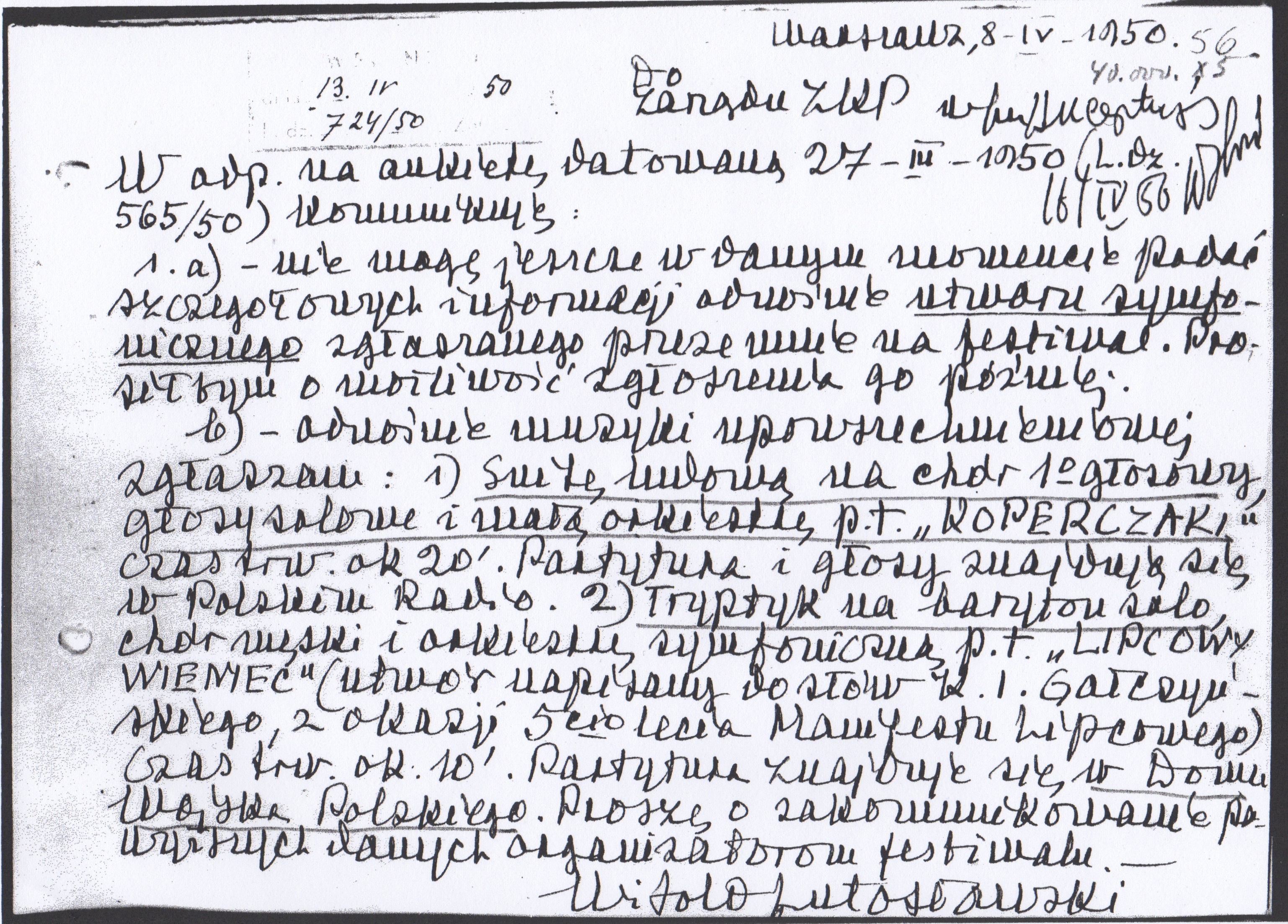
The contents of Lutosławski’s reply are astonishing, especially in light of his later comments on his music of the late 40s and early 50s, when socialist realism was at its height.  Here is his letter, with my translation.

WL letter re Lipcowy wieniec

Warsaw, 8-IV-1950
To the Board of ZKP

In rep[ly] to the enquiry dated 27-III-1950 (L.Dz.565/50), I notify you that:

1.a) – I cannot yet at this moment give detailed information relating to the symphonic work proposed by me for the Festival. I would request the possibility of submitting it later.
b) – relating to broadly-based music I offer: 1) A folk suite for unison choir, solo voices and small orchestra, ent[itled] “COURTSHIP,” dur. c. 20′.  The score and parts are to be found at Polish Radio.  2) A triptych for solo baritone, male-voice choir and symphony orchestra ent[itled] “JULY GARLAND” (a piece written to words by K. I. Gałczyński, on the occasion of the fifth anniversary of the July Manifesto), dur. c.10′.  The score is to be found at the House of the Polish Army.  Please pass on the above-mentioned notification to the Festival organisers. –
Witold Lutosławski

That Lutosławski should have composed a work with such a blatant political purpose is extraordinary.  It never surfaced during his lifetime – it never appeared in his list of works – and one suspects that he had blanked it, understandably, from his memory.  Although its link with the preceding post – WL100/48: 22 July 1944 – is self-evident, much else remains to be explained.  The next post – WL100/50: Volcano in Łowicz – looks at Lutosławski’s collaboration with Gałczyński (1905-53), one of Poland’s most distinguished poets.

• WL100/48: 22 July 1944 and after

Just days before the valiant but ultimately disastrous Warsaw Uprising on the west bank of the River Vistula, the nascent Polish Communist party issued a declaration.  Its leaders were east of the river, in Lublin, under the protection of the Soviet army.  The declaration of 22 July 1944 was headed by the Polish eagle, deprived of its crown, and the words “Manifest i pierwsze dekrety Polskiego Komitetu Wyzwolenia Narodowego (Manifesto and First Decree of the Polish Committee of National Liberation).  PKWN_Manifest

Within a few years, opposition had been eliminated and the date of 22 July came to symbolise the creation and reinforcement of Poland’s Soviet-backed political structure.  Major projects in the rebuilding of Warsaw were often opened on this date.  In 1949 it was Trasa W-Z (E-W Route), a road and tram route over the Vistula from Praga, past the (then still ruined) Royal Palace and through a newly-constructed tunnel westwards.  This date in 1950 and 1952 also ‘book-ends’ the building of the socialist-realist housing and shopping complex MDM around Plac Konstitucji.  In 1955, 22 July was chosen for the opening of the Palace of Culture and Science, Stalin’s ‘gift to Warsaw’, which still towers over the city.

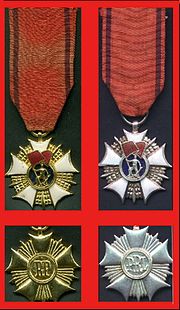
22 July was also an occasion to dish out honours to worthy citizens, from bricklayers to cultural figures.  Lutosławski could not escape such attention.  On 22 July 1955 – the same day that the Palace of Culture and Science was handed over – he received the Order of the Banner of Work (Order Sztandaru Pracy), but only Second Class (on the right, below), even though his Concerto for Orchestra had been successfully premiered eight months earlier.

180px-Order_Sztandaru_Pracy-I_i_IIkl

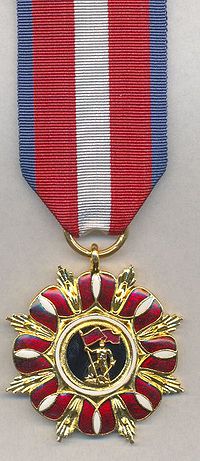
Such medals were accepted as an unavoidable part of life, especially in the early post-war decades.  But even 22 years later, in 1977, when dissident groups were making waves (it was only two years before Cardinal Wojtyła became Pope John Paul II and three years before the establishment of the free trade union Solidarity), it was hard to avoid them.  That year, Lutosławski was taken unawares when he was awarded the Order of the Builders of People’s Poland (Order Budowniczych Polski Ludowej).  This Order was normally awarded for political service and, of the 18 recipients in 1977, several were top party functionaries.  Lutosławski was the only composer given this award during its entire history (1949-85).  The ceremony took place on the eve of 22 July.*

200px-Order_Budowniczych_Polski_Ludowej_106251261zlc

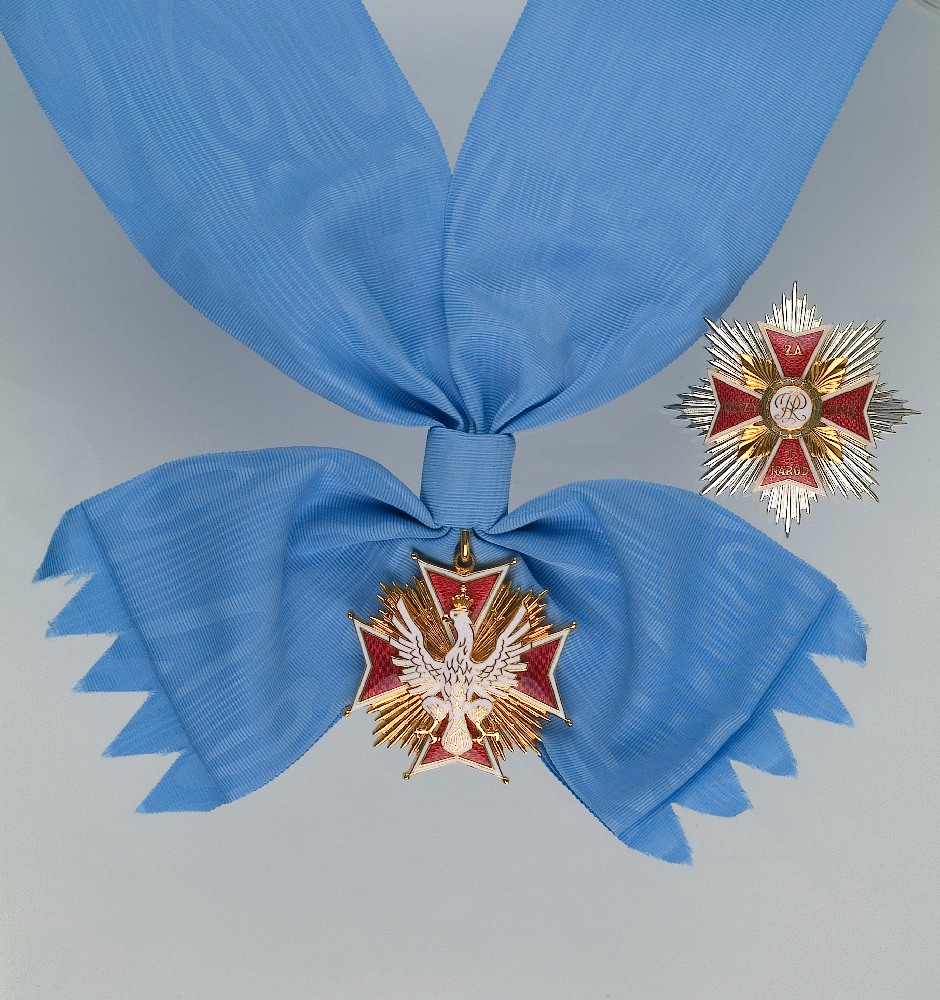
Fortunately, there were many more awards from abroad, and later in democratic Poland, that brought Lutosławski pride and joy.  He received the last of these, the Order of the White Eagle (Order Orła Białego), Poland’s highest honour, as he was dying in 1994.  (He was only the second person to be so honoured in modern times; the first was Pope John Paul II, in 1993.)  It was carried ceremonially ahead of his casket at his funeral a matter of weeks later.

9-15396

The next post in this mini-series – WL100/49: 22 July 1949 and a letter – uncovers an unknown work by Lutosławski.

* information from Danuta Gwizdalanka and Krzysztof Meyer, Lutosławski. Droga do mistrzostwa (Kraków: PWM, 2004), 230-31.

• WL100/46: Notebook June-July

I have just realised that there are no entries at all in Lutosławski’s creative Notebook (1959-84)  for the months of June and July.  Good man – he knew that holidays were important, although there were some years when he was working hard in these months.  He finished the Cello Concerto on 27 July 1970 and completed the Concerto for Orchestra on 1 August 1954.  The images of him sailing as a way of relaxing are well-known, but this creased photo from the Witold Lutosławski Society in Warsaw shows him in another craft.  My guess is that it dates from the 1950s or early 60s, but if anyone has better information it would be good to know.

Screen Shot 2013-08-17 at 11.08.32

I am playing catch-up with these WL100 posts (there are a few more to follow before I am up-to-date) – my apologies.  I have been writing about Lutosławski’s Cello Concerto all summer.  I could do with a kayak trip myself.

• WL100/42: 33 ‘Derwid’ songs published

The Polish Music Publisher PWM has just issued a press release about its two new volumes of songs by Lutosławski that he wrote under the closely guarded pseudonym ‘Derwid’.  He composed these popular dance songs – foxtrots, tangos, waltzes, etc. – in 1957-63, although the band arrangements were done in-house at Polish Radio.  Many of the songs’ melodies were published in Polish Radio’s weekly listings magazine Radio i Świat (Radio and the World) at the time.  PWM published five of Lutosławski’s piano versions as separate numbers in 1957-60 and over twenty through its fortnightly light-music imprint Śpiewamy i Tańczymy (Let’s Sing and Dance) in 1957-64.  

When I first came across this little treasure trove of largely forgotten music in 1994, I was the only person who had any interest in it.  The songs were regarded by the Polish musical establishment as of negligible interest musically or historically.  Moreover, I was told on several occasions by Polish colleagues that it would be unseemly for anyone in Poland to do even the most basic research into them or into Lutosławski’s other songs, especially his mass songs of the early 1950s.  Fortunately, that situation has long been superseded by a more curious attitude, to the extent that in a month or so’s time a new CD will be released of some of the Derwid songs in edgy and humorous interpretations by Agata Zubel, Andrzej Bauer and Cezary Duchnowski (see my post from 26 March 2013, Zubel Zings!).

Here is a list of the contents of the two volumes, which seem to present the songs in roughly chronological order. There are corrections and both additions to and omissions from the list I made in 1994 (this may be found at the end of my article, ‘Your Song is Mine’, The Musical Times, 1830 (August 1995), 403-10).  I had erroneously equated Zakochać się w wietrze (To fall in love with the wind) with Serce na wietrze (Heart on the wind).  But I also named two songs which are not in this new collection, even though they were published by PWM at the time: Kiosk na Powiślu (Kiosk by the Vistula) / Kiosk inwalidy (Kiosk of the invalid) and Wędrowny jubiler (The wandering jeweller).  Three further, unpublished songs were subsequently found amongst Lutosławski’s manuscripts at the Paul Sacher Stiftung in Basle – Dom rodzinny (Family home), which is not in this new collection, and two which are – Podlotek (Flapper) and Twoje imieniny (Your name-day).  

In Poland, each volume costs 35 złoty (= c. £7); outside Poland the price rises to 19.95 euros (c. £17).  It’s not obvious why there should be such a huge difference in price.  Here is the link to the relevant English-language page of PWM’s online shop.  You might try going on to the Polish page by clicking on the Polish flag and seeing if you can pay by ordering in złoty!

Volume 1 (19 songs)

Derwid_ok?adka zeszyt 1Milczące serce (Silent heart)
Czarownica (The witch)
Daleka podróż (Distant journey)
Cyrk jedzie (The circus is coming)
Zielony berecik (The little green beret)
Szczęśliwy traf (Good fortune)
Zakochać się w wietrze (To fall in love with the wind)
Miłość i świat (Love and the world)
Tabu (Taboo)
Kapitańska ballada (The captain’s ballad)
W lunaparku (At the funfair) / Nie kupiłeś mnie na własność (You do not own me)
Telimena (Telimena)
Warszawski dorożkarz (The Warsaw cabman)
Nie oczekuję dziś nikogo (I am not expecting anyone today)
Serce na wietrze (Heart on the wind)
Filipince nudno (The bored Filipina)
Złote pantofelki (Golden shoes)
Po co śpiewać piosenki (Why song songs)
Moje ptaki (My birds)

Volume 2 (14 songs)

derwid_ok?adka zeszyt 2Rupiecie (Odds and ends) / Wędrowny czas (Wandering time)
Na co czekasz (What are you waiting for)
I cóż to teraz będzie (What is going to happen now)
Z lat dziecinnych (From childhood)
Jeden przystanek dalej (One stop further)
Znajdziesz mnie wszędzie (You will find me everywhere)
Nie dla nas już (No longer for us)
Nie chcę z tobą się umawiać (I do not want to date you anymore)
Podlotek (Flapper)
Twoje imieniny (Your name-day)
Plamy na słońcu (Sunspots)
Tylko to słowo (Only this word)
Jak zdobywać serduszka (How to win hearts)
W pustym pokoju (In the empty room)