Wednesday, 1 February 2012
The recently published third and final volume of diaries by the Polish poet, playwright and novelist Jarosław Iwaszkiewicz (Warsaw: Czytelnik, 2011) has brought to light some interesting comments on music. Despite showing intense bitterness and self-absorption on political matters (he had, to say the least, a controversial history of working with the communist establishment since 1945), Iwaszkiewicz (1894-1980) had some keen insights on cultural matters. His background in music went back to his early years when, as Szymanowski’s younger cousin, he not only suggested the idea for and wrote the libretto of King Roger (1918-24) but also provided Szymanowski with translations of Rabindranath Tagore for the Four Songs and his own poems for Songs of an Infatuated Muezzin, both written in 1918. He also provided the verse for Szymanowski’s Three Lullabies (1922).
Here are three diary entries which have been drawn to my attention by a friend in Warsaw, who also kindly provided the translations. The first, from 1966, is a tart nostalgia for the musical past. The second (1969) and third (1977) entries contain somewhat surprising observations on two pieces by Henryk Mikołaj Górecki, who was the only Polish composer to whom Iwaszkiewicz paid any detailed attention in these diaries. I’ve added some contextual information to two of the three entries.
8 August 1966
W radio ostatni obraz Harnasi i Infantka Ravela. Wierzyć się nie chce, że oni byli, żywi, prawdziwi, dotykalni. Karol! Ravel! Co za postaci półpowieściowe, nieuchwytne, niewyobrażalne. Czy rzeczywiście nie ma już takich ludzi? Czy tylko mi się wydaje, bo jestem stary i zmęczony, i nie widzę, co mam pod bokiem. Lutosławski? Penderecki? Mój Boże, chyba tego nie można porównać. Może w ogóle teraz nie ma artystów. Może tamci jako ‘artyści’ naprawdę należeli do XIX wieku? Jak Chopin, jak Liszt?
On the radio, the last scene of Harnasie and Ravel’s Infante. I do not want to believe that they were here, living, real, tangible. Karol! Ravel! What characters, half taken from a novel, elusive, unimaginable. Are there really no such people any more? Or is it only my impression, because I am old and tired and do not see what I have close at hand. Lutosławski? Penderecki? My God, surely one cannot make any comparison. Perhaps there are no artists at all now. Perhaps those men, as ‘artists’, truly belonged to the 19th century? Like Chopin, like Liszt?
24 September 1969
Taka cudowna noc dzisiaj księżycowa. I pomyśleć, nie mam nikogo, z kim bym mógł wyjść na spacer po ogrodzie. Hania° nie wychodzi nigdy do ogrodu, zwłaszcza po zachodzie słońca. Wysłuchałem tylko co Muzyki staropolskiej Góreckiego.* Monotonne to, ale bardzo ‘wielkie’. O szerokim oddechu, prymitywne, z puszczą, z wiatrem, z mordem. Nic z lukrowanego obrazka a la Wołodyjowski.† Chyba taka Polska jest prawdziwa.
Such a wonderful moonlit night tonight. And to think that I have no one with whom I could go for a walk in the garden. Hania° never goes out into the garden, especially after sunset. I have just listened to Gorecki’s Old Polish Music.* Monotonous this, but very ‘great’. Broadly breathed, primitive, with a primeval forest, with wind, with murder. Nothing like the sentimental picture-book that is Wołodyjowski.† Such is perhaps the true Poland.
° Iwaszkiewicz’s wife, Anna
* This must have been the live broadcast on Polish Radio of the world premiere, given by the National Philharmonic SO, conducted by Andrzej Markowski, as part of the 12th ‘Warsaw Autumn’ International Festival of Contemporary Music.
† Wołodyjowski: a reference to a recent feature film Pan Wołodyjowski (Jerzy Hoffman, 1969) which was based on Henryk Sienkiewicz’s historical novel of the same name (1888).
8 September 1977
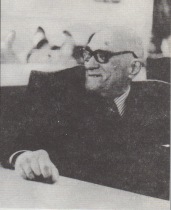
Iwazkiewicz at Baranów, 1977
Iwaszkiewicz gave the opening paper at a conference of musicologists and musicians at Baranów, 4-12 September 1977. He made this diary entry after the delegates had listened on 7 September to a recording of Górecki’s Third Symphony ‘Symphony of Sorrowful Songs’ (1976). This must have been a tape of the world premiere given in Royan five months earlier as the piece had not yet been performed in Poland (it was given its Polish premiere at the ‘Warsaw Autumn’ on 25 September 1977).
[…] tak od czasu do czasu wpisywać jakieś laments daje fałszywe wyobrażenie o całym continuum wewnętrznym, które wcale nie składa się wyłącznie z lamentów. Nie jest też tym continuum przerażającym, jakie wczoraj zaprezentował Górecki w swojej III Symfonii. Beznadziejny powrót tego samego akordu w pierwszej części symfonii sprawia wrażenie psychopatyczne, maniakalne, a jednak wstrząsające – właśnie jako continuum wewnętrznego, czegoś bardzo głębokiego i tragicznego jakby w założeniu, bez dramatycznych zawołań, bez żadnego ‘teatru dla siebie’. To bardzo dziwny i niepokojący utwór.
[…] writing down from time to time laments of some kind gives a false impression of the whole internal continuum, which does not at all consist solely of laments. Nor is it a terrifying continuum, of the kind presented yesterday by Gorecki in his Third Symphony. The hopeless return of the same chord in the first movement of the symphony makes a psychopathic, maniacal, and yet shocking impression – exactly like an inner continuum, something very deep and almost tragic in its assumption, without dramatic calls, without any ‘theatre for theatre’s sake’. A very strange and unsettling piece.
 Five videos of Polish music have newly been made available online. They date from 1968-75 and are all of performances at the Philharmonic Hall in Warsaw during the annual ‘Warsaw Autumn’ festival. There are two pieces by Lutosławski and one each by Baird, Penderecki and Serocki. Not only can we now witness Peter Pears, Wanda Wiłkomirska and Karl-Erik Welin in action but we can also experience Lutosławski conducting his own music as well as appreciate that inspirational and tireless champion of new music, Andrzej Markowski (1924-86). Many Polish composers owed him a huge debt of gratitude, including Baird, Penderecki and Serocki.
 The first double CD (BR ES01) shows that Bôłt’s intentions are not just to provide an historical record of a past age. The first CD consists of seven tape pieces from the PRES archives (by Bohdan Mazurek, Penderecki, Eugeniusz Rudnik and Schaeffer). The second CD consists of new ‘covers’ of these pieces, plus another of Schaeffer’s Symphony (1966), although the original realisation of this historically significant work by Mazurek is not included. It does appear, however, on the sixth disc of the series, which is devoted to Schaeffer.
 The second double CD (BR ES02) is devoted to Mazurek, whose name and achievement as a composer have for too long been overshadowed. In the early years, through the 1960s and beyond, Mazurek, like Rudnik, was one of the sound engineers employed by PRES, so his own compositional output never had the space to breathe that it deserved. This neglect has now been rectified. His pieces are presented solely in their original versions.
 Elsewhere, the significant aspect of this venture – and I hasten to add that I’ve not yet had the opportunity to hear any of the discs so far issued – is the revisiting of the past and the possibility for listeners to compare originals with their covers. It’s a neat and inventive idea. The third, single CD (BR ES03) consists of new versions of PRES pieces, ranging from works by Rudnik and Mazurek to later works by younger composers Krzysztof Knittel and Elżbieta Sikora, performed by
  Knittel and Sikora reappear on the fourth, triple CD (BR ES04) along with Wojciech Michniewski. Although Michniewski has since made his career as a conductor, this trio, known collectively as KEW from their first-name initials, was a driving force as an improvising ensemble in the early 1970s. This is the CD issue that excites my anticipation most, because much of it has not been heard since those years. There are three substantial group tracks, one by Michniewski, seven by Knittel and five by Sikora.
 Rudnik is also given a separate, single CD of his own (BR ES05), this time reinterpreted by D J Lemar (aka Marcin Lenarczyk), who has worked with a wide range of musicians, including the Royal String Quartet (as in a 2007 recording in which Szymanowski’s Symphony 4 makes an appearance –
  The last of the six CDs so far issued (BR ES06) is a double CD devoted to Schaeffer. The four originals on disc 1 are reinterpreted on disc 2 (there are two new versions of Assemblage to add to the two on BR ES01). Nowhere is the Bôłt approach more appropriate. Schaeffer has been an iconoclastic figure throughout his career and much of his experimental output was intentionally open to new versions. These six CD issues, comprising eleven discs in all, uniquely combine archival and live performances which promise to bring an important repertoire of the Polish avant-garde to the attention of new audiences.
 On Polish Music