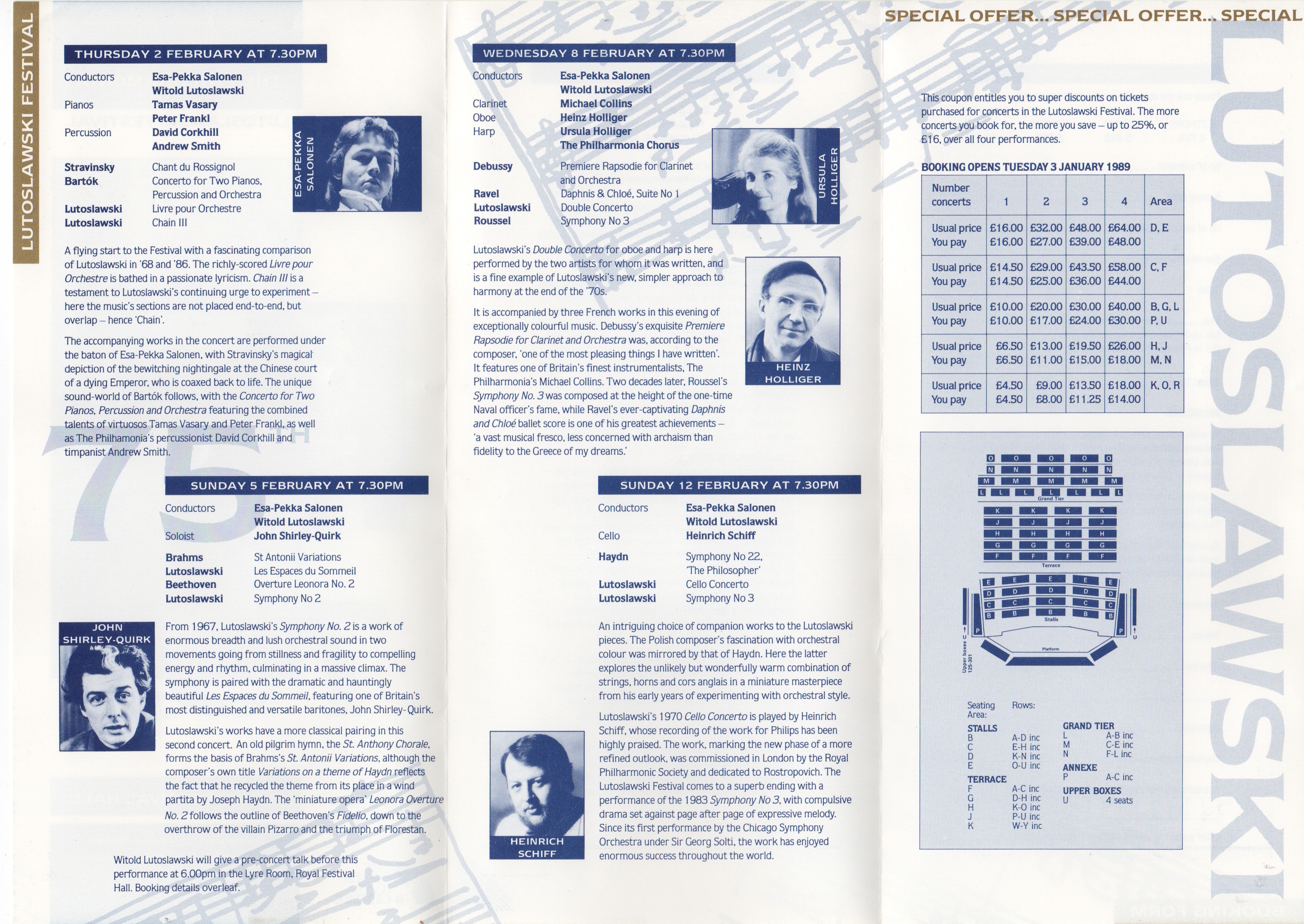
• WL100/16: Philharmonia Festival, 2-12.02.89

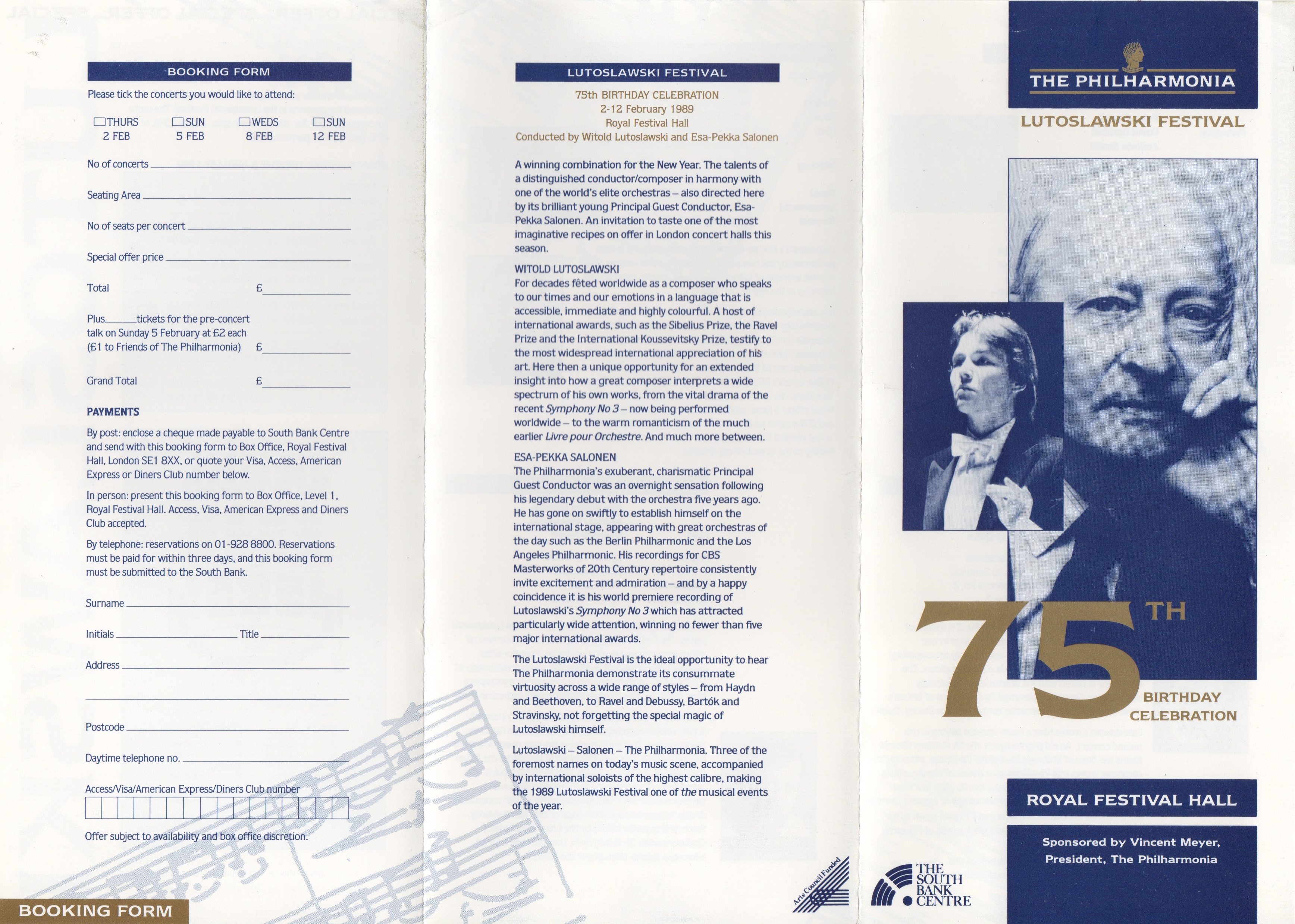
The Philharmonia’s festival to mark the centenary of the birth of Witold Lutosławski (http://woven-words.co.uk) is not the first time that the orchestra and Esa-Pekka Salonen have celebrated his music.  They also marked his 75th birthday with a series of four concerts, although for some reason these were given shortly after Lutosławski’s 76th birthday, starting on this date, 2 February, in 1989.  Very curious.

Lutosławski shared the conducting with Salonen and also gave a pre-concert talk.  His works were Symphony no.2 (1967), Livre pour orchestre (1968), Cello Concerto (1970), Les Espaces du sommeil (1975), Double Concerto (1980), Symphony no.3 (1983) and Chain 3 (1986).  Again, his music was partnered by that of 20th-century composers with whom he felt an affinity – Bartók, Debussy, Ravel, Roussel and Stravinsky – alongside works by Beethoven, Brahms and Haydn.

WL:Philharmonia 1989 front

WL:Philharmonia 1989 inside

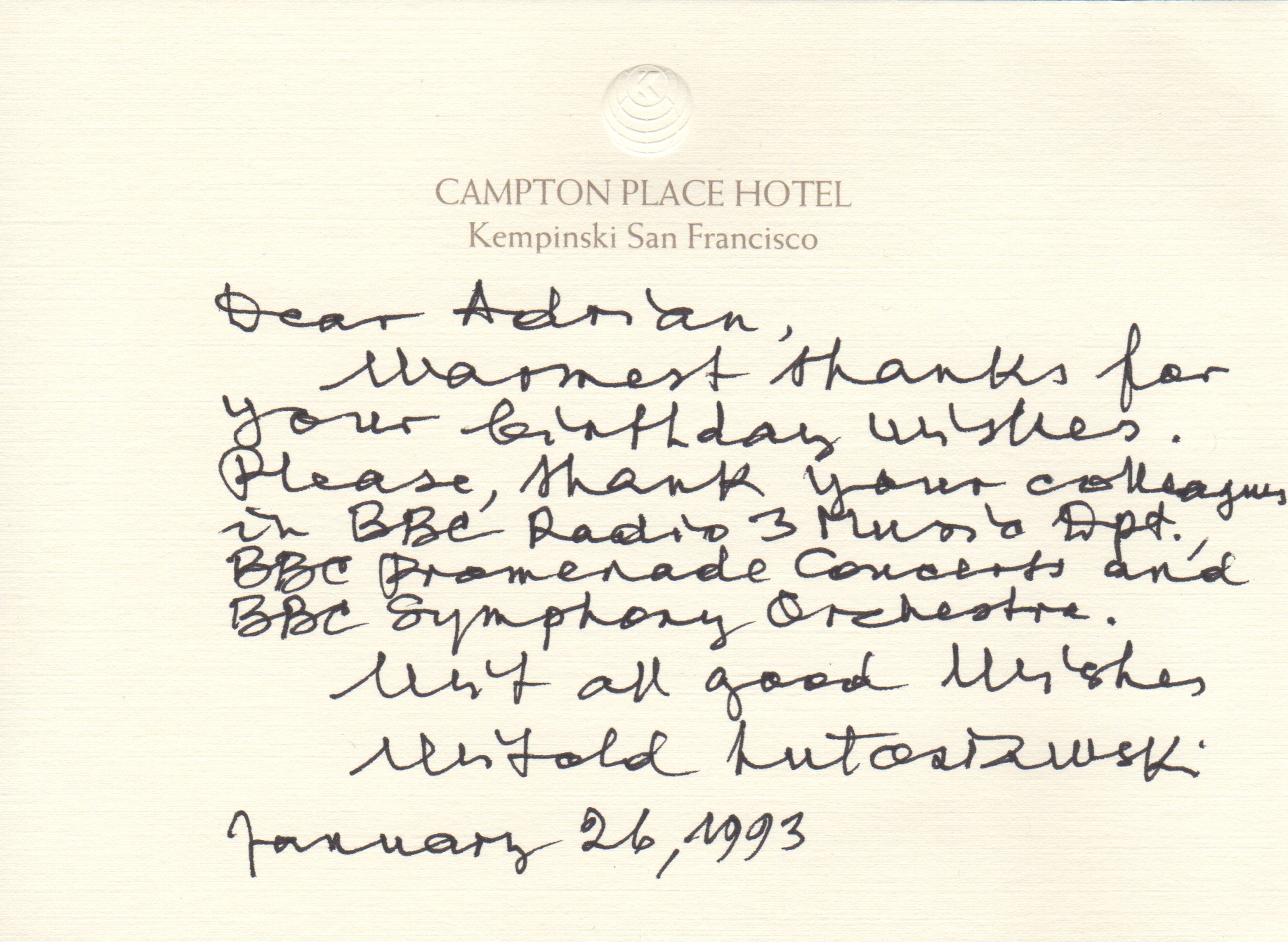
• WL100/15: Thank-you note, 26 January 1993

When I was working at BBC Radio 3, I sent Lutosławski greetings for his 8oth birthday.  In his characteristically courteous and meticulous fashion, he replied the following day.  He was in San Francisco, en route to Los Angeles, where he conducted the LAPO in the premiere of his Fourth Symphony on 5 February 1993.

Note from WL, 26.01.93

• WL100/14: Lutosławski at Polish Radio

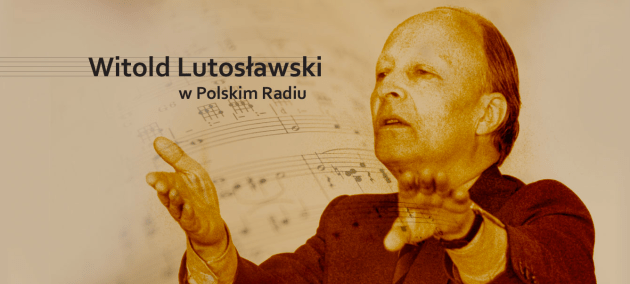
WL w Polskim RadiuPolish Radio’s new website Witold Lutosławski w Polskim Radiu looks like being one of the most interesting archival sources on the composer so far.  There are audio files and photo galleries connected with Lutosławski’s work at Polish Radio in the 1940s and 50s as well as a host of radio interviews made with and about him over the years. The initial on-screen teething problems have now been sorted, although the promised English-language transcripts of some of the items have yet to materialise.

The contents are already of considerable interest, and I hope they will be added to in the coming weeks and months. Currently the contents include:

• over thirty radio reminiscences and interviews
• two examples of incidental music for Polish Radio Theatre unheard since the mid-1950s
• three photo galleries: Witold Lutosławski and His Time (52 items), From the Family Album (22) and Documents from Polish Radio (17)

For those who don’t understand Polish, the second and third groups above may be of the greatest interest.

Incidental Music

Polish Radio has unearthed two sequences of Lutosławski’s incidental music for Polish Radio Theatre.  This activity was one which he pursued from the late 1940s until 1960.  Little has been written on his incidental music because it was thought that it existed, if at all, almost exclusively in score form.  Polish Radio has now released these two audio compilations from its sound archives.

The earlier of the two is called Anccasin ef Nocolette on the PR website.  I must admit that I cannot rationalise the language nor find any source for this title.  Martina Homma has identified the item as Okassen i Mikołajka, which seems linguistically more reliable.  She dates the broadcast of this authorless text to 8 November 1954 (eighteen days before the premiere of the Concerto for Orchestra).  Although the PR site gives the duration of the music as 5’39”, it lasts for 11’17”.  The music is Baroque pastiche, the fragments up until 08’50” for harpsichord alone. Thereafter, a flute and violin join in.  I wonder if Lutosławski was himself playing the keyboard.  The recording is rather basic and the performance is not without the occasional fluff.

The second of the two sequences was broadcast almost three months later, on 30 January 1955.  It was composed for one of the Arabic folk tales from Klechdy sezamowe (Tales of Sesame, 1913) by Stanisław Leśmian, who is better known by his first forename, Bolesław.  The music for Zeklęty rumak (PR site), or O zaklętym rumaku (Homma), is more fantastic and richly scored, for chamber ensemble, than the frankly boring music for the earlier piece.  It lasts for 10’27” (the PR site says 5’14”).  Let’s hope there are more riches in the sound archives from Lutosławski’s prolific period as a composer of incidental music.

Photo Galleries

There are many unfamiliar items here, so these three sections present new windows into the past.  The third section of documents is perhaps the least interesting as it draws on administrative paperwork from the post-war decade. The second section of family photographs consists almost entirely of old images of the Lutosławski family rather than of the composer.  His likeness to his brother Jerzy and his father Józef is very striking.

It is the first section that brings Lutosławski really to life, with photographs dating from after the Second World War up until 1993.  I was thrilled to see the sequence of photos from the rehearsals and concert for the full premiere of the Second Symphony, which Lutosławski conducted in Katowice in 1967.  There are also black and white stills from the documentary film made by Krzysztof Zanussi in 1990 for the BBC (see my post WL100/13: In Conversation with Zanussi).

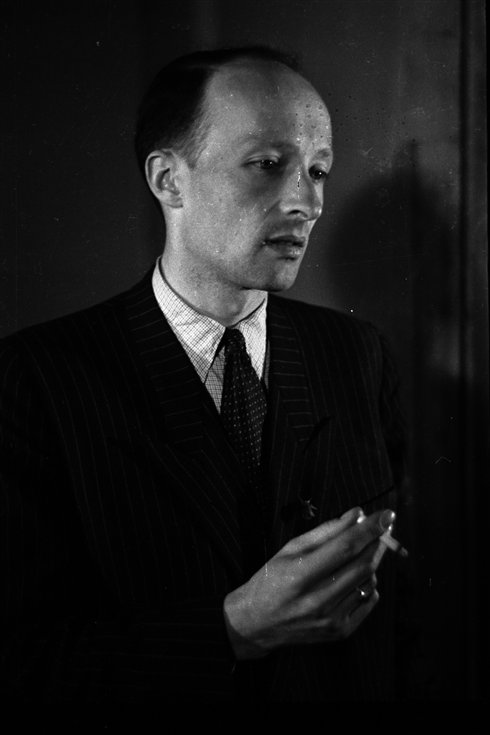
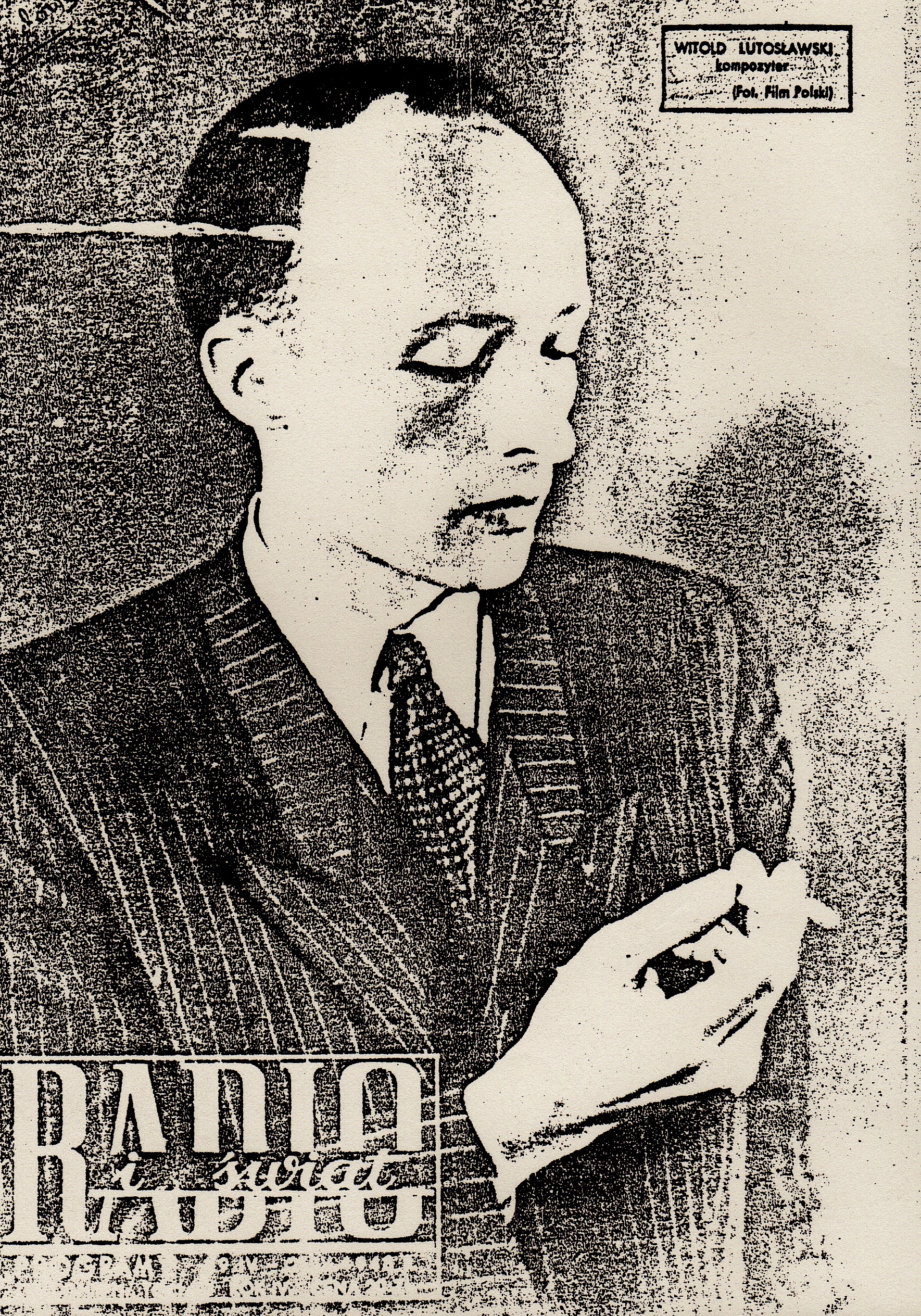
But for me it’s the first two photographs which I find utterly compelling.  They were evidently taken during the same photo shoot (PR indicates that this was in January 1946) as another image used on the front cover of Polish Radio’s listings magazine Radio i Świat in April 1948 (see the top illustration in Panel 2: 1946-49 Music for Radio from my exhibition ‘The Hidden Composer’).  Of these two new images, which are technically much better than the one reproduction that I found, it is the first which I find almost unbearably haunting.

WL, January 1946

• Gardner/BBC SO top Polish Radio poll

Yesterday afternoon (19 January), a Polish Radio panel chose Edward Gardner’s recording of Lutosławski’s Concerto for Orchestra, with the BBC SO on Chandos, as its top recommendation for CDs of this much-recorded work.  This was no ordinary ‘Building a Library’ type of format, however.  This was an elimination contest based purely on listening, with no foreknowledge of who the performers were.

UnknownRadio Dwójka (PR 2) is Polish Radio’s cultural channel.  Every fortnight on Płytowy Tribunał Dwójki, a panel of three sits down to debate and vote on the best recorded interpretation of a selected work.  There is also a studio audience which gets its own vote.  It’s an intriguing format, one in which the panel puts its reputation on the line.  Last night, it consisted of the music critics and broadcasters Dorota Kozińska and Kacper Miklaszewski, and the conductor Wojciech Michniewski.  Jacek Hawryluk was in the chair.  Michniewski knew Lutosławski well, has conducted his music frequently, including sharing the conducting of Trois poèmes d’Henri Michaux with the composer on the 6-LP boxed set of Lutosławski’s music issued by EMI in 1978.  He was a key figure in the Breaking Chains festival in London in 1997 and in 2001 recorded a CD of Lutosławski’s music on Accord.  But I digress.

The schedule for yesterday’s ‘tribunal’ on the Concerto for Orchestra was as follows:

• Round 1: Opening of I ‘Intrada’
• Round 2: Opening of II ‘Capriccio notturno ed Arioso’
• Round 3: Opening of III ‘Passacaglia’
• Round 4: Continuation of III ‘Toccata e Corale’

After listening to the ‘Intrada’ from all six unidentified recordings, two were eliminated at the end of Round 1, then one more each round until two were left in Round 4. The results were:

• After Round 1: the two recordings eliminated were both of recordings by the Warsaw Philharmonic.  The earlier recording was conducted by the man who commissioned the Concerto for Orchestra in 1950 and gave the premiere four years later, Witold Rowicki (Philips, 1964, first released on LP).  The second recording was more recent, conducted by Antoni Wit (Dux, 2005)

• After Round 2, the composer’s own recording from 1976/77 was eliminated (EMI, first released on LP in 1978).

• After Round 3, Mariss Jansons’s new recording with the Bavarian Radio SO (BR Klassik, 2011) got the chop.

That left just two recordings.  The panel had proved itself pretty much of one mind during the earlier eliminations, and so it proved here too.

• In Round 4, the runner-up was Jukka-Pekka Saraste’s recording with the London PO (LPO label, recorded live in 2008 at the Royal Festival Hall, London, released 2011).

• The winner was Edward Gardner’s recording with the BBC SO, recorded and released in 2010 on the first of Chandos’s much-acclaimed series devoted to Lutosławski (for which I’ve had the privilege of writing the booklet notes).

wl-chandos-2010

The studio audience also agreed with the panel about the top recording, but chose Lutosławski’s recording as the runner-up.  While the panel preferred the three recent versions to the older ones, I was pleased to see that Lutosławski’s powerful interpretation still made an impact.

…….

If you’ve come across Hyperion’s recent release of Juliusz Zarębski’s wonderful Piano Quintet – played by Jonathan Plowright and the Szymanowski Quartet – you may be interested that Zarębski’s work also comes up before the Polish Radio 2 ‘tribunal’ in four weeks’ time, on Saturday 16 February.  Of course, no-one knows if the Hyperion CD will be among those under discussion (my guess is that it will), but I’ll keep you posted!

…….

UPDATE! On 24 January 2013, Polish Radio 2 responded to this post with one of its own: Wyroki Trybunału komentowane w Wielkiej Brytanii (Verdicts of the Tribunal commented on in Great Britain).  When I posted on the Tribunal’s deliberations on Zarębski’s Piano Quintet, Polish Radio 2 responded again: Adrian Thomas po raz drugi o werdykcie Trybunału (Adrian Thomas for the second time on the verdict of the Tribunal).

• WL100/13: In Conversation with Zanussi

On 19 January 1991, BBC 2 showed a one-hour documentary on Lutosławski.  It was made by the distinguished Polish film director Krzysztof Zanussi.  Witold Lutosławski in Conversation with Krzysztof Zanussi (1990) utilises excerpts from a BBC Omnibus documentary Warsaw Autumn (1978)filmed by Dennis Marks in 1977, as starting points.  Zanussi steers Lutosławski through key moments of his life, interspersed with the composer conducting rehearsals or special recordings of excerpts of his music.

The results are mixed.  At times, the premise is realised archly, as at the beginning, when the interview set-up seems rather self-conscious.  At other times, Zanussi’s probing produces some interesting responses.  Lutosławski recollection of his father is rather touching, for example, and his recollection of life in the 1980s (during Solidarity and then under Martial Law) fascinating.  As always, he can be alternately open and guarded.

The interiors were filmed either in his downstairs sitting area (it’s open-plan) or in his first floor, L-shaped study (see my earlier post Lutosławski’s Carpet).  The major musical extracts are from Musique FunèbrePreludes and FugueChain 2 (with Krzysztof Jakowicz) and the Third Symphony.  Two excerpts from Witold Lutosławski in Conversation with Krzysztof Zanussi (amounting to the second and fourth quarters of the documentary) were uploaded to YouTube yesterday, so here are the links with a little commentary to each.

Excerpt 1

This section is concerned firstly with the post-war decade and socialist realism.  Habitually, Lutosławski was extremely guarded about this period, as he is here, especially in the excerpt from the Omnibus film.  The three-day conference to which Lutosławski refers took place in western Poland, at a place called Łagów, in August 1949.  (Less than half of the members of the Polish Composers’ Union attended, rather than the ‘all’ that Lutosławski mentions.)  Secondly (c. 7’45” in), the film shows Lutosławski accompanying a group of young children singing one of his children’s songs, Rzeczka (River, 1947).  The final section (c. 11’20” in) moves the questioning of the relationship between the music and social-political contexts to the 1980s.  It shows a fragment of Lutosławski’s speech on the first day of the Congress of Polish Culture in Warsaw on 12 December 1981.  Overnight, Poland found itself under Martial Law.


Excerpt 2

This section concludes the documentary with a brief discussion of the return to democracy in the late 1980s and then focuses on the Third Symphony.  There are two musical passages here, from figs 84 to 89 and from fig. 93 (Coda), in what appears to be a specially recorded session with Lutosławski conducting the Great Polish Radio SO (WOSPR) in Katowice.


• WL100/12: ‘Breaking Chains’, BBC 1997

On 17 January 1997 the BBC began the second part of its Lutosławski festival, Breaking Chains, with three days of events at the Barbican Centre in London.  It had been preceded by five days of complementary events at the GSMD. Altogether, this was one of the most concentrated celebrations of Lutosławski’s life and music.

WL Breaking Chains, coverThe repertoire covered on 17-19 January 1997 included: Twenty Polish Christmas Carols (1946/1989), Straw Chain (1951), Concerto for Orchestra (1954), Five Songs (1957), Funeral Music (1958), Jeux vénitiens (1961), Trois poèmes d’Henri Michaux (1963), String Quartet (1964), Paroles tissées (1965), Cello Concerto (1970), Les espaces du sommeil (1975), Mi-parti (1976), Grave (1981/82), Symphony no.3 (1983), Chain 1 (1983), Partita (1984/88), Chain 2 (1985), Chain 3 (1986), Piano Concerto (1988), Interlude (1989), Chantefleurs et Chantefables (1990), Symphony no.4 (1992) and Subito (1992).  When combined with the pieces performed by GSMD students, this list is remarkably comprehensive (of the orchestral works, only the Double Concerto was missing).

It was a tremendous week.  I count myself lucky to have been there, and all praise to the BBC and GSMD for putting so many resources and such imagination into the project.  We’ll probably not see the like again.  The relevant pages of the programme are reproduced below.

WL Breaking Chains, BBC. 17-19.01.97:1

WL Breaking Chains, BBC, 17-19.01.97:2

WL Breaking Chains, BBC, 17-19.01.97:3

WL Breaking Chains, BBC, 17-19.01.97:4

• WL100/11: ‘The Hidden Composer’

The Hidden Composer: Witold Lutosławski and Polish Radio

An exhibition first shown as part of the Breaking Chains festival,
Barbican Centre, London, 13-19 January 1997

I put this exhibition together in order to illuminate an area of Lutosławski’s life and work that had been obscured by history and largely ignored by commentators.  Lutosławski himself consistently drew a veil over it.  Yet it reveals much about the creative artist’s dilemmas at an extraordinarily difficult time.  Since 1997, other facets have come to light (I will return to them later in the series), but I have reproduced the exhibition faithfully rather than update it.  I have, however, added a few sound files which I could not incorporate at the time.  The illustrations were never of top quality, having been photocopied in Poland, but I hope that they give a flavour of the period and the publication from which they come.

Accompanying brochure

In these days of the Internet, it is hard to imagine how limited were the means of communication in Poland in the aftermath of World War II.  It took, for example, until the 1950s for a full network of radio stations and masts to be established (this was, of course, before television).  Each and every technical development was celebrated in Polish Radio’s listings magazine, Radio i Świat (‘Radio and the World’).

Radio i Świat logo3Like The Radio Times in the UK, Radio i Świat was intended as a printed information service for its listeners, primarily for its broadcast programmes.  But it was much more than that.  It first appeared in 1945 and for several years included technical diagrams for those wishing to build their own wirelesses.  Its listings, at least in the early years, also included details of foreign radio programmes, such as those on the BBC Home and Light Services.

When, however, the political situation began to change in 1948, Radio i Świat changed with it.  Whereas newspapers and journals promulgated the main shifts in Party policy, a magazine like Radio i Świat reflected them in ways which have not generally been regarded as quite so significant.  Its pages, however, are often more vividly revealing and surprising than other sources in the musical detailing of this momentous post-war period.

The Hidden Composer looks at Lutosławski’s musical profile and his cultural-political context from the end of the war until the early 1960s, as through the eyes of a reader of Radio i Świat.  It is not the whole story, but it is an important part of it.

[The following summaries accompanied the six panels of the original exhibition.
You will find the full texts, images and sound files for each of these panels
either by clicking on the relevant heading below
or by scrolling the ARTICLES tab above.]

PANEL 1: 1945-48  RADIO i ŚWIAT

In the early years after the war, Radio i Świat had a generously international outlook.  Photographs from the UK, for example, included Princess Elizabeth at a BBC microphone.  But increasingly the magazine looked inwards, as did Poland as a whole.  Photographs included one of Lenin, but more frequently the front covers featured the country’s most outstanding classical musicians – Fitelberg, Palester, Bacewicz and Panufnik – as well as popular singers like Godlewska and the male vocal quartet ‘Czejanda’.  Polish Radio’s Festival of Slavonic Music in November 1947 was a signal of the post-war grouping into Eastern and Western European spheres of influence.

PANEL 2: 1946-49  MUSIC FOR RADIO

RiŚ 48:16Lutosławski reached the front cover of Radio i Świat in April 1948, shortly after the premiere of his First Symphony (it was banned a year later).  During the 1940s and 1950s, his most secure source of income was his work for Polish Radio.  He wrote incidental music for poetry programmes and for radio drama (some forty productions).  Early titles included Hemingway’s For Whom the Bell Tolls and a children’s programme based on Kipling’s The Cat that Walked by Himself.  Prawda o Syrenach (The Truth about the Sirens, 1947) exhibits the use of jazz, while Fletnia chińska (The Chinese Flute, 1949) shows the increasing politicisation of radio broadcasting.  Lutosławski’s short cantata Warszawie-sława! (Glory to Warsaw!) is a tribute to the post-war rebuilding of the Polish capital, an undertaking that was frequently praised on the covers of Radio i Świat.

PANEL 3: 1949-53  SOCREALIZM

The politicisation of all public bodies came to a head culturally with the import of socialist realism (socrealizm) from Stalin’s Soviet Union.  Composers were cajoled to write for the mass of the people.  Music was subject to peer review at Polish Radio and the Composers’ Union, and Lutosławski had little choice but to accede to ‘requests’ for mass songs.  Most of these were published in Radio i Świat and broadcast on Polish Radio, where tapes of some still exist.  His least political song – Wyszłabym ja (I Would Marry) – was his most popular, and he even recorded it himself in 1950 (the tape is no longer extant).

PANEL 4: 1953-56  TRANSITION

After Stalin died, in March 1953, there was a protracted period of transition towards greater artistic freedom.  Radio i Świat reflected many of these changes.  Mass songs became less political, although two of Lutosławski’s soldiers’ songs appeared and arguable his best song – Towarzysz (Comrade) – was included in a special programme ‘Songs of the Fatherland and the Party’ as late as July 1955.  Radio i Świat also indicates that the ban on Lutosławski’s First Symphony was not as watertight nor as long-lasting as has been previously assumed (it was bropadcast in August 1954).  And, gradually, music from the ‘decadent’ West was published in the magazine, beginning with Mississippi (Ol’ Man River) in March 1954.

PANEL 5: 1956-59  NEW MUSIC

The arts played a significant part in the cultural renaissance of Poland in the mid-1950s.  Music advanced on the popular front and in the appearance of the first ‘Warsaw Autumn’ International Festival of Contemporary Music on 1956.  Radio i Świat maintained its educational tone by publishing articles, with musical examples, on twelve-note music by Berg and Webern.  Has any other radio listings magazine ever provided such a service to its readers?  Lutosławski kept a fairly low public profile while he developed a new musical language in Five Songs (1957), Funeral Music (1958) and Jeux vénitiens (1961), works which would launch his international career.

PANEL 6: 1957-63  ‘DERWID’

Lutosławski’s compositional ties with Polish Radio continued into the 1960s, partly providing incidental music for radio dramas (such as Słowacki’s tragedy Lilla Weneda), partly writing some three dozen popular songs – foxtrots, waltzes, tangos – under the pseudonym ‘Derwid.  ‘Derwid’ is the harp-playing king in Lilla Weneda, although a different pseudonym appears on the manuscripts of the first six songs.  Lutosławski-Derwid had an evident affinity with popular idioms if the quality of these songs is anything to go by.  Among the most memorable are the Gershwinesque Zielony berecik (The Little Green Beret) and the tango Daleka podróż (Distant Journey), with its quote from Debussy’s La Mer.  Nie oczekuję dziś nikogo (I’m Not Expecting Anyone Today) was his most popular song and the only one to win ‘Radio Song of the Month’.  It was also one of some ten Derwid songs printed in the ever-informative Radio i Świat and its 1958 successor, Radio i Telewizja.

Acknowledgments

This exhibition was funded by Cardiff University of Wales and the Guildhall School of Music and Drama in London.  Valuable assistance was also given by Polish Radio and the National Library in Warsaw and the Paul Sacher Foundation in Basel.  Sincere thanks are due to a number of people without whose help and advice the exhibition would not have been possible: Urszula Kubicka, Michał Kubicki, Elżbieta Markowska and Bohdan Mazurek in Warsaw, Martina Homma in Köln, Alasdair Nicolson, Alessandro Timossi and Tomasz Walkiewicz in London, and David Hopkins, Sue House and Sue Sheridan in Cardiff.

© 1997 Adrian Thomas
• WL100/10: ‘Breaking Chains’, GSMD 1997

Possibly the most intense and wide-ranging survey of the life and works of Witold Lutosławski that has ever taken place was that at the Barbican, London, in January 1997.  The climax was three days of concerts, organised by the BBC under the banner Breaking Chains on 17-19 January.  I’ll return to these events in a future post.

Preparatory to these concerts, the Guildhall School of Music and Drama, in a different part of the Barbican complex, organised five days of complementary events under the Breaking Chains umbrella, 13-17 January 1997. These included concerts, workshops, talks and discussions, as well as an exhibition.  The participants included the GSMD SO and CO, student chamber ensembles and soloists, and several speakers: Steven Stucky, Józef Patkowski, Charles Bodman Rae, John Casken and myself.

WL Breaking Chains, GSMD 13-17.01.97

The GSMD Breaking Chains repertoire included: Symphonic Variations (1938), Symphony no.1 (1947),  Little Suite (1950/51), Straw Chain (1951), Silesian Triptych (1951), children’s song cycles Autumn and Spring (1951) and four other children’s songs (1953-54), Jeux vénitiens (1961), String Quartet (1964), Symphony no.2 (1967), Livre pour orchestre (1968), Variations on a Theme by Paganini for piano and orchestra (1941/78), Novelette (1979), Chain 1 (1983), Fanfare for Louisville (1986), Prelude for GSMD (1989).  In pre-concert and afternoon events during the BBC part of Breaking Chains, GSMD students also performed Overture for Strings (1949), Five Folk Melodies (1945/52), Preludes and Fugue (1972), Partita for violin and piano (1984), songs and music for piano, as well as Chain 1 for the second time.

There were some fantastic student performances during this GSMD week.  Indeed, Symphony no.2, Novelette and Fanfare for Louisville were issued on the SOMM label (SOMMCD 219) in 1999, alongside performances of two works conducted by the composer on his visit to GSMD on 11 May 1989: Prelude for GSMD and the Cello Concerto (1970), in which the soloist was Louise Hopkins.  My strongest recollection is of the performance of the Second Symphony under the dynamic direction of Wojciech Michniewski.

Lutosławski: Symphony no.2

• Movement 1: ‘Hésitant’  

• Movement 2: ‘Direct’ (the track begins c.15″ too early with two brief events for trombones/tuba and bassoons from the end of ‘Hésitant’; ‘Direct’ begins with ppp double basses, partly masked by a final bassoon utterance)  

My own involvement also included directing a workshop performance of Jeux vénitiens and putting together an exhibition called The Hidden Composer: Witold Lutosławski and Polish Radio, of which more anon.

• WL100/9: Lutosławski’s carpet

Did you know that all of Lutosławski’s works from 1971 onwards were composed as he paced to and fro on a carpet made and sold in the British Isles?  And that his grand piano and writing desk stood on it too?  You didn’t?  Read on!

Below is an undated photo of Lutosławski’s studio.  The state of the rucked carpet, the style of the curtains and the blank walls, where subsequently there were bookshelves, allow us to date the photo (first published in 2007) to 1968-70.  How can we tell?

IMG_7140 copy

In 1968, the Lutosławskis moved from their cramped flat in East Warsaw, where they’d lived since the Second World War, to a spacious detached house in North Warsaw.  The first work that Lutosławski composed in his L-shaped first-floor studio was his Cello Concerto.  The concerto was premiered in London on 14 October 1970.  I discovered the following correspondence at the Paul Sacher Stifting in Basle in 2003:

From Faith Crook (Chester Music) to Lutosławski, 26 October 1970
“Mr Rizza [then MD of Chester Music, London] has passed on to me your note about the carpet you wish to order and get sent to you from Gamages.  […]  I note that what you require is ‘Tintawn’ No.526 (“White Heather” shade) and you asked for the 108 inch (9 feet) width, but the length you gave of 13 yards 7 inches we find rather puzzling.”

From Lutosławski to Faith Crook, 4 November 1970
“I am very sorry to bother you with that carpet for me.  The only excuse to offer is, that it will be a part of the equipment of my working room and thus – serve in a way the purposes of the firm!  […]  It may seem puzzling, but the room is not a straightforward rectangular one.  It is an “L”-form and that is why two strips of different length will have to be pieced together.”

From Faith Crook to Lutosławski, 11 November 1970
Gamage invoice, Holborn, E.C.1
Cost of carpet  £65 16s 0d
Carriage  £12 15s 0d
Packing  £1 10s 0d
Insurance  £1 6s 0d
Total  £81 7s 0d

Evidently, Lutosławski had gone to London not only for the premiere of the Cello Concerto but also with the measurements of his studio, intent on purchasing a good quality carpet.  Wall-to-wall carpets are unusual in Poland, where wooden flooring is usual, so part of his reasoning must have been to do with the room’s acoustics.  Gamage’s, which closed in 1972 and was subsequently knocked down, was a huge department store famous for its unusual diversity, from its toy department and Christmas bazaar to a specialist section for motor parts.  It evidently had a good carpet showroom too.  More particularly, it was in Holborn, barely ten minutes’ walk from Chester Music’s then offices at Eagle Court in E.C.1.  Did Lutosławski pass it by accident or was he directed to it by his publishers?

Fast forward to 2002 when, during the ‘Warsaw Autumn’ festival, I was privileged to spend several days, with Nicholas Reyland, examining Lutosławski materials at his house.  I had been downstairs in 1981, but I had never seen the ‘working room’ upstairs.  We were given extraordinary freedom to research and document what we found. It was exciting, as always, to see where a composer composed.  The grand piano had been moved out, but the general layout of the rest of the room was as it had been from the beginning.  The photo below was taken from the double doors leading onto the first-floor balcony (compare the 1968-70 photo pointing in the opposite direction).

134-3416_IMG

What was different was the increased shelf-space, the elongated desk area to accommodate the hifi and CDs, and the absence of curtains.  The coffee table and flower vase were where they had been in the late 60s, as were the leather easy chairs and sofa, but in a more modern guise.

At the time (2002), I hadn’t found out about the carpet, so took no special photos of it.  But here are a couple of clips from other photos.  The lower one, taken close to the desk, shows signs of wear and tear, but after over 20 years of Lutosławski’s pacing (he habitually composed standing at the piano, but evidently worked a great deal at his desk also), and a further decade since his death, such signs were hardly surprising.

WL's carpet

WL's carpet:2

Yet what was remarkable was how few such patches there were.  This must have been a good-quality carpet that Lutosławski chose in London.  As soon as I got back from my research to Basle in 2003, I investigated further.  And I received this prompt reply from Axminster:

Maria & Józef Lutosławscy, 1900 2

What I didn’t pick up, until it was pointed out today by my friend Colin Stark (who played Epitaph for Lutosławski in Belfast in 1987), is that this carpet was not made at Axminster but in Newbridge, Co. Kildare in Ireland.

It’s nice – if perhaps irrelevant – to think that the music of Lutosławski’s last 23 years (Preludes and FugueLes Espaces du sommeilMi-partiEpitaphGrave, Symphonies 3 and 4, Chains 1-3, Piano Concerto, Chantefleurs et Chantefables, among others) was created as he pondered his next compositional move on a carpet that he bought in London, a creative investment and a material reward, if you like, for one of his greatest artistic achievements.

• Lutosławski issue of MWM

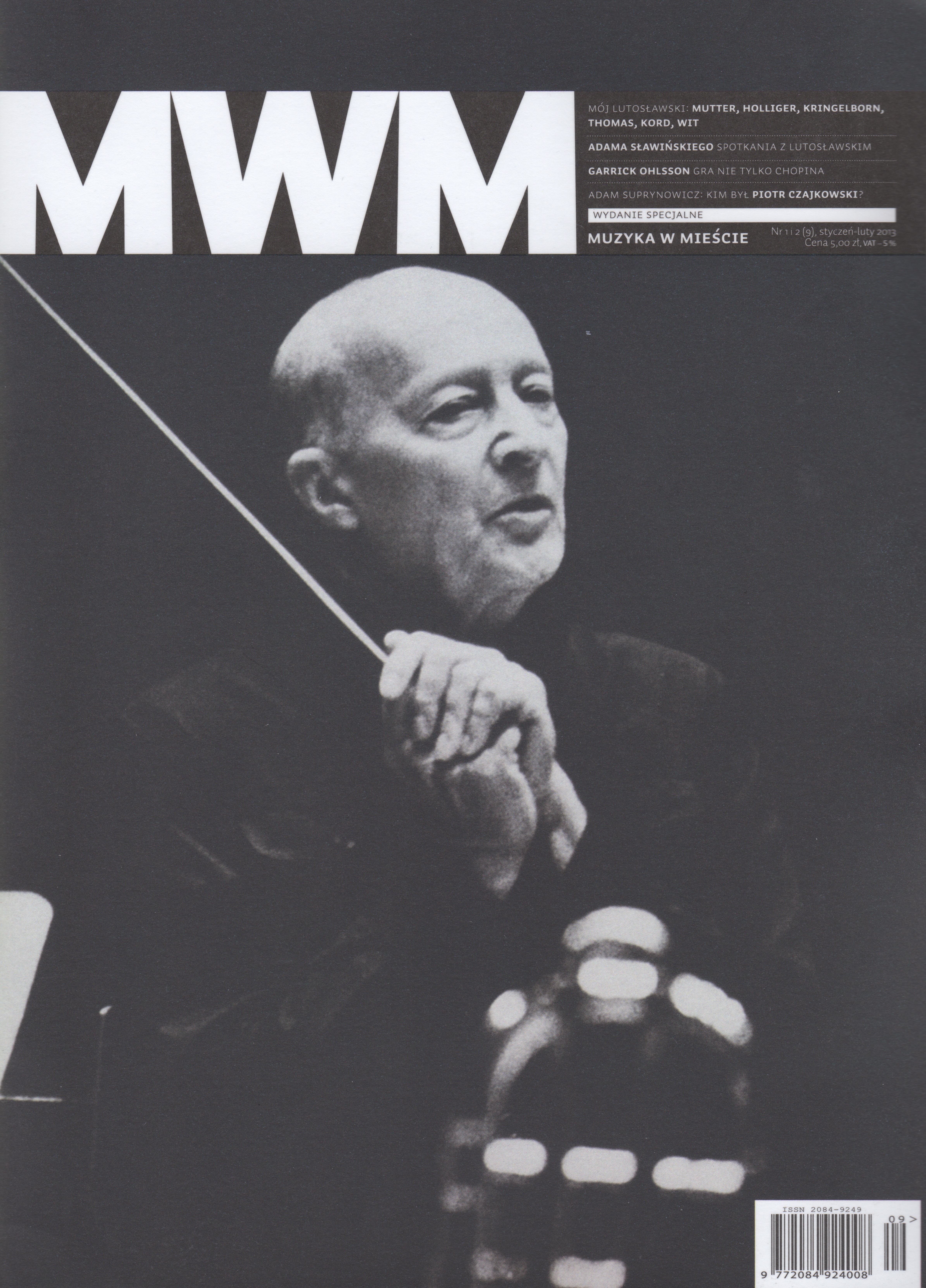
MWM WL issue cover 01.13The Wrocław Philharmonic, named after Witold Lutosławski, has just published a special issue of its house magazine MWM – Muzyka w Mieście (Music in the City).  This centenary edition comprises mainly interviews.  Although it is in Polish, there is a detachable insert with English and German excerpts from three of its eight items (marked *).

• Paweł Hendrich: ‘W roku Lutosławskiego o nim samym i jego muzyce’
• Adrian Thomas: ‘Gry brytyjskie’ *
• Adam Sławiński: ‘Spotkania z Mistrzem’ *
• Kazimierz Kord: ‘Harmonia naturalności’
• Esa-Pekka Salonen: ‘Lutosławski według Salonena’ *
• Heinz Holliger: ‘Tyle nut, ile trzeba’
• Aleksander Laskowski: ‘W poszukiwaniu nagraniowej inicjacji’
• Anne-Sophie Mutter, David Harrington, Solveig Kringleborn, Antoni Wit, Cezary Duchnowski, Agata Zubel: ‘Mój Lutosławski’