• WL100/68: Nie oczekuję dziś nikogo (1959)

While I was in Warsaw last week, I popped into an antykwariat which specialises in journals and periodicals of all types.  It also has a comparatively desultory music section, but occasionally there are interesting things to find.  This time, among large-format song sheets (mainly inter-war German popular songs), I found a much flimsier and tinier item (it measured just 15cm x 21cm): the first publication (February 1963) of one of Lutosławski’s dance songs published under his pseudonym, ‘Derwid’.

NODN cover 1963

Nie oczekuję dziś nikogo (I’m not expecting anyone today, 1959, words by Zbigniew Kaszkur and Zbirniew Zapert) was Derwid’s most popular song (he wrote some three dozen c.1957-64).  Its melody first appeared on 3 January 1960 in Radio i Świat (Radio and the World), the Polish equivalent of the British Radio Times.  The cover of this mini song sheet features the singer Rena Rolska, then in her late twenties.  I did quite a bit of research on the Derwid songs in 1994 (‘Your Song is Mine’, The Musical Times, 1830 (August 1995), 403-10) and discovered that the refrain of this ‘slowfox’ (with its C minor walking bass and sharpened 4th) bore a striking resemblance to the opening of one of Lutosławski’s politicised mass songs, Najpiękniejszy sen (The most beautiful dream, 1950).  I’m sure the similarities were coincidental!

NODN end

Rolska recorded Nie oczekuję dziś nikogo in 1960, with the Polish Radio Dance Orchestra conducted by Ryszard Damrosz:

• WL100/67: Notebook, 11 November 1961

Lutosławski on the Role of the Conductor

Between the completion of Jeux vénitiens and starting work on Trois poèmes, Lutosławski penned a short definition of the changing relationship between the conductor and players of his music.  It suggests a more radical intention than was later realised, as Lutosławski seems to be indicating a greater freedom than he eventually was prepared to allow his interpreters.

With my new technique, the conductor’s role becomes ever more like the role of the director and stage manager in one, while the role of the orchestral musicians is like the roles of actors and extras.  The old school of orchestral playing was more like taming, mechanising, drilling, in which there was no place for the musician’s individual initiative in the area of textual and expressive interpretation.

W mojej nowej technice rola dyrygenta coraz bardziej staje się podobna do roli reżysera i inspicjenta w jednej osobie, zaś rola muzyków orkiestrowych – do roli aktorów i statystów.  Stara szkoła gry orkiestrowej była raczej tresurą, mechanizowaniem, musztrą, w której nie było miejsca na indywidualną inicjatywę muzyka w zakresie interpretacji tekstu, ekspresji.

Witold Lutosławski, 11 November 1961 [my translation]

• WL100/66: Overture, **9 November 1949

One of Lutosławski’s forgotten works is his Overture for strings, premiered on this day 64 years ago in Prague, by the city’s Radio Symphony Orchestra under the Polish conductor, and Lutosławski champion, Grzegorz Fitelberg.  It seems to have been the Overture’s fate to have been composed just as socialist realism was taking a firm grip on Polish music.  Yet there seems to be no record of it having been banned or criticised.  Even though it kept its distance from the simplicity apparently being required of Polish composers – it uses an octatonic scale and has some intriguing metric subtleties – it seems simply to have disappeared, perhaps regarded as irrelevant rather than dangerous by those with programming power.  Perhaps Lutosławski himself put it to one side; he appears never to have conducted it, and during his lifetime there were only seven performances (according to Witold Lutosławski. A Bio-Bibliography). There have, however, been five commercial CD recordings.

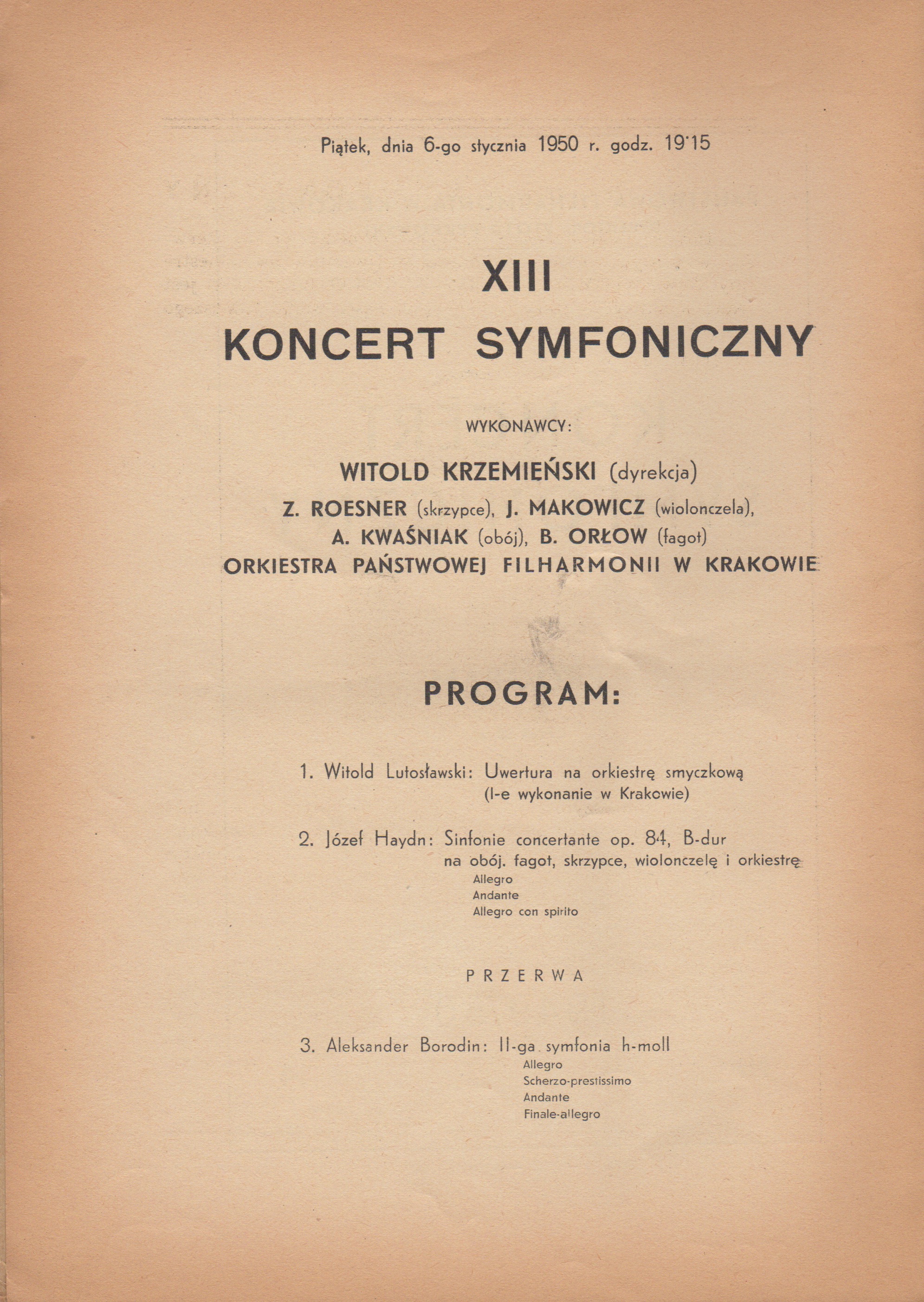
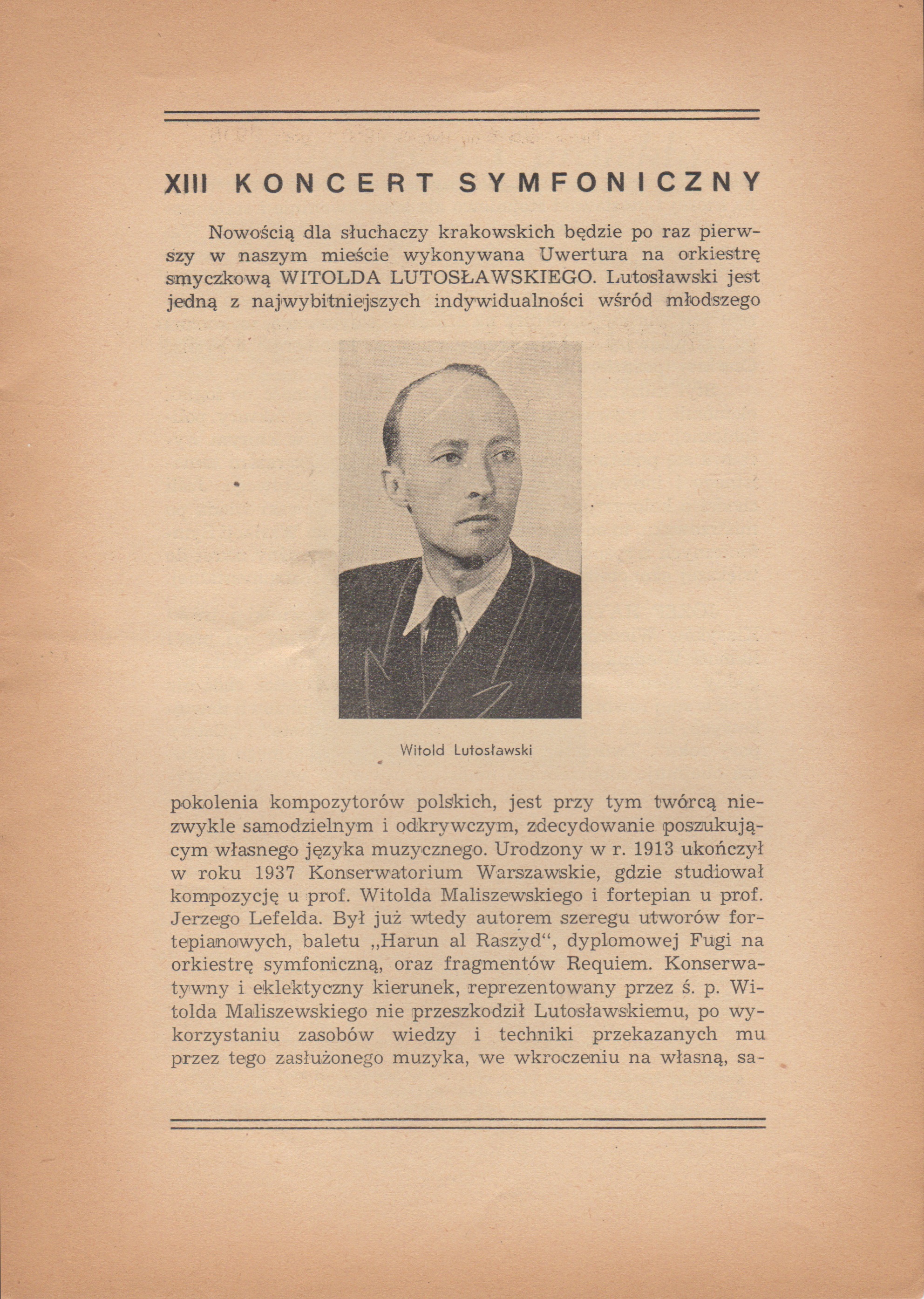
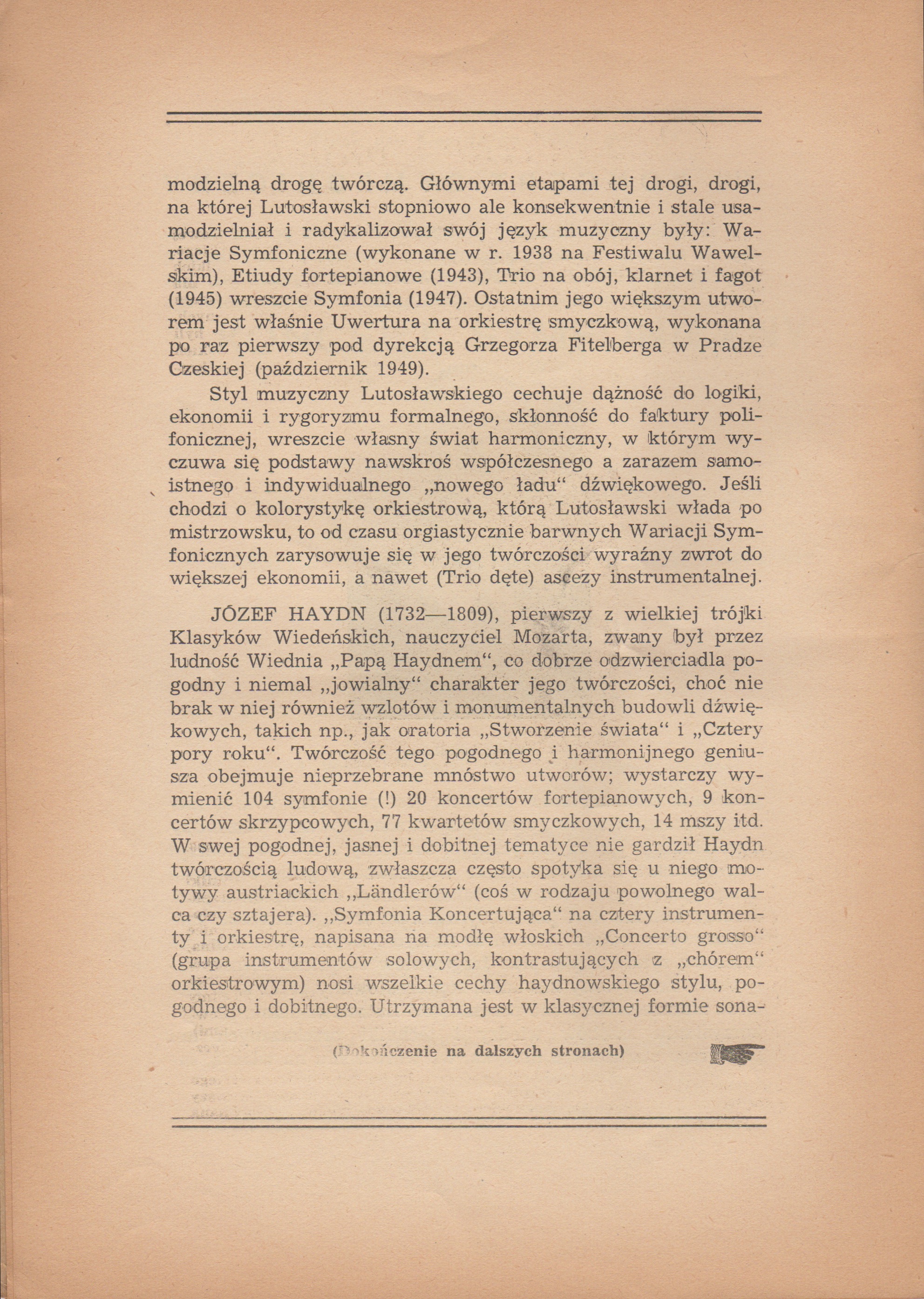
On one of my antiquarian forays in Kraków I came across the concert programme for the Overture’s first performance in the city (it looks as if it was also the Polish premiere).  It took place two months after the Prague performance, with the Kraków PO conducted by Witold Krzemieński.  The relevant pages of the programme are reproduced below, including another profile of Lutosławski – see an earlier one in WL100/54: Lutosławski and Panufnik (1945) – that sheds new light on Polish perceptions of the composer in the immediate post-war years (my translation is at the foot of this post).  There is, however, no hint in the note of state pressures for socialist-realist music, even though the concert took place just five months after the coercions unveiled at the August 1949 composers’ conference in Łagów and less than two months after official censure of his First Symphony at the Chopin Competition in Warsaw.  But Kraków was always at one remove from the capital, which is possibly why the Polish premiere took place there.

WL Overture programme 01.50

P.S.  This wasn’t the only time that a new Lutosławski piece shared the  billing with Borodin’s Second Symphony. The same was to happen in 1970 at the premiere of the Cello Concerto.

Overture 01.50 WL profile1

P.P.S.  Natty lapels!

Overture 01.50 WL profile2

New to Kraków listeners will be the first performance in our city of the Overture for string orchestra by WITOLD LUTOSŁAWSKI.  Lutosławski is one of the most outstanding personalities among the younger generation of Polish composers, through the creation of an exceptionally independent, insightful and decidedly exploratory musical language of his own.  Born in 1913, in 1937 he completed his studies at the Warsaw Conservatoire: composition with Prof. Witold Maliszewski and piano with Prof. Jerzy Lefeld.  He was by then already the composer of several pieces for piano, the ballet Harun al Rashid, a Fugue for symphony orchestra for his diploma, together with fragments of a Requiem.  The conservative and eclectic direction represented by his distinguished professor, Witold Maliszewski, did not prevent Lutosławski, after utilising the fund of knowledge and technique passed on to him by this worthy musician, from stepping out onto his own, independent artistic path.  The main stages of this path, a path on which Lutosławski gradually but consistently and steadily became independent and radicalised his musical language, were: Symphonic Variations (performed in 1938 at the Wawel Festival [it was actually in 1939: see WL100/43: Variations, **June 1939]), Etudes for piano (1943 [actually 1941]), Trio for oboe, clarinet and bassoon (1945) and finally the Symphony (1947).  His last major piece is this very Overture for string orchestra, performed for the first time under the direction of Grzegorz Fitelberg in Prague, Czechoslovakia (October 1949 [actually, November]).

Lutosławski’s musical style is characterised by a desire for logic, economy and formal rigour, an inclination towards polyphonic texture, and lastly his own harmonic world, in which one senses throughout the basis of a modern and at the same time spontaneous and individual sound of ‘the new order’.  When it comes to the orchestral palette, which Lutosławski deploys masterfully, since the orgiastically colourful Symphonic Variations there has appeared in his work a marked return to greater economy, and even instrumental asceticism (Wind Trio).

• WL100/65: Mr and Mrs

Lutosławscy, Prague 1957?

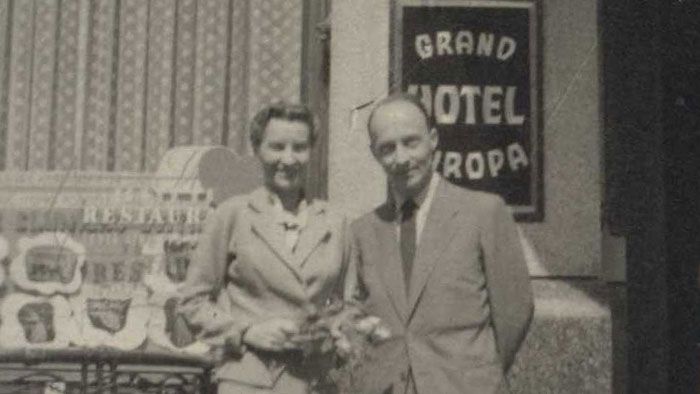
Today marks the 67th anniversary of the wedding of Witold and Danuta Lutosławscy.  Though there appear to be no photos of the occasion, here’s one from a few years later.  I’m pretty certain that this one was taken in Prague, to the left of the entrance to one of its most famous hotels (on Wenceslas Square).  When it was taken is not clear, but it looks likely that it was in May 1957, if corroborative photos are correct.*

82938504

* There is another photograph dated Prague, May 1957, with the Lutosławscy wearing the same suits and standing in the sunshine on a large square (no bouquet but a handbag!), in a selection of photographs at the back of Zofia Owińska’s Lutosławski o sobie (Gdańsk: słowo/obraz territoria and the Witold Lutosławski Society, 2010).

Lutosławscy, Wenceslas Square (?), Prague, 1957

There is also a photo, taken in Switzerland (which the Lutosławscy also visited in 1957), in which Danuta Lutosławski is wearing the same two-piece suit.  Also in shot are the composer Konstantin Regamey and the pianist Witold Małcużyński.  This photo is reproduced in Danuta Gwizdalanka & Krzysztof Meyer’s first volume (-1960) of their two-volume study of Lutosławski and his music (Kraków: PWM, 2003), between pp. 256-257.

Regamey, Lutosławscy, Małcużyński, Switzerland, 1957

The photo reproduced at the top is a cut-down version of much larger, off-vertical and unidentified photo that was published earlier this year by the Witold Lutosławski Society in its centenary album Lutosławski 1913-2013 (p.222).  Its wider angle confirms my hunch about the location.  But Danuta’s shoes seem to be different than in the photo in the square (though the same as in Switzerland!), so perhaps the two Prague photos were taken at different times.

Danuta & Witold, Prague, 1957?

• WL100/64: Notebook, 24 October 1959

Lutosławski on independence and Webern

To accomplish anything reasonable, one has to be completely independent of life outside.  This is Webern’s case.   Here also lies the fundamental difference between Webern and the Webernists, who are stuck in endless confrontation, which is why none of them even attempts to focus on something more durable, consistent, long-term.  Engaging in constant dialogue with opinion is a kind of slavery.

Aby dojść do czegoś sensownego, trzeba być całkiem uniezależnionym od życia zewnętrznego.  To jest przypadek Weberna.  Tu jest też zasadnicza różnica między Webernem a webernistami, którzy są zdani na ciągle konfrontacje i dlatego żaden z nich nie próbuje nawet skupić się nad czymś bardziej trwałym, konsekwentnym, długodystansowym.  Zaangażowanie się w ustawiczny dialog z opinią jest rodzajem niewoli.

Witold Lutosławski, 24 October 1959 [my translation]

Four years later, Lutosławski wrote a short text on Webern at the request of the renowned Slovakian arts and science periodical Slovenské Pohľady, which wished to mark the 80th anniversary of Webern’s birth.  Titled ‘Webern a hudba dneška’, it was published in Polish a few years later.

Lutosławski on ‘Webern and the Music of Today’

‘The concise man makes one think, the verbose man bores’ – with these simple words Edouard Manet once expressed a truth which – contrary to what it might seem – has served only a few composers as a signpost.*  To these few, unlike his imitators, belongs first and foremost Anton Webern.  Among the many revelations made by this man, one has really made me think.  This is the discovery of a sound-world of microscopic proportions in which the shortest, instantaneous musical event can become the source of a strong experience.

Like the work of every great explorer, Webern’s output has gone through its good and bad periods.  The current one I would call ‘bad’ for Webern, because the wave of imitations – often inept, vulgar, distorting his ideas – has not yet subsided, and we are still driving ‘postwebernism’ away like a tiresome fly.  I believe, however, that – like Debussy from ‘Debussyism’ recently – the music of Webern will free itself from the besmirching and obnoxious effect of its imitators.  It will then shine in its true and pure brilliance.

“Człowiek zwięzły skłania do zastanowienia; gadatliwy nudzi…” – tymi prostymi słowami wyraził kiedyś Edouard Manet prawdę, która – wbrew temu, co mogłoby się wydawać – tylko niewielu twórcom służyła za drogowskaz.  Do tych niewielu, w odróżnieniu od swych naśladowców, należał przede wszystkim Anton Webern.  Wśród licznych odkryć, jakich dokonał ten człowiek, jedno zastanawia mnie szczególnie.  Jest to odkrycie świata dźwiękowego mikroskopijnych rozmiarów, w którym najkrótsze, migawkowe muzyczne zdarzenie może stać się źródłem silnego przeżycia.

Jak twórczość każdego wielkiego odkrywcy, tak i twórczość Weberna przeżywa swoje dobre i złe okresy.  Obecny okres nazwałbym dla Weberna ‘złym’, ponieważ fala naśladownictw – często nieudolnych, wulgarnych, wykoślawiających jego idee – jeszcze nie opadła, i wciąż jeszcze od ‘postwebernizmu’ oganiamy się jak od uprzykrzonej muchy.  Wierzę jednak, że – jak niedawno Debussy od ‘debussyzmu’ – wyzwoli się również i dzieło Weberna od zamazujących i obrzydzających je naśladownictw.  Zalśni on wtedy swym prawdziwym i czystym blaskiem.

Witold Lutosławski, ‘Webern a hudba dneška’,
Slovenské Pohľady 79 no.12 (1963), pp.92-93 [my translation]
reproduced, in Polish, in Stefan Jarociński,
Materiały do monografii (Kraków: PWM, 1967), p.42

* I don’t know where Lutosławski found this quote, but it originated in an article by Georges Jeanniot in La Grande Revue in 1907.  The full quotation, which could equally be Lutosławski’s credo, reads:

La concision en art est une nécessité et une élégance; l’homme concis fait réfléchir, l’homme verbeux ennuie; modifiez-vous toujours dans le sens de la concision.

• WL100/63: Mi-parti, **22 October 1976

Screen Shot 2013-10-22 at 08.47.06

One of the strangest aspects of this centenary year, and indeed of the performance and recording history since Lutosławski’s death almost twenty years ago, is the neglect of some works which during his lifetime were held in high regard.  The most notorious injustice relates to Livre pour orchestre, which I will return to in a later post.  Another example is Mi-parti, which Lutosławski wrote in 1975-76 and whose premiere he conducted with the Concertgebouw Orchestra in Amsterdam 37 years ago today.

During his lifetime, Lutosławski was the person who conducted Mi-parti most frequently.  His domination of its performance history is also true of many of his other orchestral and concertante works, which made for composer-authentic concert experiences but in the long run delayed much of his music’s entry into the repertoire of a broad range of career conductors.

As to professional concert performances over the past ten years, there have been only seven (excluding immediate repeat concerts), including just three in 2013, the third and most recent being by the Berlin Staatskapelle under Daniel Barenboim.  There have been five commercial recordings:

• WOSPR (NOSPR)/Lutosławski (EMI, rec. 1976; LP, reissued several times on CD)
• Prague Radio SO/Jacek Kasprzyk (Supraphon, rec. 1980; LP only)
• BBC PO/Yan Pascal Tortelier (Chandos, rec. 1993; CD)
• WOSPR (NOSPR)/Antoni Wit (Naxos, rec. 1997; CD)
• Warsaw National PO/Antoni Wit (CD Accord, rec. 2002; CD).

Chandos, with its magnificent 5-CD set of Lutosławski’s music, has inexplicably left out both works.  At least the Opera Omnia CD series by the Wrocław PO under Jacek Kaspszyk and Benjamin Shwartz will release both pieces in the near future.  On YouTube, Mi-parti has the thinnest of presences, with Lutosławski’s own recording accompanied by photographic artwork by the uploader: http://www.youtube.com/watch?v=laFCR96RPO4.

I would be very interested to hear what readers have to say about Mi-parti.  For me, it has a magical first section (although Lutosławski sometimes expressed doubts about it) whose essential idea he seems to have had in mind when composing the first section of the Fourth Symphony sixteen years later.  The second section is one of his most pulsating, the climax interrupted by trumpets (echoes of the Cello Concerto).  The coda is especially haunting. Perhaps the trouble is that it isn’t a ‘symphony’ so, like Livre, it is being left on the sidelines in the age of convenience programming.

…….

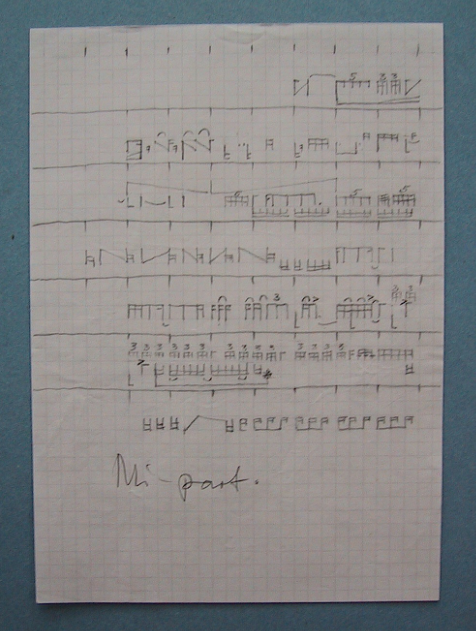
When I was researching in Lutosławski’s house in 2002, I came across many fascinating items: marked-up books, his conducting scores, a folder of folk-tune materials and a particular folder headed “ŚCIĄGACZKI” (Crib Sheets). Inside were separate pieces of MS paper connected with his work on LivreLes espaces du sommeilMi-parti and the Fourth Symphony.  Here are the two relating to Mi-parti.  They come from the second, fast section (apologies for the slightly fuzzy images).

The first is a ‘short-score’ reduction for the first eight bars of fig. 28.  The two lines represent the trumpets and trombones, whose individual purchase on the melodic line is fully worked out in the score (07’59”-08’09” on the accompanying YouTube video).

Screen Shot 2013-10-22 at 08.41.56

The second is more sketchy.  Indeed, it consists only of a (sometimes biforcated) rhythmic line.  It tracks the score from fig. 29 (i.e., two bars after the first ‘crib sheet’ stops short) as far as the third bar of fig. 35.  Although at times the link between sketch and score may seem tenuous, the sketch is consistent with the final product even if Lutosławski does use notational shorthand at times and darts from one instrumental group to another.  Effectively, this ‘crib sheet’ presents the main rhythmic template, an aide-mémoire as he worked the idea up into this extrovert, hocketing passage that leads shortly afterwards to the work’s climax (08’12”-09’09” on the accompanying YouTube video).

Screen Shot 2013-10-22 at 08.41.36

• WL100/62: Notebook, 19 October 1960

Lutosławski on objet sonore

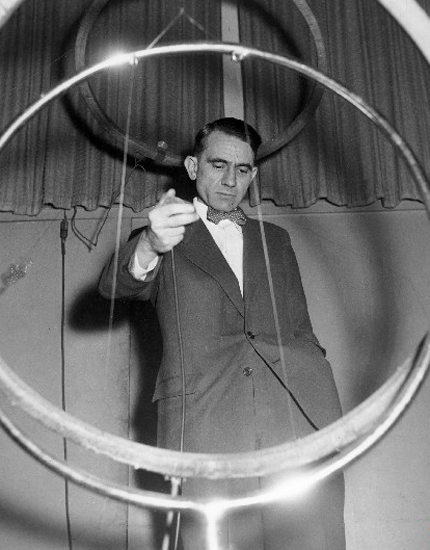
Lutosławski’s affinity with French music and literature is well-known.  But the connection with the pioneer of musique concrète, Pierre Schaeffer, has largely slipped by unnoticed.  In truth, it is not Schaeffer’s tape music as such that caught Lutosławski’s attention but his discourse on the objet sonore.  Lutosławski referenced Schaeffer’s term in talks that he prepared for the Zagreb Biennale (1961) and the Tanglewood Summer School (1962), but his musing on the implications of objet sonore began earlier, in 1960, in his Notebook of Ideas (Zapiski).

There is no evidence that Lutosławski had read Schaeffer’s book À la recherche d’une musique concrète (1952). Almost certainly, he came across the term objet sonore from both fellow Polish composers and Schaeffer himself. Schaeffer came to the third ‘Warsaw Autumn’ festival to introduce a programme of musique concrète (17 September 1959) that included a number of pieces, including his own Étude aux objets (1959).  It is more than likely that Lutosławski attended this concert (ground-breaking in the Polish context) and met Schaeffer during his visit.

Pierre Schaeffer

Just over a year later, on 21 September 1960, the fourth ‘Warsaw Autumn’ presented a lecture by Józef Patkowski, the head of the Experimental Studio at Polish Radio.  During his talk, Patkowski referred to Schaeffer and played Étude aux objets again.  Was it pure coincidence that just two days later Lutosławski made the first of two entries in his Notebook that elaborated on the idea of the objet sonore as it related to his own thinking?  Four weeks later, on 19 October, he returned to this theme.

Although Lutosławski subsequently stressed the prominence of chance procedures in his musical development in the early 1960s, he did not make any entries in his Notebook on alea and aleatorism for another year (the first appears on 20 December 1961).  In other words, it was Schaeffer’s visit in 1959 and the idea of the objet sonore that first drew his attention.  It was six months later that Lutosławski heard Patkowski introduce a recording of John Cage’s Concert for Piano and Orchestra in his ‘Musical Horizons’ programme on Polish Radio (16 March 1960) – the event which Lutosławski subsequently credited as being the critical juncture in his compositional thinking.  Yet we must no overlook Schaeffer in these developments.  In combination, both Schaeffer and Cage gave Lutosławski conceptual support just at the moment when Jeux vénitiens (1960-61) was being conceived.

It seems that rhythm (in the broadest sense, as a division of time in which the action of a musical work takes place) is the hardest element of musical material to destroy.  The idea of the ‘eternity’ of this element is tempting.  Instead of ‘melody, ‘harmony’, there appears a new element (perhaps not entirely new in its essence, but new in application) – objet sonore – the sound object.

Wydaje się, że rytmika (w najszerszym pojęciu – jako podział czasu, w którym rozgrywa się akcja utworu muzycznego) jest najtrudniejszym do zniszczenia elementem tworzywa muzycznego.  Kusi myśl o “wieczności” tego elementu.  Na miejsce “melodyki”, “harmoniki”, zjawia się nowy element (być może niezupełnie nowy w swej istocie, ale nowe w zastosowaniu) – objet sonore – przedmiot dźwiękowy.

Witold Lutosławski, 23 September 1960 [my translation]

In connection with technique based on ‘objects’:
Object = a collection of sounds, between which there is a closer connection than between each of these s[ou]nds and sounds belonging to another object.  This closer connection ensures, above all, connectivity in time.  But it can also be similarity of timbre, rhythm, attack, harm[onic] profile, choice of intervals etc..
Hence 2 rhythmic currents in a piece:
1) local rhythm, ‘small’ – interior of an object
2) general rhythm, ‘large’ – i.e., the rhythm of a sequence of objects.

W związku z techniką opartą na “przedmiotach”:
Przedmiot = zbior dźwięków, między którymi istnieje ściślejszy związek niż między każdym z tych dźw., a dźwiękami należącymi do innego przedmiotu.  Ten ściślejszy związek zapewnia przede wszystkim łączność w czasie.  Ale również może to być podobieństwo barwy, rytmiki, ataku, profilu harm., doboru interwali itd.
Stąd 2 nurty rytmiczne w utworze:
1) rytm lokalny, “mały” – wewnątrz przedmiotu
2) rytm ogólny, “duży” – czyli rytm następstwa przedmiotów.

Witold Lutosławski, 19 October 1960 [my translation]

• WL100/61: Symphonic Variations

75 years ago today, Lutosławski put the finishing touches to his Symphonic Variations, his first surviving orchestral work.  I wrote about the premiere in an earlier post (WL100/43: Variations, **17 June 1939).  Since then, the Symphonic Variations featured in the Lutosławski strand of the 2013 BBC Proms, with same forces – the BBC SO under Edward Gardner – which give such a scintillating performance on Chandos CHSA 5098 (2012).  Here’s a YouTube upload of the Polish Radio broadcast of the Proms performance on 7 August … plus Lutosławski’s own, third-person comment (undated):

This is the work with which the author (then 26) made his debut in 1939 at a musical festival in Kraków.  The style of the work is, maybe, far from being definitively crystallised and yet on the basis of the Symphonic Variations one might speak of the artistic maturity of its then young author, principally thanks to the richly developed orchestral palette as well as the compact and balanced structure.

Są utworem, którym autor (wówczas dwudziestosześcioletni) zadebiutował w 1939 roku na festiwalu muzycznym w Krakowie.  Styl utworu jest, być może, daleki od ostatecznego skrystalizowania i jeśli na podstawie Wariacji symfonicznych można by mimo to mówic o dojrzałości artystycznej ich młodego wówczas autora, to przede wszystkim dzięki bogato rozwiniętej palecie orkiestrowej oraz zwartej i zrównoważonej architekturze.

…….

Today is also the anniversary of the partial premiere of the Second Symphony, whose second movement ‘Direct’ was performed on 15 October 1966, in Hamburg, with the Sinfonie Orchester des Norddeutschen Rundfunks conducted by Pierre Boulez.  For Lutosławski, Boulez’s conducting on this occasion was not entirely satisfactory (WL100/31: Notebook, 9 April 1969), but I have never fully understood Boulez’s subsequent lack of interest in Lutosławski’s music.

• WL100/60: Cello Concerto, **14 October 1970

On this day in 1970, Lutosławski’s Cello Concerto was premiered in London’s Royal Festival Hall by Mstislav Rostropovich and the Bournemouth Symphony Orchestra under Edward Downes.  The work was commissioned by the Royal Philharmonic Society (the first post-war commission to a foreign composer) with funds from the Gulbenkian Foundation.  The work was repeated on the following nights in Bournemouth and Exeter.

The first half of the programme consisted of Balakirev’s symphonic poem Tamara and Lutosławski’s Cello Concerto, followed in the second half by Borodin’s Second Symphony and Tchaikovsky’s Variations on a Rococo Theme. Lutosławski wrote in the RPS’s copy of the programme: ‘with my warmest thanks for this unforgettable experience’. In a letter to his Danish publisher, he wrote: ‘Rostropovich is unique and played it as if it were his own work’.

Homma 1993 4

Lutosławski’s Cello Concerto is now the most recorded post-war cello concerto after the two by Shostakovich.  At the latest count, there have been 16 commercial recordings (11 of them since Lutosławski’s death), with at least two more in the pipeline.  There is also more than a handful of recent concert performances available on YouTube and other platforms.  In this centenary year, it looks as if the Cello Concerto will be his most frequently performed work.  It is a remarkable compliment to Lutosławski’s extraordinary music.

Here are the links to the current uploads of complete professional performances:

• Felix Fan/RTVE SO/Adrian Leaper (2002)
http://www.youtube.com/watch?v=qdoW0q81F24
• Nicolas Altstaedt/Finnish Radio SO/Dmitri Slobodeniuk (2007)
http://www.youtube.com/watch?v=pIxvBjP7ld8
• Silver Ainomäe/Finnish Radio SO/Dmitri Slobodeniuk (2007)
http://www.youtube.com/watch?v=ZVqx2uUls54
• Oren Shevlin/WDR SO/Jukka-Pekka Saraste (2011)
http://www.youtube.com/watch?v=6kliW2KCYq8http://www.youtube.com/watch?v=GdjzGN4dYxw
• Alexander Baillie/Boston PO/Benjamin Zander (2012)
http://vimeo.com/40106492http://vimeo.com/40153844http://vimeo.com/40113484
• Kian Soltani/Helsinki PO/John Storgårds (2013; link broken by mid-December 2013)
http://areena.yle.fi/tv/1907455
• Paul Watkins/BBC SO/Thomas Adès (2013)
http://www.youtube.com/watch?v=Se-S8iEMWI8

• WL100/59: Lutosławski in Moscow (1951)

In 1951, Witold Lutosławski was a (no doubt reluctant) member of an official delegation from Poland to the Soviet Union, visiting Moscow, Rostov and Leningrad over the space of three weeks, all in the cause of ‘Polish-Russian Friendship’.   Quite apart from his dismay at the blatantly political role of the visit, a large part of his reluctance to be part of this 22-strong group must have stemmed from his childhood memories of his father’s fate: Lutosławski saw him briefly in prison before both his father and his uncle were shot by Bolshevik forces in 1918 (see my earlier post: WL100/55: Death of Lutosławski’s father).

Lutosławski subsequently reported on his visit for the Polish journal Muzyka 2 (November 1951, no.11 (20), pp.6-7). But his subject matter is remarkably distanced from standard politicised propaganda about the USSR.   Even so, its unctuous tone is so exaggerated that one wonders who could have genuinely believed that Lutosławski’s heart was in it.  Indeed, it is more than likely that it was edited by a political minder or even written by one and added to by Lutosławski.  On the eve of my first visit to Moscow – to its Conservatoire, among other places – I thought of his account, written under considerably more duress than affects today’s visitors to Russia, who cannot be unaware, however, of its government’s perpetuation, even expansion of restrictions on personal freedoms and self-expression.

Homma 1993 1

This article is reprinted in Witold Lutosławski. O muzyce. Pisma i wypowiedzi, ed. Zbigniew Skowron (Warsaw, 2011, pp.365-7), but it is not included in the preceding English version Lutosławski on Music (Lanham MD, 2007).  The translation here is my own.

A few impressions from a trip to the USSR
Kilka wrażen z podróży do ZSRR

When one goes down into the Moscow metro for the first time, one succumbs to feelings of awe and admiration: we are in a palace.  Marble, sculptures, mosaics, intricate chandeliers, wall lamps, all sparkling clean, all gleaming with light.  Each glimpsed station delights the eye with its novelty, different from the one before.  Like rooms in a grand residence, individual metro stations make up a precisely worked-out, artistic whole.  The splendid Ploshchad Revolyutsii, filled with bronze figures, the modest Mayakovskaya, all graceful, finished steel curves, and much, much more.

Gdy po raz pierwszy zejdziemy do metra moskiewskiego, ulegniemy uczuciom zdumienia i podziwu: jesteśmy w pałacu.  Marmury, rzeźby, mozaiki, kunsztowne żyrandole, kinkiety, wszystko lśni czystością, jarzy się światłem.  Każda ujrzana stacja raduje oczy swą nowością, niepodobna jest do poprzedniej.  Jak sale w pysznej rezydencji, stacje metra stanowią – każda osobno – starannie wypracowaną, artystyczną całość.  Wspaniała, wypełniona postaciami z brązu stacja Rewolucji, skromna, cała we wdzięcznych, stalą wykończonych łukach Majakowskaja i wiele, wiele innych.

We are awed in that first moment.  Our habits and memories from other European cities still make us associate the idea of an underground station with some sort of huge, dirty bathroom.  Our amazement recedes, however, after a moment’s reflection.  The metro is still a mechanism for millions of people, so what is odd about so much work and artistic finish being put into its construction?  Is it not more amazing – in the negative sense of the word – that in recent times palaces have been built for the daily use of just one family?  While works of art, these buildings are also evidence of unbounded self-centredness.  In the Soviet Union, they are today admittedly converted into museums, accessible to every citizen, though they are not daily at anyone’s disposal.  The only true palace built for millions of people is the Moscow metro.  Every citizen in this capital of several million feels at home in this palace; not a day goes by when he does not spend a few moments in it and can rejoice at will in its splendour.

Zdumiewamy się tym w pierwszym momencie.  Przyzwyczajenia nasze i wspomnienia z innych miast Europy każą nam przecież kojarzyć pojęcia stacji kolei podziemnej z jakąś olbrzymią, brudnawą łazienką.  Zdumienie nasze ustępuje jednak po chwili zastanowienia.  Metro jest przecież urządzeniem dla milionów ludzi, cóż więc dziwnego, że w jego budowę włożono tu tyle pracy i artystycznego wykończenia?  Czyż nie bardziej zdumiewającym – w ujemnym sensie tego słowa – jest fakt, że w minionych czasach budowano pałace, mające na co dzień służyć zaledwie jednej rodzinie?  Będąc dziełami sztuki, były te budowle jednocześnie świadectwem bezgranicznego egocentryzmu.  W Związku Radzieckim są dziś one wprawdzie zamienione na muzea, są dostępne każdemu obywatelowi, nikomu jednak na co dzień nie służą.  Prawdziwym pałacem zbudowanym dla milionów ludzi jest dopiero metro moskiewskie.  Każdy obywatel kilkumilionowej stolicy czuje się w tym pałacu u siebie, nie ma dnia, aby nie spędził w nim kilku chwil, może do woli radować się jego wspaniałością.

*

The Moscow Conservatoire, named after Tchaikovsky, is an academy of great, universal traditions.  Its founder was Anton Rubinstein, one of its professors Tchaikovsky.  From the walls of this academy have come great artists, whose names belong to the first rank in the world.  Today, the Moscow Conservatoire is the leading music academy in the Soviet Union.  Young people from the many nations of the USSR are educated there.  The great traditions are alive in every sense and year on year are enriched by new talents and new pedagogical achievements at the highest level.

Konserwatorium moskiewskie imienia Czajkowskiego jest uczelnią o wielkich, światowych tradycjach.  Założycielem jego był Antoni Rubinstein, jednym z profesorów – Czajkowski.  Z murów tej uczelni wyszło wielu artystów, których nazwiska należą do pierwszych w świecie.  Dziś konserwatorium moskiewskie jest przodującą uczelnią muzyczną Związku Radzieckiego.  Kształci się w nim młodzież wielu narodów ZSRR.  Wielkie tradycje żyją w całej pełni i są z roku na rok wzbogacane nowymi talentami i nowymi osiągnięciami pedagogicznymi na najwyższym poziomie.

We were at the Conservatoire to become acquainted with the work of students in the composition class.  For this unique opportunity we are indebted to the exceptional kindness of the director of the conservatoire, [Alexandra] Sveshnikova, as well as Professors [Yuri] Shaporin and [Anatoly] Bogatyrev, who at our request specially organised a little compositional event.  With passionate interest we hear this improvised concert.  Before us a group of students, composers and performers, representatives of various nationalities: besides the Russians there are also citizens of Georgia, Armenia, Kazakhstan and the Mari El Republic.

Znaleźliśmy się w konserwatorium, aby zapoznać się z twórczością studentów klas kompozycji.  Wyjątkową tę okazję mamy do zawdzięczenia niezwykłej uprzejmości dyrektora konserwatorium Swiesznikowa, jak również profesorów Szaporina i Bogatyriowa, którzy na naszą prośbę specjalnie zorganizowali małą produkcję kompozytorską.  Z żarliwym zainteresowaniem słuchamy tego zaimprowizowanego koncertu.  Przed nami grupa studentów, kompozytorów i wykonawców, przedstawicieli różnych narodowości: oprócz Rosjan są to obywatele Gruzji, Armenii, Kazachstanu, Republiki Maryjskiej.

We will try to sketch the common features of the pieces being performed.  The words that immediately suggest themselves are clarity of thought, simplicity and melodiousness.  A lack of any excesses or technical displays. Compositional technique is used here as a means of expression.  None of the young composers has given in to the temptation to show first and foremost what he knows.  He always shows what he has to say.  This displays great maturity, a developed sense of responsibility.  Tremendous maturity is also met in the instrumental aspects of the works.  Each of the compositions that we hear sounds instrumentally accurate and idiomatic, and not infrequently is a testament to real artistry in its field (e.g. the Piano Toccata by [Andrei] Eshpai or the Cello Suite by [Sulkhan] Tsintsadze).  The performing side of the event we heard was of the highest level.  Some students are fully mature, first-rate artists.  Among them, a star of the first magnitude: the cellist [Daniil] Shafran.

Spróbujemy naszkicować wspólne cechy wykonanych utworów. Słowa, które od razu same się narzucają, to jasność myśli, prostota, melodyjność.  Brak wszelkich przerostów i popisów technicznych.  Technika kompozytorska służy tu jako środek wyrazu.  Żaden z młodych kompozytorów nie ulega pokusie, aby pokazywać przede wszystkim to, co umie.  Zawsze pokazuje to, co ma do powiedzenia.  W tym widać dużą dojrzałość, rozwinięte poczucie odpowiedzialność.  Ogromną dojrzałość widzi się również w stronie instrumentalnej utworów.  Każda z usłyszanych kompozycji uderza trafnością i swobodą w użyciu instrumentu, nierzadko zaś jest świadectwem prawdziwego kunsztu w tej dziedzinie (np. Toccata fortepianowa Eszpaja czy Suita wiolonczelowa Cyncadze).  Strona wykonawcza usłyszanej produkcji stała na najwyższym poziomie.  Niektórzy studenci to zupełnie dojrzali, świetni artyści.  Wśród nich – gwiazda pierwszej wielkości: wiolonczelista Szafran.

*

Ruza is a village 120 kilometres distant from Moscow.  The location of the village is exceptionally beautiful: mixed forest, traversed by narrow paths, on the upper Moscow River, a small bathing area, a landing stage.  In the woods, at a few hundred metres, are one-, two- and three-room cottages, wooden or brick, fully furnished, with a piano.  In these cottages work Soviet composers.  Each a member of the Composers’ Union, and if he has a plan to devote several months to working on his own composition, he is directed to one such artistic colony.  He finds everything here that is essential for work: peace, quiet, delightful nature, without all the troubles of everyday life.  After work he can relax in the fresh air, play sports like tennis, volleyball, swimming, rowing, skiing in winter, skating, etc..  If he wants, he can spend time in Ruza with his family.

Ruza jest to miejscowość odległa o 120 kilometrów od Moskwy.  Położenie miejscowości jest wyjątkowo piękne: las mieszany, poprzecinany wąskimi dróżkami, niżej rzeka Moskwa, małe kąpielisko, przystań.  W lesie, co paręset metrów domek jedno-, dwu- lub trzypokojowy, drewniany lub murowany, kompletnie urządzony, z fortepianem.  W tych domkach pracują kompozytorzy radzieccy.  Każdy członek Związku Kompozytorów, jeśli ma zamiar poświęcić kilkumiesięczny okres wyłącznie na pracę nad swym dziełem, skierowywany jest do jednej z podobnych kolonii twórczych.  Znajduje tam wszystko, co mu jest niezbędne do pracy: spokój, ciszę, uroczą przyrodę, brak wszelkich kłopotów dnia codziennego.  Po pracy może wypocząć w zdrowym powietrzu, używać sportów, jak tenis, siatkówka, pływanie, wiosłowanie, zimą narty, ślizgawka itd.  Jeśli chce, może przebywać w Ruzie z rodziną.

We go to Ruza with the General Secretary of the Composers’ Union, [Tikhon] Khrennikov.  While taking a walk in the grounds, we visit composers at work in their cottages.  [Marian] Koval, busy with the instrumentation of a children’s opera [probably the second version of The Wolf and the Seven Kids (1951)], then [Aram] Khachaturian, working on his ballet Spartacus [(1954)].  We ate lunch together with all the residents of the colony.  We are welcomed in an atmosphere of uncommon sincerity and comradeship.  In conversations with Russian colleagues we have the chance to see that they are all full of enthusiasm for Ruza and the excellent conditions that are found there for their work.  From the examples of Ruza we are able to determine with our own eyes how much importance the Soviet authorities attach to art and how admirably they protect the creative endeavours of artists.

Do Ruzy jedziemy z sekretarzem generalnym Związku Kompozytorów Chrennikowem.  Odbywszy przechadzkę po terenie, odwiedzamy kompozytorów w ich domkach przy pracy.  Kowala, zajętego instrumentacją opery dla dzieci, następnie Chaczaturiana, pracującego nad baletem Spartakus.  Spożywamy wspólny obiad z wszystkimi mieszkańcami kolonii.  Jesteśmy przyjęci w atmosferze niezwykłej serdeczności i koleżeństwa.  W rozmowach z kolegami radzieckimi mamy możność przekonać się, że wszyscy oni są pełni entuzjazmu dla Ruzy i znakomitych warunków, jakie tam znajdują dla swej pracy.  Na przykładzie Ruzy i my mamy możność stwierdzić naocznie, jak wielką wagę przywiązuje władza radziecka do sztuki i jak wspaniałą opieką otacza twórczy wysiłek artystów.