• WL100/74: Lutosławski Rules!

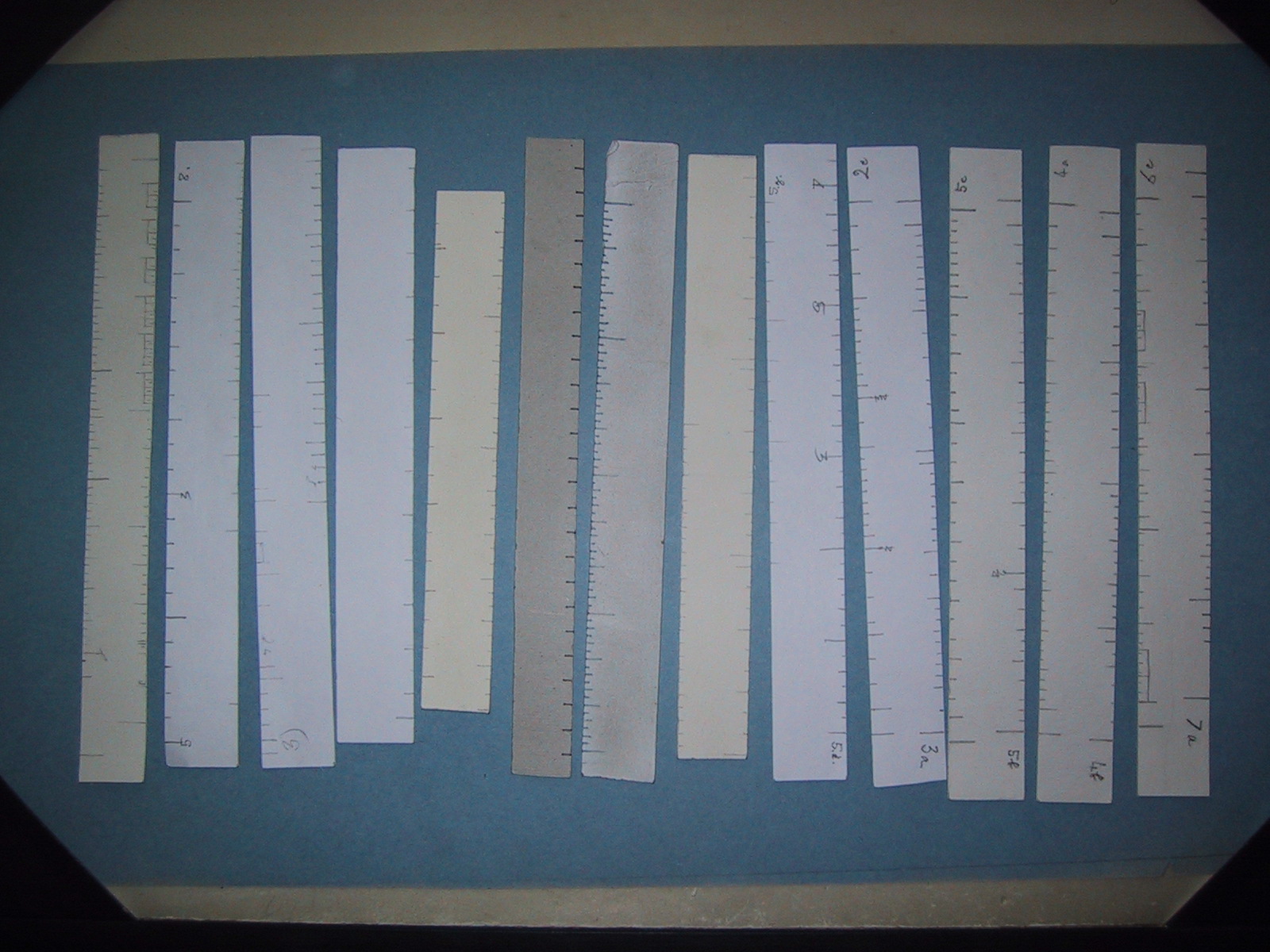
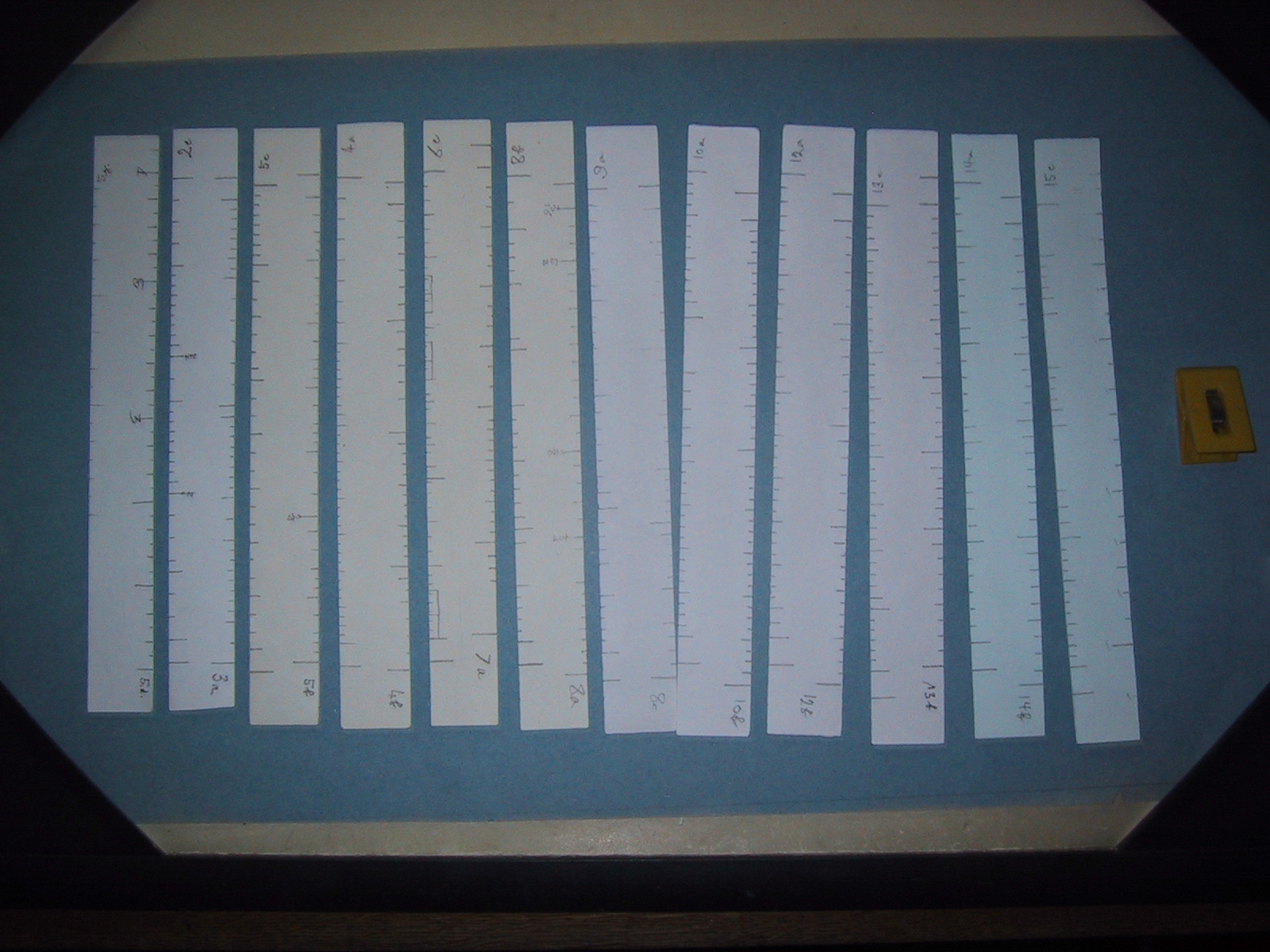
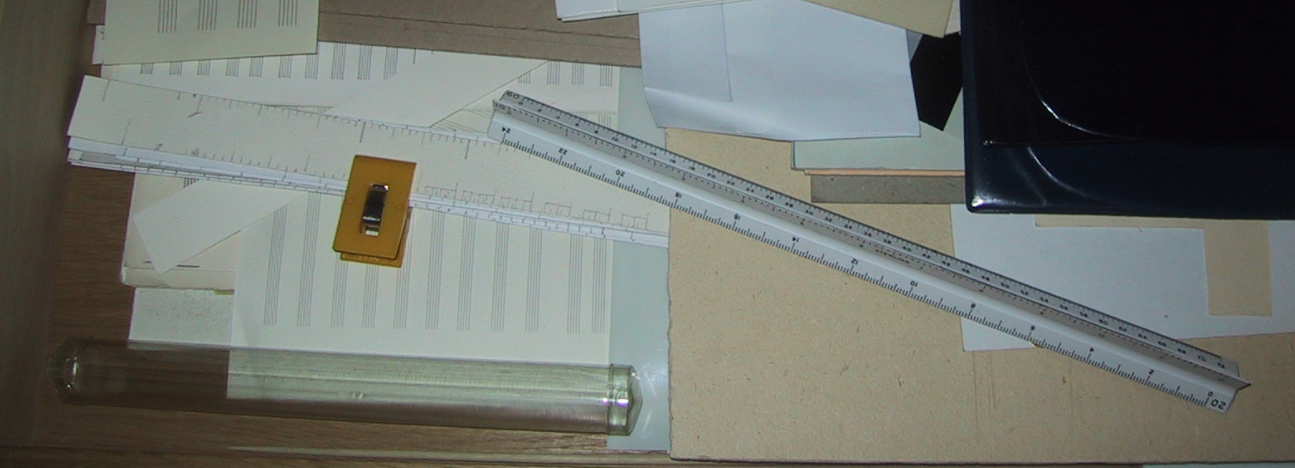
Another drawer in Lutosławski’s desk contained various odds and ends, loose scraps of unused manuscript paper and strips of card held together with a strong clip.

Screen Shot 2014-12-23 at 19.20.44

These strips turned out to be 20 individual hand-drawn rulers, no doubt measured from the three-edged ruler (or its predecessor) that was also in the drawer.  Some of the card rulers were double-edged, and there was a number (and usually a letter) attached to almost every one.  I imagine that he used them in his sketching: there are quite a few instances of the regular pattern being overwritten as the compositional process took over.

I laid them all out on Lutosławski’s blotting pad to photograph them.  The last five on the RH side of the top photo also appear as the first five on the LH of the lower photo (don’t ask me why).  Someone may have fun trying to match them up with the music…

134-3413_IMG

134-3414_IMG

• WL100/73: Lutosławski’s Batons

One drawer in Lutosławski’s desk contained batons with different cork handles, their plastic sleeves and, with one exception, orange protective tubes.  I am not sure which makes or models are represented here (one tube says ‘GLASS FIBER 340mm’) – does anyone recognise them or know about Lutosławski’s preferences in batons?

Screen Shot 2014-12-23 at 15.45.14  Tomorrow: Lutosławski Rules!

• WL100/72: Lutosławski’s Desk

My series WL100 was curtailed at the end of last year as I was preoccupied with preparations for my four-month walk across France at the start of this year.  I am going to try to bring it up to my goal of 81 posts (chosen because that was Lutosławski’s age when he died in 1994).  So that’s ten more to go, including this one.

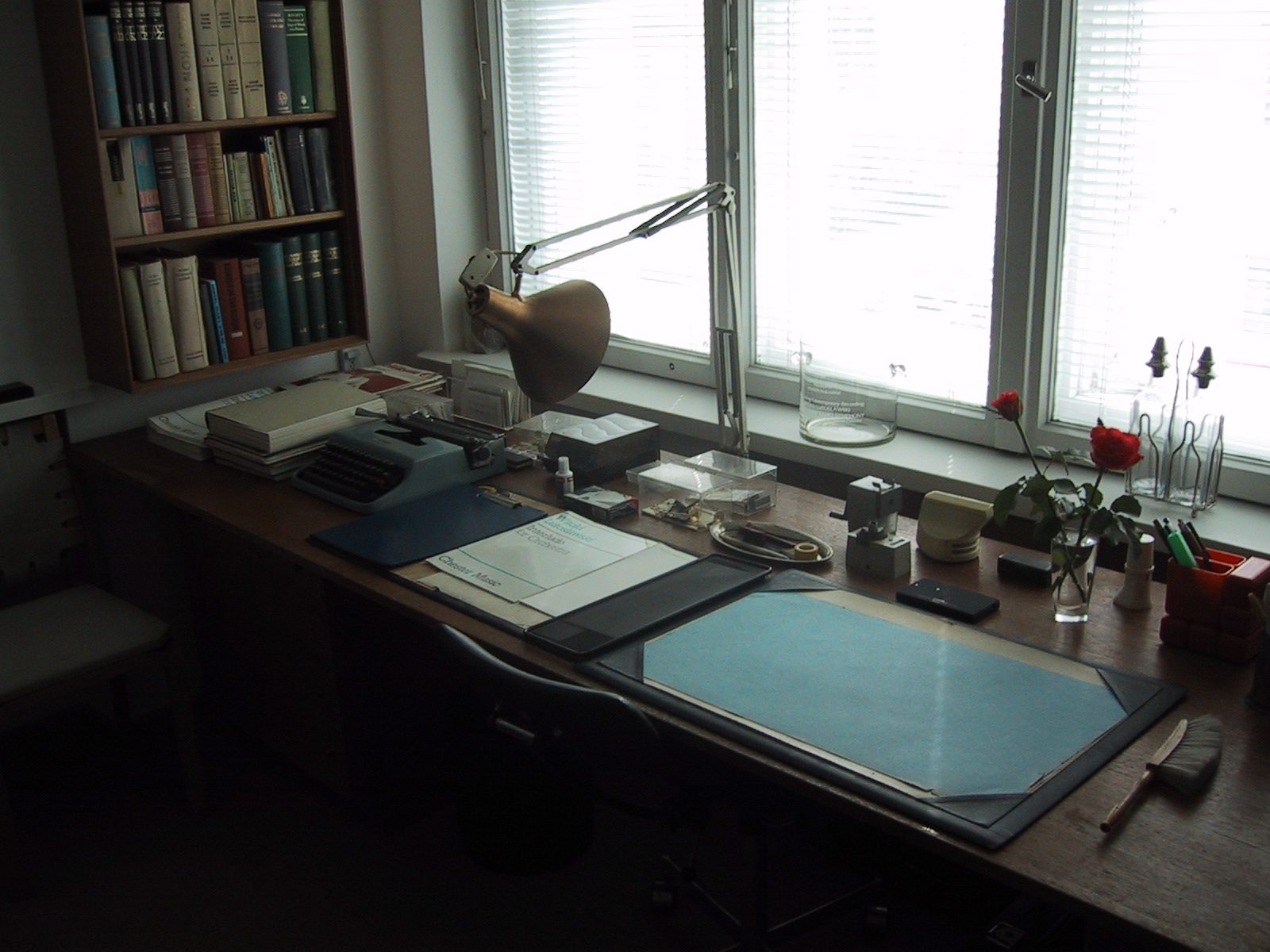
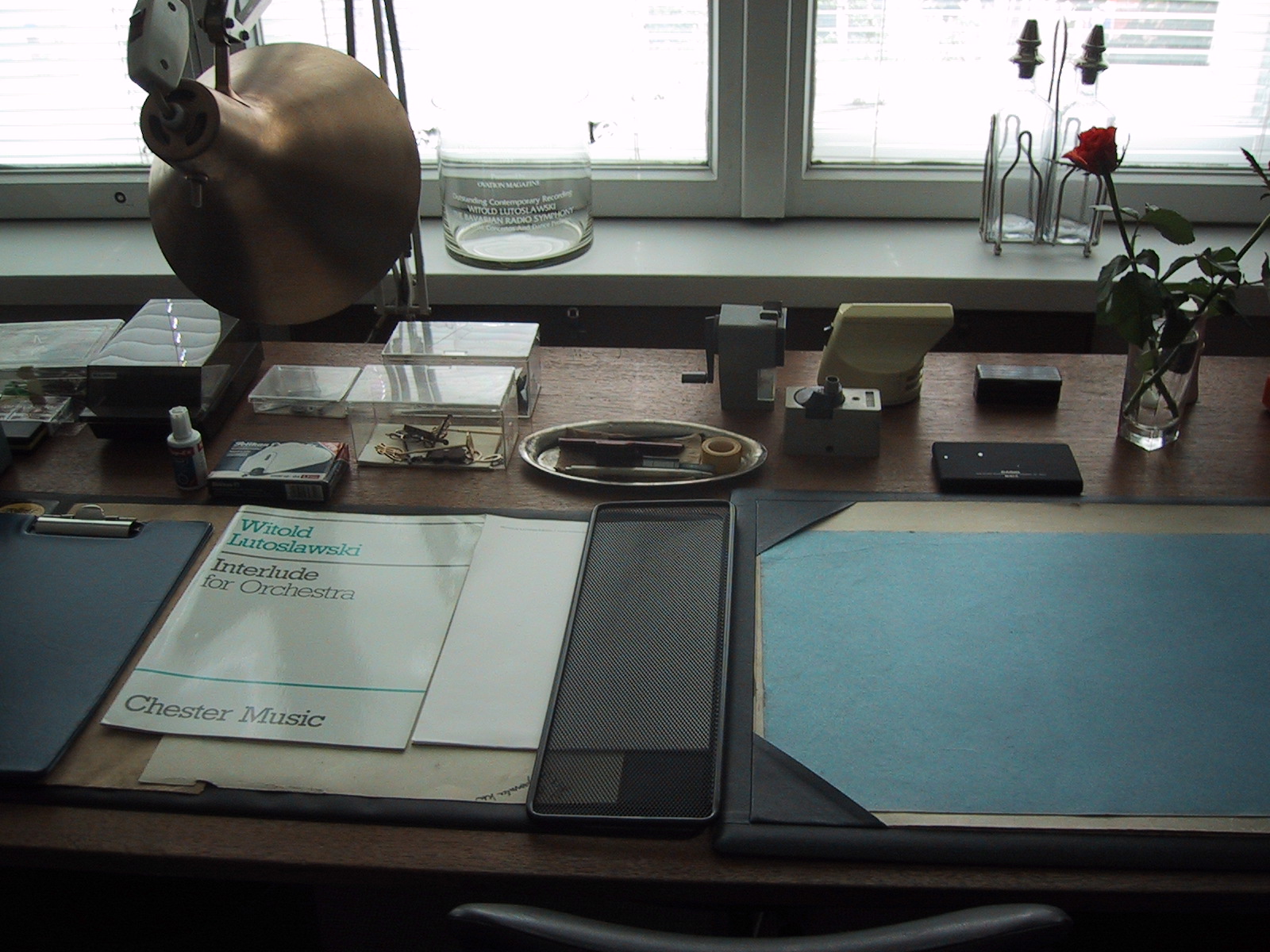
WL100/9: Lutosławski’s Carpet included a distant shot of Lutosławski’s desk, as it was in September 2002.  Here are two closer shots.  Lutosławski was innately neat and tidy, but I have no idea how much the desk was rearranged, added to or subtracted from after his death.  Some familiar items are here: the blotting pad, pencil sharpeners, and brush (see A Brush with Lutosławski).  There’s something rather melancholic about these photos, despite the red roses.  The day was dark and light very poor.  Tomorrow I will post what I hope will be intriguing shots of the desk drawer and some of its contents. (I should add that permission was granted by Lutosławski’s family to investigate his work spaces and take photographs.)

134-3415_IMG

135-3501_IMG

• Reviews in translation (Górecki-Gibbons)

Penderecki_Gorecki_LutoslawskiFacebook friends will know that I posted last week about an unusual event at Warsaw’s Grand Theatre that was taking place on Saturday 29 November.  Here are my translations of two reviews that have since reached me (apologies for any linguistic infelicities).  I don’t usually occupy myself with reviews, as others are better placed to do them.  But the nature of the event is such that I think these opinions from Sunday 30 November may be of interest. They were written for well-regarded newspaper outlets, polityka.pl and wyborcza.pl.

I’m not going to develop the arguments here, but I may well return, in another post, to the trend of not leaving composers’ works alone.  Chopin is one thing, and his music has been used a creative resource for many years.  But in recent years in Poland it has been the music of lately deceased or living composers that has come in for treatment that ranges from ‘dressing-up’ to something more materially radical.  But that is for another day.

The first of the reviews comes from Dorota Szwarcman’s online blog for Polityka.

Three People, Two People and Spotlights (Trzech, dwóch i reflektory)

Dorota Szwarcman

The purpose of the concert at the Grand Theatre was to record it for DVD, but the audience had to endure aggressive noise emanating from antediluvian spotlights.  It was impossible to convince the organisers to do something about it.  In fact, ‘noise’ is an understatement.  It was a din.  It impeded hearing the performances, was superimposed on them and distorted them, especially in the quiet moments. I understand that it will be filtered out in the recording, but why then invite an audience?  They could have recorded it in rehearsal.  And so we felt simply as if we’d been given a kicking.

OK, but we must consider the pieces.  The ‘Three People’ are Penderecki, Lutosławski and Górecki.  As the only surviving member of this trio, it fell to Penderecki to conduct the works of all of them.  There was a continuation of the Penderecki-Greenwood project (48 Responses to Polymorphia was performed again), extended by the new Réponse Lutosławski by Bryce Dessner; plus works by the members of Radiohead and The National (the ‘Two People’), conducted by Bassem Akiki.  And NOSPR [National Symphony Orchestra of Polish Radio] played.

What can one say about these pieces?  My reflection is that people who play music every day which is completely different, sharper, become awfully polite when they suddenly enter the classical world.  Isolated timid clusters are lost in a sea of wistful tonal fragments, this tonality being slightly disturbed, so that everything is not just repeated literally, but is still all very discreet. While the relationship between Greenwood’s piece and Penderecki’s is very obvious – its successive fragments originate in Polymorphia‘s famous final C-major chord – it is hard to see what links Dessner’s composition with Lutosławski’s Funeral Music, perhaps two notes, not more.  It is easier to hear connections with Philip Glass, who has nothing in common with Lutosławski.  The responses therefore do not constitute in either case a counterbalance to the ‘questions’, i.e. the works by Penderecki and Lutosławski.

Another thing: the visuals were terribly distracting, supposedly attractive and interesting (made by the same people who have been in charge of the staging of concerts at Wrocław’s Centenary Hall), but here too expressive and riveting.  It was hard to take in the music at the same time.  There may be some for whom it was easier…

The second half was another story.  Starting with the visuals themselves, which were the work of John Milton, who is in charge of the packaging and staging for Portishead concerts, and ending with the introduction of Beth Gibbons in Symphony of Sorrowful Songs.  In an “excuse me for living” position (I thought that, in her situation, she was being unusually shy, but it turns out that she is always like this), she sat on a chair and sang into a microphone.  It has to be said that she had been really well coached by an expert – after all, she does not read music, knows no Polish and, moreover, has never sung in any language other than English, and furthermore has never sung with an orchestra [AT: although she and Portishead have performed with a backing orchestra]. Somehow she made it happen, even if in some places she had to sing down an octave; she sang in her own way, just as she does with Portishead, the voice slightly murmuring, slightly whining, but clear for all that…  The greatest advantage of this singing was its sincerity and directness – she knew what she was singing about and tried to express it; one may say that her singing was ‘sorrowful’ in reference to the work’s title, though this term is ambiguous.  The visuals underlined the claustrophobic-despressive mood, showing a wall of lichens, murky corridors without end, guttering candles.  All in all, I don’t know the reason for this experiment, because Górecki’s Third Symphony has just no need of popularisation, but apparently foreign concert halls are already interested in this concert.  Well, let’s see.

The second review, also dated 30 November 2014, is by Anna S. Dębowska for Wyborcza.

Anglo-Saxons from the World of Pop in a Concert with Music from the Polish Classics (Anglosasi ze świata popu na jednym koncercie z muzyką polskich klasyków)

Anna S. Dębowska

Radiohead, The National and Portishead connected with Polish music in a National Audiovisual Institute project.  The result was at least debatable, but what kind of art is without controversy?  A review of Saturday’s concert in the Grand Theatre – National Opera in Warsaw.

Commissioned by the National Audiovisual Institute, Jonny Greenwood and Bryce Dessner composed short pieces for string orchestra inspired by Krzysztof Penderecki’s Polymorphia from 1961 (Greenwood) and by Witold Lutosławski’s Funeral Music from 1958 (Dessner).  Beth Gibbons sang the soprano part in Henryk Mikołaj Górecki’s Third Symphony ‘Symphony of Sorrowful Songs’ (1976).  The performances of the Polish music were conducted by Krzysztof Penderecki and the new pieces by Bassem Akiki, the young Lebanese-Polish conductor who made his debut at Wrocław Opera a few years ago.  The National Symphony Orchestra of Polish Radio played.

That about sums it up.  The idea came from Michał Merczyński, head of the National Audiovisual Institute, the artistic selections made by Filip Berkowiczm director of the Kraków festival Sacrum Profanum. “I’m very interested in bringing together the worlds of serious music and ambitious entertainment”, he told Wyborcza. “Such collaborations provide an extraordinary boost to the participants, for their work reaches a whole new audience.  I am glad that Michał Merczyński has once more invited me to collaborate and again allowed me to stir it.”

Water and Fire One Year Later

Indeed, Berkowicz has stirred things up.  He’s already done it many times.  It is sufficient to recall projects like ‘Penderecki Reloaded’ – initiated jointly with Merczyński, processing the classics through performances by Greenwood and Aphex Twin – or ‘Polish Icons’ – with Skalpel remixing Penderecki, Górecki and Lutosławski at Sacrum Profanum [AT: 2014].  But this is nothing compared with Beth Gibbons, the vocalist with the trip-hop group Portishead, cast in the oratorio-cantata soprano role in Górecki’s Third Symphony.

Saturday’s concert was due to happen a year ago during the jubilees of the three great Polish composers.  I do not think that the change of date influenced its reception.  For some it was from start to finish a proposition that was hard to take, while others saw in it an interesting attempt to link different worlds, for which the blurring of boundaries is a trump card.  For others it is an alarming attempt to tamper with copyrighted musical texts.

That is why Gibbons fans reacted enthusiastically, in contrast to classical music connoisseurs, who took the thing with chilly scepticism (the family of Henryk Mikołaj Górecki disassociated themselves from the project). This attempt to reconcile fire with water convinced me more, however, than the compositional proposals of Greenwood and Dessner, who entered too willingly into the role of imitators.

Simple and Authentic Beth Gibbons

Accepting Gibbons in the Górecki demanded openness and a reorientation to a different kind of vocal expression.  It is difficult to measure the star of Portishead as a classical singer and compare her to Stefania Woytowicz, Dawn Upshaw or Zofia Kilanowicz, great performers of the Third Symphony.  Not that vocal strength, that range or that technique.  That is not what it is about.  Despite obvious vocal shortcomings, she found herself surprisingly at home in the atmosphere of Górecki’s music, inspired by the lament of a mother in pain at the death of her son.  The trump card was the musicality, simplicity and authenticity of a non-professional.  She was herself – she sang sitting at the microphone, sheltering behind her hair like an introvert. She must have put in a great deal of work on her Polish, because it sounded impeccable at times.  The high notes were evidently problematic for her, but the amplification helped in producing them.

It was an interesting experiment, but one hopes even so that Gibbons does not spawn imitators (Bjork once turned down an invitation to sing the Third Symphony).  Górecki is only superficially simple and wistful, not suitable for the stage.  Rather he did not approve the use of his music for other purposes, as when he did not permit the Polish distribution of the film in which the director Tony Palmer illustrated the Third Symphony with images of war.

Rockers Write in a Twentieth-Century Fashion

In the case of Greenwood’s and Dessner’s meeting with the classics there was nothing new.  The commissioning of orchestral works from them was the result of compositional try-outs by both musicians. Dessner has had a classical training and has written for the Kronos Quartet.  It is great that someone suggested Lutosławski to him, although Philip Glass was a greater influence in his piece (Réponse Lutosławski) than the great Pole, except maybe for the cluster from Funeral Music.  Even so, the Dessner seems a more interesting, more independent composer that Greenwood with his 48 Responses to Polymorphia, in which he drew liberally from the arsenal of avant-garde and sonoristic devices from the second half of the twentieth century.

Time will tell whether Dessner’s piece will be an encouragement to fans of The National to reach for Lutosławski.  If that happens, there awaits them a meeting with unusually complicated musical material of outstanding expressive qualities.  Saturday’s performance of Funeral Music once again showed that it is a masterpiece.  Likewise, Polymorphia under the baton of its creator, Krzysztof Penderecki, has lost nothing of its freshness and acuity.

It was moving that these pillars of Polish music (Polymorphia, Funeral Music, Symphony of Sorrowful Songs) sounded out under the baton of Krzysztof Penderecki, the only performer who had been a witness and co-originator of the era in which these works were created.  He naturally became the keystone of all of the concert’s themes.  Recruiting him for this project was Michał Merczyński’s and Filip Berkowicz’s unquestionable success.

The concert will be released on DVD by NiNA.


• Commemorating Composers

Six weeks ago, Andrzej Panufnik had a walk named after him in a Warsaw park.  Today, I passed by plaques set side-by-side on the wall of a building in the Saska Kępa district (south-east Warsaw) where the conductor and composer Andzej Markowski and the composer Zbigniew Turski once lived.  They are not far from the building where Witold Lutosławski lived after the war until 1968.  He too has his plaque.

unnamed

photo courtesy Michał Kubicki

Later on, my hosts and I passed near a skwer (Eng.: square/green) in Ujazdowski Park named after the critic, writer and composer Stefan Kisielewski.  Panufnik may have his road sign and Markowski, Turski and Lutosławski their plaques, but Kisielewski has not just one skwer but two.  Half an hour later, in Piaseczno, south of Warsaw, we drove past a second ‘Skwer im. Stefana Kisielewskiego’.

Our destination, en route to a family get-together, was a few hundred metres further on: the old cemetery at Piaseczno.  There lies Witold Maliszewski, a composer who is known primarily for one thing – having been Lutosławski’s composition teacher.  While Markowski, Turski, Kisielewski and Lutosławski were all buried in Powązki in north Warsaw, Maliszewski was interred in Piaseczno, close to where he had lived.  Like all Polish cemeteries, it was a riot of colour from the flowers placed there on All Saints’ Day and All Souls’ Day, the weekend before last.

IMG_5152

• Letters from 1950

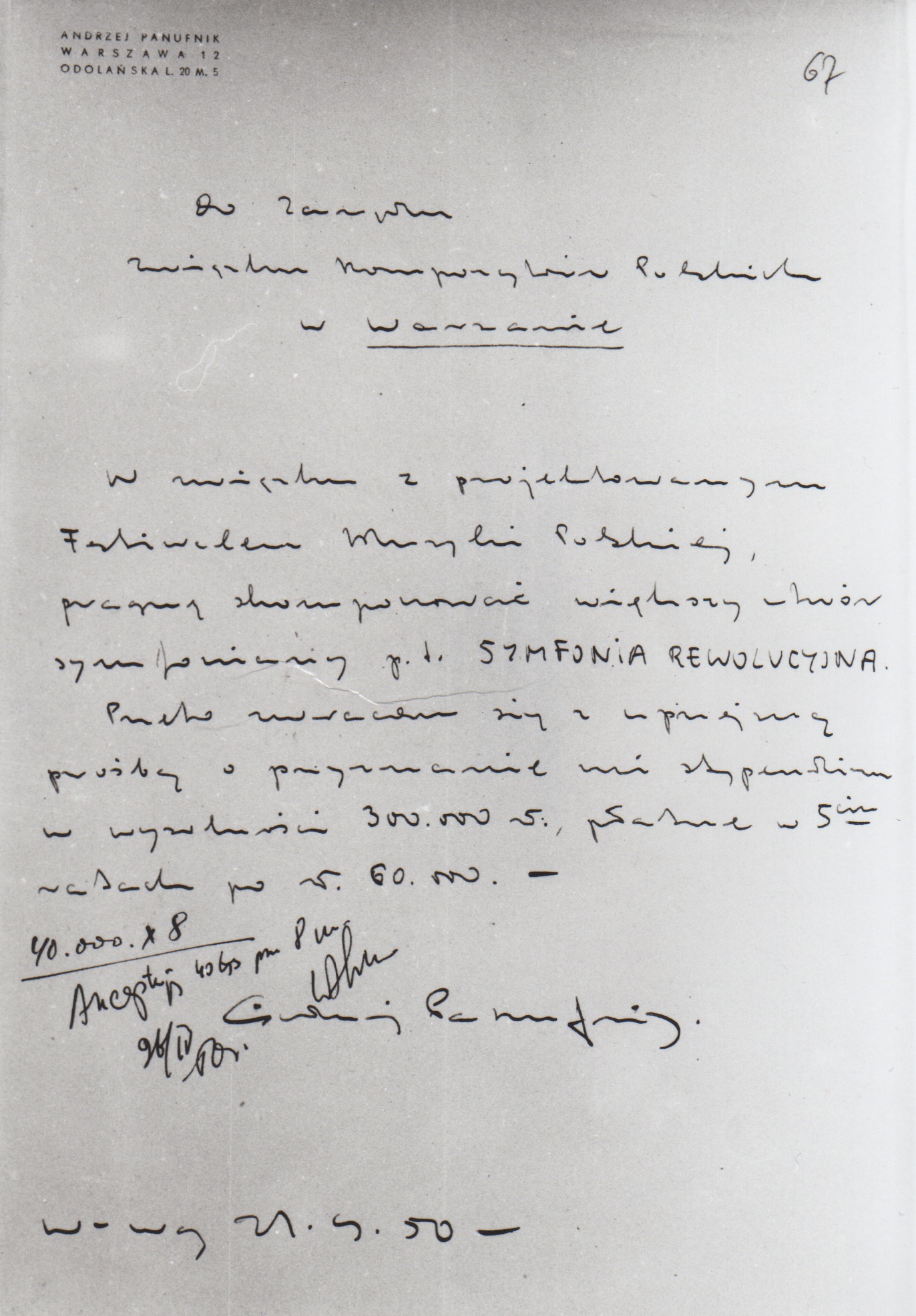
Reproduced here for the first time is a letter dated 21 April 1950.  It is from Andrzej Panufnik, who expresses his desire to write a Revolutionary Symphony.  Not heard of this work before?  That’s not surprising, because he never wrote it. Instead, the project transmuted itself into his Symphony of Peace (1951).

Scan 4The source of this letter, and of letters from over 50 other Polish composers, is a file I stumbled across in a Polish archive, half a century after it was sent.  I have written about Panufnik’s letter and Lutosławski’s before, and my article on this collection was published online by the Polish Music Center in Los Angeles in 2002.  I have now republished it here – File 750: Composers, Politics and the Festival of Polish Music (1951) – alongside updated appendices.

These letters from 1950 provide an insider’s view of how composers navigated the system of commissions and funding at the height of socialist realism, what they had already written that they deemed suitable, what they wanted to write, how they justified their proposals, how much they thought they were worth financially, and how much the Minister of Culture rated them.  There are further research questions to be asked of this primary material, not least of which is the fact that the majority of the proposed compositions never materialised.  Here, for starters, is my initial survey from 2002.

• NINATEKA: WL, KP & HMG

My preparations for and execution of my peregrinations in France prevented me from highlighting a major online resource that was launched in Poland at the end of 2013.  I have been provoked into posting details now by the world premiere on 21 April of Henryk Mikołaj Górecki’s Kyrie.  Although a recording has already been posted on YouTube (https://www.youtube.com/watch?v=NNuWAb_5OPk), there is also an audio file on NINATEKA: Three Composers.  It can, however, take some time for the NINATEKA files to load on the in-built player, although I can’t tell if this is down to the strength or weakness of the wifi signal.

Screen Shot 2014-05-12 at 11.45.51

NINATEKA is hosted by Poland’s Narodowy Instytut Audiowizualny (National Audiovisual Institute) and covers a wide range of creative arts.  It is a Polish-language site, with the notable exception of Trzej Kompozytorzy (Three Composers).  Witold Lutosławski, Krzysztof Penderecki and Górecki all had significant anniversaries in 2013, and this initiative brings together archive recordings of their music, mostly from Polish Radio.  Here you will find not only the major concert works but also smaller, less familiar pieces.  There are timelines, biographies and glossaries (‘alphabet’).  Tucked away is the roster of the editorial team, led by Dr Iwona Lindstedt.

The navigating tools are fairly straightforward once you have worked them out.  Under ‘music’, you can pick an individual year or span of years, you can see a composer’s complete repertoire (‘all forms/genres’) or narrow it down under this same heading or in groups (scroll down ‘all categories’).  You can be guided by ‘recommended’ or ‘popular’ or read the playlists suggested by musicians and family members.  Or you can use ‘advanced search’ to filter by duration, instrumentation etc..  But if you want to look chronologically, you may initially be stumped.  For this, you have to look higher up the page and click on ‘creative periods’.

Happy exploration.  NINATEKA: Three Composers really is a treasure trove.

• WL100/71: Lissa on Concerto for Orchestra

As a follow-up to WL100/70, here’s the final section (in translation) of a huge article on Lutosławski’s Concerto for Orchestra.  Its author was Zofia Lissa, the dominant presence in Polish musical policy during the post-war decade. She was a musicologist with an early specialism in film, but she is best known for her Marxist ideology and her role in shaping Polish musical thought during the period of socialist realism.

Lissa, Panufnik, Lutosławski in Prague, 1950

Zofia Lissa (left), Andrzej Panufnik (immediately behind) and Witold Lutosławski (right) in Prague, 1950.

With the closing down of the less-than-obedient Ruch Muzyczny (Musical Movement) in 1949, publications on music were tightly controlled in Stalinist Poland.  In came a new journal, Muzyka, and subsequently the much weightier (in all senses of the word) Studia Muzykologiczne (1953-56).  It was in the fifth and final volume of this latter publication that Lissa published an article of over 100 pages: ‘Koncert na orkiestrę Witold Lutosławskiego. (Szkic analyticzny)’ (Witold Lutosławski’s Concerto for Orchestra. (An Analytical Sketch)’), Studia Muzykologiczne (1956), pp.196-299. (The deadly earnest of Studia Muzykologiczne may be demonstrated by the opening item in this fifth volume, an even heftier article by Stefania Łobaczewska: ‘Próba zbadania realism socjalistycznego w muzyce na podstawie polskiej twórczości 10-lecia’ (An attempt at an investigation of socialist realism in music on the basis of Polish composition of the past decade), pp.7-195.)

ZKP visit to Poznań, 1953

A visit by the Polish Composers’ Union to Poznań, 1953.  Zofia Lissa (front row, third from right), Witold Lutosławski (top right, looking characteristically wary).

As might be expected, the analytical aspects of Lissa’s article were embedded in a view of music that promoted a socialist-realist view of the function of the arts in communist society.  The article is far too long to reproduce in a post. Here instead is the concluding section, translated by Michał Kubicki and myself a few years ago, but never published.  It gives a flavour of the musical environment of the time.  It is a curious, transitional mix between the defensive and the confessional, because by 1956 – two years after the premiere of the Concerto for Orchestra – Polish music and musicology, and Lissa herself, were rapidly changing their tune as the barriers to Western music and its aesthetics were brought down.

…….

Lutoslawski’s Concerto in the music of the post-war decade
(pp.292-9)

If the problem of mastery in contemporary Polish music has not to date been taken up by our musicology, it is mainly because there have in fact been few pieces which have borne the hallmarks of mastery.  It seems to me that it would not be an expression of ‘hagiography’ if we were to acknowledge this mastery in Lutosławski’s Concerto.  Mastery in diversity and originality, in the innovative character of its expressive devices; mastery in the economic way of employing them, in the perfect coordination of these devices with a form that is both new and his own in conception; mastery in the new treatment of folklore, in the synthesis of ‘old’ and ‘new’.  In the Concerto Lutosławski has given yet more proof that he has his own style of utterance; the influence of this style can already be detected in works by other composers (such as  Baird’s Lyric Suite [1953]).

Our remarks about Lutosławski’s Concerto would not be complete, however, if we did not pose the question: what is the role of this piece in Polish music of the [post-war] decade. What is the relationship of the work to the various postulates which our life has thrust forward, to the issues which have preoccupied this period?  We can only become fully aware of the significance of a musical piece, having exhausted the analytical aspect connected with the description and explanation of its shape, if we are able to answer this question. And there is another one: what is the role of this piece, when it comes to the composer and the individual development of his talent?

Let us start with an answer to the latter question.  Writing at the end of 1951 and the beginning of 1952 about Little Suite and [Silesian] Triptych [1], I saw in them the first attempts at a synthesis of two strands in the composer’s music: that of monumental works, stemming from the premises of the inter-war period, difficult, long and painstakingly elaborated and by no means easy for the average listener to grasp.  Here belonged the First Symphony, Symphonic Variations as well as the later Overture [for Strings].  The second creative strand focused on charming miniatures, wonderfully carved and strongly linked to folklore,  thanks to which Lutosławski’s music managed to penetrate through to fairly broad layers of the listening public.  Folk Melodies for piano, Children’s Songs set to Tuwim’s verse, A Straw Chain, Bucolics and Dance Preludes for clarinet and piano – these are the main works within this strand.  Little Suite and Silesian Triptych were the harbingers of the merger of these two strands in Lutosławski’s music. On the basis of the analysis of these two works I tried to account for processes which were to be fully confirmed by the Concerto for Orchestra itself.  If those two works constituted a preparatory stage for this synthesis, the Concerto was its full and ultimate realisation.  In it met the experiences and attempts of Lutosławski’s previous development, realised both in symphonic forms and in the other field of his creative activities – the miniatures. It is only on the basis of these activities, in which folklore was the starting point for the conception, material and form, that the composer’s new attitude to folklore, as currently realised in the Concerto, could be born.  It is only on the basis of an organic merger of one’s own reservoir of musical ideas with folk ideas that the kind of unity that can be observed in the Concerto could be brought into being.  This is the characteristic blending of folklore into monumental form, whose concept, however, is the [composer’s] own, individual concept, as in the First Symphony or the Symphonic Variations, and not a concept stemming from non-musical ideas, connected with the people [lud], as in Little Suite or Triptych.  One may have some doubts whether it is valid to employ folkloristic material without linking the concept of the work with a specific content derived from ideas about the people, with the representation of folk scenes.  Indeed, in the majority of pieces using folkloristic material from one’s own or from a foreign country, the folklore was to serve just these aims.  In the Concerto it fulfils a different function, even though it surely contributes to the creation of the ‘atmosphere’ of Polishness in the piece. Under no circumstances does it perform functions that are descriptive, functions that specify aspects relating to content. The same, albeit less consistent manner of employing folkloristic material can also be seen in Szabelski’s Third Symphony [1951].

Lutosławski’s Concerto links together two strands of his music and two musical worlds which in the composer’s imagination have up to now proceeded, as it were, independently of each other, contained in pieces which were somewhat different in style and format.  In this sense the Concerto should be regarded as a crucial moment in Lutosławski’s compositional career.

It should be considered a work of special significance from yet another point of view: the quality of its resources, the perfection/carving of its details, the frugality of their use, the originality of the ideas and the purity of the distinctly national style – all this had also been noticeable in Lutosławski’s small forms, including Little Suite and Triptych.  But the same discipline, inventiveness, originality and stylistic accuracy in such a monumental form as the Concerto, the same national countenance, albeit differently realised, already testify to the full maturity of compositional  craft, to the crystallisation of an individual style, to the composer’s mature mastery.

We should look at Lutosławski’s Concerto from yet another perspective, from the perspective of the development of the totality of our music during the ten years of People’s Poland, the postulates put forward during that period, undoubtedly correct in their essence, but often vulgarised by numerous scribblers on music or civil servants, not always musical experts.

To put the issue unambiguously straight away: Lutosławski does not follow the slogans which call – at the stage of a simplified understanding of the essence of socialist realism – for a rejection of 20th-century technical devices, for a return to romantic-neoromantic means; if there is a clarification of his style, it is as a result of the tremendous discipline of construction, the deep reflection and the frugality in the choice of resources and not in order to return to the stylistic traits of past periods.  At a time when a return to the style of the 19th century was postulated, he managed to be forthright but not academic, accessible but persuasive, with a new type of simplicity, without at the same time rejecting the technical achievements of the inter-war period, achievements which seemed to him to be indispensable for his own compositional craft.  Nor did Lutosławski move in his symphonic pieces towards programme music.  This does not mean at all that he went the way of constructivism, that he renounced expressive content in favour of technical values.  On the contrary,  turning to the form of the song, namely the linking of music with text, shows that his precise goal was the most adequate rendition of content – expression.  The use in Triptych of the textual and vocal aspect confirms that [Lutosławski’s] attitude towards the realisation of content encompassed even symphonic forms.  The same ‘concrete nature’ of ideas, this time relating to dance, lies at the basis of Little Suite.  If we say that Lutosławski avoided an illustrative programmatic approach, it does not mean that his attitude was anti-expression.  Besides, we must stress here that in this respect  he assumed an attitude practically like that of the whole circle  of Polish composers in the [post-war] decade, among whom the slogan of the programmatic in the context of symphonic music met with a very weak response.  Apart from Woytowicz’s Warsaw Symphony, and also Serocki’s Second Symphony, which involved choirs (meaning that the content was manifested verbally), this postulate was realised rather feebly.

One of the decade’s slogans, however, was readily accepted by Lutosławski and realised out of his own inner need: the slogan of crystallising a new, contemporary national style.  Lutosławski brings this out in his entire cycle of ‘miniatures’, to a larger extent in Little Suite and Triptych.  And in a new way in the Concerto.

Lutosławski’s  music is stylistically homogenous, be it a small prelude for piano, an orchestral piece, a children’s song or a monumental symphonic form – all his works are an expression of noble beauty, a beauty created by a man from our epoch, our milieu, our generation.  In this sense Lutosławski’s music is the music of our time, enriching the culture of our country, belonging to the culture and ideological world of our society, despite the fact that is does not speak in concrete and explicit terms either about the revolution that we are living through or about the goals which we set ourselves.  In this sense, too, Lutosławski’s Concerto belongs to the first decade of People’s Poland, even though, with its programme, textual content or selected genre, it does not directly support its ideology, does not immediately contribute to the struggle which is the axis of this decade.  It is music which fights for the enrichment of the inner life of the Polish listener, for the development of Polish musical culture, for a new national style for our time. And this is a great deal.

To put forward the issue once again clearly and openly: Lutosławski’s Concerto for Orchestra does not belong to easy pieces addressed to the unprepared listener.  It is not possible, leaving the concert hall after its performance, to hum or whistle the themes; which would be tantamount to trivialising and vulgarising the practical criteria of ‘musical realism’ for everyday use.  On the contrary, this work is evidently geared to the listener who is already prepared, versed and accustomed to the norms of 20th–century music; a listener whose musical imagination is not confined to the categories of romanticism or neo-romanticism.  Is Lutosławski’s Concerto, therefore, a manifestation of an ‘elitist’ attitude, something which has so far been the most serious accusation levelled against our composers during the decade?

It is impossible to answer this question without throwing light on the key issue of our cultural revolution in the field of music.

The fact that the need for such music was rightly and continues to be rightly propounded – music that would educate, raise those listeners who are unfamiliar with music to a higher level of  their ‘musical consciousness’ – should not at all be understood in such a manner as if all music by contemporary composers was to be directed to this type of addressee.  Millions of copies of Falski’s primer [2] hardly abolish scientific research or hinder the publication of studies addressed to several thousand specialists.  Are we therefore returning to an old concept: one kind of music ‘for specialists’ and another kind of music ‘for lesser mortals’?  Definitely not.  We simply believe that the manifold varieties of ‘musical consciousness’ in our contemporary society, which are a remnant of the class split in the field of cultural needs, must have fairly different musical needs and that there must be fairly different means through which these needs are satisfied.  Under no circumstances can this fact be the reason why contemporary Polish composers should give up their right to look for new devices which correspond to what they want to express with their music today.  One thing is certain and was certain when attempts were made (i.e. when our administration attempted) to classify this as ‘formalist inclinations’: devices adequate to the expressive needs of contemporary composers can in no way be the same as those for composers 100 or 50 years ago, even today, when it is precisely these ‘century-old’ devices which constitute the foundation of the listening habits of the broad masses of end-users in our country.

One of the most serious mistakes committed by many of those who express their opinion about music (in many cases, unfortunately, non-musicians) was that they postulated a uniform front for the music of our epoch, forgetting about the highly heterogenous needs of our society and its perceptive abilities.  But – let us return to the already quoted statement by Marx –  ‘for the non-musical [i.e. unhearing, unprepared – Z.L.] ear even the most beautiful music makes no sense’.  A peculiar ‘Berkeleyism’ has been utilised by us [in Poland] in day-to-day practice: travestying Berkeley’s famous thesis – esse est percipi – it was believed that it is only the music that an opinion-former can grasp, understand and sense which is good, correct, needed by our society and, what is more, realistic.  Everything else was just ‘formalism’.  One’s own, subjective, often very limited categories of musical ideas were objectivised and were merely given labels of ‘commonly binding norms’.  Music that was personally inaccessible, difficult, elusive, was thoroughly mixed up with objective music standing in the enemy camp.  The difficulties of semantic criteria in reference to music rendered this misunderstanding even greater and deeper.

Of course, nobody negates here the uniformity of musical culture conceived as a service to our society which is moving towards socialism; uniformity in the sense of the utterance of the man of our time, of our milieu, the man who senses our reality.   But one cannot also fail to notice the diversity of functions which this music has to fulfil today in our society, the diversity of needs stemming from our cultural heritage, burdened of course by all the negative features of a society split by class.

The musical listener in People’s Poland continues to be highly diversified as regards the categories of musical thinking, which bears deep traces of the class stratification in which Polish musical culture had been shaped for centuries.  The scope of musical needs here is very broad, while listening habits, which listeners use in the perception of music, are historically very diversified.  We have today many music lovers who are genuinely in love with music and yet they do not go beyond Bach or Beethoven, for whom even the world of Debussy and Ravel is already alien to the ear, who have to struggle through Szymanowski as if it was an aural jungle, not to speak yet of the ‘sound worlds’ of Honegger or… Lutosławski.  What in Lutosławski’s miniatures was still ‘digestible’ for them becomes sonic chaos in the Concerto for Orchestra.  They reject from the position of their listening habits (wrongly objectivised as the only correct aural norms) everything which goes beyond their subjective limits of reception.  This conflict has, incidentally, been constant in the history of music.  The struggle for new expressive devices on the one hand and on the other the struggle against them for the sake of the devices that are already well known and mastered by the ‘ear’ of a given generation appears in almost every epoch, in every generation, only to cede victory, of course, to a ‘new’ music which creates in the listeners the aural habits that are specific to it.  Ars nova by Philippe de Vitry (14th cent.), the tract which gave the name to an entire period in music, is already proof of this.

It is clear that this struggle takes on a new shape in periods when social revolution contributes to an intense broadening of the range of music listeners. The backwardness in the musical appreciation of the classes newly emerging on the historical scene is far bigger, because indeed objectively they depend on class conditions which hinder access to the manifestations of culture.  At such historical moments, the stratification of musical needs  manifests itself much more strongly and different ‘musical consciousnesses’ oppose one another far more acutely.  The pressure of the needs of new listeners mounts and it is clear that in the first stage they have to reject the more complex devices which do not get through to them.

Another thing is that they also reject the philosophical point of view – Weltbild – which is often hidden beneath the elitism and sublimation of devices.  The whole picture of the development of Soviet music to date, with its successive variations – of RAPM [3],  of ASM [4], with the breakthroughs of 1937 and 1948,  is precisely a reflection of this fundamental historical and class conflict.

Admittedly, these differences in ‘musical consciousness’  do not always have their own class conditioning, but nevertheless this factor is the basis of objective conflict. This conflict was also present in the music of our decade.  A simplified, anti-psychological and anti-historical approach to the issue led to a situation where the struggle for a new content in the music of the decade became a struggle against innovative devices. The struggle for access to musical culture for the whole nation was for a certain period identified (falsely) with giving up the creative quest.  The need to conform to the tastes of the broad masses was proclaimed.  But when dealing with a society as musically neglected as ours (if only in comparison with our closest neighbours to the East and West), as was but natural, a postulate was made to level down [5], a postulate against which in the 1920s the then Soviet culture minister, Lunacharsky, was still warning.  The postulate for a uniform trend in such conditions was definitely premature.  The time for a fully uniform trend and homogenous devices will come perhaps in a communist society, in which differences in ‘musical consciousness’ will no longer be a result of the ability or inability to have access to musical culture but will be confined solely to individual ‘realisations’, which doubtless will not disappear at that time either.

It was the anticipation of some sort of imaginary, uniform ‘musical consciousness’ of our society already now, 10 years after the revolution, that was the source of many simplifications in our cultural policy in the field of music.  Attempts were made to condemn works, which – just like those by Lutosławski – unquestionably remain inaccessible to the whole nation today but will become a nourishment for the broad masses when these masses eradicate their musical illiteracy just as they had already eradicated their educational illiteracy.  Indeed – what is needed today are works which will help eradicate this illiteracy, which in a considered way will fulfil educational functions.  Lutosławski’s Concerto is not capable of performing such a role.  And we have to admit that there are too few pieces in our music output of the last decade which deliberately undertook such functions.  The great sacrifice of Soviet music – which for over 30 years indeed placed substantial limits on its innovatory explorations in order to give the entire nation the simple nourishment on which its musical categories could develop – was not in vain.  Today,  Soviet music proceeds in its fullness along new roads; it calls in the resonant voice of its most outstanding composers for the right to innovation.  But it has behind it over 35 years of educating its society.  The difficulties of our music stem from the fact that even though it fights, justly and sometimes against the department of culture, for the right to innovation, it has not yet educated its own society in such a way that it could become its end-user.

At any rate – alongside works playing an educational function, we need innovative pieces, just like Lutosławski’s Concerto, pieces which, inaccessible to the masses today, will be accessible to them, will be a document of today for when the level of receptivity of the masses increases.  The theory of a ‘uniform trend’ will by no means resolve this conflict.  If despite this anyone wants to employ such simplifying notions like ‘elitism’ and ‘universality’, it should be clearly stated that Lutosławski’s Concerto belongs rather to the first group.  Not because it expresses some sort of ultra-subjective content, or turns its back on its own society, or is alien to our epoch and our line of development, but because it is difficult, because it does not employ hackneyed devices, because it is – within the framework of the technical achievements of our music – innovative.  These aspects assign it a special place in the music of our decade.

As it happens, this Concerto does not depart in the least either from the general line of the development of music or from the individual line of the development of Lutosławski’s style.  It is inventive but not experimental, it is innovative but never breaks with tradition.  On the contrary, we may notice in it a peculiar though organic blend of such traditions as the Baroque, Romanticism, Impressionism and elements of the style of the inter-war period, presented in a characteristic, individual synthesis of an evidently Polish character. Lutosławski simply derives from the closer and more distant traditions what he needs in order to realise his own concept.  This manner of drawing from traditions, be they close or distant in terms of time or geographical location,  has always existed in music and is hardly deserving of condemnation.  This is just a way and form of blending national styles with the norms of their own epochs, norms which are international.  This is at the same time a manifestation of the continuity of transformations in the development of musical styles.  Lutosławski is to a high degree national and at the same time European, and what strikes the listener above all is what is already the composer’s own, individual face, his original, crystallised style.  This seems to be the highest praise that can be given to a composer during his lifetime: his own individual style which is simultaneously a modern style, i.e. the style of his own epoch and a national style.  It is precisely such individual achievements that should be recognised as the development of a national style, as a new contribution to the tradition of a given national musical culture.  About Lutosławski’s music we can already say today that it is and will be a lasting contribution to 20th-century Polish musical culture.


[1] Z. Lissa, ‘Mała suita  i Tryptyk  Witolda Lutos’awskiego’, Muzyka 5-6 (1952), pp.7-56.
[2] Marian Falski’s Primer was used in Polish primary schools for several decades.
[3]  RAPM: Revolutionary Association of Proletarian Musicians, emerged from the Proletkult organisation around 1924, fully developed around 1928, dissolved in 1932.
[4] ASM: Association of Contemporary Music, equivalent of the Society for Contemporary Music, active around 1934, mainly in Leningrad.
[5]  Here Lissa uses the Russian-based phrase, ‘urawnilovka w dol‘.
• WL100/70: Concerto for Orchestra, **26.11.54

For all Lutosławski’s protestations, his Concerto for Orchestra, premiered on this night 60 years ago, remains his most popular work.  It is his most recorded and performed composition and has deservedly entered the orchestral repertoire worldwide.  That is notwithstanding his subsequent reservations about having to work, in the early 1950s, in ways which were inimical and with material with which he claimed to have little innate sympathy.  Yet his approach to Polish folk tunes was ingenious and natural, innovative and subtle, and the Concerto for Orchestra (1950-54) was undoubtedly the Polish masterpiece of the post-war decade.

Six folk tunes were itemised by the Polish musicologist, Zofia Lissa (‘Koncert na orkiestrę Witold Lutosławskiego’, Studio Muzykologiczne, 1956, pp.196-299), no doubt with Lutosławski’s assistance.  Over 20 years later, Steven Stucky added two more (Lutosławski and His Music, 1981, p.50), again aided by Lutosławski.  Lutosławski indirectly led to the discovery of three more tunes when I came across a forgotten folder of folk materials in the attic room of his house in 2002.  I wrote a short paper on these tunes and the Concerto for Orchestra for the 2004 Symposium of the International Musicological Society, held in Melbourne (Marginal Tincturing?).

There are therefore eleven identifiable folk tunes in the Concerto for Orchestra.  They all come from the Mazowsze region of Poland and were taken from Oskar Kolberg’s multi-volume collection of folk sources, volume 25 (Mazowsze, vol.2) with one theme taken from volume 28 (Mazowsze, vol.5) – no.7 in the list below.

One phrase that has been used to describe this folk material is the bizarre ‘rough stuff’.  This is how Lutosławski reportedly described it in Irina Nikolska’s Conversations with Lutosławski (1994).  Although Lutosławski’s original Polish is not available for this particular part of the conversations, and given that the English translation is at times very odd, I have little hesitation in saying that ‘rough stuff’ would be more accurately understood as ‘raw material’. So here, for the first time in public print, are the eleven pieces of ‘raw material’, taken directly from Kolberg.  I have placed them in the order in which they first appear in the finished composition.

1.  Lissa (p.244): Kolberg, Mazowsze, vol.2, no.421 (p.181) – including variants:

Homma 1993

2.  Stucky: Kolberg, Mazowsze, vol.2, no.463 (p.192) – including variants:

WL KO:Kolberg 463

3.  Stucky: Kolberg, Mazowsze, vol.2, no.502 (p.201) – first phrase:

WL KO:Kolberg 502

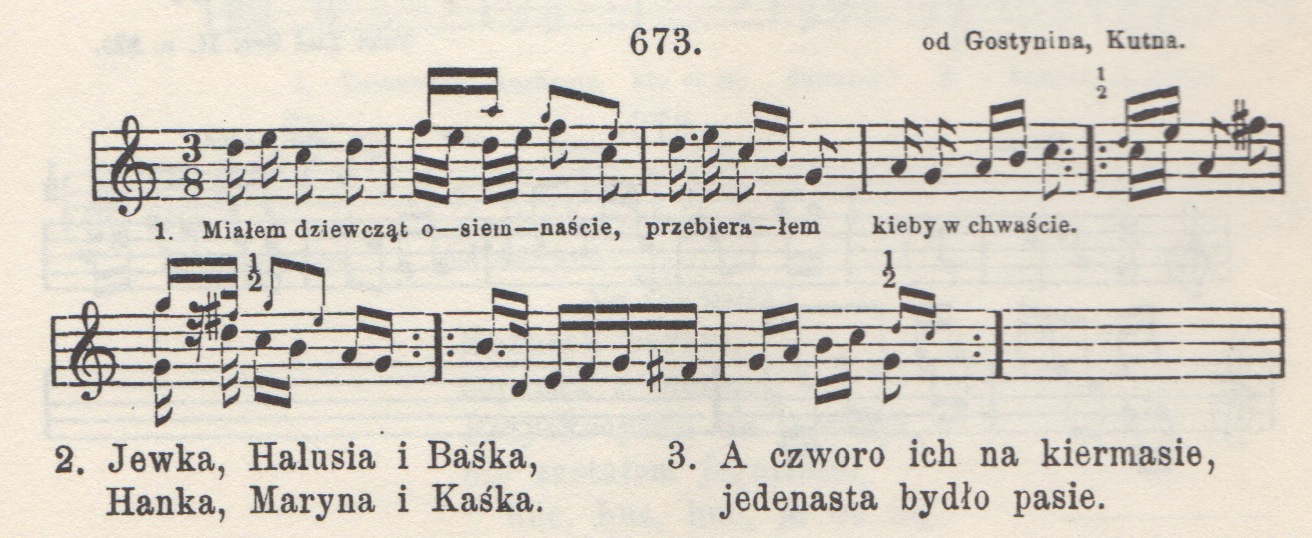
4.  Thomas: Kolberg, Mazowsze, vol.2, no.673 (p.241) – concluding 2 bars:

WL KO:Kolberg 673

5.  Thomas: Kolberg, Mazowsze, vol.2, no.452 (p.189) – second beat of b.3 to (sharpened) start of b.5:

WL KO:Kolberg 452

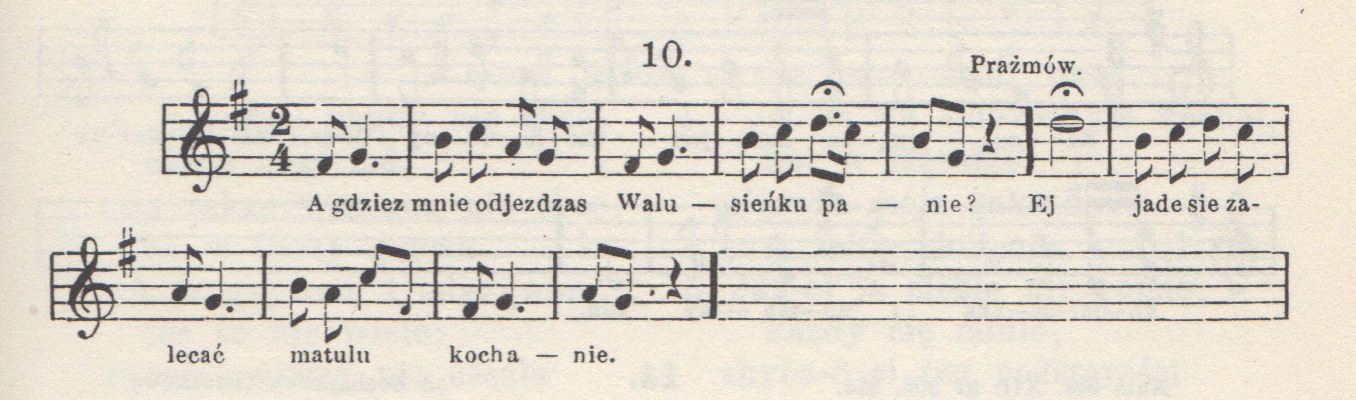
6.  Lissa (p.242): Kolberg, Mazowsze, vol.2, no.10 (p.5) – complete (the only tune to be used in more than one movement):

WL KO:Kolberg 10

7.  Lissa (p.245): Kolberg, Mazowsze, vol.5, no.333 (p.299) – first phrase:

WL KO:Kolberg 333

8.  Lissa (p.241): Kolberg, Mazowsze, vol.2, no.131 (p.54) – elaborated:

WL KO:Kolberg 131

9.  Lissa (p.245): Kolberg, Mazowsze, vol.2, no.43 (p.17):

WL KO:Kolberg 43

10.  Thomas: Kolberg, Mazowsze, vol.2, no.22 (p.9):

WL KO:Kolberg 22

11.  Lissa (p.245): Kolberg, Mazowsze, vol.2, no.103 (p.42):

WL KO:Kolberg 103

• WL100/69: Livre, **18 November 1968

The now-neglected jewel in the crown of Lutosławski’s orchestral music was premiered on this day in 1968, by the Hagen City Orchestra, conducted by Berthold Lehmann, to whom it is dedicated.  Had Lutosławski had his way (as Nicholas Reyland has revealed), he would have changed the title from Livre pour orchestre to Symphony no.3, which undoubtedly would have placed it quite differently within his oeuvre and raised its external profile, especially today. But Lutosławski’s change of heart came too late – the publicity was already out in Hagen.

The performance and recording history of Livre is odd.  Speak to anyone who knew Lutosławski’s music during his lifetime and they are more than likely to place Livre in the top five of his orchestral pieces, if not at the pinnacle.  Yet, there have been only seven commercial recordings to date (another – the first for over 15 years – is due shortly in the Opera Omnia series from the Wrocław Philharmonic).  This compares unfavourably with the 18 accorded his next piece, the Cello Concerto.  Bizarrely, the otherwise superlative Chandos series by the BBCSO under Edward Gardner ignored Livre, which is a shame, not least because Lutosławski performed it with the BBC SO on three occasions (1975, 1982, 1983 – BBC Proms).  Lutosławski conducted Livre at least four more times in the UK (not including programme repeats), with the Philharmonia Orchestra (1981, 1989), with the Royal Academy of Music SO (1984) and with the Hallé Orchestra (1986).

This centenary year, Livre has continued to languish in the shadows when compared to the number of performances of his other major orchestral works.  His publisher, Chester Music, itemises just two performances, which is nothing short of scandalous: 30 January, Warsaw PO/Michał Dworzyński, and 17 November (yesterday), Duisberger Philharmoniker/Rüdiger Bohn.  Mind you, Chester’s list of recordings is incomplete, listing just three.  Here is the full list (giving the original record label), as far as I can ascertain.  Only the recordings by Lutosławski, Herbig and Wit seem to be available currently on digital formats.

• National PO, Warsaw/Jan Krenz (Polskie Nagrania, 1969)
• National PO, Warsaw/Witold Rowicki (Polskie Nagrania, 1976)
• WOSPR (now NOSPR)/Witold Lutosławski (EMI, 1978)
• Berlin PO/Günter Herbig (Eterna, 1979)
• Eastman Philharmonia/David Effron (Mercury, 1981)
• WOSPR (now NOSPR)/Jan Krenz (Adès, 1988)
• PRNSO/Antoni Wit (Naxos, 1998)

…….

1454688_661788100528035_2044002059_nHere is an audio recording of Livre, digitised by my friend Justin Geplaveid (who also provided the performance details), from a concert given on 16 August 1972 in Munich as part of the Olympic Games or on the following day in Augsburg.  The players were the UNESCO Jeunesses Musicales World Orchestra, and included among the violins was one Ervine Arditty [sic]….

1452253_661788107194701_1578121087_nThe original LP recording, conducted by Witold Rowicki, has some interesting orchestral balances.

…….

By far the most satisfactory YouTube offering is a video of Herbig conducting the Spanish Radio and Television Orchestra in Madrid on 11 November 2011.  It is available on Justin Geplaveid’s YouTube site (and one other: http://www.youtube.com/watch?v=ZfeDBNyZLPU).  Geplaveid’s stream also has some fascinating archival videos from the ‘Warsaw Autumn’.

…….

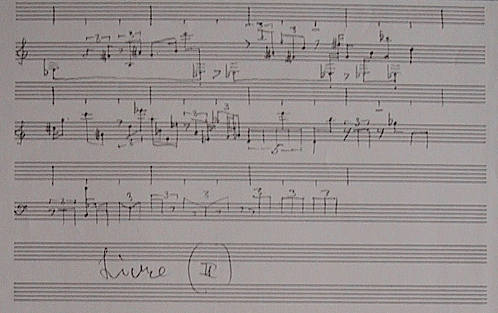
Screen Shot 2013-10-22 at 08.47.06A few weeks ago, I put up some isolated sketch pages for Mi-parti that I’d come across in Lutosławski’s house in 2002.  From that same folder “ŚCIĄGACZKI” (Crib Sheets), here are four more sketches that had not been sent on to the Lutosławski archive at the Paul Sacher Stiftung in Basle.  I hope that they are there now!  I have not looked at the Livre sketches in the Stiftung, so cannot say how these four abandoned sheets relate to the greater mass of material in Basle.

These four sheets relate to the first two chapitres.  The first three relate to the second chapitre, starting at fig. 207.

Screen Shot 2013-11-17 at 15.23.03

The top one presents a rhythmic ‘crib’ for the eleven bars from fig.207 to fig.209 (it’s enlarged below).  The notes beamed underneath present the rhythmic pattern of the piano (bb.1-4) and brass entries (bb.5-6, trumpets and trombones).  The notes with upward stems have a more complicated relationship to the score and do not always correlate to Lutosławski’s final thoughts.  On the first system below (equivalent to the six bars of fig.207), the upper stems concern the outline rhythm in the strings (no glissandi or sustained durational values are indicated).  There are discrepancies in a few places, especially in bb.3-6, where some of the triplet quavers and semiquaver entries diverge from the score.  On the lower system (the five bars of fig.208), the lower rhythm reverts to the piano while the upper notes pick out the brass entries (horns and trombones).

Screen Shot 2013-11-17 at 15.21.20

The middle sketch (they weren’t photographed in any thought-out order back in 2002!) relates to this same passage. It is a pitch reduction for the instrumental ensemble, but there are minor rhythmic variations for some of the entries and missing pitches (cf. b.6 in particular).  Bars 7-11 (the five bars of fig.208) give the rhythmic pattern for the piano, as in the example above, plus the four pinpointing rhythms and pitches on the trombones.

Screen Shot 2013-11-17 at 15.20.41

The lowest of these three sketches relates just to the six bars of fig.207.  It is a pitch and rhythmic reduction of all the instruments involved – piano, strings trumpets and trombones.

Screen Shot 2013-11-17 at 15.22.02

The last of the four sheets presents more of a conundrum.

Screen Shot 2013-11-17 at 16.08.20

Evidently, the bottom two systems are a skeletal version of the top two, but initially I could not relate these ten bars to any part of the first chapitre.  Where were these ascending semiquavers, these descending quavers?  In the end, it was the pause sign in bar 10 that gave me clue.  In the score, there are only two pause signs in the first chapitre: in b.2 and in the bar before fig.109.  The ten bars of this sketch match the ten bars immediately before fig.109, from the third bar of fig.108.  It is the passage for brass (trumpets, horns and trombones) that leads to the clatter of tom-toms, xylophone and gran cassa that initiates the ‘codetta’ of the first chapitre.  

The phrasal cadences are very similar, identical in some places (notably in the last six bars).  The direction of movement also matches.  The differences with the score suggest that the sketch is an early rhythmic attempt at this passage.  What may be Lutosławski’s shorthand here (but even for him such a shorthand is stretching the point) equates the upper stave in each pair to the phrases for trumpets and horns I & II.  The lower stave refers to the descending phrases for horns III & IV and the trombones.  But whereas this sketch has clearly defined and short-lived rhythmic movement in both staves, the fully metred section of the score stretches out the lines heterophonically, with the trombones adding glissandi between notes for good measure.  As a result, there is no pause between phrases as the two ensembles overlap, creating a more fluid texture.  I must admit to being a little mystified by the long horizontal lines between the two staves, so if anyone has an idea of their significance please say so.