• New Article (Lutosławski’s Parallel Lives)

I’ve just posted a new article – ‘Parallel Lives of a Captive Muse’ – which has been published at www.woven-words.co.uk as part of the Philharmonia Orchestra’s celebration of the centenary of Lutosławski’s birth next year.

• Lutosławski Centenary 2013: Philharmonia

We are still over two months from the actual centenary of the birth of Witold Lutosławski (25 January 2013), but things are already hotting up.  I, for one, am busy preparing copy for Belgium, Germany and the UK, and this morning I’m doing a telephone interview for the in-house magazine of the Witold Lutosławski PO in Wrocław.

But by far the most intensive preparations outside Poland – so far – have been taking place in London for the Philharmonia Orchestra’s three-concert series at the South Bank Centre in January and March next year.  The soloists are Krystian Zimerman, Truls Mørk, Jennifer Koh and Matthias Goerne.  There are also three associated chamber recitals and one orchestral concert performed by students from the Royal College of Music.  Most of the concerts place Lutosławski’s music alongside repertoire by other composers: Chopin, Szymanowski, Roussel, Ligeti and (principally) Ravel and Debussy.

And that’s not all: the Philharmonia is taking parts of its Lutosławski programme – called ‘Woven Words’ after his piece Paroles tissées (1965) – to nine other cities between February and September 2013: Tokyo, Warsaw, Modena, Oviedo, Madrid, Dresden, Vienna, Ljubljana and Berlin.  Full details of the programme and schedule may be found at http://woven-words.co.uk, but here’s a list of the pieces by Lutosławski that are being performed in London by the Philharmonia and the Royal College of Music.

Philharmonia  30 January: Musique funèbre and Piano Concerto.  7 March: Cello Concerto and Concerto for Orchestra.  21 March: Symphony no.4, Les Espaces du sommeil and Chain 2.
RCM  4 February: String Quartet.  6 February: Jeux vénitiens and Symphony no.3.  27 February: Two Studies and Bucolics.  6 March: Mini Overture, Fanfare for CUBE, Epitaph, Subito, Grave and Dance Preludes.

The Philharmonia doesn’t do things by halves.  There was a press launch in  London in late October (unfortunately while I was in Warsaw), fronted by the two men whose idea this celebration has been: the conductor Esa-Pekka Salonen, who knew Lutosławski well and has long championed his music,  and the composer Steven Stucky, the author of the eloquent Lutosławski and His Music (1981).  The Philharmonia’s website http://woven-words.co.uk is a substantial achievement in itself, with a gallery of archival photographs assembled, special films made and essays written for the occasion.

Films

Salonen and Stucky travelled to Poland in the summer of 2012.  The results may be seen in five contextually stimulating films in which they chart Lutosławski’s life and work, with archive stills and footage as well as a wealth of location shots (I liked the appearance of Blikle’s famous café in ‘World War II’!).  Some of Lutosławski’s rarely seen manuscripts are discussed (especially in ‘Stalinist Years’) and there are excerpts from the music (the main footage being of the Concerto for Orchestra).  Archive footage of the composer is also incorporated.  The widow of Władysław Szpilman (The Pianist) appears in the third film, while  Charles Bodman Rae (first two films) and Zbigniew Skowron (fourth film) also make telling contributions.

• Early Life
• World War II
• Stalinist Years
• Maturity
• In Conversation

Essays

The Philharmonia has commissioned five essays, which I understand will also appear in the programme book for the series (Steven Stucky’s insightful notes for the orchestral programmes are also presented in advance on the website).

Steven Stucky, ‘Remembering Lutosławski’
Charles Bodman Rae, ‘Lutosławski and the Scars of Wars’
Adrian Thomas, ‘Lutosławski- Parallel Lives of a Captive Muse’
Nicholas Reyland, ‘Essences and Essentials: Lutosławski’s Musical Stories’
Zbigniew Skowron, ‘Lutosławski’s Aesthetics and Their Sources’

My own essay is also available on this site here.

• Grave matters

I’m catching up on Polish arrears, having dallied since my visit to Warsaw last month by staying in London to see Covent Garden’s Ring cycle (frankly, I might just as well have listened to it on the radio, so inept and wilfully contrary was the set design and production; the final half hour in particular was a total travesty).  And then I succumbed to a week of ‘underweatherness’ here in Cornwall, and that has meant a backlog of deadlines.

Today – 12 November 2012 – is the second anniversary of the death of Henryk Mikołaj Górecki.  Two nights ago, Polish Television broadcast a new documentary about him (Please Find, directed by Violetta Rotter-Kozera), with contributors from Europe and America, including myself.  I should have been in Katowice last Friday to see a private screening with the family, but circumstances got in the way.  I’m looking forward to seeing it in due course.

This morning, BBC Radio 3 broadcast the second movement of his Third Symphony, choosing not Dawn Upshaw’s breakthrough recording (now 20 years old), but the first ever recording, by Stefania Woytowicz with the Polish Radio Symphony Orchestra, conducted by Jerzy Katlewicz.  Upshaw and Woytowicz are two quite different singers, and I admire them both, but for me that first recording captures the excitement and extraordinary atmosphere of the late 1970s and the powerful shock that the symphony made on me and on others who were lucky enough to come across it at the time.  It was this recording, for example, that captivated the conductor David Atherton, who played a huge role in promoting it during the 1980s.

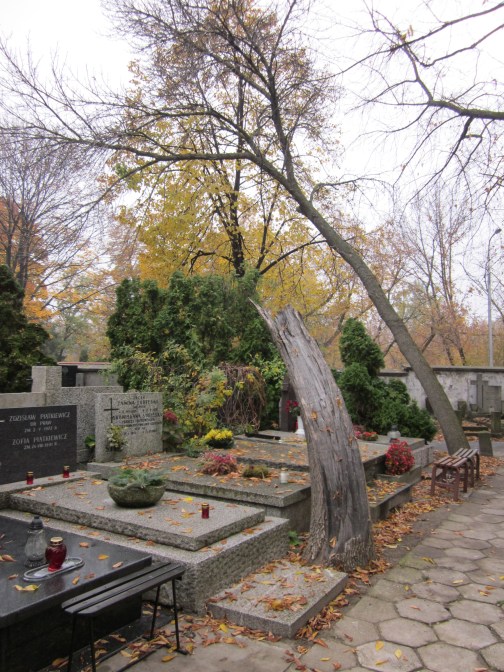
This is all a bit by-the-by.  I had intended to visit Henryk’s grave on my visit to Katowice.  Niestety, nie zdążyłem.  I did, however, manage to visit Powązki Cemetery in Warsaw last month, mainly to pay homage to particular people, but also to sample again its special atmosphere.

…….

Finding it as it was.

…….

My first main port of call was the grave of my friend, the Polish musicologist and critic, Andrzej Chłopecki, who had died a month earlier.

…….

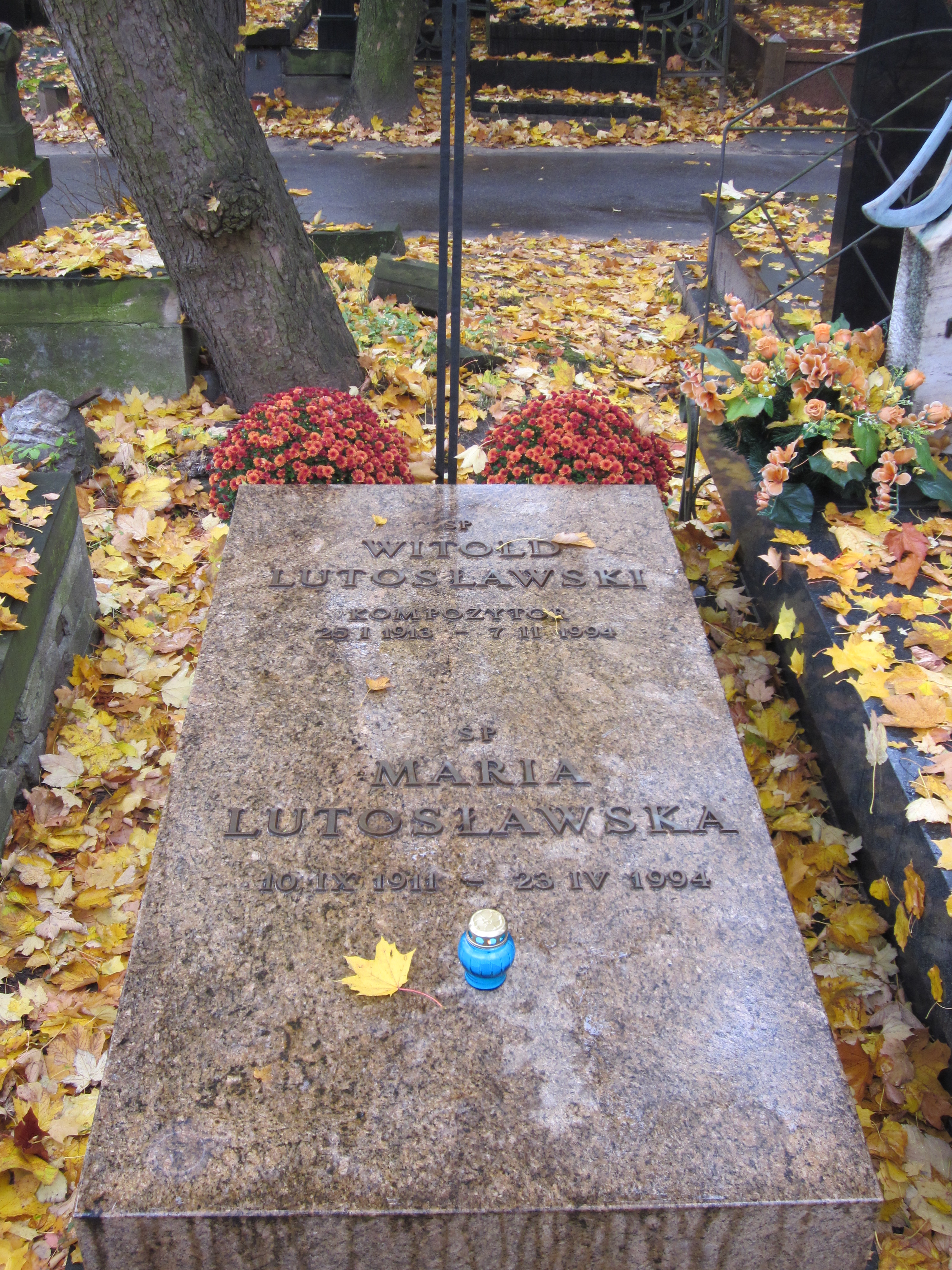
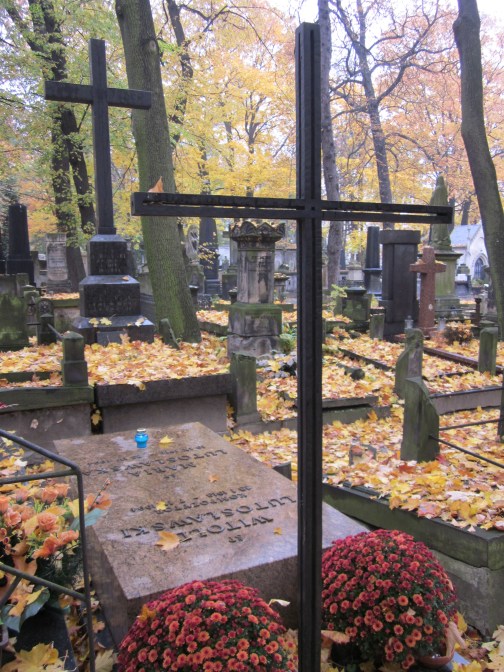
Some distance away, not far from the cemetery chapel, lie a number of composers and conductors who shaped Polish music in the second half of the twentieth century.  First and foremost, there’s the grave of Witold Lutosławski and his wife.

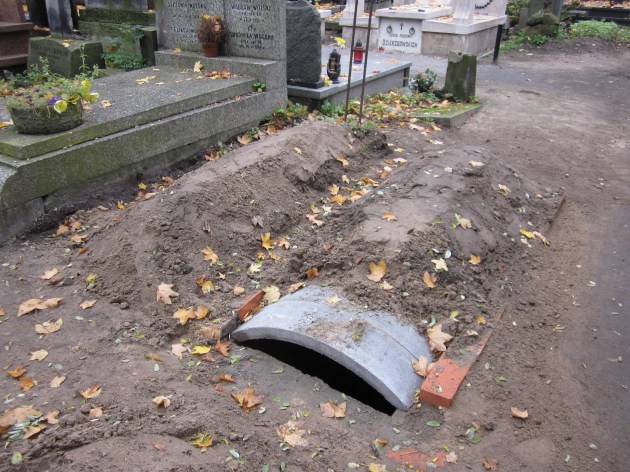
Here’s the grave from the rear.  I was present at his funeral and watched from this vantage point as his stepson climbed into the grave to place his urn on the floor of the chamber.  It now has a classically restrained gravestone and had evidently been attended to recently.
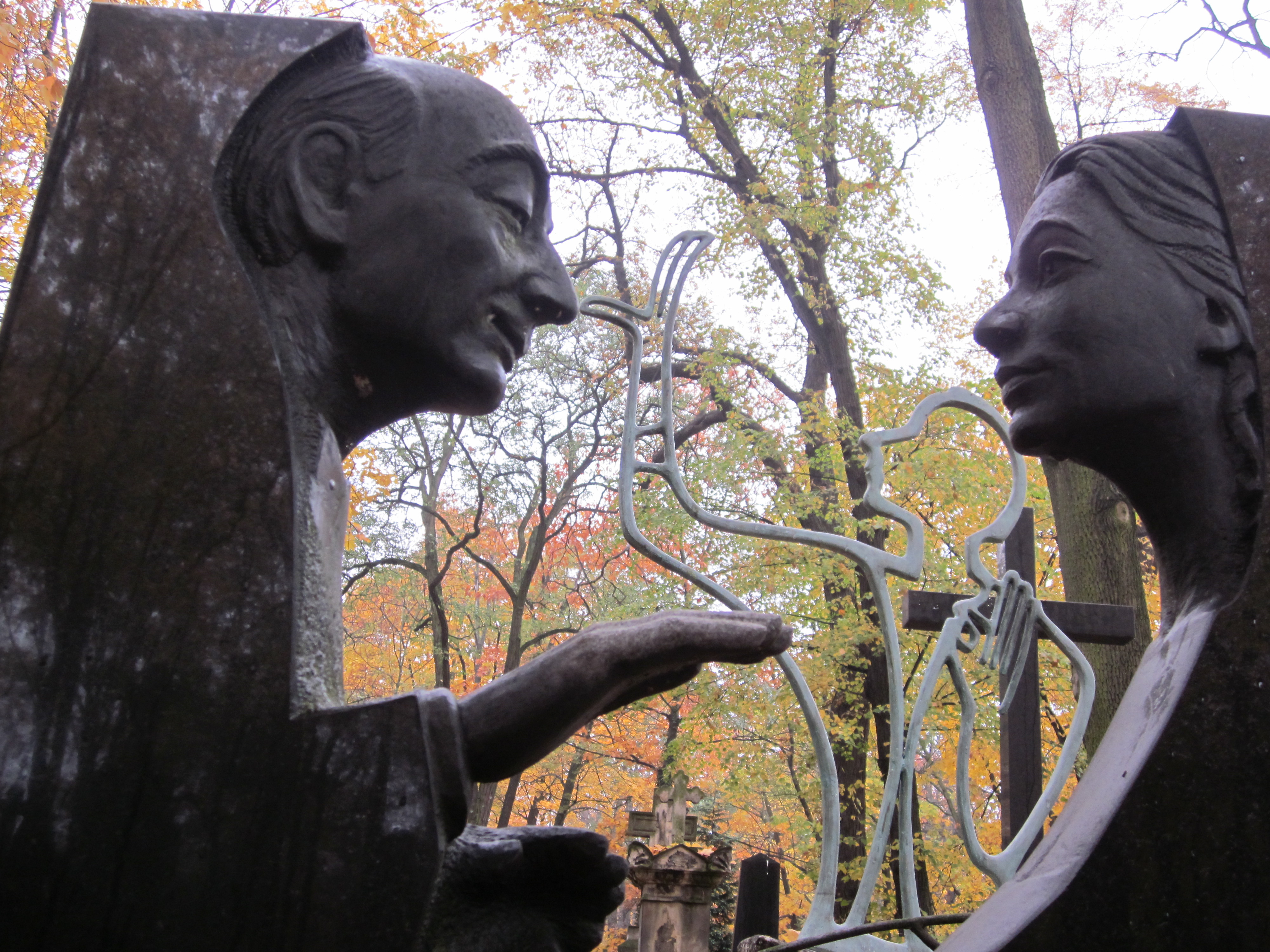
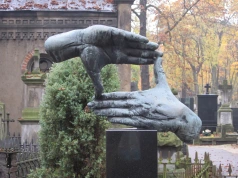
Next door lies that great champion of Polish music, the conductor Witold Rowicki. His grave is more demonstrative!

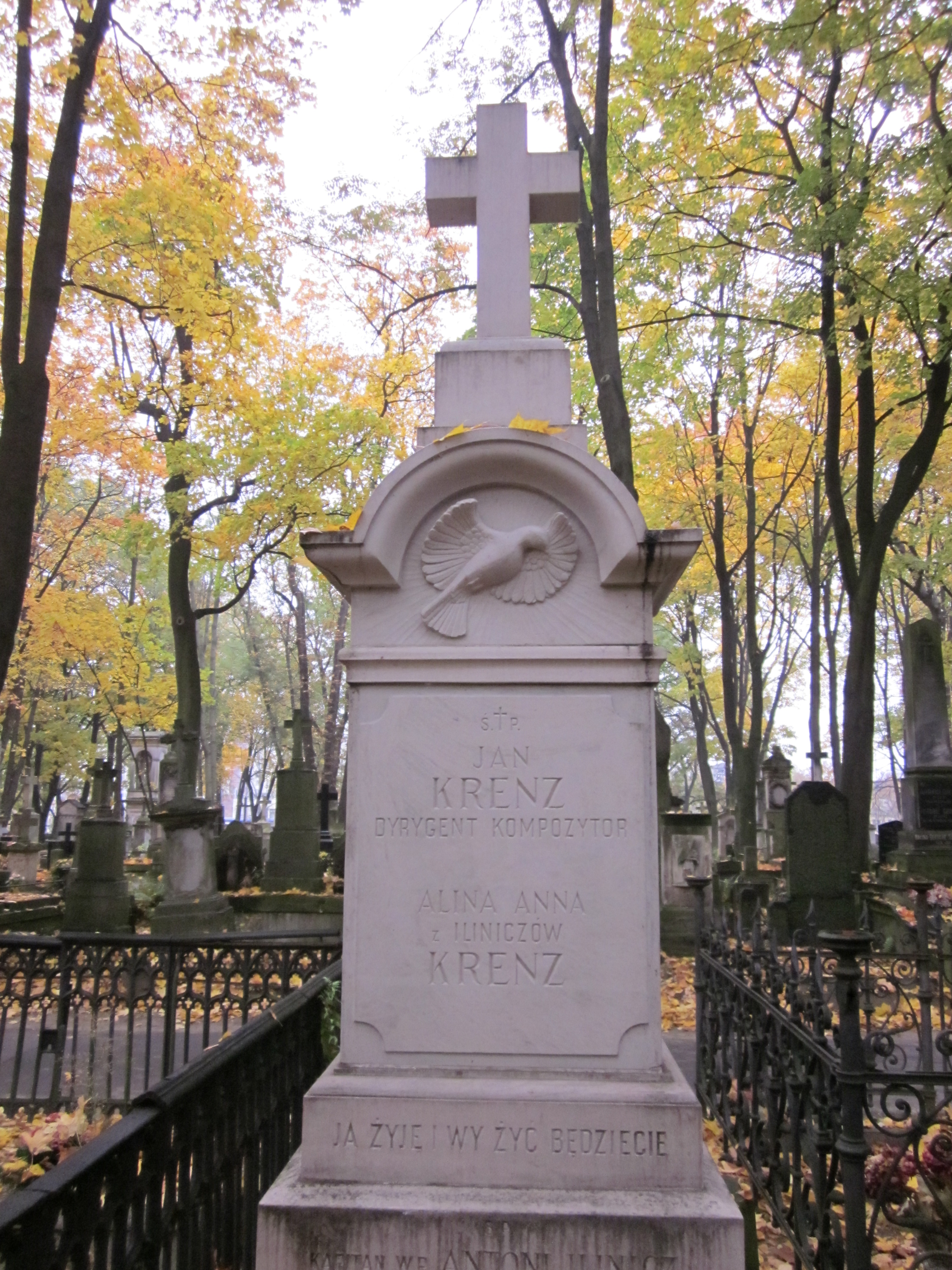
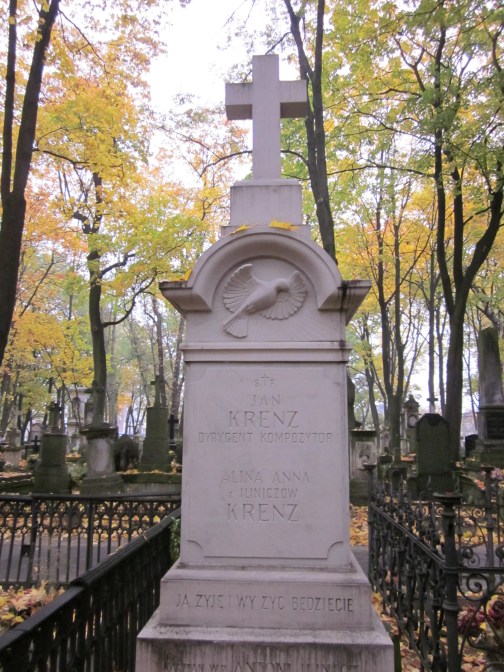
A little further to the right of Rowicki’s grave is one set aside for Jan Krenz, a champion of contemporary Polish music.  It seems strange to me (but it’s not unusual there) that such monuments are erected before death.
Behind Rowicki’s grave is that of Stefan Rachoń – a far less well-known conductor, at least outside Poland –  and his widow, the opera singer Barbara Nieman.

On the other side of the main path from these graves are several more.  Notable among them are those of Kazimierz Serocki and Tadeusz Baird, whose music deserves to be far more widely known and appreciated.  Baird, Krenz and Serocki formed ‘Grupa ’49’ as the youngest generation of composers during post-war socialist realism.

…….

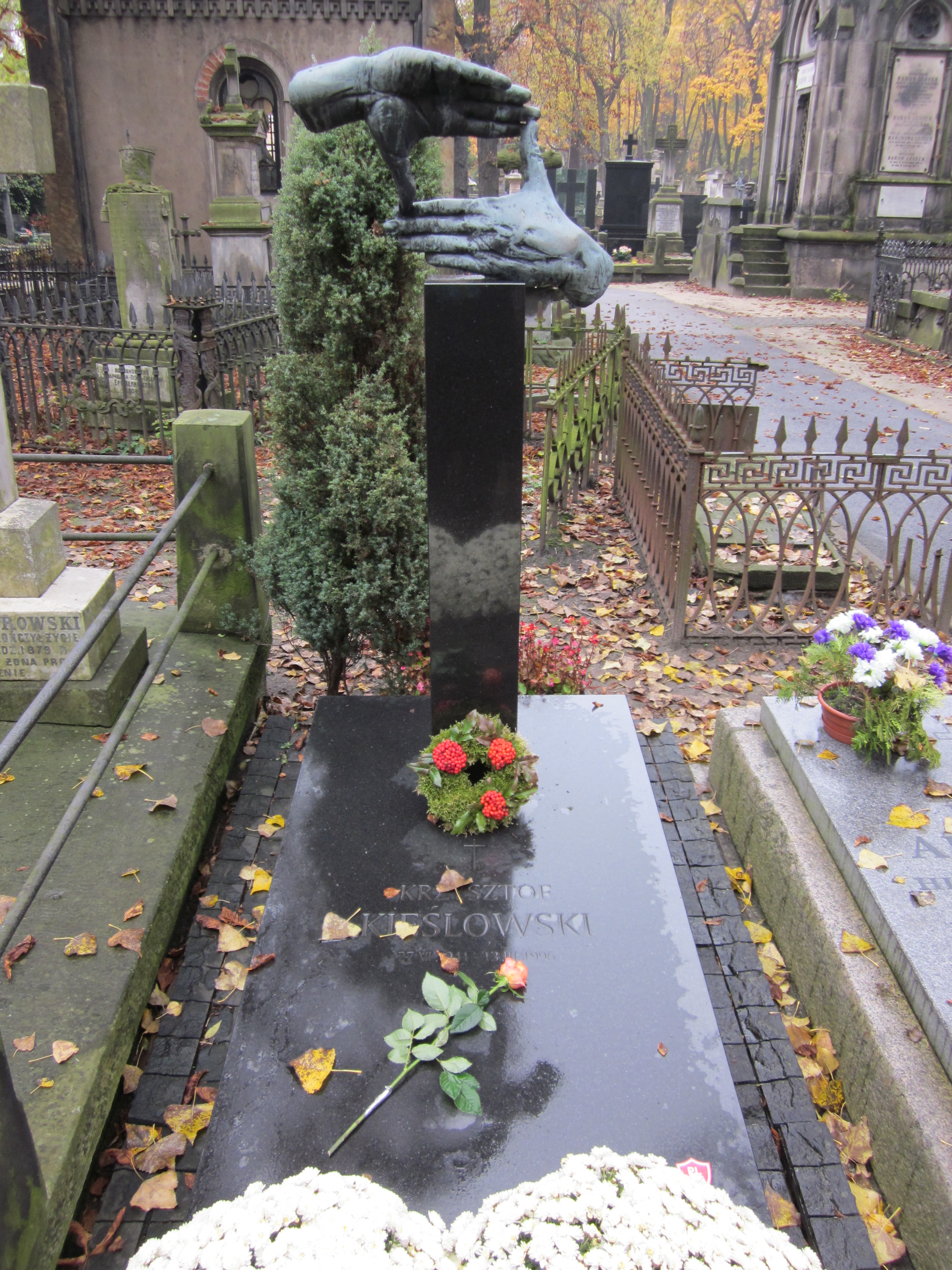
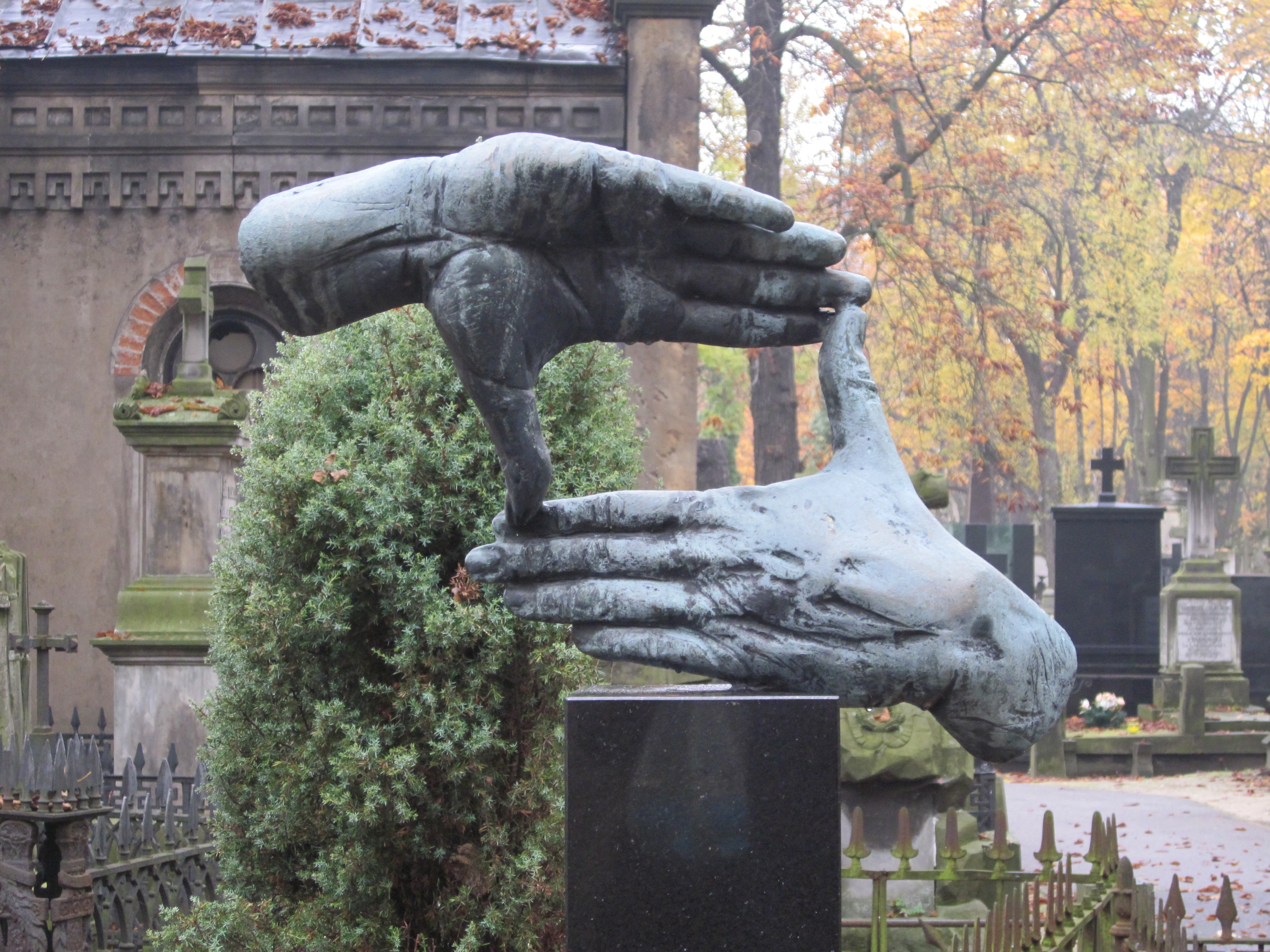
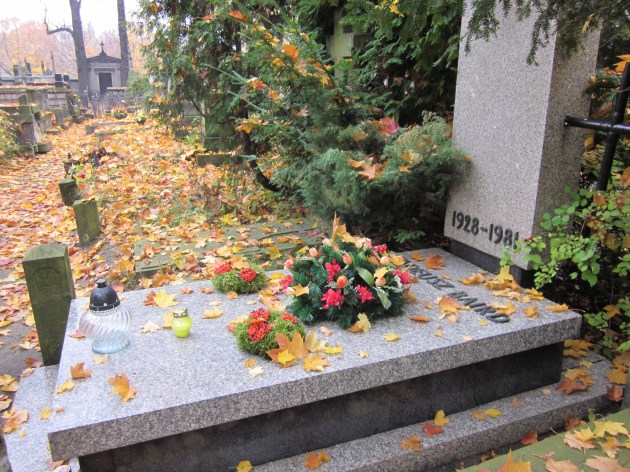
One of the most striking graves is that of the film-maker, Krzysztof Kieślowski.  If only I had his eye for framing.

• New CD Note (Lutosławski vol.4/Chandos)

It’s been ten months since the release of the third volume of Edward Gardner’s Lutosławski series with the BBC Symphony Orchestra.  Now volume four has appeared, and it’s a cracker (for the first time in the series, the cover illustration comes from outside Warsaw – it’s Wrocław).  The preceding CDs were:

Orchestral Works: Concerto for Orchestra, Symphony 3, Chain 3
Vocal Works: Lacrimosa, Silesian Triptych, Sleep, sleep, Paroles tissées, Les Espaces du sommeil, Chantefleurs et Chantefables
Orchestral Works II: Symphonic Variations, Paganini Variations, Piano Concerto, Symphony 4

Lutosławski: Orchestral Works III opens with Little Suite (1950), a work whose spirited nature masks the subtlety of its language when most other Polish composers were buckling under the weight of socialist-realist expectations.  A decade and a half later, Lutosławski was wrestling with large-scale form in his Second Symphony (1965-67), which is given an exceptionally persuasive reading here.  The soloist on this CD is Paul Watkins, who not only plays the Cello Concerto (1970) – which must have easily surpassed any other concerto written since then in its number of CD recordings – but also Lutosławski’s orchestration of Grave for cello and piano (1981/82).

Here’s the link to my booklet note for Lutosławski: Orchestral Works III, or you can scroll the CD NOTES tab above.

• Prix Europa for ‘Warsaw Variations’

Huge congratulations to Alan Hall of Fallingtree Productions on winning ‘Best European Radio Music Programme’ last week at the 2012 Prix Europa in Berlin. The award was given for his half-hour programme ‘Warsaw Variations’, first broadcast on BBC Radio 4 on 20 December 2011.

‘Warsaw Variations’ charts the musical friendship of Witold Lutosławski and Andrzej Panufnik during and after World War II.  Among its interviewees are Camilla Panufnik, my former PhD student Beata Bolesławska and myself. Alan was one of my colleagues at Radio 3 in the early 1990s.  He later went independent and is one of the most inventive and insightful producers around.  It was an absolute delight to work with him again.

You can hear the programme via the Fallingtree website:
• http://fallingtree.co.uk/listen/warsaw_variations

A few other links:
• http://www.thenews.pl/1/11/Artykul/116810,BBC-radio-feature-on-Polish-music-wins-Prix-Europa-
http://www.fallingtree.co.uk/news/2012/triple_awards_success_at_the_prix_europa!
• https://www.facebook.com/fallingtreeproductions

• BBC Scottish SO’s ‘Muzyka Polska’

Later this week I’m paying a flying visit to Glasgow to give a pre-concert talk as part of the first night of the BBC Scottish SO’s Muzyka Polska series during its 2012-13 season.  This has been built around next year’s centenary of the birth of Witold Lutosławski and I’m very happy to have been able to play a small part in advising on the choice of repertoire.  With its concentration on Lutosławski and on Szymanowski, the 75th anniversary of whose death falls this year, there was limited room for other major figures (no Baird, Górecki or Serocki, for example).  I’m particularly delighted to see Mieczysław Karłowicz’s Eternal Songs (1906) in the mix and pleased to see that there is music by at least one composer born after World War II, Paweł Szymański’s A Study of Shade (1989).  The ‘big’ night is on 17 January 2013, when six Polish works will be performed.

• Chopin  Piano Concerto no.2 (1829-30)   14 March 2013
• Chopin  Piano Concerto no.1 (1830)   11 October 2012
• Szymanowski  Concert Overture (1905)   11 October 2012
• Karłowicz  Eternal Songs (1906)   15 November 2012
• Szymanowski  Songs of a Fairytale Princess (1915, orch. 1933)   17 January 2013
• Szymanowski  Violin Concerto no.1 (1916)   15 November 2012
• Szymanowski  Songs of an Infatuated Muezzin (1918, orch. 1934)   17 January 2013
• Bacewicz  Concerto for String Orchestra (1948)   25 October 2012
• Lutosławski  Concerto for Orchestra (1954)   17 January 2013
• Penderecki  Polymorphia (1961)   17 January 2013 (Post-Concert Coda)
• Lutosławski  Cello Concerto (1970)   28 February 2013
• Szymański  A Study of Shade (1989)   17 January 2013 (Post-Concert Coda)
• Lutosławski  Symphony no.4 (1992)   17 January 2013

There are two supplementary chamber recitals as Post-Concert Codas: Johannes Moser will play Polish music for cello on 28 February after his performance of Lutosławski’s Cello Concerto, and Garrick Ohlsson will play solo piano pieces by Chopin on 14 March after his performance of Chopin’s Second Piano Concerto.  Ohlsson rocketed to fame after winning the Chopin Competition in Warsaw in 1970.  Moser is becoming one of the foremost performers of the Lutosławski.  His Glasgow appearance follows on from a performance in Poole in January with the Bournemouth SO (which premiered the work with Rostropovich in 1970), three performances in Stuttgart the week before he comes to Glasgow, and he then plays it twice in Bilbao in April.

The full schedule for the BBC SSO Muzyka Polska series may be accessed here or by navigating from its home website.

• Proof-reading bloopers (BBC Music Mag)

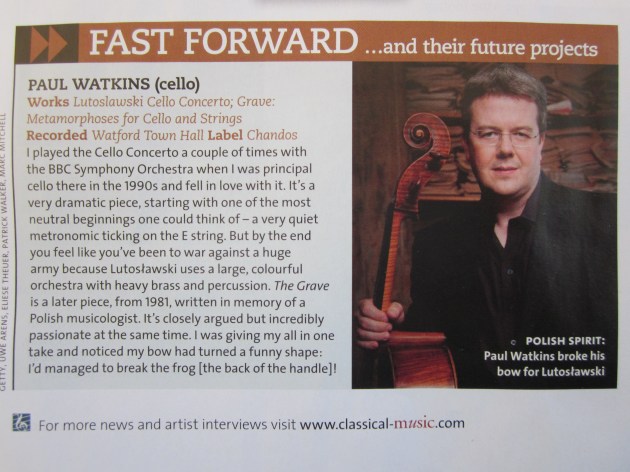
Where’s a musically literate editor when you need one?  Here’s a panel from the September issue of the BBC Music Magazine, where Paul Watkins is interviewed in advance of the release of his recording with the BBC SO under Edward Gardner of Lutosławski’s Cello Concerto and Grave (Chandos CHSA 5106).  I spotted the glaring transcription error (line 6), but my friend John Fallas spotted the funnier typographical one (line 9).  Depressingly sloppy copy.

IMG_0686 copy

• 5 Archival Polish Music Videos

Five videos of Polish music have newly been made available online.  They date from 1968-75 and are all of performances at the Philharmonic Hall in Warsaw during the annual ‘Warsaw Autumn’ festival.  There are two pieces by Lutosławski and one each by Baird, Penderecki and Serocki.  Not only can we now witness Peter Pears, Wanda Wiłkomirska and Karl-Erik Welin in action but we can also experience Lutosławski conducting his own music as well as appreciate that inspirational and tireless champion of new music, Andrzej Markowski (1924-86).  Many Polish composers owed him a huge debt of gratitude, including Baird, Penderecki and Serocki.

In chronological order of recording, these five videos are:

• Krzysztof Penderecki: Capriccio for violin and orchestra (1967).  Wanda Wiłkomirska, National Philharmonic, cond. Andrzej Markowski, 21 September 1968 (opening concert).
http://www.youtube.com/watch?v=jLYY6Knc77w
• Kazimierz Serocki: Fantasia elegiaca for organ and orchestra (1972).  Karl-Erik Welin, Sinfonie-Orchester des Hessischen Rundfunks, Frankfurt, cond. Andrzej Markowski, 28 September 1973 (Polish premiere).
Very little of Serocki’s music post-1956 is available in audio formats, let alone video, so this upload is welcome.
http://www.youtube.com/watch?v=g4NuCcpakbU
• Witold Lutosławski: Preludes and Fugue for thirteen solo strings(1972).  Chamber Ensemble of the National Philharmonic, cond. Lutosławski, 30 September 1973 (Polish premiere).
A minor frustration here: this was the first half of the concert which closed the 1973 festival.  In the second half, Lutosławski conducted Heinrich Schiff in the much-postponed Polish premiere of the Cello Concerto.  How I would love to see a video of that!
http://www.youtube.com/watch?v=Vo1pdDEeLaM
• Tadeusz Baird: Elegeia (1973).  National Philharmonic, cond. Andrzej Markowski, 21 September 1974 (opening concert).
http://www.youtube.com/watch?v=PPKxpv8gBZs
• Witold Lutosławski: Paroles tissées (1965).  Peter Pears, Chamber Ensemble of the National Philharmonic, cond. Lutosławski, 25 September 1975.
Peter Pears had been the dedicatee and first performer of this song cycle at the Aldeburgh Festival ten years earlier, on 20 June 1965This was not its Polish premiere, but it was the only time that Pears sang it there.
http://www.youtube.com/watch?v=czUDDNjwo_Q

• More Szymanowski from Doctor Hughes

In the three months since I last posted links to William Hughes’s invaluable English translations of Polish articles on Szymanowski (The Chronicles of Dr Hughes), he has posted 36 more, making 63 to date, with more to come.  I am in awe of his industry and generosity as well as his insights in those postings where he provides commentaries or explications.

I’m adding here the two previous tranches of links posted on 28 March (14 items) and 13 May 2012 (13 items).    The 36 new pieces focus in the main around the reaction within Poland to the death of Szymanowski in March 1937.  But William Hughes has also selected further writings, by Mycielski and Iwaszkiewicz, which are more revealing of the music itself, of Szymanowski’s character, his writings or his faith.  Hughes is also not afraid in these translations to reveal (where others have glossed over) Szymanowski’s occasional anti-Jewish jibes or vulgarity.

You can find The Chronicles of Doctor Hughes at http://drwilliamhughes.blogspot.co.uk/.

• 13.08.12  Witold Hulewicz, ‘Bibliographic Sketch’Muzyka Polska no.4 (1937)
• 13.08.12  Witold Hulewicz, ‘On Karol Szymanowski’s Literary Activity’Muzyka Polska no.4 (1937)
• 9.08.12  Zbigniew Drzewiecki, ‘Szymanowski’s Testament’Muzyka Polska no.4 (1937)
• 7.08.12  Kazimierz Sikorski, ‘Address’ [at Szymanowski’s funeral]Muzyka Polska no.4 (1937)
• 4.08.12  Prof. Ujejski, ‘Address’ [at Szymanowski’s funeral]Muzyka Polska no.4 (1937)
• 31.07.12  Adolf Chybiński, ‘Karol Szymanowski (1883[sic]-1937)’Muzyka Polska no.4 (1937)
• 27.07.12  Stefania Szurlejówna, ‘The Funeral of Karol Szymanowski in KrakówProsto z mostu no.18 (1937)
• 24.07.12  Zygmunt Mycielski on Szymanowski’s Symphonie Concertante, pt.2Ucieczki z pięciolinii (1952)
• 21.07.12  Zygmunt Mycielski on Szymanowski’s Symphonie Concertante, pt.1Ucieczki z pięciolinii (1952)
• 17.07.12  Zygmunt Mycielski, ‘Nine Years Ago’Ucieczki z pięciolinii (1946)
• 14.07.12  ‘From Letters and Remembrances of Szymanowski’, pt.3Prosto z mostu no.17 (1937)
• 12.07.12  ‘From Letters and Remembrances of Szymanowski’, pt.2Prosto z mostu no.17 (1937)
• 10.07.12  ‘From Letters and Remembrances of Szymanowski’, pt.1Prosto z mostu no.17 (1937)
• 6.07.12  Stanisław Piasecki, ‘Szymanowski’s Final Moments’Prosto z mostu no.17 (1937)
• 4.07.12  Stefania Szurlejówna, ‘The Funeral of Karol Szymanowski [in Warsaw], pt.3Prosto z mostu no.17 (1937)
• 2.07.12  Stefania Szurlejówna, ‘The Funeral of Karol Szymanowski [in Warsaw], pt.2Prosto z mostu no.17 (1937)
• 1.07.12  Stefania Szurlejówna, ‘The Funeral of Karol Szymanowski [in Warsaw], pt.1Prosto z mostu no.17 (1937)
• 29.06.12  Jerzy Waldorff, ‘Szymanowski, the ‘Educator of a Generation’ ‘Prosto z mostu no.17 (1937)
• 27.06.12  Michał Kondracki, ‘A Memoir about Szymanowski’Prosto z mostu no.17 (1937)
• 25.06.12  Karol Szymanowski, ‘Religion as a Power Fortifying the Life of the Soul’ [poem ‘To Man’, plus commentary], undated
• 21.06.12  Stanisław Piasecki, ‘From Tymoszówka to the Skałka’Prosto z mostu no.17 (1937)
• 19.06.12  Zygmunt Piasecki, ‘Lecioły Zórazie’ [on the Kurpian Songs], Ucieczki z pięciolinii (1934)
• 17.06.12  Jerzy Andrzejewski, [untitled]Prosto z mostu no.17 (1937)
• 15.06.12  Konstanty Regamey, ‘Szymanowski’s Oeuvre’, pt.2Prosto z mostu no.17 (1937)
• 12.06.12  Konstanty Regamey, ‘Szymanowski’s Oeuvre’, pt.1Prosto z mostu no.17 (1937)
• 10.06.12  Karol Szymanowski, ‘A Man’s Individual Ethic’, [undated]
• 9.06.12  Bolesław Miciński, ‘Memory’Prosto z mostu no.17 (1937)
• 8.06.12  Roman Maciejewski, ‘Szymanowski’s Religiousness’Prosto z mostu no.17 (1937)
• 6.06.12  Zygmunt Mycielski, ‘Karol Szymanowski’Prosto z mostu no.17 (1937)
• 3.06.12  Zygmunt Mycielski, ‘What was Szymanowski Like?’, pt.2 (1972)
• 3.06.12  Zygmunt Mycielski, ‘What was Szymanowski Like?’, pt.1 (1972)
• 28.05.12  Jarosław Iwaszkiewicz, ‘Karol in Słupsk’ (1972)
• 26.05.12  Iwaszkiewicz, ‘About a Friendship’ [Dzieje przyjaźni – Szymanowski’s Correspondence], Życie Warszawy no.7 (1972)
• 24.05.12  Zygmunt Mycielski, ‘Szymanowski’s Letters’Notatki o muzyce i muzykach (1958)
• 21.05.12  Jarosław Iwaszkiewicz, ‘ ‘From the Letters’ of Karol Szymanowski’ (1957)
• 17.05.12  Jarosław Iwaszkiewicz, ‘Szymanowski as a Writer’ (1947)
…….

• 12.05.12  Jarosław Iwaszkiewicz, ‘Szymanowski’s ‘King Roger”Wiadomość Literackie no.26 (1926)
• 11.05.12  Jarosław Iwaszkiewicz, ‘Ahead of the premiere of King Roger’Wiadomość Literackie no.25 (1926)
• 10.05.12  Jarosław Iwaszkiewicz, ‘The History of ‘King Roger”Muzyka no.6 (1926)
• 8.05.12  Jarosław Iwaszkiewicz, ‘My composition lessons with Szymanowski’Muzyka Polska no.3 (1939)
• 5.05.12  Stanisława Korwin-Szymanowska, ‘The Last Days of Karol Szymanowski’, pt.3Muzyka Polska no.4 ( 1937)
• 1.05.12  Stanisława Korwin-Szymanowska, ‘The Last Days of Karol Szymanowski’, pt.2Muzyka Polska no.4 (1937)
• 26.04.12  Stanisława Korwin-Szymanowska, ‘The Last Days of Karol Szymanowski, pt.1Muzyka Polska no.4 (1937)
• 22.04.12  Zygmunt Mycielski, ‘Szymanowski’s Horizon’Nowiny Literackie no.3-4 (1947)
• 16.04.12  Zygmunt Mycielski, ‘Szymanowski – the Romantic?’Odrodzenie (1947)
• 11.04.12  Mycielski reminisces… Muzyka Polska no.4 (1937)
• 8.04.12  Zygmunt Mycielski, ‘Harnasie in Paris’Prosto z mostu no.19 (1936)
• 4.04.12  Leonia Gradstein, ‘Harnasie in Paris’, pt.2Ruch Muzyczny no.3 (1948)
• 1.04.12  Leonia Gradstein, ‘Harnasie in Paris’, pt.1Ruch Muzyczny no.3 (1948)
…….

• 28.03.12  Szymanowski’s Piano Concerto, pt.2 (1950)
• 28.03.12  In memoriam Karol Szymanowski (28/03/1937)
• 24.03.12  Szymanowski’s Piano Concerto, pt.1 (1950)
• 19.03.12  Tadeusz Baird, ‘Szymanowski’s music has always meant so much to me’ (1979)
• 17.03.12  Stefan Kisielewski, ‘Karol Szymanowski’s Final Journey’, pt.3 (1937)
• 15.03.12  Stefan Kisielewski, ‘Karol Szymanowski’s Final Journey’, pt.2 (1937)
• 10.03.12  Stefan Kisielewski, ‘Karol Szymanowski’s Final Journey’, pt.1 (1937)
• 4.03.12  ‘Stefania Łobaczewska, ‘The Myth of Karol Szymanowski’Muzyka no.4-5 (1937)
• 28.02.12  Paying Homage, pt.4: Roman MaciejewskiMuzyka no.4-5 (1937)
• 24.02.12  Paying Homage, pt.3: Zygmunt MycielskiMuzyka no.4-5 (1937)
• 22.02.12  Paying Homage, pt.2: Piotr Perkowski, Muzyka no.4-5 (1937)
• 21.02.12  Paying Homage, pt.1: Jan MaklakiewiczMuzyka no.4-5 (1937)
• 17.02.12  ‘The Breath of Greatness’: Lutosławski on SzymanowskiMuzyka Polska no.4 (1937)
• 13.02.12  Andrzej Dobrowolski analyses Szymanowski’s ‘Preludium and Fugue’Ruch Muzyczny no.20 (1948)

• Altstaedt plays Lutosławski

A couple of hours ago I heard an electrifying performance of Lutosławski’s Cello Concerto (1970) on BBC Radio 3.  It was by Nicolas Altstaedt, with the BBC Symphony Orchestra conducted by the Polish conductor Michał Dworzyński.  After digging around on the web for further information, I believe that this recording was made on 26 October 2010 in the BBC Maida Vale studios.  The dynamism as well as sensitivity of Altstaedt’s approach to this work is already in evidence on a three-part YouTube upload (see my post of 4 December 2011), but unfortunately the second and third parts are marred by dislocation between sound and vision.

Today’s performance was a couple of minutes longer than Altstaedt’s YouTube recording, but it lost nothing in its immediacy and intimate understanding of the composer’s dramatic concept.  Catch it if you can: it’s available for the next seven days only, via http://www.bbc.co.uk/programmes/b01blr2y#synopsis (click on Listen Now).  It begins two hours in.

I hope that there are plans for Altstaedt to record the Lutosławski commercially.  That really would be something to look forward to.