• On What Would Have Been His 78th Birthday

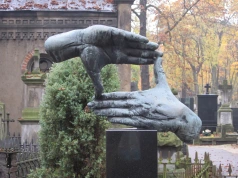
On what would have been Henryk Mikołaj Górecki’s 78th birthday, his daughter Anna has sent me a photograph of his newly installed gravestone (nagrobek).  One of the words which I have long used to describe his music is ‘granitic’, so I am fascinated by the sculptural use of this material above what looks like a smooth, dark-slate grave cover.  It conveys the character of the man and his creative outlook brilliantly: rugged, imposing and unconventional, yet warm-hearted, touching and touchable.

• A Last Amen for Górecki

I had not intended to post so much on Górecki over the past few days, but events and memories have rather taken over.  Not least of these are my recollections of the funeral, which took place in Katowice on this date last year.  I hope that my account below will give some sense of the occasion.
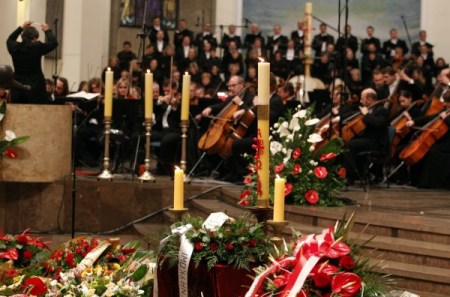
I caught an early train from Warsaw along with Polish friends and colleagues.  The cloud hung grey and dismal over the central lowlands.  Katowice looked the same as it had two weeks earlier, when I’d come to see Górecki for what turned out to be the last time.  Katowice, too, was grey and dismal, but then it often looks that way.  There was time for a reviving cup of tea and a sandwich, time for my friend to collect a bouquet, and time to buy the new edition of Tygodnik Powszechny, which had published my appreciation of Górecki along with those of others.  We walked to the Arch-Cathedral of Christ the King, whose huge dome sits squatly atop the cruciform building.  The dome should have been higher, but the post-war communist authorities did not want a Christian building dominating the area.  It was just as well that we arrived early, because the Cathedral was packed long before the scheduled start at 13.00.

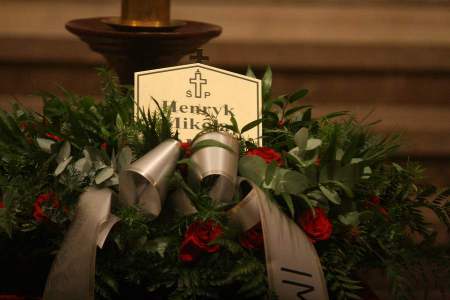
Górecki had been cremated the previous day, in a private ceremony.  I was told that the Roman Catholic church in Poland barely tolerates cremation and would not countenance a funeral service beforehand, which is customary here in the UK.  (I recollect that, in 1994, Lutosławski’s ashes were brought to the chapel in Powązki Cemetery in Warsaw for the funeral service.  He had been cremated in the (then) only crematorium in Poland, in Poznań in the centre of the country.)  Urns are always buried, as the scattering of ashes is illegal in Poland.  Most of the close relatives, including his daughter Anna and her family, arrived at 12.45, his widow Jadwiga and son Mikołaj on the dot of 13.00.  They were followed by the funeral directors bearing wreaths and Górecki’s funeral urn, which was placed, gently sloping, on its back, with a large central candle behind and the funeral plaque in front.

The ceremony was in two parts, designed to last about two hours.  Almost inevitably, it overran, by almost an hour. First there was a concert, then the service proper.  The musical institutions of Katowice and further afield had pulled out all the stops.  Górecki’s former pupil, Eugeniusz Knapik, who is the senior figure at the Academy of Music in the city, where both Górecki and he studied, had played a key role in bringing everything together.  Three of Katowice’s orchestras performed – the National SO of Polish Radio, the Silesian PO and the AUKSO CO – alongside soloists and choirs from Katowice and Kraków.

The concert began with Szymanowski’s Stabat Mater, a work with which Górecki had a deep affinity.  Unfortunately, the Cathedral has a ballooning acoustic with a reverberation time of almost 10″.  The a cappella fourth movement, however, sounded well.  There followed a performance of Górecki’s Beatus vir (1979), the last of the three monumental works that he composed in the 70s – it had been preceded by the Second Symphony ‘Copernican’ (1972) and Third Symphony ‘Symphony of Sorrowful Songs’ (1975).  It sounded as strong and imposing as it must have done at its first performance, which Górecki conducted in Kraków in front of the newly elected John-Paul II.
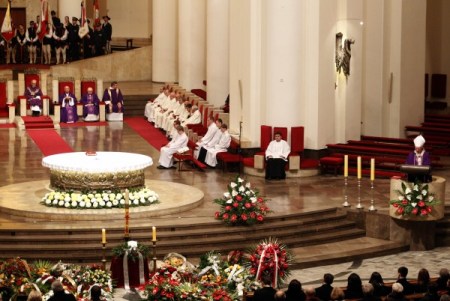
The mass, which began at 14.15, was presided over by Cardinal Franciszek Macharski, a close family friend.  There were addresses by other church figures, by the Minister of Culture and by the President of the Polish Composers’ Union.  In the congregation were composers of Górecki’s generation – Krzysztof Penderecki (Kraków) and Wojciech Kilar (Katowice) – and younger ones too, including Górecki’s pupils Knapik and Rafał Augustyn.  As far as I am aware, I was the only person from abroad, which I found rather sad, given how significant had been the relationship between the composer and major broadcasting, concert, publishing and recording institutions outside Poland.

There were a couple of musical surprises too.  A performance of Totus Tuus was to be expected, but Penderecki conducting Amen was less so.  And I was not the only one to be taken unawares, at the start of the communion service, by the performance of an excerpt from Strauss’s Metamorphosen.  According to his widow, this had been the one musical request for his funeral that Górecki had made.

The ceremonies came to a close at 15.45.  This must have come as a blessed relief for the representatives of organisations from Katowice and the Polish mountains who had stood with their banners at the far end of the Cathedral for the preceding three hours (see the photo above).  They now moved down to the aisle, leading the procession out of the main doors.  Górecki’s oldest grandchild, still in his mid-teens, carried the urn, flanked by his father and his uncle.  Then began the walk to the cemetery.  It took some 15′ for everyone to leave the Cathedral, and by this time dusk was falling fast.  We proceeded slowly up the side street, just a few hundred metres, and into the cemetery, but such was the crush of people that I had to look on from some distance.
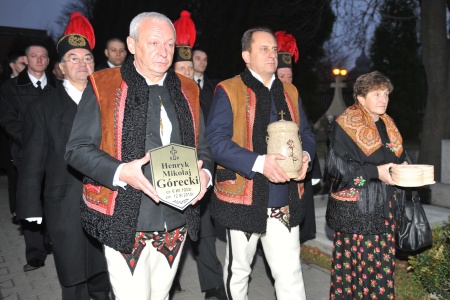
En route, a miner’s band played solemn music and the urn was carried in relay, concluding with a trio of mourners from the mountain town of Zakopane (also carrying the plaque and a heart-shaped carved box containing soil from the mountains).  Most of Górecki’s happiest moments had been spent in this region since the late 1950s.  He honeymooned there and for many years in the 1970s and 80s rented a log cabin in the little village of Chochołów, before finally buying his own house in the 1990s in the village of Ząb, on a high ridge facing the magnificent jagged peaks of the Tatra Mountains.  He revelled in the views and the culture of the place.

At the graveside, further prayers and blessings were said, the urn placed in the ground and the mountain soil poured over.

There was then a patient wait to greet the family, a process further lengthened by the many mourners who carefully placed their wreaths and bouquets, creating a waist-high bank of flowers around the grave.  I became aware, beyond the low murmuring about me, of distant music.  It seemed familiar.  50 or so metres away, indistinguishable in the shadows, was a folk kapela, a string ensemble from the mountains.  They were playing a melody from the Tatras, keening and unbelievably poignant.  Earlier, they had walked from the Cathedral in daylight.  Now, they were paying a final tribute to their adopted son as night closed in.

Postscript

At the reception afterwards in the Academy of Music, his widow Jadwiga told me about her husband’s last moments. She has now repeated the story in public in an interview, ‘Dom na dwa fortepiany’ (Home for Two Pianos), in the Polish Catholic weekly Gość Niedzielny (Sunday Guest, 13 November 2011, 58-59):
Father Krzysztof Tabath, the hospital chaplain for Katowice-Ochojec, … came to the hospital half an hour later than usual.  At my request, he movingly described those last moments: “Eventually, I reached Mr Gorecki.  I began with “Our Father”, then “Hail Mary”, and then “Soul of Christ, sanctify me” “.  And there, the whole time, above the bed, were flashing the monitors to which my husband was connected.  During the saying of the prayer the display panel gradually dimmed, then went out altogether, and he died. During the prayer, he had crossed over into the other world.  I cannot imagine a better death.  It was simply wonderful.  I am happy that it was like that.

When Jadwiga told me the story, she added the resonant detail that Henryk had died as the priest uttered the final ‘Amen’.

• Recalling Górecki: Two Radio Tributes

The other day, I came across these two short tributes on the Polish Radio website thenews.pl.  Although they were broadcast a year ago, they are still available.  Just follow the indicated mp3 link on each page.

The first is by David Harrington, the leader of Kronos Quartet.  Harrington was instrumental in commissioning Górecki’s three string quartets (1988, 1991 and 1995/2005) and he and Górecki formed a close professional and personal friendship.  On the day of Górecki’s death (12 November 2010), Kronos happened to be in Poland to give  a concert that evening in Wrocław.  In tribute, they played an arrangement of ‘Z Torunia ja parobecek’ (I am a Farmhand from Toruń), the fourth of Górecki’s Five Kurpian Songs (1999).  Harrington spoke the following day with Michał Kubicki.

http://thenews.pl/1/6/Artykul/21737,A-tribute-to-Gorecki

The second interview is one that I also recorded with Michał Kubicki that day.

http://thenews.pl/1/6/Artykul/21742,‘He-had-a-fantastic-sense-of-humour

• Polish Orchestra Named After Górecki

The city of Katowice in southern Poland today honoured its most famous and distinguished musical son.  The Silesian PO (Filharmonia Śląska) has been named in memory of Henryk Mikołaj Górecki, who died on 12 November 2010.

His widow Jadwiga, who was present at the announcement, said that the initiative to confer the title left her “breathless with delight and emotion”.  Also present were their daughter Anna, her husband and their three children.

Górecki’s association with the Silesian PO went back to before he became a student at the State Higher School of Music in Katowice in 1955.  He would often travel from his home town two hours away to hear concerts both by the Silesian PO and by the other full-size symphony orchestra in Katowice, the Great SO of Polish Radio.

The Silesian PO first honoured Górecki, while he was still a student, by devoting an entire concert to his recent compositions.  On 27 February 1958, it premiered Toccata for two pianos (1955), Variations for violin and piano (1956), Quartettino (1956), Songs of Joy and Rhythm (1956), Sonata for two violins (1957) and Concerto for Five Instruments and String Quartet (1957).  It subsequently premiered Epitafium (1958) at the 2nd ‘Warsaw Autumn’ Festival on 3 October 1958, Genesis II: Canti strumentali (1962) at the 6th ‘Warsaw Autumn’ on 16 September 1962 and Choros I (1964) at the 8th ‘Warsaw Autumn’ on 22 September 1964.

In choosing Górecki as its patron, the Silesian PO is following an honourable new tradition in Polish music.  The Zielona Góra PO renamed itself after the composer Tadeusz Baird in 1982, the year after his death, and the Wrocław PO renamed itself after Witold Lutosławski in 1994, with the blessing of his widow, who died just three months after her husband.

The commemorations to mark the first anniversary of Górecki’s death have already included a concert last night in which his Three Pieces in Old Style (1963) was played.  Tomorrow night, the ‘Górecki Philharmonic’, conducted by Mirosław Błaszczyk, will give a concert in the Arch-Cathedral in Katowice (where the funeral service was held last year).  Opening the programme will be the premiere of Nocturne (2011) by Górecki’s son Mikołaj, and this will be followed by a performance of Symphony of Sorrowful Songs.

• and a Bench for Tuwim too

It was only as I was researching my preceding post – on Henryk Górecki and his attachment to Julian Tuwim’s poem Song of Joy and Rhythm – that I came across what looks like a remarkable parallel between memorials to these two giants of 20th-century Polish culture.

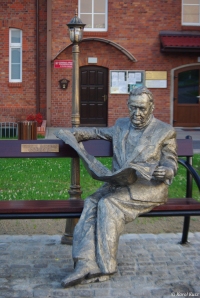
In another post twelve days ago – A Conversation with Henryk Górecki – I reported on a whimsical yet thoughtful monument to him that had been unveiled on 10 September in Rydułtowy, the town in Silesia where he lived from the age of 2 until he was 22.  As you’ll see or have seen, Górecki is sitting on the right-hand end of a bench, reading a musical score.

Well, blow me down, Tuwim too has been honoured with a bench, in his home town, Łódź, in central Poland.  This is the work of Wojciech Gryniewicz and was unveiled in 1999.  Like Górecki, Tuwim is seated on the right-hand end of a bench that in his case is also sculpted.  The key difference here is the posture.  Tuwim is looking out, not down, possibly above and beyond the eyeline of any companion.  Maybe he’s ‘lying in wait for God’ (Czyhanie na Bogu, the title of the collection that included Song of Joy and Rhythm).

I must say that I’m rather taken by the modest, down-to-earth approach of these sculpture-installations.  Does anyone know of other examples in addition to Maggi Hambling’s A Conversation with Oscar Wilde in London?

• Song of Joy and Rhythm

A text message came through from Anna Górecka, at 08.24 on this day last year, to say that her father had died earlier that morning.  She was away on tour and went on to fulfil her commitment to perform Górecki’s Piano Concerto that evening in Szczecin.  Her husband left me a voice message.  Although I knew that Henryk Górecki was dying, it was still a shock.  The rest of the day was a blur.  I phoned his publishers in London, but the news was not yet public knowledge even in Poland.  At 10.30, a friend in Warsaw, whom I’d alerted as soon as I had heard, phoned to let me know that Górecki’s death had just been announced.

The phone rang off the hook: advice for a researcher on R4’s PM programme, an interview for the World Service’s The Strand, a live interview on R3’s In Tune, a call from R4’s Front Row and an unfulfilled promise “We’ll phone back”, an interview down the line to a live Polish TV tribute, plus writing a short appreciation for The Guardian.  The last was difficult to do.

Amidst this, I had a visitation at 10.20 from a blue tit, which flew in unannounced through a narrowly open window, stood immobile on the floor for a while, eyeing me keenly, before eventually finding its way back outside and to freedom.  I’m not given to fanciful symbolism, but even I found myself seeing a message in the bird’s arrival and departure.  They say that it’s good to open a window after a death to let the spirit free.

When I was writing on Górecki in the early 1990s, I came across the poem which inspired the title of his extrovert Pieśni o radości i rytmie (Songs of Joy and Rhythm, 1956/60).  This early work bears all the hallmarks of Górecki’s contrasting musical and personal temperaments.  The heart of the work is the contemplative third movement.  It is arguably here that Górecki principally evokes the wonderment of the poem from which he borrowed his title.

Pieśń o radości i rytmie was written by one of Poland’s best-known poets of the twentieth-century, Julian Tuwim (1894-1953).  Many Polish composers have set Tuwim’s verse, including Szymanowski and Lutosławski.  Górecki was particularly attached to Tuwim’s poetry, setting it in his early student days (3 Songs, 1956) and again for his five-year-old daughter (2 Little Songs, 1972).  His most striking setting, in a terse Webernian style, was in Epitafium (1958), for SATB choir, piccolo, D trumpet, five percussionists and viola.  The text is Tuwim’s last poetic fragment, written on a serviette in a coffee shop just an hour before his death.  Its enigmatic message – ‘… for the sake of economy put out the light eternal, if it were ever to shine for me’ – is evocatively captured by Górecki’s exploratory score.

A year ago today, I looked out Tuwim’s (singular) poem and read it several times, mainly because it immediately recalled Górecki’s boundless energy and the inner peace which he sought during his often difficult life.  So I offer it here, in my own raw translation, as a tribute to a composer and a man for whom I had enormous respect and affection and who miraculously returned the favour.   

Pieśń o radości i rytmie (Song of Joy and Rhythm)
from Chyhanie na Bogu (Lying in Wait for God, 1918)

The stars twinkled in the sky.
In space – billions of universes.
Silence.

Resting my forehead in my hand and thinking.
I do not dream.
A big Reality has awoken me,
A truth that strikes the eye,
The truth that is being, visible, unique,
Eternal:

I – under this huge starry dome,
I – perceiving its entirety with my brain,
I relish it, I become one with myself
And slowly – inside – I am restored to myself:
To profound joy and perfect rhythm.

All my thoughts, words and deeds
Were only bringing me closer
To universal embrace:
Here I am resting joyfully in myself
Wrapped in deep silence on all sides
And my heart beats in the rhythm of
Everything that surrounds me.
Enough.  No need for words.

• On Tour with Górecki

It is rather encouraging that the approaching first anniversary of Henryk Górecki’s death on 12 November has occasioned a flurry of activity in this country.  Firstly, there was a Górecki edition of BBC Radio 3’s Sunday evening programme ‘The Choir’, which was broadcast on 6 November.  This series, which is devoted to all aspects of the composition and performance of choral music, broadcast the opening song from Górecki’s first collection of folksong settings, Broad Waters (1979), his most famous and most recorded a cappella piece, Totus Tuus (1987), his set of Five Kurpian Songs (1999) and Amen (1975).  And the programme also included Górecki’s earliest choral work – this time with instruments – Epitafium (1958), a stylistic (Webernian) corrective to the popular image of Górecki as a composer interested only in slow modal music.  A few weeks ago, I recorded an interview for the programme alongside Roxanna Panufnik, the daughter of the Polish composer Andrzej Panufnik.  Friends tell me that they enjoyed the programme, especially those who knew nothing of Górecki’s music and life beforehand.  Unfortunately, I missed the broadcast as I was on a coach with the Polish Radio Choir from Kraków (see below).

Secondly, I was visited late on a dark and stormy night at the end of last week, here on the Cornish moors, by a team from Polish Television in Katowice, Górecki’s home city.  They’d driven from France that day and were going on subsequently to interview Górecki’s London publishers and to speak to Bob Bibby, the Englishman who discovered that the subject of the second movement of Górecki’s Symphony of Sorrowful Songs had not died at the hands of the Gestapo, as had generally been feared, but had lived a full life, dying in 1999 (Guardian appreciation, 25 November 2010). I settled the Polish TV director, Violetta Rotter-Kozera, in front of a roaring log fire and we had an intense and warm-hearted discussion about Górecki’s music, life, personality and temperaments.  The programme (my hour or so will be cut down to a few minutes, I’m sure!) will probably be broadcast sometime early in 2012.

Thirdly, I’ve just come back from being ‘on tour’, with the Polish Radio Choir from Kraków, a promotion initiated by Ed McKeon of Third Ear.  It was my first such experience, and probably my last.  Even though this was a short, four-concert tour, I came away with a better understanding of the many and varied pressures that performers experience when daily on the move from one venue/hotel to another.  I was full of admiration for their unflappability and good humour.  This was nowhere more apparent than shortly after the start of the concert in Durham Cathedral, that solidly magnificent example of Romanesque architecture.  The peaceful prayer that is Totus Tuus was suddenly counterpointed by a barrage of deafening booms and bangs that seemed to be coming from right outside the building.  It was like a medieval siege, a terrifying bombardment.  It went on for over 15′.  The choir didn’t bat an eyelid, no voice trembled.  While the choir had no idea what was going on, we in the audience knew well enough.  It took a bit of explaining afterwards (November 5 customs can seem very strange to visitors to the UK).

The choir had flown into Liverpool the previous day and joined the tour coach for the first concert in Durham (Saturday night), on to London (Sunday lunchtime), Bristol (Monday evening) and Liverpool (Tuesday evening).  My role was to give three pre-concert talks, each of a different duration, before the first three concerts.  The choir was very welcoming and after the concert in Bristol asked me if I would become an honorary member of its Association of Artists and Friends, which came out of the blue and was very touching.

The Polish Radio Choir, under its conductor Artur Sędzielarz, is one of those rare commodities, a choir that is funded by a broadcaster.  In the UK, we are lucky to have the BBC Singers and some other European countries still invest in similar vocal groups for the sake of repertoires past and future.  It is a very fine ensemble.  They brought 29 singers and their textural blend was second-to-none.  Equally wonderful were the choir’s harmonic voicing and unfailingly clear articulation.  Dynamically, they encompassed the quietest of pianissimos and the most emphatic of fortissimos.  I was reminded of the extremist markings that Górecki used in his vocal-instrumental Ad Matrem (1971).  On the one hand, in that score he asked for moments that were ritmico-marcatissimo-energico-furioso-con massima passion e grande tensione.  On the other hand, elsewhere he wanted tranquillissimo-cantabilissimo-dolcissimo-affetuoso e ben tenuto e LEGATISSIMO.  The Polish Radio Choir brought such contrasts fully to life, especially in the Five Kurpian Songs, and I’m sure that Górecki would have been beaming at them had he been present.

It is a strange phenomenon in Górecki’s output that he makes little difference in his compositional approach to folksong settings and to church songs.  This is particularly evident in the overwhelmingly slow tempi and sustained vocal lines.  These demand extraordinary stamina and vocal evenness, which the Polish Radio Choir delivered effortlessly.  The programme moved from Totus Tuus, through the Five Kurpian SongsThree Lullabies (1984, in Bristol and Liverpool only, although the first lullaby was sung as the encore in London), and the Song of the Katyń Families (2004).  The concerts ended with Come Holy Spirit (1988) and Amen.

For me, the outstanding piece was Song of the Katyń Families.  It lasts for barely 5′, yet its expressive power became more and more apparent at each subsequent performance.  Typically for Górecki, the piece takes a slightly oblique slant, setting a contemporary text that links the first line of the Polish national anthem with the memory of the Soviet slaughter of thousands of Polish army officers during World War II.  The piece’s lower overall tessitura made quite an impression at this stage in the concert.  When the basses dropped lower still, the harmonic resonance spoke volumes.  And when they moved down two further steps, the luminosity of the choir’s sound was breathtaking.  Song of the Katyń Families deserves as wide a recognition as Totus Tuus.

I wonder if the Polish Radio Choir’s unanimity and utter faithfulness to the spirit and letter of Górecki’s music, as well as their sensitivity to timbral colour, come not only from their collective musical sensibilities but also from their wide musical interests outside their choral work, which include – to take just three examples – musicology, cabaret and period instrument performance.  Whatever their secret ingredient is, it made for rivetting performances that elicited hugely enthusiastic audience responses.  I hope that the choir returns to the UK before too long.

…..

The Polish Radio Choir released a 2-CD recording of Górecki’s a cappella music in 2007.  It’s on the Polish Radio label, Polskie Radio PRCD 1104-1105.  It includes Broad WatersFive Kurpian SongsCome Holy SpiritSong of the Katyń Families and Amen, plus the folksong My Vistula (1981) and Marian Songs (1985).

…..

For Rian Evans’s review of the Bristol Concert, see The Guardian (9 November 2011).

• A Conversation with Henryk Górecki

Exactly one year ago I flew to Poland for what turned out to be my last meetings with Henryk Mikołaj Górecki.  When I had learned a few days earlier that he had been awarded Poland’s highest honour, the Order of the White Eagle, and that the presentation had taken place at his hospital bedside, I sensed that the end was near.  His fellow composer Witold Lutosławski (1913-94) had been honoured in the same way just before his death, although he was too ill to receive it in person.

Staying once again with members of Górecki’s family, I was taken on three occasions to see Henryk in his hospital on the outskirts of Katowice.  It is never easy to see a close friend in such circumstances, when their vivacity, robustness and combativeness have seemingly vanished.  He was able to communicate only through those still-penetrating eyes.  I showed him pictures of the moorland where I live and reminisced about the often hilarious holiday that I had with him and the family at Chochołów in the Tatra Mountains in August 1987 and about our many walks and talks together.  I recounted my recent visit to the St Magnus Festival in Orkney, where the Royal Quartet from Poland had given an unforgettable account of his Third String Quartet ‘… songs are sung’ and where I’d been mesmerised by the pianism and imagination of the jazz interpretations by Leszek Możdżer.  Even though all he could do was to look me straight in the eye, as he always did, I knew that he’d been listening and had understood.  There were to be no more moments like this.  I wish now that I had had the forethought to bring along some poetry or other texts to read to him, just as depicted in the film The Diving Bell and the Butterfly.

I may yet write about the day of his death (12 November 2010) and his funeral five days later, but for now I’m going to fast-forward to 10 September 2011.  I’ve been rather tardy in writing about a touching and somewhat whimsical tribute that was paid to him on that day in Poland.

Photo by Karol Kusz

Between the ages of two and twenty two, before he went to study composition in Katowice, Górecki lived some 50km to the south west, in a small town called Rydułtowy. There he went to school and subsequently taught primary school children a range of subjects, including Polish history, maths, biology, natural history and art.  Earlier this year, the town recognised its most famous son by renaming the Public Library in his honour.  On 10 September, ceremonies were held to mark the occasion, including the customary speeches and musical performances.  Górecki’s widow, Jadwiga, unveiled a plaque inside the library and also unveiled a sculpture outside.  But this sculpture – or is it a statue, or perhaps an installation? – is not a run-of-the-mill representation of the composer, nor an abstract concept inspired by his music.  It’s more in the line of Maggi Hambling’s A Conversation with Oscar Wilde (1998), which has been placed in London at the bottom of the pedestrian Adelaide St, behind the church of St Martin’s in the Fields and close to Charing Cross station.

Whereas Hambling (left) gives passers-by the opportunity to sit on Wilde’s all-too-solid ‘coffin’ and have a face-to-face exchange of witty one-liners (or sit in the opposite direction and ignore him), Henryk Fojcik’s sculpture (above) encourages side-by-side contemplation.  Górecki sits on the right-hand side of a posher-than-normal park bench, a lamp-post placed centrally behind (plenty of openings here on a rainy day for Gene Kelly impersonators).  He’s reading what looks like a newspaper, although I never knew him as an avid reader of newsprint.

In the picture below, in which his widow Jadwiga was persuaded to sit next to him on the bench, it seems that Górecki is looking instead at a piece of music, even though it’s oversize and much bigger than his largest score, Scontri.  He wasn’t one for looking at his existing compositions, either.  He preferred to work on new pieces.  It’s a good likeness, however: the head and face are pretty faithful and characteristic (much more so than the relief image on the plaque inside the library) and his body posture is very well captured.  And there is something wonderfully relaxed, quietly alive and of good humour about Fojcik’s sculpture.  It invites participation and companionship.

For myself, I think a chance has been missed by having his eyes downcast.  How more engaging it would be if his head had been facing towards the other person on the bench, fixing him or her with his searching eyes as if to say: “What are you doing now? … Well, get up and do it!”.

Further information may be found online at

• < http://www.biblioteka.rydultowy.pl/archiwum.php?id=263> – a report by the Rydułtowy Public Library of the event on 10 September 2011, with 27 photographs.

• < http://www.telewizjatvt.pl/raport/2011-09-13/5103> – a short news video by the local television station of the events on 10 September 2011.

• A Distant Echo of God’s Word

Yesterday I finished writing the programme notes for a forthcoming visit of the Polish Radio Choir from Kraków.  Between 5 and 8 November, the choir is giving concerts at Durham Cathedral, King’s Place in London, St George’s in Bristol and in St George’s Hall Concert Room in Liverpool.  The programmes, under the title ‘Polish Spirituals’, commemorate Henryk Mikolaj Górecki, who died on 12 November last year.  For more details and an introductory essay by Ed McKeon, please follow the link to the tour web site, set up by the UK organisers, Third Ear.

Late in the day, I remembered a particular passage from a homily by Pope John-Paul II that Górecki admired.  The Pope was speaking at a Mass for Artists in Brussels on 20 May 1985.  So here it is, with Górecki’s little postscript, as a tribute to both men and their vision of what it means to be an artist.

Each authentic work of art interprets the reality beyond sensory perception.  It is born of silence, admiration, or the protest of an honest heart.  It tries to bring closer the mystery of reality.  So what constitutes the essence of art is found deep within each person.  It is there where the aspiration to give meaning to one’s life is accompanied by the fleeting sense of beauty and the mysterious unison of things.  Authentic and humble artists are perfectly well aware, no matter what kind of beauty characterises their handiwork, that their paintings, sculptures or creations are nothing else but the reflection of God’s Beauty.  No matter how strong the charm of their music and words, they know that their works are only a distant echo of God’s Word.

Górecki quoted these words at the Catholic University of America, in Washington D.C., on 28 February 1995, adding:

Those words are perfect: you can neither add to them nor take anything away.  Just think deeply about the sense of those words.