• WL100/32: Les espaces, **12 April 1978

If you dip into any study of Lutosławski’s music that includes Les espaces du sommeil (1975, premiered by Dietrich Fischer-Dieskau and the Berlin PO under the composer’s baton on 12 April 1978), you will read that the text is by Robert Desnos (1900-45) and probably also that it comes from his volume of poetry Corps et Biens (Paris, 1930).  In fact, it had been published four years earlier in La révolution Surréaliste (June 1926), where his new collection of poems was printed under the title ‘À la mystérieuse’, a reference to Desnos’s lover, the singer Yvonne George.

Lutosławski’s source was actually a much later volume, a copy of which he owned and in which he also bookmarked poems by four other writers.  How do I know this?  In September 2002, I spent several days in Lutosławski’s house with permission to explore the contents of his study and attic store-room.  One particular book leaped off the shelves at me, figuratively speaking.

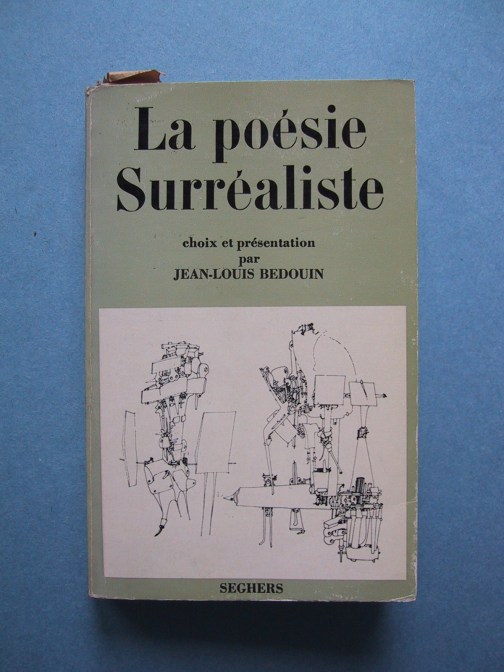
It was La poésie Surréaliste (Paris: Editions Seghers, 1964, repr. 1970), selected by Jean-Louis Bedouin.  The cover featured a drawing by Yves Tanguy.*

141-4164_IMGDesnos’s poem was the first that Lutosławski bookmarked (with paper strips torn, as was his wont, from an old notebook or diary).  The second was Météores by the Croatian Radovan Ivšić (1921-2009).  The third was a group of eleven short verses by the Anglo-Egyptian Joyce Mansour (1928-86).  The fourth was De tout repos by Pierre de Massot (1900-69).  And the fifth was Pierre de soleil (Piedra de sol) by the Mexican Octavio Paz (1914-98).
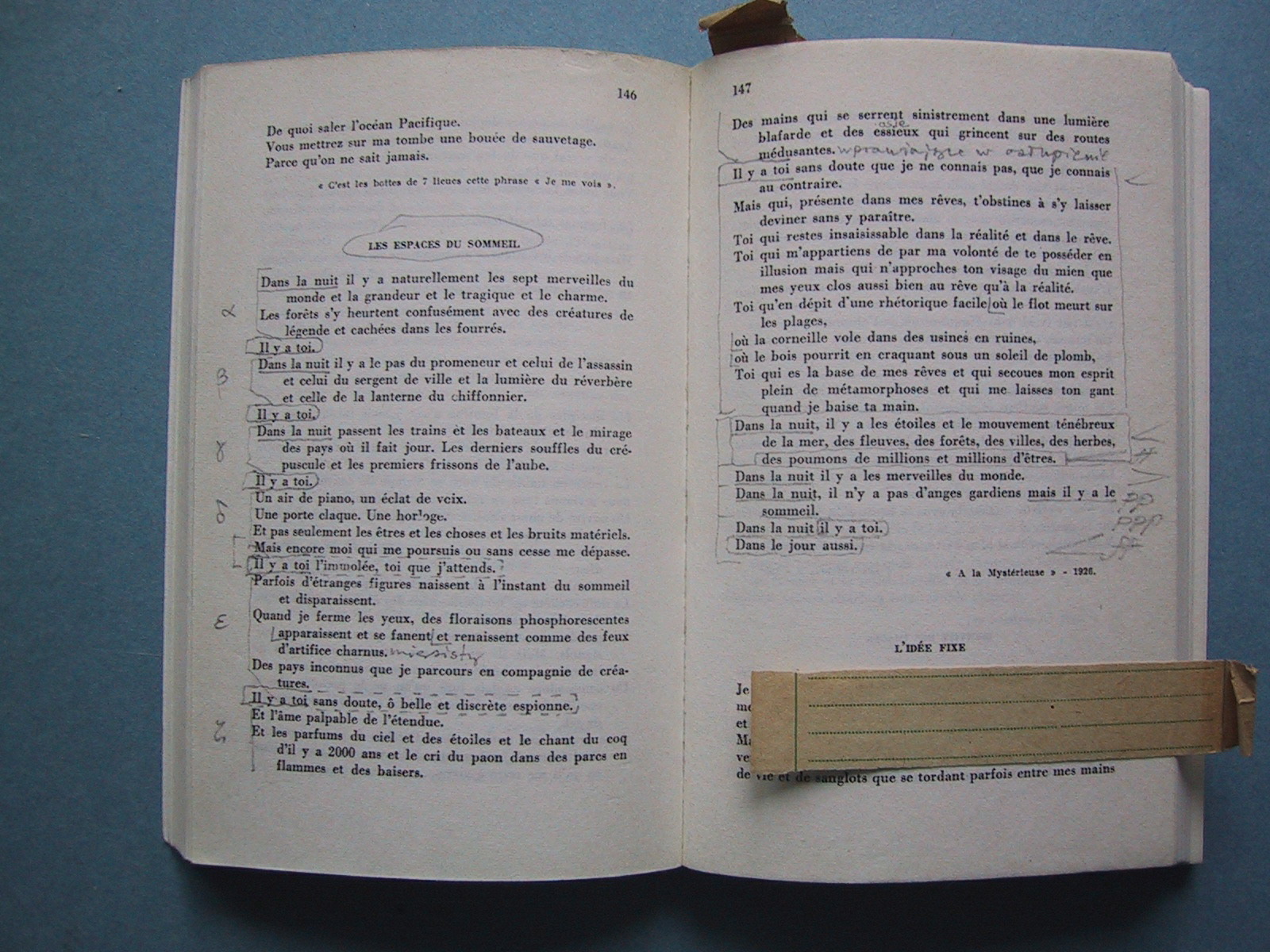
What immediately grabbed my attention and thrilled me was that the only poem that Lutosławski had marked up was Desnos’s Les espaces du sommeil.  Here was Lutosławski’s structural analysis of the text, complete with brackets, underlinings, circlings, Greek letters, a few translations into Polish and even some key dynamic markings at the very end.  He underlines or circles the two dominant refrains ‘Dans la nuit’ and ‘Il y a toi’.  He gives Greek letters α-ζ (another characteristic habit) to the subsections of the first two of the work’s three main sections.  He translates three words that he doesn’t know (‘charnus’, ‘essieux’ and ‘médusantes’).

15. La poésie Surréaliste 146-7 Desnos

Above all, Lutosławski is clearly captivated on these two pages by the text’s musical possibilities in terms of verse and refrain and the final climax.  How excited he must have been to find a poem which dovetailed so neatly with his symphonic preoccupations of the 1960s and 70s.

…….

* When I was in Warsaw in January this year, I was invited to Lutosławski’s house.  I learned from the wife of Lutosławski’s stepson that unfortunately this volume seems since to have disappeared.  If this is so, then these photographs, taken against a piece of Lutosławski’s blotting paper on his desk, are quite possibly the only record of this particular background to Les espaces du sommeil.

…….

I have written in a little more detail about Lutosławski and his approach to text setting in ‘One Last Meeting: Lutosławski, Szymanowski and the Fantasia’ (2007).

• WL100/31: Notebook, 9 April 1969

Lutosławski on Conducting (and Boulez)


If I accept a proposal to conduct my own works, this is not out of conceit.  On the contrary, it is out of modesty.  I do not have enough confidence that the most prominent conductors will ever take on the works of my last period (after Musique fun.) or, even if they do, I do not imagine that they will have enough time, inclination and independence from their habits to conduct them well.  Of course the exception here is Janek Krenz.  But he rarely has the opportunity to conduct my pcs now.  The surprise, however, contrary to what I wrote at the beginning, is that serious conductors have interested themselves so quickly in my Symphony 2 (Skrowaczewski, Bour).  So perhaps there really is no need for me to conduct?  I am tempted, however, to experience it for myself and prove to others that, e.g., Symphony 2 can and should be conducted as the notation stipulates, and not, e.g., as Boulez did in some bits. 

Jeśli przyjmuję propozycje dyrygowania własnymi utworami, to nie przez zarozumiałość.  Przeciwnie, przez skromność.  Nie mam dość wiary w to, że najwybitniejsi dyrygenci zabiorą się kiedykolwiek do utworów mego ostatniego okresu (po Muzyce żał.), albo jeśli nawet się zabiorą, to nie wyobrażam sobie, że będą mieć dość czasu, chęci i – niezależności od swych przyzwyczajeń – aby je dyrygować dobrze.  Naturalnie wyjątkiem tutaj jest Janek Krenz.  Ale on rzadko ma okazję dyrygowania moich utw. teraz.  Niespodzianką jest natomiast to, że wbrew temu, co napisałem na początku, poważni dyrygenci zainteresowali się tak szybko moją II Symfonią (Skrowaczewski, Bour).  Może więc rzeczywiście nie ma potrzeby, abym sam dyrygował?  Korci mnie jednak, aby samemu doświadzyć i innym udowodnić, że np. II Symfonią można i należy tak dyrygować, jak przewiduje jej zapis, a nie np. tak, jak to zrobił w niektórych fragmentach Boulez.

Witold Lutosławski, 9 April 1969 [my translation]

Screen Shot 2013-04-08 at 21.44.44When he wrote this, Lutosławski had been conducting his own music on the international stage for almost six years. He had shared the podium with Slavko Zlatić for the premiere of Trois poèmes d’Henri Michaux (Zagreb, 9 May 1963) and with Jan Krenz for the work’s first recording (1964).  He gradually increased his profile as a conductor during the 1960s (it was, after all, a useful way of increasing his hard-currency income).  He conducted the premiere of Paroles tissées with Peter Pears (Aldeburgh Festival, 20 June 1965) as well as of the Second Symphony (Katowice, 9 June 1967), followed by the second and third performances of the Second Symphony at the ‘Warsaw Autumn’ Festival (24 September, 1967) and again in Warsaw (16 February, 1968).

Screen Shot 2013-04-08 at 21.58.24The references to Stanisław Skrowaczewski and Ernest Bour refer to the facts that Bour gave the first performance of the Second Symphony outside Poland (Baden-Baden, summer 1968), followed by Skrowaczewski (Minnesota, 21 February 1969; New York, 3 March 1969).  Lutosławski conducted the seventh performance less than a fortnight before this diary entry (Uppsala, 28 March 1969).  Four more performances followed in 1969 (making a total of seven that year), two in 1970, four in 1971, and one in 1972.  The work seems to have fallen by the wayside for several years, reappearing once in 1978 and again in 1979, once in each of 1981, 1982, 1983 and 1984, and then languishing until single performances in 1989 and 1993.  That amounts to 26 performances during Lutosławski’s lifetime, one for each year since 1967.  It was long regarded as a weaker cousin to Livre pour orchestre (1968), although in recent years their fortunes seem to have been reversed and it is now Livre which is on the sidelines.  But that is a topic for a further discussion.

Screen Shot 2013-04-08 at 22.00.37Lutosławski’s confidence that other conductors would take up the Second Symphony went largely unrealised. Neither Bour nor Skrowaczewski touched it again during his lifetime.  The other conductors were Charles Groves (twice) and Paul Huppert (1969), Andrzej Markowski (1970), Konstantin Iliev (1971) and Matthias Bamert (1993). Jan Krenz’s name is not on the list.  All the other performances (bar one whose details are incomplete) were conducted by Lutosławski (data from Stanisław Będkowski & Stanisław Hrabia, Witold Lutosławski. A Bio-Biography, Westport CT, 2001).  His initial premonition proved correct, as he ended up conducting 15 of the 26 performances.

Screen Shot 2013-04-08 at 22.02.04The Boulez story is one of the oddities in Lutosławski’s career.  He had not finished the first movement of the Second Symphony in time for the scheduled premiere (Hamburg, 15 October 1966), in which the Sinfonie Orchester der Norddeutschen Rundfunk was conducted by Pierre Boulez.  The performance therefore consisted only of the second movement.  I’ve never heard a recording of this concert, so I cannot comment on Lutosławski’s little sideswipe at Boulez.  What is certain, however, is that Boulez has not since conducted any of Lutosławski’s music.  By any measure, given that Boulez has recently performed and recorded music by Szymanowski (not someone with whom I would ever have linked him), this is a strange not to say glaring omission.

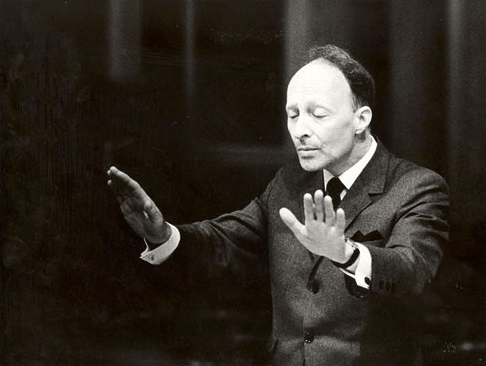
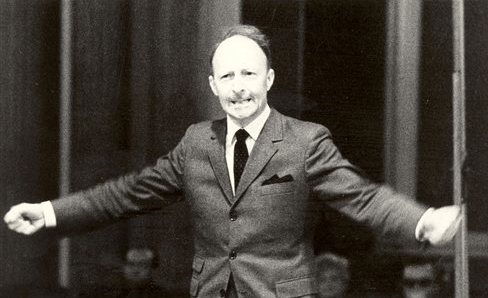
The images of Lutosławski were taken by Jan Zegalski in Katowice during rehearsals for the premiere of the Second Symphony in Katowice in June 1967.  They come from Witold Lutosławski w Polskim Radiu (I posted on this fascinating web resource in WL100/14 on 21.01.13).  In one shot, Lutosławski is in conversation with Krenz, who had been his conducting mentor since the early 1950s.

Screen Shot 2013-04-08 at 22.03.28

• WL100/30: Notebook, 7 April 1960

Lutosławski on Cage


The bottom of this pot, from which we all draw, is already visible.  The zealous ones (Cage) have already scraped it.  As for me – I’m not particularly hurrying towards that moment, to which our history of music is unavoidably heading, i.e. the absence of all music.

W tym garnku, z którego wszyscy czerpiemy, już widać dno.  Co gorliwsi (Cage) już się do niego doskrobali. Co do mnie – nie śpieszę się tak do tej chwili, do której zmierza nieuchronnie nasza historia muzyki, tj. do braku wszelkiej muzyki.

Witold Lutosławski, 7 April 1960 [my translation]

This reaction to Cage, and what he stood for, was indicative of Lutosławski’s essentially traditional frame of mind, even when he was trying to break free of the past in early 1960.  What is strange about this comment is that only three weeks earlier Cage had had a liberating effect on Lutosławski’s music.  It has been known for a long time that Lutosławski heard a performance of Cage’s Piano Concert (1958) on the radio in 1960.  This chance hearing was a bolt from the blue for Lutosławski’s subsequent development, but commentators have never pinpointed the date.

Unknown-1
The broadcast details are contained in Danuta Gwizdalanka’s commentary on the Lutosławski Guide to Warsaw app (Routes>Warsovian>Saskia [sic] Kępa, Zwycięzców 39>’From (controlled) accident to accident’):

This event took place on 16 March 1960 at 10.10 p.m., when Polish Radio 3 broadcast a programme featuring the music of John Cage as part of the series Music Horizons.

 
Here is but one of a number of Lutosławski’s more positive public responses to Cage’s liberating significance:

[…] I heard on the radio a short fragment of John Cage’s second Piano Concerto [i.e., Concert for Piano and Orchestra].  The use of the element of chance opened for me a way to use a lot of musical ideas, that were kept ‘in stock’ in my imagination without any way to use them.  It was not a direct influence of Cage’s music, but the impulse, which enabled me to use my own possibilities.  So I wrote to him that he was a spark thrown on a barrel of gunpowder inside me. 

(‘Sound Language’, unpublished and undated typescript in English, included in
Zbigniew Skowron, Lutosławski on Music, Lanham MD, 2007, p.99)


• WL100/29: Notebook, 6 April 1961

Lutosławski and Poor Alternatives


I often see in my finished works only wretched caricatures of what were once their first concepts.

Często widzę w moich zrealizowanych utworach tylko nędzne karykatury tego, czym były w swoim czasie ich pierwsze wyobrażenia.

Witold Lutosławski, 6 April 1961  [my translation]

This single-sentence entry in his notebook reflects Lutosławski’s dissatisfaction at the very moment when he was racing to complete Jeux vénitiens.  He had finished the first movement the previous day (5.04) and would complete the final movement the following day (7.04).  The premiere took place in Venice less than three weeks later (24.04), but he immediately withdrew this version for a major overhaul.  The revised piece was premiered in full on 16 September that year at the Warsaw Autumn festival.  For previous notebook entries and commentaries on Jeux vénitiens, see WL100/18 (12.02.61), WL100/24 (11.03.61) and WL100/27 (19.03.61).

A comment on vocabulary.  I wonder if previous versions understate the intensity of Lutosławski’s comment.  In Lutosławski on Music (Lanham MD, 2007), Zbigniew Skowron translates ‘nędzne’ as ‘poor’:

I often see in my finished works only poor caricatures of what their first conception was like.

So too does Joanna Holzman in Lutosławski. Homagium, an exhibition catalogue published by Galeria Kordegarda (Warsaw, 1996).  Her version, despite the unnecessary insertion of ‘very’, is nicely succinct:

I very often view my finished works as poor caricatures of the original concept.

I pondered for quite a while on ‘nędzne’, because a range of Polish-English dictionaries gives a range of much stronger translations as well, of which the following is a selection: abject, abysmal, beggarly, lousy, meagre, mean, measly, miserable, paltry, poor, sad, shabby, sordid, sorry, squalid, vile, worthless, wretched.  It seems to me that ‘poor’ is the mildest of these.  It is quite likely that Lutosławski was feeling particularly frustrated and under pressure, sandwiched between the two days when he completed the outer movements of  Jeux vénitiens, just in time for the parts to be copied and sent off for rehearsal (which must have been an interesting event, as it was the first time any performers had encountered Lutosławski’s aleatory procedures and notation).

Of the alternatives to ‘poor’ I sense that ‘lousy’ (although overly colloquial), ‘measly’, ‘miserable’, ‘sad’, ‘sorry’ and ‘wretched’ are equally if not more suitable for his mood at this particularly stressful moment.  Are there any other views out there?

• WL100/28: Jazz Conversations (Lutosphere)

Having heard Agata Zubel, Andrzej Bauer and Cezary Duchnowski in conversation with Lutosławski’s alter ego ‘Derwid’ at the end of the Philharmonia’s Woven Words festival last month (Zubel Zings!), I’ve revisited an earlier set of ‘conversations with Lutosławski’.  These took place in the project Lutosphere, when Bauer teamed up with the pianist Leszek Możdżer and the DJ M.Bunio.S to explore Lutosławski’s concert music.  Among the pieces which they reference are the Intrada and Passacaglia from the Concerto for Orchestra (1954) and the Cello Concerto (1970). As I’ve written before, there’s quite a tradition of Polish jazz musicians reworking the music of major Polish composers (Chopin, Szymanowski), but this is the first time that the composer’s own voice has been included in the process!

There are currently a handful of uploads on YouTube, some with live video footage.  Here are five (two of them are short extracts), dating from 2008-10.

OFF festival, Mysłowice (8.08.2008)


Polish Radio (pre 6.11.2008, with partly English-language intro by Możdżer)


(pre 17.05.2009)


Kraków Philharmonic (31.10.2009)


Theatre on the 6th Floor, Warsaw (26.08.2010)


• WL100/27: Notebook, 19 March 1961

Lutosławski and Rain

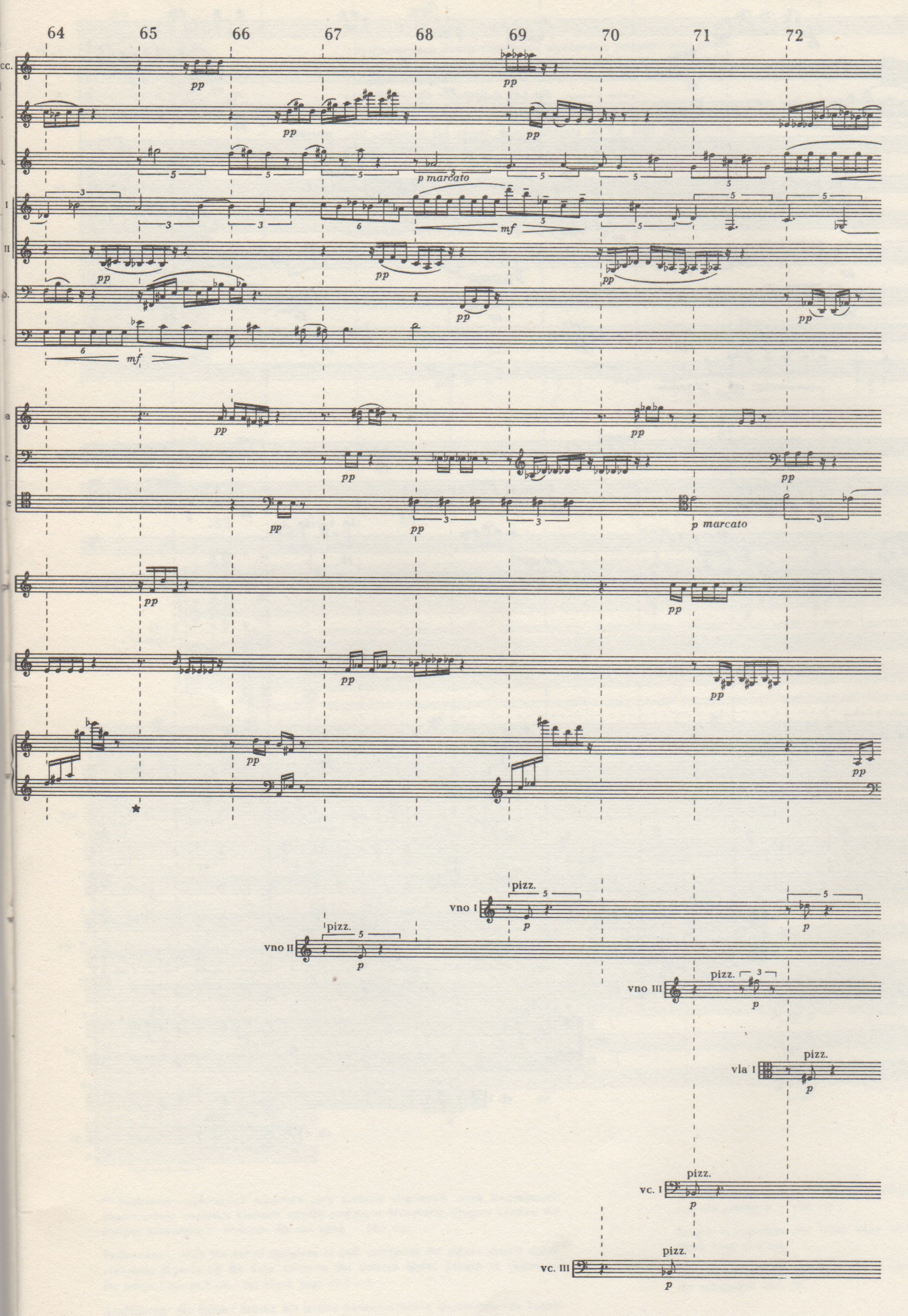
In order to justify classical rhythmic formulae, the argument has been used that this rhythm (i.e. ‘harmonic’, based on pulse) comes from nature: walking, the heartbeat.  Well, it is not correct to say that other rhythms have no counterpart in nature.  In fact, natural phenomena proceed for the most part in an irregular rhythm.  Example: the rhythm of the drops as rain begins to fall (pizz., in b.67 presto (II) from Jeux v.).

Dla uzasadnienia klasycznych formuł rytmicznych posługiwano się argumentem, że rytm ten (tzn. ‘harmoniczny’, oparty na pulsacji) pochodzi z natury: chodzenie, bicie serca.  Otóż nie jest słuszne twierdzenie, że inne rytmy nie mają odpowiedników w naturze.  Na pewno zjawiska natury przebiegają w swej większości w rytmie niepulsacyjnym.  Przykład: rytm kropel, gdy deszcz zaczyna padać (pizz., w t. 67 presto (II) z Jeux v.).

Witold Lutosławski, 19 March 1961  [my translation]

This is a rare example of Lutosławski linking extramusical observations to his music, aside from his several references to the theatre.  The passage in question (in the second movement of Jeux vénitiens, which he was writing at this very time and would complete nine days later) is interesting from a number of points of view.

For one thing, the string pizzicati are almost completely covered by a denser, more active texture in the woodwind, brass, pitched percussion and harp, so hardly of foreground interest.  For another, this is not the first but the third such passage in the movement: the first is led off by the bassoon at b.9 and the second (more briefly) by vibraphone at b.46, both against a background of scurrying muted strings played arco.  In each of these first two cases, the ‘irregular’ rhythms lead to fuller textures in the wind and pitched percussion, and it is the second of these that eventually runs in parallel with the string pizzicati cited by Lutosławski above.

This third and most developed passage extends from b.67 to b.82 and is given to the strings for the first time and marked pizzicato to make the point (the orchestration of these three sections is a good example of how Lutosławski thought of his music’s instrumentation in structural terms).  Bars 67-82 take the form of an increasingly dense rhythmic texture that is interrupted by the playing of cardboard tubes on the strings of the piano at b.83 (see WL100/24: Notebook, 11 March 1961 for details of this passage).  Given the dating of both this diary entry and of his work on the second movement, it looks highly possible that Lutosławski did have the irregular rhythm of a natural phenomenon like raindrops in mind when he composed not only bb.67-82 but also the two earlier passages to which this pizzicato section is the successor.  Incidentally, the movement is not headed Presto in the published score – it simply has the tempo indication of crotchet/quarter-note = 150.

Here’s a recording of the (unrevised) second movement from the premiere of the otherwise revised and completed version of Jeux vénitiens, given at the Warsaw Autumn on 16 September 1961, with the National Philharmonic conducted by Witold Rowicki.  The bassoon entry at b.9 is at 0’05”, while the vibraphone at b.46 is inaudible, as too is most of the string pizzicato starting at b.67 (0’46”).

WL JV:II bb.64-72

WL JV:II bb.73-81

• WL100/26: Notebook, 13 March 1961 (2)

Lutosławski on Electronic Music

It might be said that, in the works which I am now writing, the influences of electronic music are evident. Maybe.  One thing is clear to me, that electr. and concr. music realises, to a certain degree, timbral and rhythmic elements which from early on have imposed themselves on my imagination.

Mozna by mówić, że w utworach, które teraz piszę, widać wpływy muzyki elektronowej.  Być może.  Jedno jest dla mnie pewne, że muzyka elektr. i konkr. realizuje w pewnym stopniu elementy dźwiękowe i rytmiczne, które od dawna narzucają się mej wyobraźni.

Witold Lutosławski, 13 March 1961  [my translation]

Lutosławski, who was in the middle of composing Jeux vénitiens at the time, was not alone among his generation in the early 1960s in sensing parallels between his music and the new sound-worlds of electronic music and music concrète.  In 1960, the year of her Sixth String Quartet and a year before the orchestral Pensieri notturni, Grażyna Bacewicz (1909-69) made a similar observation: “I am struck by electronic music: it invents new sound colours and new rhythms”.

• WL100/25: Notebook, 13 March 1961 (1)

Lutosławski on Feeling in Music

For the thousandth time: music does not express any specific feelings, it only constitutes the formal framework into which, during its performance, each person pours their own emotions, whatever they are. Hence a v. simple explanation for the tears of the Gestapo listening to Mozart.

Po raz tysiączny: muzyka nie wyraża żadnych określonych uczuć, stanowi tylko ramy formalne, w które przy jej odtwarzaniu każdy wlewa swoje własne emocje, takie, na jakie go stać.  Stąd b. proste wytłumaczenie łez gestapowców słuchających Mozarta.

Witold Lutosławski, 13 March 1961  [my translation]

• WL100/24: Notebook, 11 March 1961

Lutosławski on New Instruments

New instruments, or the direction in which they should be investigated:
1) Piano enriched with different sounds (those that to date have been obtained by ‘preparation’ and others), achieved by means of mechanically moved nakładka on the strings, etc.. as well as percussive elements;
2) instruments which will fuse traditional instr. with electronic ones, e.g. double-bass, electr. guitar, etc.

Nowe instrumenty lub kierunek, w którym należałoby ich poszukiwać
1)  Fortepian wzbogacony o różne brzmienia (te, które uzyskuje się dotychczas przez “preparowanie” i inne) uzyskiwane za pomocą mechanicznie poruszanych nakładek na struny, etc. oraz elementów perkusyjnych;
2)  instrumenty będące połączeniem instr. tradycyjnych z elektronicznymi, jak np. kontrabas, gitara elektr. etc.

Witold Lutosławski, 11 March 1961  [my translation]

In mid-March 1961, Lutosławski was trying to complete Jeux vénitiens for its premiere in Venice on 24 April 1961. He had finished the final (fourth) movement just four days before he wrote this diary entry on 11 March, and he would complete the second movement two and a half weeks later (28 March).  At this pivotal point in his career, when he was not completely certain of how to develop his musical language ( although he had already started making use of aleatory procedures in the finale), he was evidently looking at a number of possibilities.

2)  instruments which will fuse traditional instr. with electronic ones, e.g. double-bass, electr. guitar, etc.

The idea for new instrumental construction never had any traction in Lutosławski’s further thinking.  He did, however, utilise extended oboe techniques in the Double Concerto (1980), written for Heinz Holliger and his wife Ursula.  But to my ears at least, this rare departure from his normal practice is not an entirely happy foray into untraditional sound sources.

1)  Piano enriched with different sounds (those that to date have been obtained by ‘preparation’ and others), achieved by means of mechanically moved nakładka on the strings, etc.. as well as percussive elements;

This observation is more interesting.  It implies that Lutosławski was aware of John Cage’s music for prepared piano. More intriguing is his use of the phrase ‘mechanically moved nakładka on the strings’.  Skowron (Lutosławski on Music, 2007, p.299) translates this as ‘mechanically moved objects placed on the strings’.  The first question is raised by ‘mechanically moved’.  What did Lutosławski have in mind – what type of mechanism?  Had he come across it in an existing piece by another composer or was it a flight of fancy on his part?  The second question – which I hope Polish readers may solve – is the meaning of nakładka.  It seems variously to mean flat metal or wooden objects (like fish-plates joining two stretches of railway rail, or the overlapping of planks on a clinker-built ship), or sheaths or covers to protect sharp objects.  I cannot work out quite how this transfers to piano preparation. Any ideas?

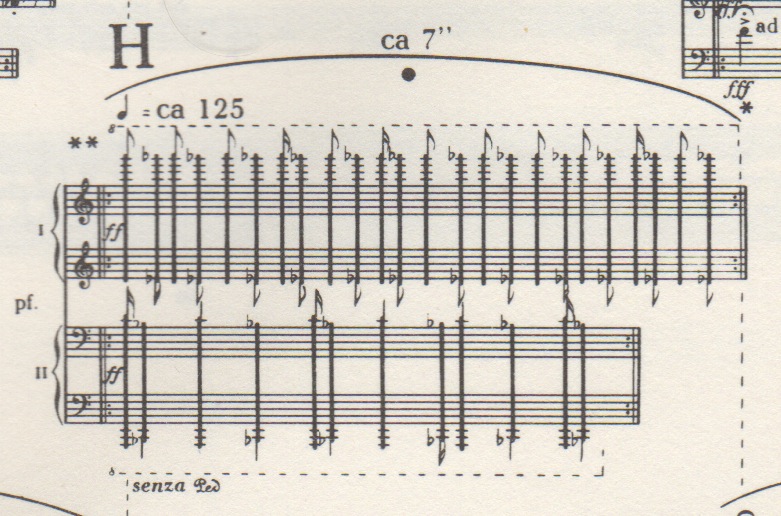
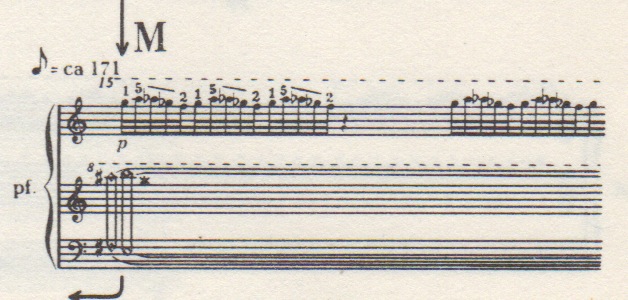
There is one unconventional technique that Lutosławski does employ.  It’s in Jeux vénitiens.  He does so in the two movements whose composition chronologically flanks this diary entry of 11 March 1961.  In the otherwise stylistically conservative second movement, which was not changed between the Venice premiere and the revised version that we know today, he uses ‘cylinders of stiff cardboard’ in bb.83-103.  The device also reappears in the finale, at letter H and from letter M to the end (although, as I have not seen the first version of this movement, I cannot say if the cylinders were used here originally).

In the second movement of Jeux vénitiens, six different lengths of cardboard tube are required for the two pianists (on one piano).  At b.83 (marked p), Player I depresses the white keys between specified pitches with a 60cm tube, the black keys with one that is 59.5cm long.  A moment later, Player II uses a 54.5cm tube for the white keys, 52.5cm for the black.  At b.87, Player I starts a series of p clusters at varying pitches using shorter tubes, 14.4cm for the white keys, 15.6cm for the black.

WL JV:II b.83

At letter H in the finale (part of the movement’s climax), the two players are instructed to use the (longest) tubes ff.

WL JV:IV letter H

Lutosławski’s technique at letter M in the finale is different.  Just one player is implied – the score does not indicate that a second player is required, although it might make it easier if two were involved.  Three and a half octaves are to be suppressed silently by the tubes (no length given): ‘hold them down with the elbow and left hand until the end’. On top of this, the right hand plays a little five-note riff.

WL JV:IV letter M

It seems to me that these three passages in Jeux vénitiens link in directly with Lutosławski’s first musing on 11 March 1961, even if he took his observations no further in subsequent pieces (not even in the central, percussive movement of his next work, Trois poèmes d’Henri Michaux).

• WL100/23: 9-10 March 1957

Lutosławski Speaks Out (1957)

Lutosławski chose his moment to make statements of a political-artistic nature.  He stayed noticeably silent during the discussions at Łagów on 5-8 August 1949, when politicians, composers and performers tried to determine what constituted socialist realism in music.  On 9 March 1957, however, he opened the 9th General Assembly of the Polish Composers’ Union (9-10 March) with a short speech.  At a pivotal moment in Polish culture, six months after the first ‘Warsaw Autumn’ festival and before any music from the Western avant-garde had been played in Poland, Lutosławski reflected on both the creative trauma of the past seven and a half years and the creative opportunities that lay ahead of Polish composers.

Our Assembly, for the first time in a very long while, is taking place in an atmosphere of true creative freedom.  No one here will persecute anyone for so-called formalism, no one will prevent anyone from expressing his aesthetic opinions, regardless of what individual composers represent.

Zjazd nasz po raz pierwszy od dłuższego już czasu odbywa się w atmosferze prawdziwej wolności twórczej. Nikt tu nikogo nie będzie prześladował z tzw. formalizm, nikt nikomu nie przeszkodzi wypowiedzieć swych poglądów estetycznych niezależnie od tego, co reprezentują poszczególni kompozytorzy.

When today, from the perspective of eight [sic] and a half years, I look back on the notorious conference in Łagów in 1949, when the frontal attack on Polish musical creativity began, I go cold just remembering that dreadful experience.   In fact, it is hard [to find] a more absurd argument than this – that one should erase the output of recent decades and return to the musical language of the nineteenth century.  But they still tried to make us believe this argument.  What is more, they frequently tried to promote works that were imitative and bland, simultaneously closing off the route to the concert platform for works that were original and creative.  We all know that this was the work of people to whom the very idea of beauty is totally foreign, people for whom music is of no interest unless there is some tale or legend attached.

Gdy dziś, z perspektywy ośmiu i pół lat, patrze na sławetny Zjazd w Łagowie w 1949 roku, kiedy to zapoczątkowano frontalny atak na polską twórczość muzyczną – zimno mi się robi na wspomnienie tego okropnego przeżycia.  W istocie trudno o bardziej absurdalną tezę niż ta, że należy przekreślić dorobek ostatnich kilkudziesięciu lat i powrócić do języka muzycznego XIX stulecia.  A jednak starano się tę tezę nam wmówić.  Mało tego – starano się nieraz lansować utwory epigońskie i jałowe, zamykając jednocześnie drogę do estrady dziełom oryginalnym i twórczym.  Wszyscy wiemy, że działo się to za sprawa ludzi, którym obce jest najzupełniej samo pojęcie piękna – ludzi, których nic nie obchodzi muzyka, jeśli nie można do niej doczepić jakiejś historyjki, jakiejś legendy.

The period of which I speak may not have lasted long, because it actually passed a couple of years ago, but it was nevertheless long enough to have visited tremendous damage on our music.  The psyche of a creative artist is an extremely delicate and precise instrument.  So the attack on that instrument and the attempt to subdue it caused not a few of us moments of severe depression.  Being completely cut off from what was happening in the arts in the West likewise played no small role in that dismal experiment to which we were subjected.

Okres, o którym mówię, trwał może niedługo, bo faktycznie minął już parę lat temu, dość jednak długo na to, aby wyrządzić naszej muzyce olbrzymie szkody.  Psychika artysty twórczego jest instrumentem niezmiernie delikatnym i precyzyjnym.  Toteż zamach na ten instrument i próba zawładnięcia nim przyprawiły niejednego z nas o momenty ciężkiej depresji.  Całkowite odcięcie od tego, co działo się w sztuce na Zachodzie, odegrało również niemała rolę w tym ponurym eksperymencie, jakiemu nas poddano.

Have we shaken ourselves free of this state of dejection?  Do we have enough enthusiasm for new, creative explorations?  Certainly yes.  But even so our situation is far from easy.  Before each of us stands the problem of finding our place in the tumult represented by the arts of our time.  This problem is sharply drawn particularly for those of us who, after a gap of some years, have established contact with Western European music.  Not all of us have a clear view on what is happening in this music, where it is going.  I believe, however, that it is only a question of time, that not only will we reach a clear view on the situation but also that we will play a positive and not insignificant role in it.  This optimistic feeling allows me above all to cherish the fact that today we are breathing an atmosphere of true creative freedom.  And that is the first and indispensable requirement for the development of every art.

Czy otrząsnęliśmy się ze stanu przygnębienia?  Czy mamy dość zapału do nowych, twórczych poszukiwań? Na pewno tak.  Ale mimo to sytuacja nasza nie jest bynajmniej łatwa.  Przed każdym z nas staje problem znalezienia swego miejsca w tym zamęcie, jaki przedstawia sobą sztuka naszej epoki.  Szczególnie ostro rysuje się ten problem przed tymi z nas, którzy po kilkuletniej przerwie nawiązali kontakt z muzyką zachodnioeuropejską.  Nie mamy tu wszyscy jasnego poglądu na to, co się w tej muzyce dzieje, ku czemu ona zmierza.  Wierzę jednak, że jest to tylko kwestią czasu, że nie tylko zdobędziemy jasny pogląd na sytuację, ale że odegramy w niej pozytywną i wcale nie najmniejszą rolę.  To optymistyczne uczucie pozwala mi żywić przede wszystkim fakt, że oddychamy dziś atmosferą prawdziwej wolności twórczości.  A to jest pierwszym i nieodzownym warunkiem rozwoju wszelkiej sztuki.

Lutosławski’s opening address was printed in Ruch Muzyczny no.1 (1 May, 1957), pp.2-3.  Ruch Muzyczny resumed publication with this number, having been ‘liquidated’ by the authorities late in 1949 for being too independent.  My translation above appeared in a slightly shorter form in Polish Music since Szymanowski (Cambridge, 2005), p.92. Steven Stucky provided his own translation in Lutosławski and His Music (Oxford, 1981), pp. 63-4, and Zbigniew Skowron reproduced it in Lutosławski on Music (Scarecrow, 2007), 231-2.