• Poles launch ‘100/100 Lutosławski’

18619_437344239663934_545288166_nLutosławski year was officially launched in Warsaw yesterday under the banner ‘100/100 Lutosławski’.  A new website has been published (in Polish/English), but precise details of events are yet to be fully revealed.  I outlined the details of the Philharmonia’s splendid Woven Words website, launched in October, in an earlier post.  Here, I’ll outline what has so far emerged from Polish sources.

Websites

• http://lutoslawski.culture.pl/web/lutoslawskien  The ‘100/100 Lutosławski’ website, hosted by the Adam Mickiewicz Institute, is a companion to the one launched to mark the 75th anniversary of Szymanowski‘s death earlier this year. It currently has a three SoundCloud clips (Concerto for Orchestra, Symphonies 3 and 4), though not all the clips and the accompanying notes are credited.  There’s a short video discussion between Steven Stucky and Esa-Pekka Salonen as well as videos shared with the Woven Words website.  Its Calendar of events has still to be unveiled, and its list of Resources consists at the moment only of a short bibliography that has got as far as the letter ‘R’ (so no Stucky yet…).  No doubt the whole website will become more fully populated in the coming days and weeks.
• http://www.lutoslawski.org.pl/en/lutoslawski2013/info  This is the home of the Witold Lutosławski Society, which has existed since the late 1990s.  Like ‘100/100 Lutosławski’, it has both a Polish and an English site.  It promises details shortly.  By the way, for anyone with a short orchestral piece close to hand, the WLS is hosting a composition competition with a deadline of 25 January 2013, the 100th anniversary of the composer’s birth.  The competition’s regulations may be accessed here.

Performances

The Lutosławski components of the Warsaw Philharmonic’s forthcoming programmes have been published for some time and may be found by scrolling the Warsaw Philharmonic’s concert schedule.  Its celebrations begin on 11 January 2013.  Until the ‘100/100 Lutosławski’ Calendar is uploaded, you can find details of quite a few concerts worldwide at https://www.facebook.com/LutoslawskiCentennialCelebration, under ‘About’.

Recordings

It seems to me that it has been non-Polish ensembles and recording companies who have been taking the lead in this area of activity, notably the BBC SO under Edward Gardner for Chandos (4 CDs since 2010, a fifth on its way). Next month, Sony re-releases the Los Angeles PO/Salonen recordings of Symphonies 2-4 plus their newly-recorded version of the First Symphony.  The Polish Accord label started its Lutosławski Opera Omnia series in 2008, but there has been no further release since the third CD in 2010.  I am not privy to Polish recordings planned for release in 2013.  I am, however, very excited by the two ventures outlined below.

UnknownAs part of the official launch yesterday in the Witold Lutosławski Studio at Polish Radio and Television, the Polish National Audiovisual Institute (NInA) issued a press release (in Polish) containing the following information:

• A unique collection of recordings will be made available on the nina.gov.pl portal in the second half of 2013. All of Lutosławski’s compositions will be uploaded in at least one performance.  (As the 80th birthdays of Henryk Mikołaj Górecki (d. 2010) and Krzysztof Penderecki also fall in 2013, their music will be similarly covered by NInA next year.)  This online collection – drawn from Polish Radio archives – will be developed further in due course.  Its accompanying texts, by the late Polish Radio broadcaster and musicologist Andrzej Chłopecki, will be available in both Polish and English.

• NInA will also issue a six-disc set called ‘Lutosławski/świat’ (Lutosławski/World) – 5 CDs and a DVD – in the second half of 2013.  The vast majority of these recordings, from Polish Radio and WFDF (Documentary and Feature Film Studio), are being released for the first time.  They include archive recordings conducted by Lutosławski, and the booklet notes, many by young musicologists, promise fresh perspectives.  The project editor is Adam Suprynowicz.

What is especially interesting in the Polish context is the promise that Lutosławski’s complete output will be represented, including those works (socialist-realist pieces, film music and popular songs) which, as the press release says, ‘he himself sometimes wanted to forget’.  This promises to be a fascinating document, one which sets Lutosławski’s rich legacy of pieces and recordings in the broadest possible context.

• Lutosławski Centenary 2013: Philharmonia

We are still over two months from the actual centenary of the birth of Witold Lutosławski (25 January 2013), but things are already hotting up.  I, for one, am busy preparing copy for Belgium, Germany and the UK, and this morning I’m doing a telephone interview for the in-house magazine of the Witold Lutosławski PO in Wrocław.

But by far the most intensive preparations outside Poland – so far – have been taking place in London for the Philharmonia Orchestra’s three-concert series at the South Bank Centre in January and March next year.  The soloists are Krystian Zimerman, Truls Mørk, Jennifer Koh and Matthias Goerne.  There are also three associated chamber recitals and one orchestral concert performed by students from the Royal College of Music.  Most of the concerts place Lutosławski’s music alongside repertoire by other composers: Chopin, Szymanowski, Roussel, Ligeti and (principally) Ravel and Debussy.

And that’s not all: the Philharmonia is taking parts of its Lutosławski programme – called ‘Woven Words’ after his piece Paroles tissées (1965) – to nine other cities between February and September 2013: Tokyo, Warsaw, Modena, Oviedo, Madrid, Dresden, Vienna, Ljubljana and Berlin.  Full details of the programme and schedule may be found at http://woven-words.co.uk, but here’s a list of the pieces by Lutosławski that are being performed in London by the Philharmonia and the Royal College of Music.

Philharmonia  30 January: Musique funèbre and Piano Concerto.  7 March: Cello Concerto and Concerto for Orchestra.  21 March: Symphony no.4, Les Espaces du sommeil and Chain 2.
RCM  4 February: String Quartet.  6 February: Jeux vénitiens and Symphony no.3.  27 February: Two Studies and Bucolics.  6 March: Mini Overture, Fanfare for CUBE, Epitaph, Subito, Grave and Dance Preludes.

The Philharmonia doesn’t do things by halves.  There was a press launch in  London in late October (unfortunately while I was in Warsaw), fronted by the two men whose idea this celebration has been: the conductor Esa-Pekka Salonen, who knew Lutosławski well and has long championed his music,  and the composer Steven Stucky, the author of the eloquent Lutosławski and His Music (1981).  The Philharmonia’s website http://woven-words.co.uk is a substantial achievement in itself, with a gallery of archival photographs assembled, special films made and essays written for the occasion.

Films

Salonen and Stucky travelled to Poland in the summer of 2012.  The results may be seen in five contextually stimulating films in which they chart Lutosławski’s life and work, with archive stills and footage as well as a wealth of location shots (I liked the appearance of Blikle’s famous café in ‘World War II’!).  Some of Lutosławski’s rarely seen manuscripts are discussed (especially in ‘Stalinist Years’) and there are excerpts from the music (the main footage being of the Concerto for Orchestra).  Archive footage of the composer is also incorporated.  The widow of Władysław Szpilman (The Pianist) appears in the third film, while  Charles Bodman Rae (first two films) and Zbigniew Skowron (fourth film) also make telling contributions.

• Early Life
• World War II
• Stalinist Years
• Maturity
• In Conversation

Essays

The Philharmonia has commissioned five essays, which I understand will also appear in the programme book for the series (Steven Stucky’s insightful notes for the orchestral programmes are also presented in advance on the website).

Steven Stucky, ‘Remembering Lutosławski’
Charles Bodman Rae, ‘Lutosławski and the Scars of Wars’
Adrian Thomas, ‘Lutosławski- Parallel Lives of a Captive Muse’
Nicholas Reyland, ‘Essences and Essentials: Lutosławski’s Musical Stories’
Zbigniew Skowron, ‘Lutosławski’s Aesthetics and Their Sources’

My own essay is also available on this site here.

• Grave matters

I’m catching up on Polish arrears, having dallied since my visit to Warsaw last month by staying in London to see Covent Garden’s Ring cycle (frankly, I might just as well have listened to it on the radio, so inept and wilfully contrary was the set design and production; the final half hour in particular was a total travesty).  And then I succumbed to a week of ‘underweatherness’ here in Cornwall, and that has meant a backlog of deadlines.

Today – 12 November 2012 – is the second anniversary of the death of Henryk Mikołaj Górecki.  Two nights ago, Polish Television broadcast a new documentary about him (Please Find, directed by Violetta Rotter-Kozera), with contributors from Europe and America, including myself.  I should have been in Katowice last Friday to see a private screening with the family, but circumstances got in the way.  I’m looking forward to seeing it in due course.

This morning, BBC Radio 3 broadcast the second movement of his Third Symphony, choosing not Dawn Upshaw’s breakthrough recording (now 20 years old), but the first ever recording, by Stefania Woytowicz with the Polish Radio Symphony Orchestra, conducted by Jerzy Katlewicz.  Upshaw and Woytowicz are two quite different singers, and I admire them both, but for me that first recording captures the excitement and extraordinary atmosphere of the late 1970s and the powerful shock that the symphony made on me and on others who were lucky enough to come across it at the time.  It was this recording, for example, that captivated the conductor David Atherton, who played a huge role in promoting it during the 1980s.

This is all a bit by-the-by.  I had intended to visit Henryk’s grave on my visit to Katowice.  Niestety, nie zdążyłem.  I did, however, manage to visit Powązki Cemetery in Warsaw last month, mainly to pay homage to particular people, but also to sample again its special atmosphere.

…….

Finding it as it was.

…….

My first main port of call was the grave of my friend, the Polish musicologist and critic, Andrzej Chłopecki, who had died a month earlier.

…….

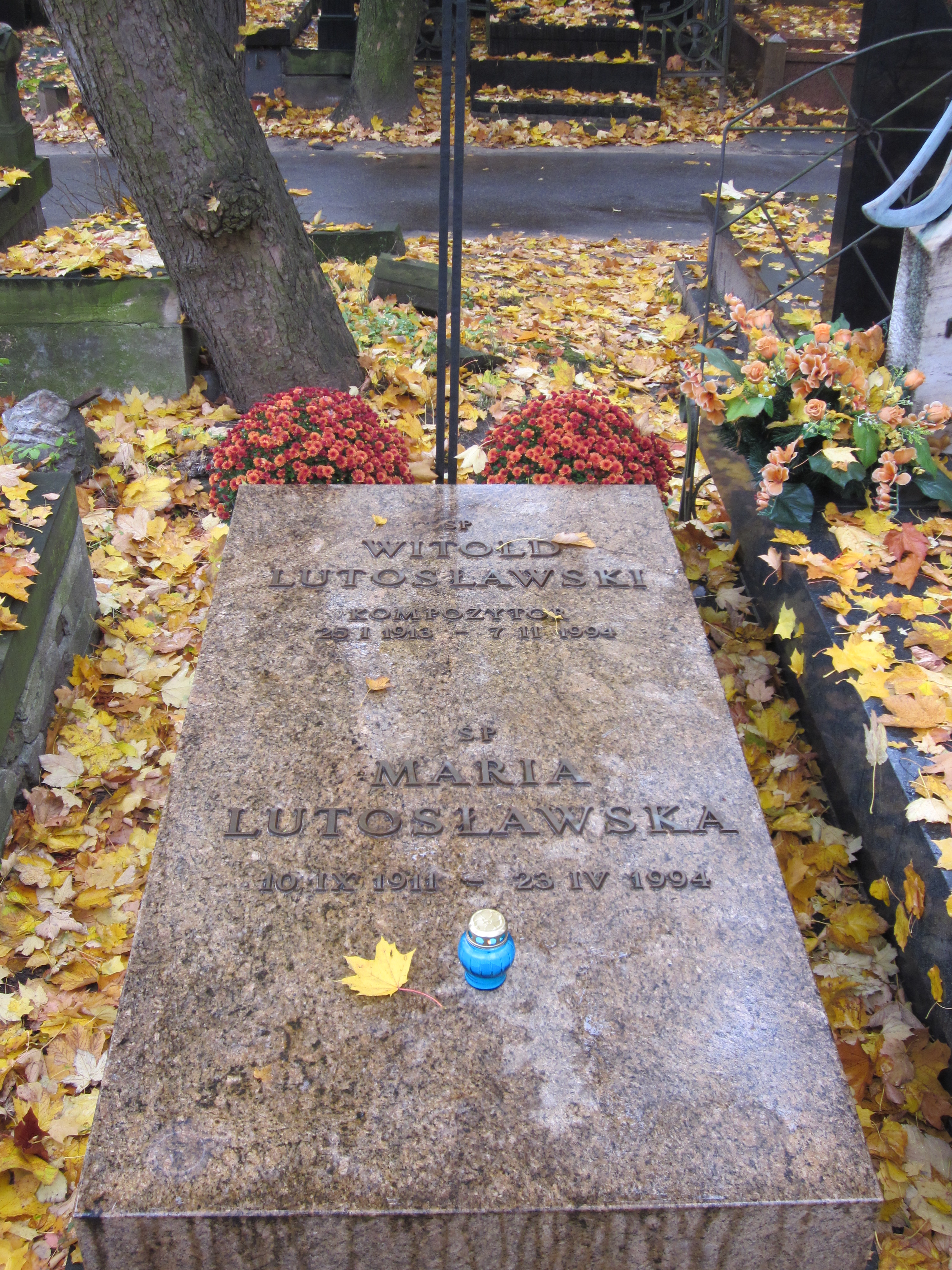
Some distance away, not far from the cemetery chapel, lie a number of composers and conductors who shaped Polish music in the second half of the twentieth century.  First and foremost, there’s the grave of Witold Lutosławski and his wife.

Here’s the grave from the rear.  I was present at his funeral and watched from this vantage point as his stepson climbed into the grave to place his urn on the floor of the chamber.  It now has a classically restrained gravestone and had evidently been attended to recently.

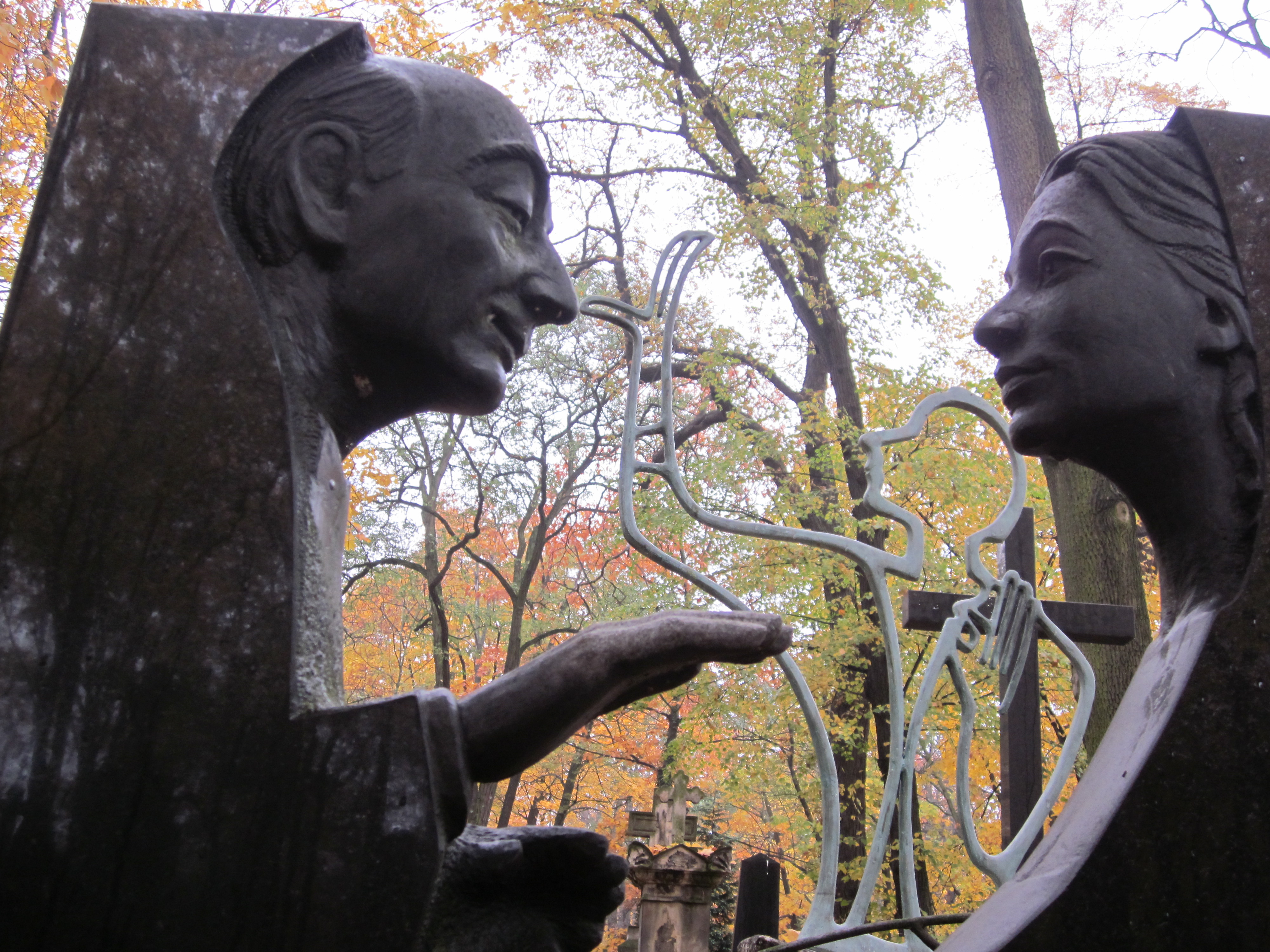
Next door lies that great champion of Polish music, the conductor Witold Rowicki. His grave is more demonstrative!

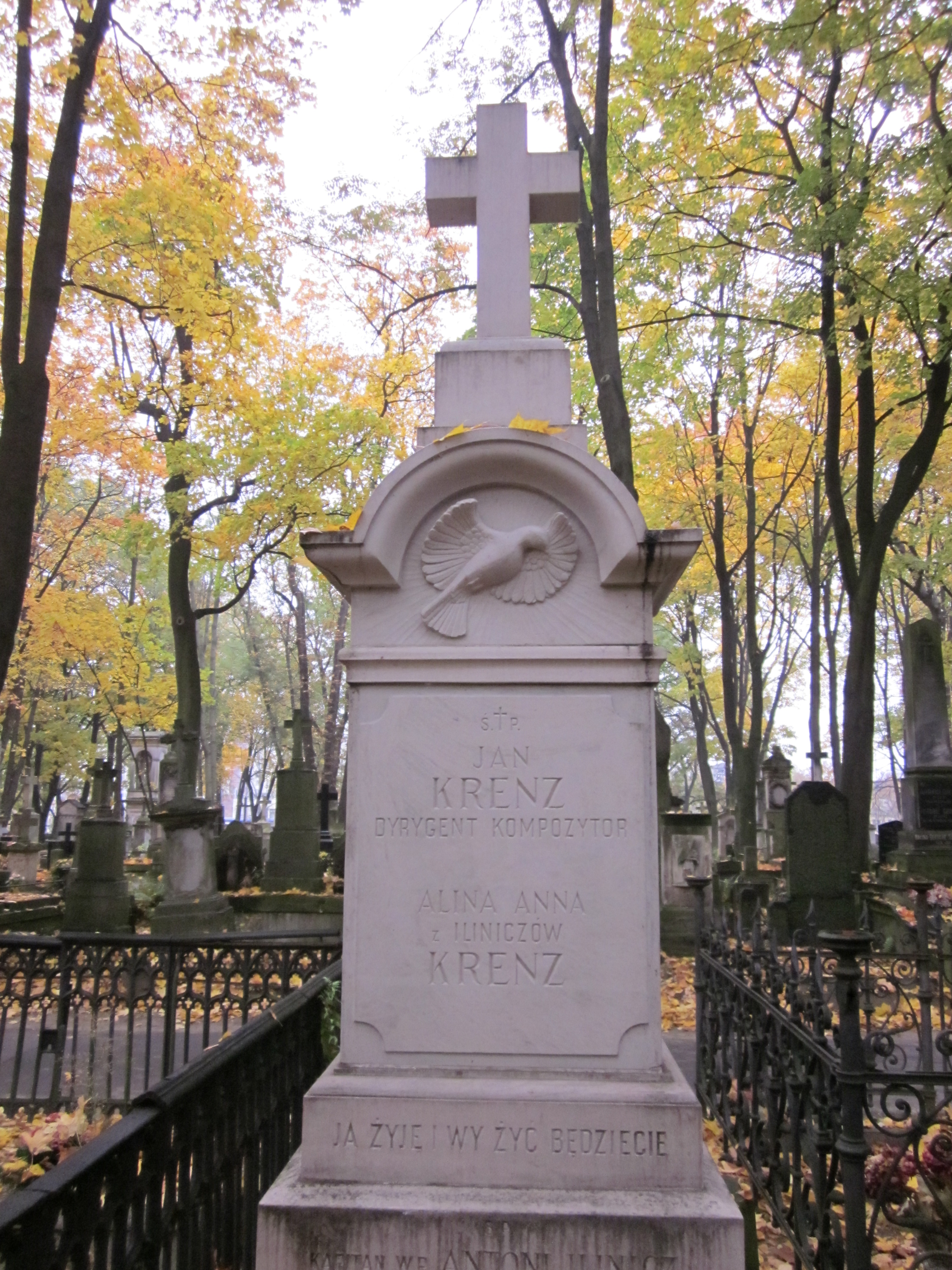
A little further to the right of Rowicki’s grave is one set aside for Jan Krenz, a champion of contemporary Polish music.  It seems strange to me (but it’s not unusual there) that such monuments are erected before death.

Behind Rowicki’s grave is that of Stefan Rachoń – a far less well-known conductor, at least outside Poland –  and his widow, the opera singer Barbara Nieman.

On the other side of the main path from these graves are several more.  Notable among them are those of Kazimierz Serocki and Tadeusz Baird, whose music deserves to be far more widely known and appreciated.  Baird, Krenz and Serocki formed ‘Grupa ’49’ as the youngest generation of composers during post-war socialist realism.

…….

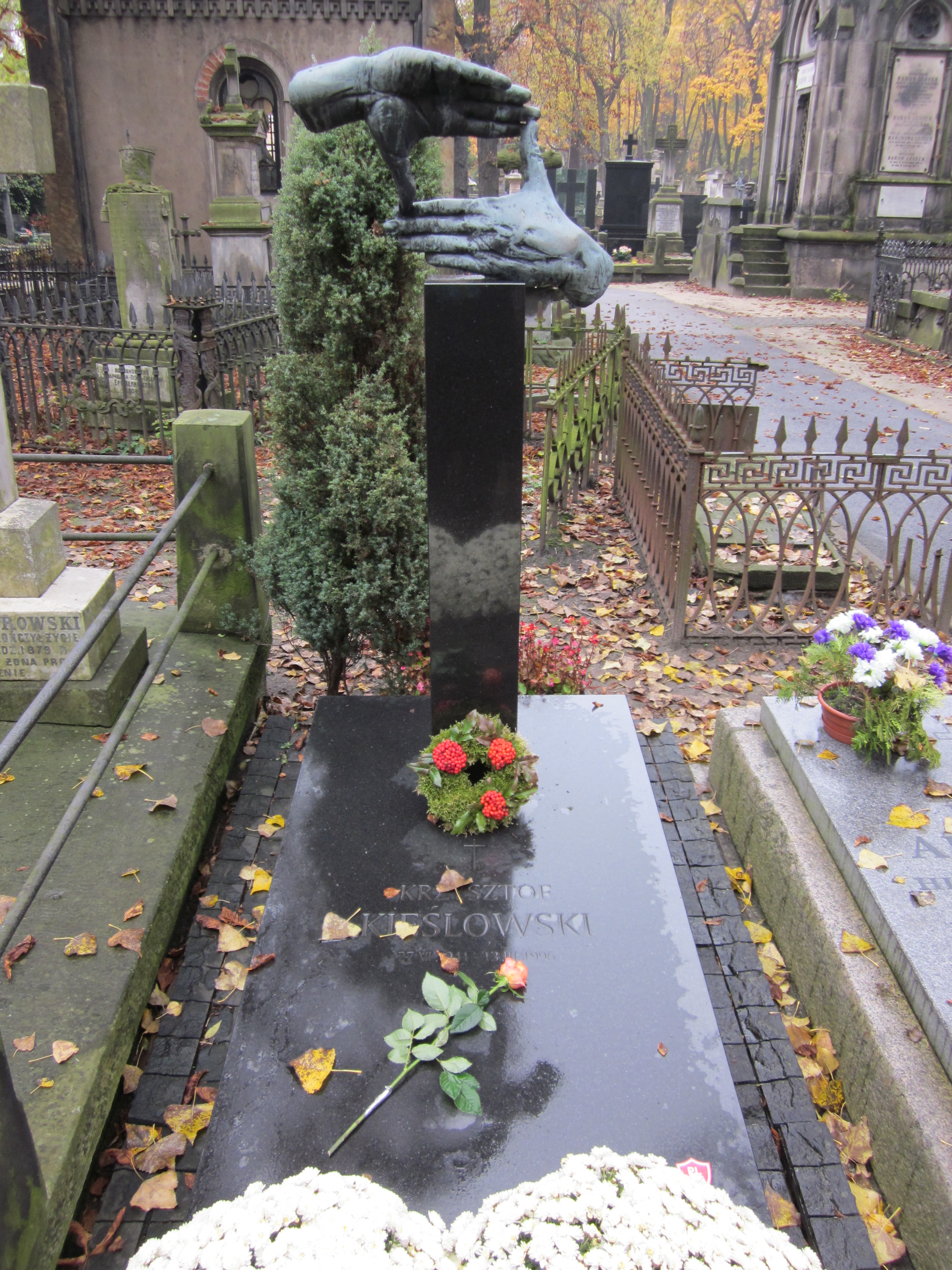
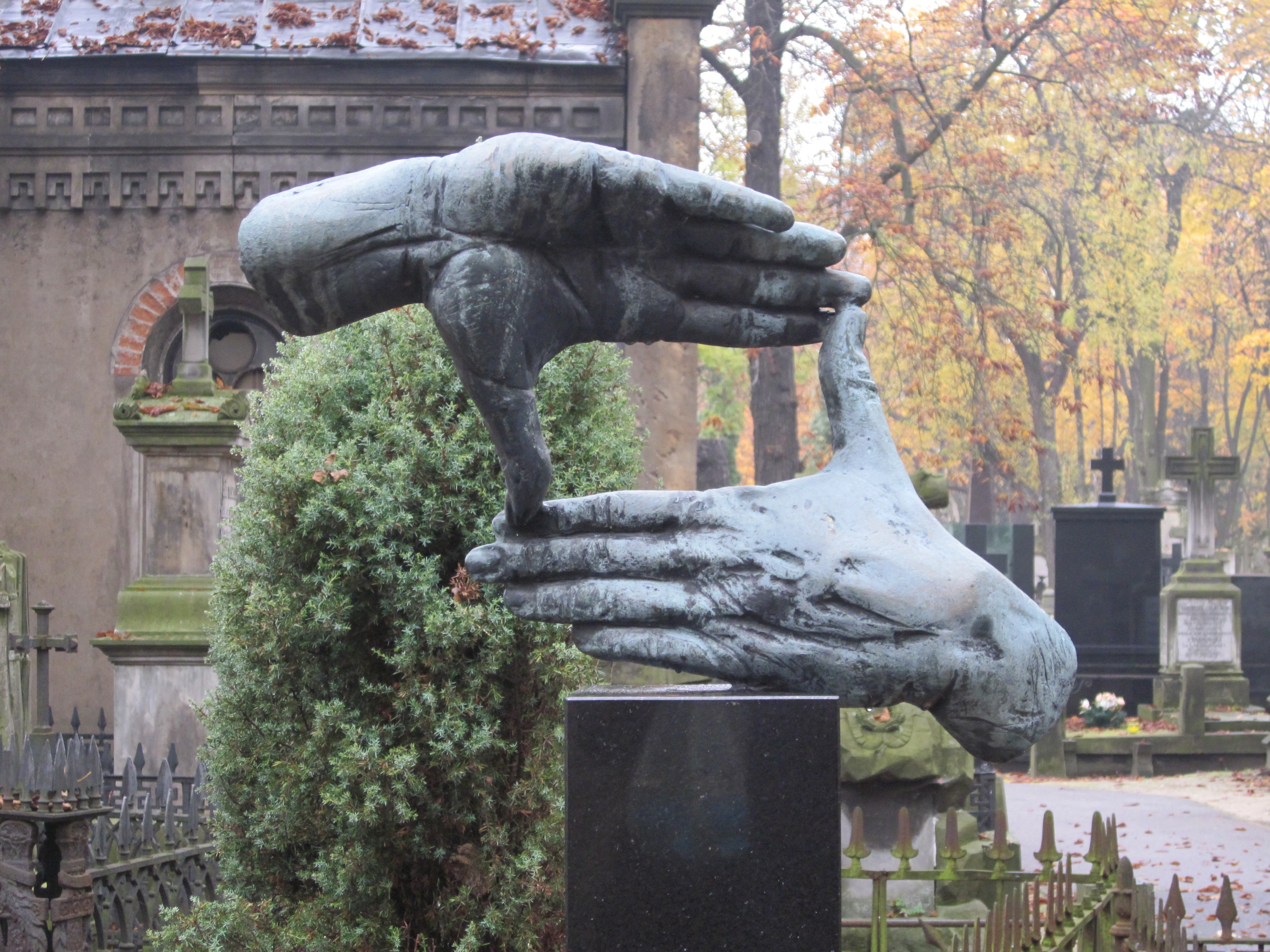
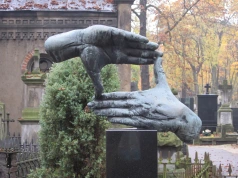
One of the most striking graves is that of the film-maker, Krzysztof Kieślowski.  If only I had his eye for framing.

• Prix Europa for ‘Warsaw Variations’

Huge congratulations to Alan Hall of Fallingtree Productions on winning ‘Best European Radio Music Programme’ last week at the 2012 Prix Europa in Berlin. The award was given for his half-hour programme ‘Warsaw Variations’, first broadcast on BBC Radio 4 on 20 December 2011.

‘Warsaw Variations’ charts the musical friendship of Witold Lutosławski and Andrzej Panufnik during and after World War II.  Among its interviewees are Camilla Panufnik, my former PhD student Beata Bolesławska and myself. Alan was one of my colleagues at Radio 3 in the early 1990s.  He later went independent and is one of the most inventive and insightful producers around.  It was an absolute delight to work with him again.

You can hear the programme via the Fallingtree website:
• http://fallingtree.co.uk/listen/warsaw_variations

A few other links:
• http://www.thenews.pl/1/11/Artykul/116810,BBC-radio-feature-on-Polish-music-wins-Prix-Europa-
http://www.fallingtree.co.uk/news/2012/triple_awards_success_at_the_prix_europa!
• https://www.facebook.com/fallingtreeproductions

• History of Music in Poland: Romanticism

[Book Review]

I hope to review the occasional book, recording and musical event in these posts.  These reviews are intended to be indicative rather than comprehensive.  To date, I’ve turned my attention to two topics: Lutosławski’s Cello Concerto on YouTube (4 December 2011) and Polish Music ‘Muzyka Nowa’, WQXR (25 January 2012).  I’ve now got round to looking at a two-volume study of Polish music and musical life during the second half of the nineteenth century:

• Irena Poniatowska, Romanticism Part 2A, 1850-1900: Musical Output (Warsaw: Sutkowski Edition, 2011), 424pp. ISBN 978-83-917035-7-1
• Elżbieta Szczepańska-Lange, Romanticism Part 2B, 1850-1901: Musical Life in Warsaw (Warsaw: Sutkowski Edition, 2011), 481pp. ISBN 978-83-917035-7-1

These two complementary volumes constitute vol.5  from the series ‘The History of Music in Poland’.  They were first published in Polish in 2010 and have been ably translated into English by John Comber (who has worked on all the volumes in the series).  They effectively cover the history of Polish music from the death of Chopin (1849) to the establishment of the first properly professional symphony orchestra, the Warsaw Philharmonic (1901).

The series is the brainchild of Stefan Sutkowski, who turned 80 in March this year.  His musical career has been extraordinarily varied.  In 1954-1974 he was an oboist with the National Philharmonic and therefore played a role in the premieres of a host of new Polish compositions.  From 1957, he also took the initiative in developing the performance of early music in Poland (Musicae Antiquae Collegium Varsoviense).  This strand in his activities led eventually to the establishment of the Warsaw Chamber Opera and a series of special festivals devoted to Mozart (1991), Baroque Opera (1993), Rossini (1999) and Handel (2000).  He also founded Pro Musica Camerata in order to disseminate Polish music through new printed editions of early music and on CD.

‘The History of Music in Poland’ has done something never before attempted: a history from medieval times to the present, in Polish and, more importantly, in English.  For the first time, non-Polish readers are able to obtain both an overview and more detailed insights into the many riches of Polish musical culture.  I should add that there is also one specific volume that, unfortunately, has yet to be translated.  This is not on an historical period, as elsewhere in the series, but on a single composer.  Tadeusz Kaczyński’s chronicled reminiscences in Lutosławski. Zycie i muzyka (Lutosławski. Life and Music), published in 1994 but apparently no longer available, is a mine of information, so I hope that plans are afoot for it to appear in English.

Musical Output

Poniatowska’s volume on musical output is organised by genre, ten in all: opera, ballet, song, cantata, choral music, sacred music (oratorio, mass, organ music), symphonic music, the instrumental concerto, chamber music and piano music.  These chapters are further divided.  The last, for example, consists of an informative introduction and subsections on the etude, sonata, variations, suites and collections of works, romantic salon-style lyrical miniatures (with further headlines for characteristic Polish dances), profiles of three individual composers (Stolpe, Zarębski and Paderewski), and an account of the reception and resonance of Chopin’s music.

The volume begins with an invaluable synoptic table covering over 40pp, tabulating side-by-side the four chronologies of world history and culture, Polish history and culture, European music and Polish music.  Her first chapter succinctly sketches in the historical, cultural and educational contexts within which Polish music of this period existed.

The ten subsequent chapters on genre are designed as a ‘handbook’, synthesising and building upon existing scholarship.  The overview that emerges will be new to many Polish and non-Polish readers.  Despite the obstacles put in the way of cultural activity – in admittedly different degrees – by the three partitioning powers of Russia, Prussia and Austria, there is far more to be discovered in these fifty years than has previously been recognised.  Music history has focused on Moniuszko (opera, vocal music), Wieniawski (music for violin), Paderewski (music for piano), with further reference to Zarębski, Żeleński and Noskowski.  The reputation of Polish music of the period has therefore rested on the shoulders of six or so composers, mainly because their music found its way into print during their lifetimes or, in the case of Zarębski’s Piano Quintet (1885), almost fifty years after his death.  There is still a backlog of manuscripts and performing materials in Polish archives.  There would have been even more had a huge amount not been destroyed during World War II.

What Poniatowska has achieved here is to place a newly widened range of Polish composers and their music in the public eye.  In the chapter on opera, there are outline analyses of plots, numbers and music styles, creating, by the variety and extent of observation, a compelling narrative of the range of output of several dozen composers (I lost count).  The same is true of the other chapters.  While opera was evidently the genre that thrived best in these turbulent decades, symphonic music was ‘most modest’.  That’s putting it kindly.  With no dedicated symphony orchestras, where were the opportunities?  It was a desert for new Polish symphonic music (with a few exceptions) until the turn of the century, so it is understandable that Poniatowska should extend her chronological envelope to 1910 in this chapter to include the symphonies by Paderewski and Karłowicz, though interestingly there is no mention of Szymanowski’s First Symphony (1907).  Yet, in the light of Szczepańska-Lange’s account, it is sad to realise that the moderately active concert life of the period did not extend as fully as it might to the support and development of homegrown compositional talent.

I can testify to the value and usefulness of this book.  I’m currently writing a CD note on three works for piano and orchestra by Żeleński and Zarzycki, a composer who until now has just been a name to me.  I know that I shall be indebted to the information on these composers and their pieces, as there is nowhere else to access it in such a comprehensive and readable compendium.

Musical Life in Warsaw

Szczepańska-Lange’s chronicle of Warsaw in the second half of the nineteenth century is a different kind of book, focused on one city and divided into just two very substantial sections: opera and concert life. These are each subdivided into an introduction and mainly a chronological sequence of smaller periods.  The chapter on concert life also has subdivisions concerned with individual features such as charity concerts and the move towards the founding of the Warsaw Philharmonic.

Szczepańska-Lange marshalls her materials deftly, with plentiful excerpts from newspaper reports bringing the narrative to life.  She has sifted through a wealth of sources (she gratefully acknowledges the friendly atmosphere of the microform reading room of the National Library where she spent ‘hundreds of hours’), and her diligence, perceptiveness and enthusiasm show through.  In particular, she has detailed the vagaries of political pressures from Russia and their impact on cultural organisations.

A measure of how Warsaw more or less managed to keep up with opera houses to the West (Wagner excepted) may be gleaned from the dates of key premieres: Don Carlos (1873), Aida (1875), Lohengrin (1879), Mefistofele (1880), Carmen (1882), Tannhäuser (1883), La Gioconda (1885), Manon (1888) and Otello (1893).  Language for performance became problematic: the Warsaw premieres of Eugene Onegin (1899) and The Queen of Spades (1900) were both given in Italian, symptomatic of the times.  Warsaw Opera was no different from its counterparts in its intrigues, but its repertoire during this period of occupation was surprisingly wide and varied.

Although Wagner’s operas from The Ring onwards were not performed in Warsaw until well into the twentieth century, preludes and excerpts did occasionally appear on concert programmes (the Prelude to Parsifal in 1883). Concert music was a very poor cousin to opera, with no adequate venues, infrequent visits by virtuosi like Wieniawski, and concert-going habits quite different to those which developed later.  The distinguished Polish author Stefan Żeromski wrote in his diary about a concert that Anton Rubinstein gave in 1880:

The hall was overcome by the most remarkable silence in concert history; it was something truly incredible, almost no one was late; and what is even more unlikely, no one ran out for their garments to the cloakroom during the last number; the ladies refrained from conversing aloud; and the gentlemen did not go out after every number for a cigarette!  Verily, one has to be such an Orpheus as Rubinstein to perform such miracles.

Szczepańska-Lange’s overview of the period in her Introduction is a model of its kind, giving accounts of different types of events and their appearance within the chronology.  In the subsequent chronicle, the artistic and organisational comings and goings are effectively woven in with details of repertoire.  The move towards a permanent symphony orchestra began long before 1901.  In 1881, the composer Noskowski created his own orchestra with the specific intention of promoting new works by himself and others, both Polish and foreign, such as Smetana, Dvóřak and Saint-Saëns.  But little concrete happened until the very end of the century, when the conductor and composer Młynarski spearheaded the final drive to establishing not only the orchestra but also the Philharmonic Hall, which remains the home of the Warsaw Philharmonic to this day.

Polish composers had to fend for themselves, usually through teaching or administration.  The few composer-virtuosi – Wieniawski, Zarębski and Paderewski – based themselves abroad.  Zarębski is an interesting case.  He studied with Liszt, toured across Europe and lived and taught in Brussels, died in 1885 in his 30s, and left a modest body of music for solo piano and the marvellous Piano Quintet.  Ponietowska discusses his music in her volume, but Zarębski’s appearances in Szczepańska-Lange’s companion volume are few, indicating how rarely he visited Warsaw (it appears he played there only twice).  There are, however, wonderfully intemperate and sarcastic responses to his appearance in 1879 playing the Mangeot double-keyboard piano.  The interlinking of compositions and performances across these two volumes does not require the mental and physical gymnastics mastered by Zarębski on the Mangeot piano, but it does lead to a hugely enriched and enriching double account of this largely forgotten period of Polish musical history.  I for one am immensely grateful to have this new interlinked resource on my bookshelves as I prepare my CD note on Żeleński and Zarzycki.

What neither of these books does is to engage with aesthetic and philosophical approaches to Romanticism.  This is not for want of knowledge or understanding.  It is simply that these books have a different and more basic goal: to put into print the essential facts about the largely hidden composers and music of this period in Polish culture.  They offer opportunities for the rest of us to explore further, but that exploration will not come to much unless scholars edit and publish the scores so that performers, broadcasters and recording labels can enable us to hear the music.  What has until recently been dismissed as a dank backwater of European music may then be seen and heard to have had a much more intriguing and lively character, if these two volumes are anything to go by.  At that point, issues concerning the term ‘Romanticism’ within the Polish context will come into focus.

• The Pianist (b. 5.12.1911) and his Red Bus

Thanks to an alert last night from a friend in Warsaw, I was reminded that today marks the centenary of the birth of Władysław Szpilman (1911-2000). Szpilman was well-known in Poland from the 1930s as a fine concert pianist and as a composer of concert music and popular songs, especially after World War II.  He recounted his extraordinary survival of the war in his memoir Śmierć Miasta (Death of a City).  The memoir was republished in English as The Pianist shortly before his death and turned into an award-winning, internationally popular film of the same title by Roman Polański (2002), with Adrien Brody playing the lead role.

I once sat behind the quiet, elderly Szpilman at a concert in Warsaw.  I regret not speaking to him.  Later, I wanted to reproduce the opening page of one of his songs – Jak młode Stare Miasto (Like The Young Old Town, 1951) – in my book Polish Music since Szymanowski (Cambridge, 2005).  But permission was refused by his family as they thought that some of his songs were not representative of his talents (and also perhaps because 1951 was the height of the socialist-realist push in the arts). Yet this hugely popular song had already been released on CD (‘Golden Hits of Socialism’ [!], Intersonus ISO84).  Such is the unpredictability of copyright permission.

In 2000, Polish Radio issued a 5-CD set of Szpilman’s performances and compositions (PRCD 241-245):

• CD 1: 19 songs (1952-91).
• CD 2: Szpilman as pianist – including in his own Concertino (1940), Rachmaninov’s Rhapsody on a Theme of Paganini (1954), Schumann’s Fantasy in C Major (1960) and two pieces by Chopin, including the Nocturne in C# minor (1980) with which he both closed Polish Radio broadcasts in 1939 and reopened them in 1945.
• CD 3: Szpilman as a member of the Warsaw Quintet – piano quintets by Brahms and Schumann (1963-65).
• CD 4: Szpilman with Bronisław Gimpel (who also led the Warsaw Quintet) – violin sonatas by Brahms (no.3), Grieg (no.3) and Franck (1958-65).
• CD 5: songs for children including three extended ‘musical fairytales’ (1962-75).

One of Szpilman’s most popular songs was Czerwony Autobus (The Red Bus, 1952).  The recording on CD 1 above is particularly fine, not least because of its sense of good humour, considerably aided by Szpilman’s own swinging piano.  Search it out if you can.  That recording was made by the best close-harmony male-voice quartet of the time, Chór Czejanda (Czejanda Choir).  They also made another, longer recording with dance orchestra.  In the YouTube video below (Legendy PRL: Legends of the Polish People’s Republic), this audio recording is accompanied by shots of Warsaw buses in various ‘picturesque’ locations of the post-war socialist capital [14 October 2014: the original video – www.youtube.com/watch?v=x_xZGriR2DE – has since been withdrawn ‘for multiple third-party notifications of copyright infringement’.  But there are several other videos with the same recording, so here’s one of them instead.  The video element this time is not of buses, sadly, but still shots in black and white of scenes in Warsaw in the 1950s].  I’ve put my translation of the first three verses below.  Enjoy!

When at dawn I run like a wind through the streets,
The city like a good friend welcomes me,
And – honestly – I wish you all such happiness
As every day gives me in Warsaw.

On board, please!  No-one will be late for work,
We will go quickly, even though we’re surrounded by a forest –
A forest of scaffolding, which really does mean
That here time does not stand still.

The red bus rushes along my city’s streets,
Passes the new, bright houses and the gardens’ cool shade.
Sometimes a girl will cast us a glance like a fiery flower.
Not only ‘Nowy Swiat’* is new – here each day is new.

* ‘New World’, a beautiful old street in Warsaw, reconstructed after the war.

[For more information, go to http://www.szpilman.net/]

• Lutosławski and Paganini

Yesterday, I wrote a CD note for the piano and orchestra version (1978) of Lutosławski’s tour-de-force for two pianos, Variations on a Theme of Paganini (1941).  It took me back over twenty years to when I conducted this version with the composer Kevin Volans at the piano and the Queen’s University SO in Belfast.  We had enormous fun, especially with the syncopations, and the one slow variation, no.5, was magical in its simplicity.  We especially liked kicking in with the funky rhythms of variation 9.  What makes the orchestral version so rewarding is that Lutosławski repeats all but variations 10 and 11, swapping the solo and orchestral material for the repeat.  (In fact, Paganini repeated the last 8 bars of each variation as well as the first 4, so Lutosławski’s orchestral version comes closer in its proportions to Paganini’s.)  This way, he was able to give himself space to show off his scintillating orchestration and make this version a real match for the original.

It set me thinking about the circumstances in which Lutosławski composed his Variations.  Musical life was heavily circumscribed in Nazi-occupied Poland.  To scrape a living, Lutosławski and his fellow composer and pianist Andrzej Panufnik, then in their mid-late 20s, formed a piano duo and played in musical cafés.  The Poles have always been resilient, and in the darkest days of the Second World War anything that lightened the mood and distracted people from their grim circumstances was welcomed.  These cafés promoted all sorts of music, from complete cycles of the Beethoven sonatas to popular song and the light-music arrangements made by Lutosławski and Panufnik.  They made over 200 such arrangements, but all were destroyed in the Warsaw Uprising of 1944.  Lutosławski luckily took the score of the Variations on a Theme of Paganini with him when he fled the city.  It whets the appetite for what we might have enjoyed had their arrangements survived and it’s a testament to the brilliance of their pianism.

A further thought on the aptness of Lutosławski’s take on Paganini’s Caprice no.24 for solo violin.  Unlike Brahms, Rachmaninov and others, Lutosławski sticks close to the structure and material of Paganini’s original.  In that sense it veers more towards being a modern realisation than a new composition.  But he brings such imagination, joy and panache to the task, adding textures, counterpoints and edgy harmonies.  It seems to me that, of all those composers who’ve been fascinated by Paganini’s theme and the virtuosity of this caprice, Lutosławski has come closest to its pyrotechnical spirit and yet made it his own.

I’m sharing a live recording (26 July) from this year’s Verbier Festival, where the pianists were Evgeny Kissin (I) and Martha Argerich (II).  I was astonished to realise that Argerich is the same age as the Variations.  Where other pianists sometimes push the tempos beyond their technique and mush the rhythms, the performance of Kissin and Argerich is crystal clear, glittering, with only a rushed cadence at the very end to mar a thrilling 5’.  The original uploader has provided the printed music, expertly synced, for those who want to see as well as hear what a technically challenging piece this is!


You can also watch the performance on <http://www.medici.tv/#!/verbier-festival-celebrates-2011>.