• Signposting Panufnik

unnamed-1

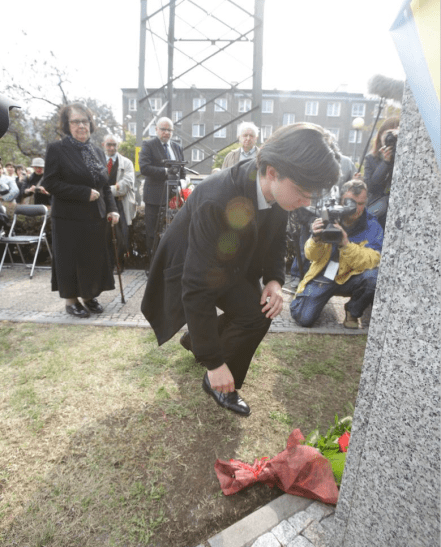
My thanks to Michał Kubicki for taking the trouble to photograph the new sign for Aleja Andrzeja Panufnika (Andrzej Panufnik Avenue).  It was unveiled yesterday in Warsaw in the presence of Panufnik’s widow Camilla and son Jeremy. Officials present included the Mayor of Warsaw.

The avenue is located in Morskie Oko (Eye of the Sea) Park in the Mokotów district south of Warsaw’s city centre.  It runs directly east from the arterial Puławska Street that heads south through Warsaw.  The newly-named avenue leads to the Szuster Palace, where one of Panufnik’s grandmothers once lived.  It was an area that Panufnik knew very well, and it is a nice touch that the Warsaw Music Society now has its headquarters in the palace.

• Panufnik in Warsaw (Aug-Sept)

Screen Shot 2014-08-16 at 10.38.26A phone call today from the director of the ‘Chopin and his Europe’ festival in Warsaw has alerted me to a raft of Panufnik performances that this imaginative festival is including this year.  Lutosławski was similarly honoured by the festival on his centenary last year.  In May I wrote a post here, Panufnik Centenary, giving some details of the worldwide coverage of his music in 2014.  Last week, BBC Music Magazine published my profile of Panufnik, ‘Poland’s Great Exile’ (its subtitle, not mine), in its regular ‘Composer of the Month’ slot.

I’ll pass over the loss, in the editing of the article, of my comment that the BBC Proms have ignored the Panufnik centenary.  And it remains the case that there are rather large repertoire gaps elsewhere in the centenary celebrations, such as the continuing absence of four of the symphonies (an improvement on the situation in May; see next paragraph).  Even the ‘Warsaw Autumn’, which reintroduced Panufnik’s music onto Polish concert platforms in 1977 (after a gap of 23 years following his escape to the UK) – and programmed eleven of his works when Panufnik visited Poland for the first and only time in 1990, is not marking the centenary.  It is a bit perplexing that it has passed up this opportunity to celebrate its key role.  It is, however, providing an umbrella for a three-day conference ‘Andrzej Panufnik i jego wizja muzyki’ (Andrzej Panufnik and his Vision of Music’, 24-26 September), which the Chopin Music University has organised.  The conference also includes a series of chamber concerts outside the ‘Warsaw Autumn’ programme.

The day after the ‘Warsaw Autumn’ ends, Polish Radio is hosting a concert of Panufnik’s orchestral music which plugs two earlier gaps in the celebrations: the orchestral Nocturne and Sinfonia rustica, both works dating from the late 1940s. The programme is completed by the Cello Concerto, played by Raphael Wallfisch.  The conductor is Łukasz Borowicz, whose recently completed 8-CD set of Panufnik recordings is a dynamic survey of the orchestral music.

It has been left to other festivals to provide audiences with cross-sections of Panufnik’s music, and two of these take place this month.  The Presteigne Festival in mid-Wales is one, and I posted on its repertoire in May: Poles in Presteigne.  The Panufnik component in Warsaw’s ‘Chopin and his Europe’ is as follows:

• Twelve Miniature Studies for piano (Cycle of Fifths) (1947)
• Piano Concerto (1961)
• Violin Concerto (1971)
• Sinfonia concertante for flute, harp and strings (Symphony no.4) (1973)
• String Quartet no. 1 (1976)
• String Quartet no.2 ‘Messages’ (1980)
• Arbor cosmica for strings (1983)
• String Sextet ‘Train of Thoughts’ (1987)
• Symphony no.10 (1988)
• String Quartet no.3 ‘Wycinanki’ (1990)
• Cello Concerto (1991)

• MoMA on Polish Music

moma-logo-post-new1Yet another initiative that I missed earlier this year is a series of essays and other items emanating from New York’s Museum of Modern Art.  I came across MoMA’s post – notes on modern and contemporary art around the globe while writing my preceding post about the late Bohdan Mazurek.  On 19 December 2013 MoMA published a theme called Polish Radio Experimental Studio: A Close Look, in which Mazurek features.

This really is a superb English-language introduction to one of the ground-breaking initiatives in Western and Eastern European music in the 1950s.  PRES was the brainchild of Józef Patkowski. It was a most unlikely development in communist Poland and one that had a profound impact on the sound of Polish music.  Many composers, including Penderecki, Kotoński, Schäffer and Dobrowolski, made use of its expertise (principally Bohdan Mazurek and Eugeniusz Rudnik), and soon non-Polish composers also flocked to use its facilities.

The MoMA theme includes the following:

Essays

• Daniel Muzyczuk, ‘The Future Sound of Warsaw: Introduction to PRES
• David Crowley, ‘Spatial Music: Design and the Polish Radio Experimental Studio
• Michał Libera: Alchemist Cabinet of the Polish Radio Experimental Studio: Music Scores of and for Experiments

Interview

• Daniel Muzyczuk, ‘How much Rudnik is in Penderecki, and how much Rudnik is in Nordheim?  Interview with Eugeniusz Rudnik

Scores

• PRES Music Scores 1959-1972
[browsable scores originally published by PWM]
• Kotoński Music for One Cymbal Stroke (1959)*
• Dobrowolski Music for Magnetic Tape (1963)*
• Schaeffer Symphony – Electronic Music (1964)*
• Dobrowolski Music for Magnetic Tape and Oboe Solo (1965)
• Dobrowolski Music for Strings, Two Groups of Wind Instruments and Two Loudspeakers (1966)
• Kotoński Aela. Electronic Music (1970)*
• Dobrowolski Music for Magnetic Tape and Piano Solo (1972)*

No sound files are included on the MoMA site, but there is a fascinating double CD (2013) from Bôłt Records that brings together the original realisations of the five scores marked * above, plus modern realisations of the same pieces.  The two CDs are called PRES Scores and also include then-and-now versions of Penderecki’s Psalmus (1961).

• Bohdan Mazurek (1937-2014)

kronika_3_-_mazurekThe Polish composer and sound engineer Bohdan Mazurek – a key figure in the development of electronic music in Poland – has died at the age of 76.  Alongside Eugeniusz Rudnik, Mazurek helped to develop the Polish Radio Experimental Studio after its foundation in 1957 by Józef Patkowski into a central force in Polish music in the 1960s and 70s.  He assisted many composers in realising their electronic music but was also a composer, in his own right, of both electronic and film music.  His music won prizes in several competitions (Dartmouth, Bourges) and he taught not only at the Warsaw Music Academy but at several institutions in the USA.

I knew Bohdan Mazurek early on in my involvement in Polish music.  He was a gentle giant, modest and with a selfless devotion to his metier.  He was a thoroughly decent and lovely man and I recall spending many good-spirited hours in his company.  He helped me hugely as I tried to find my way in the rich panorama of Polish music.  His own music went largely undervalued, with very little percolating abroad.  Bozzetti was, however, included in the 1970 boxed LP set ‘Electronic Panorama’ (Philips 6740 001), which profiled new electronic compositions from Paris, Tokyo, Utrecht and Warsaw.

br_es02Fortunately, in 2010  the Warsaw-based independent label Bôłt Records, in partnership with Polish Radio and Foundation 4.99, issued a double CD of Mazurek’s music, Sentinel Hypothesis’.  It includes an excellent essay and notes by Bolesław Błaszczyk. The twelve works on these discs are: Bozzetti (1967), Epitaph for Jan Palach (1969), Sinfonia Rustica (1970), Canti (1973), Ballade (1976), Children’s Dreams (1976), Daisy Story (1977-79), Six Electronic Preludes (1981), From the Notebook (1983), Letter to Friends (1986), Pennsylvania Dream (1987), Reverie (1989).

An appreciation just published (in Polish) at culture.pl includes YouTube links for Bozzetti (1967) and Canti (1973).

OBITUARY

• BBC R3 ‘Polska!’: 19 November 1993

Screen Shot 2013-11-18 at 20.26.52Twenty years ago today I was in Warsaw preparing to present my first ever live concert, and I could hardly have chosen a more publicised event.  I was at Studio S1 at Polish Radio, broadcasting to BBC Radio 3 for the opening concert of Polska!, the most extensive celebration of any nation’s culture mounted by a single BBC channel.  For 18 days, from 19 November to 6 December 1993, Radio 3 broadcast over 120 separate programmes involving producers, writers, performers and broadcasters not only from the musical world but many others too: poetry, fiction, drama, art, cabaret, history, cuisine, politics.

In late 1992, I was working as Head of Music at Radio 3.  I was wondering how the station might celebrate the 60th birthdays, at the end of the following year, of Krzysztof Penderecki (23 November) and Henryk Mikołaj Górecki (6 December) as well as mark the 80th birthday of Witold Lutosławski at the start of the 1993.  (Little did we know that Lutosławski had already been diagnosed with cancer as Polska! began and that he would die in February 1994.)  I went to discuss the idea of a festival with the Controller of Radio 3, Nicholas Kenyon, and we quickly realised that we had the resources to organise something really special, involving not only all the BBC orchestras and the BBC Singers but the other departments which contributed to the rich variety of Radio 3’s programming.  If I remember correctly, it was Nicholas Kenyon who came up with the title and he was unreservedly enthusiastic and encouraging.  And so Polska! was born.

Polska!

Over the next 18 days, I will be posting occasionally about Polska!, its live and recorded music repertoire, its non-musical programmes, the press coverage in the UK and in Poland, and including as many direct images of press reviews etc. as possible.

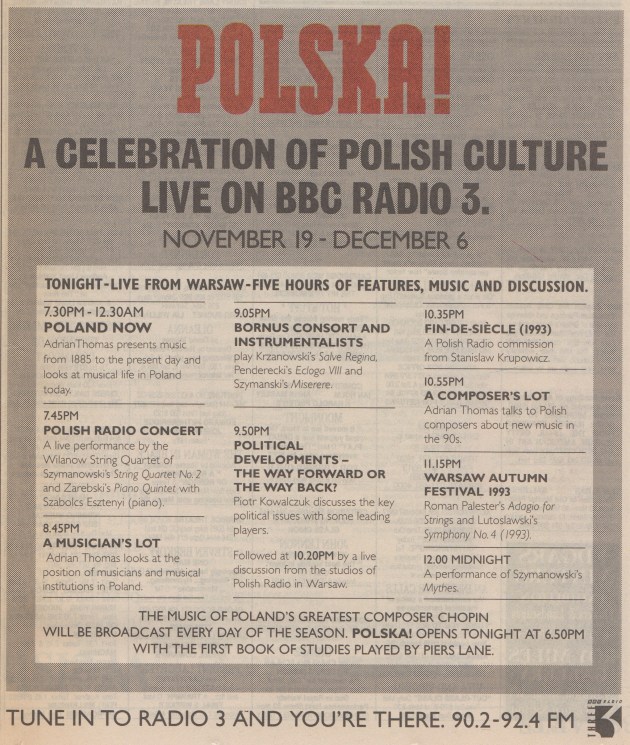
Although I had left the channel at the end of June 1993, I remained deeply involved in the planning and programming of Polska! and was slated to do some of the presentation, both in Poland and the UK.  Hence my ‘continuity’ presence in Warsaw on 19 November.  A flavour of the musical breadth of the festival may be gathered from that evening’s five-hour opener, ‘Poland Now’ (a second blockbuster came towards the end of the festival).
Homma 1993

The opening evening’s main feature was the live broadcast from Polish Radio 2.  The first half was devoted to chamber music (I was intent on including the then-neglected Zarębski Piano Quintet, which today has a deservedly higher profile), while the second consisted of contemporary vocal repertoire (including Paweł Szymański’s recent Miserere, a commission from Polish Radio).
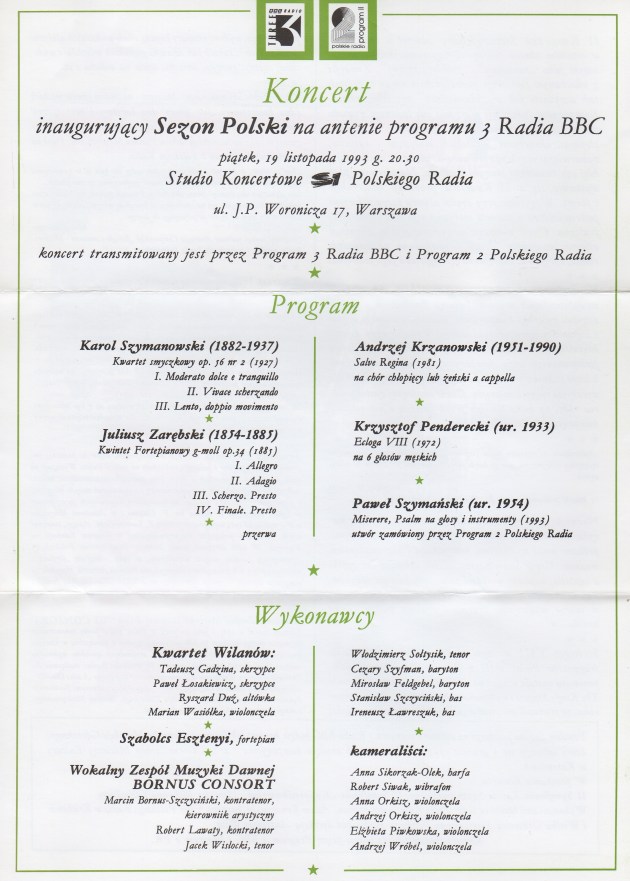
Polska! Programme 19.11.93

In the interval, for ‘A Musician’s Lot’, I talked with Szymański and two other Polish composers – Rafał Augustyn and Zygmunt Krauze –  as well as to the pianist Paweł Kowalski, to Monika Strugała, one of the organisers of the choral festival Wratislavia Cantans, to Elżbieta Szczepańska, Head of Promotion at the music publisher PWM, and to Andrzej Rakowski, a professor at the Chopin Academy of Music in Warsaw and the author of a recent report on music education in Poland.

In the 45′ profile of Polish political life – still a compelling issue four years after the ‘Round Table’ conference of 1989 had restored a level of democracy to the country – Piotr Kowalczuk was joined by Krzysztof Bobiński (Financial Times), the writer and lawyer Wiktor Osiatyński and Andrzej Wróblewski (Polityka), among others.

A second recent Polish Radio commission followed – Stanisław Krupowicz’s Fin-de-siècle, introduced by the composer and performed by WOSPR (Polish Radio Great SO), conducted by Takao Ukigaya.  For ‘A Composer’s Lot’, I was joined again by Augustyn, Krauze and Szymański, by three other composers, Krupowicz, Hanna Kulenty and Marta Ptaszyńska, and by Grzegorz Michalski from Polish Radio 2 and Elżbieta Szczepańska from PWM.

We were then able to draw on that year’s ‘Warsaw Autumn’ festival when Lutosławski had conducted a complete programme of his own music with the Warsaw PO (it turned out to be his last appearance on the podium in Poland). He talked with me about the Fourth Symphony to introduce the broadcast.  Palester’s Adagio for Strings (1954) was performed by Sinfonia Varsovia under Jan Krenz.

The evening had begun with a specially recorded performance by Piers Lane of Chopin’s Etudes op.10 (virtually all of Chopin’s music was played during Polska! and Lane bookended the festival on 6 December with the Etudes op.25).  It ended with Szymanowski’s Myths and, like every subsequent evening of the festival, the last notes were left to one or more of Szymanowski’s mazurkas.

• WL100/66: Overture, **9 November 1949

One of Lutosławski’s forgotten works is his Overture for strings, premiered on this day 64 years ago in Prague, by the city’s Radio Symphony Orchestra under the Polish conductor, and Lutosławski champion, Grzegorz Fitelberg.  It seems to have been the Overture’s fate to have been composed just as socialist realism was taking a firm grip on Polish music.  Yet there seems to be no record of it having been banned or criticised.  Even though it kept its distance from the simplicity apparently being required of Polish composers – it uses an octatonic scale and has some intriguing metric subtleties – it seems simply to have disappeared, perhaps regarded as irrelevant rather than dangerous by those with programming power.  Perhaps Lutosławski himself put it to one side; he appears never to have conducted it, and during his lifetime there were only seven performances (according to Witold Lutosławski. A Bio-Bibliography). There have, however, been five commercial CD recordings.

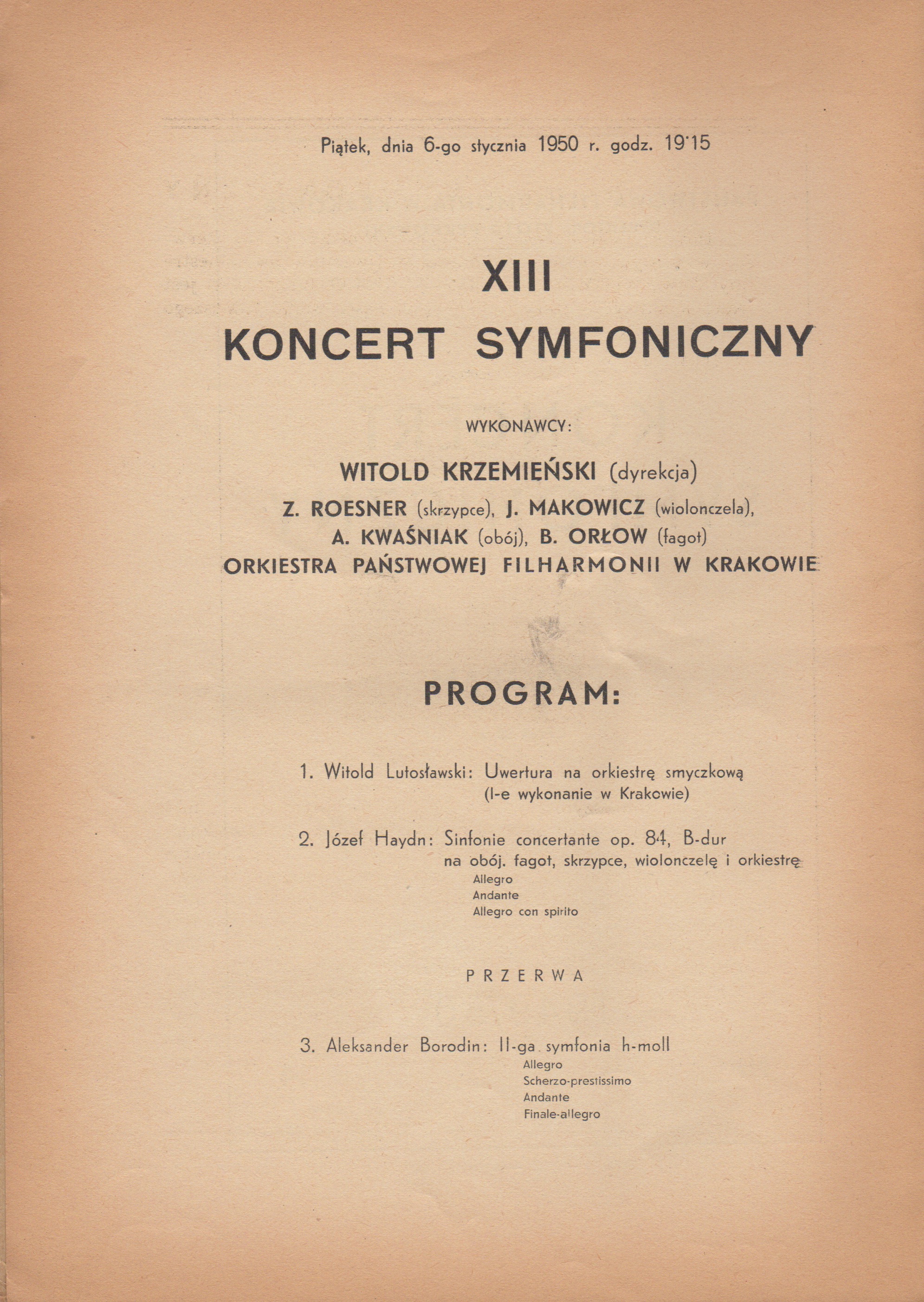
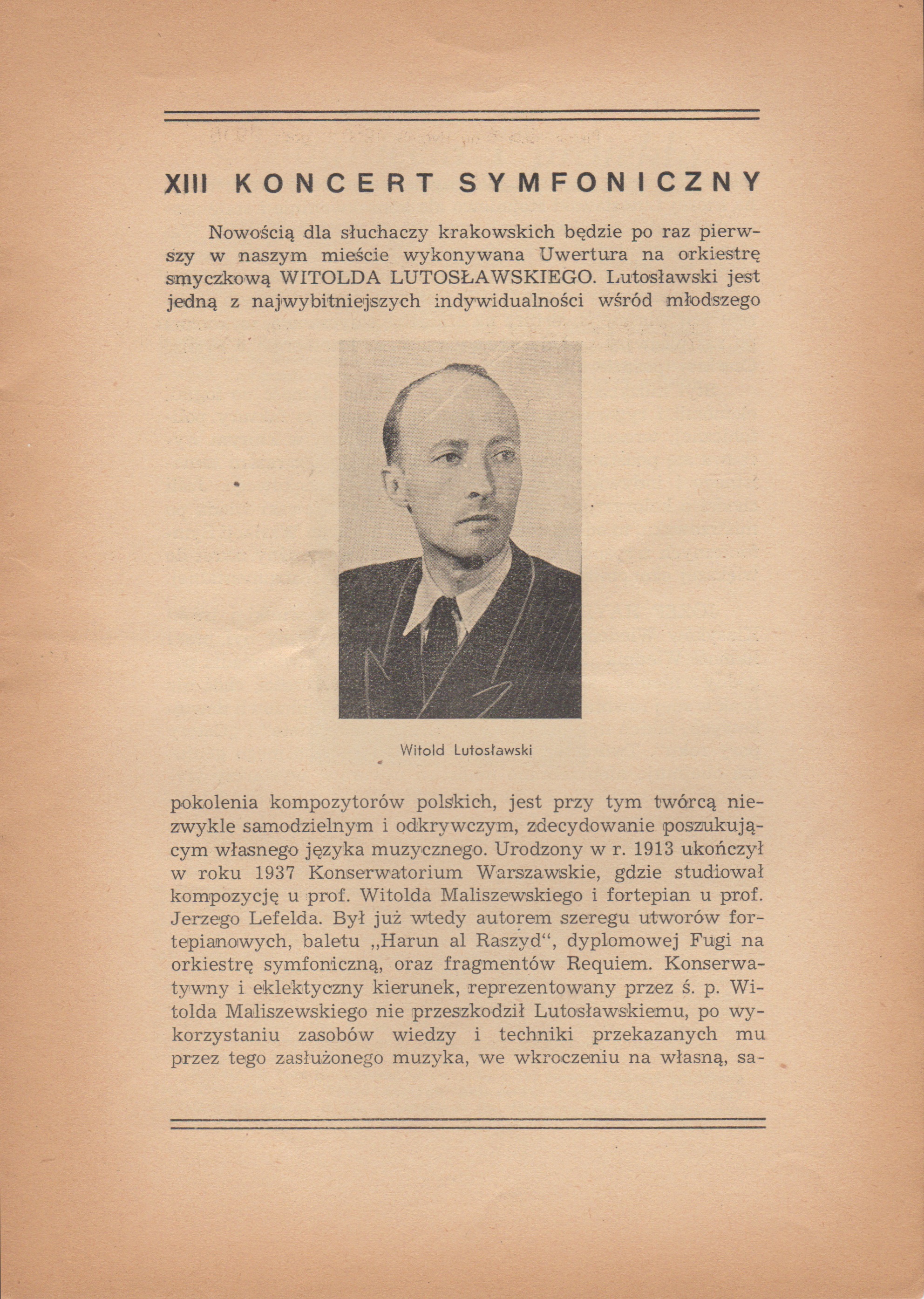
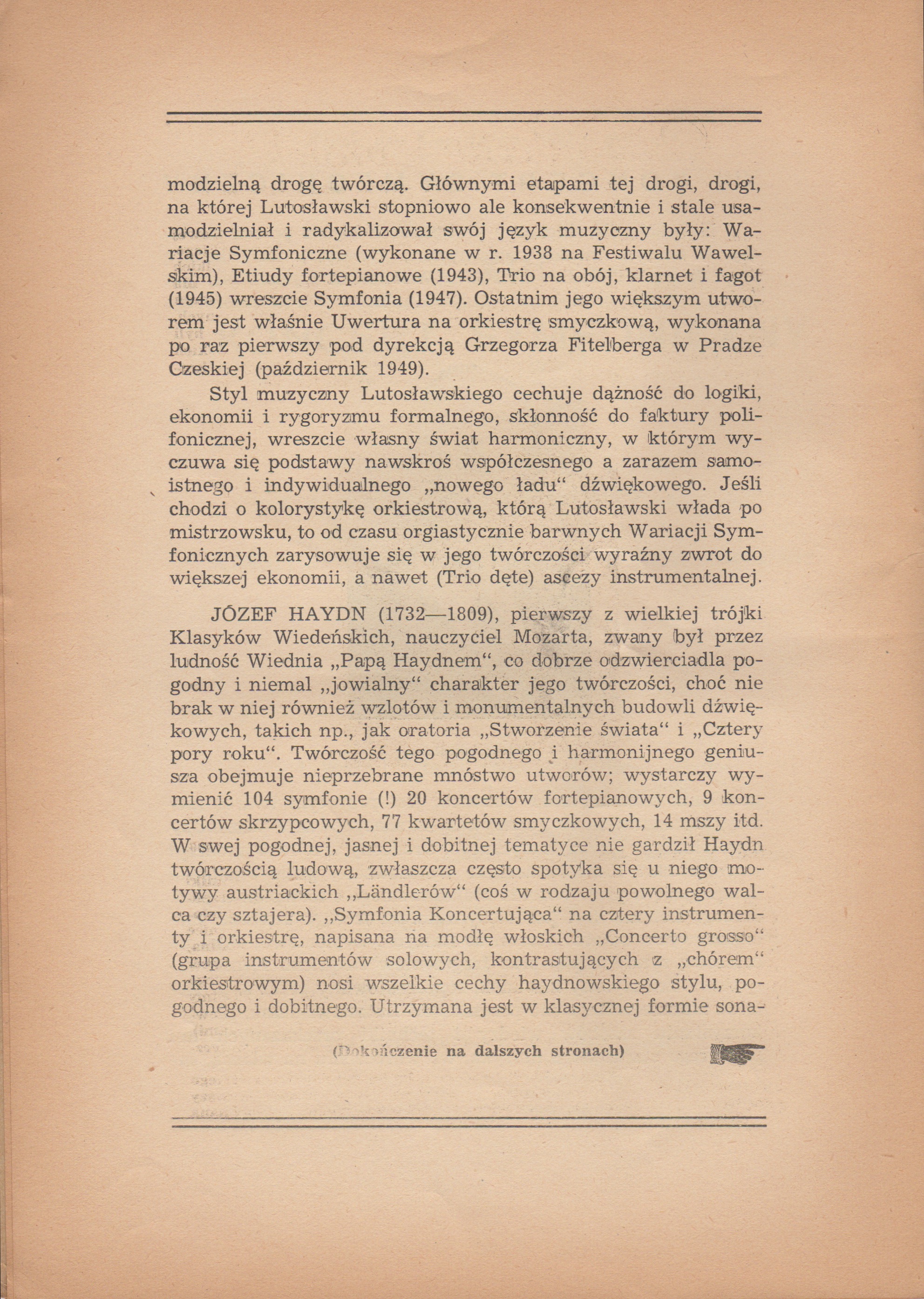
On one of my antiquarian forays in Kraków I came across the concert programme for the Overture’s first performance in the city (it looks as if it was also the Polish premiere).  It took place two months after the Prague performance, with the Kraków PO conducted by Witold Krzemieński.  The relevant pages of the programme are reproduced below, including another profile of Lutosławski – see an earlier one in WL100/54: Lutosławski and Panufnik (1945) – that sheds new light on Polish perceptions of the composer in the immediate post-war years (my translation is at the foot of this post).  There is, however, no hint in the note of state pressures for socialist-realist music, even though the concert took place just five months after the coercions unveiled at the August 1949 composers’ conference in Łagów and less than two months after official censure of his First Symphony at the Chopin Competition in Warsaw.  But Kraków was always at one remove from the capital, which is possibly why the Polish premiere took place there.

WL Overture programme 01.50

P.S.  This wasn’t the only time that a new Lutosławski piece shared the  billing with Borodin’s Second Symphony. The same was to happen in 1970 at the premiere of the Cello Concerto.

Overture 01.50 WL profile1

P.P.S.  Natty lapels!

Overture 01.50 WL profile2

New to Kraków listeners will be the first performance in our city of the Overture for string orchestra by WITOLD LUTOSŁAWSKI.  Lutosławski is one of the most outstanding personalities among the younger generation of Polish composers, through the creation of an exceptionally independent, insightful and decidedly exploratory musical language of his own.  Born in 1913, in 1937 he completed his studies at the Warsaw Conservatoire: composition with Prof. Witold Maliszewski and piano with Prof. Jerzy Lefeld.  He was by then already the composer of several pieces for piano, the ballet Harun al Rashid, a Fugue for symphony orchestra for his diploma, together with fragments of a Requiem.  The conservative and eclectic direction represented by his distinguished professor, Witold Maliszewski, did not prevent Lutosławski, after utilising the fund of knowledge and technique passed on to him by this worthy musician, from stepping out onto his own, independent artistic path.  The main stages of this path, a path on which Lutosławski gradually but consistently and steadily became independent and radicalised his musical language, were: Symphonic Variations (performed in 1938 at the Wawel Festival [it was actually in 1939: see WL100/43: Variations, **June 1939]), Etudes for piano (1943 [actually 1941]), Trio for oboe, clarinet and bassoon (1945) and finally the Symphony (1947).  His last major piece is this very Overture for string orchestra, performed for the first time under the direction of Grzegorz Fitelberg in Prague, Czechoslovakia (October 1949 [actually, November]).

Lutosławski’s musical style is characterised by a desire for logic, economy and formal rigour, an inclination towards polyphonic texture, and lastly his own harmonic world, in which one senses throughout the basis of a modern and at the same time spontaneous and individual sound of ‘the new order’.  When it comes to the orchestral palette, which Lutosławski deploys masterfully, since the orgiastically colourful Symphonic Variations there has appeared in his work a marked return to greater economy, and even instrumental asceticism (Wind Trio).

• New Górecki sculpture in Katowice

A ceremony took place today in Górecki’s home city to unveil a new memorial to the Polish composer, who died just under three years ago.  In the presence of his widow Jadwiga, his daughter Anna and her family, the new relief sculpture was seen in public for the first time.  The sculpture is located in Plac Grunwaldzki, north of the city centre and less than five minutes’ walk from where Górecki lived for many decades.  Górecki’s sculpture is the latest in a line of such annual commemorations in Katowice, designed to honour citizens who have made distinguished contributions to the artistic and cultural life of the city.  The sculptor is Zygmunt Brachmański, born three years after Górecki and in the same small town, Rydułtowy, where Górecki grew up.  Here’s a photo of both Brachmański (centre) and Górecki (right), looking at Brachmański’s bust of Szymanowski, on the occasion of the opening of the new building of the Szymanowski Music Academy in Katowice in 2008.  The photo is © Aleksandra Konieczna.

brachmanski_zygmunt_gorecki_mikolaj

Back to today’s unveiling of Brachmański’s memorial to Górecki.  All the photos below are © Arkadiusz Gola.

Screen Shot 2013-09-13 at 14.53.42

Jadwiga Górecka unveiling the memorial to her husband.

Screen Shot 2013-09-13 at 14.51.32

Górecki oldest grandson, after laying a bouquet at the foot of the memorial.

Screen Shot 2013-09-13 at 14.48.50

A close-up from the left side of the bas-relief – it’s a pretty good likeness!

For Arkadiusz Gola’s full online sequence of photos, you can follow this link to Katowice’s regional daily newspaper, Dziennik Zachodni.  Here’s a translation of an excerpt from the accompanying report:

This year there was a choice of eleven candidates.  Those nominated were Grzegorz Fitelberg – conductor and composer [one of Poland’s most significant musical figures of the last century], Andrzej Seweryn Kowalski – artist and teacher, Tadeusz Michejda – architect, Theophilus Ociepka – painter and representative of Polish naive art, Stanisław Ptak – stage and film actor and operetta singer, Bolesław Szabelski – composer, organ virtuoso  and teacher [he was Górecki’s teacher too], Andrzej Szewczyk – artist, Stefan Marian Stoiński – ethnographer, conductor, composer and teacher, Witold Szalonek – outstanding composer and teacher [he also lived close by], Andrzej Urbanowicz – artist and cultural animateur, and Górecki.

• WL100/55: Death of Lutosławski’s Father

It is 95 years since Lutosławski’s father Józef and uncle Marian were shot dead in Russia: ‘In April 1918 they were arrested in Murmansk by the Bolsheviks, taken to Moscow and there charged with counter-revolutionary activities and the alleged forgery of secret diplomatic documents.  On 5 September of the same year, without a trial, the brothers were killed in a mass execution in Vshekh-Shvyatskoye, a village outside Moscow.  Five-year-old Witold visited his father in the Butyrki Prison just before the execution.’ (Witold Lutosławski. A Bio-Bibliography, 2001, 1-2).

A few days later, the news reached Warsaw.  The twice-daily Nowa Gazeta printed three items on Wednesday 11 September 1918, and I am very grateful to Elżbieta Szczepańska-Lange for sending me the front pages of both the morning and afternoon editions from that day.  The morning edition included a prominent funeral notice:

WL Nowa Gazeta 11.09.18 no.363

WL Nowa Gazeta obituary notice

The official communication of the loss in Moscow of our two distinguished countrymen, the brothers Marjan and Józef Lutosławski, has undoubtedly filled the whole of Polish society with absolute indignation, horror and grief.  Giving voice to this sentiment, the Office of the Civil Regency Council extends an invitation to the requiem mass for the repose of their souls, on Thursday 12 September at the Church of the Holy Cross at 11.30 a.m..

In the afternoon edition, there were two front-page items, the longer of which focused on the lives and careers of Marian and Józef, with a concluding paragraph on what was then known of the the circumstances of their deaths:

WL Nowa Gazeta account of lives+                                                          deaths

Obituary.  The Lutosławski brothers, who have died such a tragic death, were known in circles across our city. The late Marjan was born in 1871 in Drozdowo, in the Łomża district.  By profession an engineer, and settled in Warsaw, he developed energetic activities as both an engineer and an inventor, as well as in the field of social welfare.  From 1904, he played an active part in the work of the  National Democratic Party.  After the outbreak of war, he was a member of the Cent[ral] Cit[izens’] Com[mittee] and with it he went to Minsk and then to Moscow.  In 1916 he went to London, Paris and Italy, after which he returned to St Petersburg.
The late Marjan Lutosławski leaves a wife Marja (née Zielińska) and four children.
From his writings dedicated mostly to industrial-economic issues should be mentioned his major work, “Electric Current”.  He was also the author of the comprehensive handbook, “The Art of Conducting Debates”.
The late Józef Lutosławski was born to the same Drozdowo family in 1882.  After completing his agricultural studies in Zurich, and his socio-economic studies in London, he returned to this country and founded and edited for two years the political weekly “Polish Thought”.  He subsequently lived in Drozdowo, where he took over the management of local industrial plants.  In 1915, he was forced by the retreating Russian army to leave Drozdowo and found himself in Moscow.  There he became the plenipotentiary of the CCC [Central Citizens’ Committee] for the Ryazansky region and during his brother Marjan’s visit to the West he became his proxy for the central district.  In 1917 he took an active part as a working journalist in the columns of “Gazeta Polska” and also contributed to the creation of Polish army units.  He leaves a widow, a doctor of medicine (née Olszewska), and 3 children.
The Lutosławski brothers were arrested half a year ago in connection with the disbandment by the Bolshevik authorities in Moscow of the Bartosz Głowacki regiment.  The commander of the regiment, Colonel Kazimierz Majewski, was arrested along with the Lutosławskis.  A few weeks ago, rumours began to circulate that Colonel Majewski had been shot.  Faced with the execution of the Lutosławskis, this is seems highly probable.

The third item is dedicated principally to the memory of Marian Lutosławski:

WL Nowa Gazeta city tribute

Commemoration.  Opening yesterday’s sitting of the city council, the President, Eng[ineer] P. Drzewiecki, in brief words full of gravity, informed those present of the news that had reached Warsaw of the crimes committed on the persons of the brothers Marjan and Józef Lutosławski in Moscow.  Paying tribute to the victims of this bloody terror, the speaker highlighted the merits of the late Marjan Lutosławski, who, in his position as a member of the former citizens’ committee in the first period of its existence, had been of great service to the city. The council commemorated the late Marjan Lutosławski by rising.

• Lutosławski Research Conference

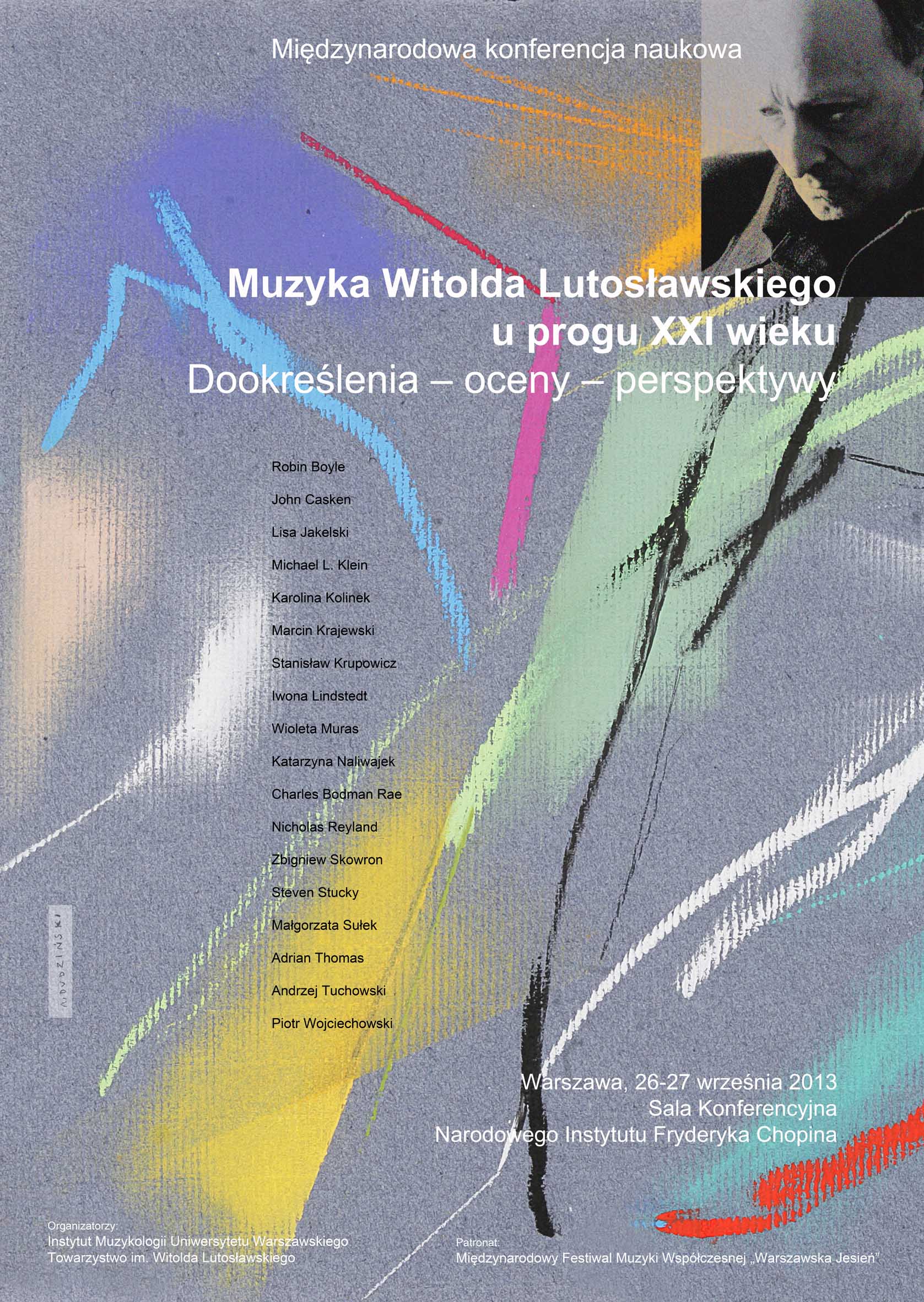
In three weeks’ time, under the patronage of the ‘Warsaw Autumn’ festival, an international two-day conference will be held to celebrate the centenary of a certain Polish composer: ‘The music of Witold Lutosławski on the threshold of the 21st century’.  A fine poster has been produced, in the time-honoured tradition of Polish graphic design.

Konferencja naukowa - Muzyka Witolda Lutosławskiego - plakat

• WL100/54: Lutosławski and Panufnik (1945)

Here are two forgotten assessments of Lutosławski and Panufnik from 1945.  I think that this is the first time that this material has been seen in modern times.  On one of my rummages in second-hand bookshops in Kraków, back in the 1990s, I came across a bundle of concert programme, one of which I featured in an earlier Lutosławski post: WL100/43: Variations, **17 June 1939.  This second programme, which I explored in the preceding post WL100/53: Trio, **2 September 1945, has the biographies of the five composers on the back page.  In fact, the biographical elements on Lutosławski and Panufnik take second place to assessments of the composers’ creative personae.  It is not indicated who wrote them.  I’ve translated the two for Lutosławski and Panufnik below.

WL program 2.09.45 4

WITOLD LUTOSŁAWSKI b. 1913 represents the youngest generation of Polish composers and, among them, the direction of the “extreme left”.  This avant-gardism expresses itself in Lutoslawski in the openly fanatical pursuit of logic and rigour in the design of his prevailing use of polyphony as a means towards these goals, searching absolutely for his own sound world, as far removed as possible from that used by previous generations of composers.  It is especially interesting to find that this avant-gardism appeared in Lutoslawski independently, as an expression of his own internal needs.  During his studies he found no external stimulus in this direction, nor did the environment in which he grew up and was educated have the slightest intrusive impact.  He completed his music studies at the Warsaw Conservatory in the class of Witold Maliszewski, one of the representatives of the most conservative tendency among our composers and teachers.
Among the most important works by Lutoslawski we may mention: Piano Sonatas (which he has performed several times), Symphonic Variations (performed at the Wawel Festival in 1939), Variations on a Theme of Paganini for two pianos, fragments of a Requiem, piano pieces and songs.  Currently he is working on a symphony, of which the first movement is already fully completed, the rest in sketches.

This biography is fascinating for several reasons: (1) the placing of Lutosławski as a radical “extreme left” composer on the basis, presumably, of his main composition so far, the Symphonic Variations, (2) the early indication of his life-long desire for logic and rigour, (3) the emphasis on polyphonic writing (with only a few pieces as evidence) as distinct from the later emphasis on harmony, (4) the strong statement about Lutosławski’s independence from external sources and events (something which he reiterated over and again until the end of his life), and (5) the deliberate distancing from his teacher Maliszewski, whom later he often cited as a key influence on his structural thinking while recognising Maliszewski’s disapproval of the Symphonic Variations.  Given the strength of opinion expressed in this paragraph, it wouldn’t surprise me at least if it was written by the unknown author on the basis of a detailed briefing from the composer.  I don’t have the feeling that Lutosławski penned it himself (see the error mentioned in the paragraph below).

The list of works curiously multiplies the Piano Sonata.  This is the only time that I have read any suggestion that there might be more than one!  It also reveals where Lutosławski was in the composition of the First Symphony (1941-47).  We may now date the completion of the first movement as by August 1945 at the latest, with the other three movements being finished over the following two years.

ANDRZEJ PANUFNIK, whose “Tragic Overture” was such a success in Kraków’s last concert season*, is the second strong supporter – alongside Lutosławski – of radical trends among our youngest composers. And with him at the forefront, the quest for the greatest formal logic is advancing, and for the most part he experiments with clearly positive results in the pursuit of a new musical language.  At the same time, a very specific note of lyricism is revealed in his music, which gives his pieces the most distinctive physiognomy.
Panufnik is the author of: Variations for piano, Trio for violin, cello and piano, Folk Songs with wind instr. accomp., Songs with chamber orchestra, “Tragic Overture”, Orchestral Variations, Symphonic Image and two symphonies.
As an outstandingly gifted conductor himself, he is the best performer of his symphonic works.  In recent times, he has worked regularly with the Polish Film Unit in Łódż.

Panufnik’s biography is interesting for largely different reasons.  He has long been regarded as the most experimental Polish composer of the second half of the 1940s, so it is fascinating to see that he already bore this mantle in 1945 with a work like Tragic Overture (1942, reconstructed 1945) and that the lyrical side of his music achieves prominent notice at a moment when he was focusing on tight motivic cells.  The list of works includes some that had been lost during the Second World War and have generally been left out of his list of works since, including his early student Variations for piano, the Symphonic Variations – which Panufnik had conducted in the graduation concert – and Symphonic Image (both works were composed during Panufnik’s last year at the Warsaw Conservatoire, 1935-36) as well as the two symphonies (1940, 1941).**  The Songs with chamber orchestra are unidentifiable.

…….

* The dates of the wartime premiere in Warsaw of Tragic Overture vary according to the source: the Polish Encyklopedia Muzyczna and Panufnik’s autobiography Composing Myself give 1943, while the monographs by Beata Bolesławska and Ewa Siemdaj give 19 March 1944.  As to the premiere in Kraków of the reconstructed score, Siemdaj gives 10 January 1946, but this leaflet indicates that it was given sometime during the 1944-45 season.
** In his autobiography, Panufnik noted: ‘I then decided to try to rescue my Symphony no.1.  But here my memory faltered and the results were disappointing.  I performed it in one of our symphony concerts, but afterwards destroyed the score.  With that I renounced further reconstruction work…’.  Concert programmes from Kraków indicate that Panufnik conducted the premiere of his reconstructed First Symphony on 30 November 1945, and again on 6 December.