Later this week I’m paying a flying visit to Glasgow to give a pre-concert talk as part of the first night of the BBC Scottish SO’s Muzyka Polskaseries during its 2012-13 season. This has been built around next year’s centenary of the birth of Witold Lutosławski and I’m very happy to have been able to play a small part in advising on the choice of repertoire. With its concentration on Lutosławski and on Szymanowski, the 75th anniversary of whose death falls this year, there was limited room for other major figures (no Baird, Górecki or Serocki, for example). I’m particularly delighted to see Mieczysław Karłowicz’s Eternal Songs (1906) in the mix and pleased to see that there is music by at least one composer born after World War II, Paweł Szymański’s A Study of Shade (1989). The ‘big’ night is on 17 January 2013, when six Polish works will be performed.
• Chopin Piano Concerto no.2 (1829-30) 14 March 2013
• Chopin Piano Concerto no.1 (1830) 11 October 2012
• Szymanowski Concert Overture (1905) 11 October 2012
• Karłowicz Eternal Songs (1906) 15 November 2012
• Szymanowski Songs of a Fairytale Princess (1915, orch. 1933) 17 January 2013
• Szymanowski Violin Concerto no.1 (1916) 15 November 2012
• Szymanowski Songs of an Infatuated Muezzin (1918, orch. 1934) 17 January 2013
• Bacewicz Concerto for String Orchestra (1948) 25 October 2012
• Lutosławski Concerto for Orchestra (1954) 17 January 2013
• Penderecki Polymorphia (1961) 17 January 2013 (Post-Concert Coda)
• Lutosławski Cello Concerto (1970) 28 February 2013
• Szymański A Study of Shade (1989) 17 January 2013 (Post-Concert Coda)
• Lutosławski Symphony no.4 (1992) 17 January 2013
There are two supplementary chamber recitals as Post-Concert Codas: Johannes Moser will play Polish music for cello on 28 February after his performance of Lutosławski’s Cello Concerto, and Garrick Ohlsson will play solo piano pieces by Chopin on 14 March after his performance of Chopin’s Second Piano Concerto. Ohlsson rocketed to fame after winning the Chopin Competition in Warsaw in 1970. Moser is becoming one of the foremost performers of the Lutosławski. His Glasgow appearance follows on from a performance in Poole in January with the Bournemouth SO (which premiered the work with Rostropovich in 1970), three performances in Stuttgart the week before he comes to Glasgow, and he then plays it twice in Bilbao in April.
The full schedule for the BBC SSO Muzyka Polska series may be accessed hereor by navigating from its home website.
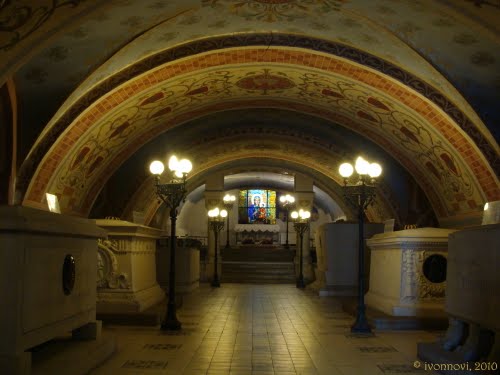
Last week it was announced that a new Polish Pantheon would be established in Kraków. The existing Krypta/ Panteon Zasłużonych (Crypt/Pantheon of the Distinguished), under St Stanisław’s Church on Skałka, has no more room.
The existing Crypt was first brought into use in 1880, and first honoured Jan Długosz, an early Renaissance historian and diplomat. Over the past 130 years, the Crypt of the Distinguished has become the final resting place of just twelve more men (no women), most of whom were writers and many of whom had Kraków connections.
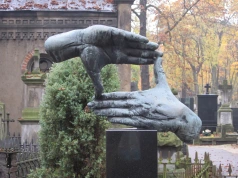
Photo: Ivonna Nowicka (2010). Szymanowski’s tomb is on the far left
1880 Jan Długosz
1881 Wincenty Pol
1881 Lucjan Siemieński
1887 Józef Ignacy Kraszewski
1893 Teofil Lenartowicz
1897 Adam Asnyk
1902 Henryk Siemiradzki
1907 Stanisław Wyspiański
1929 Jacek Malczewski
1937 Karol Szymanowski
1954 Ludwik Solski
1955 Tadeusz Banachiewicz
2004 Czesław Miłosz
Wyspiański was also a renowned artist, and his interment and that of the painter Siemiradzki seem to have opened the way for other non-literary figures to be included: Malczewski (painter), Szymanowski (composer), Solski (actor and theatre director) and Banachiewicz (mathematician and astronomer).
As the above list indicates, the Crypt was used very intermittently, so can hardly be said to be representative of the great and the good from the worlds of the arts and sciences over the last 130 years. I wonder whom the authorities have got in mind for the new Pantheon, which will be under the Church of SS Peter and Paul, close to Kraków’s city centre? They could, I imagine, disinter some who are already dead, such as the composers Witold Lutosławski (Warsaw) or Henryk Mikołaj Górecki (Katowice), but somehow I think that is unlikely. When Krzysztof Penderecki’s time comes, he might be a likely candidate, not least because he is Kraków born and bred. Among literary figures, Wisława Szymborska – who died earlier this year and, like Miłosz, was a Nobel laureate – might be considered. It remains to be seen how the new Pantheon will mark the resting places of those who have been cremated.
The Poles are attached to their great figures and believe in good memorials. Being given a magnificent tomb in such a crypt, however, is no guarantee of long-lasting recognition or significance, especially outside Poland, as the list of those in the existing Crypt makes evident.
Sometimes you can find just as much dignity and remembrance in a graveyard open to the air. The Powązki Cemetery in Warsaw is a case in point. It is the resting place of huge numbers of distinguished people from all walks of life, from times of both peace and war. There is a particular area with a cluster of composers and performers, including Lutosławski, Baird, Serocki, Rowicki and many others. I make a point of going to Powązki when I am in Warsaw for more than a couple of days. Next time I go, I will search out the grave of my friend and distinguished music critic and thinker, Andrzej Chłopecki, who was buried there three days ago.
In the three months since I last posted links to William Hughes’s invaluable English translations of Polish articles on Szymanowski (The Chronicles of Dr Hughes), he has posted 36 more, making 63 to date, with more to come. I am in awe of his industry and generosity as well as his insights in those postings where he provides commentaries or explications.
I’m adding here the two previous tranches of links posted on 28 March (14 items) and 13 May 2012 (13 items). The 36 new pieces focus in the main around the reaction within Poland to the death of Szymanowski in March 1937. But William Hughes has also selected further writings, by Mycielski and Iwaszkiewicz, which are more revealing of the music itself, of Szymanowski’s character, his writings or his faith. Hughes is also not afraid in these translations to reveal (where others have glossed over) Szymanowski’s occasional anti-Jewish jibes or vulgarity.
William Hughes has been busy translating more Polish accounts of Szymanowski to extend the list that I linked to on 28 March (The Chronicles of Dr Hughes). The thirteen new translations include accounts of the Paris premiere in 1935 of the ballet Harnasie (Mountain Robbers) by Szymanowski’s secretary Leonia Gradstein and his young friend, the composer Zygmunt Mycielski. There are three further articles by Mycielski and contributions from the writer Jarosław Iwaszkiewicz. Iwaszkiewicz was Szymanowski’s cousin and the co-author with the composer of the libretto for Szymanowski’s opera King Roger. Iwaszkiewicz’s three articles about King Roger are particularly interesting. The highlight of William Hughes’s new translations is the account of Szymanowski’s sister Stanisława of the composer’s last days. She is remarkably frank and detailed, and her emotional description is still moving today, 75 years after his death.
I’m posting links to these new translations below, starting with the most recent. Further down the page I’ve reprinted the list from 28 March, so that they can be viewed together.
Szymanowski’s sister Stanisława by her brother’s coffin, Lausanne, March-April 1937
Today is the 75th anniversary of Szymanowski’s funeral ceremony in Warsaw and tomorrow the anniversary of his burial in Kraków. His body had travelled to Warsaw by train from Lausanne, where he had died on the night of 28-29 March 1937 (see my earlier post, When did Szymanowski die?). The train stopped for commemorative ceremonies in Berlin, at the German-Polish border, and in Poznań in central Poland. It arrived in Warsaw on Sunday evening, 4 April, and was taken to the Conservatory of Music, where it lay in state until the following evening.
The Warsaw funeral took place on the morning of Tuesday, 6 April, in the Church of the Holy Cross (where an urn containing Chopin’s heart was immured). Szymanowski’s Stabat Mater was performed during the service. Afterwards, the cortège moved north up Krakowskie Przedmieście, past the University, and turned left to pass in front of the Grand Theatre, where an excerpt from Wagner’s Götterdämmerung was played. From there it moved south to the Philharmonic, pausing while an arrangement of some of Szymanowski’s piano Variations on a Polish Folk Theme was heard. Late that evening, the coffin was placed on an overnight train to Kraków.
Szymanowski’s coffin arrived in Kraków early on Wednesday, 7 April, and by 09.00 it had been ceremonially placed in the Mariacki Church on the city’s central square. During the Kraków service, which began two hours later, Berlioz’s Requiem was performed. At noon, the famous daily iteration of the hejnał (trumpet alarm) was sounded from the top of the church tower.
Afterwards, the cortège wound its way, to the strains of Beethoven, south-west past Wawel castle and on to St Stanisław church on Skałka (‘the little rock’). There, Szymanowski’s coffin was placed in the Krypt Zasłużonych (Crypt of the Distinguished). Szymanowski shares this Polish Pantheon with a dozen other distinguished artistic figures, including Adam Asnyk, Stanisław Wyspiański, Jacek Malczewski and Czesław Miłosz. Szymanowski is the only composer. The last music heard after his committal was a folk tune played by Tatra highlanders (a modern commemoration is shown in the picture below), a tribute that was also paid in Katowice at the burial of Henryk Mikołaj Górecki in 2010.
For a contemporary account of the events of 4-7 April 1937, by the composer and critic Stefan Kisielewski, see the following three-part English translation by William Hughes:
Photos from these impressive ceremonies in Warsaw and Kraków can be found on several pages of the Narodowe Archiwum Cyfrowe (National Digital Archive), starting at http://www.audiovis.nac.gov.pl/haslo/279:224/. They knew how to do funerals in those days.
As I write, Wikipedia and several other English-language websites give Karol Szymanowski’s date of death as 28 March 1937 – 75 years ago today. Yet hard-copy publications, including the 2001 New Grove Dictionary of Music and Musicians, generally state that it was 29 March 1937 – 75 years ago tomorrow. So which date is correct?
Szymanowski was in the terminal stages of tuberculosis of the throat and lungs when he was admitted to the ‘Signal’ clinic in Lausanne, Switzerland, on Thursday 25 March 1937. By Easter Sunday, 28 March, he was failing fast and was dead within hours. Christopher Palmer, in his BBC Music Guide Szymanowski (1983), reports that the composer ‘died just before midnight on 29 March 1937’, in other words, late on the following day. Teresa Chylińska, the foremost authority on Szymanowski’s life and work, and the author/editor of multiple Polish-language volumes on his life and of his correspondence and writings, corroborated this in her English-language biography Szymanowski (1993): ‘On Easter Sunday he became worse. He died on March 29, 1937, fifteen minutes before midnight’. I must admit to my own failing here: I took Chylińska’s apparent equation of Easter Sunday 1937 with 29 March as gospel and dated Szymanowski’s death accordingly at the start of my own Polish Music since Szymanowski (2005). I should have checked more carefully, because Easter Sunday was on 28 March in 1937.
Fast forward to Chylińska’s most recent account of Szymanowski’s life, the three-volume Karol Szymanowski i jego epoka (Karol Szymanowski and His Epoch, 2008), and her dating becomes even more erratic. In close succession, at the end of volume 2, Easter Sunday is on 29 March (p.756), then 28 March (p.758). The time of his death has changed, however, from 23.45:
Szymanowski died at 23.05. In Poland (according to the Warsaw meridian) it was Easter Sunday 28 March, while in Switzerland (in keeping with its geographical longitude, in other words its time zone) it was 00.05 on Easter Monday, and this date – 29 March 1937 – is written on the death certificate. The composer was 55 years old. [In fact, he was 54 (he was born on 3 October 1882).]
Chylińska is here repeating the hypothesis which she advanced in an earlier volume of his correspondence (2002).
I do not know how zones and clocks were set internationally in 1937, but they were certainly different from today, when Poland and Switzerland are in the same time zone. Switzerland is a good distance west of Poland, so why was its time zone ahead of Poland’s? But the Warsaw dimension is irrelevant anyway, as the salient details of the discrepancy between times and dates of Szymanowski’s death are contained solely in the surviving documentation from the ‘Signal’ clinic in Lausanne.
Even so, this evidence still lacks conclusiveness. At least we now have a credible account from Jerzy Stankiewicz in his Polish-language article ‘Smierć Karola Szymanowskiego’ (The Death of Karol Szymanowski) in the multi-authored volume Karol Szymanowski w perspektywie kultury muzycznej przeszłości i terazniejszości (Karol Szymanowski from the perspectives of musical culture past and present), edited by Zbigniew Skowron (2007), pp. 369-76.
Stankiewicz reproduces Szymanowski’s patient card, with entries on his condition, temperature, pulse and medication for the four days that he was in the clinic. The entry on his condition on 28 March reads: ‘décédé à 23h. 45’ (died at 23.45). That seems to confirm the time of day reported by Palmer (1983) and Chylińska (1993), but on 28 March rather than on 29 March.
Yet by Stankiewicz’s account, the death certificate lodged with the authorities in Lausanne on 30 March, reads: ‘Died 29 March 1937 at 00.05 in Lausanne’. The timing and dating on the death certificate, rather than the entry on Szymanowski’s patient card, is the basis for Chylińska’s 2008 hypothesis.
My hunch, for what it’s worth, is that the 20-minute discrepancy, which happened to cross over the hour of midnight and therefore straddled two different days in the Swiss time zone, is simply explained. It’s the period between the moment of Szymanowski’s death (23.45 on Easter Sunday, 28 March) – when staff were carrying out the immediate tasks of cleaning, dressing and preparing his body – and the completion of the paperwork five minutes into Easter Monday, 29 March. Perhaps the doctor didn’t think it was that important that the two documents didn’t tally.
To this day, 29 March 1937 is the official, generally recognised date of Szymanowski’s death, even if there is compelling evidence that it actually happened on the previous day, 28 March. It’s really not a matter of great importance, except when anniversaries such as this come by, but it is a pity that the confusion persists.
Any thoughts, corrections or alternative hypotheses warmly welcomed!
A few months ago, I heard again from a colleague whom I’d last met in the mid-2000s. It turned out that he’d been posting on Szymanowski for some time and was about to translate key Polish tributes to the composer into English. I can’t emphasise too strongly how important this is. Polish is a tricky language and far too little of its literature, especially that written earlier than the last 50 years or so, has been translated. This applies to texts on music too.
So, as the 75th anniversary of the hour of Szymanowski’s death approaches, all praise to William Hughes for his selfless service to lovers of Szymanowski’s music by giving us access to Polish writings, especially those penned immediately after his death. I’m posting links to these translations below, starting with the most recent.
There are other posts connected to Szymanowski, one on the vagaries of Polish publishing standards, insights into another of William Hughes’s passions – Bill Evans, and sound files of some of Hughes’s own compositions.
I’m about to engage in a labour of love: writing a CD note for one of the ‘forgotten’ masterpieces of 19th-century music. The name Juliusz Zarębski (pronounced Yooliush Zarempski) is hardly known outside his native Poland, but in his time he was one of the most famous pianists in Europe. Zarębski (1854-85) was one of Liszt’s pupils and started teaching at the Conservatory in Brussels when he was in his mid-20s. But, like too many of his contemporaries, he succumbed to tuberculosis and died when he was only 31.
I am a passionate advocate of Zarębski’s Piano Quintet, which he completed shortly before he died, and it is very exciting that a new recording will be issued here later this year (I can say no more!). There have been over a handful of CD recordings already, but none has penetrated the market much beyond Poland. Yet major figures have performed it: Martha Argerich played it in Poland last year.
I remembered yesterday that I had a written a little piece on Zarębski for a Polish CD magazine, Studio, about 15 years ago. So, as a tribute to the composer, who was born on this day in 1854, and in an attempt to whet the appetite for the new CD, I’ve reproduced the article below (unaltered except for a few recording updates) and intercut it with YouTube videos of a concert performance given by the Bulgarian Quarto Quartet with Darina Vassileva on 12 April 2010. This is a committed and fervent interpretation which brings out the work’s great strength, passion and originality.
(Some hair! You can see where Paderewski’s lion mane came from.)
Zarębski
(published in Polish in Studio magazine, Warsaw, 1997)
Last October, returning to London from the Warsaw Autumn, I glanced at a notice hung on the railings of the church at the end of my street. I was quite taken aback to see that, later that day, there would be a performance of a chamber music concert including the Piano Quintet by Zarębski. Now, you could count on the fingers of at most two hands the number of live performances this work has ever had in the United Kingdom (it is less well known than Górecki’s Third Symphony was before the Upshaw/London Sinfonietta recording). I suspect that Zarębski’s Quintet is just as neglected in other countries too. This plainly is a scandal, and the reaction of the audience to the performance I heard in October was one of wonderment that such a work could exist and yet not be as familiar as piano quintets by Schumann, Dvořak, Franck and Brahms.
I first came across Zarębski’s Quintet in the CD recording by Waldemar Malicki and the Varsovia Quartet (Pavane ADW 7218, rec. 1989), and there have been subsequent CDs by Szabolcs Esztényi and the Wilanów Quartet (Accord 201332, 1990) and Jerzy Witkowski and string quartet (Olympia OCD 383, 1992). [2012 update: more recent CDs include Paweł Kowalski and the Silesian Quartet (PNCD 404, 1997), Malicki again, this time with the Amar Corde Quartet (Amar Corde 002, 1997), Krzysztof Jabłoński and the Warsaw Quintet (DUX 0530, 2005) and Wojciech Świtała and the Royal Quartet (Bearton CDB036, 2006).] Some of Zarębski’s music for solo piano is now also available on CD – Les roses et les épines (Katarzyna Popowa-Zydron on Accord 201332, 1990), Lullaby, Tarantelle and Grande polonaise (Elżbieta Wiedner-Zając on Dorian DIS-80121, 1993) and the first CD of the complete Zarębski played by Karol Radziwonowicz (Selene CD-s 9505.28, 1993). All of these recordings have appeared since 1989, marking a turning point in the public’s access to what remains for most a figure shrouded in romantic myths and mists.
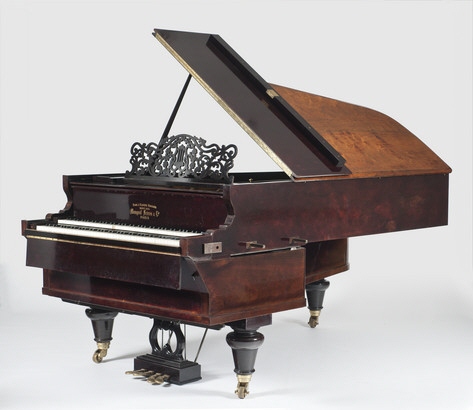
Who was this Zarębski? Does he appeal because he died of tuberculosis aged only 31 (in Żytomierz in 1885)? Or is it because he was a phenomenal pianist taught by Liszt? Or perhaps it is that he had been caught up in that curiously nineteenth-century Belgian fad for creating outlandish musical instruments? I, for one, would have loved to have been in the crowds that flocked to hear Zarębski at the Paris Exhibition in 1878, when he wowed audiences as he played the two-keyboard piano invented by Eduard Mangeot. Unlike other double-keyboard monsters, Mangeot’s had the bizarre distinction of having the top keyboard running in the opposite direction (the bass to the right, the treble to the left) to the other ‘normal’ keyboard below.
Unfortunately for us, Zarębski’s performing genius died with him and his compositional output was very small – 34 acknowledged opus numbers plus a few miscellaneous pieces. Of these, the Piano Quintet – his last completed work, finished in 1885 – stands supreme. It is one of those works (Szymanowski’s Stabat mater often has a similar effect on the unwary listener) which communicates immediately and powerfully in its individuality, even though it stands well outside the canon of mainstream Western classical music. Certainly, it shares several traits with a predecessor like the piano quintet by Brahms (1864), although I am more inclined to link it, however tenuously, with the lyrical freshness of another unjustly neglected Polish chamber work, the youthful Piano Quartet (1879) by Zygmunt Noskowski (recorded by the Polish Piano Quartet on Olympia OCD 381 along with Żeleński’s Piano Quartet).
But contrasting Zarębski with Brahms is more likely to point up differences than similarities. Where Brahms is structurally conventional, Zarębski experiments (on the simplest level, there are no repeat signs). Where Brahms is portentous and grave, Zarębski is openly exultant. Where Brahms has problems of instrumental balance, Zarębski is clarity personified. Now, don’t get me wrong, I love the Brahms quintet, but Zarębski brings something new and compelling to the genre. First and foremost, he has an astonishing melodic gift. Who can fail to be moved by the sweep and passion of the opening? And yet, daringly, Zarębski cuts this short as he shoots forward to an even more lyrical idea. There is no sense that he is obeying any received rules of sonata structure, and when the third lyrical (and characteristically melancholic) idea is introduced, we might be forgiven for thinking that the composer lacked a certain dynamism. But again Zarębski shows his skill as he uses his material to develop a sustained peroration. Having explored his first idea so strongly, Zarębski curtails the recapitulation (a masterpiece of concision), moving inexorably towards an end that has not one but two propulsive codas, separated by a moment of reflection.
Perhaps the most winning aspect of Zarębski’s compositional inspiration in the Piano Quintet is the sheer subtlety of expression. The second movement is a beguiling mix of rhythmic and tonal wrong-footing (the downbeat and key at the opening are not where they seem to be) and of the seemingly introverted nature of the main melodic idea, which later flowers into something quite overwhelming in its harmonic and melodic dimensions. At the end, Zarębski reintroduces the opening bars (again off-beat and in another unexpected tonality) not at the recapitulation but as part of the coda. Nothing can be taken for granted.
The quality of understatement is frequently apparent, especially in the way Zarębski meshes the piano with the strings. The piano is genuinely primus inter pares, even though, as in the Scherzo, it initially takes the lead. This is a real scherzo in the sense that it teases rhythmically (it is a slightly jokey galop), thematically (a ‘downhome’ idea subsequently treated fugally), and texturally (beautiful and delicate use of string harmonics). Furthermore, it is a structurally extended movement with another lyrical section at its centre.
We shouldn’t be surprised that the finale revisits ideas from earlier in the work. The way in which the finale begins as if the composer has decided to start the Scherzo all over again from the beginning is an imaginative twist to the by then accepted notion of thematic or cyclic integration. Having wooed us in previous movements with his lyrical gifts, the predominant tone of the finale is one of extrovert exuberance, by turns folksy and deeply romantic. As throughout this masterpiece, Zarębski astonishes us by the bold swerves with which he manipulates both his material and us, the listeners. To make a dubiously crude analogy, it is like being on the shoulders of a world champion skier as he negotiates a mixture of cross-country and downhill terrain. The sense of exhilaration engendered takes the breath away.
As to the music for solo piano, much of this is still languishing in obscurity. Is this situation justified? There is a decidedly more overt Polishness in many of the pieces than in the Piano Quintet. In addition to conventional and often showy miniatures (waltzes, menuets, etudes and serenades), there are mazurkas and polonaises, almost obligatory calling-cards for nineteenth-century Polish pianists. The most impressive of them all is the Grande polonaise in F sharp minor, Op.6, which brings together limpid Lisztian figuration and a thematic and rhythmic élan which proclaims strong links with Chopin’s own F sharp minor Polonaise. And yet, as in the Piano Quintet, Zarębski takes us beyond the standard structural expections of a polonaise into realms inhabited by Chopin’s Polonaise-fantaisie. The scale is symphonic (it lasts c. 10 minutes), the style bravura. A thoughtful Chopinesque influence may be felt in the Ballade in G minor, Op.18. It is a truism, here and elsewhere, that Zarębski the composer rarely indulges in showmanship for its own sake – there is always a core of ear-catching material which sustains both the introvert and extrovert sides of his musical persona.
Much has been made of Zarębski’s prophetic harmonic explorations in his later pieces, aside from the Piano Quintet. His innate lyricism was a natural counterpart to harmonic experiment, and early signs of this trait may be heard in Les roses et les épines, Op.13. The opening Andante con moto, for example, belongs to the genre of semi-pictorial mood pieces for solo piano beloved of Liszt and which anticipate Ravel. The texture is suggestive rather than emphatic, although the type of impassioned harmonic-melodic lyricism encountered in the Piano Quintet is already fully formed here. The sense of veiled detachment continues in the second Andante con moto (the third movement), with its short and elliptical phrases.
It cannot quite be claimed, however, that Zarębski went as far as Liszt did in contemporary works like Nuages gris or La lugubre gondola (1881-2). In this light, it may seem strange that it is the nominally conventional dance movements of the Suite polonaise, Op.16, which, as Stanisław Haraschin has commented, have ‘a distinct tendency towards tonal ‘decomposition’, strident and unexpected modulations and harsh polyphonic phrases’. Their deceptively simple textures mask an almost deconstructivist approach to miniatures which by the 1880s in other hands had become overburdened with saccharine sentimentality. Such accretions were evidently not to Zarębski’s taste and his music at all times strives for direct expression as well as for fresh extensions of his compositional boundaries. In this sense, his renewal of familiar genres looks forward to Szymanowski’s music for solo piano, notably the mazurkas.
The textural clarity and sparse harmonies of the Berceuse, Op.22, and the very adult insouciance of the suite for children, Étrennes, Op.27, continue Zarębski’s search for an increasingly lean and ‘classical’ means. Slight they may be, but these ‘New Year Gifts’ are incredibly elegant and soignées, provoking suggestions of anticipations not so much of Debussy as of Satie and Ravel. The sense of what in French hands became recognised as neoclassical is reinforced in Zarębski not only in antique titles (see also the Gavotte, Op.29) but in the melodic and harmonic style, with its turns, runs, grace notes and cadences that recall any number of 18th-century composers.
So where does that leave Zarębski as a figure in the musical world of the late 19th-century? Certainly someone to be treasured, someone whose compositional vision was international not provincial. Until his music becomes more readily available – in print, on air and on disc – it is hard to make a comprehensive case for him in the pantheon. But, on the basis of works like the Grande polonaise, Les roses et les épines, and above all the Piano Quintet, he deserves recognition as a master whose music adds immensely to our understanding and appreciation of the transition between high romanticism and the 20th century.
Tomorrow and on Sunday, at 13.00-14.00, BBC Radio 3’s Early Music Show is devoting its attention to Renaissance and Baroque music from Poland. Saturday’s programme is a CD compilation; Sunday’s is a broadcast of music from a concert given by the Retrospect Ensemble at last year’s Lufthansa Festival in London (I posted on this two weeks ago under Baroque Rocks). Now that the programme details of the Saturday broadcast are available, I thought I’d pop them up alongside those for Sunday’s. Both programmes are presented by Lucie Skeaping, with me chipping in with the odd Polish word on the Sunday.
Saturday, 25 February 2012, 13.00-14.00
Johann Adolf Hasse (1699-1783): March of the King of Poland
Wacław z Szamotuł (c.1524-c.1560): Six Polish Songs
Giovanni Anerio (c.1567-1630): Jubilemus in arca Domini Dei
Mikołaj Zieleński (c.1550-c.1616?): Magnificat
Balint Bakfark (1507-76): Czarna krowa (Black Cow)
Matthäus Waissel (c.1540-1602): Polish Dance
Wojciech Długoraj (c.1557/8-after 1619): Fantasia and Chorea polonica Bartłomiej Pękiel (?-c.1670): ‘O vita ista misera’ from the dialogue Audite mortales
Franciszek Lilius (c.1600-57): Tua Jesu dilectio Johann Adolf Hasse:Dance of the King of Poland
The eagle-eyed will have noticed that there are some non-Polish composers here. Foreign musicians played an important part in Polish culture in the Renaissance and Baroque periods, among them the Italians Luca Marenzio and Marco Scacchi. Anerio was another. He spent the last six years of his life as choirmaster to King Sigismund III in Poland. The Hungarian Bakfark also had strong Polish connections. Hasse, though German, was musically an Italian and seems to have been almost entirely successful in avoiding Poland and Warsaw when his employer’s court moved there from Dresden. Waissel, the earliest composer in the programme, was German through and through, with no connection to Poland of which I am aware, so his Polish Dance must have been one of the genre of ‘characteristic national’ pieces that found their way into many lute tablatures in the Renaissance and early Baroque.
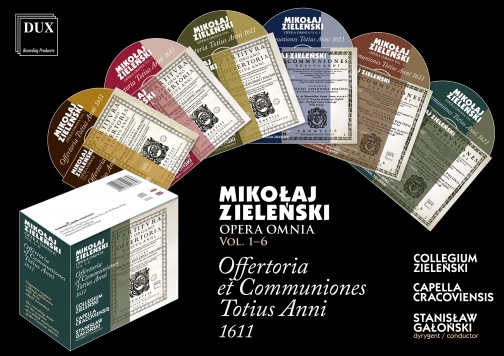
The Polish composers – z Szamotuł, Zieleński, Długoraj, Pękiel and Lilius – were key participants in their country’s musical development. The ‘Six [Religious] Polish Songs’ by z Szamotuł were not envisaged as a collection, but individually are among the most beautiful choral songs of the 16th century. My favourite is Modlitwa: Już się zmierzcha (Prayer: Dusk Is Falling), which was also one of Górecki’s ‘found’ treasures – he used it in three of his pieces.* Zieleński’s Magnificat is his crowning glory. Compared with the little that has survived of the music by other Polish Renaissance and Baroque composers, Zieleński’s surviving output is enormous and the DUX label in Poland has just issued a 6-CD set of his Offertoria et Communiones Totius Anni 1611 (DUX 0864). The second programme in this Early Music Show Polish weekend has more music by Zieleński.
The music by Długoraj (as well as by Bakfark and Waissel) is for lute. All three were noted players of their day. The music of Pękiel is too little known outside Poland, and this programme includes his Advent ‘dialogue’ Audite mortales, based on a paraphrase of the biblical account of the Last Judgment. Lilius was Pękiel’s predecessor at Wawel Cathedral in Kraków. He was the son of an Italian musician and his music embodies many of the different styles that came to characterise this era in Polish music.
* In the event, only three of the six songs by z Szamotuł were played (and they didn’t include Modlitwa!).
Sunday, 26 February 2012, 13.00-14.00 (see Baroque Rocks)
Adam Jarzębski (before 1590-after 1648): Canzon quinta
Mikołaj Zieleński (c.1550-c.1616?): Domus mea
Stanisław Sylwester Szarzyński (fl.1692-1713): Iesu spes mea
Adam Jarzębski: Chromatica
Damian Stachowicz (1658-99): Veni consolator
Grzegorz Gerwazy Gorczycki (1665(7?)-1734): Completorium
I’ve just returned from recording another interview for BBC Radio 3, this time for The Early Music Show. I almost didn’t make it, as I thought it began an hour later than it did and it took a wild cross-country dash to Radio Devon in Plymouth to get me into the studio only 15 minutes late. Not 20th-century Polish music this time, but a recording of Polish gems from the Baroque period. I was probably brought in only because I can pronounce the composers’ names …! It was fun talking with Lucie Skeaping and no doubt the producer Chris Wines will make sense of my bzdura (gobbledegook).
I am constantly amazed by the richnesses of Polish music before 1750. The great misfortune is that most of us never hear it. Why? Well, so little has survived multiple acts of war (notably World War II), so little was printed at the time, and very few CDs and scores make it outside Polish borders today. When a rare concert of early Polish music takes place, do go, as you will be astonished by its beauty and vitality. Happily, Radio 3 picked up a concert given by the Retrospect Ensemble at last year’s Lufthansa Festival in London and is broadcasting most of it on The Early Music Show – alongside another concert of early Polish music – on Saturday 25 and Sunday 26 February, 13.00-14.00:
Adam Jarzębski (before 1590 – after 1648): Canzon quinta
Mikołaj Zieleński (c.1550 – c.1616?): Domus mea
Stanisław Sylwester Szarzyński (fl.1692 -1713): Iesu spes mea
Adam Jarzębski: Chromatica
Damian Stachowicz (1658-99): Veni consolator
Grzegorz Gerwazy Gorczycki (1665(7?)-1734): Completorium
Jarzębski has left only 27 compositions, all instrumental. He was a talented man: composer, violinist, poet, author of the first ever guide to Warsaw, and architect to the king. The title of his Chromatica reveals its unexpectedly dark heart, which seems to have sprung from a madrigal [the automatic spell-checker ‘corrected’ this to ‘marital’] by Monteverdi or Gesualdo. All that’s missing is an Ohime! or two. Here’s a video which aptly counterpoints the music with pictures of the Ujazdowski Palace just outside Warsaw’s city centre. In Jarzębski’s time, it would have been in the country. Its appearance today is rather more developed than it was when Jarzębski was its Intendant of Works.
The vocal pieces in the broadcast are very varied, ending with one of the glories of the Polish Baroque, Gorczycki’s Completorium, with its inspired mix of stile antico and stile moderno. For now, here’s one of the other great beauties of this period, Iesu spes mea by Szarzyński. This Cistercian monk left barely a dozen pieces, but this is a real jewel.
It’s particularly interesting because it is based on a Polish hymn for the dead and does interesting things with the tune. Here’s the original hymn – Przez czyśćcowe upalenia – and translation of the first verse:
Through purgatorial fires (Przez czyśćcowe upalenia)
Which take away the sins (Którzy gładzą przewinienia)
Shedding tears without consolation (Łzy lejąc bez pocieszenia)
They beg Your mercy (Żebrzą Twego użalenia)
O Mary! (O Maryja!)
Szarzyński takes this, puts it into 3/4 with the first downbeat on the first Bb, and ornaments it. The hymn itself is strangely constructed in its phrasing (though it’s quite typical for Polish hymns and folk tunes), but Szarzyński does wonderfully unexpected things with it. The soprano’s first entry – ‘Jesus, my hope, my comfort’ (Iesu spes mea, Iesu solarium meum) – has two four-bar phrases followed by a five-bar phrase, and this fluid approach continues once the two violins enter. Yet such ‘irregularities’ seem relaxed and unforced. I particularly like the contrasting. almost desperate urgency of the middle section, with its repeated alliteration – ‘In you will I hope, to you will I cry out, I will sing to you, I will adore you, I will beseech you, I will give you my heart’ (In te sperabo et reclamabo, tibi cantabo, te adorabo, te invocabo, tibi cor dabo).
This concert performance by the Polish group Risonanza is a bit slow for my taste, there is some audience noise, and the camera position means that the vocal soloist is mostly out of sight … But listen to Retrospect Ensemble on 26 February for a really tight interpretation and a fantastic diminuendo at the very end.

 William Hughes has been busy translating more Polish accounts of Szymanowski to extend the list that I linked to on 28 March (

 Szymanowski was in the terminal stages of tuberculosis of the throat and lungs when he was admitted to the ‘Signal’ clinic in Lausanne, Switzerland, on Thursday 25 March 1937. By Easter Sunday, 28 March, he was failing fast and was dead within hours. Christopher Palmer, in his BBC Music Guide Szymanowski (1983), reports that the composer ‘died just before midnight on 29 March 1937’, in other words, late on the following day. Teresa Chylińska, the foremost authority on Szymanowski’s life and work, and the author/editor of multiple Polish-language volumes on his life and of his correspondence and writings, corroborated this in her English-language biography Szymanowski (1993): ‘On Easter Sunday he became worse. He died on March 29, 1937, fifteen minutes before midnight’. I must admit to my own failing here: I took Chylińska’s apparent equation of Easter Sunday 1937 with 29 March as gospel and dated Szymanowski’s death accordingly at the start of my own Polish Music since Szymanowski (2005). I should have checked more carefully, because Easter Sunday was on 28 March in 1937.
 A few months ago, I heard again from a colleague whom I’d last met in the mid-2000s. It turned out that he’d been posting on Szymanowski for some time and was about to translate key Polish tributes to the composer into English. I can’t emphasise too strongly how important this is. Polish is a tricky language and far too little of its literature, especially that written earlier than the last 50 years or so, has been translated. This applies to texts on music too.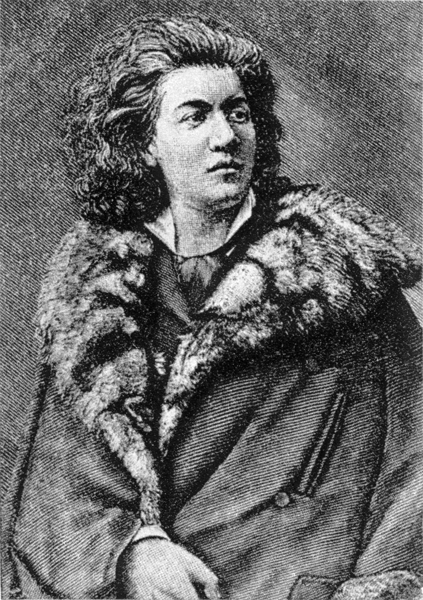


 On Polish Music