• New CD Note (Żeleński & Zarzycki/Hyperion)

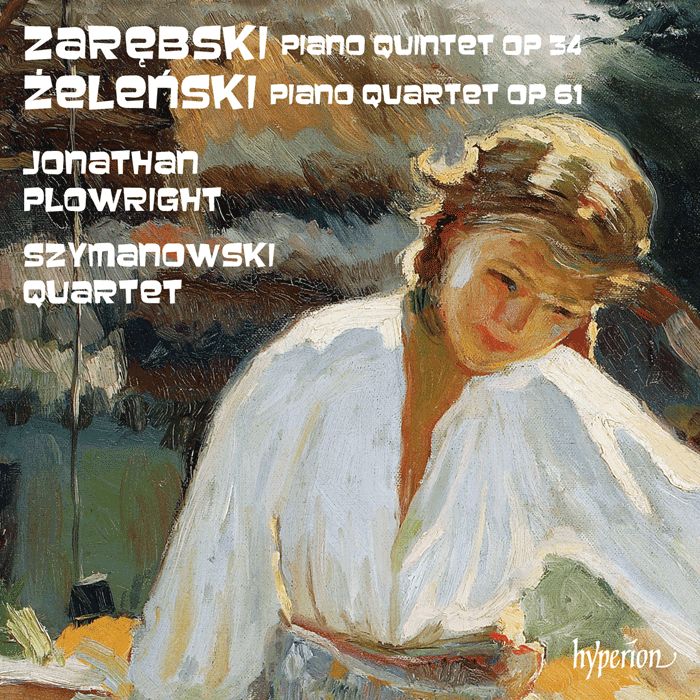
034571179582I’ve recently been drawn into writing about nineteenth-century Polish music, mainly about composers whose surnames begin with Z or Ż.  Here are two of them: Władysław Żeleński and Aleksander Zarzycki.  Following his highly acclaimed 2012 recording of Zarębski and Żeleński chamber music with the Szymanowski Quartet on Hyperion, Jonathan Plowright performs music for piano and orchestra by Żeleński and Zarzycki on his new Hyperion CD.  It’s the 59th CD in Hyperion’s ‘Romantic Piano Concerto’ series.  Plowright’s partners on this occasion are the BBC Scottish SO and the Polish conductor Łukasz Borowicz.

Here’s the link to my booklet note for Żeleński and Zarzycki, or you can scroll the CD NOTES tab above.

NEWSFLASH!  MusicWeb-International has awarded this CD ‘Discovery of the Month’ (May, 2013).  En passant, the review by Dan Morgan comments on my ‘admirably succinct liner-notes’ (3 May 2013).  In his review in Gramophone (June, 2013, p.69), Jeremy Nicholas refers to ‘Adrian Thomas’s informative booklet’.

• Zarębski Piano Quintet on PR ‘Trybunał’

For the second time in a month, I tuned in yesterday to Polish Radio 2 ‘Dwójka’ for one of its fortnightly ‘tribunals’. The format is simple but unusual.  Three commentators – on this occasion, two critics plus a performer – whittle down a selection of six recordings of the same piece until it votes for a winner.  All six CDs are heard in the same initial section of the piece, then four in a second section, three in a third and two in a fourth.  It’s an interesting idea and draws in the listener.  One might argue, however, if the sections are always chosen in the order that the work progresses, that a recording that improves as it unfolds may lose out too soon.  The line-up for yesterday’s panel was Dorota Kozińska (critic), Kacper Miklaszewski (critic), Jacek Hawryluk (chair) and Karol Radziwonowicz (pianist).

d1a06fe4-72f6-4f8b-8df8-e16a9097513d.file

Yesterday it was the turn of the Piano Quintet (1885) by Juliusz Zarębski (1854-85).  I have enthused on this work elsewhere in these pages, almost exactly a year ago (Zarębski’s Piano Quintet).  Last February, I was especially keen on a YouTube recording by Darina Vassileva and the Quarto Quartet from Bulgaria and included links in my post, but I’ve still not been able to find a copy of its CD recording on the Arcadium label.

The schedule yesterday was:

• Round 1: Opening of first movement
• Round 2: Opening of second movement
• Round 3: Opening of third movement
• Round 4: Opening of fourth movement.

After Round 1, the panel was (almost) unanimous in eliminating CDs 3 and 4, both of which – from this opening section only – sounded untidy, messy of tempo and somewhat over-egged expressively.  They were both live performances.

• It turned out that both CD3 and CD4 had Martha Argerich at the keyboard: a CD from the Lugano Festival (2011) and a DVD from a Warsaw concert (2012).  I must admit to being surprised that two of the six slots were taken up by one major player, when in fact there are now over a dozen recordings that have been issued on CD over the past 20 years or so.  A pity, therefore, that one of these was not chosen to replace one of the Argerich recordings.

• Round 2 resulted in the elimination of another recent recording (CD6), this one by Piotr Sałajczyk and the Lasoń Ensemble (Accord, 2012) [thanks to William Hughes for pointing me in the right direction for the info on the players].

By this stage, the panel had isolated CD2 as being the least Slavonic/Romantic in tone and temperament, so the discussion seemed to be coming to a head partly on that basis.

• Round 3 used a sizeable chunk from the beginning of the Scherzo.  For my money, the only recording to live up to the title of the movement was CD2.  It was light on its feet, whereas the others – especially the pianists – chose slow, deliberate tempos and made heavy weather of an admittedly difficult movement.  After some deliberation, CD1 was lost – Wojciech Świtała with the Royal String Quartet (Bearton, 2006).  It was now down to a contest between the new, ‘non-Slavonic’ CD2 and the archival, ‘Slavonic’ CD5.

• I could tell which way Round 4 was going to go from the comments so far.  What puzzled me was that to my ears the excerpts from CD5 had severe drawbacks.  Its first movement showed little shaping of cadential phrases (they simply motored on), while the second was on the slow side, with over-emphatic rhythmic articulation and a main theme (violin) that was overcooked and pretty horrid.  The finale sounded better, though the piano playing still seemed mannered in places.  CD2, on the other hand, brought freshness and new perspectives, even if it did not have the lushness and depth of tone of CD5.

• CD2 was the runner-up: Jonathan Plowright and the Szymanowski Quartet (Hyperion, 2012).*  CD5 was the only archive recording of the six, dating (if I caught it right) from c.1963.  It featured ‘The Pianist’ Władysław Szpilman as a member of the Warsaw Piano Quintet, with Bronisław Gimpel as first violin.  Well, that’s me told, but I stick to my guns about the over-ripe tone of the theme in the second movement.  This remastered LP recording has been reisued on a 3-CD set of Szpilman’s ‘Legendary Recordings’ (Sony, 2005).

This got me thinking about the recording history of the Zarębski Piano Quintet.  For a work that was not published until the 1930s and which has never had much of a presence or reputation outside Poland, its tally of over twelve CD recordings is remarkable.  Here’s my list, with the six recordings considered yesterday in bold – if you know of any omissions or errors, please let me know.  It’s in chronological order of release (as far as I can ascertain).

Władysław Szpilman, Warsaw Piano Quintet (1963; Sony 3-CD set, 2005)
• Waldemar Malicki, Varsovia String Quartet (Pavane, 1990)
• Szábolcs Esztényi, Wilanów String Quartet (Accord, 1991)
• Jerzy Witkowski and friends (Olympia, 1992)
• Waldemar Malicki, Amar Corde String Quartet (Amar Corde, 1997)
• Paweł Kowalski, Silesian String Quartet (Polskie Nagranie, 1998)
• Krzysztof Jabłonski, Warsaw Quintet (Dux, 2005)
Wojciech Świtała, Royal String Quartet (Bearton, 2006)
• Darina Vassileva, Quarto String Quartet (Arcadium, 2010)
Martha Argerich +, live (EMI 3-CD set, 2011)
Martha Argerich +, live (Chopin Institute DVD, 2012)
Piotr Sałajczyk, Lasoń Ensemble (CD Accord, 2012)
Jonathan Plowright, Szymanowski String Quartet (Hyperion, 2012)

There is also a newly-issued CD of the quintet in an arrangement for piano and string orchestra (my thanks to Tomasz Andrzejewski for this information; see comments below).
• Ewa Pobłocka, Amadeus CO of Polish Radio, cond. Agnieszka Duczmal (Polish Radio, 2013)

If the Vassileva-Quarto recording of 2010 is anything like the live video on YouTube, it could be something really special.  I still remain true to the first recording that I heard – the Malicki-Varsovia on Pavane – even if it verges on being an archival recording.  For one thing, its pacing and sense of musical drama are hard to better and, for another, it strikes a terrific balance between expressivity and momentum.  If you can get hold of a copy, do.  If you can’t, then my undoubted winner – for its revelatory and unfettered insights – is the most recent recording, by Jonathan Plowright and the Szymanowski Quartet on Hyperion.

………..

* I must declare my interest here, although I listened with innocent ears: I wrote the booklet notes for the Plowright/Szymanowski recording.

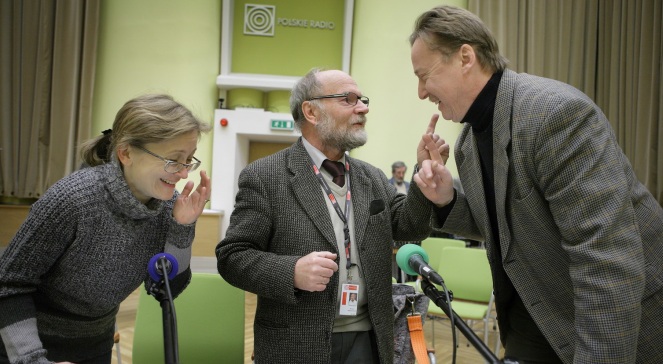
UPDATE!  On 22 February 2013, Polish Radio 2 responded to this post by posting about it themselves: Adrian Thomas po raz drugi o werdykcie Trybunału (Adrian Thomas for the second time on the verdict of the Tribunal).  They also put up this rather jolly second photo from the recording session:

bf3f27ec-f747-40f9-8ac5-1ac5371af15d.fileMy first post had been • Gardner/BBC SO top Polish Radio poll the day after the Tribunal on 19 January 2013 for Lutosławski’s Concerto for Orchestra.  It received this response from Warsaw on 24 January: Wyroki Trybunału komentowane w Wielkiej Brytanii (Verdicts of the Tribunal commented on in Great Britain).

• William Hughes completes his Szymanowski

It is almost five months since I last posted links to William Hughes’s invaluable English translations of Polish articles on Szymanowski (The Chronicles of Dr Hughes), the vast majority of them from 1937-38.  Since then, he has posted 68 more, making a final total of over 130 translations.  This has been a mammoth task, undertaken with love and care as well as from a burning desire to share these important documents with a wider audience.  I hope that his efforts will one day be rewarded with a hard-copy publication, so if you appreciate his extraordinarily selfless achievement and agree with me about wanting to see this material in print, do let him know.  He has redesigned his website so that is is easy to scroll through the summaries and click for the full articles.  He’s also added images to many of the items.

It’s superfluous for me to itemise these documents as in my previous posts, so it gives me great pleasure to direct you straight to his own site: http://drwilliamhughes.blogspot.co.uk/.  Bravo, William!

• New CD Note (Szymanowski/Chandos)

CHAN 5115After four volumes of Lutosławski in its ‘Muzyka Polska’ series, with a fifth to follow shortly, Chandos has begun a new Polish strand.  New Year’s Day 2013 marks the issue of its first Szymanowski CD in the series.  The principal forces remain the BBC Symphony Orchestra under Edward Gardner.

I heard Louis Lortie’s recording of Szymanowski’s Symphony no.4 ‘Symphonie Concertante’ when it was broadcast on Radio 3 last November.  It fairly zinged along and the finale was the best that I’ve heard.  Also on this new CD are the early Concert Overture and Symphony no.2.

The front cover, if I’m not mistaken, shows the Tatra Mountains from the southern, Slovakian side rather than from a Polish vantage point that Szymanowski might have known.  The lake is Štrbské Pleso.

Here’s the link to my booklet note for this new Szymanowski CDor you can scroll the CD NOTES tab above.

• Lutosławski: A Christmas Carol

Poland has a wonderfully rich heritage of carols.  In 1946, as the country was recovering from the devastation of World War II, Lutosławski collected together a set of Dwadzieście kolęd (Twenty Carols) for voice and piano; in 1984-89, he arranged them for soprano, female choir and chamber orchestra.

Exactly 22 years ago today (14 December 1990), in Aberdeen in Scotland, Lutosławski conducted the premiere of this second version, with Susan Hamilton, the Scottish Philharmonic Singers and the Scottish Chamber Orchestra.

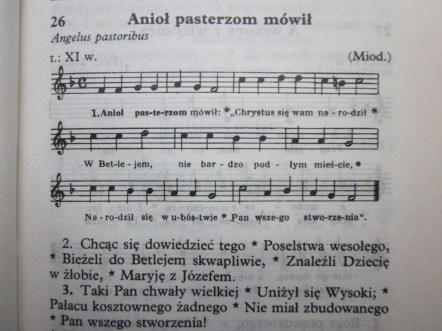
Here’s a recording of the first carol in the set, ‘Anioł pasterzom mowił’ (The Angel Said to the Shepherds).  The text is 11th-century, the music from the Śpiewnik kościelny (Church Hymnbook, 1838-53) compiled by Michał Marcin Mioduszewski.  On this recording, only verses 1 and 3 are sung.  The melody has an interesting construction of eleven bars (Lutosławski repeats the last seven).


IMG_7124 copy

• New CD Note (Zarębski & Żeleński/Hyperion)

I’ve been an advocate of Juliusz Zarębski’s Piano Quintet for years and so I’m delighted that Hyperion has just released this new recording. It’s accompanied by the Piano Quartet by his slightly older compatriot, Władysław Żeleński. If you haven’t come across either composer. you’re in for a treat.  Zarębski in particular is a gem largely hidden outside his native Poland, even though in his short lifetime (he died of tuberculosis aged just 31) he was renowned across Europe as a stupendous pianist. A pupil of Liszt, he wrote mostly piano music, some of it stylistically advanced for the time. He composed the Piano Quintet in the last year of his life (1885), and I don’t think that I’m overstating it when I assert that it rivals any other example of the genre.  One of these days, it will be more widely recognised for the masterpiece that it is.

Here’s the link to my booklet note for Zarębski and Żeleński, or you can scroll the CD NOTES tab above.  Here’s another link, this time to an earlier post about the Zarębski Quintet, plus one I wrote a few weeks ago on Zarębski, Zarzycki and Żeleński.

NEWSFLASH!  In its review, the BBC Music Magazine (Christmas issue 2012, p.93) awarded the CD ✭✭✭✭✭ for Performance and ✭✭✭✭✭ for Recording and also made it its ‘Chamber Choice’.  Thoroughly deserved – bravo to Jonathan Plowright and the Szymanowski Quartet.  It was also nice – and unexpected – to read the last sentence: ‘With the inclusion of Adrian Thomas’s expert sleeve notes, this represents another invaluable Hyperion release’!

NEWSFLASH no.2!  On Radio 3’s CD Review on 9 February 2013, Andrew McGregor gave an enthusiastic response to this CD, also drawing on what he called “Adrian Thomas’s excellent notes”.  Thanks Andrew!

NEWSFLASH no.3!  Jonathan Plowright has passed on to me a ✭✭✭✭✭ online review in Audiophile Audition, dated 13 February 2013.  It ends: ‘Adrian Thomas’s excellent liner [notes?] tell some intriguing musical stories[.]’.

NEWSFLASH no.4 and no.5!  Another great review for this CD from Steve Arloff, including several references to the notes, including ‘the excellent booklet notes’: online review on MusicWeb-International.  Previously on MusicWeb-Interntional, its Classical editor Rob Barnett also posted an enthusiastic review, including the comment: ‘Adrian Thomas provides the much-needed commentary and does so with both style and sterling content’.

• Not Forgetting Noskowski

As a postscript to my post Ż-z-z earlier today, I’ve just discovered a recent YouTube upload of the complete Piano Quartet op.8 (1879) by Zygmunt Noskowski (1846-1909).  And it comes with the score too, always a plus for little-known pieces.  The recording is that by the Polish Piano Quartet, released by Olympia back in 1992 on OCD 381 alongside Żeleński’s Piano Quartet.

This really is a wonderful and joyous work, and its youthful spirit never fails to brighten the day.  If I could master the piano part, I’d pay good money to find a string trio to play it with.  I hope that, like the Zarębski Piano Quintet and the Żeleński Piano Quartet, it soon percolates through to non-Polish performers, CD companies and audiences.  It is, frankly, a cultural scandal that it has been so neglected.

The upload is split into three: first movement; second and third movement (9’23” in); fourth movement.


• Ż-z-z

How many composers do you know whose names begin with Z?  Zappa, Zarlino, Zelenka, Zemlinsky, Zender, Zimmermann, Ziporyn, Zorn?  There are more than you think, especially in Poland.  Contemporary composers there include Artur Zagajewski, Patryk Zakrocki, Krzysztof Zarębski, Anna Zawadzka-Gołosz, Barbara Zawadzka, Lidia Zielińska, Maciej Zieliński, Agata Zubel and even a double Z: Wojciech Ziemowit Zych.  There are yet more when you go back to before 1900.  I’ve recently been spending a very enjoyable time in the company of three of them: Żeleński, Zarębski and Zarzycki.

In a couple of weeks’ time, Hyperion will be releasing a CD of nineteenth-century Polish chamber music with piano, played by Jonathan Plowright and the Szymanowski Quartet.  The CD has two substantial pieces from the Polish Z list: the Piano Quintet by Juliusz Zarębski (1854-85) and the Piano Quartet by Władysław Żeleński (1837-1921).  Look out for it.  And at the weekend I was finishing off some work on Żeleński and Aleksander Zarzycki (1834-95) for a forthcoming CD of their piano concertos, again on Hyperion, with Jonathan Plowright and the BBC Scottish SO, conducted by Łukasz Borowicz.  That’s due for release in 2013.

I’ve written on Zarębski before and have admired Żeleński’s Piano Quartet for a number years.  But the period between the death of Chopin in 1849 and the establishment of a professional orchestra – the Warsaw Philharmonic – in 1901 remains a dark age in Polish music.  That’s mainly because very few pieces survived in the repertoire into the 20th century.  Paderewski has been well served, others less so.  Today, much of the music remains unprinted, unperformed and unrecorded.  There have been isolated modern premieres in Poland since 2000, but virtually nothing substantial on CD, though the Polish label Acte Préalable is a notable exception.  It’s taken a foreign company – Hyperion – to come to the rescue (from partly later repertoire it has already recorded works by Melcer and Stojowski as part of its Romantic Piano Concerto series).

Zarębski’s Piano Quintet (1885) is a masterpiece.  At long last, non-Polish performers and companies are beginning to sit up and take note.  In addition to the forthcoming Hyperion CD, a DVD of a performance with Martha Argerich has been released this year.  That concert took place in the Philharmonic Hall in Warsaw on 17 August 2011 as part of the festival Chopin i jego Europa (Chopin and His Europe).  The recording is published by the Narodowy Instytut Fryderyka Chopina on NIFCDVD-002.  Here’s an audio of the Scherzo from that performance.


Żeleński’s Piano Quartet op.61 (undated) is one of his better-known pieces, alongside his ‘characteristic overture’ W Tatrach op.27 (In the Tatras, 1868-70).  Another recording, by Joanna Ławrynowicz and members of the Four Strings Quartet, was issued on Acte Préalable earlier this year.  Prior to that, there was a great Olympia CD with the Polish Piano Quartet, which coupled the Żeleński with another, even more joyous piano quartet by Zygmunt Noskowski. Żeleński’s Piano Concerto op.60 dates from later in his life (according to a recent source, from 1903).  Holding the fort before the CD releases of both the Piano Concerto (next year) and the Piano Quartet (next month), here’s the first movement of the latter, from the OLympia recording.


Of these three Zs, Zarzycki is by far the least known.  But the forthcoming Hyperion CD of works for piano and orchestra gives an opportunity to redress the situation, not only with his Piano Concerto but also his Grande Polonaise, both dating from 1859-60 when he was studying in Paris.  He gave the premieres himself.  Up until now, Zarzycki’s been known for his small-scale chamber pieces.  One of these, the Mazurka in G for violin and piano, has caught the attention over the years of distinguished violinists, including David Oistrakh.  I don’t know when this was filmed, but Oistrakh certainly makes the case for the piece.


• History of Music in Poland: Romanticism

[Book Review]

I hope to review the occasional book, recording and musical event in these posts.  These reviews are intended to be indicative rather than comprehensive.  To date, I’ve turned my attention to two topics: Lutosławski’s Cello Concerto on YouTube (4 December 2011) and Polish Music ‘Muzyka Nowa’, WQXR (25 January 2012).  I’ve now got round to looking at a two-volume study of Polish music and musical life during the second half of the nineteenth century:

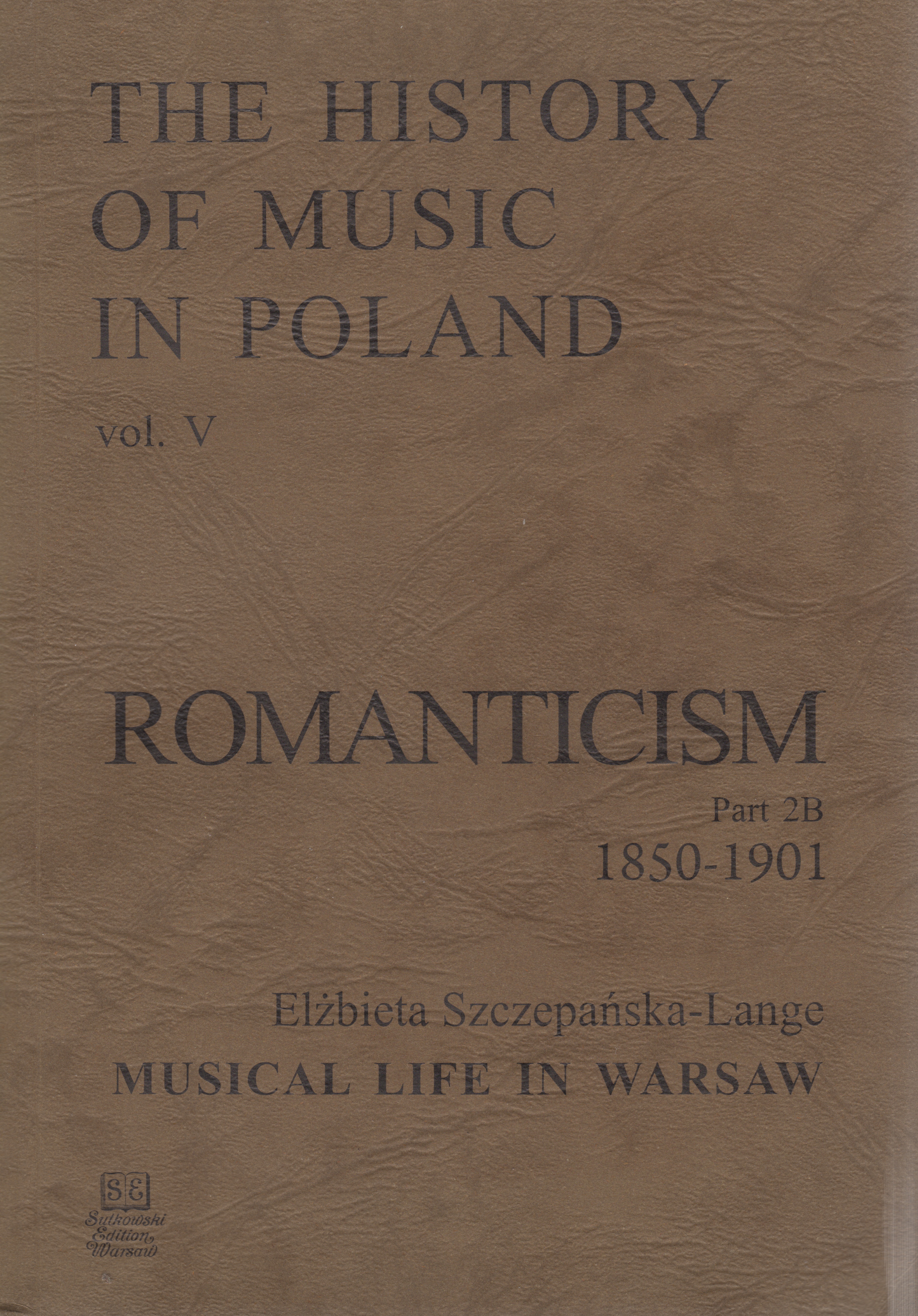
• Irena Poniatowska, Romanticism Part 2A, 1850-1900: Musical Output (Warsaw: Sutkowski Edition, 2011), 424pp. ISBN 978-83-917035-7-1
• Elżbieta Szczepańska-Lange, Romanticism Part 2B, 1850-1901: Musical Life in Warsaw (Warsaw: Sutkowski Edition, 2011), 481pp. ISBN 978-83-917035-7-1

These two complementary volumes constitute vol.5  from the series ‘The History of Music in Poland’.  They were first published in Polish in 2010 and have been ably translated into English by John Comber (who has worked on all the volumes in the series).  They effectively cover the history of Polish music from the death of Chopin (1849) to the establishment of the first properly professional symphony orchestra, the Warsaw Philharmonic (1901).

The series is the brainchild of Stefan Sutkowski, who turned 80 in March this year.  His musical career has been extraordinarily varied.  In 1954-1974 he was an oboist with the National Philharmonic and therefore played a role in the premieres of a host of new Polish compositions.  From 1957, he also took the initiative in developing the performance of early music in Poland (Musicae Antiquae Collegium Varsoviense).  This strand in his activities led eventually to the establishment of the Warsaw Chamber Opera and a series of special festivals devoted to Mozart (1991), Baroque Opera (1993), Rossini (1999) and Handel (2000).  He also founded Pro Musica Camerata in order to disseminate Polish music through new printed editions of early music and on CD.

‘The History of Music in Poland’ has done something never before attempted: a history from medieval times to the present, in Polish and, more importantly, in English.  For the first time, non-Polish readers are able to obtain both an overview and more detailed insights into the many riches of Polish musical culture.  I should add that there is also one specific volume that, unfortunately, has yet to be translated.  This is not on an historical period, as elsewhere in the series, but on a single composer.  Tadeusz Kaczyński’s chronicled reminiscences in Lutosławski. Zycie i muzyka (Lutosławski. Life and Music), published in 1994 but apparently no longer available, is a mine of information, so I hope that plans are afoot for it to appear in English.

Musical Output

Poniatowska’s volume on musical output is organised by genre, ten in all: opera, ballet, song, cantata, choral music, sacred music (oratorio, mass, organ music), symphonic music, the instrumental concerto, chamber music and piano music.  These chapters are further divided.  The last, for example, consists of an informative introduction and subsections on the etude, sonata, variations, suites and collections of works, romantic salon-style lyrical miniatures (with further headlines for characteristic Polish dances), profiles of three individual composers (Stolpe, Zarębski and Paderewski), and an account of the reception and resonance of Chopin’s music.

The volume begins with an invaluable synoptic table covering over 40pp, tabulating side-by-side the four chronologies of world history and culture, Polish history and culture, European music and Polish music.  Her first chapter succinctly sketches in the historical, cultural and educational contexts within which Polish music of this period existed.

The ten subsequent chapters on genre are designed as a ‘handbook’, synthesising and building upon existing scholarship.  The overview that emerges will be new to many Polish and non-Polish readers.  Despite the obstacles put in the way of cultural activity – in admittedly different degrees – by the three partitioning powers of Russia, Prussia and Austria, there is far more to be discovered in these fifty years than has previously been recognised.  Music history has focused on Moniuszko (opera, vocal music), Wieniawski (music for violin), Paderewski (music for piano), with further reference to Zarębski, Żeleński and Noskowski.  The reputation of Polish music of the period has therefore rested on the shoulders of six or so composers, mainly because their music found its way into print during their lifetimes or, in the case of Zarębski’s Piano Quintet (1885), almost fifty years after his death.  There is still a backlog of manuscripts and performing materials in Polish archives.  There would have been even more had a huge amount not been destroyed during World War II.

What Poniatowska has achieved here is to place a newly widened range of Polish composers and their music in the public eye.  In the chapter on opera, there are outline analyses of plots, numbers and music styles, creating, by the variety and extent of observation, a compelling narrative of the range of output of several dozen composers (I lost count).  The same is true of the other chapters.  While opera was evidently the genre that thrived best in these turbulent decades, symphonic music was ‘most modest’.  That’s putting it kindly.  With no dedicated symphony orchestras, where were the opportunities?  It was a desert for new Polish symphonic music (with a few exceptions) until the turn of the century, so it is understandable that Poniatowska should extend her chronological envelope to 1910 in this chapter to include the symphonies by Paderewski and Karłowicz, though interestingly there is no mention of Szymanowski’s First Symphony (1907).  Yet, in the light of Szczepańska-Lange’s account, it is sad to realise that the moderately active concert life of the period did not extend as fully as it might to the support and development of homegrown compositional talent.

I can testify to the value and usefulness of this book.  I’m currently writing a CD note on three works for piano and orchestra by Żeleński and Zarzycki, a composer who until now has just been a name to me.  I know that I shall be indebted to the information on these composers and their pieces, as there is nowhere else to access it in such a comprehensive and readable compendium.

Musical Life in Warsaw

Szczepańska-Lange’s chronicle of Warsaw in the second half of the nineteenth century is a different kind of book, focused on one city and divided into just two very substantial sections: opera and concert life. These are each subdivided into an introduction and mainly a chronological sequence of smaller periods.  The chapter on concert life also has subdivisions concerned with individual features such as charity concerts and the move towards the founding of the Warsaw Philharmonic.

Szczepańska-Lange marshalls her materials deftly, with plentiful excerpts from newspaper reports bringing the narrative to life.  She has sifted through a wealth of sources (she gratefully acknowledges the friendly atmosphere of the microform reading room of the National Library where she spent ‘hundreds of hours’), and her diligence, perceptiveness and enthusiasm show through.  In particular, she has detailed the vagaries of political pressures from Russia and their impact on cultural organisations.

A measure of how Warsaw more or less managed to keep up with opera houses to the West (Wagner excepted) may be gleaned from the dates of key premieres: Don Carlos (1873), Aida (1875), Lohengrin (1879), Mefistofele (1880), Carmen (1882), Tannhäuser (1883), La Gioconda (1885), Manon (1888) and Otello (1893).  Language for performance became problematic: the Warsaw premieres of Eugene Onegin (1899) and The Queen of Spades (1900) were both given in Italian, symptomatic of the times.  Warsaw Opera was no different from its counterparts in its intrigues, but its repertoire during this period of occupation was surprisingly wide and varied.

Although Wagner’s operas from The Ring onwards were not performed in Warsaw until well into the twentieth century, preludes and excerpts did occasionally appear on concert programmes (the Prelude to Parsifal in 1883). Concert music was a very poor cousin to opera, with no adequate venues, infrequent visits by virtuosi like Wieniawski, and concert-going habits quite different to those which developed later.  The distinguished Polish author Stefan Żeromski wrote in his diary about a concert that Anton Rubinstein gave in 1880:

The hall was overcome by the most remarkable silence in concert history; it was something truly incredible, almost no one was late; and what is even more unlikely, no one ran out for their garments to the cloakroom during the last number; the ladies refrained from conversing aloud; and the gentlemen did not go out after every number for a cigarette!  Verily, one has to be such an Orpheus as Rubinstein to perform such miracles.

Szczepańska-Lange’s overview of the period in her Introduction is a model of its kind, giving accounts of different types of events and their appearance within the chronology.  In the subsequent chronicle, the artistic and organisational comings and goings are effectively woven in with details of repertoire.  The move towards a permanent symphony orchestra began long before 1901.  In 1881, the composer Noskowski created his own orchestra with the specific intention of promoting new works by himself and others, both Polish and foreign, such as Smetana, Dvóřak and Saint-Saëns.  But little concrete happened until the very end of the century, when the conductor and composer Młynarski spearheaded the final drive to establishing not only the orchestra but also the Philharmonic Hall, which remains the home of the Warsaw Philharmonic to this day.

Polish composers had to fend for themselves, usually through teaching or administration.  The few composer-virtuosi – Wieniawski, Zarębski and Paderewski – based themselves abroad.  Zarębski is an interesting case.  He studied with Liszt, toured across Europe and lived and taught in Brussels, died in 1885 in his 30s, and left a modest body of music for solo piano and the marvellous Piano Quintet.  Ponietowska discusses his music in her volume, but Zarębski’s appearances in Szczepańska-Lange’s companion volume are few, indicating how rarely he visited Warsaw (it appears he played there only twice).  There are, however, wonderfully intemperate and sarcastic responses to his appearance in 1879 playing the Mangeot double-keyboard piano.  The interlinking of compositions and performances across these two volumes does not require the mental and physical gymnastics mastered by Zarębski on the Mangeot piano, but it does lead to a hugely enriched and enriching double account of this largely forgotten period of Polish musical history.  I for one am immensely grateful to have this new interlinked resource on my bookshelves as I prepare my CD note on Żeleński and Zarzycki.

What neither of these books does is to engage with aesthetic and philosophical approaches to Romanticism.  This is not for want of knowledge or understanding.  It is simply that these books have a different and more basic goal: to put into print the essential facts about the largely hidden composers and music of this period in Polish culture.  They offer opportunities for the rest of us to explore further, but that exploration will not come to much unless scholars edit and publish the scores so that performers, broadcasters and recording labels can enable us to hear the music.  What has until recently been dismissed as a dank backwater of European music may then be seen and heard to have had a much more intriguing and lively character, if these two volumes are anything to go by.  At that point, issues concerning the term ‘Romanticism’ within the Polish context will come into focus.

• Stokowski on Chopin

This extraordinary track popped up this morning as one of Simon Callow’s choices on R3’s ‘Essential Classics’ (how I still loathe this programme title, one year on). Callow is culturally literate but even he underplayed the mind-blowing chutzpah of this arrangement.  Even harder to understand today is the milieu in which a transcription such as this was both artistically acceptable and regarded as worthy of audio recording by the LSO in the early 1970s.  But I’m glad it survives, even if only as a curiosity, one whose un-mazurka-like tempo is a rival to Bernstein’s ‘Nimrod’…


It’s almost tempting (but not quite!) to see connections in the light of today’s revelation that the ‘signer’ on Rothko’s painting at Tate Modern at the weekend is also of Polish origin.

http://www.thenews.pl/1/11/Artykul/114815,Polish-artist-charged-with-damaging-Rothko-mural-at-Tate-Modern