• The Spoils of Warsaw

One of the many joys of visiting Poland over the decades has been searching out scores, books and recordings (not to mention classic posters and dark spadziowy honey).  This year was no different.  I’d not been in Warsaw since last November, so there was plenty to catch up on and to indulge my hunter-gatherer tendencies.

There are two major music shops in Warsaw.  One is SAWART (online Polish-language link here) on Moliera at Plac Teatralny near Teatr Wielki.  The other is the shop in what used to be the Akademia Muzyczna Fryderyka Chopina and what is now the Uniwersytet Muzyczny Fryderyka Chopina.  You can also find CDs and DVDs in branches of EMPIK and at Teatr Wielki’s own shop.

Books

Screen Shot 2014-09-30 at 16.00.45Two Panufnik volumes have appeared in Poland in his centenary year.  The first is a reissue of his autobiography Composing Myself (1987), translated in 1990 as Panufnik o Sobie (Panufnik on Himself), although this paperback omitted the photographs from the UK edition.  It has been republished in hardback as Panufnik. Autobiografia with a supplementary section by his widow Camilla covering the final years of his life.  An English-language reprint, likewise updated and with additional documentation, is in press … watch this space.

The next Panufnik publication is the third in a sequence of interview recollections published by Polish Music Publishers PWM.  Scan 3First was Górecki. Portret w pamięci (Górecki. A Portrait in Memory, 2013), consisting of 42 interviews carried out by Beata Bolesławska-Lewandowska. The second, slimmer volume inaugurated a new series ‘Rozmowy o kompozytorach’ (Conversations on Composers) and heralded a new design.  The interviews for Lutosławski. Skrywany wulkan (Lutosławski. A Hidden Volcano, 2013) were carried out by Aleksander Laskowski and focused on just four conductors: Edward Gardner, Simon Rattle, Esa-Pekka Salonen and Antoni Wit.  Both of these publications won major book prizes in Poland this year. Laskowski’s interviews will be published in English by Chester Music.

Scan 4Now comes Panufnik. Architekt emocji (Panufnik. Architect of Emotion, 2014), with a preface by the poet Adam Zagajewski.  It was launched during this year’s ‘Warsaw Autumn’ in the presence of Panufnik’s widow Camilla.  The author is again Beata Bolesławska-Lewandowska, whose authoritative biography (PWM, 2001) will be published in English by Ashgate in the coming months.  She spoke to twelve people:

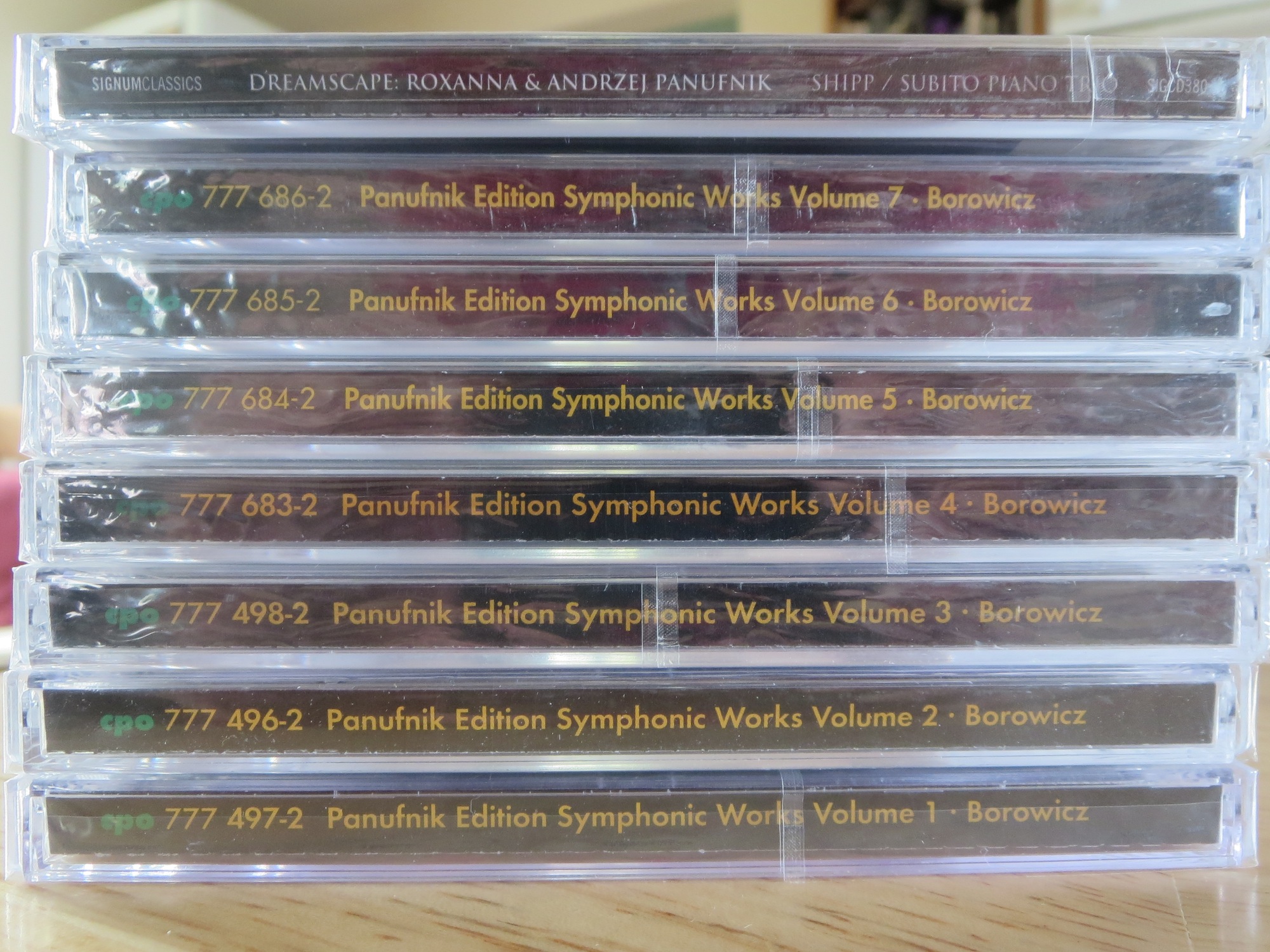
Łukasz Borowicz, the conductor of the comprehensive cpo series of eight CDs of Panufnik’s orchestral music
Roxanna Panufnik, Panufnik’s daughter and composer
Andrzej Dzierżyński, the painter and family friend, whose images adorn the covers of all but one (no.2) of the eight cpo CDs
Gerard Schwarz, conductor-laureate of the Seattle SO with whom he made a CD of Panufnik’s music in 1996
Stanisław Skrowaczewski, the conductor and composer, still active on the podium aged 91, who knew Panufnik early in their lives
Wanda Wiłkomirska, the violinist whose 1980 performance of Panufnik’s Violin Concerto can be heard on the new ninateka.pl site
Camilla Panufnik, the composer’s widow and tireless supporter since they met in England in the early 1960s
Ewa Pobłocka, who has made two commercial recordings of Panufnik’s Piano Concerto, one of them under the composer’s baton
Mark Stephenson, the British conductor who worked closely with the composer in his later years
Wojciech Michniewski, an insightful interpreter of contemporary Polish music who shared the podium with Panufnik during the concert when the composer conducted his Tenth Symphony in Warsaw in September 1990
Jem Panufnik, Panufnik’s son and graphic designer and musician
Julian Anderson, composer

I’ve not had time to read the interviews properly, but one observation by Julian Anderson caught my attention.  He concludes (p.243) that ‘one of the main things that Panufnik bequeathed to Polish music after his escape was the Polish experimental creativity that developed after 1956’ (I am translating from the Polish; these may not have been Anderson’s exact words).  This demands more scrutiny than this post allows, so I will return to this anon.

Scan 5Another book just hitting the shops is a compilation of writings by the music critic and broadcaster Andrzej Chłopecki, who died in 2012 in his early fifties: Dziennik Ucha. Słuchane na ostro (Ear Diary. Sharp Listening).  Chłopecki’s loss is still keenly felt, because he was unafraid to speak his mind, was not fazed by the establishment and quizzed everyone and everything.  His writings and charismatic radio broadcasts brought zest and intelligent prickliness to musical and philosophical debate.  This collection, running to over 500 pages,  brings together Chłopecki’s columns for Res Publica Nowa – ‘Dziennik Ucha’ (Ear Diary, 1993-98) and Gazeta Wyborcza – ‘Słuchane na ostro’ (Sharp Listening, 2001-11).  His range was astonishing.  His essays give pause for thought as well as huge enjoyment.  Sadly, they are unlikely to be translated into English.

However, there is good news on a related front.  The collection of Chłopecki’s essays on Lutosławski’s compositions, published as Andrzej Chłopecki. PostSłowie (Andrzej Chłopecki. AfterWord) in 2012, is a testament to his ability to look at – and to enable listeners to hear – music afresh.  And in the case of a composer as much discussed and analysed as Lutosławski, that was a very special gift.  The book, which he oversaw in the smallest detail and signed off just before his death, has now been translated into English by John Comber and may be out by the end of this year.

Encyklopedia Muzyczna

Finally, I have completed the set.  EM’s first volume ‘ab’ was published 35 years ago.  The series was completed by vol.12 ‘w-ż’ in two years ago.  There have also been supplements, necessary given the protracted timespan of the encyclopaedia – ‘ab’ (1998) and cd (2001) – although this process has stalled.  Instead, PWM has brought out special composer supplements: Chopin (2010), Górecki (2011), Szymanowski (2012) and Wieniawski (2011).  The Górecki volume is quite slight.  It runs to just 18 pages and was issued to commemorate the composer after his death in 2010.  It has an updated work list (but does not include posthumously released works like the Fourth Symphony), bibliography and a brand-new essay by Maciej Jabłoński.  The others supplements are more substantive: the Wieniawski has over 70 pages, the Szymanowski over 130 and the Chopin 180.Scan 2

This time I picked up a copy of the Lutosławski supplement (77 pages), published in 2013. In addition to an essay written by the late Jadwiga Paja-Stach and by Zbigniew Skowron, there are individual entries on over 60 performers, composers, poets, publishers and authors closely associated with him.  It is an honour to have been included in this distinguished gathering.

Recordings

Scan 7Various CDs have come my way in recent months, not least a range of discs from the ever-productive DUX company.  I also received a smart boxed set from Sinfonia Varsovia issued to mark the 70th anniversary of the Warsaw Uprising and the end of Word War II.  This non-commercial 3-CD set is called (a little loosely) Anthology of Polish Contemporary Music 1939-1945 and it contains much music that is hard to find elsewhere on disc.  The conducting duties for the twelve pieces are shared between Renato Rivolta (6), Jerzy Maksymiuk (5) and Jacek Kaspszyk (1).  There is an excellent booklet essay by Katarzyna Naliwajek-Mazurek.  The complete repertoire is:

Grażyna Bacewicz, Overture (1943)
Andrzej Czajkowski, Piano Concerto no.2 (1966-71), with Maciej Grabowski
Tadeusz Zygfryd Kassern, Concerto for String Orchestra (1943)
Stefan Kisielewski, Concerto for Chamber Orchestra (1944, 1949)
Witold Lutosławski, Symphonic Variations (1938)
Andrzej PanufnikTragic Overture (1942)
Andrzej Panufnik, Sinfonia elegiaca (1957, 1966)
Karol Rathaus, Music for Strings (1941)
Ludomir RóżyckiPietà. On Smouldering Ruins of Warsaw (1942, 1944)
Antoni Szałowski, Overture (1936)
Aleksander Tansman, Rapsodia polska (1940)
Mieczysław Weinberg, Cello Concerto (1948), with Marcel Markowski

Contemporary composers in Poland have as difficult time as anywhere getting their music heard and recorded, but there have been some initiatives in recent years to plug some of the gaps.  The ‘Warsaw Autumn’ annual chronicle of seven or more CDs provides a permanent reminder of live performances.  The chronicle is non-commercial, but libraries, institutes and interested individuals may request to be put on the distribution list.  The recordings come with either the Polish or English programme book for the year.  Enquiries may be made via this link.

In 2009, DUX launched an initiative called Young Polish Composers in Homage/Tribute to Frederic Chopin, in honour of the composer’s bicentenary in 2010.  The eleven CDs in the series introduced ten Polish composers and one Czech to the wider public:

Stanisław Bromboszcz (b.1980): Chamber Music, DUX 0746
Michał Dobrzyński (b.1980): Expression DUX 0752
Marcin Gumiela (b.1980): Sacred Works DUX 0753
Paweł Hendrich (b.1979): Chamber Works DUX 0754
Michał Moc (b.1977): Emotions DUX 0756
Dariusz Przybylski (b.1984): Works for Orchestra DUX 0721
• Weronika Ratusińska (b.1977): Works for Orchestra DUX 0723
Agnieszka Stulgińska (b.1978): Chamber Works DUX 0759
Sławomir Zamuszko (b.1973): Works for Orchestra DUX 0724
Wojciech Ziemowit Zych (b.1976): Works for Orchestra DUX 0722
+ the Czech composer
• Kryštof Mařatka (b.1972): Chamber Works DUX 0784

DUX prefaced the series in 2008 with a double sampler CD DUX 0635/0636, with mostly different pieces plus works by two other composers who did not go on to have had their own individual CDs: Marcin Stańczyk (b.1977) and Marcin Tomasz Strzelecki (b.1975).

On my visit to Warsaw last week I came across a more recent series devoted mostly to an older generation of Polish composers.  Under the heading Polish Music Today. Portraits of Contemporary Polish Composers, Polish Radio and the Polish Music Information Centre launched ten CDs earlier this year.  They are available via the Polish Radio online shop (click on links below), where you will also find information on each composer and tracks, but only in Polish.  The intention is to develop the project further.  The ten lucky composers so far are:

Magdalena Długosz (b.1954): PRCD 1743
Jacek Grudzień (b.1961): PRCD 1746
Aleksander Kościów (b.1974): PRCD 1750
Zbigniew Penherski (b.1935): PRCD 1741
Jarosław Siwiński (b.1964): PRCD 1747
Michał Talma-Sutt (1969): PRCD 1748
Ewa Trębacz (1973): PRCD 1749
Tadeusz Wielecki (b.1954): PRCD 1744
Anna Zawadzka-Gołosz (1955): PRCD 1745
Lidia Zielińska (b.1953): PRCD 1742

Now I must get down to some serious reading and listening…

• Signposting Panufnik

unnamed-1

My thanks to Michał Kubicki for taking the trouble to photograph the new sign for Aleja Andrzeja Panufnika (Andrzej Panufnik Avenue).  It was unveiled yesterday in Warsaw in the presence of Panufnik’s widow Camilla and son Jeremy. Officials present included the Mayor of Warsaw.

The avenue is located in Morskie Oko (Eye of the Sea) Park in the Mokotów district south of Warsaw’s city centre.  It runs directly east from the arterial Puławska Street that heads south through Warsaw.  The newly-named avenue leads to the Szuster Palace, where one of Panufnik’s grandmothers once lived.  It was an area that Panufnik knew very well, and it is a nice touch that the Warsaw Music Society now has its headquarters in the palace.

• Panufnik’s Mushrooms (1991)

I met Panufnik only once, and that was in odd circumstances.  Although I had been at the ‘Warsaw Autumn’ in 1990 when he made his one and only return to Poland, I didn’t meet him then.  It was not until the following year that fate intervened, a month before he died.

At the end of September 1991, I called in at the ‘Warsaw Autumn’ temporary office on the first floor of the Europejski Hotel to thank the staff for once again hosting me as a guest of the festival.  There was a lady standing there, tenderly holding a package: “Do you know of anyone going to London after the festival?”, she was asking.  I replied that I was leaving at that moment.  “Ah, could you do me a great favour?  Andrzej Panufnik has expressed a wish to have wild mushroom soup, so I have been to the forest and picked these for him.  Do you think you could take them to Twickenham?”  I was only to happy to oblige.

I was living in London then, working at BBC Radio 3, so once I landed at Heathrow I hopped into a taxi and arrived at the Panufnik home mid-evening.  I knocked on the door.  Camilla Panufnik opened it and was puzzled by this stranger standing there, holding a dubious package.  “I’ve brought mushrooms for you from Warsaw”, I spluttered. “Oh, thank you!  You must come in and meet Andrzej.”

I was led upstairs to meet the composer, who was in a quietly cheery mood and thrilled to receive these fungal goodies from Poland.  Not wishing to tire him with any prolonged conversation, I quickly bid my farewells and got back into the taxi.  I gathered later that the soup was delicious and much appreciated.  I was just glad to have been one link in a chain that brought him some contentment in his last weeks.

• New Sikorski & Panufnik websites

During this year’s Warsaw Autumn festival two new composer websites were launched.  This brings the roster of such Polish sites to eight over the past three years and they are an invaluable source for anyone wanting to learn more about Polish music.

Tomasz Sikorski‘s life and career were sadly short – he died in 1988 aged 49, and his decline is poignantly described in the biographical section of http://www.sikorski.polmic.pl/.  His music speaks of personal angst translated into obsessive repetition and an uncompromising approach to musical material, which is characteristically stark.  But it is by the same token compelling.  The focus piece is Music in Twilight, presented in video from the 2006 Warsaw Autumn.  There are a few pieces on YouTube and I wrote a post on 13 November 2013 in which I give these YouTube items (as they were available then) plus details of two recent CD issues of Sikorski’s music.

panufnik-kolekcja595

Andrzej Panufnik needs no introduction, one might think, but his centenary year has not been as comprehensively covered in concert as one would wish.  Earlier this year, the POLMIC (Polish Music Information Centre) series in which Sikorski’s site is the latest, set up a site devoted to Panufnik.  Now, NINATEKA, hosted by Narodowy Instytut Audiowizualny (National Audiovisual Institute), has added him to its collection alongside Górecki, Lutosławski and Penderecki, whose ‘Three Composers‘ site went live at the end of 2013.  These sites are primarily audiovisual but there are also highly informative notes on each piece.   You may choose English or Polish pathways.

Almost all of Panufnik’s compositions are available on http://ninateka.pl/kolekcje/en/panufnik/ in audio format (sometimes in two performances) and there are a dozen video files. The most interesting of the latter are two fairly recent films on Panufnik: Errata do biografii (Grzegorz Braun, 2008, in English/Polish) in which Panufnik’s life is explored, especially the Polish years, and My Father, the Iron Curtain and Me (Krzysztof Rzączyński, 2009, in English/Polish), in which his son Jeremy travels to Poland to explore his relationship with his father.

• Panufnik in Warsaw (Aug-Sept)

Screen Shot 2014-08-16 at 10.38.26A phone call today from the director of the ‘Chopin and his Europe’ festival in Warsaw has alerted me to a raft of Panufnik performances that this imaginative festival is including this year.  Lutosławski was similarly honoured by the festival on his centenary last year.  In May I wrote a post here, Panufnik Centenary, giving some details of the worldwide coverage of his music in 2014.  Last week, BBC Music Magazine published my profile of Panufnik, ‘Poland’s Great Exile’ (its subtitle, not mine), in its regular ‘Composer of the Month’ slot.

I’ll pass over the loss, in the editing of the article, of my comment that the BBC Proms have ignored the Panufnik centenary.  And it remains the case that there are rather large repertoire gaps elsewhere in the centenary celebrations, such as the continuing absence of four of the symphonies (an improvement on the situation in May; see next paragraph).  Even the ‘Warsaw Autumn’, which reintroduced Panufnik’s music onto Polish concert platforms in 1977 (after a gap of 23 years following his escape to the UK) – and programmed eleven of his works when Panufnik visited Poland for the first and only time in 1990, is not marking the centenary.  It is a bit perplexing that it has passed up this opportunity to celebrate its key role.  It is, however, providing an umbrella for a three-day conference ‘Andrzej Panufnik i jego wizja muzyki’ (Andrzej Panufnik and his Vision of Music’, 24-26 September), which the Chopin Music University has organised.  The conference also includes a series of chamber concerts outside the ‘Warsaw Autumn’ programme.

The day after the ‘Warsaw Autumn’ ends, Polish Radio is hosting a concert of Panufnik’s orchestral music which plugs two earlier gaps in the celebrations: the orchestral Nocturne and Sinfonia rustica, both works dating from the late 1940s. The programme is completed by the Cello Concerto, played by Raphael Wallfisch.  The conductor is Łukasz Borowicz, whose recently completed 8-CD set of Panufnik recordings is a dynamic survey of the orchestral music.

It has been left to other festivals to provide audiences with cross-sections of Panufnik’s music, and two of these take place this month.  The Presteigne Festival in mid-Wales is one, and I posted on its repertoire in May: Poles in Presteigne.  The Panufnik component in Warsaw’s ‘Chopin and his Europe’ is as follows:

• Twelve Miniature Studies for piano (Cycle of Fifths) (1947)
• Piano Concerto (1961)
• Violin Concerto (1971)
• Sinfonia concertante for flute, harp and strings (Symphony no.4) (1973)
• String Quartet no. 1 (1976)
• String Quartet no.2 ‘Messages’ (1980)
• Arbor cosmica for strings (1983)
• String Sextet ‘Train of Thoughts’ (1987)
• Symphony no.10 (1988)
• String Quartet no.3 ‘Wycinanki’ (1990)
• Cello Concerto (1991)

• New Website for Panufnik

10325233_442302385905268_5695306740097370493_n

http://www.panufnik.polmic.pl

One of the most valuable initiatives of the Polish Music Information Centre (POLMIC), in conjunction with the Polish Composers’ Union (ZKP) and other institutes and publishers, is a series of composer websites.  The first, in 2012, was devoted to Kazimierz Serocki, and the second, in 2013,  to Tadeusz Baird.  Today, it is the turn of Andrzej Panufnik, in his centenary year.  With the launch last year of the threecomposers.pl website at NINATEKA (Górecki, Lutosławski, Penderecki), there are now accessible sources in English and Polish for six of Poland’s most distinctive composers of the second half of the twentieth century.

The leading light of the editorial team on the Panufnik site is Beata Bolesławska-Lewandowska (she was closely involved involved in its predecessors). The three POLMIC sites have similar formats, although the Panufnik site is more extensive.  It has eight principal sections, most with several sub-sections: Life, Timeline, Work, Musical Inspirations, Places, Gallery, Bibliography, Discography, plus a featured work, in this case Sinfonia sacra.

It looks as thorough and informative as its predecessors.  There are, for example, excerpts from most works at the top of their individual entries, which give useful background information on compositional circumstances, Panufnik’s concept and reception.  There is even information on the mass songs (with pages from the published scores).  The six entries under Musical Inspirations are useful little essays and a new feature (Places), possibly taking its cue from the mobile app released a year ago for Lutosławski’s Warsaw, explores half-a-dozen locations in each of Poland and Great Britain that were significant to Panufnik.

As one might expect, the Gallery of photos is especially rich, given Camilla Panufnik’s renown as a photographer.  The Bibliography is substantial and the CD Discography looks comprehensive.  There is the occasional navigational oddity (the audio excerpts are grouped under Gallery-Music), while the left sidebar can be a bit too sensitive to the touch of the cursor.  It would also be helpful sometime to have English translations of the documents that feature as photographs.

This new Panufnik site is an exceptional new resource, and a credit to all involved.  It is well worth investigating at leisure.  I wonder who will be next in this series?

Later on 16.05.14: Beata Bolesławska-Lewandowska has informed me that the next composer in the series will be Tomasz Sikorski – excellent news. His website will be launched at the 2014 ‘Warsaw Autumn’ festival.

• Panufnik Centenary (200th post)

Screen Shot 2014-05-12 at 17.44.39Another event (or, rather, series of events) that I have missed by being away is the initial celebration of the centenary of Andrzej Panufnik, who was born in Warsaw on 24 September 1914.  So far it seems to have been relatively quiet, certainly in comparison to the Lutosławski centenary last year.  Yet there is quite a bit going on.  There are conferences and focused events as well as performances within the 2013-14 and 2014-15 season.  There are over 100 concerts, principally in Poland and the UK, with a smattering in each of Austria, Germany, Latvia, Kosovo, Bulgaria, Romania, Australia and Brazil.  The gaps, though, speak for themselves.  Really, is there nothing in the USA except for Camilla Panufnik’s guest lecture at the University of Southern California? Nothing in Scandinavia, Holland, France, Spain or Italy?

Last month there was surprise, and dismay, that the BBC Proms had programmed no music by Andrzej Panufnik in 2014, although his daughter Roxanna makes a welcome appearance.  This isn’t good enough.  Just because last year’s Proms included two short works composed while Panufnik still lived in Poland – Tragic Overture and Lullaby – is no reason to ignore his substantial orchestral and chamber output composed since he settled in the UK in 1954.

But the Proms season is not alone.  Very few British orchestras have programmed Panufnik’s music this year.  The London SO is the leading light here, with performances of Lullaby and Sinfonia sacra (Symphony no.3) in February and Symphony no.10 in October in the new Polish Radio concert hall in Katowice and, the following night, in the Barbican Hall, London.  The list of performances monitored by Panufnik’s publishers, Boosey & Hawkes, shows how a wonderful opportunity has been missed.  As it stands, only half of Panufnik’s ten symphonies are being played this year.  Sinfonia sacra, arguably his most compelling symphony, has six performances overall, no.10 three, and nos 2, 4 and 5 two each.  That means that Sinfonia rustica (no.1), Sinfonia mistica (no.6), Metasinfonia (no.7), Sinfonia votiva (no.8) and Sinfonia di Speranza (no.9) are at present totally absent from concert halls around the world in this centenary year.  I find this totally mystifying.  The non-symphonic orchestral repertoire is more frequently on the bill: Tragic Overture (three), Lullaby (four), Heroic Overture (perhaps his least characteristic work, eight), Autumn Music (just one), Arbor cosmica (two) and Harmony (three).  No sign of one of his best pieces, Nocturne, which is nothing short of scandalous (I am reminded here of the rarity of Lutosławski’s masterpiece Livre during 2013).  Other notable absentees include Katyń Epitaph and Universal Prayer.

The concertos and chamber music fare better (Sinfonia concertante, no.4, should really figure in the first group).  The Piano Concerto and Piano Trio are notching up 13 performances apiece, while the Violin Concerto is being played on nine occasions and the Cello Concerto three. The string quartets and string sextet appear between three and six times each, and rising.  One of the major events is at the Presteigne Festival in Wales.  Over its six days (21-26 August), six of Panufnik’s pieces for voice(s), piano, chamber ensemble and string orchestra will be heard.  Isn’t it often the case that small or modest-scale organisations are more imaginative and flexible than big ones?

Nevertheless, most of Panufnik’s pieces are represented at some point during 2014, the vast majority in professional concerts, with a healthy sprinkling of amateur performances.  Some works have multiple hearings through tours or back-to-back concerts, and some are the repeated focus of specific performers, such as the Piano Concerto (Maciej Grzybowski). The Violin Concerto does particularly well in terms of range of soloists (Tai Murray, Maria Machowska, Tasmin Little, Aleksandra Kuls, Szymon Krzeszowiec, Alexander Sitkovetsky).

I live in hope, even at this late stage in concert planning for 2014-15, that some of the repertoire gaps will be bridged and that more of Panufnik’s music – which is distinctive, powerful, lyrical and tightly focused in an exceptional way – will be brought before the ears of the concert-going public this year.  And if not this year, then in subsequent years as a testimony to his unique creative voice.

panufnik.com

The Boosey & Hawkes list is located at the impressive panufnik.com.  This site has been up and running for a while, and includes his biography, a discography (current and past), a complete list of published works (by category and chronologically), audio excerpts, stills and a few videos from his brief film career in Poland (under the heading Extras-Unknown Panufnik) and a generous bibliography of Polish and English coverage (Extras-Further Reading). There is also a very welcome collection of Panufnik’s diagrammatic designs that are attached to eleven of his compositions.

The audio excerpts are taken from the cpo series (2008-13) with the Polish Radio SO under Łukasz Borowicz.  I have just today – very belatedly – taken delivery of its seven CDs (and the just-released father-daughter double act with Roxanna’s music) and am eagerly looking forward to listening to them.  Borowicz is a persuasive conductor and, even if live performances of Panufnik’s orchestral music are unfairly patchy this year, at least there is this well-planned and comprehensive series that will last well beyond 2014.

IMG_3295 copy

Where panufnik.com is shy of being fully comprehensive is in some of the repertoire from the late 1940s and early 1950s.  Symphony of Peace (1951), although it was published in Poland, gets only a passing mention as furnishing the material for Sinfonia elegiaca (1957), and it is absent from the biography.  Also missing are the several mass songs that he wrote, and were published, in 1949-54 (no mention, for example, under Unknown Panufnik).  No-one is pretending for one moment that these minor propaganda pieces have musical importance, but they do have cultural-political significance and to imply that they never existed is unfortunate.  One only has to look at the openness with which such items were dealt with during the Lutosławski centenary to see that there are huge benefits for the understanding of the difficult life of Polish composers in those years.

In every other respect, panufnik.com is a valuable source of information, easy to navigate and handsome to look at.


• Poles in Presteigne

UnknownThe 2014 Presteigne Festival in mid-Wales (21-26 August) has designed a special focus on Polish music.  This includes a new commission and premieres as well as sampling the music of composers such as Bacewicz, Lutosławski, Penderecki and Górecki.  There is a particular emphasis on the music of Andrzej Panufnik, on the centenary of his birth.  The full schedule may be found at: https://www.presteignefestival.com/PDFs/PF2014_brochure_for_web.pdf.

Here is an alphabetical-by-composer list of the Polish repertoire plus details of relevant talks and discussions
(** World premiere, * UK premiere):

Grażyna Bacewicz
• Concerto for String Orchestra (1948)
• Two Etudes for piano (1956)

Henryk Mikołaj Górecki
Two Sacred Songs for baritone and piano (1971)
• String Quartet no.1 ‘Already It Is Dusk’ (1988)

Witold Lutosławski
Dance Preludes for clarinet and piano (1954)
• Grave for cello and piano (1981)
• Partita for violin and piano (1984)

Paweł Łukaszewski
• Piano Trio (2008)
• Requiem** (2014, Festival commission)

Andrzej Panufnik
Miniature Etudes (Circle of Fifths), Book II, for piano (1947)
Landscape for string orchestra (1962/65)
Song to the Virgin Mary for choir (1964/69)
• Sinfonia Concertante for flute, harp and strings (1973)
• Love Song 
for mezzo-soprano and piano (1976)
• String Quartet no.3 ‘Wycinanki’ (1990)

Krzysztof Penderecki
• Prelude for solo clarinet (1987)
• Quartet for clarinet and string trio (1993)
• Serenade for string orchestra (1997)

Maciej Zieliński
• Lutosławski in memoriam for oboe and piano (1999)
Trio for MB for clarinet, violin and piano (2004)
Concello* (2013)

Talks and Discussions

• Warsaw Variations (award-winning Fallingtree Production, first broadcast on BBC R4 in 2012, with contributions by Beata Bolesławska-Lewandowska, Camilla Panufnik and Adrian Thomas), followed by a discussion with Camilla and Roxanna Panufnik, radio producer Alan Hall, chaired by David Wordsworth
• Pre-concert event: Roxanna Panufnik, with Stephen Johnson
• Pre-concert event: Paweł Łukaszewski, with Thomas Hyde
• Pre-concert event: Paweł Łukaszewski, with Adrian Thomas
• Talk: Three Generations of Polish Composers (Adrian Thomas)
• Pre-concert event: Maciej Zieliński, with Adrian Thomas

• WL100/54: Lutosławski and Panufnik (1945)

Here are two forgotten assessments of Lutosławski and Panufnik from 1945.  I think that this is the first time that this material has been seen in modern times.  On one of my rummages in second-hand bookshops in Kraków, back in the 1990s, I came across a bundle of concert programme, one of which I featured in an earlier Lutosławski post: WL100/43: Variations, **17 June 1939.  This second programme, which I explored in the preceding post WL100/53: Trio, **2 September 1945, has the biographies of the five composers on the back page.  In fact, the biographical elements on Lutosławski and Panufnik take second place to assessments of the composers’ creative personae.  It is not indicated who wrote them.  I’ve translated the two for Lutosławski and Panufnik below.

WL program 2.09.45 4

WITOLD LUTOSŁAWSKI b. 1913 represents the youngest generation of Polish composers and, among them, the direction of the “extreme left”.  This avant-gardism expresses itself in Lutoslawski in the openly fanatical pursuit of logic and rigour in the design of his prevailing use of polyphony as a means towards these goals, searching absolutely for his own sound world, as far removed as possible from that used by previous generations of composers.  It is especially interesting to find that this avant-gardism appeared in Lutoslawski independently, as an expression of his own internal needs.  During his studies he found no external stimulus in this direction, nor did the environment in which he grew up and was educated have the slightest intrusive impact.  He completed his music studies at the Warsaw Conservatory in the class of Witold Maliszewski, one of the representatives of the most conservative tendency among our composers and teachers.
Among the most important works by Lutoslawski we may mention: Piano Sonatas (which he has performed several times), Symphonic Variations (performed at the Wawel Festival in 1939), Variations on a Theme of Paganini for two pianos, fragments of a Requiem, piano pieces and songs.  Currently he is working on a symphony, of which the first movement is already fully completed, the rest in sketches.

This biography is fascinating for several reasons: (1) the placing of Lutosławski as a radical “extreme left” composer on the basis, presumably, of his main composition so far, the Symphonic Variations, (2) the early indication of his life-long desire for logic and rigour, (3) the emphasis on polyphonic writing (with only a few pieces as evidence) as distinct from the later emphasis on harmony, (4) the strong statement about Lutosławski’s independence from external sources and events (something which he reiterated over and again until the end of his life), and (5) the deliberate distancing from his teacher Maliszewski, whom later he often cited as a key influence on his structural thinking while recognising Maliszewski’s disapproval of the Symphonic Variations.  Given the strength of opinion expressed in this paragraph, it wouldn’t surprise me at least if it was written by the unknown author on the basis of a detailed briefing from the composer.  I don’t have the feeling that Lutosławski penned it himself (see the error mentioned in the paragraph below).

The list of works curiously multiplies the Piano Sonata.  This is the only time that I have read any suggestion that there might be more than one!  It also reveals where Lutosławski was in the composition of the First Symphony (1941-47).  We may now date the completion of the first movement as by August 1945 at the latest, with the other three movements being finished over the following two years.

ANDRZEJ PANUFNIK, whose “Tragic Overture” was such a success in Kraków’s last concert season*, is the second strong supporter – alongside Lutosławski – of radical trends among our youngest composers. And with him at the forefront, the quest for the greatest formal logic is advancing, and for the most part he experiments with clearly positive results in the pursuit of a new musical language.  At the same time, a very specific note of lyricism is revealed in his music, which gives his pieces the most distinctive physiognomy.
Panufnik is the author of: Variations for piano, Trio for violin, cello and piano, Folk Songs with wind instr. accomp., Songs with chamber orchestra, “Tragic Overture”, Orchestral Variations, Symphonic Image and two symphonies.
As an outstandingly gifted conductor himself, he is the best performer of his symphonic works.  In recent times, he has worked regularly with the Polish Film Unit in Łódż.

Panufnik’s biography is interesting for largely different reasons.  He has long been regarded as the most experimental Polish composer of the second half of the 1940s, so it is fascinating to see that he already bore this mantle in 1945 with a work like Tragic Overture (1942, reconstructed 1945) and that the lyrical side of his music achieves prominent notice at a moment when he was focusing on tight motivic cells.  The list of works includes some that had been lost during the Second World War and have generally been left out of his list of works since, including his early student Variations for piano, the Symphonic Variations – which Panufnik had conducted in the graduation concert – and Symphonic Image (both works were composed during Panufnik’s last year at the Warsaw Conservatoire, 1935-36) as well as the two symphonies (1940, 1941).**  The Songs with chamber orchestra are unidentifiable.

…….

* The dates of the wartime premiere in Warsaw of Tragic Overture vary according to the source: the Polish Encyklopedia Muzyczna and Panufnik’s autobiography Composing Myself give 1943, while the monographs by Beata Bolesławska and Ewa Siemdaj give 19 March 1944.  As to the premiere in Kraków of the reconstructed score, Siemdaj gives 10 January 1946, but this leaflet indicates that it was given sometime during the 1944-45 season.
** In his autobiography, Panufnik noted: ‘I then decided to try to rescue my Symphony no.1.  But here my memory faltered and the results were disappointing.  I performed it in one of our symphony concerts, but afterwards destroyed the score.  With that I renounced further reconstruction work…’.  Concert programmes from Kraków indicate that Panufnik conducted the premiere of his reconstructed First Symphony on 30 November 1945, and again on 6 December.

• WL100/53: Trio, **2 September 1945

With this programme leaflet, the precise date of the premiere of Lutosławski’s Trio for oboe, clarinet and bassoon (1944-45) can be determined.  It has long been known that it was given its first performance in Kraków during the Festival of Contemporary Polish Music (1-4 September 1945).  This leaflet indicates that the premiere was on Sunday 2 September, which was also the final day of the Congress of the Union of Composers (subsequently known as the Union of Polish Composers, ZKP), held 29 August – 2 September to galvanise Poland’s musical life in the immediate post-war months.  Lutosławski was appointed Secretary-Treasurer of the new union during the congress.

WL program 2.09.45 1

The programme of this Chamber Concert does not specify that this was the premiere of the Trio, but then it also fails to do the same for at least one of the other pieces.  The previously understood details of the premiere of Andrzej Panufnik’s Five Folk Songs (later known in English as Five Polish Peasant Songs, 1940, reconstructed 1945) were only that the piece was premiered during this festival under the young conductor and composer Stanisław Skrowaczewski (b.1923).  The details here give not only the date, but also the full complement of players, under a different conductor and composer, Artur Malawski (1904-57).

WL program 2.09.45 2

Also in the first half of the programme were several piano pieces by Jan Ekier (who celebrated his 100th birthday four days ago), most of them written before the war.

The second half of the programme focused on Roman Padlewski (1915-44) , whose death in valour during the Warsaw Uprising in August 1944 was one of the greatest losses to Polish music during the Second World War. Padlewski’s first and third string quartets were destroyed during the Uprising, but the Second Quartet (1940-42) survived.  I don’t know if it was performed in one of Warsaw’s secret concerts during the war or whether this was its premiere.  It was preceded here by Tryptyk żałobny (Mourning Triptych), by Tadeusz Kassern (1904-57), which was based on melodies from a 16th-century hymnal and dedicated to Padlewski’s memory.

WL program 2.09.45 3