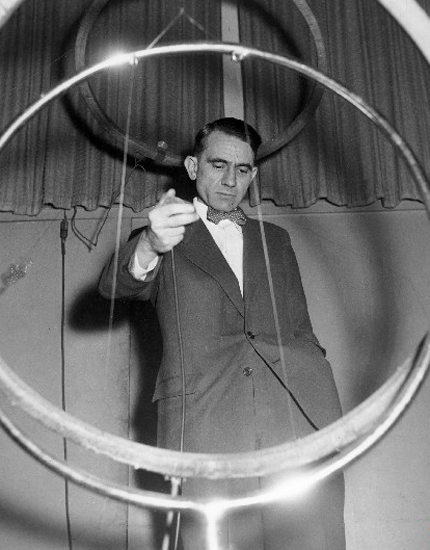
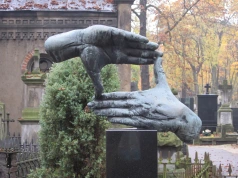
• Tomasz Sikorski, d.13 November 1988

Today is  the 25th anniversary of the death of Górecki’s near-contemporary Tomasz Sikorski (1939-1988). Yesterday marked the third anniversary of Górecki’s death, but some sources (Wikipedia) also give yesterday as the date of Sikorski’s death, while others (Encyklopedia MuzykiNew Grove) give tomorrow, 14 November.  The most reliable Polish sources (Encyklopedia Muzyczna, Polish Music Information Centre POLMIC, PWM) give today, 13 November.
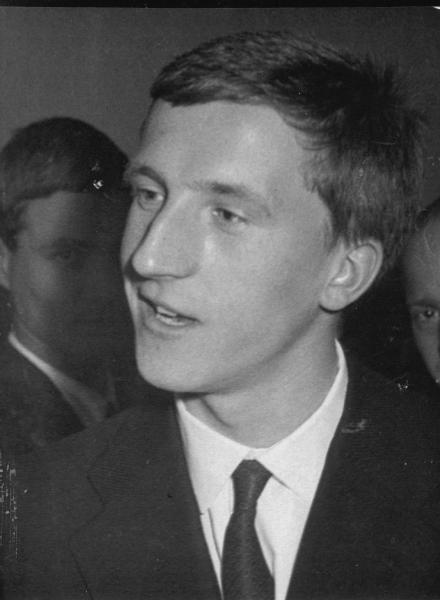
284_rdSikorski was and is one of the most singular voices in post-war Polish music and it is good to see that he still attracts a devoted following, not least through recent releases of his work on Bôłt Records.

When I was in Warsaw in January I went to a recital of some of his pieces by his friend and lifelong advocate of Polish piano music, the Hungarian pianist Szabolcs Esztényi.  The event marked the recent release of two Bôłt CDs, issued in partnership with several like-minded advocates such as Polish Radio 2, Polish Radio Experimental Studio, Foundation 4.99, DUX records, Bocian Records and the journal Glissando.  Sikorski’s music is/was published by PWM, Author’s Agency (Agencja Autorska), Moeck and Edition Modern.

sikorski_solitudeSolitude of Sounds. In memoriam Tomasz Sikorski (DUX 0936/0937) is a 2-CD set that also includes pieces by Esztényi (Created Music no.3 and Concerto) and Kasia Głowicka (Presence).  The Sikorski pieces are Echoes II (1963), Antiphons (1963), Solitude of Sounds for tape (1975) and Diario 87 for reciter and tape.  Sikorski himself performs on the first two of these archival recordings, and Esztényi writes a penetrating and disturbing recollection of his friend, who died in unexplained circumstances aged just 49.

sikor_tilburyThe second CD marks another, if briefer friendship, this time with forged with John Tilbury (b.1936), who met Sikorski in Zbigniew Drzewiecki’s piano class at the Higher School of Music in Warsaw in the early 1960s.  Tilbury’s CD For Tomasz Sikorski includes recent recordings that he made of his friend’s Zerstreutes Hinausschauen (1972), Autograph (1980) and Rondo (1984) plus his own Improvisation for Tomasz Sikorski (2011).

There is also, happily, a fair representation on YouTube, mostly uploaded by nocontrol696.  Jackamo Brown has created a 12-work playlist from nocontrol696’s uploads:

Monodia e Sequenza for flute and piano (1966)
Homophony for four horns, three trumpets, three trombones, gong and piano (Homofonia, 1970)
For Strings for three violins/violas (Na smyczki, 1970)
Zerstreutes Hinausschauen for piano (1972)
Holzwege for orchestra (1972)
• Music for Listening for two pianos (Muzyka Nasłuchiwania, 1973)
• Other Voices for 24 wind instruments, four gongs and bells (Inne głosy, 1975)
Sickness unto Death for two pianos, for horns and four trumpets (Choroba na śmierć, 1976)
Strings in the Earth for strings (Struny w ziemi, 1980)
• Autograph for piano (Autograf, 1980)
La Notte for strings (1984)
Diario 87 for reciter and tape

…….

For what they’re worth, here are two passages from my book Polish Music since Szymanowski (CUP, 2005), pp.213, 219-22, which discuss Sikorski and, initially, his contemporary and closest friend, Zygmunt Krauze, who happily is still very much with us (we met in Warsaw last Saturday).

If sonorism of the Pendereckian mould emanated from Kraków, Warsaw maintained a polite distance, preferring, in the music of Lutosławski, Baird, Serocki and others, to develop a closer architectonic relationship with detailed rhythmic and pitch organisation.  Of the younger Warsaw generation who graduated in the 1960s, two composers quickly became pre-eminent: Zygmunt Krauze and Tomasz Sikorski (1939-88), son of the composer Kazimierz Sikorski.  They were both his students, the latest in a line that already included Bacewicz, Baird, Kisielewski, Krenz, Palester, Panufnik and Serocki.  From the beginning, they each showed a determined individuality which defined a different stream in contemporary Polish music.

[…]

Tomasz Sikorski’s contribution to Music Workshop [Krauze’s pioneering ensemble of clarinet, trombone, cello and piano] reinforces the essentially minimal ethos not only of much of the music promoted by the ensemble but also Sikorski’s own distinctive voice.  This he established in a series of works in the mid-1960s – Antiphons and Echoes II (1963), Prologi (1964), Concerto breve (1965) and Sequenza I (1966) – in which the music proceeds by means of chains of small ad libitum fragments grouped in larger sequences.  The quasi-improvisational chordal fragments are deployed antiphonally or as live or tape playback echoes in a reiterative heterophony that is obsessive and, like some of Krauze’s pieces, achieves a disembodied, altered state, particularly in the cumulative resonances and polymorphic character of Antiphons and Echoes II.  Prologi is characterised by its mix of triadic ideas, diatonic scales and more dissonant material; his use of four-note cells, constructed from pairs of perfect fourths, is a feature of this and other compositions, where tritonal harmonies or pedals become a regular feature.

Sikorski’s pervasive nervous energy and unremitting focus on reductive processes occasionally approached the sonoristic values apparent elsewhere in Polish music (Concerto breve, Sequenza I), mainly by developing flickering, amorphous and quasi-stochastic textures.  But in the works of the late 1960s he returned to an introspective, often fractured idiom which focussed on one or two key notions.  In one of his rare comments on his compositional intentions, he described Sonant for piano (1967) in the following terms:

This work is based on the contrast between the attack and decay of sound.  The work’s construction, above all its temporal organisation (augmentation of rhythmic values, approximate values, whose duration depends each time on the timbral characteristics of the piano), as well as its ‘form’ (static aspect, repetitions of structures, etc.), are the consequences of the distribution of Sonant‘s sound material in two strata: those of attack and decay.*

By the time of Homophony (1970), Sikorski had intensified the concentration of his material: ‘It is a proposal for static, one-dimensional music.  In this work, both the sound material and its structuring are reduced to a minimum’.**

Homophony‘s instrumental forces reiterated Sikorski’s lifelong interest in specific timbres (it is scored for twelve brass, piano and gong) and he reinforced his fascination with the interface of diatonicism and dissonance in utilising a six-note bitonal chording, a combination of first-inversion G major and second-inversion B flat minor triads.  His fundamentally diatonic language is particularly evident – even exposed – in the pared-down minimal reiterations of his Music Workshop commission, Untitled (1972).  He had, by this stage, defined his musical persona as uncompromisingly austere in terms of both material and its deployment and of the timbral-expressive world which he explored (cf. Górecki in the late 1960s).  He largely eschewed the temptations of orchestral sonorism (although in Holzwege for small orchestra, 1972, he achieved an almost Messiaen-like luxuriance both texturally and harmonically), usually preferring an ascetic palette in which his intense and often bleak reiterations could be given full rein outside traditional modes of discourse.  In the 1970s and 1980s, these meditations took on a more defined existential and elegiac hue: he notably drew on the philosophical ideas of authors such as Heidegger (Holzwege), Kierkegaard (Sickness unto Death – Choroba na śmierć, 1976), Joyce (Strings in the Earth – Struny na ziemi, 1980), Beckett (Afar a Bird – W dali ptak, 1981), Nietzsche (La notte, 1984), Kafka (Das Schweigen der Sirenen, 1986) and Borges (Diario, 1987).  Aside from his connections with Krauze, however, he remained a somewhat isolated figure, tirelessly and intriguingly exploring a consistent if narrow range of compositional rituals.

* Note in 1967 ‘Warsaw Autumn’ programme book, pp.89-90.
** Note in 1970 ‘Warsaw Autumn’ programme book, p.19.

• Górecki memento/2: photo 1997

Here’s a photo taken in October 1997 (during the ‘Górecki Autumn’ festival in Los Angeles) in the house of Stefan and Wanda Wilk, the founders of the Polish Music Center at USC.  I think he was trying to teach me a góral version of Chopsticks.  A happy memory to soften the realisation that today is the third anniversary of his death.

gorthomasI also wrote a post on this day in 2011: Song of Joy and Rhythm.

• WL100/67: Notebook, 11 November 1961

Lutosławski on the Role of the Conductor

Between the completion of Jeux vénitiens and starting work on Trois poèmes, Lutosławski penned a short definition of the changing relationship between the conductor and players of his music.  It suggests a more radical intention than was later realised, as Lutosławski seems to be indicating a greater freedom than he eventually was prepared to allow his interpreters.

With my new technique, the conductor’s role becomes ever more like the role of the director and stage manager in one, while the role of the orchestral musicians is like the roles of actors and extras.  The old school of orchestral playing was more like taming, mechanising, drilling, in which there was no place for the musician’s individual initiative in the area of textual and expressive interpretation.

W mojej nowej technice rola dyrygenta coraz bardziej staje się podobna do roli reżysera i inspicjenta w jednej osobie, zaś rola muzyków orkiestrowych – do roli aktorów i statystów.  Stara szkoła gry orkiestrowej była raczej tresurą, mechanizowaniem, musztrą, w której nie było miejsca na indywidualną inicjatywę muzyka w zakresie interpretacji tekstu, ekspresji.

Witold Lutosławski, 11 November 1961 [my translation]

• WL100/66: Overture, **9 November 1949

One of Lutosławski’s forgotten works is his Overture for strings, premiered on this day 64 years ago in Prague, by the city’s Radio Symphony Orchestra under the Polish conductor, and Lutosławski champion, Grzegorz Fitelberg.  It seems to have been the Overture’s fate to have been composed just as socialist realism was taking a firm grip on Polish music.  Yet there seems to be no record of it having been banned or criticised.  Even though it kept its distance from the simplicity apparently being required of Polish composers – it uses an octatonic scale and has some intriguing metric subtleties – it seems simply to have disappeared, perhaps regarded as irrelevant rather than dangerous by those with programming power.  Perhaps Lutosławski himself put it to one side; he appears never to have conducted it, and during his lifetime there were only seven performances (according to Witold Lutosławski. A Bio-Bibliography). There have, however, been five commercial CD recordings.

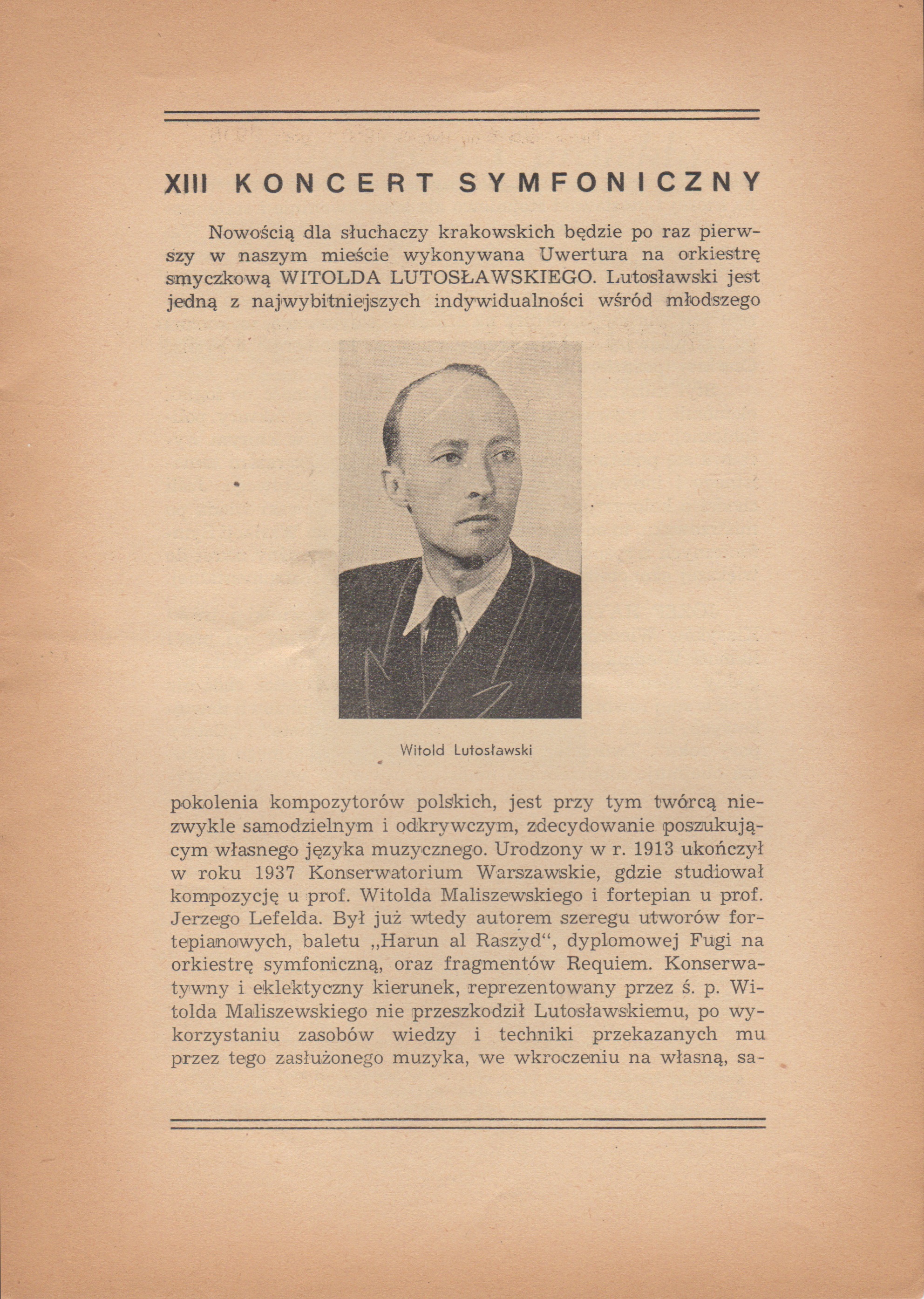
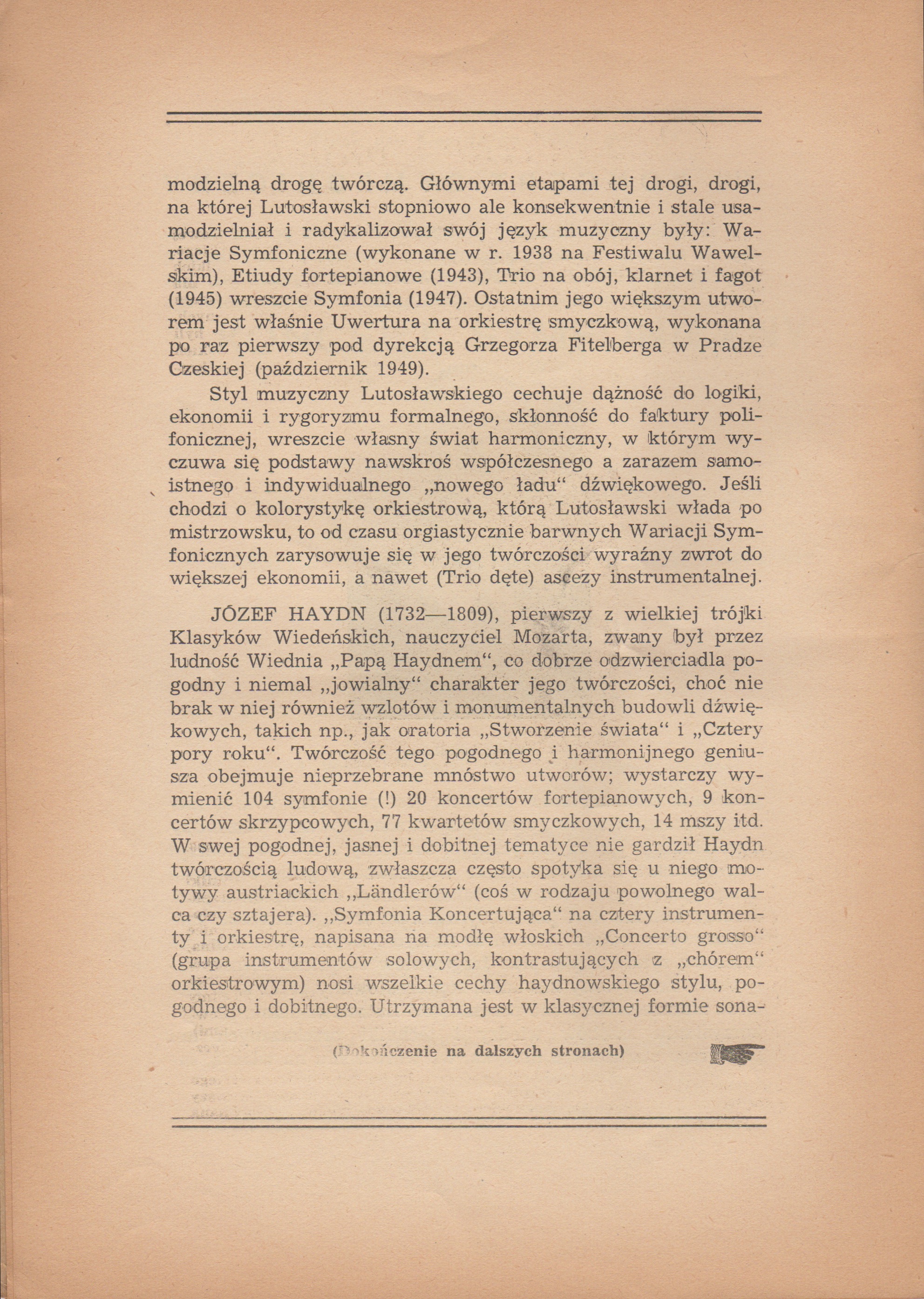
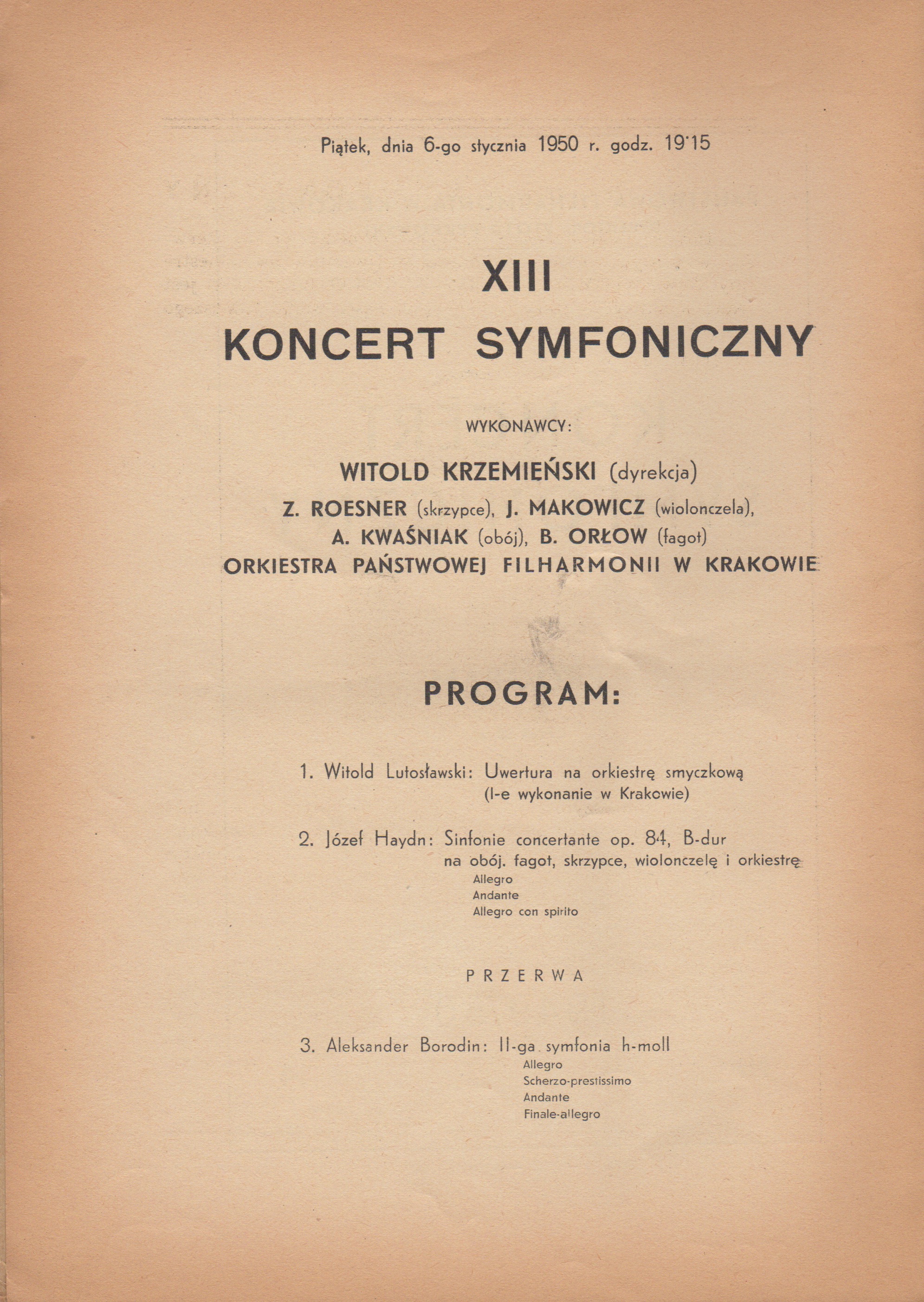
On one of my antiquarian forays in Kraków I came across the concert programme for the Overture’s first performance in the city (it looks as if it was also the Polish premiere).  It took place two months after the Prague performance, with the Kraków PO conducted by Witold Krzemieński.  The relevant pages of the programme are reproduced below, including another profile of Lutosławski – see an earlier one in WL100/54: Lutosławski and Panufnik (1945) – that sheds new light on Polish perceptions of the composer in the immediate post-war years (my translation is at the foot of this post).  There is, however, no hint in the note of state pressures for socialist-realist music, even though the concert took place just five months after the coercions unveiled at the August 1949 composers’ conference in Łagów and less than two months after official censure of his First Symphony at the Chopin Competition in Warsaw.  But Kraków was always at one remove from the capital, which is possibly why the Polish premiere took place there.

WL Overture programme 01.50

P.S.  This wasn’t the only time that a new Lutosławski piece shared the  billing with Borodin’s Second Symphony. The same was to happen in 1970 at the premiere of the Cello Concerto.

Overture 01.50 WL profile1

P.P.S.  Natty lapels!

Overture 01.50 WL profile2

New to Kraków listeners will be the first performance in our city of the Overture for string orchestra by WITOLD LUTOSŁAWSKI.  Lutosławski is one of the most outstanding personalities among the younger generation of Polish composers, through the creation of an exceptionally independent, insightful and decidedly exploratory musical language of his own.  Born in 1913, in 1937 he completed his studies at the Warsaw Conservatoire: composition with Prof. Witold Maliszewski and piano with Prof. Jerzy Lefeld.  He was by then already the composer of several pieces for piano, the ballet Harun al Rashid, a Fugue for symphony orchestra for his diploma, together with fragments of a Requiem.  The conservative and eclectic direction represented by his distinguished professor, Witold Maliszewski, did not prevent Lutosławski, after utilising the fund of knowledge and technique passed on to him by this worthy musician, from stepping out onto his own, independent artistic path.  The main stages of this path, a path on which Lutosławski gradually but consistently and steadily became independent and radicalised his musical language, were: Symphonic Variations (performed in 1938 at the Wawel Festival [it was actually in 1939: see WL100/43: Variations, **June 1939]), Etudes for piano (1943 [actually 1941]), Trio for oboe, clarinet and bassoon (1945) and finally the Symphony (1947).  His last major piece is this very Overture for string orchestra, performed for the first time under the direction of Grzegorz Fitelberg in Prague, Czechoslovakia (October 1949 [actually, November]).

Lutosławski’s musical style is characterised by a desire for logic, economy and formal rigour, an inclination towards polyphonic texture, and lastly his own harmonic world, in which one senses throughout the basis of a modern and at the same time spontaneous and individual sound of ‘the new order’.  When it comes to the orchestral palette, which Lutosławski deploys masterfully, since the orgiastically colourful Symphonic Variations there has appeared in his work a marked return to greater economy, and even instrumental asceticism (Wind Trio).

• Górecki: Refren, **27 October 1965

Before I first went to Poland, my fellow student Jim Samson brought back from Warsaw an LP of music by Henryk Mikołaj Górecki.  It blew our socks off.  Released a couple of years earlier, Polskie Nagrania ‘Muza’ XL 0391 (reissued over 25 years later on Olympia OCD 385 as ‘The Essential Górecki’) contained music the like of which neither of us had heard before.  There was the brief, Webernian Epitafium (1958), the explosive Scontri (Collisions, 1960), the incantatory Genesis II: Canti strumentali (1962) and the comparatively restrained Refren (Refrain, 1965). Thrilling though the first three pieces were, it was the last work that made the most profound impression.  Here is that recording of 1967, by the the Great Symphony Orchestra of Polish Radio (WOSPR) conducted by Jan Krenz.

Screen Shot 2013-10-26 at 11.58.47Over the summer of 2013, information emerged about the commissioning and premiere of Refren (which took place in Geneva on this date 48 years ago, Wednesday 27 October 1965, with the Orchestre de la Suisse Romande conducted by Pierre Colombo – it had been commissioned for the Centenary of the International Telecommunications Union, which was and still is based in Geneva).  This little story unfolded after I was contacted in early June by the Head of the Library and Archives service of the ITU, Kristine Clara.  She had come across a photograph in the October 1965 issue of the ITU’s Communication Journal and could find no further trail of the ITU’s connection with Refren.  “Could I help?”.

Screen Shot 2013-10-26 at 12.20.43

This must be one of the strangest photographs connected with a new score.  No sign of the composer, none of the conductor or orchestral musicians.  Instead, there are three now-forgotten figures from the worlds of politics and the unions looking at Górecki’s manuscript (although it looks more like one of the orchestral parts than the full score).  It is possible that Górecki had been invited, but I know that he was in Poland on the day that this photograph was taken and that he was ill at home on the day of the premiere six weeks later.  Kristine Clara also wondered where the score was – it was not in the ITU archives.  As far as I am aware, it went back to Poland, to the composer and to his publisher PWM, who brought it out in 1967.  As to the commission, my guess is that it was engineered by the Polish government and its Ministry of Culture.  It was a very important moment in Górecki’s life: his first foreign commission and premiere.

One piece of information that I could now furnish concerned the precise dates of Refren‘s composition.  The dates that Górecki had given were May-June 1965.  Having recently looked at his diaries, I was able to say that he started work on the piece on 26 April and finished it on 30 June.

As our email conversation progressed, Kristine Clara unearthed other information, this time about the premiere.  The Swiss Radio listings for 27 October indicate that Refren was broadcast live.

Screen Shot 2013-10-26 at 14.48.09

She also came across the catalogue card for the Swiss Radio tape of the premiere, which indicated that not only was it broadcast live but, contrary to the BBC’s practice at the time, was also recorded, enabling it to be rebroadcast on New Year’s day 1966.

Screen Shot 2013-10-26 at 14.51.48

I have not yet been able to determine if this tape still exists.  It would be fascinating to hear it, not least to verify the unexpected comment – with exclamation mark – written on the card: ‘Attention: rumeurs dans le public!’ (Warning: audience noise!).

Kristine Clara also unearthed several relevant items from the Journal de Genève – ‘de notre envoyé spécial’.  This turns out to be Franz Walter, a music critic and broadcaster best known today for having interviewed the pianist Dinu Lipatti less than three months before his death in 1950 (http://www.youtube.com/watch?v=NqftMxn1PrI).  Walter had been at the ‘Warsaw Autumn’ festival a few weeks before the premiere of Refren; I may come back at a later date to his two reviews of the festival in Journal de Genève (18 and 27 October).  More pertinent here is his review of the Suisse Romande concert on 27 October, which appeared in Journal de Genève the following day (it is the only review of the premiere of which I am aware).  I will pass over Walter’s enthusiastic response to the performance of Prokofiev’s First Violin Concerto by the young Claire Bernard.  His response to Refren is revealing.  His touchstone here was the performance he had heard in Warsaw on 23 September of Górecki’s Elementi for violin, viola and cello (1962), in a performance by Ensemble Instrumental Musiques Nouvelles de Bruxelles.

Screen Shot 2013-06-06 at 16.56.12 copy

Pierre Colombo, who had shaped the concerto’s accompaniment with great care – after a Mozart symphony which I could not hear [maybe Walter was returning to the hall having just introduced the concert on air] – then presented the world premiere of a work by the Pole Henryk Górecki.  The Warsaw Festival had just recently aired a string trio by this composer, a trio in which the players were induced to utter all the most incongruous and horrifying sounds that one can draw from a string instrument, yielding also to a “bruitist” mode that was very much in evidence at this recent festival.  The point of such a work could only be to get on the nerves of the listener.  The work which Pierre Colombo presented to us, with large orchestral forces, pursued in short the same goal, though by different means.  Long chordal aggregates, tirelessly repeated and punctuated by brief… how shall I put it… gusts of wind from the brass, frantic barking from these same brass, splashes from the strings, explosions from the timpani, such is the material which furnishes Refrains [sic].

The nervous effect was produced.  In the event, it found expression in laughter.  But our public is not yet used to this music.  Elsewhere people listen with great seriousness (and for my part with profound boredom).  F.W.

There are some inconsistent aspects of Walter’s account, especially in the short second paragraph, but it is clear that he found Górecki’s new piece insupportable and gives the clue to the ‘audience noise’ mentioned on the Swiss Radio catalogue card.  I wonder how widespread this laughter was.  One has to marvel, though, at Walter’s response.  He had heard much more rebarbative music in Warsaw a few weeks earlier, and Górecki’s Refren is not that far removed in aesthetic from Messiaen’s Les offrandes oubliées, composed 35 years earlier.  It marks, as we now know, the turning point from the overt dynamism of the preceding decade to the largely contemplative mode of his subsequent music.  But to contemporary ears (or at least Walter’s) it sounded as bad as the earlier pieces.

• WL100/65: Mr and Mrs

Lutosławscy, Prague 1957?

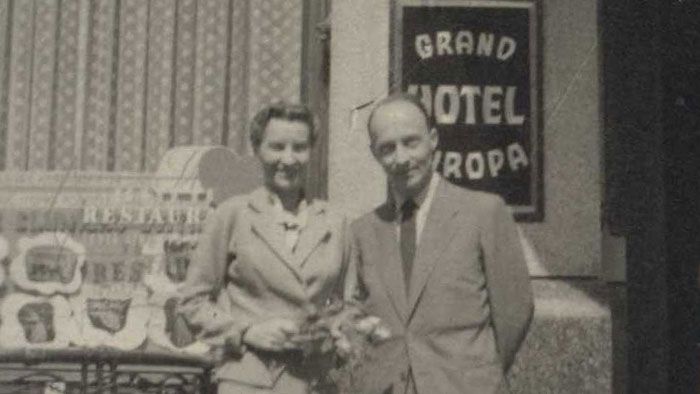
Today marks the 67th anniversary of the wedding of Witold and Danuta Lutosławscy.  Though there appear to be no photos of the occasion, here’s one from a few years later.  I’m pretty certain that this one was taken in Prague, to the left of the entrance to one of its most famous hotels (on Wenceslas Square).  When it was taken is not clear, but it looks likely that it was in May 1957, if corroborative photos are correct.*

82938504

* There is another photograph dated Prague, May 1957, with the Lutosławscy wearing the same suits and standing in the sunshine on a large square (no bouquet but a handbag!), in a selection of photographs at the back of Zofia Owińska’s Lutosławski o sobie (Gdańsk: słowo/obraz territoria and the Witold Lutosławski Society, 2010).

Lutosławscy, Wenceslas Square (?), Prague, 1957

There is also a photo, taken in Switzerland (which the Lutosławscy also visited in 1957), in which Danuta Lutosławski is wearing the same two-piece suit.  Also in shot are the composer Konstantin Regamey and the pianist Witold Małcużyński.  This photo is reproduced in Danuta Gwizdalanka & Krzysztof Meyer’s first volume (-1960) of their two-volume study of Lutosławski and his music (Kraków: PWM, 2003), between pp. 256-257.

Regamey, Lutosławscy, Małcużyński, Switzerland, 1957

The photo reproduced at the top is a cut-down version of much larger, off-vertical and unidentified photo that was published earlier this year by the Witold Lutosławski Society in its centenary album Lutosławski 1913-2013 (p.222).  Its wider angle confirms my hunch about the location.  But Danuta’s shoes seem to be different than in the photo in the square (though the same as in Switzerland!), so perhaps the two Prague photos were taken at different times.

Danuta & Witold, Prague, 1957?

• WL100/64: Notebook, 24 October 1959

Lutosławski on independence and Webern

To accomplish anything reasonable, one has to be completely independent of life outside.  This is Webern’s case.   Here also lies the fundamental difference between Webern and the Webernists, who are stuck in endless confrontation, which is why none of them even attempts to focus on something more durable, consistent, long-term.  Engaging in constant dialogue with opinion is a kind of slavery.

Aby dojść do czegoś sensownego, trzeba być całkiem uniezależnionym od życia zewnętrznego.  To jest przypadek Weberna.  Tu jest też zasadnicza różnica między Webernem a webernistami, którzy są zdani na ciągle konfrontacje i dlatego żaden z nich nie próbuje nawet skupić się nad czymś bardziej trwałym, konsekwentnym, długodystansowym.  Zaangażowanie się w ustawiczny dialog z opinią jest rodzajem niewoli.

Witold Lutosławski, 24 October 1959 [my translation]

Four years later, Lutosławski wrote a short text on Webern at the request of the renowned Slovakian arts and science periodical Slovenské Pohľady, which wished to mark the 80th anniversary of Webern’s birth.  Titled ‘Webern a hudba dneška’, it was published in Polish a few years later.

Lutosławski on ‘Webern and the Music of Today’

‘The concise man makes one think, the verbose man bores’ – with these simple words Edouard Manet once expressed a truth which – contrary to what it might seem – has served only a few composers as a signpost.*  To these few, unlike his imitators, belongs first and foremost Anton Webern.  Among the many revelations made by this man, one has really made me think.  This is the discovery of a sound-world of microscopic proportions in which the shortest, instantaneous musical event can become the source of a strong experience.

Like the work of every great explorer, Webern’s output has gone through its good and bad periods.  The current one I would call ‘bad’ for Webern, because the wave of imitations – often inept, vulgar, distorting his ideas – has not yet subsided, and we are still driving ‘postwebernism’ away like a tiresome fly.  I believe, however, that – like Debussy from ‘Debussyism’ recently – the music of Webern will free itself from the besmirching and obnoxious effect of its imitators.  It will then shine in its true and pure brilliance.

“Człowiek zwięzły skłania do zastanowienia; gadatliwy nudzi…” – tymi prostymi słowami wyraził kiedyś Edouard Manet prawdę, która – wbrew temu, co mogłoby się wydawać – tylko niewielu twórcom służyła za drogowskaz.  Do tych niewielu, w odróżnieniu od swych naśladowców, należał przede wszystkim Anton Webern.  Wśród licznych odkryć, jakich dokonał ten człowiek, jedno zastanawia mnie szczególnie.  Jest to odkrycie świata dźwiękowego mikroskopijnych rozmiarów, w którym najkrótsze, migawkowe muzyczne zdarzenie może stać się źródłem silnego przeżycia.

Jak twórczość każdego wielkiego odkrywcy, tak i twórczość Weberna przeżywa swoje dobre i złe okresy.  Obecny okres nazwałbym dla Weberna ‘złym’, ponieważ fala naśladownictw – często nieudolnych, wulgarnych, wykoślawiających jego idee – jeszcze nie opadła, i wciąż jeszcze od ‘postwebernizmu’ oganiamy się jak od uprzykrzonej muchy.  Wierzę jednak, że – jak niedawno Debussy od ‘debussyzmu’ – wyzwoli się również i dzieło Weberna od zamazujących i obrzydzających je naśladownictw.  Zalśni on wtedy swym prawdziwym i czystym blaskiem.

Witold Lutosławski, ‘Webern a hudba dneška’,
Slovenské Pohľady 79 no.12 (1963), pp.92-93 [my translation]
reproduced, in Polish, in Stefan Jarociński,
Materiały do monografii (Kraków: PWM, 1967), p.42

* I don’t know where Lutosławski found this quote, but it originated in an article by Georges Jeanniot in La Grande Revue in 1907.  The full quotation, which could equally be Lutosławski’s credo, reads:

La concision en art est une nécessité et une élégance; l’homme concis fait réfléchir, l’homme verbeux ennuie; modifiez-vous toujours dans le sens de la concision.

• WQXR Q2: A new Polish marathon

The New York classical music station WQXR Q2 is about to launch another focus on Polish music.  In January last year, I reported on its intensive, week-long ‘Muzyka Nowa: A Celebration of Contemporary Polish Music’.  On that occasion, the results were mixed, as I wrote at the time: Polish Music ‘Muzyka Nowa’, WQXR ★★★✩✩.  This year, the ‘Celebrating Poland’ focus seems more selective and is split up over a longer period.

celebrating-Poland

There are three 24-hour marathons: this coming weekend (Friday 25 October), six days later (Thursday 31 October) and on Tuesday 12 November.  The first date includes a ‘live performance stream’ of music by Penderecki and there is a final event on Friday 13 December, this time a live relay of music by Lutosławski.

Friday 25 October
The first marathon promises an examination of ‘the strength and diversity of contemporary classical music from Poland’.  I certainly hope that the programmers broaden the range beyond familiar names and play more music by composers now in their 20s, 30s and 40s than the few examples that were included last year.  It will be very interesting to see how much music written in the last ten years is included to illustrate what is really happening in contemporary Polish music.  The programme of the Penderecki live relay – Cadenza for viola (1984), String Quartet no.3 (2008), Capriccio for cello (1968), Clarinet Quartet (1993) and Sextet (2000) – gives slight cause for hope in this regard.

Thursday 31 October
Polish music will form part of what is billed as a ‘Halloween Scarathon’.  Guess which pieces/composers…

Tuesday 12 November
This is the most promising of WQXR Q2’s offerings.  It will examine ‘the full spectrum of and story behind Lutosławski’s contributions to 20th-century classical music’.  Even more assuringly, it will include seven one-hour episodes curated by Steven Stucky, so real authority and insight will be brought to the proceedings.  Esa-Pekka Salonen will also make an appearance.

Friday 13 December
Steven Stucky resurfaces as a composer in the second live relay, from Symphony Space with the American Contemporary Music Ensemble.  The programme consists of Lutosławski’s Sacher Variation for cello (1975), Bukoliki in the arrangement cello for viola and cello (1952/62) and the String Quartet (1964).  Stucky’s contribution consists of Dialoghi for solo cello (2006) and Nell’ombra, nella luce for string quartet (1999-2000).

You can catch these online broadcasts by accessing any page of WQXR and clicking on the Q2 Music tab at the top (the play/pause tab is to the left).  Schedules and playlists can be accessed by selecting the relevant tabs on the next bar below.  No specific timings were available when this post was uploaded, but as NY time is 5/6 hours behind UK/European time WQXR Q2’s evening events will be in the small hours this side of the Atlantic.

• WL100/63: Mi-parti, **22 October 1976

Screen Shot 2013-10-22 at 08.47.06

One of the strangest aspects of this centenary year, and indeed of the performance and recording history since Lutosławski’s death almost twenty years ago, is the neglect of some works which during his lifetime were held in high regard.  The most notorious injustice relates to Livre pour orchestre, which I will return to in a later post.  Another example is Mi-parti, which Lutosławski wrote in 1975-76 and whose premiere he conducted with the Concertgebouw Orchestra in Amsterdam 37 years ago today.

During his lifetime, Lutosławski was the person who conducted Mi-parti most frequently.  His domination of its performance history is also true of many of his other orchestral and concertante works, which made for composer-authentic concert experiences but in the long run delayed much of his music’s entry into the repertoire of a broad range of career conductors.

As to professional concert performances over the past ten years, there have been only seven (excluding immediate repeat concerts), including just three in 2013, the third and most recent being by the Berlin Staatskapelle under Daniel Barenboim.  There have been five commercial recordings:

• WOSPR (NOSPR)/Lutosławski (EMI, rec. 1976; LP, reissued several times on CD)
• Prague Radio SO/Jacek Kasprzyk (Supraphon, rec. 1980; LP only)
• BBC PO/Yan Pascal Tortelier (Chandos, rec. 1993; CD)
• WOSPR (NOSPR)/Antoni Wit (Naxos, rec. 1997; CD)
• Warsaw National PO/Antoni Wit (CD Accord, rec. 2002; CD).

Chandos, with its magnificent 5-CD set of Lutosławski’s music, has inexplicably left out both works.  At least the Opera Omnia CD series by the Wrocław PO under Jacek Kaspszyk and Benjamin Shwartz will release both pieces in the near future.  On YouTube, Mi-parti has the thinnest of presences, with Lutosławski’s own recording accompanied by photographic artwork by the uploader: http://www.youtube.com/watch?v=laFCR96RPO4.

I would be very interested to hear what readers have to say about Mi-parti.  For me, it has a magical first section (although Lutosławski sometimes expressed doubts about it) whose essential idea he seems to have had in mind when composing the first section of the Fourth Symphony sixteen years later.  The second section is one of his most pulsating, the climax interrupted by trumpets (echoes of the Cello Concerto).  The coda is especially haunting. Perhaps the trouble is that it isn’t a ‘symphony’ so, like Livre, it is being left on the sidelines in the age of convenience programming.

…….

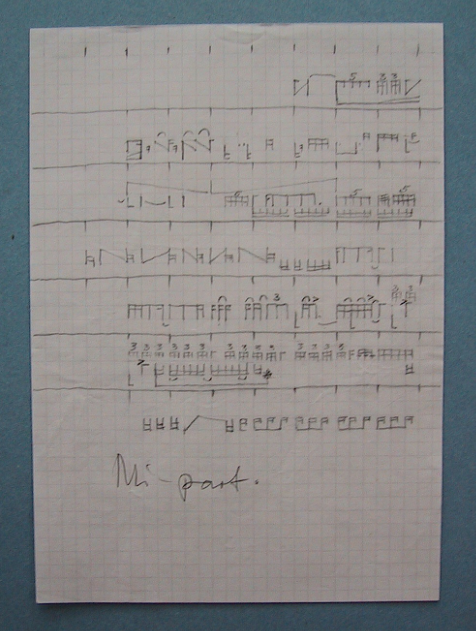
When I was researching in Lutosławski’s house in 2002, I came across many fascinating items: marked-up books, his conducting scores, a folder of folk-tune materials and a particular folder headed “ŚCIĄGACZKI” (Crib Sheets). Inside were separate pieces of MS paper connected with his work on LivreLes espaces du sommeilMi-parti and the Fourth Symphony.  Here are the two relating to Mi-parti.  They come from the second, fast section (apologies for the slightly fuzzy images).

The first is a ‘short-score’ reduction for the first eight bars of fig. 28.  The two lines represent the trumpets and trombones, whose individual purchase on the melodic line is fully worked out in the score (07’59”-08’09” on the accompanying YouTube video).

Screen Shot 2013-10-22 at 08.41.56

The second is more sketchy.  Indeed, it consists only of a (sometimes biforcated) rhythmic line.  It tracks the score from fig. 29 (i.e., two bars after the first ‘crib sheet’ stops short) as far as the third bar of fig. 35.  Although at times the link between sketch and score may seem tenuous, the sketch is consistent with the final product even if Lutosławski does use notational shorthand at times and darts from one instrumental group to another.  Effectively, this ‘crib sheet’ presents the main rhythmic template, an aide-mémoire as he worked the idea up into this extrovert, hocketing passage that leads shortly afterwards to the work’s climax (08’12”-09’09” on the accompanying YouTube video).

Screen Shot 2013-10-22 at 08.41.36

• WL100/62: Notebook, 19 October 1960

Lutosławski on objet sonore

Lutosławski’s affinity with French music and literature is well-known.  But the connection with the pioneer of musique concrète, Pierre Schaeffer, has largely slipped by unnoticed.  In truth, it is not Schaeffer’s tape music as such that caught Lutosławski’s attention but his discourse on the objet sonore.  Lutosławski referenced Schaeffer’s term in talks that he prepared for the Zagreb Biennale (1961) and the Tanglewood Summer School (1962), but his musing on the implications of objet sonore began earlier, in 1960, in his Notebook of Ideas (Zapiski).

There is no evidence that Lutosławski had read Schaeffer’s book À la recherche d’une musique concrète (1952). Almost certainly, he came across the term objet sonore from both fellow Polish composers and Schaeffer himself. Schaeffer came to the third ‘Warsaw Autumn’ festival to introduce a programme of musique concrète (17 September 1959) that included a number of pieces, including his own Étude aux objets (1959).  It is more than likely that Lutosławski attended this concert (ground-breaking in the Polish context) and met Schaeffer during his visit.

Pierre Schaeffer

Just over a year later, on 21 September 1960, the fourth ‘Warsaw Autumn’ presented a lecture by Józef Patkowski, the head of the Experimental Studio at Polish Radio.  During his talk, Patkowski referred to Schaeffer and played Étude aux objets again.  Was it pure coincidence that just two days later Lutosławski made the first of two entries in his Notebook that elaborated on the idea of the objet sonore as it related to his own thinking?  Four weeks later, on 19 October, he returned to this theme.

Although Lutosławski subsequently stressed the prominence of chance procedures in his musical development in the early 1960s, he did not make any entries in his Notebook on alea and aleatorism for another year (the first appears on 20 December 1961).  In other words, it was Schaeffer’s visit in 1959 and the idea of the objet sonore that first drew his attention.  It was six months later that Lutosławski heard Patkowski introduce a recording of John Cage’s Concert for Piano and Orchestra in his ‘Musical Horizons’ programme on Polish Radio (16 March 1960) – the event which Lutosławski subsequently credited as being the critical juncture in his compositional thinking.  Yet we must no overlook Schaeffer in these developments.  In combination, both Schaeffer and Cage gave Lutosławski conceptual support just at the moment when Jeux vénitiens (1960-61) was being conceived.

It seems that rhythm (in the broadest sense, as a division of time in which the action of a musical work takes place) is the hardest element of musical material to destroy.  The idea of the ‘eternity’ of this element is tempting.  Instead of ‘melody, ‘harmony’, there appears a new element (perhaps not entirely new in its essence, but new in application) – objet sonore – the sound object.

Wydaje się, że rytmika (w najszerszym pojęciu – jako podział czasu, w którym rozgrywa się akcja utworu muzycznego) jest najtrudniejszym do zniszczenia elementem tworzywa muzycznego.  Kusi myśl o “wieczności” tego elementu.  Na miejsce “melodyki”, “harmoniki”, zjawia się nowy element (być może niezupełnie nowy w swej istocie, ale nowe w zastosowaniu) – objet sonore – przedmiot dźwiękowy.

Witold Lutosławski, 23 September 1960 [my translation]

In connection with technique based on ‘objects’:
Object = a collection of sounds, between which there is a closer connection than between each of these s[ou]nds and sounds belonging to another object.  This closer connection ensures, above all, connectivity in time.  But it can also be similarity of timbre, rhythm, attack, harm[onic] profile, choice of intervals etc..
Hence 2 rhythmic currents in a piece:
1) local rhythm, ‘small’ – interior of an object
2) general rhythm, ‘large’ – i.e., the rhythm of a sequence of objects.

W związku z techniką opartą na “przedmiotach”:
Przedmiot = zbior dźwięków, między którymi istnieje ściślejszy związek niż między każdym z tych dźw., a dźwiękami należącymi do innego przedmiotu.  Ten ściślejszy związek zapewnia przede wszystkim łączność w czasie.  Ale również może to być podobieństwo barwy, rytmiki, ataku, profilu harm., doboru interwali itd.
Stąd 2 nurty rytmiczne w utworze:
1) rytm lokalny, “mały” – wewnątrz przedmiotu
2) rytm ogólny, “duży” – czyli rytm następstwa przedmiotów.

Witold Lutosławski, 19 October 1960 [my translation]