• Lutosławski’s Cello Concerto on YouTube

Talking with a friend the other day about his experience of a concert performance of Lutosławski’s Cello Concerto in London’s Cadogan Hall (Jacob Kullberg, RPO, conducted by Christopher Austin, 25 October 2011), I realised that it’s been a long time since I saw this concerto live.  Chester Music’s website indicates that the only forthcoming performance is in Tokyo next month.  So I looked again through the currently available YouTube videos (excluding the purely audio postings).

The continuing appeal of Lutosławski’s Cello Concerto (1970) is remarkable.  I believe that no other cello concerto since Shostakovich’s two (1959, 1966) has had as many commercial audio recordings (17 and counting).  And it is noticeable that Lutosławski’s ground-breaking concerto attracts young performers in particular.  The only senior performer on YouTube is Yo-Yo Ma, who regrettably has never committed his interpretation to disc, even though he has performed the work on a number of occasions.

Yo-Yo Ma
This is just a short excerpt, taken from a performance that Yo-Yo Ma gave (with score, on which he seems to be surprisingly dependent in the closing stages) with the Los Angeles PO, conducted by Esa-Pekka Salonen.  It consists of the immediate build-up to the work’s climax, which then leads on to the Coda.  It has all the hallmarks of Ma’s artistry, so it is the more regrettable that there is no current access to the preceding 20′ or so.

http://www.youtube.com/watch?v=_g_ECLBvUS0 (Finale from just after fig.130 + Coda; 2’14”)

Inbal Segev
The Israeli-American cellist Inbal Segev (Inbalsegev) uploaded two excerpts on 17 June 2008.  They come from her performance during the second Paulo Cello Competition in Helsinki in 1996, when she was accompanied by the Helsinki Radio SO under Petri Sakari.  The first excerpt is from near the start of the central slow Cantilena, up to its middle point, while the second makes rather heavy weather of what should be the soloist’s helter-skelter ‘escape’ (as Lutosławski put it) from orchestral attacks in the Finale.

http://www.youtube.com/watch?v=U97ko6MEypU (Cantilena, figs 64d-75; 2’53”)
http://www.youtube.com/watch?v=edxiFjbfgFc (Finale, figs 104-127; 1’41”)

David Eggert

This is a name new to me.  David Eggert is a Canadian in his mid-20s who is studying in Europe.  His YouTube video, with the Slovenian PO, conducted by Uroš Lajovic, was posted by powertimsah on 23 September 2010.  Its four-part upload is not fully in line with the four movements of Lutosławski’s concerto: Introduction, Four Episodes, Cantilena, Finale + Coda.

http://www.youtube.com/watch?v=MXS5mHUxPf4  (Introduction; 3’02” , missing c.2′)
http://www.youtube.com/watch?v=hscqZFloArI  (Four Episodes, rather crudely cut before the soloist’s first pizzicato low E at fig.63; 6’14”)
http://www.youtube.com/watch?v=GO_61BvsVrs (Cantilena and Finale to fig.90; 7’11”)
http://www.youtube.com/watch?v=JEVpzrxckk0 (Finale from fig.90 + Coda; 4’50” + 40″ applause)

There are two major drawbacks, neither of them Eggert’s fault.  Firstly, the recording starts halfway through the Introduction, on the high Bbs on system 11 of the first page of the score.  Carelessness or misfortune, either way it ruins the performance as a whole. Secondly, the sound quality is often poor because it is plagued by high-pitched ‘twittering’. This is a great pity, because Eggert (playing from score) is a committed soloist, commanding both delicate and strong articulation.   What is there of the introduction indicates that he understands the import of both his solo role and the brass interruptions (he responds subtly to the latter, both behaviourally and musically), while the Finale is one of the most urgent and dramatically shaped that I have heard.

Nicolas Altstaedt

German-born Nicolas Altstaedt is a BBC New Generation Artist and has developed an impressive career in recent years. This complete recording, first uploaded by haekueroenstoe on 6 February 2010, is with the Finnish Radio SO under Dmitri (Dima) Slobodeniouk.  It appears to come from Altstaedt’s participation at the fourth Paulo Cello Competition in Helsinki in 2007.  The upload separates the recording into three instalments that unfortunately cut against the grain of Lutosławski’s structure.  Worse still, in the second instalment there is a time-lapse of over 1″ as the image falls behind the sound, and this time-lapse lengthens to over 7″ in the third instalment.  If you close your eyes, however, there’s much to appreciate here.

UPDATE (12 June 2013)
On 9 March 2013, the technical problems were sorted out when the uploader posted this performance in a single video: http://www.youtube.com/watch?v=pIxvBjP7ld8.  Great news, as this performance is riveting!  Only the first of the three instalments from the original upload is still available.

http://www.youtube.com/watch?v=uvp8GF76VXQ (Introduction and Episodes 1-2; 9’46” including 1’03” arrival on stage)
http://www.youtube.com/watch?v=-w_3yE5Owbk (Episodes 3-4, Cantilena and Finale to fig.88; 8’42”)
http://www.youtube.com/watch?v=acEVBscbtH8 (Finale from fig.88 + Coda; 5’20”)

Altstaedt (playing without score) produces a fiery and exciting performance which is matched by Slobodeniouk’s tight orchestral direction.  At c. 22’25” it is also one of the shortest.  Only two performances, both conducted by the composer (with Roman Jabłoński and Louise Hopkins) are shorter, and then only marginally.  In the Introduction, Altstaedt plays with studied intensity rather than absent-minded indifference, recalling Rostropovich’s determined approach (though Altstaedt maintains a greater timbral and rhythmic consistency).  He also evinces a high degree of self-confident independence in the Episodes where others may aim for intimate rapport with the orchestra.  Altstaedt’s approach emphasises the dynamism of Lutosławski’s score, even in the Cantilena, where he is especially eloquent.  He dominates even the Finale, making the confrontation between soloist and orchestra more like a battle of equals whose outcome cannot be taken for granted.  If that makes the cello’s vanquishment a little surprising, its subsequent resurrection is triumphant.

Oren Shevlin
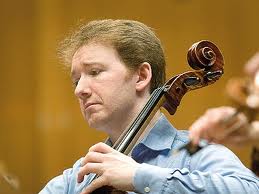
Although Oren Shevlin is another name new to me, he is British by birth.  He does not appear to have his own website. He uploaded these two videos – whose division acknowledges Lutosławski’s structure – on 20 September 2011 (under the name orencello).  They come from performances that he gave (without score) on 3 and 4 February this year with the WDR SO in Cologne, conducted by Jukka-Pekka Saraste.

http://www.youtube.com/watch?v=6kliW2KCYq8 (Introduction, Four Episodes; 12’15”, including 48″ arrival on stage)
http://www.youtube.com/watch?v=GdjzGN4dYxw (from after fig.64: Cantilena, Finale + Coda; 11’13” +1’31” applause)

It is a very fine performance, executed with a modesty and deceptive frailty that fits the character imagined by the composer.  Lutosławski was wary of performers who over-invested the Introduction with emotion and thus ran the danger of blunting the drama that follows.  Shevlin’s reaction to the marking indifferente over the repeated D naturals is to look vaguely outwards and his demeanour really does suggest the mind-lessness and whimsicality that Lutosławski was aiming for in the opening 4′ solo.  Shevlin genuinely works with the orchestra in the Episodes that follow, seeking the common ground, with subtlety and apparent extemporaneity, that is periodically thwarted by interruptive brass.

If Shevlin’s tone is not as robust as those of some other performers of this work, his empathy with the strings in the Cantilena, as the section moves towards the ringing unison, is persuasive.  Here is the cellist as Everyman, emotionally open and vulnerable.  This pays dividends in the Finale, where the orchestra attempts to quash his voice.  At fig.88, Shevlin plays the cello’s response to the orchestra’s battery in a way which emphasises the survival instinct of the downtrodden and their sense of irony, even humour, at such moments.  And this was precisely what Lutosławski wanted here.  I’ve never heard the phrase at fig.88 uttered with such wry poignancy.  The ‘escape’ that follows is raw.  Shevlin plays as if he is fleeing and pleading for his life.  When he emerges with weeping cello sobs and then climbs to the heights of those strong, almost desperate A naturals at the very end, one can believe that he has survived the ordeal, but only just and, as Lutosławski said, ‘in another world’.

Shevlin has also uploaded the Introduction separately (on 22 July 2010 – he calls it the Cadenza).  Here he is younger and beardless, and I’ve identified the occasion as an excerpt from his performance during the second Paulo Cello Competition (1996).  The conductor is Petri Sakari with the Helsinki Radio SO (as for Segev’s excerpts, above).

http://www.youtube.com/watch?v=pojl2C3KTCI (Introduction, up to fig.9; 4’52”)

Coda
What is striking about the performers of the videos detailed above is the strong level of participation by Finnish musicians: the Finnish Radio SO features on three videos (Segev, Altstaedt, and the Shevlin excerpt from 1996) and three Finnish conductors take the helm on four: Salonen (Yo-Yo Ma), Sakari (Segev and Shevlin excerpts) and Saraste (Shevlin complete).  The (usually) triennial Paulo Cello Competition in Finland’s capital has evidently played a key role for several of these players.  There is also a strong Eastern European showing: the Slovenian PO and Lajovic (Eggert) and the Russian conductor Slobodeniouk (Altstaedt).  The nationalities of the soloists, however, are more broad (American, Israeli, Canadian, German and British).

Yo-Yo Ma, Inbal Segev and Oren Shevlin (1996) give only excerpts, so these are unable to provide substantial insights. It is interesting, however, to be able to compare the two Shevlin Introductions, performed 15 years apart.  It is enormously frustrating that David Eggert’s perceptive account is marred by the missing first 2′ and its poor sound quality, but I am keen to hear his interpretation under better circumstances.  Equally, I eagerly await a proper chance to hear Altstaedt in concert as it is impossible to watch most of this clumsily divided upload because of the time-lapses in the second and third instalments.  The first instalment gives a good idea of Altstaedt’s firm grasp of Lutosławski’s score, and it is of course possible to listen to the rest with eyes closed.  It is a performance to savour for its muscularity and momentum.

So that leaves only Shevlin’s complete performance (2011) with the WDR SO under Saraste.  As indicated above, I think that this is a truly insightful interpretation and one that repays listening and deserves wide recognition.  It also bears repeated viewings for the TV direction, with its imaginative camera angles (including a hidden floor-camera in front of the soloist) and variety of split-screen shots which highlight key orchestral participants and textures.
• A Last Amen for Górecki

I had not intended to post so much on Górecki over the past few days, but events and memories have rather taken over.  Not least of these are my recollections of the funeral, which took place in Katowice on this date last year.  I hope that my account below will give some sense of the occasion.

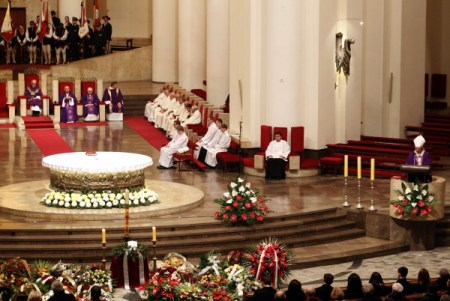
I caught an early train from Warsaw along with Polish friends and colleagues.  The cloud hung grey and dismal over the central lowlands.  Katowice looked the same as it had two weeks earlier, when I’d come to see Górecki for what turned out to be the last time.  Katowice, too, was grey and dismal, but then it often looks that way.  There was time for a reviving cup of tea and a sandwich, time for my friend to collect a bouquet, and time to buy the new edition of Tygodnik Powszechny, which had published my appreciation of Górecki along with those of others.  We walked to the Arch-Cathedral of Christ the King, whose huge dome sits squatly atop the cruciform building.  The dome should have been higher, but the post-war communist authorities did not want a Christian building dominating the area.  It was just as well that we arrived early, because the Cathedral was packed long before the scheduled start at 13.00.

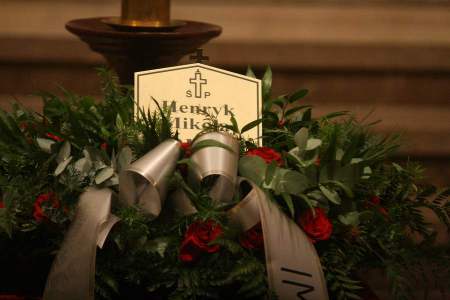
Górecki had been cremated the previous day, in a private ceremony.  I was told that the Roman Catholic church in Poland barely tolerates cremation and would not countenance a funeral service beforehand, which is customary here in the UK.  (I recollect that, in 1994, Lutosławski’s ashes were brought to the chapel in Powązki Cemetery in Warsaw for the funeral service.  He had been cremated in the (then) only crematorium in Poland, in Poznań in the centre of the country.)  Urns are always buried, as the scattering of ashes is illegal in Poland.  Most of the close relatives, including his daughter Anna and her family, arrived at 12.45, his widow Jadwiga and son Mikołaj on the dot of 13.00.  They were followed by the funeral directors bearing wreaths and Górecki’s funeral urn, which was placed, gently sloping, on its back, with a large central candle behind and the funeral plaque in front.

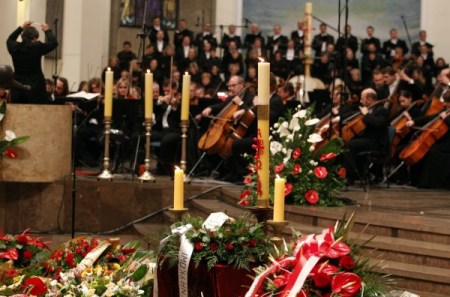
The ceremony was in two parts, designed to last about two hours.  Almost inevitably, it overran, by almost an hour. First there was a concert, then the service proper.  The musical institutions of Katowice and further afield had pulled out all the stops.  Górecki’s former pupil, Eugeniusz Knapik, who is the senior figure at the Academy of Music in the city, where both Górecki and he studied, had played a key role in bringing everything together.  Three of Katowice’s orchestras performed – the National SO of Polish Radio, the Silesian PO and the AUKSO CO – alongside soloists and choirs from Katowice and Kraków.

The concert began with Szymanowski’s Stabat Mater, a work with which Górecki had a deep affinity.  Unfortunately, the Cathedral has a ballooning acoustic with a reverberation time of almost 10″.  The a cappella fourth movement, however, sounded well.  There followed a performance of Górecki’s Beatus vir (1979), the last of the three monumental works that he composed in the 70s – it had been preceded by the Second Symphony ‘Copernican’ (1972) and Third Symphony ‘Symphony of Sorrowful Songs’ (1975).  It sounded as strong and imposing as it must have done at its first performance, which Górecki conducted in Kraków in front of the newly elected John-Paul II.

The mass, which began at 14.15, was presided over by Cardinal Franciszek Macharski, a close family friend.  There were addresses by other church figures, by the Minister of Culture and by the President of the Polish Composers’ Union.  In the congregation were composers of Górecki’s generation – Krzysztof Penderecki (Kraków) and Wojciech Kilar (Katowice) – and younger ones too, including Górecki’s pupils Knapik and Rafał Augustyn.  As far as I am aware, I was the only person from abroad, which I found rather sad, given how significant had been the relationship between the composer and major broadcasting, concert, publishing and recording institutions outside Poland.

There were a couple of musical surprises too.  A performance of Totus Tuus was to be expected, but Penderecki conducting Amen was less so.  And I was not the only one to be taken unawares, at the start of the communion service, by the performance of an excerpt from Strauss’s Metamorphosen.  According to his widow, this had been the one musical request for his funeral that Górecki had made.

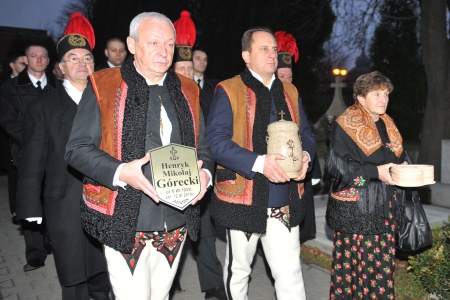
The ceremonies came to a close at 15.45.  This must have come as a blessed relief for the representatives of organisations from Katowice and the Polish mountains who had stood with their banners at the far end of the Cathedral for the preceding three hours (see the photo above).  They now moved down to the aisle, leading the procession out of the main doors.  Górecki’s oldest grandchild, still in his mid-teens, carried the urn, flanked by his father and his uncle.  Then began the walk to the cemetery.  It took some 15′ for everyone to leave the Cathedral, and by this time dusk was falling fast.  We proceeded slowly up the side street, just a few hundred metres, and into the cemetery, but such was the crush of people that I had to look on from some distance.

En route, a miner’s band played solemn music and the urn was carried in relay, concluding with a trio of mourners from the mountain town of Zakopane (also carrying the plaque and a heart-shaped carved box containing soil from the mountains).  Most of Górecki’s happiest moments had been spent in this region since the late 1950s.  He honeymooned there and for many years in the 1970s and 80s rented a log cabin in the little village of Chochołów, before finally buying his own house in the 1990s in the village of Ząb, on a high ridge facing the magnificent jagged peaks of the Tatra Mountains.  He revelled in the views and the culture of the place.

At the graveside, further prayers and blessings were said, the urn placed in the ground and the mountain soil poured over.

There was then a patient wait to greet the family, a process further lengthened by the many mourners who carefully placed their wreaths and bouquets, creating a waist-high bank of flowers around the grave.  I became aware, beyond the low murmuring about me, of distant music.  It seemed familiar.  50 or so metres away, indistinguishable in the shadows, was a folk kapela, a string ensemble from the mountains.  They were playing a melody from the Tatras, keening and unbelievably poignant.  Earlier, they had walked from the Cathedral in daylight.  Now, they were paying a final tribute to their adopted son as night closed in.

Postscript

At the reception afterwards in the Academy of Music, his widow Jadwiga told me about her husband’s last moments. She has now repeated the story in public in an interview, ‘Dom na dwa fortepiany’ (Home for Two Pianos), in the Polish Catholic weekly Gość Niedzielny (Sunday Guest, 13 November 2011, 58-59):

Father Krzysztof Tabath, the hospital chaplain for Katowice-Ochojec, … came to the hospital half an hour later than usual.  At my request, he movingly described those last moments: “Eventually, I reached Mr Gorecki.  I began with “Our Father”, then “Hail Mary”, and then “Soul of Christ, sanctify me” “.  And there, the whole time, above the bed, were flashing the monitors to which my husband was connected.  During the saying of the prayer the display panel gradually dimmed, then went out altogether, and he died. During the prayer, he had crossed over into the other world.  I cannot imagine a better death.  It was simply wonderful.  I am happy that it was like that.

When Jadwiga told me the story, she added the resonant detail that Henryk had died as the priest uttered the final ‘Amen’.

• Recalling Górecki: Two Radio Tributes

The other day, I came across these two short tributes on the Polish Radio website thenews.pl.  Although they were broadcast a year ago, they are still available.  Just follow the indicated mp3 link on each page.

The first is by David Harrington, the leader of Kronos Quartet.  Harrington was instrumental in commissioning Górecki’s three string quartets (1988, 1991 and 1995/2005) and he and Górecki formed a close professional and personal friendship.  On the day of Górecki’s death (12 November 2010), Kronos happened to be in Poland to give  a concert that evening in Wrocław.  In tribute, they played an arrangement of ‘Z Torunia ja parobecek’ (I am a Farmhand from Toruń), the fourth of Górecki’s Five Kurpian Songs (1999).  Harrington spoke the following day with Michał Kubicki.

http://thenews.pl/1/6/Artykul/21737,A-tribute-to-Gorecki

The second interview is one that I also recorded with Michał Kubicki that day.

http://thenews.pl/1/6/Artykul/21742,‘He-had-a-fantastic-sense-of-humour

• Polish Orchestra Named After Górecki

The city of Katowice in southern Poland today honoured its most famous and distinguished musical son.  The Silesian PO (Filharmonia Śląska) has been named in memory of Henryk Mikołaj Górecki, who died on 12 November 2010.

His widow Jadwiga, who was present at the announcement, said that the initiative to confer the title left her “breathless with delight and emotion”.  Also present were their daughter Anna, her husband and their three children.

Górecki’s association with the Silesian PO went back to before he became a student at the State Higher School of Music in Katowice in 1955.  He would often travel from his home town two hours away to hear concerts both by the Silesian PO and by the other full-size symphony orchestra in Katowice, the Great SO of Polish Radio.

The Silesian PO first honoured Górecki, while he was still a student, by devoting an entire concert to his recent compositions.  On 27 February 1958, it premiered Toccata for two pianos (1955), Variations for violin and piano (1956), Quartettino (1956), Songs of Joy and Rhythm (1956), Sonata for two violins (1957) and Concerto for Five Instruments and String Quartet (1957).  It subsequently premiered Epitafium (1958) at the 2nd ‘Warsaw Autumn’ Festival on 3 October 1958, Genesis II: Canti strumentali (1962) at the 6th ‘Warsaw Autumn’ on 16 September 1962 and Choros I (1964) at the 8th ‘Warsaw Autumn’ on 22 September 1964.

In choosing Górecki as its patron, the Silesian PO is following an honourable new tradition in Polish music.  The Zielona Góra PO renamed itself after the composer Tadeusz Baird in 1982, the year after his death, and the Wrocław PO renamed itself after Witold Lutosławski in 1994, with the blessing of his widow, who died just three months after her husband.

The commemorations to mark the first anniversary of Górecki’s death have already included a concert last night in which his Three Pieces in Old Style (1963) was played.  Tomorrow night, the ‘Górecki Philharmonic’, conducted by Mirosław Błaszczyk, will give a concert in the Arch-Cathedral in Katowice (where the funeral service was held last year).  Opening the programme will be the premiere of Nocturne (2011) by Górecki’s son Mikołaj, and this will be followed by a performance of Symphony of Sorrowful Songs.

• and a Bench for Tuwim too

It was only as I was researching my preceding post – on Henryk Górecki and his attachment to Julian Tuwim’s poem Song of Joy and Rhythm – that I came across what looks like a remarkable parallel between memorials to these two giants of 20th-century Polish culture.

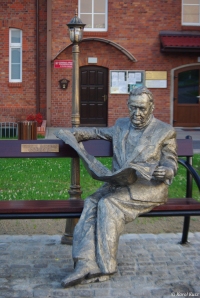
In another post twelve days ago – A Conversation with Henryk Górecki – I reported on a whimsical yet thoughtful monument to him that had been unveiled on 10 September in Rydułtowy, the town in Silesia where he lived from the age of 2 until he was 22.  As you’ll see or have seen, Górecki is sitting on the right-hand end of a bench, reading a musical score.

Well, blow me down, Tuwim too has been honoured with a bench, in his home town, Łódź, in central Poland.  This is the work of Wojciech Gryniewicz and was unveiled in 1999.  Like Górecki, Tuwim is seated on the right-hand end of a bench that in his case is also sculpted.  The key difference here is the posture.  Tuwim is looking out, not down, possibly above and beyond the eyeline of any companion.  Maybe he’s ‘lying in wait for God’ (Czyhanie na Bogu, the title of the collection that included Song of Joy and Rhythm).

I must say that I’m rather taken by the modest, down-to-earth approach of these sculpture-installations.  Does anyone know of other examples in addition to Maggi Hambling’s A Conversation with Oscar Wilde in London?

• Song of Joy and Rhythm

A text message came through from Anna Górecka, at 08.24 on this day last year, to say that her father had died earlier that morning.  She was away on tour and went on to fulfil her commitment to perform Górecki’s Piano Concerto that evening in Szczecin.  Her husband left me a voice message.  Although I knew that Henryk Górecki was dying, it was still a shock.  The rest of the day was a blur.  I phoned his publishers in London, but the news was not yet public knowledge even in Poland.  At 10.30, a friend in Warsaw, whom I’d alerted as soon as I had heard, phoned to let me know that Górecki’s death had just been announced.

The phone rang off the hook: advice for a researcher on R4’s PM programme, an interview for the World Service’s The Strand, a live interview on R3’s In Tune, a call from R4’s Front Row and an unfulfilled promise “We’ll phone back”, an interview down the line to a live Polish TV tribute, plus writing a short appreciation for The Guardian.  The last was difficult to do.

Amidst this, I had a visitation at 10.20 from a blue tit, which flew in unannounced through a narrowly open window, stood immobile on the floor for a while, eyeing me keenly, before eventually finding its way back outside and to freedom.  I’m not given to fanciful symbolism, but even I found myself seeing a message in the bird’s arrival and departure.  They say that it’s good to open a window after a death to let the spirit free.

When I was writing on Górecki in the early 1990s, I came across the poem which inspired the title of his extrovert Pieśni o radości i rytmie (Songs of Joy and Rhythm, 1956/60).  This early work bears all the hallmarks of Górecki’s contrasting musical and personal temperaments.  The heart of the work is the contemplative third movement.  It is arguably here that Górecki principally evokes the wonderment of the poem from which he borrowed his title.

Pieśń o radości i rytmie was written by one of Poland’s best-known poets of the twentieth-century, Julian Tuwim (1894-1953).  Many Polish composers have set Tuwim’s verse, including Szymanowski and Lutosławski.  Górecki was particularly attached to Tuwim’s poetry, setting it in his early student days (3 Songs, 1956) and again for his five-year-old daughter (2 Little Songs, 1972).  His most striking setting, in a terse Webernian style, was in Epitafium (1958), for SATB choir, piccolo, D trumpet, five percussionists and viola.  The text is Tuwim’s last poetic fragment, written on a serviette in a coffee shop just an hour before his death.  Its enigmatic message – ‘… for the sake of economy put out the light eternal, if it were ever to shine for me’ – is evocatively captured by Górecki’s exploratory score.

A year ago today, I looked out Tuwim’s (singular) poem and read it several times, mainly because it immediately recalled Górecki’s boundless energy and the inner peace which he sought during his often difficult life.  So I offer it here, in my own raw translation, as a tribute to a composer and a man for whom I had enormous respect and affection and who miraculously returned the favour.   

Pieśń o radości i rytmie (Song of Joy and Rhythm)
from Chyhanie na Bogu (Lying in Wait for God, 1918)

The stars twinkled in the sky.
In space – billions of universes.
Silence.

Resting my forehead in my hand and thinking.
I do not dream.
A big Reality has awoken me,
A truth that strikes the eye,
The truth that is being, visible, unique,
Eternal:

I – under this huge starry dome,
I – perceiving its entirety with my brain,
I relish it, I become one with myself
And slowly – inside – I am restored to myself:
To profound joy and perfect rhythm.

All my thoughts, words and deeds
Were only bringing me closer
To universal embrace:
Here I am resting joyfully in myself
Wrapped in deep silence on all sides
And my heart beats in the rhythm of
Everything that surrounds me.
Enough.  No need for words.

• On Tour with Górecki

It is rather encouraging that the approaching first anniversary of Henryk Górecki’s death on 12 November has occasioned a flurry of activity in this country.  Firstly, there was a Górecki edition of BBC Radio 3’s Sunday evening programme ‘The Choir’, which was broadcast on 6 November.  This series, which is devoted to all aspects of the composition and performance of choral music, broadcast the opening song from Górecki’s first collection of folksong settings, Broad Waters (1979), his most famous and most recorded a cappella piece, Totus Tuus (1987), his set of Five Kurpian Songs (1999) and Amen (1975).  And the programme also included Górecki’s earliest choral work – this time with instruments – Epitafium (1958), a stylistic (Webernian) corrective to the popular image of Górecki as a composer interested only in slow modal music.  A few weeks ago, I recorded an interview for the programme alongside Roxanna Panufnik, the daughter of the Polish composer Andrzej Panufnik.  Friends tell me that they enjoyed the programme, especially those who knew nothing of Górecki’s music and life beforehand.  Unfortunately, I missed the broadcast as I was on a coach with the Polish Radio Choir from Kraków (see below).

Secondly, I was visited late on a dark and stormy night at the end of last week, here on the Cornish moors, by a team from Polish Television in Katowice, Górecki’s home city.  They’d driven from France that day and were going on subsequently to interview Górecki’s London publishers and to speak to Bob Bibby, the Englishman who discovered that the subject of the second movement of Górecki’s Symphony of Sorrowful Songs had not died at the hands of the Gestapo, as had generally been feared, but had lived a full life, dying in 1999 (Guardian appreciation, 25 November 2010). I settled the Polish TV director, Violetta Rotter-Kozera, in front of a roaring log fire and we had an intense and warm-hearted discussion about Górecki’s music, life, personality and temperaments.  The programme (my hour or so will be cut down to a few minutes, I’m sure!) will probably be broadcast sometime early in 2012.

Thirdly, I’ve just come back from being ‘on tour’, with the Polish Radio Choir from Kraków, a promotion initiated by Ed McKeon of Third Ear.  It was my first such experience, and probably my last.  Even though this was a short, four-concert tour, I came away with a better understanding of the many and varied pressures that performers experience when daily on the move from one venue/hotel to another.  I was full of admiration for their unflappability and good humour.  This was nowhere more apparent than shortly after the start of the concert in Durham Cathedral, that solidly magnificent example of Romanesque architecture.  The peaceful prayer that is Totus Tuus was suddenly counterpointed by a barrage of deafening booms and bangs that seemed to be coming from right outside the building.  It was like a medieval siege, a terrifying bombardment.  It went on for over 15′.  The choir didn’t bat an eyelid, no voice trembled.  While the choir had no idea what was going on, we in the audience knew well enough.  It took a bit of explaining afterwards (November 5 customs can seem very strange to visitors to the UK).

The choir had flown into Liverpool the previous day and joined the tour coach for the first concert in Durham (Saturday night), on to London (Sunday lunchtime), Bristol (Monday evening) and Liverpool (Tuesday evening).  My role was to give three pre-concert talks, each of a different duration, before the first three concerts.  The choir was very welcoming and after the concert in Bristol asked me if I would become an honorary member of its Association of Artists and Friends, which came out of the blue and was very touching.

The Polish Radio Choir, under its conductor Artur Sędzielarz, is one of those rare commodities, a choir that is funded by a broadcaster.  In the UK, we are lucky to have the BBC Singers and some other European countries still invest in similar vocal groups for the sake of repertoires past and future.  It is a very fine ensemble.  They brought 29 singers and their textural blend was second-to-none.  Equally wonderful were the choir’s harmonic voicing and unfailingly clear articulation.  Dynamically, they encompassed the quietest of pianissimos and the most emphatic of fortissimos.  I was reminded of the extremist markings that Górecki used in his vocal-instrumental Ad Matrem (1971).  On the one hand, in that score he asked for moments that were ritmico-marcatissimo-energico-furioso-con massima passion e grande tensione.  On the other hand, elsewhere he wanted tranquillissimo-cantabilissimo-dolcissimo-affetuoso e ben tenuto e LEGATISSIMO.  The Polish Radio Choir brought such contrasts fully to life, especially in the Five Kurpian Songs, and I’m sure that Górecki would have been beaming at them had he been present.

It is a strange phenomenon in Górecki’s output that he makes little difference in his compositional approach to folksong settings and to church songs.  This is particularly evident in the overwhelmingly slow tempi and sustained vocal lines.  These demand extraordinary stamina and vocal evenness, which the Polish Radio Choir delivered effortlessly.  The programme moved from Totus Tuus, through the Five Kurpian SongsThree Lullabies (1984, in Bristol and Liverpool only, although the first lullaby was sung as the encore in London), and the Song of the Katyń Families (2004).  The concerts ended with Come Holy Spirit (1988) and Amen.

For me, the outstanding piece was Song of the Katyń Families.  It lasts for barely 5′, yet its expressive power became more and more apparent at each subsequent performance.  Typically for Górecki, the piece takes a slightly oblique slant, setting a contemporary text that links the first line of the Polish national anthem with the memory of the Soviet slaughter of thousands of Polish army officers during World War II.  The piece’s lower overall tessitura made quite an impression at this stage in the concert.  When the basses dropped lower still, the harmonic resonance spoke volumes.  And when they moved down two further steps, the luminosity of the choir’s sound was breathtaking.  Song of the Katyń Families deserves as wide a recognition as Totus Tuus.

I wonder if the Polish Radio Choir’s unanimity and utter faithfulness to the spirit and letter of Górecki’s music, as well as their sensitivity to timbral colour, come not only from their collective musical sensibilities but also from their wide musical interests outside their choral work, which include – to take just three examples – musicology, cabaret and period instrument performance.  Whatever their secret ingredient is, it made for rivetting performances that elicited hugely enthusiastic audience responses.  I hope that the choir returns to the UK before too long.

…..

The Polish Radio Choir released a 2-CD recording of Górecki’s a cappella music in 2007.  It’s on the Polish Radio label, Polskie Radio PRCD 1104-1105.  It includes Broad WatersFive Kurpian SongsCome Holy SpiritSong of the Katyń Families and Amen, plus the folksong My Vistula (1981) and Marian Songs (1985).

…..

For Rian Evans’s review of the Bristol Concert, see The Guardian (9 November 2011).

• A Conversation with Henryk Górecki

Exactly one year ago I flew to Poland for what turned out to be my last meetings with Henryk Mikołaj Górecki.  When I had learned a few days earlier that he had been awarded Poland’s highest honour, the Order of the White Eagle, and that the presentation had taken place at his hospital bedside, I sensed that the end was near.  His fellow composer Witold Lutosławski (1913-94) had been honoured in the same way just before his death, although he was too ill to receive it in person.

Staying once again with members of Górecki’s family, I was taken on three occasions to see Henryk in his hospital on the outskirts of Katowice.  It is never easy to see a close friend in such circumstances, when their vivacity, robustness and combativeness have seemingly vanished.  He was able to communicate only through those still-penetrating eyes.  I showed him pictures of the moorland where I live and reminisced about the often hilarious holiday that I had with him and the family at Chochołów in the Tatra Mountains in August 1987 and about our many walks and talks together.  I recounted my recent visit to the St Magnus Festival in Orkney, where the Royal Quartet from Poland had given an unforgettable account of his Third String Quartet ‘… songs are sung’ and where I’d been mesmerised by the pianism and imagination of the jazz interpretations by Leszek Możdżer.  Even though all he could do was to look me straight in the eye, as he always did, I knew that he’d been listening and had understood.  There were to be no more moments like this.  I wish now that I had had the forethought to bring along some poetry or other texts to read to him, just as depicted in the film The Diving Bell and the Butterfly.

I may yet write about the day of his death (12 November 2010) and his funeral five days later, but for now I’m going to fast-forward to 10 September 2011.  I’ve been rather tardy in writing about a touching and somewhat whimsical tribute that was paid to him on that day in Poland.

Photo by Karol Kusz

Between the ages of two and twenty two, before he went to study composition in Katowice, Górecki lived some 50km to the south west, in a small town called Rydułtowy. There he went to school and subsequently taught primary school children a range of subjects, including Polish history, maths, biology, natural history and art.  Earlier this year, the town recognised its most famous son by renaming the Public Library in his honour.  On 10 September, ceremonies were held to mark the occasion, including the customary speeches and musical performances.  Górecki’s widow, Jadwiga, unveiled a plaque inside the library and also unveiled a sculpture outside.  But this sculpture – or is it a statue, or perhaps an installation? – is not a run-of-the-mill representation of the composer, nor an abstract concept inspired by his music.  It’s more in the line of Maggi Hambling’s A Conversation with Oscar Wilde (1998), which has been placed in London at the bottom of the pedestrian Adelaide St, behind the church of St Martin’s in the Fields and close to Charing Cross station.

Whereas Hambling (left) gives passers-by the opportunity to sit on Wilde’s all-too-solid ‘coffin’ and have a face-to-face exchange of witty one-liners (or sit in the opposite direction and ignore him), Henryk Fojcik’s sculpture (above) encourages side-by-side contemplation.  Górecki sits on the right-hand side of a posher-than-normal park bench, a lamp-post placed centrally behind (plenty of openings here on a rainy day for Gene Kelly impersonators).  He’s reading what looks like a newspaper, although I never knew him as an avid reader of newsprint.

In the picture below, in which his widow Jadwiga was persuaded to sit next to him on the bench, it seems that Górecki is looking instead at a piece of music, even though it’s oversize and much bigger than his largest score, Scontri.  He wasn’t one for looking at his existing compositions, either.  He preferred to work on new pieces.  It’s a good likeness, however: the head and face are pretty faithful and characteristic (much more so than the relief image on the plaque inside the library) and his body posture is very well captured.  And there is something wonderfully relaxed, quietly alive and of good humour about Fojcik’s sculpture.  It invites participation and companionship.

For myself, I think a chance has been missed by having his eyes downcast.  How more engaging it would be if his head had been facing towards the other person on the bench, fixing him or her with his searching eyes as if to say: “What are you doing now? … Well, get up and do it!”.

Further information may be found online at

• < http://www.biblioteka.rydultowy.pl/archiwum.php?id=263> – a report by the Rydułtowy Public Library of the event on 10 September 2011, with 27 photographs.

• < http://www.telewizjatvt.pl/raport/2011-09-13/5103> – a short news video by the local television station of the events on 10 September 2011.

• A Distant Echo of God’s Word

Yesterday I finished writing the programme notes for a forthcoming visit of the Polish Radio Choir from Kraków.  Between 5 and 8 November, the choir is giving concerts at Durham Cathedral, King’s Place in London, St George’s in Bristol and in St George’s Hall Concert Room in Liverpool.  The programmes, under the title ‘Polish Spirituals’, commemorate Henryk Mikolaj Górecki, who died on 12 November last year.  For more details and an introductory essay by Ed McKeon, please follow the link to the tour web site, set up by the UK organisers, Third Ear.

Late in the day, I remembered a particular passage from a homily by Pope John-Paul II that Górecki admired.  The Pope was speaking at a Mass for Artists in Brussels on 20 May 1985.  So here it is, with Górecki’s little postscript, as a tribute to both men and their vision of what it means to be an artist.

Each authentic work of art interprets the reality beyond sensory perception.  It is born of silence, admiration, or the protest of an honest heart.  It tries to bring closer the mystery of reality.  So what constitutes the essence of art is found deep within each person.  It is there where the aspiration to give meaning to one’s life is accompanied by the fleeting sense of beauty and the mysterious unison of things.  Authentic and humble artists are perfectly well aware, no matter what kind of beauty characterises their handiwork, that their paintings, sculptures or creations are nothing else but the reflection of God’s Beauty.  No matter how strong the charm of their music and words, they know that their works are only a distant echo of God’s Word.

Górecki quoted these words at the Catholic University of America, in Washington D.C., on 28 February 1995, adding:

Those words are perfect: you can neither add to them nor take anything away.  Just think deeply about the sense of those words.

• Lutosławski and Jeux vénitiens

This is a story in three parts: (i) the 2011 ‘Warsaw Autumn’, which opens tonight; (ii) the significance of Jeux vénitiens (1960-61) for Witold Lutosławski and developing terminology for chance procedures; (iii) my meeting with the composer about the score and sketches after the 1981 ‘Warsaw Autumn’.  Today; 50 years ago; 30 years ago.

The 2011 ‘Warsaw Autumn’

The 54th ‘Warsaw Autumn’ International Festival of Contemporary Music begins today.  It is a most remarkable phenomenon, unique in its longevity and perpetual re-invention.  It began in 1956, at the cusp of monumental political, societal and cultural changes not only in Poland but in some of the other satellite countries of the then Soviet Union (USSR) in Eastern Europe.  It has been the proving ground and showcase for generations of Polish composers and has provided a priceless opportunity for Polish audiences to hear the latest developments in new music from abroad as well as dipping into historical moments in post-war music.

This year’s programme is as inventive as ever.  Historical contexts are offered by performances of Górecki’s firebrand orchestral work Scontri (1960), to commemorate his death last November (Scontri opens the festival this evening), of Nono’s A-Ronne and Penderecki’s radio programme The Brigade of Death on Sunday (18.09), 17 parts of Stockhausen’s Klang next Thursday (22.09) and Nono’s Il canto sospeso in the closing concert a week tomorrow (24.09.11).  There is a strong thread of music theatre and documentary works on current topics (child soldiers in Africa, the sale of Eastern European women for prostitution in the West), with pieces by Phil Niblock, Heiner Goebbels, Justé Janulyté, Perttu Haapanen, Lotta Wennäkoski, Hannes Seidl and Daniel Kötter, and Carola Bauckholt leading the way.  There’s even ‘a street oratorio with orchestra and Warsaw residents’ choir, a sort of composed rally, a polyphony of citizens that feel ignored by social discourse’.  No-one can accuse the ‘Warsaw Autumn’ of resting on its laurels.

A brand-new and enchanting development is ‘Little WA’ (Little Warsaw Autumn), a programme of new music aiming to appeal to children 5-12 years old.  By the look of it, this is no hand-me-down nor dumb-me-down outreach.  As always with the ‘Warsaw Autumn’, the musical experience will be direct and stimulating, uncompromising in all the good senses of the word.

The 1961 ‘Warsaw Autumn’ 

This is all by way of introduction to a special anniversary that also falls today.  On 16 September, exactly fifty years ago today, a premiere took place in the opening concert of the 5th ‘Warsaw Autumn’ that was to mark a signal turning-point in the work not only of its composer but also, I would argue, in Polish music.  I’m not thinking of another work premiered six days later at the 1961 ‘Warsaw Autumn’ – Penderecki’s Threnody for the Victims of Hiroshima (1960-61) – more monumental though its impact has been.  My focus is on Lutosławski’s Jeux vénitiens (also 1960-61).

This premiere of Jeux vénitiens was not as simple as that.  It was, in fact, its second premiere, if that’s not a contradiction in terms.  In brief, this short (13’) chamber orchestra piece had been commissioned by the dynamic and somewhat maverick Polish conductor Andrzej Markowski for performance at the Venice Biennale on 24 April 1961.  That performance went ahead, but evidently the piece was not to Lutosławski’s satisfaction, and between May and August 1961 he revised significant parts of it (notably the first and last movements) and added an extra (third) movement.  The ‘Warsaw’ version was, to all intents and purposes, a new piece.  (If you are interested in reading about the differences between the ‘Venice’ and ‘Warsaw’ versions, I can refer you to a book chapter that I wrote ten years ago for OUP’s Lutosławski Studies, even though the book’s cost price today – in the region of £136-£144 – is beyond exorbitant).

The significance of the finished Jeux vénitiens for Lutosławski was enormous.  He was trialling new techniques and modes of expression as part of the seething musical cauldron that was Polish music in 1958-62.  Composers 20 years his junior were pushing boundaries even further in their new pieces, Górecki’s Scontri and Penderecki’s Threnody first among them.  I’m in no doubt that Lutosławski thought it necessary to join this experimental stream, and Jeux vénitiens and, to a more moderate extent, its successor Trois poèmes d’Henri Michaux (1961-63) fulfilled this need.

Lutosławski’s terminologies of chance (1960-68)

Lutosławski’s experiments lay less in his harmonic language, which he had been developing over several years prior to Jeux vénitiens, than in his loosening of moment-to-moment rhythmic ties and the concomitant rethinking of motivic material (I cover this in detail in the chapter mentioned above).  To describe this rhythmic loosening, Lutosławski searched for terms that would encapsulate his take on chance procedures that would make clear the difference with the compositional methods and aesthetics of other composers, especially John Cage.  (It had been a chance hearing of Cage’s Concert for Piano and Orchestra that ‘was a stimulus, a spark to ignite the powder keg in me’.)  Key to this search were two terms: objet sonore and the adjective ‘aleatory’.

In his recently published Zapiski (Notebook of Ideas), Lutosławski noted:

23 September 1960: ‘Instead of ‘melody’ and ‘harmony’ there is a new element (perhaps not completely new in its essence, but new in use) – objet sonore – sound object’.

It is almost certain that Lutosławski’s adoption of this term, invented by the French composer Pierre Schaeffer, was caused either by meeting Schaeffer when he came to the 3rd ‘Warsaw Autumn’ and presented a programme of musique concrète on 17 September 1959 and/or by hearing Schaeffer’s Étude aux objets during the 4th ‘Warsaw Autumn’ two days before making this notebook entry.

Lutosławski’s use of ‘aleatory’ is more extensive and varied.  In 1965 he articulated his opposition to a more widespread, Cagean use of chance (‘absolute aleatorism’) or the use of chance in determining musical structure (‘aleatorism of form’).  But in 1960 he was just at the start of his process of formulation.

Initially, he preferred writing about rhythm and objets than about chance:

19 October 1960: ‘Thus two rhythmic flows in a piece: 1. local rhythm ‘small’ (mały) – inside the object; 2. general rhythm ‘large’ (duży) – i.e. the rhythm of a succession of objects’.

It was not until 14 months had passed, and three months after the premiere of Jeux vénitiens, that Lutosławski first used the word ‘alea’:

20 December 1961: ‘Lecture on mus[ical] character, [… there then follows a series of subject headings] … alea …’.

Lutosławski first mentioned aleatorism by name only as he was drafting a series of lectures to be delivered during a forthcoming residency at the Berkshire Music Centre in Tanglewood, Mass. in the summer of 1962.  Under the heading ‘Attention: alea’, he wrote:

15 March 1962: ‘Terms: ‘small aleatorism’ (mały aleatoryzm) – concerning detail, ad libitum in performance itself, approximate treatment of rhythm, the methods of A etc. [‘A’ probably refers to the revised, ‘Warsaw’ version of the first movement of Jeux vénitiens]; ‘large aleatorism’ (duży aleatoryzm) – chance as the base for constructing forms, the alternation of sections, even of whole movements (Boulez’s III Sonata, Klavierstück XI, etc.)’.

Lutosławski seems to have first used his preferred term ‘limited aleatorism’ in 1963 when giving an interview about Trois poèmes:

What is this technique?  It is hardly, however, ‘classic’ aleatorism (‘klasyczny’ aleatoryzm) [this seems to be Lutosławski’s precursive definition for ‘absolute’], because the separate parameters of the piece are not completely abandoned to chance but rather are more or less defined.  This technique might be called ‘approximate’ (aproksymatywna).  The term ‘limited aleatorism’ (aleatoryzm ograniczony) might define it more accurately.

Four years later, writing about the imminent premiere of the complete Second Symphony (9 June 1967), Lutosławski broadened the vocabulary: ‘the technique called in general usage ‘controlled’ (kontrolowany)or ‘limited’ (ograniczony) aleatorism’.  This has led some translators and commentators to use ‘controlled’ to represent both Polish adjectives, which is unfortunate as there are subtle differences in meaning.  I suspect that kontrolowany came from ‘general usage’ rather than from Lutosławski himself.

One final observation on ‘aleatory’.  In Stockholm in 1965, he coined the term ‘aleatory counterpoint’, which neatly encapsulates the motivic marriage between rhythmic patterns and harmonic movement in his music.  Yet, once again, Lutosławski confused the terminological issue in 1969, when discussing Livre pour orchestre (1968).  He suggested that an alternative term to ‘aleatory counterpoint’ might be ‘controlled aleatorism’.

Lutosławski’s developing commentary on this signal new aspect of his technique that emerged in the two versions of Jeux vénitiens is witness to his creative vision in the 1960s.  It is also a confirmation of the validity and success of his experimental trials in Jeux vénitiens.  Its publication in 1962 by both the Polish PWM and the German company Moeck ensured that its raw energy and experimentalism achieved a wide audience of composers, performers and analysts.

The 1981 ‘Warsaw Autumn’

One of those analysts was me.  I had written about Lutosławski’s technical and expressive armoury during my Masters degree and had been particularly fascinated by Jeux vénitiens.  I had noticed two things that seemed unusual.  The first, and more significant, was the extraction of superimposed motifs from the ‘A’ section of the first movement (the revised version, though I did not know that at the time) to provide juxtaposed material for the flute cantilena in the third movement (new to the revised version).  Less important, but instrumental in the story that follows, was my realisation, in analysing the motifs and harmony of the first movement’s ‘A’ section, that there were misprints in the published score.  In other words, some pitches did not belong to the constant 12-note harmony of the background chord.

In September 1981, I went to the ‘Warsaw Autumn’ for the fourth time.  I was also going there to witness the extraordinary happenings in Poland, led by the Solidarity and Rural Solidarity trades unions.  It was a time of unbelievably activism, passion, belief in the future combined with fear of government and of the big bear to the East (remembering Prague 1968, only 13 years before).  And the fear was justified: martial law was declared three months later, on 13 December.  It was also a time when the authorities put pressure on every citizen by thwarting basic supplies: I remember walking into one huge new supermarket in which every shelf was bare and only blackened fish were on sale.  They were horrific conditions, although the ordinary Pole still managed somehow to find ways to buy bread, fruit and veg (it was harvest time) and, if lucky, some meat brought in from the countryside.

The 25th ‘Warsaw Autumn’ went on, however.  New Polish pieces included Lutosławski’s Grave (1981), Wojciech Kilar’s outrageously cinematic Exodus (1981), complete with audience ‘baa-baa’ at the end, and tributes to Kazimierz Serocki and Tadeusz Baird who had died that year.  Younger composers came to the fore: I recall the vivid impression of Ryszard Szeremeta’s Advocatus diaboli (1980-81) and feeling that Paweł Buczyński’s Music of Falling Leaves (1980) captured in its title and music the underlying sadness of that Polish autumn.  Xenakis made a triumphant visit with his Ais (1980) being a highpoint of the festival, while Penderecki’s most recent blockbuster, his Te Deum (1980), played to an over-packed St John’s Cathedral.  A lighter diversion was provided by a 15-year-old piece by my old teacher in Kraków, Bogusław Schäffer.  His gift for musical theatre was demonstrated by the hilarious Quartet for Four Actors (1966).

Meeting Lutosławski (October 1981)

During an interval in one of the concerts I approached Lutosławski with a request to talk to him about Jeux vénitiens.  I said that I was writing an article (‘Jeux vénitiens: Lutosławski at the Crossroads’, Contact, 24 (Spring, 1982), 4-7, since largely subsumed into my chapter of 2001).  I had found some misprints.  His interest was piqued.  We arranged that I would visit him one evening after the festival.  It turned out to be the night before I was due to return to the UK and on to Belfast for the start of the new academic year.

I’d been advised that Lutosławski liked his single-malt Scotch whisky, so armed with a bottle I turned up at the modernist cubed house that he and his wife owned in north Warsaw.  He ushered me into his downstairs living room, which had a large L-shaped sofa with a coffee table nestling in its crook.  I gave him the whisky – which seemed to please him enormously – and he opened up a large nearby chest on the parquet floor and placed it inside among what looked to me like dozens of other bottles.  We sat down on the two sides of the sofa, he to my left.  “So, what’s this about misprints?”, he asked.

I took out my score and pointed to section ‘A’ of the first movement: fl.I, motif 3, A natural [should be B natural?]; fl.II, motif 1, A flat [should be B natural or F sharp?]; fl.II, motif 4, A flat again; cl.I, motif 8, A natural [should be B natural or F sharp?].  Four errors in the score.  He was puzzled.  “Wait a minute.  I must go and get the sketches”.  I held my breath.  This was more than I could have hoped for.

When he returned, I saw that each of the four movements had its own envelope.  He got out the sketches for the first movement.  He leafed through them.  “This isn’t of interest, this isn’t of interest, this isn’t of interest.”  Even at right angles I could tell that these were gold dust: rhythmic sketches, harmonic possibilities, strange drawings which looked like circuit diagrams.  Of course they were of interest – to me!

From somewhere, I don’t know where, I plucked up the courage to ask a question.  “I’m unfortunately flying out of Warsaw before dawn tomorrow morning.  Could I study these sketches overnight before I go?   My friends could return them to you tomorrow.”  I’ll never forget Lutosławski’s reply: “Of course you can.  Why don’t you take them with you to England, copy what you wish and post them back to me when you’ve finished looking at them.”  I was dumbstruck, but not for long.  “I can’t do that,” I said, “They’re too precious.  If I may take them to where I’m staying, I’ll study them overnight and then they can be returned safely into your hands.”  Lutosławski agreed.  “Do you want to look at all of them?”  I knew that I didn’t have enough time to do that, so I reluctantly asked if I could take the envelopes for just the first and third movements (how I wish now that I’d also taken the fourth!).  As a parting gift for one of my MA students who was studying his music, Lutosławski gave me a clutch of miniature scores of his music.  Six years later, that student would be able to thank Lutosławski in person when he played in a concert of his music to celebrate the conferment of an honorary DMus on Lutosławski by Queen’s University.

I think that I have never carried such a treasured package on trams across Warsaw than I did that autumn night in 1981.  I reached my friends’ flat about 23.00 hrs and immediately set about studying and copying onto my own MS paper the relevant sketches so that I could study them at leisure when back in the UK.  This was before digital cameras, so no shortcuts there.  And, because the Polish state regarded photocopiers as agents of dissension, there were no services available on that front either.  So there was nothing to be done except spend the next seven hours furiously writing by hand (I had to do the same again, over ten years later, with some Górecki materials).  I left Warsaw the following morning, exhausted, with a cramped right hand, but marvelling at Lutosławski’s generosity and my good fortune.

There is something about sketches of early and ‘transitional’ works that reveals more about their creator’s thought processes than perhaps other pieces do.  It’s not a watertight observation, as I know from studying the sketches of his Cello Concerto (1969-70).  But, in the case of Jeux vénitiens, I was privileged to be the first to see his mathematical tables (whose rationales have still not been revealed), his ‘circuit diagrams’ of the pitch designs of sections B, D, E and F in the first movement, designs which are intricate, purposeful, but barely audible without the prior knowledge that these preparations revealed.  Above all, these sketches demonstrated, if demonstration were needed, that Lutosławski worked methodically, precisely, though without dating his many separate sheets.  Chronology therefore had to be a matter of intelligent conjecture.

This was a special moment in my life with Polish music.  There would be many others, including a second visit to Lutosławski’s house 21 years later, of which perhaps more at a future date.  But this moment, in those heady yet bleak days of autumn 1981, twenty years after the full premiere of Jeux vénitiens and thirty years ago from now, has remained the most memorable.