• Zanussi, Wajda and Michniewski on Kilar

As a little supplement to my earlier post today on Kilar at 80, here are two interviews I’ve since discovered by the film directors Krzysztof Zanussi and Andrzej Wajda.  They’re in Polish but with excellent English subtitles.  It’s interesting to observe the different ways in which Zanussi and Wajda talk about their frequent collaborations with Kilar.  Zanussi speaks touchingly and intelligently, referring to Kilar by the semi-formal ‘Pan Wojciech’ (Mr Wojciech).  Wajda is revealing in other ways, freer and more relaxed, and uses the more familiar ‘Wojtek’.

The interviews also offer glimpses of some of the films.  In Zanussi’s case, the excerpts are fairly brief: Struktura kryształu (The Structure of Crystal, 1969), Iluminacja (Illumination, 1973), Brat naszego Boga (Our God’s Brother, 1997).  The excerpts in the Wajda interview are a bit longer: Ziemia obiecana (Land of Promise, 1974), Kronika wypadków miłosnych (Chronicle of Amorous Events, 1986) and Pan Tadeusz (Mr Thaddeus, 1999).  Both accounts display Kilar’s mastery of the complementary score, sometimes in the most minimal way, an approach which often pays dividends in the cinema.

Both interviews have been recently uploaded by the Polish Music Publishers, PWM Edition, as part of its celebration of Kilar’s life and work.  There are also YouTube interviews with two Polish conductors: Antoni Wit (who has recorded several CDs of Kilar’s work for Naxos and other labels) and Wojciech Michniewski.

The interview with Michniewski, who has a background as a composer, is particularly engaging.  He gives a fascinating and anecdotally rich account of his connections with Kilar, concentrating on Orawa (1986) and Siwa mgła (Grey Mist, 1979), including the delightful inscriptions that Kilar wrote in his copies of these scores.

• Kilar at 80

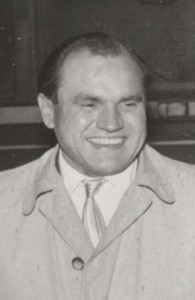
Wojciech Kilar (photo from the 1970s?)

Wojciech Kilar is one of the stayers of Polish music.  He turns 80 today. Of his fellow internationally-known composers, only Witold Lutosławski (1913-94) has reached the same milestone.  Two months ago, the Polish president awarded Kilar the country’s highest honour, the Order of the White Eagle.  I hope that this is not an omen of mortality, as its conferral on both Lutosławski and Henryk Mikołaj Górecki took place when they were on their deathbeds.  Equally, I’m not anxious to mark this event with anything like an obitual ode, and I’ll draw a polite veil over Kilar’s concert music of the last twenty years or so.

Although many other Polish composers have written film music, Kilar is undoubtedly the best-known, with well over 100 film scores to his credit (his first was in 1958).  He’s worked on a wealth of Polish films, such as Kazimierz Kutz’s Sół ziemi czarnej (Salt of the Black Earth, 1969), Krzysztof Zanussi’s Struktura kryształu (The Structure of Crystal, also 1969), Andrzej Wajda’s Ziemia obiecana (The Promised Land, 1974) and Krzysztof Kieślowski’s Przypadek (Blind Chance, 1981).  Kilar became internationally famous for his work on English-language films, such as Francis Ford Coppola’s Bram Stoker’s Dracula (1992) and Jane Campion’s The Portrait of a Lady (1996).  He has a gift for a catchy melodic hook, like that which haunts his score for Roman Polański’s The Pianist (2002).

Kilar’s concert music follows a similar trajectory to those of his Polish contemporaries, at least from the 1950s through to the 1980s.  It’s not often realised, however, that he was known as an up-and-coming talent several years earlier than Krzysztof Penderecki and Górecki, who were born just a year later.  His music of the early-mid 1950s unsurprisingly shows a neoclassical bent (Horn Sonata, 1954; Little Overture, 1955).  After his Ode in memoriam Béla Bartók (1957), he seems to have taken a compositional breather, while other composers were sorting out their responses to the Western avant-garde in public at the new, ground-breaking ‘Warsaw Autumn’ festivals.  Kilar stormed back in the fourth, fifth and sixth festivals in 1961-63 with Herbsttag (1960), Riff ’62 (1962) and Générique (1963).

Although they challenged the audiences, these scores were quite different to those of Penderecki and Górecki. Kilar’s music was more febrile, less obviously unified, less closely wedded to the sonoristic movement of his contemporaries.  It was lighter than Górecki’s equivalent pieces (Elementi, 1962) and less homogenous than Penderecki’s, as the jazz and rhythmic components in Riff ’62 shows.  For a while in the late 1960s, Kilar seemed close to Górecki (they both lived and worked in Katowice) as they moved towards a more consonant idiom, but their paths started to diverge.

I once characterised their differences as Kilar preferring the major third while Górecki went for the minor.  This pat observation has a certain element of truth, in the sense that Kilar developed a sweeter compositional tooth than Górecki.  This is borne out when comparing two works from 1972: Kilar’s Przygrywka i kolęda (Prelude and Christmas Carol) and Górecki’s Second Symphony ‘Copernican’.  Kilar was the first (after Zygmunt Krauze’s Folk Music, 1972) to plunge wholeheartedly into the world of folk culture, and in 1974 he came up with a stunner that remains one of his most-performed orchestral works.


Krzesany (Sparking Dance) is a vigorous re-imagining of one of the Polish highlanders’ most characteristic dances. It’s hard to realise 40 years on how refreshing and jovial this piece was, bringing together as it did elements of sonorism and national music.  Polish folk music, which twenty years earlier had been somewhat tainted among composers for its role in promoting communist socialist realism, had been released by Krauze and Kilar.  For my money, Kilar’s Orawa for strings (1986) is a more successful and if less obviously colourful example, and I remember having great fun when conducting it many years ago, though the players had to work harder than I did!  There are two intervening symphonic poems which also draw inspiration from the Podhale region north of the Tatra Mountains – Kościelec 1909 (1976; the title refers to the mountain where the composer Mieczysław Karłowicz met his death by avalanche) and Siwa mgła (Grey Mist, 1979).

With Bogurodzica (Mother of God, 1975), Kilar got into his stride with religious contextualisation or historical memorialisation.  Subsequent pieces include Victoria (written for Pope John Paul II’s second visit to Poland), Angelus (1984), Piano Concerto (1997), Missa pro pace (2000) and September Symphony (2003, his response to 9/11).

The most notorious of these pieces was Exodus (1981).  Krzesany had created a sensation at the 1974 ‘Warsaw Autumn’, and Exodus did likewise at the 1981 festival. This was at the height of the Solidarity movement and just three months before the imposition of martial law, so Kilar’s reference to the Old Testament story accumulated contemporary symbolism.  Here, the ‘major third’ aspect of Kilar’s aesthetic came to the fore, allied to a Boléro-like structure.  And there’s no doubting the filmic aspect too – it’s as if Kilar was writing for  a Hollywood biblical epic.  I was present at the premiere in the Philharmonic Hall in Warsaw.  The audience became very excitable, provoked by the repetitious refrain (some even joining in), and as Exodus reached its final choral-orchestral flourish, someone next to me let out a loud ‘Mehhhhhhh’.

Here’s a video put up yesterday by the Polish Music Publishers, PWM Edition.  It’s a live performance of BogurodzicaAngelus (starting at 11’08”) and Exodus (starting shortly after 31’55”).  (Warning: there are virtually no gaps between pieces in this tightly edited video.)   The concert was given on 1 May this year in the presence of the composer at the monastery church at Częstochowa, where Kilar has long had a private retreat.

Whether by design or in naivety, Kilar’s music of the past 40 years has divided audiences as violently as the parting of the Red Sea.  In his pared-down, transparent pieces since 2000, some hail him as having a mystical link – through his music – to the Almighty.  Others see an updated version of the story of the Emperor’s New Clothes.  But no-one can accuse him of not following his compositional instincts, and his music continues to touch audiences and film-goers across the world.

• Górecki’s ‘Ad Matrem’ premiere on video

Once again I’m indebted to the eagle eyes of Tim Rutherford-Johnson (http://johnsonsrambler.wordpress.com/) who tweeted yesterday (https://twitter.com/#!/moderncomp) about a YouTube video he’d discovered of the premiere of Górecki’s Ad Matrem.  It’s a black and white film made by Polish Television on 24 September 1972 at the final concert of that year’s ‘Warsaw Autumn’ festival.  The venue was the National Philharmonic Hall, with Stefania Woytowicz and the National Philharmonic SO and Choir conducted by Andrzej Markowski.  It’s a bit of a shame that the film cuts out just before Górecki came onto the stage to acknowledge the applause.


The Górecki concluded the concert, and therefore crowned the festival.  Ad Matrem was preceded in the programme by a typically eclectic festival mix of repertoire: Schoenberg’s Five Orchestral Pieces, Tomasz Sikorski’s Holzwege (Paths to Nowhere, premiere), Franco Oppo’s Digressione (Polish premiere) and Penderecki’s Partita (also a Polish premiere), with soloists Felicja Blumental and Terje Rypdal.*

Woytowicz went on to give the premieres of Górecki’s second and third symphonies as well as O Domina nostra, which was dedicated to her.  (She also sang Lutosławski’s Lacrimosa at his funeral in 1994.)

Markowski was a great supporter of Górecki’s music, having given the premiere of his Epitafium at the second ‘Warsaw Autumn’, in 1958, and conducting several subsequent premieres: Little Music II (‘Warsaw Autumn’, 1967), Wratislaviae gloria (Wrocław, 1969), Old Polish Music (‘Warsaw Autumn’, 1969) and the Second Symphony with Woytowicz (Warsaw, 1973).  Markowski was a passionate advocate not only of Górecki’s music but also that of other contemporary composers from home and abroad.  Something of his character may be gleaned from the fact that he fought in the Warsaw Uprising of 1944 as a member of the Polish underground Home Army.

Górecki’s Ad Matrem (1972) is a powerful and lean work.  The chorus utters only two words (‘Mater mea’), just twice in the early stages. The music’s trajectory, from pulsing bass drums, through these interjections and on to a luminous dominant thirteenth and beyond, is very striking, not least because Górecki places these textures sparingly.  The soprano does not sing her four words (‘Mater mea, lacrimosa dolorosa’) until the closing bars.  I’ve often thought of this approach as painterly in the sense that Patrick Heron, for example, created abstract paintings with a huge swathe of one colour at one end of the canvas but very telling and contrasting colour-blocks at the other end or in isolated patches in between.

* Despite Ad Matrem being one of the most unconventionally moving and striking of Górecki’s works, it has remained largely unrecognised outside Poland, even though it won First Prize at the UNESCO Composers’ Rostrum in Paris in 1973.  In the UK, it took the initiative of the British composer John Casken to bring about the UK premiere. This took place, performed by students at Manchester University under his direction, in December 2002, a full thirty years after its premiere in Warsaw.

• New Polish CDs from Bôłt

Thanks to the eagle eye of The Rambler – thanks, Tim! – I’ve just been reading an article uploaded by Agata Pyzik on her blogsite nuitssansnuit on 21 May 2012. Published in a shorter version a year ago in The Wire (March, 2011), her article ‘Polish Radio Experimental Studio released’ gives a brief overview of PRES in order to promote a new venture by the independent Polish label, Bôłt.  Bôłt has recently remastered electronic music produced at PRES since its foundation in 1957.  Key works, especially from the early years of PRES, are now available in digital form, and Bôłt deserves huge congratulation for taking the trouble to sort through the studio archives.

Pyzik’s article includes links to several sound files on YouTube.  Its English translation is not always ideal, unfortunately, and there are a few loose ends, but it’s worth reading as an introduction to this formative period in the careers of Andrzej Dobrowolski, Włodzimierz Kotoński, Krzysztof Penderecki and Bogusław Schaeffer, among others.  You will not yet find any music by Dobrowolski or Kotoński on the Bôłt series (but Pyzik provides YouTube links to a few of their pieces).  I thought it might be helpful to write a few words on each of the six PRES CDs so far issued by Bôłt (there are over a dozen other CDs in its catalogue which range more broadly both chronologically and geographically outside Poland).  You can access the Bôłt CD home page at http://boltrecords.pl/en_cd.html.

The first double CD (BR ES01) shows that Bôłt’s intentions are not just to provide an historical record of a past age.  The first CD consists of seven tape pieces from the PRES archives (by Bohdan Mazurek, Penderecki, Eugeniusz Rudnik and Schaeffer). The second CD consists of new ‘covers’ of  these pieces, plus another of Schaeffer’s Symphony (1966), although the original realisation of this historically significant work by Mazurek is not included.  It does appear, however, on the sixth disc of the series, which is devoted to Schaeffer.

The second double CD (BR ES02) is devoted to Mazurek, whose name and achievement as a composer have for too long been overshadowed.  In the early years, through the 1960s and beyond, Mazurek, like Rudnik, was one of the sound engineers employed by PRES, so his own compositional output never had the space to breathe that it deserved.  This neglect has now been rectified.  His pieces are presented solely in their original versions.

Elsewhere, the significant aspect of this venture – and I hasten to add that I’ve not yet had the opportunity to hear any of the discs so far issued – is the revisiting of the past and the possibility for listeners to compare originals with their covers.  It’s a neat and inventive idea.  The third, single CD (BR ES03) consists of new versions of PRES pieces, ranging from works by Rudnik and Mazurek to later works by younger composers Krzysztof Knittel and Elżbieta Sikora, performed by Zeitkratzer.

Knittel and Sikora reappear on the fourth, triple CD (BR ES04) along with Wojciech Michniewski.  Although Michniewski has since made his career as a conductor, this trio, known collectively as KEW from their first-name initials, was a driving force as an improvising ensemble in the early 1970s.  This is the CD issue that excites my anticipation most, because much of it has not been heard since those years.  There are three substantial group tracks, one by Michniewski, seven by Knittel and five by Sikora.

Rudnik is also given a separate, single CD of his own (BR ES05), this time reinterpreted by D J Lemar (aka Marcin Lenarczyk), who has worked with a wide range of musicians, including the Royal String Quartet (as in a 2007 recording in which Szymanowski’s Symphony 4 makes an appearance – http://www.youtube.com/watch?v=NEEpLBctesM).  The CD cover, by not mentioning Rudnik by name, implies that Lenarczyk’s improvisations are somehow more significant than Rudnik’s original input.

The last of the six CDs so far issued (BR ES06) is a double CD devoted to Schaeffer. The four originals on disc 1 are reinterpreted on disc 2 (there are two new versions of Assemblage to add to the two on BR ES01).  Nowhere is the Bôłt approach more appropriate.  Schaeffer has been an iconoclastic figure throughout his career and much of his experimental output was intentionally open to new versions.  These six CD issues, comprising eleven discs in all, uniquely combine archival and live performances which promise to bring an important repertoire of the Polish avant-garde to the attention of new audiences.

• More Szymanowski from Doctor Hughes

William Hughes has been busy translating more Polish accounts of Szymanowski to extend the list that I linked to on 28 March (The Chronicles of Dr Hughes). The thirteen new translations include accounts of the Paris premiere in 1935 of the ballet Harnasie (Mountain Robbers) by Szymanowski’s secretary Leonia Gradstein and his young friend, the composer Zygmunt Mycielski.  There are three further articles by Mycielski and contributions from the writer Jarosław Iwaszkiewicz.  Iwaszkiewicz was Szymanowski’s cousin and the co-author with the composer of the libretto for Szymanowski’s opera King Roger.  Iwaszkiewicz’s three articles about King Roger are particularly interesting.  The highlight of William Hughes’s new translations is the account of Szymanowski’s sister Stanisława of the composer’s last days.  She is remarkably frank and detailed, and her emotional description is still moving today, 75 years after his death.

I’m posting links to these new translations below, starting with the most recent. Further down the page I’ve reprinted the list from 28 March, so that they can be viewed together.

You can find The Chronicles of Doctor Hughes at http://drwilliamhughes.blogspot.co.uk/.

• 12.05.12  Jarosław Iwaszkiewicz – ‘Szymanowski’s ‘King Roger” (‘Wiadomość Literackie’ 1926, nr 26)
• 11.05.12  Jarosław Iwaszkiewicz – ‘Ahead of the premiere of King Roger’ (‘Wiadomość Literackie’ 1926, nr 25)
• 10.05.12  Jarosław Iwaszkiewicz – ‘The History of ‘King Roger” (‘Muzyka’ 1926, nr 6)
• 8.05.12  Jarosław Iwaszkiewicz – ‘My composition lessons with Szymanowski’ (‘Muzyka Polska’ 1939, nr 3)
• 5.05.12  Stanisława Korwin-Szymanowska – ‘The Last Days of Karol Szymanowski’ (‘Muzyka Polska’ 1937, nr 4) [part III]
• 1.05.12  Stanisława Korwin-Szymanowska – ‘The Last Days of Karol Szymanowski’ (‘Muzyka Polska’ 1937, nr 4 [part II]
• 26.04.12  Stanisława Korwin-Szymanowska – ‘The Last Days of Karol Szymanowski’ (‘Muzyka Polska’ 1937, nr 4 [part I]
• 22.04.12  Zygmunt Mycielski – ‘Szymanowski’s Horizon’ (‘Nowiny Literackie’ 1947, nr 3-4)
• 16.04.12  Zygmunt Mycielski – ‘Szymanowski – the Romantic?’ (‘Odrodzenie’ 1947)
• 11.04.12  Mycielski reminisces… (‘Muzyka Polska’ 1937, no.4)
• 8.04.12  Zygmunt Mycielski – ‘Harnasie in Paris’ (‘Prosto z mostu’ 1936, nr 19)
• 4.04.12  Leonia Gradstein – ‘Harnasie in Paris’ (‘Ruch Muzyczny’ 1948, nr 3) [Part II]
• 1.04.12  Leonia Gradstein – ‘Harnasie in Paris’ (‘Ruch Muzyczny’ 1948, nr 3) [Part I]

• 28.03.12  Szymanowski’s Piano Concerto [Part II] (1950)
• 28.03.12  In memoriam Karol Szymanowski (28/03/1937)
• 24.03.12  Szymanowski’s Piano Concerto [Part I] (1950)
• 19.03.12  Tadeusz Baird – ‘Szymanowski’s music has always meant so much to me’ (1979)
• 17.03.12  Stefan Kisielewski – ‘Karol Szymanowski’s Final Journey’ [Part Three] (1937)
• 15.03.12  Stefan Kisielewski – ‘Karol Szymanowski’s Final Journey’ [Part Two] (1937)
• 10.03.12  Stefan Kisielewski – ‘Karol Szymanowski’s Final Journey’ [Part One] (1937) 
• 4.03.12  ‘The Myth of Karol Szymanowski’ – Stefania Łobaczewska (‘Muzyka’ 1937, nr 4-5)
• 28.02.12  Paying Homage (Part IV): Roman Maciejewski (‘Muzyka’ 1937, nr 4-5)
• 24.02.12  Paying Homage (Part III): Zygmunt Mycielski (‘Muzyka’ 1937, nr 4-5)
• 22.02.12  Paying Homage (Part II): Piotr Perkowski (‘Muzyka’ 1937, nr 4-5)
• 21.02.12  Paying Homage (Part I): Jan Maklakiewicz (‘Muzyka’ 1937, nr 4-5)
• 17.02.12  ‘The Breath of Greatness’: Lutosławski on Szymanowski (‘Muzyka Polska’, 1937, No 4)
• 13.02.12  Andrzej Dobrowolski analyses Szymanowski’s ‘Preludium and Fugue’ (‘Ruch Muzyczny’, 1948 nr.20)

Serocki: A Severe Case of Neglect

If by its deeds a country disposes of or ignores its heritage, it can hardly expect that heritage to be known or appreciated abroad.  And when composers die, it’s a truism that their music often slips from the concert hall or the airwaves.  Some buck the trend: Lutosławski hasn’t done too badly since he died in 1994, and it’ll be interesting to see how much is made both in Poland and, more particularly, abroad, during the centenary of his birth in 2013.  Not that I’m that fixated on anniversaries, but they are a useful tool for the celebration, or to remind us, of somebody or something which has fallen by the wayside and been forgotten.  Such is the case with Kazimierz Serocki (1922-81).

Today – 3 March 2012 – is the 90th anniversary of Serocki’s birth.  Any sign of a commemoration in Poland?  None that I can see.*  Anywhere else?  Nope.  On the other hand, Witold Szalonek, who was born on 2 March, was accorded an 85th-anniversary concert in Katowice last night, and thoroughly deserved it was too.  But nothing for Serocki, it seems.  Even the author of the one major  book on him, Tadeusz A. Zieliński, has now gone – he died a week ago.  Symptomatic of Serocki’s disappearance from view was the total absence of his music from a large-scale American public radio festival of Polish music in January (see my post of 25.01.12).  For someone who had been at the epicentre of Polish musical life for over 30 extraordinary years, this was cruel.

* The only immediately forthcoming performance that I have been able to locate is of the orchestral Dramatic Story (1970), one of his most persuasive and inventive pieces.  It’s being played in three weeks’ time,  on 23 March 2012, in the inaugural concert of the ‘Poznań Spring’ Festival of Contemporary Music.

Serocki’s imaginative, experimental, avant-garde and often witty output from the late 1950s onwards has also been largely ignored by the record industry, even before the advent of CDs.  The pat answer for this neglect might be that he died prematurely, aged 58. Had he lived into the digital age, I am convinced that he would now be better known. A more complex response would revolve around the nature of his output, which remained wedded to the experimental ethos of the 1960s, even at the end of his life when other composers around him were moving with the times and rounding off the edges of their radicality.

Commercial CDs

• 1951: Piano Concerto, DUX 0651 (rec.1999)
• 1952: Suite of Preludes for piano, nos 2-4, OCD 316 (1973)
• 1953: Suite for four trombones, BIS CD-694 (1994)
• 1953: Trombone Concerto, BIS CD-538 (1991)
• 1954: Sonatina for trombone and piano, Crystal CD 380 (1978), BIS CD-318 (1985)
• 1956: Sinfonietta for two string orchestras PNCD 474 (1959) – the last of Serocki’s neoclassical pieces

• 1963: A piacere for piano, AP 0016 (1999) – an open-form piece
• 1966: Continuum for six percussionists, OCD 324 (1982) – a spatial anticipation of Xenakis’s Persephassa

…….

Rather than launch into a detailed account of his music, here are some links which will give you some idea of his life and music.  You can judge for yourself.  By following them, you will be contributing to the dissemination of Serocki’s dynamic and distinctive music, so thank you!

YouTube

A larger number of works both pre-1956 and afterwards has been uploaded than is available on commercial CD. (There is a choice of amateur and professional performers of the early, neoclassical-based repertoire.)  The list of uploaded music from 1956 onwards is still meagre (only one of the seven pieces below is a true video file).

• 1956: Sinfonietta http://www.youtube.com/watch?v=BIkH6Dp7m5c (see CD recording above)
• 1959: Episodes for strings and three percussion ensembles http://www.youtube.com/watch?v=UHy7sTSsI_c (unknown source, possibly LP: XL 0267) – a key work in the development of spatial music in the 1950s and 60s
• 1961: Segmenti for ensemble http://www.youtube.com/watch?v=9XhpblSJmew (unknown source, possibly LP: XL 0267)
• 1964: Symphonic Frescoes http://www.youtube.com/watch?v=u14yrb6BDGI (from LP: XL 0267) – one of his most extrovert pieces
• 1966: Continuum http://www.youtube.com/watch?v=86BE0zrQ1B4 (see CD recording above)
• 1970: Swinging Music for clarinet, trombone, cello and piano http://www.youtube.com/watch?v=4-hS4nkg-dE (this is the only video in this list: the performers are the miXte Ensemble, and it was uploaded just five weeks ago) – probably his best-known and most frequently performed piece, a send-up of the extended instrumental techniques of the time, but in a foreign idiom. I’ve performed this myself (piano), and it’s good fun.
• 1978: Pianophonie for piano, electronics and orchestra [in three uploads:] http://www.youtube.com/watch?v=t_QPPkB7lkUhttp://www.youtube.com/watch?v=RuPFPh45yx0http://www.youtube.com/watch?v=w5FF5WxoQLc, [or in a single upload:] http://www.youtube.com/watch?v=eJt5zotNk10 (from LP: SX 1850) – with electronic manipulation of the solo piano part

Online Information

• http://www.usc.edu/dept/polish_music/composer/serocki.html
• http://www.unsungcomposers.com/forum/index.php?topic=1999.0
• http://www.pytheasmusic.org/serocki.html
• http://www.culture.pl/web/english/resources-music-full-page/-/eo_event_asset_publisher/eAN5/content/kazimierz-serocki

• Polish Radio Choir to be liquidated?

Chór Polskiego Radia (1948-2012?)

Last November, I joined the Polish Radio Choir in Durham for the start of its UK tour.  Yesterday, I learned that, unless Polish Radio relents, the choir is to be liquidated.  It’s a strong term, ‘liquidation’, reserved for businesses or the horrors of ethnic cleansing.  But it’s the one chosen by Polish Radio to describe its decision about the Kraków-based Radio Choir.  Coming on the eve of the 75th anniversary (today) of Polish Radio’s cultural channel PR2 (the equivalent of BBC R3 in the UK), this news could hardly have been more pointed.

There is still an outside chance that the choir will be saved, but it looks like a forlorn hope.  The Minister of Culture yesterday reiterated his offer of an annual subsidy of 800,000 zł.  It was there on the table before the Polish Radio Management Board took its executive decision last week, but it had no effect.  800,000 zł is a sizeable offer – the equivalent of c.£162,630 – and represents almost 50% of the total annual cost of the choir, £1.7m zł (= c.£345,589). In the larger scheme of things, it’s not a huge sum of money to pay each year for such a world-class ensemble (individual annual salaries must average around £10K). Whether Polish Radio reverses its decision at the meeting of its Supervisory Board on 15 March is anybody’s guess, but the omens do not look good.

Whatever public hand-wringing goes on, whatever platitudes are uttered about painful decisions and whatever regrets expressed (and how hollow such sentiments ring), the fact is simple.  Like any organisation that finds itself in financial straits, priorities are made and if an individual or group is not deemed central to future operations, then that’s it.  Polish Radio evidently thinks that this outstanding choir is no longer essential, even though it has been a key part of its cultural strategy since the choir was founded in 1948.  It has been one of its most distinguished – and economically effective – cultural ambassadors.  If Polish Radio had wanted to keep the choir, it could and would have, and some other sector of the organisation would have suffered instead.  I’m not in a position to know what elements in Polish Radio’s current programming policy are more central, more essential or more worth saving, but you can bet your bottom złoty that they ain’t going to add quality to its cultural programming.

One of the key elements in any public broadcasting strategy is to provide programming initiatives that are distinctive. In music, that requires ‘house’ orchestras and other ensembles, like specialist choirs.  With far fewer commercial pressures than independent orchestras and choirs, these performing bodies are in a position to put on concerts whose repertoire can often, indeed should be more adventurous and wide-ranging.  The BBC Singers, whose history dates back almost 90 years to the mid-1920s, are, at 24 singers, fewer in number than their Polish counterparts but fulfil a similar function, with challenging and less frequently performed repertoire at their core. Fortunately, the BBC Singers seem secure in the BBC’s cultural strategy, but if they were ever to come under threat the outcry would be enormous.

Polish Radio, however, has ridden roughshod over the national outcry at its decision.  All the major cultural institutions in Poland – including the Ministry of Culture and its generous offer of recurrent subsidy – plus numerous individuals, including senior composers such as Krzysztof Penderecki and Wojciech Kilar, have argued cogently against it, but to no avail.  If nothing changes a fortnight today, the choir will be disbanded this summer.

I have a personal reason to be dismayed by this, as I took part (giving pre-concert talks) in the choir’s UK tour last November.  They sang at Durham Cathedral, King’s Place in London, St George’s in Bristol and St George’s Hall in Liverpool.  They gave wonderfully attuned performances of a cappella pieces by their compatriot Henryk Mikołaj Górecki, who had died just a year earlier.  Audiences were mesmerised not just by the music but by the exceptional quality of the choir’s sound.  Enthusiastic applause and standing ovations were instinctive responses.

This is a lamentable turn of events, and an unwarranted farewell is on the cards.  One last, unexpected memory for me was from the choir’s first night, in Durham Cathedral.  They had hardly begun the concert, with Górecki’s peaceful Totus Tuus, when the building seemed to be assaulted by a barrage of explosions as if we were under siege.  Not a single singer blinked, no-one looked askance, no voice wavered.  They didn’t know it, but it was Bonfire Night.  I am sure that they will bear the next few months with similar dignity and sense of musical purpose if the worst comes to the worst.

If you want to write a letter of protest, you can do so by contacting the President of the Polish Radio Supervisory Board, Mr. Stanisław Jędrzejewski (who will chair the board meeting on 15 March), at <marta.rybak@polskieradio.pl>.

• New Concert Hall for Katowice

Not before time, and after several years of planning, the building contract was signed today for a new concert hall in Katowice, Poland.  Its ambitious completion date is by the end of next year.  It will be the home of the Polish Radio National Symphony Orchestra (NOSPR) and will also include a chamber-sized hall.

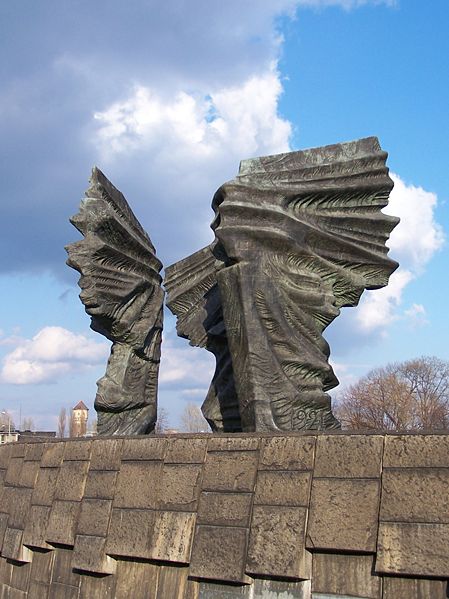
The new hall will be situated to the north of the city centre, not far from where the composers Henryk Mikołaj Górecki and Witold Szalonek lived, as well as the conductor Jan Krenz.  Its near neighbours will be the monument to the three Silesian Uprisings of 1919-21

and the Flying Saucer arena (Spodek), below.  I remember being taken aback by both the monument (1967) and this space-age construction (1971) as I walked to my first meeting with Górecki in Spring 1972.

The new concert hall will seat 1800, the chamber hall 300.  Here’s a promotional and rather stylish virtual tour of the new building, with both the monument and the arena appearing in the final image. The building’s columnar exterior seems to be a reference to the architecture of the brown-brick miners’ community built outside Katowice at Nikiszowiec at the start of the 20th century.  It is well worth a visit.

Although the video’s sound-track uses Brahms, I’m told that the huge music relief on the curved wall in the atrium will be from the manuscript of Beethoven’s Ninth Symphony.

• Altstaedt plays Lutosławski

A couple of hours ago I heard an electrifying performance of Lutosławski’s Cello Concerto (1970) on BBC Radio 3.  It was by Nicolas Altstaedt, with the BBC Symphony Orchestra conducted by the Polish conductor Michał Dworzyński.  After digging around on the web for further information, I believe that this recording was made on 26 October 2010 in the BBC Maida Vale studios.  The dynamism as well as sensitivity of Altstaedt’s approach to this work is already in evidence on a three-part YouTube upload (see my post of 4 December 2011), but unfortunately the second and third parts are marred by dislocation between sound and vision.

Today’s performance was a couple of minutes longer than Altstaedt’s YouTube recording, but it lost nothing in its immediacy and intimate understanding of the composer’s dramatic concept.  Catch it if you can: it’s available for the next seven days only, via http://www.bbc.co.uk/programmes/b01blr2y#synopsis (click on Listen Now).  It begins two hours in.

I hope that there are plans for Altstaedt to record the Lutosławski commercially.  That really would be something to look forward to.

• Iwaszkiewicz on Górecki

The recently published third and final volume of diaries by the Polish poet, playwright and novelist Jarosław Iwaszkiewicz (Warsaw: Czytelnik, 2011) has brought to light some interesting comments on music.  Despite showing intense bitterness and self-absorption on political matters (he had, to say the least, a controversial history of working with the communist establishment since 1945), Iwaszkiewicz (1894-1980) had some keen insights on cultural matters.  His background in music went back to his early years when, as Szymanowski’s younger cousin, he not only suggested the idea for and wrote the libretto of King Roger (1918-24) but also provided Szymanowski with translations of Rabindranath Tagore for the Four Songs and his own poems for Songs of an Infatuated Muezzin, both written in 1918.  He also provided the verse for Szymanowski’s Three Lullabies (1922).

Here are three diary entries which have been drawn to my attention by a friend in Warsaw, who also kindly provided the translations.  The first, from 1966, is a tart nostalgia for the musical past.  The second (1969) and third (1977) entries contain somewhat surprising observations on two pieces by Henryk Mikołaj Górecki, who was the only Polish composer to whom Iwaszkiewicz paid any detailed attention in these diaries.  I’ve added some contextual information to two of the three entries.

8 August 1966

W radio ostatni obraz Harnasi  i Infantka Ravela.  Wierzyć się nie chce, że oni byli, żywi, prawdziwi, dotykalni.  Karol!  Ravel!  Co za postaci półpowieściowe, nieuchwytne, niewyobrażalne.  Czy rzeczywiście nie ma już takich ludzi?  Czy tylko mi się wydaje, bo jestem stary i zmęczony, i nie widzę, co mam pod bokiem.  Lutosławski?  Penderecki?  Mój Boże, chyba tego nie można porównać.  Może  w ogóle teraz nie ma artystów.  Może tamci jako ‘artyści’ naprawdę należeli do XIX wieku?  Jak Chopin, jak Liszt?

On the radio, the last scene of Harnasie and Ravel’s Infante.  I do not want to believe that they were here, living, real, tangible.  Karol!  Ravel!  What characters, half taken from a novel, elusive, unimaginable.  Are there really no such people any more?  Or is it only my impression, because I am old and tired and do not see what I have close at hand.  Lutosławski?  Penderecki?  My God, surely one cannot make any comparison.  Perhaps there are no artists at all now.  Perhaps those men, as ‘artists’, truly belonged to the 19th century?  Like Chopin, like Liszt?

24 September 1969

Taka cudowna noc dzisiaj księżycowa.  I pomyśleć, nie mam nikogo, z kim bym mógł wyjść na spacer po ogrodzie.  Hania° nie wychodzi nigdy do ogrodu, zwłaszcza po zachodzie słońca.  Wysłuchałem tylko co Muzyki staropolskiej Góreckiego.*  Monotonne to, ale bardzo ‘wielkie’.  O szerokim  oddechu, prymitywne, z puszczą, z wiatrem, z mordem.  Nic z lukrowanego obrazka a la Wołodyjowski.†  Chyba taka Polska jest prawdziwa.

Such a wonderful moonlit night tonight.  And to think that I have no one with whom I could go for a walk in the garden.  Hania° never goes out into the garden, especially after sunset.  I have just listened to Gorecki’s Old Polish Music.*  Monotonous this, but very ‘great’.  Broadly breathed, primitive, with a primeval forest, with wind, with murder.  Nothing like the sentimental picture-book that is Wołodyjowski.†  Such is perhaps the true Poland.

° Iwaszkiewicz’s wife, Anna
* This must have been the live broadcast on Polish Radio of the world premiere, given by the National Philharmonic SO, conducted by Andrzej Markowski, as part of the 12th ‘Warsaw Autumn’ International Festival of Contemporary Music.
† Wołodyjowski: a reference to a recent feature film Pan Wołodyjowski (Jerzy Hoffman, 1969) which was based on Henryk Sienkiewicz’s historical novel of the same name (1888).

8 September 1977
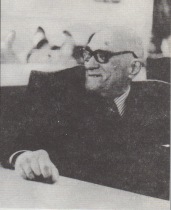
Iwazkiewicz at Baranów, 1977

Iwaszkiewicz gave the opening paper at a conference of musicologists and musicians at Baranów, 4-12 September 1977.  He made this diary entry after the delegates had listened on 7 September to a recording of Górecki’s Third Symphony ‘Symphony of Sorrowful Songs’ (1976).  This must have been a tape of the world premiere given in Royan five months earlier as the piece had not yet been performed in Poland (it was given its Polish premiere at the ‘Warsaw Autumn’ on 25 September 1977).

[…] tak od czasu do czasu wpisywać jakieś laments daje fałszywe wyobrażenie o całym continuum wewnętrznym, które wcale nie składa się wyłącznie z lamentów.  Nie jest też tym continuum przerażającym, jakie wczoraj zaprezentował Górecki w swojej III Symfonii.  Beznadziejny powrót tego samego akordu w pierwszej części symfonii sprawia wrażenie psychopatyczne, maniakalne, a jednak wstrząsające – właśnie jako continuum wewnętrznego, czegoś bardzo głębokiego i tragicznego jakby w założeniu, bez dramatycznych zawołań, bez żadnego ‘teatru dla siebie’.  To bardzo dziwny i niepokojący utwór.

[…] writing down from time to time laments of some kind gives a false impression of the whole internal continuum, which does not at all consist solely of laments.  Nor is it a terrifying continuum, of the kind presented yesterday by Gorecki in his Third Symphony.  The hopeless return of the same chord in the first movement of the symphony makes a psychopathic, maniacal, and yet shocking impression – exactly like an inner continuum, something very deep and almost tragic in its assumption, without dramatic calls, without any ‘theatre for theatre’s sake’.  A very strange and unsettling piece.