• BBC Scottish SO’s ‘Muzyka Polska’

Later this week I’m paying a flying visit to Glasgow to give a pre-concert talk as part of the first night of the BBC Scottish SO’s Muzyka Polska series during its 2012-13 season.  This has been built around next year’s centenary of the birth of Witold Lutosławski and I’m very happy to have been able to play a small part in advising on the choice of repertoire.  With its concentration on Lutosławski and on Szymanowski, the 75th anniversary of whose death falls this year, there was limited room for other major figures (no Baird, Górecki or Serocki, for example).  I’m particularly delighted to see Mieczysław Karłowicz’s Eternal Songs (1906) in the mix and pleased to see that there is music by at least one composer born after World War II, Paweł Szymański’s A Study of Shade (1989).  The ‘big’ night is on 17 January 2013, when six Polish works will be performed.

• Chopin  Piano Concerto no.2 (1829-30)   14 March 2013
• Chopin  Piano Concerto no.1 (1830)   11 October 2012
• Szymanowski  Concert Overture (1905)   11 October 2012
• Karłowicz  Eternal Songs (1906)   15 November 2012
• Szymanowski  Songs of a Fairytale Princess (1915, orch. 1933)   17 January 2013
• Szymanowski  Violin Concerto no.1 (1916)   15 November 2012
• Szymanowski  Songs of an Infatuated Muezzin (1918, orch. 1934)   17 January 2013
• Bacewicz  Concerto for String Orchestra (1948)   25 October 2012
• Lutosławski  Concerto for Orchestra (1954)   17 January 2013
• Penderecki  Polymorphia (1961)   17 January 2013 (Post-Concert Coda)
• Lutosławski  Cello Concerto (1970)   28 February 2013
• Szymański  A Study of Shade (1989)   17 January 2013 (Post-Concert Coda)
• Lutosławski  Symphony no.4 (1992)   17 January 2013

There are two supplementary chamber recitals as Post-Concert Codas: Johannes Moser will play Polish music for cello on 28 February after his performance of Lutosławski’s Cello Concerto, and Garrick Ohlsson will play solo piano pieces by Chopin on 14 March after his performance of Chopin’s Second Piano Concerto.  Ohlsson rocketed to fame after winning the Chopin Competition in Warsaw in 1970.  Moser is becoming one of the foremost performers of the Lutosławski.  His Glasgow appearance follows on from a performance in Poole in January with the Bournemouth SO (which premiered the work with Rostropovich in 1970), three performances in Stuttgart the week before he comes to Glasgow, and he then plays it twice in Bilbao in April.

The full schedule for the BBC SSO Muzyka Polska series may be accessed here or by navigating from its home website.

• New Web Page for Marek Stachowski

A new web page for Marek Stachowski (1936-2004) has just appeared.  It’s partly in English – Biography, Works (an essay by Maciej Jabłoński), Compositions, Prizes and Awards – and partly in Polish – Kalendarium and Wspomnienie (Recollection, by Mariusz Dubaj).  Thanks to the composer and cellist Jacek Ajdinović for drawing this to my attention (his website is in Polish, but there’s an English bio at http://www.myspace.com/jacekwiktorajdinovic).

http://www.marekstachowski.pl

I have exceptionally happy memories of my meetings with Marek: at his home and at numerous concerts and festivals.  His music may have been eclipsed, like that of his fellow Cracovian Zbigniew Bujarski (b.1933), by his better-known contemporaries.  These include not only another Kraków-based composer, a certain Krzysztof Penderecki (b.1933), but also two composers from nearby Katowice, Wojciech Kilar (b.1932) and Henryk Mikołaj Górecki (1933-2010).  But Stachowski’s music is distinctive in its own right and is well worth exploring, not least for its often delicate and lyrical qualities.

This new website doesn’t (yet) have a Discography.  There is at present only one (CD-ripped) recording on YouTube, called ‘One Rose’.  It’s the concluding section from one of his first works, Pięć zmysłów i róża (The Five Senses and a Rose, 1964) for mezzo soprano, flute, xylorimba, trombone and harp, to a text by Tadeusz Kubiak.  It makes for an interesting comparison with contemporary pieces by his more famous colleagues.


• Do Historians Hate Music?

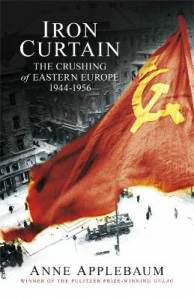
I’m a peaceable sort of chap, but occasionally my musical hackles are raised. Today, they’re up again, occasioned by the arrival in the post of Anne Applebaum’s just-published tome Iron Curtain. The Crushing of Eastern Europe 1944-1956 (Allen Lane).  Anyone who knows me also knows that I’ve spent a good few years of my life exploring Polish music in this very period.  So for me to head straight for chapters such as ‘Homo sovieticus‘, ‘Socialist realism’, ‘Ideal cities’, ‘Reluctant collaborators’ and ‘Passive opponents’ is a totally predictable action, one undertaken I’m afraid more in hope than expectation.

The plain fact is that most historians seem not to like music.  Or, rather, they avoid writing about it if they possibly can.  Literature and the visual arts – fine, although even they are often poorly attached appendages.  Is it therefore a case of such historians believing that music has no place in social, political or cultural history?  Or is it that they have no analytical or descriptive vocabulary with which to discuss it?  There have been occasional exceptions that bridge this gaping hole, one of them being in the writings of Norman Davies.  Davies not only makes the effort but also understands cultural contexts and has the writing skills to convey the significance of music and the other arts to his readers.  Another exception is the historian Toby Thacker, whose Music after Hitler, 1945-1955 (Ashgate, 2007) is a searching enquiry that covers both East and West Germany.  (Applebaum does quote from a 2002 article by Thacker, but his book is not in her bibliography.)  There are also historians whose brief is cultural history, such as Frances Stonor Saunders and her perspective from outside the Soviet bloc in Who Paid the Piper?  The CIA and the Cultural Cold War (Granta, 1999).

I have been poring over Applebaum’s book this morning.  It’s a weighty volume, focusing on three countries: East Germany, Hungary and Poland.  In major respects, it promises to be a fascinating read, a work of breadth and synthesis which I hope will help me in placing Polish music of the post-war decade within a wider context.  In fact, Iron Curtain barely acknowledges that there was such a thing as music, let alone its crucial role in socialist-realist propaganda.  And propaganda, not least that involving music and the visual arts, was at the heart of the ‘crushing’ communist machine.

There is mention of the prohibition of jazz and dance music as part of early 50s rebellious youth culture in Poland; elsewhere there is a quotation of the text of an East German mass song.  As for the music intended to promote socialist realism through mass songs or cantatas – or the concert music of the period – there’s almost nothing, except an incomplete recollection of one incident from Andrzej Panufnik, which Applebaum misleadingly glosses. Chopin Year (1949) is discussed, but not the two Festivals of Polish Music (1951, 1955).  Władysław Szpilman gets a mention for his radio broadcasts at the start and end of World War II, but then casually to remark that he ‘continued to work for the radio until 1963′ totally ignores his principal role in writing mass songs – some of them extremely popular – in the 1950s.  Applebaum has a few easily-reached quotes from Panufnik’s autobiography Composing Myself (Methuen, 1987), but these hardly count as a measured response to the issue.  The gaps are yawning.

I have not yet read Iron Curtain through from start to finish, so it is possible that its focus does not require the sort of essential details whose omission is so glaring to me.  Its attention to literature and film, for example, is a little greater, but any book on the period that fails to engage with Czesław Miłosz’s The Captive Mind (1953) – although it is in the bibliography – or a literary figure like Konstanty Ildefons Gałczyński, who was forced into ‘internal exile’ in the early 1950s for not fitting in with Poland’s socialist-realist drive, cannot fail to raise serious questions.  The visual arts are as notable for their absence as is music (a couple of illustrations do not make up for the dearth of discussion of painting, sculpture and poster art).  The general level of interest is summed up by a sentence towards the end of the chapter on ‘Socialist realism’:

In due course, the most obviously Stalinist films became embarrassments to their directors, some of whom denounced or disavowed them after his death in 1953.  The crudest High Stalinist paintings, sculpture, poetry, fiction and architecture met the same fate.

Why is music excluded there?

Readers who are curious in any way about the role of music in history are normally compelled to look elsewhere for enlightenment, to the work of music historians.  There are several recent books, by dedicated writers on music, which engage meaningfully with the cultural, historical and political contexts of post-war Eastern Europe.  (None of these authors is referenced by Applebaum, and it looks as if no music historians were consulted.  I can’t tell if specialist historians in the other arts were consulted.)  But no-one can pretend that any of these music-oriented books reaches the ‘broad masses’ who might pick up history books like this one.  There is something deeply wrong about this state of affairs.  Why is there so little reciprocity on the part of historians?  Do they not recognise what they – and consequently the reader – are missing?

Don’t get me wrong: Applebaum’s book looks as if it will, in other respects, be an engaging read, not least for its interviews with ‘time witnesses’.  And I promise to read it for what it aims to be, despite my disappointment at the failure of yet another historian to incorporate musical and other cultural aspects closer to the centre of the argument.
• New Polish Pantheon in Kraków

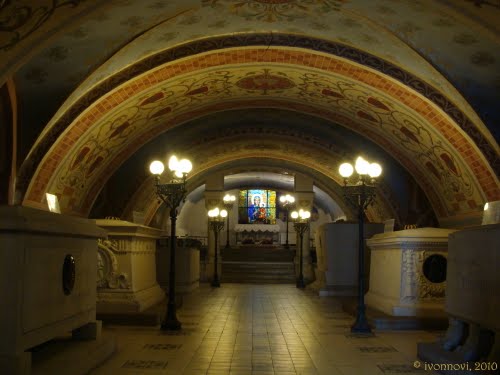
Last week it was announced that a new Polish Pantheon would be established in Kraków.  The existing Krypta/ Panteon Zasłużonych (Crypt/Pantheon of the Distinguished), under St Stanisław’s Church on Skałka, has no more room.

The existing Crypt was first brought into use in 1880, and first honoured Jan Długosz, an early Renaissance historian and diplomat.  Over the past 130 years, the Crypt of the Distinguished has become the final resting place of just twelve more men (no women), most of whom were writers and many of whom had Kraków connections.

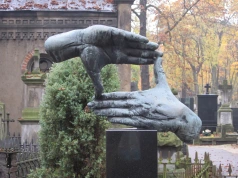
Photo: Ivonna Nowicka (2010). Szymanowski’s tomb is on the far left


1880  Jan Długosz
1881  Wincenty Pol
1881  Lucjan Siemieński
1887  Józef Ignacy Kraszewski
1893  Teofil Lenartowicz
1897  Adam Asnyk
1902  Henryk Siemiradzki
1907  Stanisław Wyspiański
1929  Jacek Malczewski
1937  Karol Szymanowski
1954  Ludwik Solski
1955  Tadeusz Banachiewicz
2004  Czesław Miłosz


Wyspiański was also a renowned artist, and his interment and that of the painter Siemiradzki seem to have opened the way for other non-literary figures to be included: Malczewski (painter), Szymanowski (composer), Solski (actor and theatre director) and Banachiewicz (mathematician and astronomer).

As the above list indicates, the Crypt was used very intermittently, so can hardly be said to be representative of the great and the good from the worlds of the arts and sciences over the last 130 years.  I wonder whom the authorities have got in mind for the new Pantheon, which will be under the Church of SS Peter and Paul, close to Kraków’s city centre?  They could, I imagine, disinter some who are already dead, such as the composers Witold Lutosławski (Warsaw) or Henryk Mikołaj Górecki (Katowice), but somehow I think that is unlikely.  When Krzysztof Penderecki’s time comes, he might be a likely candidate, not least because he is Kraków born and bred.  Among literary figures, Wisława Szymborska – who died earlier this year and, like Miłosz, was a Nobel laureate – might be considered.  It remains to be seen how the new Pantheon will mark the resting places of those who have been cremated.

The Poles are attached to their great figures and believe in good memorials.  Being given a magnificent tomb in such a crypt, however, is no guarantee of long-lasting recognition or significance, especially outside Poland, as the list of those in the existing Crypt makes evident.

Sometimes you can find just as much dignity and remembrance in a graveyard open to the air.  The Powązki Cemetery in Warsaw is a case in point.  It is the resting place of huge numbers of distinguished people from all walks of life, from times of both peace and war.  There is a particular area with a cluster of composers and performers, including Lutosławski, Baird, Serocki, Rowicki and many others.  I make a point of going to Powązki when I am in Warsaw for more than a couple of days.  Next time I go, I will search out the grave of my friend and distinguished music critic and thinker, Andrzej Chłopecki, who was buried there three days ago.

• New CD Note (Górecki/Hyperion)

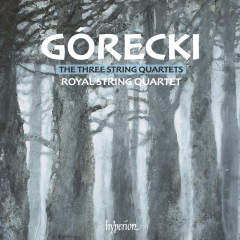
hmg-hyperion-2011This is the third time that I have written CD booklet notes on the Górecki string quartets. Back in 1993, I wrote on no.2 ‘Quasi una fantasia’, followed 14 years later by no.3 ‘.. songs are sung’, both for Kronos on Nonesuch.  In 2008, the Silesian Quartet – great friends of the composer – brought out all three quartets on EMI Poland.  Now, in 2011, another Polish ensemble, the young and dynamic Royal String Quartet, has recorded these quartets for Hyperion.  It has been a privilege to revisit these three masterpieces in its company.


Here’s the link to my note for this new Górecki CDor you can scroll the CD NOTES tab above.

• Remembering Andrzej Chłopecki

It came as a shock to hear on Sunday that Andrzej Chłopecki, the Polish writer on contemporary music, had died that day, aged 62.  He was a singular man with multiple attributes.  He was keenly perceptive, wise, staunch, quirky, witty, impish, and never afraid to speak out whenever he came across the shallow or the hollow.  He got into very hot water with the Establishment when he dared to criticise Penderecki’s Piano Concerto after its Polish premiere at the end of the 2002 ‘Warsaw Autumn’ festival.  I admired him hugely for being a real critic.  Above all, he was the most warm-hearted of colleagues and friends.

Others in Poland knew him much better than I did (he published almost exclusively in Polish, although his penetrating CD notes were translated into other languages for non-Polish labels).  And they can verify his enormous contribution to Polish musical life over the past 40 years and more.  He was for many years a key member of the Repertoire Committee of the ‘Warsaw Autumn’ and at the time of his death was the Artistic Director of the biennial ‘Musica Polonica Nova’ festival in Wrocław.

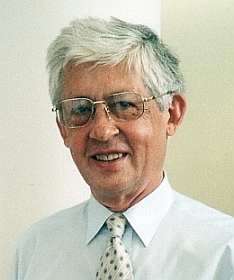
He was a brilliant broadcaster, acute in his thinking and challenging in his debates.  My abiding personal memory is of when we jointly presented the live opening concert of BBC Radio 3’s Polska! festival on 19 November 1993, from the Witold Lutosławski Studio at Polish Radio in Warsaw.  He, however, was in a balcony on the opposite side of the hall, with a clear view of the artists’ entrance (which I could not see) below my balcony seat.  We were supposed to have a shared script and timing.  But Andrzej decided that he had more to say, with the result that I, with no experience of live concert presentation, ended up scrabbling to describe the interior of the hall (in English, across the EBU network) while he continued to improvise on the merits of the programme to Polish listeners, barely one eye on the players waiting below me.  I had no idea how long this was going to last.  Later on, there was a party at someone’s flat (it may even have been his) and, as the photo indicates, there were no hard feelings, though perhaps my expression indicates something along the lines of “You cheeky …!” and his of “Never mind, that’s what you get with me!”.  The cheeky fingers above Andrzej’s head belong to the composer Paweł Szymański.

Andrzej came from the generation whose composers succeeded Górecki, Kilar and Penderecki and brought new blood into Polish music in the late 1970s and 1980s.  Among them was not only Szymański, but also Rafał Augustyn, Eugeniusz Knapik, Stanisław Krupowicz, Andrzej Krzanowski and Aleksander Lasoń.  They came of age during the anti-communist protests of the 1970s and the rise and fall of Solidarity at the turn of the decade.  They were activists through music, and Andrzej paid for this by losing his job at Polish Radio between 1981 and 1991.  Their position has been vindicated by history.

I trawled through my photograph albums today and found a second photo, taken two years later in 1995, at a party held to mark the 25th anniversary (…) of my first visit to Warsaw and the ‘Warsaw Autumn’.  Quite why I’m holding a shotgun – and pointing it at him – is a mystery, but the ever-convivial Andrzej is obligingly filling my glass.  Behind me is Krupowicz, to his right Szymański, and behind/between them my longest-standing Polish friend, Michał Kubicki.  We had a good evening, and no-one got shot.

Andrzej would have wanted those who knew him to have a good wake in his memory.  Like all his friends and colleagues, I’m devastated that he has gone.  A crumb of comfort – which may turn out to be not that small – is that a week before he died he completed a book about Lutosławski which will be published in time to mark his centenary next year.  Thank you Andrzej for everything.

• New CD Note (Górecki/Decca)

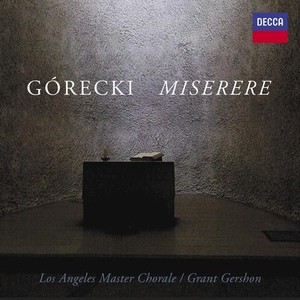
Two fine new CDs of Górecki’s choral music have appeared recently, one by British performers, one by Americans. First out was ‘Henryk Górecki: Totus Tuus’, sung by the National Youth Choir of Great Britain, conducted by Mike Brewer, on Delphian (DCD34054).  Second to appear was ‘Górecki: Miserere’, sung by the Los Angeles Master Chorale, conducted by Grant Gershon, on Decca (478 3537).  The NYCGB seems to be marginally the larger of the two sizeable choirs.  Both are superbly blended and able to sustain the long and often quiet lines and harmonies of Górecki’s music.  The two repertoires complement one another nicely, with only the previously unrecorded Lobgesang (2000) on both discs.  Together, they give as representative a survey of Górecki’s sacred choral music (mostly a cappella) as you could wish for.  And you can also appreciate the contrasts between young and mature voices.

The Delphian CD contains Euntes ibant et flebant (1972), Amen (1975), Totus Tuus (1987), Lobgesang and Salve, sidus Polonorum (2000).  The excellent booklet note is by Ivan Moody.  The full texts are included, in Latin/Polish and in English.

The Decca CD contains Miserere (1981), Five Marian Songs (1985) and Lobgesang. The full texts are included, in Latin/Polish, German, French and English.

Here’s the link to my booklet note for Górecki: Miserere, or you can scroll the CD NOTES tab above.

• Proof-reading bloopers (BBC Music Mag)

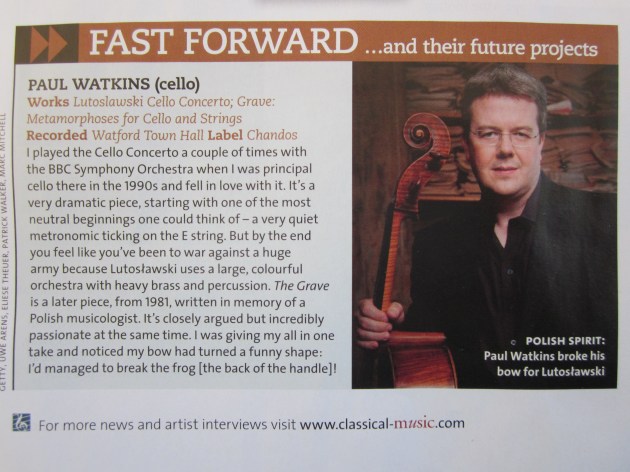
Where’s a musically literate editor when you need one?  Here’s a panel from the September issue of the BBC Music Magazine, where Paul Watkins is interviewed in advance of the release of his recording with the BBC SO under Edward Gardner of Lutosławski’s Cello Concerto and Grave (Chandos CHSA 5106).  I spotted the glaring transcription error (line 6), but my friend John Fallas spotted the funnier typographical one (line 9).  Depressingly sloppy copy.

IMG_0686 copy

• 5 Archival Polish Music Videos

Five videos of Polish music have newly been made available online.  They date from 1968-75 and are all of performances at the Philharmonic Hall in Warsaw during the annual ‘Warsaw Autumn’ festival.  There are two pieces by Lutosławski and one each by Baird, Penderecki and Serocki.  Not only can we now witness Peter Pears, Wanda Wiłkomirska and Karl-Erik Welin in action but we can also experience Lutosławski conducting his own music as well as appreciate that inspirational and tireless champion of new music, Andrzej Markowski (1924-86).  Many Polish composers owed him a huge debt of gratitude, including Baird, Penderecki and Serocki.

In chronological order of recording, these five videos are:

• Krzysztof Penderecki: Capriccio for violin and orchestra (1967).  Wanda Wiłkomirska, National Philharmonic, cond. Andrzej Markowski, 21 September 1968 (opening concert).
http://www.youtube.com/watch?v=jLYY6Knc77w
• Kazimierz Serocki: Fantasia elegiaca for organ and orchestra (1972).  Karl-Erik Welin, Sinfonie-Orchester des Hessischen Rundfunks, Frankfurt, cond. Andrzej Markowski, 28 September 1973 (Polish premiere).
Very little of Serocki’s music post-1956 is available in audio formats, let alone video, so this upload is welcome.
http://www.youtube.com/watch?v=g4NuCcpakbU
• Witold Lutosławski: Preludes and Fugue for thirteen solo strings(1972).  Chamber Ensemble of the National Philharmonic, cond. Lutosławski, 30 September 1973 (Polish premiere).
A minor frustration here: this was the first half of the concert which closed the 1973 festival.  In the second half, Lutosławski conducted Heinrich Schiff in the much-postponed Polish premiere of the Cello Concerto.  How I would love to see a video of that!
http://www.youtube.com/watch?v=Vo1pdDEeLaM
• Tadeusz Baird: Elegeia (1973).  National Philharmonic, cond. Andrzej Markowski, 21 September 1974 (opening concert).
http://www.youtube.com/watch?v=PPKxpv8gBZs
• Witold Lutosławski: Paroles tissées (1965).  Peter Pears, Chamber Ensemble of the National Philharmonic, cond. Lutosławski, 25 September 1975.
Peter Pears had been the dedicatee and first performer of this song cycle at the Aldeburgh Festival ten years earlier, on 20 June 1965This was not its Polish premiere, but it was the only time that Pears sang it there.
http://www.youtube.com/watch?v=czUDDNjwo_Q

• Yours for only £1131/$1767 …

No author likes being remaindered, but this Amazon ad (sent to me by Raymond Yiu) is absurd.  What planet are they on?  £1131/$1767?  That’s £11/$17 dollars per page.
My extremely modest little paperback study, Grażyna Bacewicz: Chamber and Orchestral Music, was published in Los Angeles in 1985, and remains the only book in English that explores Bacewicz’s music in any detail.  I’ve no idea what the print-run was, though it wouldn’t have been large.  Scarcity is one thing, but imagining that anyone would pay anything over the list price (c.£11/$17 – equivalent to a single page at this ad’s rate) is plain ridiculous.

There is another used copy on Amazon, on sale for $350, which is preposterous in itself.  If anyone interested in Bacewicz’s music would like to see what I sketched out in 1985, just get in touch and I’ll see what I can do.

…….

Another friend, Justin Geplaveid, alerted me this week to a Polish TV documentary on Bacewicz, made in 1999 to mark the 90th anniversary of her birth and the 30th of her death.  It’s an old-style, chronological account, and none the worse for that.  It is in Polish only.  Even so, much can be gleaned about her life and work.  There are plentiful excerpts from an interview with her sister Wanda and appearances by her teachers Kazimierz Sikorski and Nadia Boulanger. Keen observers will also glimpse Lutosławski, Mycielski and Serocki in company with Boulanger and Bacewicz.  There are some home movies and, most importantly, excerpts of live performances of her music.  There is a full list of performances and performers at the end of the film.

Included in these archive performances are Divertimento (1965), Witraż (1934), Violin Concerto 1 (1937), Oberek (1949, Grażyna Bacewicz, with her brother Kiejstut), Concerto for String Orchestra (1948, the first movement in a compilation of recordings, including one conducted by Yehudi Menuhin), Olympic Cantata (1948), String Quartet 4 (1951), Symphony 3 (1952), Music for Strings Trumpet and Percussion (1958), Musica sinfonica (1965, as a ballet), The Adventure of King Arthur (1959, radio opera), String Quartet 7 (1965) and Violin Concerto 7 (1965, conducted by Krzysztof Penderecki).