• 5th Festival of Premieres, Katowice

Unknown

Festiwal Prawykonań (Festival of Premieres) is a biennial celebration of new pieces by Polish composers of all generations.  This year’s event runs over the last weekend of next month, 26-28 April 2013 (the Polish website is complete but the English is still under construction).  It’s organised in Katowice by NOSPR (Narodowa Orkiestra Symfoniczna Polskiego Radia – National Symphony Orchestra of Polish Radio; or as NOSPR bizarrely prefers to translate it – Polish National Radio Symphony Orchestra).  The festival started in 2005 and a full list of previous festival concerts is available under its Archiwum tab.

There’s a mix of chamber and orchestral concerts (seven in all).  Some are free, the others have a one-price tag of 10zł (c. £2).  How’s that for a bargain?  I’m sure that most if not all of these concerts will be broadcast online by Polish Radio Dwójka (PR2), either live or delayed.  Here’s this year’s repertoire, in alphabetical order by composer:

** World premiere   * Polish premiere
• Marcin Bortnowski: Miserere for chamber choir and percussion ensemble**
• Michał Dobrzyński: Three Songs to words by Rilke**
• Ryszard Gabryś: Voyelles de Arthur Rimbaud**
• Mikołaj Górecki: Symphony no.2**
• Aleksandra Gryka: 10, 12, 13, -31 for string quartet**
• Paweł Hendrich: Ertytre for cello ensemble**?
• Rafał Janiak: Symphony no.2**
• Dobromiła Jaskot: Elferiae for string quartet**
• Krzysztof Knittel: Partita for saxophone, orchestra and electronic media**
• Benedykt Konowalski: Nowa pieśń chwały for clarinet and mixed chamber choir**
• Włodzimierz Kotoński: Arietta e i fiori for trombone and synthesized sounds**
• Justyna Kowalska-Lasoń: String Quartet no.3**
• Zygmunt Krauze: Canzona for instrumental ensemble*
• Stanisław Krupowicz: Piano Concerto**
• Hanna Kulenty: String Quartet no.5*
• Andrzej Kwieciński: Canzon de’ baci for tenor and orchestra**
• Mikołaj Majkusiak: Pulsaciones for accordion, classical guitar and string orchestra**
• Maciej Małecki: Concertino for cello and orchestra**
• Krzysztof Meyer: Piano Quartet op.112 (new version)**
• Piotr Moss: Cavafy Verses for baritone and orchestra**
• Aleksander Nowak: Z górnego piętra for violin and percussion**
• Tomasz Opałka: L.A. Concerto for violin and orchestra**
• Ryszard Osada: Double Reflection for cello octet**
• Bronisław Kazimierz Przybylski: Lofoten, Concerto-Symphony for viola and orchestra**
• Dariusz Przybylski: Cello Concerto**
• Marta Ptaszyńska: Of Time & Space, concerto for percussion, electronics and orchestra**
• Adrian Robak: Vocal Concerto ‘Camerata’**
• Marcin Rupociński: Non possumus for choir, chamber ensemble and electronics**
• Wojciech Widłak: Festivalente for orchestra**
• Sławomir Wojciechowski: Fingertrips for eight prepared cellos**
• Agata Zubel: Pomiędzy odpływem myśli a przypływem snu for voice and string orchestra**

• WL100/27: Notebook, 19 March 1961

Lutosławski and Rain

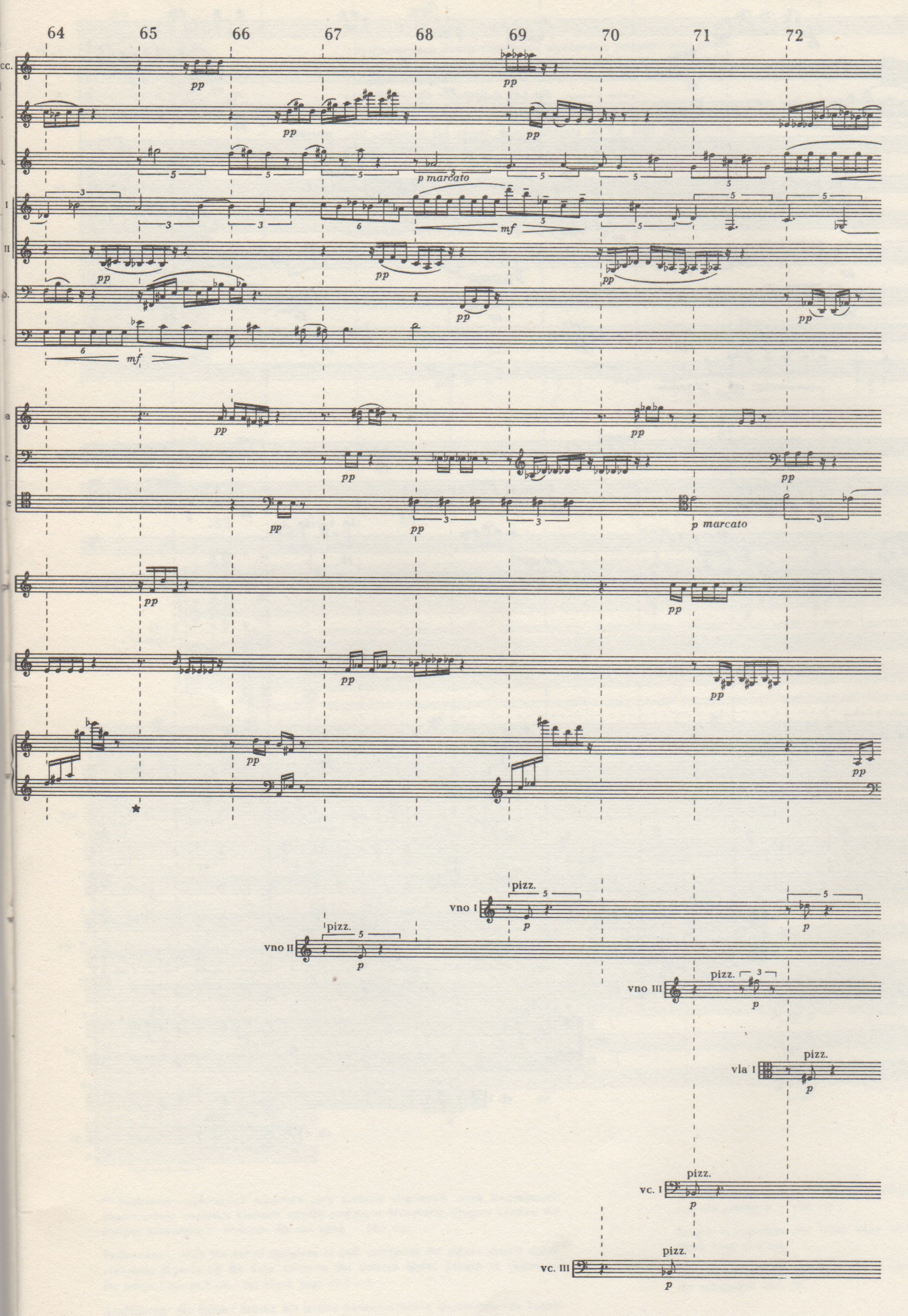
In order to justify classical rhythmic formulae, the argument has been used that this rhythm (i.e. ‘harmonic’, based on pulse) comes from nature: walking, the heartbeat.  Well, it is not correct to say that other rhythms have no counterpart in nature.  In fact, natural phenomena proceed for the most part in an irregular rhythm.  Example: the rhythm of the drops as rain begins to fall (pizz., in b.67 presto (II) from Jeux v.).

Dla uzasadnienia klasycznych formuł rytmicznych posługiwano się argumentem, że rytm ten (tzn. ‘harmoniczny’, oparty na pulsacji) pochodzi z natury: chodzenie, bicie serca.  Otóż nie jest słuszne twierdzenie, że inne rytmy nie mają odpowiedników w naturze.  Na pewno zjawiska natury przebiegają w swej większości w rytmie niepulsacyjnym.  Przykład: rytm kropel, gdy deszcz zaczyna padać (pizz., w t. 67 presto (II) z Jeux v.).

Witold Lutosławski, 19 March 1961  [my translation]

This is a rare example of Lutosławski linking extramusical observations to his music, aside from his several references to the theatre.  The passage in question (in the second movement of Jeux vénitiens, which he was writing at this very time and would complete nine days later) is interesting from a number of points of view.

For one thing, the string pizzicati are almost completely covered by a denser, more active texture in the woodwind, brass, pitched percussion and harp, so hardly of foreground interest.  For another, this is not the first but the third such passage in the movement: the first is led off by the bassoon at b.9 and the second (more briefly) by vibraphone at b.46, both against a background of scurrying muted strings played arco.  In each of these first two cases, the ‘irregular’ rhythms lead to fuller textures in the wind and pitched percussion, and it is the second of these that eventually runs in parallel with the string pizzicati cited by Lutosławski above.

This third and most developed passage extends from b.67 to b.82 and is given to the strings for the first time and marked pizzicato to make the point (the orchestration of these three sections is a good example of how Lutosławski thought of his music’s instrumentation in structural terms).  Bars 67-82 take the form of an increasingly dense rhythmic texture that is interrupted by the playing of cardboard tubes on the strings of the piano at b.83 (see WL100/24: Notebook, 11 March 1961 for details of this passage).  Given the dating of both this diary entry and of his work on the second movement, it looks highly possible that Lutosławski did have the irregular rhythm of a natural phenomenon like raindrops in mind when he composed not only bb.67-82 but also the two earlier passages to which this pizzicato section is the successor.  Incidentally, the movement is not headed Presto in the published score – it simply has the tempo indication of crotchet/quarter-note = 150.

Here’s a recording of the (unrevised) second movement from the premiere of the otherwise revised and completed version of Jeux vénitiens, given at the Warsaw Autumn on 16 September 1961, with the National Philharmonic conducted by Witold Rowicki.  The bassoon entry at b.9 is at 0’05”, while the vibraphone at b.46 is inaudible, as too is most of the string pizzicato starting at b.67 (0’46”).

WL JV:II bb.64-72

WL JV:II bb.73-81

• RSQ +1

Following its acclaimed CD of the Górecki quartets for Hyperion in 2011, the Royal String Quartet is riding high with its new Hyperion release of the quartets by Penderecki and Lutosławski.  Since its inception 15 years ago, when its members were students at the (then) Academy of Music in Warsaw, its concerts and recordings have received worldwide praise.  The RSQ has had a particularly fruitful career in the UK.  In 2004-06 it was chosen as one of the participants in BBC Radio 3’s renowned New Generation Artists scheme, and since 2012 it has been Quartet in Residence at The Queen’s University of Belfast, where I worked for the first 23 years of my own career.  I want to draw your attention, however, to the other music-making that the RSQ carries out in its native Poland which may not be so familiar to listeners elsewhere.

First and foremost are the RSQ’s ‘Kwartesencja’ festivals that it has mounted in Warsaw every year bar one since 2004.  These are designed not only to feature the RSQ but also to explore a huge range of collaborative possibilities with one or more other musicians.  Its two concerts from last year alone are excellent pointers to the versatility and imagination that the RSQ brings to its programming.

Kwartesencja 2012

I wish that I had been at the two concerts on 7 and 8 December 2012 (the programmes for this and previous Kwartesencja festivals are still online, but only in Polish).  Fortunately, the RSQ is media-savvy and excerpts from the 2012 events and follow-up recordings are now available on YouTube.

The first +1 was the actress Stanisława Celińska, well-known in Poland on stage and screen.  She performed ‘Songs about Warsaw’ with the RSQ, in arrangements by Bartek Wąsik (piano).  The concert on 7 December 2012 was a huge success and the project was encored on 4-5 January 2013.  It’s being repeated tomorrow night (19 March) in Wrocław.  Several of the songs have since appeared on YouTube and the collection has been issued on the CD Nowa Warszawa (New Warsaw).

These songs are but the most recent in a long Polish tradition of part-sung, part-declaimed lyrics with a mix of melancholic and nostalgic texts (my favourite in this regard is still the magical collaboration between Ewa Demarczyk and Zygmunt Konieczny in the 1960s).  Whether Nowa Warszawa has wider appeal outside Poland – Polish lyrics might be the sticking point – remains to be seen, but I hope it does.  Here’s the video of  ‘Warszawa’ from Kwartesencja 2012.  (It was originally recorded by the Polish ’80s band, T[eenage]. Love, whose own version is quite a contrast: http://www.youtube.com/watch?v=DCfDEusHaDw.)


Here’s a track from the Nowa Warszawa CD: Stanisław Sojka/Soyka’s ‘Tango Warszawa’:
http://www.youtube.com/watch?v=O8WeRk4wDt8

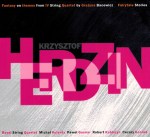
herdzinThe second +1, on 8 December 2012, was the young Polish jazz violinist, Adam Baldych.  In a move which might come across as sacrilegious, the RSQ and Baldych created a far-reaching improvisation on Lutosławski’s String Quartet.  Such an approach to their musical heritage is not entirely unknown among Polish musicians. Chopin has been the subject of attention from the Jagodziński Trio and Leszek Możdżer.  And the RSQ previously worked with the Polish jazz pianist Krzysztof Herdzin and his quartet, in Herdzin’s Fantasy on Themes from Grażyna Bacewicz’s Fourth String Quartet (CD issued in 2008, right).

See and hear for yourself what Baldych and the RSQ made of the Lutosławski quartet.  In this studio recording for Polish TV Kultura, there are some odd things going on in the background (the changing number of people sitting around the table in the shadows), plus two editing blips (at 12’31” and 16’02”), which make it hard to determine what the full performance was like.  Nevertheless, it makes an intriguing counterpart to the RSQ’s riveting performance of Lutosławski’s original quartet on its new Hyperion CD.


• WL100/26: Notebook, 13 March 1961 (2)

Lutosławski on Electronic Music

It might be said that, in the works which I am now writing, the influences of electronic music are evident. Maybe.  One thing is clear to me, that electr. and concr. music realises, to a certain degree, timbral and rhythmic elements which from early on have imposed themselves on my imagination.

Mozna by mówić, że w utworach, które teraz piszę, widać wpływy muzyki elektronowej.  Być może.  Jedno jest dla mnie pewne, że muzyka elektr. i konkr. realizuje w pewnym stopniu elementy dźwiękowe i rytmiczne, które od dawna narzucają się mej wyobraźni.

Witold Lutosławski, 13 March 1961  [my translation]

Lutosławski, who was in the middle of composing Jeux vénitiens at the time, was not alone among his generation in the early 1960s in sensing parallels between his music and the new sound-worlds of electronic music and music concrète.  In 1960, the year of her Sixth String Quartet and a year before the orchestral Pensieri notturni, Grażyna Bacewicz (1909-69) made a similar observation: “I am struck by electronic music: it invents new sound colours and new rhythms”.

• WL100/25: Notebook, 13 March 1961 (1)

Lutosławski on Feeling in Music

For the thousandth time: music does not express any specific feelings, it only constitutes the formal framework into which, during its performance, each person pours their own emotions, whatever they are. Hence a v. simple explanation for the tears of the Gestapo listening to Mozart.

Po raz tysiączny: muzyka nie wyraża żadnych określonych uczuć, stanowi tylko ramy formalne, w które przy jej odtwarzaniu każdy wlewa swoje własne emocje, takie, na jakie go stać.  Stąd b. proste wytłumaczenie łez gestapowców słuchających Mozarta.

Witold Lutosławski, 13 March 1961  [my translation]

• New app: Lutosławski Guide to Warsaw

Unknown-1News has just come through that two of the three app. platforms (IoS and Android) are now up and running for the Witold Lutosławski Guide to Warsaw.  It’s available in Polish or English.  There’s a very helpful website which tells you all about this inventive app., which is one of the more unusual ways that the Poles have come up with to celebrate the centenary of Lutosławski’s birth.   I wonder what he’d make of it.

To obtain further information on the IoS, Android and Windows versions of the app., click on this link to Przewodnik po Warszawie.

• WL100/24: Notebook, 11 March 1961

Lutosławski on New Instruments

New instruments, or the direction in which they should be investigated:
1) Piano enriched with different sounds (those that to date have been obtained by ‘preparation’ and others), achieved by means of mechanically moved nakładka on the strings, etc.. as well as percussive elements;
2) instruments which will fuse traditional instr. with electronic ones, e.g. double-bass, electr. guitar, etc.

Nowe instrumenty lub kierunek, w którym należałoby ich poszukiwać
1)  Fortepian wzbogacony o różne brzmienia (te, które uzyskuje się dotychczas przez “preparowanie” i inne) uzyskiwane za pomocą mechanicznie poruszanych nakładek na struny, etc. oraz elementów perkusyjnych;
2)  instrumenty będące połączeniem instr. tradycyjnych z elektronicznymi, jak np. kontrabas, gitara elektr. etc.

Witold Lutosławski, 11 March 1961  [my translation]

In mid-March 1961, Lutosławski was trying to complete Jeux vénitiens for its premiere in Venice on 24 April 1961. He had finished the final (fourth) movement just four days before he wrote this diary entry on 11 March, and he would complete the second movement two and a half weeks later (28 March).  At this pivotal point in his career, when he was not completely certain of how to develop his musical language ( although he had already started making use of aleatory procedures in the finale), he was evidently looking at a number of possibilities.

2)  instruments which will fuse traditional instr. with electronic ones, e.g. double-bass, electr. guitar, etc.

The idea for new instrumental construction never had any traction in Lutosławski’s further thinking.  He did, however, utilise extended oboe techniques in the Double Concerto (1980), written for Heinz Holliger and his wife Ursula.  But to my ears at least, this rare departure from his normal practice is not an entirely happy foray into untraditional sound sources.

1)  Piano enriched with different sounds (those that to date have been obtained by ‘preparation’ and others), achieved by means of mechanically moved nakładka on the strings, etc.. as well as percussive elements;

This observation is more interesting.  It implies that Lutosławski was aware of John Cage’s music for prepared piano. More intriguing is his use of the phrase ‘mechanically moved nakładka on the strings’.  Skowron (Lutosławski on Music, 2007, p.299) translates this as ‘mechanically moved objects placed on the strings’.  The first question is raised by ‘mechanically moved’.  What did Lutosławski have in mind – what type of mechanism?  Had he come across it in an existing piece by another composer or was it a flight of fancy on his part?  The second question – which I hope Polish readers may solve – is the meaning of nakładka.  It seems variously to mean flat metal or wooden objects (like fish-plates joining two stretches of railway rail, or the overlapping of planks on a clinker-built ship), or sheaths or covers to protect sharp objects.  I cannot work out quite how this transfers to piano preparation. Any ideas?

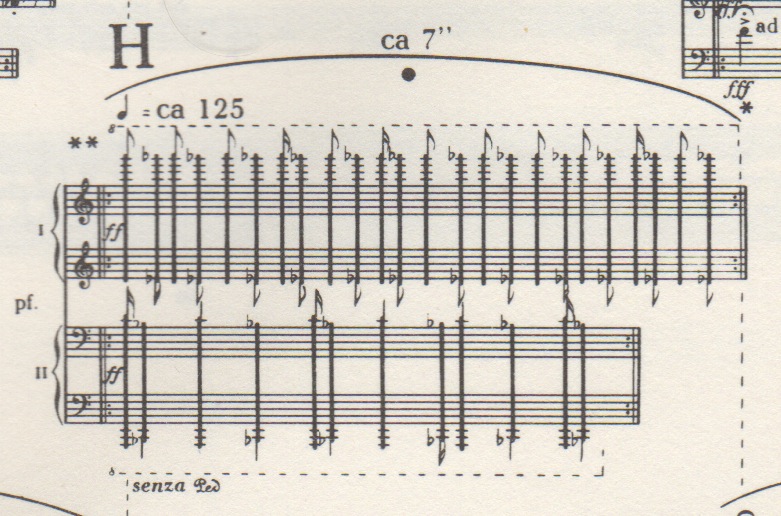
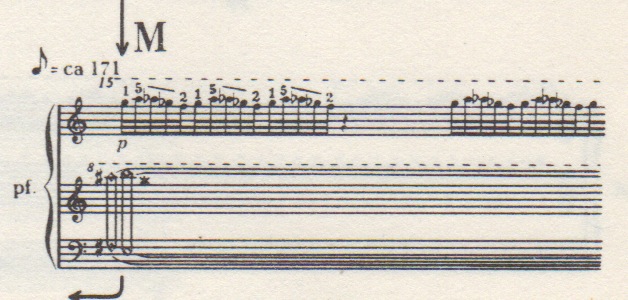
There is one unconventional technique that Lutosławski does employ.  It’s in Jeux vénitiens.  He does so in the two movements whose composition chronologically flanks this diary entry of 11 March 1961.  In the otherwise stylistically conservative second movement, which was not changed between the Venice premiere and the revised version that we know today, he uses ‘cylinders of stiff cardboard’ in bb.83-103.  The device also reappears in the finale, at letter H and from letter M to the end (although, as I have not seen the first version of this movement, I cannot say if the cylinders were used here originally).

In the second movement of Jeux vénitiens, six different lengths of cardboard tube are required for the two pianists (on one piano).  At b.83 (marked p), Player I depresses the white keys between specified pitches with a 60cm tube, the black keys with one that is 59.5cm long.  A moment later, Player II uses a 54.5cm tube for the white keys, 52.5cm for the black.  At b.87, Player I starts a series of p clusters at varying pitches using shorter tubes, 14.4cm for the white keys, 15.6cm for the black.

WL JV:II b.83

At letter H in the finale (part of the movement’s climax), the two players are instructed to use the (longest) tubes ff.

WL JV:IV letter H

Lutosławski’s technique at letter M in the finale is different.  Just one player is implied – the score does not indicate that a second player is required, although it might make it easier if two were involved.  Three and a half octaves are to be suppressed silently by the tubes (no length given): ‘hold them down with the elbow and left hand until the end’. On top of this, the right hand plays a little five-note riff.

WL JV:IV letter M

It seems to me that these three passages in Jeux vénitiens link in directly with Lutosławski’s first musing on 11 March 1961, even if he took his observations no further in subsequent pieces (not even in the central, percussive movement of his next work, Trois poèmes d’Henri Michaux).

• WL100/23: 9-10 March 1957

Lutosławski Speaks Out (1957)

Lutosławski chose his moment to make statements of a political-artistic nature.  He stayed noticeably silent during the discussions at Łagów on 5-8 August 1949, when politicians, composers and performers tried to determine what constituted socialist realism in music.  On 9 March 1957, however, he opened the 9th General Assembly of the Polish Composers’ Union (9-10 March) with a short speech.  At a pivotal moment in Polish culture, six months after the first ‘Warsaw Autumn’ festival and before any music from the Western avant-garde had been played in Poland, Lutosławski reflected on both the creative trauma of the past seven and a half years and the creative opportunities that lay ahead of Polish composers.

Our Assembly, for the first time in a very long while, is taking place in an atmosphere of true creative freedom.  No one here will persecute anyone for so-called formalism, no one will prevent anyone from expressing his aesthetic opinions, regardless of what individual composers represent.

Zjazd nasz po raz pierwszy od dłuższego już czasu odbywa się w atmosferze prawdziwej wolności twórczej. Nikt tu nikogo nie będzie prześladował z tzw. formalizm, nikt nikomu nie przeszkodzi wypowiedzieć swych poglądów estetycznych niezależnie od tego, co reprezentują poszczególni kompozytorzy.

When today, from the perspective of eight [sic] and a half years, I look back on the notorious conference in Łagów in 1949, when the frontal attack on Polish musical creativity began, I go cold just remembering that dreadful experience.   In fact, it is hard [to find] a more absurd argument than this – that one should erase the output of recent decades and return to the musical language of the nineteenth century.  But they still tried to make us believe this argument.  What is more, they frequently tried to promote works that were imitative and bland, simultaneously closing off the route to the concert platform for works that were original and creative.  We all know that this was the work of people to whom the very idea of beauty is totally foreign, people for whom music is of no interest unless there is some tale or legend attached.

Gdy dziś, z perspektywy ośmiu i pół lat, patrze na sławetny Zjazd w Łagowie w 1949 roku, kiedy to zapoczątkowano frontalny atak na polską twórczość muzyczną – zimno mi się robi na wspomnienie tego okropnego przeżycia.  W istocie trudno o bardziej absurdalną tezę niż ta, że należy przekreślić dorobek ostatnich kilkudziesięciu lat i powrócić do języka muzycznego XIX stulecia.  A jednak starano się tę tezę nam wmówić.  Mało tego – starano się nieraz lansować utwory epigońskie i jałowe, zamykając jednocześnie drogę do estrady dziełom oryginalnym i twórczym.  Wszyscy wiemy, że działo się to za sprawa ludzi, którym obce jest najzupełniej samo pojęcie piękna – ludzi, których nic nie obchodzi muzyka, jeśli nie można do niej doczepić jakiejś historyjki, jakiejś legendy.

The period of which I speak may not have lasted long, because it actually passed a couple of years ago, but it was nevertheless long enough to have visited tremendous damage on our music.  The psyche of a creative artist is an extremely delicate and precise instrument.  So the attack on that instrument and the attempt to subdue it caused not a few of us moments of severe depression.  Being completely cut off from what was happening in the arts in the West likewise played no small role in that dismal experiment to which we were subjected.

Okres, o którym mówię, trwał może niedługo, bo faktycznie minął już parę lat temu, dość jednak długo na to, aby wyrządzić naszej muzyce olbrzymie szkody.  Psychika artysty twórczego jest instrumentem niezmiernie delikatnym i precyzyjnym.  Toteż zamach na ten instrument i próba zawładnięcia nim przyprawiły niejednego z nas o momenty ciężkiej depresji.  Całkowite odcięcie od tego, co działo się w sztuce na Zachodzie, odegrało również niemała rolę w tym ponurym eksperymencie, jakiemu nas poddano.

Have we shaken ourselves free of this state of dejection?  Do we have enough enthusiasm for new, creative explorations?  Certainly yes.  But even so our situation is far from easy.  Before each of us stands the problem of finding our place in the tumult represented by the arts of our time.  This problem is sharply drawn particularly for those of us who, after a gap of some years, have established contact with Western European music.  Not all of us have a clear view on what is happening in this music, where it is going.  I believe, however, that it is only a question of time, that not only will we reach a clear view on the situation but also that we will play a positive and not insignificant role in it.  This optimistic feeling allows me above all to cherish the fact that today we are breathing an atmosphere of true creative freedom.  And that is the first and indispensable requirement for the development of every art.

Czy otrząsnęliśmy się ze stanu przygnębienia?  Czy mamy dość zapału do nowych, twórczych poszukiwań? Na pewno tak.  Ale mimo to sytuacja nasza nie jest bynajmniej łatwa.  Przed każdym z nas staje problem znalezienia swego miejsca w tym zamęcie, jaki przedstawia sobą sztuka naszej epoki.  Szczególnie ostro rysuje się ten problem przed tymi z nas, którzy po kilkuletniej przerwie nawiązali kontakt z muzyką zachodnioeuropejską.  Nie mamy tu wszyscy jasnego poglądu na to, co się w tej muzyce dzieje, ku czemu ona zmierza.  Wierzę jednak, że jest to tylko kwestią czasu, że nie tylko zdobędziemy jasny pogląd na sytuację, ale że odegramy w niej pozytywną i wcale nie najmniejszą rolę.  To optymistyczne uczucie pozwala mi żywić przede wszystkim fakt, że oddychamy dziś atmosferą prawdziwej wolności twórczości.  A to jest pierwszym i nieodzownym warunkiem rozwoju wszelkiej sztuki.

Lutosławski’s opening address was printed in Ruch Muzyczny no.1 (1 May, 1957), pp.2-3.  Ruch Muzyczny resumed publication with this number, having been ‘liquidated’ by the authorities late in 1949 for being too independent.  My translation above appeared in a slightly shorter form in Polish Music since Szymanowski (Cambridge, 2005), p.92. Steven Stucky provided his own translation in Lutosławski and His Music (Oxford, 1981), pp. 63-4, and Zbigniew Skowron reproduced it in Lutosławski on Music (Scarecrow, 2007), 231-2.

• WL100/22: Chain 1, figs 40-41

Twenty five years ago today, I came across a Lutosławski autograph and immediately knew I had to buy it.  I was between my 40th and 41st birthdays at the time, so how could I resist?  A quick phone call and it was secured.  It was being sold by Lisa Cox, who had bought it in November/December 1987 at an auction in London held by Phillips in aid of the Musicians Benevolent Fund.  She was under the impression that Lutosławski had donated the manuscript along with a couple of signed photographs.  I paid the princely sum of £75 plus 50p postage.  (Excuse the skew-whiff angle and the camera flash – I had to photograph it in the dark to avoid reflections!)

IMG_8091 copy

• New CD Note (Penderecki & Lutosławski/Hyperion)

034571179438-1I have been a fan of the Royal String Quartet for several years.  I heard these superb Polish musicians play Górecki’s Third String Quartet at the St Magnus Festival on Orkney in 2010 and subsequently wrote the booklet note for their Hyperion CD of all three Górecki quartets.  Now they’ve released an equally stunning account of the three Penderecki quartets alongside Lutosławski’s sole contribution to the genre.

Here’s the link to my booklet note for Penderecki & Lutosławski String Quartets, or you can scroll the CD NOTES tab above.