• New app: Lutosławski Guide to Warsaw

Unknown-1News has just come through that two of the three app. platforms (IoS and Android) are now up and running for the Witold Lutosławski Guide to Warsaw.  It’s available in Polish or English.  There’s a very helpful website which tells you all about this inventive app., which is one of the more unusual ways that the Poles have come up with to celebrate the centenary of Lutosławski’s birth.   I wonder what he’d make of it.

To obtain further information on the IoS, Android and Windows versions of the app., click on this link to Przewodnik po Warszawie.

• WL100/24: Notebook, 11 March 1961

Lutosławski on New Instruments

New instruments, or the direction in which they should be investigated:
1) Piano enriched with different sounds (those that to date have been obtained by ‘preparation’ and others), achieved by means of mechanically moved nakładka on the strings, etc.. as well as percussive elements;
2) instruments which will fuse traditional instr. with electronic ones, e.g. double-bass, electr. guitar, etc.

Nowe instrumenty lub kierunek, w którym należałoby ich poszukiwać
1)  Fortepian wzbogacony o różne brzmienia (te, które uzyskuje się dotychczas przez “preparowanie” i inne) uzyskiwane za pomocą mechanicznie poruszanych nakładek na struny, etc. oraz elementów perkusyjnych;
2)  instrumenty będące połączeniem instr. tradycyjnych z elektronicznymi, jak np. kontrabas, gitara elektr. etc.

Witold Lutosławski, 11 March 1961  [my translation]

In mid-March 1961, Lutosławski was trying to complete Jeux vénitiens for its premiere in Venice on 24 April 1961. He had finished the final (fourth) movement just four days before he wrote this diary entry on 11 March, and he would complete the second movement two and a half weeks later (28 March).  At this pivotal point in his career, when he was not completely certain of how to develop his musical language ( although he had already started making use of aleatory procedures in the finale), he was evidently looking at a number of possibilities.

2)  instruments which will fuse traditional instr. with electronic ones, e.g. double-bass, electr. guitar, etc.

The idea for new instrumental construction never had any traction in Lutosławski’s further thinking.  He did, however, utilise extended oboe techniques in the Double Concerto (1980), written for Heinz Holliger and his wife Ursula.  But to my ears at least, this rare departure from his normal practice is not an entirely happy foray into untraditional sound sources.

1)  Piano enriched with different sounds (those that to date have been obtained by ‘preparation’ and others), achieved by means of mechanically moved nakładka on the strings, etc.. as well as percussive elements;

This observation is more interesting.  It implies that Lutosławski was aware of John Cage’s music for prepared piano. More intriguing is his use of the phrase ‘mechanically moved nakładka on the strings’.  Skowron (Lutosławski on Music, 2007, p.299) translates this as ‘mechanically moved objects placed on the strings’.  The first question is raised by ‘mechanically moved’.  What did Lutosławski have in mind – what type of mechanism?  Had he come across it in an existing piece by another composer or was it a flight of fancy on his part?  The second question – which I hope Polish readers may solve – is the meaning of nakładka.  It seems variously to mean flat metal or wooden objects (like fish-plates joining two stretches of railway rail, or the overlapping of planks on a clinker-built ship), or sheaths or covers to protect sharp objects.  I cannot work out quite how this transfers to piano preparation. Any ideas?

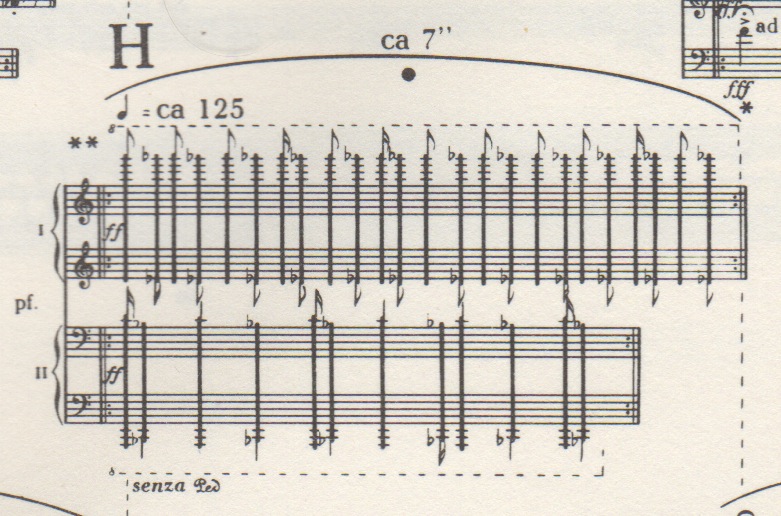
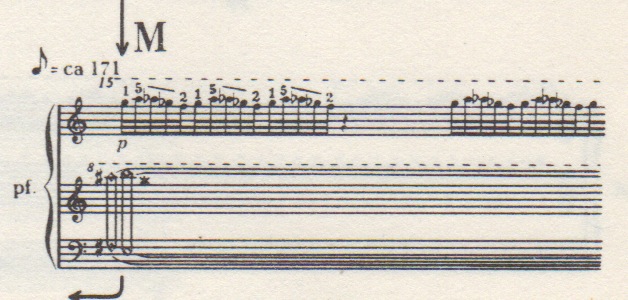
There is one unconventional technique that Lutosławski does employ.  It’s in Jeux vénitiens.  He does so in the two movements whose composition chronologically flanks this diary entry of 11 March 1961.  In the otherwise stylistically conservative second movement, which was not changed between the Venice premiere and the revised version that we know today, he uses ‘cylinders of stiff cardboard’ in bb.83-103.  The device also reappears in the finale, at letter H and from letter M to the end (although, as I have not seen the first version of this movement, I cannot say if the cylinders were used here originally).

In the second movement of Jeux vénitiens, six different lengths of cardboard tube are required for the two pianists (on one piano).  At b.83 (marked p), Player I depresses the white keys between specified pitches with a 60cm tube, the black keys with one that is 59.5cm long.  A moment later, Player II uses a 54.5cm tube for the white keys, 52.5cm for the black.  At b.87, Player I starts a series of p clusters at varying pitches using shorter tubes, 14.4cm for the white keys, 15.6cm for the black.

WL JV:II b.83

At letter H in the finale (part of the movement’s climax), the two players are instructed to use the (longest) tubes ff.

WL JV:IV letter H

Lutosławski’s technique at letter M in the finale is different.  Just one player is implied – the score does not indicate that a second player is required, although it might make it easier if two were involved.  Three and a half octaves are to be suppressed silently by the tubes (no length given): ‘hold them down with the elbow and left hand until the end’. On top of this, the right hand plays a little five-note riff.

WL JV:IV letter M

It seems to me that these three passages in Jeux vénitiens link in directly with Lutosławski’s first musing on 11 March 1961, even if he took his observations no further in subsequent pieces (not even in the central, percussive movement of his next work, Trois poèmes d’Henri Michaux).

• WL100/23: 9-10 March 1957

Lutosławski Speaks Out (1957)

Lutosławski chose his moment to make statements of a political-artistic nature.  He stayed noticeably silent during the discussions at Łagów on 5-8 August 1949, when politicians, composers and performers tried to determine what constituted socialist realism in music.  On 9 March 1957, however, he opened the 9th General Assembly of the Polish Composers’ Union (9-10 March) with a short speech.  At a pivotal moment in Polish culture, six months after the first ‘Warsaw Autumn’ festival and before any music from the Western avant-garde had been played in Poland, Lutosławski reflected on both the creative trauma of the past seven and a half years and the creative opportunities that lay ahead of Polish composers.

Our Assembly, for the first time in a very long while, is taking place in an atmosphere of true creative freedom.  No one here will persecute anyone for so-called formalism, no one will prevent anyone from expressing his aesthetic opinions, regardless of what individual composers represent.

Zjazd nasz po raz pierwszy od dłuższego już czasu odbywa się w atmosferze prawdziwej wolności twórczej. Nikt tu nikogo nie będzie prześladował z tzw. formalizm, nikt nikomu nie przeszkodzi wypowiedzieć swych poglądów estetycznych niezależnie od tego, co reprezentują poszczególni kompozytorzy.

When today, from the perspective of eight [sic] and a half years, I look back on the notorious conference in Łagów in 1949, when the frontal attack on Polish musical creativity began, I go cold just remembering that dreadful experience.   In fact, it is hard [to find] a more absurd argument than this – that one should erase the output of recent decades and return to the musical language of the nineteenth century.  But they still tried to make us believe this argument.  What is more, they frequently tried to promote works that were imitative and bland, simultaneously closing off the route to the concert platform for works that were original and creative.  We all know that this was the work of people to whom the very idea of beauty is totally foreign, people for whom music is of no interest unless there is some tale or legend attached.

Gdy dziś, z perspektywy ośmiu i pół lat, patrze na sławetny Zjazd w Łagowie w 1949 roku, kiedy to zapoczątkowano frontalny atak na polską twórczość muzyczną – zimno mi się robi na wspomnienie tego okropnego przeżycia.  W istocie trudno o bardziej absurdalną tezę niż ta, że należy przekreślić dorobek ostatnich kilkudziesięciu lat i powrócić do języka muzycznego XIX stulecia.  A jednak starano się tę tezę nam wmówić.  Mało tego – starano się nieraz lansować utwory epigońskie i jałowe, zamykając jednocześnie drogę do estrady dziełom oryginalnym i twórczym.  Wszyscy wiemy, że działo się to za sprawa ludzi, którym obce jest najzupełniej samo pojęcie piękna – ludzi, których nic nie obchodzi muzyka, jeśli nie można do niej doczepić jakiejś historyjki, jakiejś legendy.

The period of which I speak may not have lasted long, because it actually passed a couple of years ago, but it was nevertheless long enough to have visited tremendous damage on our music.  The psyche of a creative artist is an extremely delicate and precise instrument.  So the attack on that instrument and the attempt to subdue it caused not a few of us moments of severe depression.  Being completely cut off from what was happening in the arts in the West likewise played no small role in that dismal experiment to which we were subjected.

Okres, o którym mówię, trwał może niedługo, bo faktycznie minął już parę lat temu, dość jednak długo na to, aby wyrządzić naszej muzyce olbrzymie szkody.  Psychika artysty twórczego jest instrumentem niezmiernie delikatnym i precyzyjnym.  Toteż zamach na ten instrument i próba zawładnięcia nim przyprawiły niejednego z nas o momenty ciężkiej depresji.  Całkowite odcięcie od tego, co działo się w sztuce na Zachodzie, odegrało również niemała rolę w tym ponurym eksperymencie, jakiemu nas poddano.

Have we shaken ourselves free of this state of dejection?  Do we have enough enthusiasm for new, creative explorations?  Certainly yes.  But even so our situation is far from easy.  Before each of us stands the problem of finding our place in the tumult represented by the arts of our time.  This problem is sharply drawn particularly for those of us who, after a gap of some years, have established contact with Western European music.  Not all of us have a clear view on what is happening in this music, where it is going.  I believe, however, that it is only a question of time, that not only will we reach a clear view on the situation but also that we will play a positive and not insignificant role in it.  This optimistic feeling allows me above all to cherish the fact that today we are breathing an atmosphere of true creative freedom.  And that is the first and indispensable requirement for the development of every art.

Czy otrząsnęliśmy się ze stanu przygnębienia?  Czy mamy dość zapału do nowych, twórczych poszukiwań? Na pewno tak.  Ale mimo to sytuacja nasza nie jest bynajmniej łatwa.  Przed każdym z nas staje problem znalezienia swego miejsca w tym zamęcie, jaki przedstawia sobą sztuka naszej epoki.  Szczególnie ostro rysuje się ten problem przed tymi z nas, którzy po kilkuletniej przerwie nawiązali kontakt z muzyką zachodnioeuropejską.  Nie mamy tu wszyscy jasnego poglądu na to, co się w tej muzyce dzieje, ku czemu ona zmierza.  Wierzę jednak, że jest to tylko kwestią czasu, że nie tylko zdobędziemy jasny pogląd na sytuację, ale że odegramy w niej pozytywną i wcale nie najmniejszą rolę.  To optymistyczne uczucie pozwala mi żywić przede wszystkim fakt, że oddychamy dziś atmosferą prawdziwej wolności twórczości.  A to jest pierwszym i nieodzownym warunkiem rozwoju wszelkiej sztuki.

Lutosławski’s opening address was printed in Ruch Muzyczny no.1 (1 May, 1957), pp.2-3.  Ruch Muzyczny resumed publication with this number, having been ‘liquidated’ by the authorities late in 1949 for being too independent.  My translation above appeared in a slightly shorter form in Polish Music since Szymanowski (Cambridge, 2005), p.92. Steven Stucky provided his own translation in Lutosławski and His Music (Oxford, 1981), pp. 63-4, and Zbigniew Skowron reproduced it in Lutosławski on Music (Scarecrow, 2007), 231-2.

• WL100/22: Chain 1, figs 40-41

Twenty five years ago today, I came across a Lutosławski autograph and immediately knew I had to buy it.  I was between my 40th and 41st birthdays at the time, so how could I resist?  A quick phone call and it was secured.  It was being sold by Lisa Cox, who had bought it in November/December 1987 at an auction in London held by Phillips in aid of the Musicians Benevolent Fund.  She was under the impression that Lutosławski had donated the manuscript along with a couple of signed photographs.  I paid the princely sum of £75 plus 50p postage.  (Excuse the skew-whiff angle and the camera flash – I had to photograph it in the dark to avoid reflections!)

IMG_8091 copy

• New CD Note (Penderecki & Lutosławski/Hyperion)

034571179438-1I have been a fan of the Royal String Quartet for several years.  I heard these superb Polish musicians play Górecki’s Third String Quartet at the St Magnus Festival on Orkney in 2010 and subsequently wrote the booklet note for their Hyperion CD of all three Górecki quartets.  Now they’ve released an equally stunning account of the three Penderecki quartets alongside Lutosławski’s sole contribution to the genre.

Here’s the link to my booklet note for Penderecki & Lutosławski String Quartets, or you can scroll the CD NOTES tab above.

• New CD Note (Lutosławski vol.5/Chandos)

CHAN 5108-1Lutosławski: Orchestral Works IV is the fifth Chandos CD in the BBCSO/Gardner series.  I hope that there will be a sixth to include Livre pour orchestre (1968) and Mi-parti (1976) and a selection from Musique funèbre (1958), Jeux vénitiens (1961), Novelette (1979) and the Double Concerto (1980).  Then the series will have included all Lutosławski’s major symphonic and vocal pieces.  It’s been a fantastic series.  The first CD included the Concerto for Orchestra, which on Polish Radio was recently voted the best recording of this popular work.  I wrote an account of the programme discussion on 20 January: Gardner/BBC SO top Polish Radio poll.

Here’s the link to my booklet note for Lutosławski: Orchestral Works IV, or you can scroll the CD NOTES tab above.

• WL100/21: Funeral and Homily, 16.02.94

It was Ash Wednesday, 1994.  I had not gone specially to Warsaw for Lutosławski’s funeral on 16 February; I had arrived a week earlier on a pre-planned research trip.  But I could not stay away from Powązki Cemetery.  My recollections are slender, my few photographs, for what they are worth, rather remote.  Those were the days before digital photography, my camera had a poor zoom, and it didn’t seem right to photograph those present at close quarters (how customs have changed in less then 20 years).

Funeral

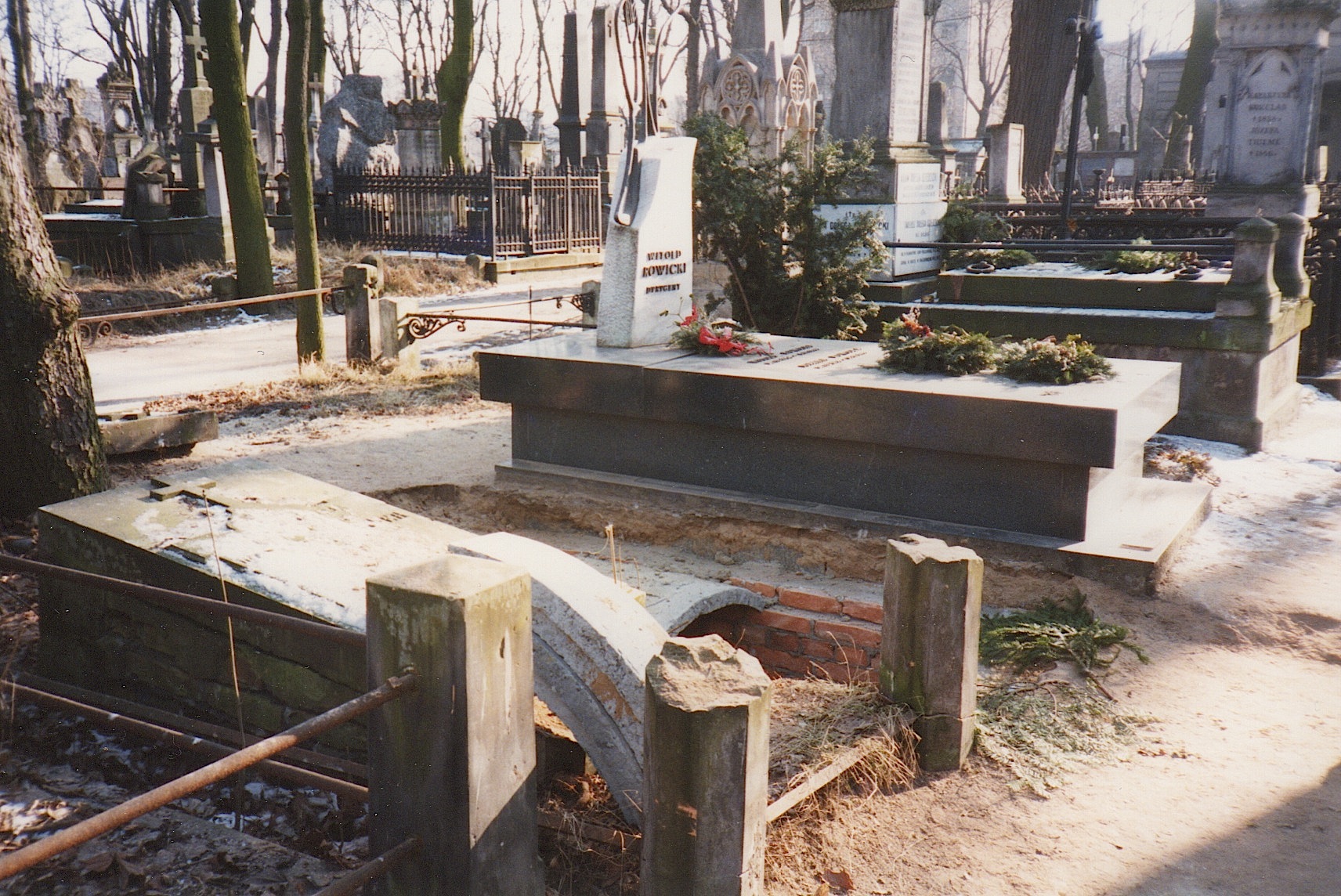
As you would expect, it was a cold day, but not snowbound as on my recent visit to the grave on the centenary of his birth.  Lutosławski had been cremated (there was at that stage only one crematorium in Poland – in Poznań – and the Roman Catholic church had an ambivalent attitude to cremation, to say the least).  I got to the cemetery early, before the mass in the chapel.  I located the grave, which was squeezed in next to that of Witold Rowicki, the conductor who commissioned Lutosławski’s Concerto for Orchestra in 1950.  I was intrigued to see that a full-size grave had been dug, a couple of feet deep, lined with bricks and half covered-over with curved concrete panels.
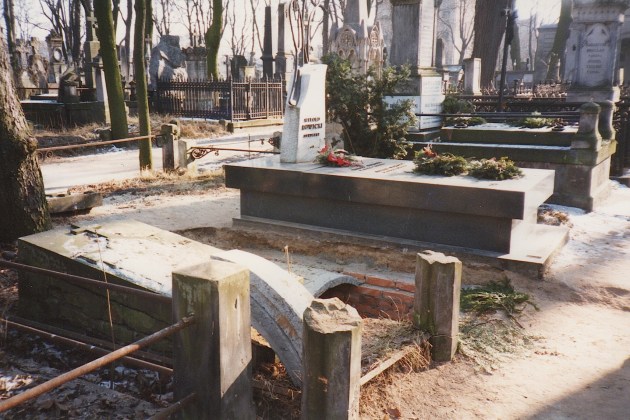
WL Funeral, 16.02.94:1

WL Funeral, 16.02.94:2

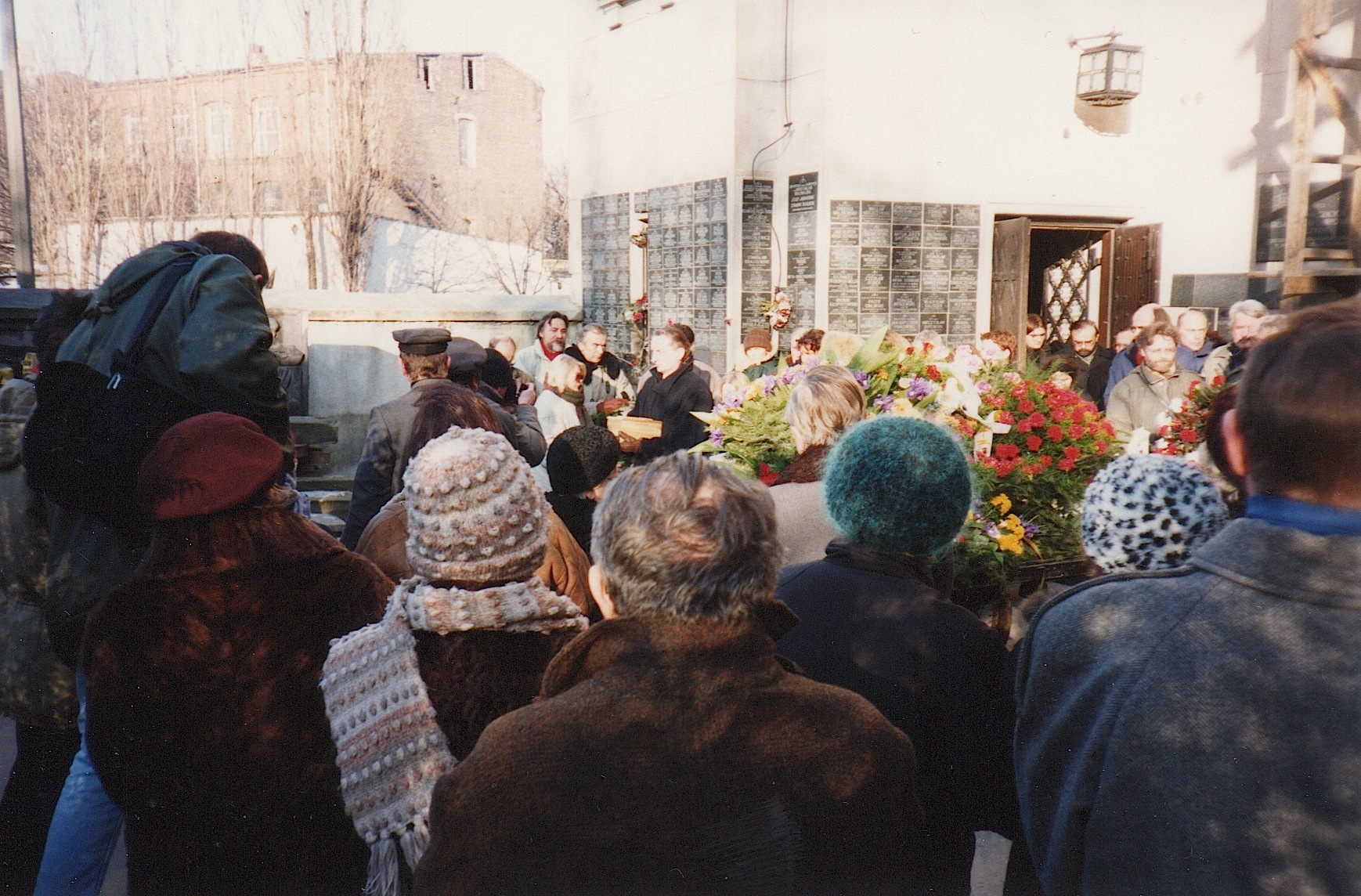
The chapel at the edge of the cemetery, inside the three-metre perimeter wall, was packed and stuffy.  The family wanted the minimum of fuss, with only one oration (translated below).  Stefania Woytowicz, who had been one of the great Polish sopranos and a passionate advocate of new Polish music, gave a less than steady account of the early Lacrimosa.  I decided to move outside.  Eventually, the funeral party emerged past an array of wreaths. Lutosławski’s stepson carried the simple wooden casket (to the left of the wreaths in the photo below).

WL Funeral, 16.02.94:3It was a circuitous route to the graveside.  A soldier carried the Order of the White Eagle, Poland’s highest honour, which had been awarded to Lutosławski shortly before he died.

WL Funeral, 16.02.94:4

I found myself standing the other side of the grave from the family.  Lutosławski’s stepson, Marcin Bogusławski, climbed into the narrow opening to place Lutosławski’s casket on the grave’s floor (not the easiest of tasks). Lutosławski’s widow Danuta looked terribly frail.  She was heard to say: “Happy Rowicka, that she died straight after her husband!” (she must have glanced to her right and seen the inscription on the adjacent grave of Rowicki and his wife, who died within weeks of each other in 1989).  Danuta Lutosławska died less than three months after her husband, on 23 April 1994.

I returned a day or two later to see the grave, now covered in a mound of earth.

WL Funeral, 16.02.94:5

Homily

The homily at Lutosławski’s funeral was given by Father Wiesław Niewęgłowski.  It was reproduced at the end of Tadeusz Kaczyński’s Lutosławski. Życie i muzyka (Warsaw: Sutkowski, 1994), 237-8.  The translation is mine.

We have come here to say farewell to Witold Lutosławski, who is going on a long journey.  Among his incessant travels around the world, this is the last.  The final stop the house where there are many mansions – eternity.  He has left us citizens of the world, while simultaneously being a faithful son of the Polish homeland.  An eminent artist, a great composer, and above all a man of integrity.

He was born during the winter in Warsaw.  And in Warsaw he also died on a winter day.  A graduate of the Warsaw Conservatory.  Before he knew what success was, he experienced deprivation.  During the years of occupation he earned his living playing the piano in a few cafés in the capital city.  During martial law, he took the side of society.

An artist of great talent.  He created his own musical language.  A unique art.  Already during his lifetime he was seen as a classic of the twentieth century.  His works entered the treasure-house of world musical culture.  They are of permanent and universal value.  He was aware of his gift, but also the responsibility for these gifts entrusted to him.  Which is why he once said, “Talent is a good entrusted.  And with this good I need to do something wise and noble.  Talent must be given back to people.  It is the duty of the artist”.  These talents he multiplied and generously gave to the world.  Inspired, but also hard-working, he repeated after Tchaikovsky: “Inspiration does not visit the lazy”.

We know how he avoided publicity.  He was self-effacing.  But the world appreciated him – he was presented with honorary degrees by many renowned universities, many distinguished prizes and decorations.  A great talent, heart and spirit.  Open to people, kindly, independent and steadfast.  Totally elegant and calm, he was a free man.  But his freedom, both as an artist and as a man, created a harmonious whole.  He was a person of clear choices.  Which is why he was seen as an unquestioned authority, not only musically but also morally.

He leaves on the day when at Church people pour ashes on their heads, saying an old truth: remember man, that you are dust and to dust you shall return.  A funeral ceremony on Ash Wednesday in a way doubly proclaims the truth about life.  Europe, as a result of strenuous efforts in the field of philosophy and culture, has sponsored an anthropological reduction of people.  The latest proposed model according to the conception of the West is a man devoid of the spiritual dimension, a man crippled.  Today’s European man is conceived of as an irreligious man.  But is it possible to limit him and his thinking space on the horizon of eternity?  As you know, unbelief is the idea only of white, European man.  Atheism in the cultures of other continents is an unknown phenomenon.  Today’s ceremony has revealed the need for the Absolute.  It shows that, alongside mental activity, the spiritual element, humility and realism are necessary for every climate. 

Remember, man, that you are dust and to dust you shall return – this sentence is not uttered to arouse fear.  Dust does not evoke a symbol but reality.  Man is a transient being.  But he is the only being who the inevitability of his own death knows.  The ritual of the ash and the ritual of the funeral, however, proclaim the truth not about death, but about life.  From the time of Christ, the insignificance of man is filled with the infinite, death brings life – like the chrysalis of a butterfly.  As the ash fertilises the earth and thus becomes a source of new life during the following spring, so  the ash, which is man, sown in the ground with Christ, may have its own spring.

In this liturgy, we ask God for this eternal spring for Witold Lutosławski.  We heard in today’s reading from the Letters of St Paul, that Man does not live for himself, but for Christ.  Man does not live for himself, but for people with whom Jesus identifies himself.  Our recently deceased brother Witold fulfilled this truth in his service as an artist, in his service as a Christian.  May his actions intercede for him with God, and that will be a sign for how we must go.

Przyszliśmy tutaj, aby pożegnać Witolda Lutosławskiego, który udaje się w daleką drogę.  Wśród jego bezustannych podróży po świecie – ta jest ostatnią.  Kóncowym przystankiem dom, w którym mieszkań jest wiele – wieczność.  Odchodzi od nas obywatel świata, a jednocześnie wierny syn polskiej ojczyzny.  Wybitny artysta, wielki kompozytor, a przede wszystkim człowiek prawy.

Urodził się podczas zimy w Warszawie. I w Warszawie też umarł w zimowy dzień.  Absolwent Konserwatorium Warszawskiego.  Zanim dowiedział się czym jest sukces, poznał smak niedostatku.  W latach okupacji zarobkował grą na fortepianie, w kilku kawiarniach stołecznego miasta.  W stanie wojennym opowiedział się po stronie społeczeństwa.

Artysta wielkiego talentu.  Stworzył własny język muzyczny.  Sztukę niepowtarzalną.  Już za życia postrzegano go jako klasyka XX wieku.  Jego dzieła weszły do skarbca światowej kultury muzycznej.  Są wartością stałą i uniwersalną.  Miał świadomość własnego obdarowania, ale i odpowiedzialności za powierzone mu dary. Dlatego kiedyś powiedział: “Talent to dobro powierzone.  I z tym dobrem trzeba coś mądrego i szlachetnego zrobić.  Talent trzeba oddać ludziom.  Jest to obowiązek artysty”.  Owe talenty mnożył i hojnie rozdawał światu. Natchniony, ale i pracowity – powtarzał za Czajkowskim: “natchnienie nie nawiedza leniwych”.

Wiemy, jak unikał rozgłosu.  Był skromny.  Ale świat go docenił – ofiarowano mu doktoraty honoris causa wielu renomowanych uczelni, wiele znakomitych nagród i orderów.  Wielki talentem, sercem i duchem.  Otwarty na ludzi, życzliwy, niezależny i niezawodny.  Pełen elegancji i spokoju, był człowiekiem wolnym.  Ale jego wolność i jako artysty, i jako człowieka, tworzyła harmonijną całość.  Był osobą jasnych wyborów.  Dlatego postrzegano go jako nie kwestionowany autorytet nie tylko muzyczny, ale i moralny.

Odchodzi w dniu, kiedy w Kościele sypie się ludziom na głowę popiół, mówiąc starą prawdę: pamiętaj człowiecze, że prochem jesteś i w proch się obrócisz.  Pogrzebowa ceremonia w Środę Popielcową jakby podwójnie głosi prawdę o życiu.  Europa w wyniku usilnych zabiegów na terenie filozofii i kultury zafundowała ludziom redukcję antropologiczną.  Proponowany najnowszy model według koncepcji Zachodu – to człowiek pozbawiony wymiaru duchowego, człowiek okaleczony.  Dzisiejszy człowiek europejski pomyślany jest jako człowiek niereligijny.  Ale czy można zamknąć go i przestrzeń jego myśli na horyzonty wieczności?  Jak wiecie, niewiara jest pomysłem jedynie człowieka białego, europejskiego.  Ateizm w kulturach innych kontynentów jest zjawiskiem nieznanym.  Dzisiejsza ceremonia odsłania potrzebę Absolutu.  Ukazuje, że obok aktywności umyśłowej potrzebny jest także każdemu klimat i pierwiastek duchowy, pokora, realizm.

Pamiętaj człowiecze, że prochem jesteś i w proch się obrócisz – to zdanie nie jest wypowiadane ku wzbudzaniu lęku.  Proch nie przywołuję symbolu, ale rzeczywistość.  Człowiek jest istotą przemijającą.  Ale jest także jedyną istotą, która o nieuchronności swej śmierci – wie.  Obrzęd popielcowy i obrzęd pogrzebowy głoszą jednak prawdę nie o śmierci, ale o życiu.  Od czasu Chrystusa znikomość człowieka wypełniona jest nieskończonością, śmierć wydaje życie – jak poczwarka motyla.  Jak popiół użyźnia ziemię i tym samym staje się przyczyną nowego życia podczas kolejnej wiosny; tak posiany z Chrystusem w ziemię proch, którym jest człowiek, może mieć swoją wiosnę.

O tę wieczną wiosnę dla Witolda Lutosławskiego prosimy Boga podczas tej liturgii.  Słyszeliśmy w czytanym dzisiaj liście św. Pawla, że Człowiek nie żyje dla siebie, ale dla Chrystusa.  Człowiek nie żyje dla siebie, ale dla ludzi, z nimi utożsamia sź Jezus.  Świętej pamięci nasz brat Witold wypełnił tę prawdę swą służbą artysty, służbą chrześcijanina.  Niech jego czyny orędują za nim u Boga, a dla nas będą znakiem, jak iść mamy.

• WL100/20: Dance Preludes, **15.02.55

Here are a couple of previously unrevealed facts about this popular piece for clarinet and piano.  The premiere of Lutosławski’s five Dance Preludes took place on 15 February 1955, although one of the set (unidentified) had already been played at a Polish Composers’ Union concert on 24 April 1954.

• In May 2002, I was doing some research in Poland when I came across some interesting information about the background of Dance Preludes which widens the chronology of its composition.  Here’s a sample:

Lutosławski evidently wrote a single Preludium taneczne in 1953.  In a letter to him dated 5 December 1953, his publisher wrote:

‘… we ask a kind favour of you: either agree to the publication of your one “Dance Prelude for clarinet and piano”, or write to us by the N. Year as to how things are with your plans for another two preludes – we would be very pleased with that.’
‘… zwracamy się do Ciebie z gorącą prośbą: Albo zgódź się na wydanie Twojego jednego “Preludium tanecznego na klarnet et fortepian”, albo napisz nam do N. Roku, tak, jak to jest w Twoich zamierzeniach jeszcze dwa preludia, z czego bardzo cieszylibyśmy się.’

Lutosławski replied by sending just the one prelude on 31 January 1954; this was almost certainly the one played in April 1954.  It eventually became the last in the set.  I have found no further correspondence about preludes in the plural until after the premiere in 1955.

• When exploring the musical and bibliographical contents of his house in September 2002 (with permission of the family), I discovered a folder marked ‘Mat. ludowe’ (Folk Mat[erials].), tucked away in a cupboard in the attic room. Among a wealth of MS examples in Lutosławski’s handwriting, there were several headed ‘Preludia tan.’ (Dan. Preludes), with tunes copied from another source.  Here’s the tune at the top of the list (it’s not been seen before; photograph taken in poor light on site), and it provided him with the initial theme for the first of the Dance Preludes.

Wl Dance Preludes:I folk tune

The insertion of differently-metred bars is characteristic of many Polish folksongs.  The connection between the source and the prelude is clear (the tempo is greatly increased), but the straightforward yet imaginative way in which Lutosławski makes a paragraph out of a (relatively) simple tune through extension, repetition and a varied underpinning is a stroke of genius.

Wl PT:1a

• WL100/19: ‘Lutosławski live’, 12-19.02.93

Twenty years ago today, ‘Lutosławski live‘ took over the concert halls of Manchester in celebration of the Polish composer’s 80th birthday two weeks earlier.  The festival was the brainchild of the British composer, John Casken, who had known Lutosławski since the early 1970s.  ‘Lutosławski live‘ placed his music within the context of composers old and new, with Casken and James Macmillan featuring as both composers and speakers and, in the case of MacMillan, as conductor too.  Lutosławski had hotfooted it back from Los Angeles, where he had just conducted the world premiere of his Fourth Symphony (5 February 1993).

The Lutosławski works performed in Manchester were: Variations on a Theme of Paganini (1941), Recitative e Arioso (1951), Concerto for Orchestra (1954), Dance Preludes (1954), Dance Preludes (1954/59), Jeux vénitiens (1961), String Quartet (1964), Preludes and Fugue (1972), Mi-parti (1976), Grave (1981), Mini-Overture (1982), Symphony no.3 (1983), Chain 1 (1983), Partita (1984), Chain 3 (1986), Piano Concerto (1988) and Slides (1988).

My recollection is of a wonderfully friendly event, with musicians drawn from the RNCM, the Allegri and Lindsay string quartets, the London Sinfonietta, the BBC PO and the Hallé.  Lutosławski himself conducted in two of the concerts.  I also have very fond memories of a relaxed post-concert supper with him, John Casken and others in a downtown Italian restaurant.  Good times.  Oh, I’ve only just noticed that I was quoted on the leaflet.  There’s observation for you.

WL live, Manchester 1993 front

WL live, Manchester 1993 inside

• WL100/18: Notebook, 12 February 1961

Lutosławski on the brink

The period which I have been going through for a long time already (a few years) has been uninteresting. It has been a period of intensive explorations into expressive devices that suit me.  This has inevitably led to a state where, for the most part, these work in poorly mastered, unfamiliar ways.  In this state, one loses one’s sure hand, loses accuracy, loses balance, loses authoritativeness and full responsibility for the outcome.   To this must be added that these investigations proceed slowly, that they bring few lasting gains.  The result of this state of affairs is the fact that the works of this period (orchestral wks from 59/60, and also a work for chamb. orch. from 1961), if going by their own intrinsic value, stand certainly lower than some of my previous pieces (Conc[erto for orchestra]., M[usique]. F[unèbre]., [Five] Songs to Iłł[akowicz].).   For me personally they still have greater value than those works because they are leading to something, are preparing something, are facilitating something which will be much more my own.  I will be able to write these pieces when the devices now being developed are to me as mastered, familiar and malleable as was the ‘late tonality’ in the Concerto for Orch.

Okres, który od dłuższego już czasu przeżywam (parę lat) jest nieciekawy.  Jest to okres wzmożonych poszukiwań odpowiednich dla mnie środków wyrazu.  Prowadzi to nieuchronnie do stanu, w którym operuje się w dużym procencie środkami źle opanowanymi, mało znanymi.  Gubi się w tym stanie pewność ręki, gubi się celność, gubi się równowagę, gubi się autorytatywność i pelnię odpowiedzialności za dzieło.  Do tego dodać należy, że te poszukiwania postępują wolno, że niewiele przynoszą trwałych zdobyczy.  Rezultatem tego stanu rzeczy jest fakt, że utwory tego okresu (utw. orkiestrowe z lat 59/60, a także utwór na ork. kam. z 1961), jeśli wziąć pod uwagę ich oderwaną od wszystkiego innego wartość, stoją na pewno niżej od niektórych poprzednich moich utworów (Konc., M. ż., Pieśni do Iłł.).  Dla mnie osobiście mają jednak wartość większą niż tamte, ponieważ prowadzą do czegoś, przygotowują coś, ułatwiają coś, co będzie o wiele bardziej moje własne.  Będę mógł te utwory napisać wtedy, kiedy opracowywane teraz środki staną się dla mnie tak opanowane, znane, podatne, jak to było z “późna tonalnością” w Koncercie na ork.

Witold Lutosławski, 12 February 1961  [my translation]

This entry in Lutosławski’s creative notebook is fascinating.  Firstly, it shows that he is still battling to find his own voice on a technical level.  With the benefit of hindsight, it seems obvious that he was tussling with the practicalities of the aleatory (chance) procedures that he had first encountered in John Cage’s Concert for Piano (1958) in a radio broadcast.  This life-changing moment occurred, by his own account, sometime in 1960.

The orchestral pieces that Lutosławski mentions from 1959-60 are what he subsequently called Three Postludes. He completed them as follows, but not in the order in which they were published (my primary source here is the German musicologist, Martina Homma):

No.1  (14 September 1958)
No.3  (4 April 1959)
No.2  (27 August 1960)

There is no record of any other work being completed during the next six months, until he started to finalise three movements from Jeux vénitiens, the chamber orchestra piece from 1961 mentioned above.  These three movements were premiered in Venice on 24 April 1961.  Two of them were then radically overhauled and a third movement added in time for the full premiere in Warsaw on 16 September 1961.  The Jeux vénitiens chronology works out as follows:

Mvt.4  (7 March 1961; rev. 11 August 1961)
Mvt.2  (28 March 1961)
Mvt.1  (5 April 1961; rev. 29 August 1961)
Mvt.3  (21 August 1961)

wl-jv-sketches-folderOne may only conjecture what was happening in Lutosławski’s head and in his studio between 27 August 1960 and 7 March 1961.  It seems probable that it was during September-December 1960 that he heard Cage’s Concert for Piano.  Evidently, on 12 February 1961 he was still nowhere near a satisfactory solution to his quest for new expressive devices.  His search almost certainly revolved around how to animate his twelve-note harmonic language (already evident in Five Songs, Musique funèbre and the ‘orchestral wks from 59/60’) with ‘unmastered, unfamiliar’ rhythmic aleatorism.  His first public attempts, aired in Venice, were quickly revised for the Warsaw premiere (I explored these issues in detail in 2001).

What is fascinating about the diary extract above is the clarity of Lutosławski’s mind about the value of this experimentation, even though his technical efforts were still in some disarray and he was far from finding the solutions that suited him.  But he knew that the direction in which he was heading was the right one, and he was determined to follow his instincts through.