• Happy 99th, Luto (2 days late!)

I’ve just this minute come across a brief salute to Lutosławski by a Polish composer 73 years his junior.  Mateusz Ryczek (b.1986) uploaded this two days ago, on what would have been Lutosławski’s 99th birthday – or, looked at another way, the start of his 100th year!  Ryczek takes the opening gesture of the Third Symphony and refashions it into the opening of the Polish birthday song, Sto Lat (One Hundred Years).

In case you’re wondering, Polish musicians often abbreviate Lutosławski to ‘Lutos’.  Non-Poles seem to say ‘Luto’.

• Polish Music ‘Muzyka Nowa’, WQXR ★★★☆☆

If you tune into New York’s WQXR Q2 this week, you’ll find yourself in the midst of a week-long celebration of Chinese music, ‘The Year of the Dragon’.  Bringing new music to its audiences is WQXR Q2’s mission.  It’s been ‘on air’ since October 2009 and is a listener-supported online streaming service devoted to music by living composers. The nature of its audience’s musical preferences may be gleaned from its 2011 ‘New-Music Countdown’, where listeners voted for their favourite music written since 1900.  22 of the top 50 pieces were by living composers, most of them American: Adams (5 works), Adès, Andriessen, Carter, Corigliano, Dennehy, Duckworth, Glass, Golijov (2), Gordon, Lang, Lindberg, Pärt (2), Reich (2) and Riley.

The only Polish composer in the top 50, unsurprisingly, was Górecki, whose Third Symphony came in fifth.

On 20 December last year, Q2 announced a new week-long venture: Muzyka Nowa. A Celebration of Contemporary Polish Music’ (16-22 January 2012).  Well, I was all ears at this news and last week I spent more waking hours listening via iTunes than I had first intended.  This was partly because the streaming audio experience was new to me and I was curious to see how it worked in practice.  I was particularly fascinated to find out how Q2 would tackle such a big theme editorially, given the dearth of Polish names in their end-of-year poll.  The results, as you’ll see, were mixed.

It is perhaps worth comparing a few statistics with the New York Juilliard School’s 27th Focus! festival – Polish Modern: New Directions in Polish Music since 1945′ – which took place exactly a year ago (22-28 January 2011). Juilliard’s Polish Modern festival presented 39 works by 36 composers (one piece per composer, with the exception of Lutosławski, who had the final concert to himself).  It had six concerts, with some 8 hours of music.  Q2’s Muzyka Nowa, by my count, had 107 (post-1945) works by 38 (Polish-born and Polish-trained) composers.  These were spread over six and a half days, including two 24-hour all-Polish marathons (actually, they were just over 21 hours). Where Polish Modern was concentrated, Muzyka Nowa tended towards the diffuse.

Streaming

At least half of each weekday’s playlist at Q2 is unhosted.  That means no announcers and no ‘on air’ indication of what is being played (you have to look ‘on screen’).  There are two main hosted programmes, each repeated twelve hours later: an hour-long slot for music involving keyboard – ‘Hammered!’ – with a short introduction to the day’s repertoire at the top; and a four-hour programme with more conventional introductions and back announcements to each piece.  This means that the online playlists are crucial for anyone wanting to find out what is ‘on air’.  These were fairly easy to access (they give composer and performer details, plus the source).  There were several times in this Polish week, however, when the playlists gave only the title, not the composer. So we had Subito (Lutosławski), Stabat Mater (Szymanowski), En blanc et noir (Augustyn, not Debussy) and String Quartet no.6 (Bacewicz? Meyer? no – Lasoń).  The major drawback is that there is generally no advance notice of programme details.  This makes structured listening impossible.  For some listeners, that may be perfect, the ideal ‘innocent ear’ environment.  But for anyone who likes to plan some or all of their listening, it can be immensely frustrating.  It doesn’t do, either, to expect a programme to begin or end at the allotted hour.

The appearance of Szymanowski was anachronistic, given the basic idea behind Muzyka Nowa.  In fact, his contribution was quite slight, with Métopes (1915), the Mazurkas op.50 (1925) and Stabat Mater (1926) being the only major pieces.  But at least they were written within the past 100 years.  Karłowicz’s 1902 Violin Concerto (3 complete airings plus two of the three movements on another occasion) was a puzzling inclusion, while the appearance of Chopin’s Polonaise in F sharp minor (1841) on this ‘Living Music. Living Composers’ station was altogether bizarre.  And even the presenter was surprised by the inclusion, during Wednesday’s all-Polish marathon, of the Tenth Piano Sonata by a Russian composer: “Scriabin, of all people”, he muttered.

A further sign of editorial fluidity was the way in which programme titles changed as the week progressed.  ‘Jakub Ciupiński Hosts’ became ‘The Holy [‘Holy’?] Trinity of Contemporary Polish Music’ and ‘Poland’s Next Wave’, while the four-hour hosted programme ‘Polish Composers: 20th Century Masters to the Next Generation’ became the exaggerated ‘Titans of Polish Music: Past, Present and Future’.  Outside the two marathon days, this particular slot, like the unhosted segments, generally devoted 50%-60% of its play time to Polish repertoire.

Presentation

To be brutally honest, little was added to listener enjoyment or knowledge by the hosted programmes, with the exception of the two slots specially hosted by Jakub Ciupiński.  Ciupiński is a young Polish composer now living in New York and he brought an insight to his chosen repertoire that was a model of enthusiasm and concision.  He should do more broadcasting.  The shame was that Q2 seemed not to have used his ability as a native speaker to do something about other presenters’ pronunciation of Polish names.

Almost twenty years since Górecki became a household name, it was extraordinary to hear ‘Goorekki’ rather than ‘Gooretski’.  Nowa inexplicably became ‘Nuova’, Piotr became ‘Peetor’.  The consonant ‘z’ frequently became invisible/inaudible.  Bruzdowicz was first said correctly (hooray!), then immediately ‘corrected’ to ‘Brudowicz’.  For Andrzej we heard ‘Andrezh’.  And yet, seconds later, the ‘J’ of Jacek miraculously was not a ‘Zh’ but the correct ‘Y’. Such manglings were all too common.  Unhosted segments suddenly seemed more attractive.

The quality of the commentaries also left something to be desired.  The real low-point was the introduction to Penderecki’s Polish Requiem during the first marathon on Wednesday.  Having described it as “big, beautiful, crazy, awesome” – a less appropriate, more vacuous series of adjectives is hard to imagine – the presenter concluded with “he sort of wrote it piecemeal … he sort of expanded it … at the basic level it’s just a setting of the requiem … Antoni Wit is the conductor of the whole shebang”.

Repertoire

The range of post-1945 music included in Muzyka Nowa was fairly impressive (a full repertoire list is given at the end of this post).  It highlighted, as Q2 put it, the ‘Titans’ or the ‘Holy Trinity’ – Lutosławski, Penderecki and Górecki – and included composers born in every decade from the 1900s to the 1980s, with the youngest composer, as far as I can tell, being the 24-year-old Jacek Sotomski.  There was a good variety of solo, chamber, orchestral, vocal and vocal-instrumental music, though no examples of opera, music theatre or jazz.  It also skirted a little around the experimental trends of the past 50 years (no Schaeffer, just one piece by Krauze).

There did not appear to be much in the way of editorial planning in terms of sub-groupings or sub-themes, and this left the sense of an opportunity missed.  After all, there is surely no automatic equation: ‘unhosted=unthemed’. Would it not have been possible to retitle and structure some of the random unhosted segments, just for this Polish week? Closest to such an idea was the programming of the six CD-available string quartets by Lasoń, but nowhere was this flagged up as a feature.  There were no complete symphonies by any of the ‘Holy Trinity’, no works written for the seminal chamber ensemble ‘Music Workshop’, no focus on any selected genre, generation or sub-period, such as sacred music, ‘Generation ’51’ or music post-1989.  But anyone who has programmed a festival will know that there is always too much choice, so hats off to Q2 at the very least  for bringing its listeners a decent if apparently random selection from the Polish table.

A word on sources.  Q2 is primarily a CD operation although it’s not afraid to use private recordings, some of them live, when it suits the programming and is of acceptable quality.  That’s all to the good.  I imagine that it is run on something of a shoestring, so is dependent on what is to hand, such as a copious supply of Naxos CDs.  It had also evidently been given a number of CDs made by the superb Silesian Quartet from Katowice.  On this occasion, importantly, it had access to live performances:

• Since the ‘Warsaw Autumn’ festival began in 1956, it has sought to promote the (mainly Polish) music that it has programmed by means of recordings, its ‘Sound Chronicles’.  These were issued initially on LPs, later on tape cassettes, and now on CDs.  Unfortunately, the Sound Chronicles have never been available commercially.  University libraries and major radio stations are the most likely places to hold these extensive and valuable recordings.  Q2 made most use of a selection of highlights from the first 50 years of the festival, compiled in 2007 by the Polish music critic Andrzej Chłopecki.  It’s a 10-CD box set, with single pieces by 70 composers, eight of which were included in Muzyka Nowa.  Recordings were also taken from the Sound Chronicles for the 2008 and 2009 festivals.
• Q2 trumpeted its broadcasting of excerpts from two other festivals.  The first of these was the 2011 UNSOUND festival in Kraków.  In the event, only one Polish piece was aired – (Michał) Jacaszek’s launch of music from his new album Glimmer – although it was very much worth it, as reviews for the album have already proved.  The second festival was last year’s Juilliard Focus! on Polish modern music, mentioned at the top of this post.  Sad to report, but only four of the 39 pieces from Polish Modern made it onto the Muzyka Nowa playlist.
• Top of the live performance contributions was Q2’s own recording of a concert last November, given to mark the first anniversary of Górecki’s death.  More on this towards the end of this post.

The outline of 107 works by 38 composers spread over almost 160 hours needs some elaboration.  At the heart of the WQXR Q2 operation is the principle of repeat programming.  This not only applies to the hosted segments, as outlined above, but to the rest of the schedule too.  So it’s not surprising to find that 2/3rds of the 107 pieces were repeated.  That’s fair enough.  But when the repetitions themselves were repeated, alarm bells started to sound and interest began to wane.  When the number of repeat airings increased further, the only conclusion that could be drawn was that insufficient editorial control had been exercised (did we really need five performances of Górecki’s Four Preludes or Lutosławski’s Piano Sonata, both early and unrepresentative works?).  34 pieces had three or more airings, with 13 of them heard four or more times:

• Joanna BruzdowiczWorld (4)
• Jakub CiupińskiMorning Tale (7: Lin, 3; Chow, 4)
• Henryk Górecki: Piano Concerto (2) = Harpsichord Concerto (4), Four Preludes (5)
• Wojciech Kilar: Chorale Prelude (5: Juilliard/Sachs, 4; NOSPR/Wit, 1)
• Eugeniusz KnapikCorale, interludio e aria (4)
• Andrzej Krzanowski: String Quartet no.3 (4)
• Witold Lutosławski: Piano Sonata (5)
• Andrzej Panufnik: Violin Concerto (4)
• Elżbieta Sikora: Canzona (4: Moscow CME/Thorel, 1; New Juilliard E/Sachs, 3)
• Stanisław SkrowaczewskiMusic at Night (4)
• Paweł Szymański: Two Studies (7: Grzybowski, 4; Esztényi, 3), Une suite de pièces de clavecin par Mr Szymański (7)

All in all, there were 131 repeat airings (not including partial repeats), compared with the basic repertoire of 107 compositions.  That made 238 broadcast items overall, at least by my reckoning (that’s equivalent to 34 a day, or one and a half pieces an hour).  There was no discernible rationale for which pieces were or were not repeated.  I for one welcome the additional exposure for Knapik, Krzanowski and Sikora (she fared particularly well).  If Q2 wanted to raise the profile of Bruzdowicz, however, they could have done better than to broadcast her song cycle World in a recording which harboured the most grotesque singing that I have ever heard.

Undoubtedly the most unbalanced programming was accorded to Szymański, whom I have admired for over 30 years and remain an ardent champion.  But even he would acknowledge that to air two of his keyboard compositions seven times apiece – and one of them with just one recording – was out of proportion.  It’s not even as if they are his most distinctive or distinguished works.

Just think what could have been done had the extent of the repetitions been cut back.  If those two keyboard works by Szymański, for example, had had just two airings each, instead of seven, that would have freed up 3 hrs 45′.  We might then have heard a wider range of Szymański works, like his Partita III, Partita IV, Lux Aeterna or Miserere.  All of these pieces, totalling just under an hour of music, are on the same CD from which Q2 drew the three airings of Szymański’s Two Studies which were played by its dedicatee, Szábolcs Esztényi.  How easy it would have been to include these four other works, and to what benefit of the repertoire.  Furthermore, their inclusion would still have left 2 hrs 45′ for other new repertoire.  The principle of this idea is self-evident.  This was a programming opportunity missed, and Muzyka Nowa was the poorer for it.

Absent Friends

It was even poorer for some serious omissions from its roster of composers.  Whether or not the relatively modest number of 38 composers was a deliberate decision is impossible to say, but seven other names among many were notable for their absence.  Firstly, though perhaps not most importantly, was Henryk Górecki’s son Mikołaj, who is also a composer and teaches in Texas.  Q2 had spoken to him and posted An Interview with Mikołaj Górecki online. They even got him to provide a playlist, commenting also that he “is plenty accomplished in his own right”.  But not a note of his music was heard.  Also absent was one of Poland’s most imaginative and internationally recognised composers, Marta Ptaszyńska, who has lived and taught in the United States for many years.  Where was she? Where also were Tadeusz Wielecki and Stanisław Krupowicz, contemporaries of Knapik, Lasoń and Szymański and equally important figures in Polish music since the late 1970s?  And where was Hanna Kulenty, surely one of the most talented and exploratory composers born in the 1960s?

The most astonishing hole in the repertoire was left by the total exclusion of Tadeusz Baird and Kazimierz Serocki. Baird and Serocki were the driving force behind the ‘Warsaw Autumn’ festival, on whose Sound Chronicles Q2 relied for the majority of its ‘live’ output.  Even if such historical significance is put to one side, is there anyone with any knowledge of Polish music who would deny that Baird and Serocki were composers of international significance, composers of striking individuality whose music stands up as well today as it did when they were alive?  All Q2 had to do, with minimum effort, was to take Chłopecki’s choice from the 1956-2005 ‘Warsaw Autumn’ boxed set – as it did for pieces by Augustyn, Bargielski, Grudzień, Knapik, Krauze, Meyer, Stachowski and Szymański – and broadcast Baird’s Play and Serocki’s Impromptu fantasque.  While Serocki is not well served by the CD catalogue, several CDs of Baird’s music are available and would have immensely enriched the mix of the week’s repertoire.

Górecki live

‘In memoriam Henryk Mikołaj Górecki’ was the flagship event for Muzyka Nowa.  It was a recording of a concert given at the New York bar/café (Le) Poisson Rouge, which has a full artistic programme of events embracing a wide musical spectrum.  On 8 November 2011, Q2 recorded two pieces: the Second String Quartet ‘Quasi una fantasia’, performed by the JACK Quartet, and Little Requiem, performed by Signal Ensemble.  The concert was preceded by an interview with Bob Hurwitz, the founder of Nonesuch Records and the man responsible for that recording of Górecki’s Third Symphony.  The transmission was scheduled for 19.00 local time (midnight UK time) last Thursday, 19 January.

Things could not have gone more disastrously wrong.  For unexplained reasons, the broadcast began 50 minutes early, the last 3′ of Quasi una fantasia were overlapped by the first 3′ of Little Requiem, and the pre-concert talk was broadcast at the end.  Fortunately, the rebroadcast during the second marathon, on Saturday, was all in order (although the ambient noise of the venue and the uneven miking did not help on either occasion).  Was this episode a consequence of misfortune or incompetence?  It certainly made me realise what a blessing it is in the UK to have responsible broadcasters.

Postscript

Despite my criticisms, I don’t want to leave the impression that this was by any means a failure, just that with a little more thought and programming tweaks it could have been excellent.  It was a bold venture and one which reaped many rewards, not least the unexpected juxtapositions of composers and pieces.  Q2’s principal aim – to bring a vibrant musical repertoire to the attention of a potentially new audience – was in good measure realised.

For this listener, there were some real highlights, among them:

• being reacquainted with music by Polish composers now in their 40s and early 50s, such as Jacek Grudzień’s Ad Naan (2002) with its dynamic use of electronic manipulation, and Agata Zubel’s Cascando (2007), in which she was the engaging vocal soloist.
• being introduced to the music of younger composers, still in their 20s or early 30s, such as Jacaszek’s electro-acoustic Glimmer (2011, already mentioned), Mateusz Ryczek’s NGC 4414 for two pianos and percussion (2008) and Krzysztof Wołek’s Elements for ensemble and live electronics (2009).
• and, best of all, hearing the extraordinary jazz trumpeter Tomasz Stańko improvising over Tomasz Sikorski’s tape piece Solitude of Sounds (1975) at the 2009 ‘Warsaw Autumn’.

…….

Q2 ‘Muzyka Nowa’ Repertoire, 16-22 January 2012

alphabetical by composer, with works in the order in which they first appeared
the (x) after a work indicates the number of times that the same recording was used

• Rafał AugustynEn blanc et noir
• Grażyna Bacewicz: Piano Sonata no.2 (2), Violin Concerto no.1, Partita for violin and piano (3), Piano Quintet no.2 (3), Overture, Concerto for String Orchestra (2), Capriccio, Violin Concerto no.3 (2), Piano Quintet no.1 (3), Sonata no.2 for Solo Violin
• Zbigniew BagińskiDanza generale
• Zbigniew BargielskiSlapstick (3)
• Wojciech BlecharzTorpor
• Wojciech BłażejczykSeica
• Marcin Bortnowski…looking into the heart of the light, the silence
• Joanna Bruzdowicz16 Pictures at an Exhibition of Salvador Dali (2), World (4)
• Jakub CiupińskiMorning Tale (7: Lin, 3; Chow, 4), Continuum/II (3), Street Prayer
• Henryk Górecki: Piano Concerto (2) = Harpsichord Concerto (4), Miserere, Four Preludes (5), Symphony no.2/II, String Quartet no.2 (2), Little Requiem (2), Piano Sonata (2), Szeroka woda, Symphony no.3, Symphony no.2, O Domina NostraGood Night
• Jacek GrudzieńAd Naan (3)
• (Michał) JacaszekGlimmer 
• Wojciech KilarOrawa (2), Kościelec 1909, Chorale Prelude (5: Juilliard/Sachs, 4; NOSPR/Wit, 1)
• Eugeniusz KnapikCorale, interludio e aria (4), String Quartet
• Krzysztof KnittelA Memoir of the Warsaw UprisingLipps (3), Harpsichord Concerto
• Jerzy KornowiczFrayed Figures
• Zygmunt KrauzeAus aller Welt stammende (2)
• Andrzej Krzanowski: String Quartet no.3 (4), Relief V
• Aleksander Lasoń: String Quartet no.6 (2), String Quartet no.2 (2), String Quartet no.3, String Quartet no.5 (3), String Quartet no.1 (2), String Quartet no.7
• Witold Lutosławski: Piano Concerto (2), String Quartet (2), Livre (2) Chantefleurs et Chantefables (3: Anderson, 2; Pasiecznik, 1), Piano Sonata (5), Symphony no.2 (2), Concerto for Orchestra (3), Subito, Variations on a Theme of Paganini (2), Sacher Variation (2), Overture for Strings (3), Symphony no.4, Symphony no.3
• Krzysztof MeyerFireballs (3)
• Paweł Mykietyn3 for 13 (2), Sonata for Cello (2)
• Aleksander NowakFiddler’s Green and White Savannahs Never More (2), Songs of Caress (3), Sonata ‘June-December’ (2)
• Andrzej Panufnik: Violin Concerto (4), Sinfonia Sacra (2), String Sextet (3), Sinfonia di sfere (3), String Quartet no.2 (2)
• Krzysztof PendereckiAnaklasis (2), Seven Gates of Jerusalem/I (2), Te Deum (2), Hymne an den heiligen Daniel (2), Polish Requiem (2),  Polish Requiem/Lacrimosa, Polish Requiem/Chaconne (2), St Luke Passion, Horn Concerto, Violin Concerto no.1, De natura sonoris no.2
• Grażyna Pstrokońska-NawratilEl Condor … ‘thinking of Vivaldi’ (Spring) (2)
• Mateusz RyczekNGC 4414 (3)
• Elżbieta Sikora: Suite (2), Le Chant de Salomon (3),  Concertino for ‘Blue’ Harp and Orchestra ‘South Shore’ (3), Three Lieder ‘Eine Rose als Stutze’, Canzona (4: Moscow CME/Thorel, 1; New Juilliard E/Sachs, 3)
• Tomasz SikorskiStrings in the Earth (2), Solitude of Sounds (2)
• Stanisław SkrowaczewskiMusic at Night (4)
• Jacek SotomskiEnneaszyna
• Marek Stachowski: Divertimento
• Witold Szalonek: Chaconne (2), Inside? – Outside?
• Paweł Szymański: Two Studies (7: Grzybowski, 4; Esztényi, 3), Une suite de pièces de clavecin par Mr Szymański (7), Singletrack (3), Gloria (3)
• Ewa TrębaczErrai
• Krzysztof WołekElements (2)
• Agata ZubelCascando (2)
• Wojciech Ziemowit Zych: Symphony no.1 (3), Bass Clarinet Concerto

• New CD Note (Lutosławski vol.3/Chandos)

The New Year brings a new CD in Chandos’s Muzyka polska series.  It’s the third in Edward Gardner’s survey with the BBC Symphony Orchestra of the music of Witold Lutosławski.  The performances have been stunning for their clarity and fresh insights into the orchestral music of the Polish composer, whose centenary will be celebrated in 2013.  Word is already out that the next CD will include Symphony no.2 and the Cello Concerto, with Paul Watkins as soloist.  I can’t wait!

This third CD comprises Symphonic Variations (1938), Variations on a Theme of Paganini (1941/78), Piano Concerto (1988) and Symphony no.4 (1992).  The soloist in the two concertante works is Louis Lortie.

Here’s the link to my booklet note for Lutosławski: Orchestral Works II, or you can scroll the CD NOTES tab above.

Happy New Year!

• Edward Gardner on Lutosławski’s Symphony 4

I’ve just caught up with last Friday’s ‘Afternoon on 3’, which included a broadcast of (what I take to be) Edward Gardner’s forthcoming CD recording – with the BBC SO on Chandos – of Lutosławski’s Symphony 4 (1988-92). Unfortunately, the BBC’s ‘play it again’ technology has no sustaining power out here in the sticks (thanks, BT!), so it’s a halting, interrupted soundscape for me for the present.

Gardner’s series of Lutosławski recordings has been wonderful so far: fresh, vital, insightful.  This performance fulfilled my high expectations: a searing opening section, followed by a great sense of motility, and a measured yet edgy lyrical build-up to the final climax.  I’ve not heard as desolate a fall-away as here.  The BBC SO’s playing is top-notch and Chandos has achieved an exemplary textural clarity.  This third CD – which also includes the early Symphonic Variations, Lutosławski’s own orchestration of the Variations on a Theme of Paganini, and the Piano Concerto – is due out in the New Year.

In his discussion with Katie Derham beforehand, Gardner gave a succinct and helpful description of ‘aleatory’ as it applies to Lutosławski’s music, and what it means for the conductor, although it’s worth noting that most of Symphony 4 and of other late Lutosławski is conducted traditionally.  Gardner also had a fascinating if unexplored take on the structure of Symphony 4.  Lutosławski conceived of it as having two movements, played without a break. I hear it more as a fantasia masking a radical reconfiguration of the composer’s characteristic structural landmarks and procedures.  Gardner hears it differently again: “You can hear four pretty distinct movements actually.  You can hear a wonderfully chaos-to-form opening, a dance movement, a slow movement and a finale, I think.”  It will be interesting to see how Gardner’s approach on the CD bears out this new perception.

• Lutosławski’s Cello Concerto on YouTube

Talking with a friend the other day about his experience of a concert performance of Lutosławski’s Cello Concerto in London’s Cadogan Hall (Jacob Kullberg, RPO, conducted by Christopher Austin, 25 October 2011), I realised that it’s been a long time since I saw this concerto live.  Chester Music’s website indicates that the only forthcoming performance is in Tokyo next month.  So I looked again through the currently available YouTube videos (excluding the purely audio postings).

The continuing appeal of Lutosławski’s Cello Concerto (1970) is remarkable.  I believe that no other cello concerto since Shostakovich’s two (1959, 1966) has had as many commercial audio recordings (17 and counting).  And it is noticeable that Lutosławski’s ground-breaking concerto attracts young performers in particular.  The only senior performer on YouTube is Yo-Yo Ma, who regrettably has never committed his interpretation to disc, even though he has performed the work on a number of occasions.

Yo-Yo Ma
This is just a short excerpt, taken from a performance that Yo-Yo Ma gave (with score, on which he seems to be surprisingly dependent in the closing stages) with the Los Angeles PO, conducted by Esa-Pekka Salonen.  It consists of the immediate build-up to the work’s climax, which then leads on to the Coda.  It has all the hallmarks of Ma’s artistry, so it is the more regrettable that there is no current access to the preceding 20′ or so.

http://www.youtube.com/watch?v=_g_ECLBvUS0 (Finale from just after fig.130 + Coda; 2’14”)

Inbal Segev
The Israeli-American cellist Inbal Segev (Inbalsegev) uploaded two excerpts on 17 June 2008.  They come from her performance during the second Paulo Cello Competition in Helsinki in 1996, when she was accompanied by the Helsinki Radio SO under Petri Sakari.  The first excerpt is from near the start of the central slow Cantilena, up to its middle point, while the second makes rather heavy weather of what should be the soloist’s helter-skelter ‘escape’ (as Lutosławski put it) from orchestral attacks in the Finale.

http://www.youtube.com/watch?v=U97ko6MEypU (Cantilena, figs 64d-75; 2’53”)
http://www.youtube.com/watch?v=edxiFjbfgFc (Finale, figs 104-127; 1’41”)

David Eggert

This is a name new to me.  David Eggert is a Canadian in his mid-20s who is studying in Europe.  His YouTube video, with the Slovenian PO, conducted by Uroš Lajovic, was posted by powertimsah on 23 September 2010.  Its four-part upload is not fully in line with the four movements of Lutosławski’s concerto: Introduction, Four Episodes, Cantilena, Finale + Coda.

http://www.youtube.com/watch?v=MXS5mHUxPf4  (Introduction; 3’02” , missing c.2′)
http://www.youtube.com/watch?v=hscqZFloArI  (Four Episodes, rather crudely cut before the soloist’s first pizzicato low E at fig.63; 6’14”)
http://www.youtube.com/watch?v=GO_61BvsVrs (Cantilena and Finale to fig.90; 7’11”)
http://www.youtube.com/watch?v=JEVpzrxckk0 (Finale from fig.90 + Coda; 4’50” + 40″ applause)

There are two major drawbacks, neither of them Eggert’s fault.  Firstly, the recording starts halfway through the Introduction, on the high Bbs on system 11 of the first page of the score.  Carelessness or misfortune, either way it ruins the performance as a whole. Secondly, the sound quality is often poor because it is plagued by high-pitched ‘twittering’. This is a great pity, because Eggert (playing from score) is a committed soloist, commanding both delicate and strong articulation.   What is there of the introduction indicates that he understands the import of both his solo role and the brass interruptions (he responds subtly to the latter, both behaviourally and musically), while the Finale is one of the most urgent and dramatically shaped that I have heard.

Nicolas Altstaedt

German-born Nicolas Altstaedt is a BBC New Generation Artist and has developed an impressive career in recent years. This complete recording, first uploaded by haekueroenstoe on 6 February 2010, is with the Finnish Radio SO under Dmitri (Dima) Slobodeniouk.  It appears to come from Altstaedt’s participation at the fourth Paulo Cello Competition in Helsinki in 2007.  The upload separates the recording into three instalments that unfortunately cut against the grain of Lutosławski’s structure.  Worse still, in the second instalment there is a time-lapse of over 1″ as the image falls behind the sound, and this time-lapse lengthens to over 7″ in the third instalment.  If you close your eyes, however, there’s much to appreciate here.

UPDATE (12 June 2013)
On 9 March 2013, the technical problems were sorted out when the uploader posted this performance in a single video: http://www.youtube.com/watch?v=pIxvBjP7ld8.  Great news, as this performance is riveting!  Only the first of the three instalments from the original upload is still available.

http://www.youtube.com/watch?v=uvp8GF76VXQ (Introduction and Episodes 1-2; 9’46” including 1’03” arrival on stage)
http://www.youtube.com/watch?v=-w_3yE5Owbk (Episodes 3-4, Cantilena and Finale to fig.88; 8’42”)
http://www.youtube.com/watch?v=acEVBscbtH8 (Finale from fig.88 + Coda; 5’20”)

Altstaedt (playing without score) produces a fiery and exciting performance which is matched by Slobodeniouk’s tight orchestral direction.  At c. 22’25” it is also one of the shortest.  Only two performances, both conducted by the composer (with Roman Jabłoński and Louise Hopkins) are shorter, and then only marginally.  In the Introduction, Altstaedt plays with studied intensity rather than absent-minded indifference, recalling Rostropovich’s determined approach (though Altstaedt maintains a greater timbral and rhythmic consistency).  He also evinces a high degree of self-confident independence in the Episodes where others may aim for intimate rapport with the orchestra.  Altstaedt’s approach emphasises the dynamism of Lutosławski’s score, even in the Cantilena, where he is especially eloquent.  He dominates even the Finale, making the confrontation between soloist and orchestra more like a battle of equals whose outcome cannot be taken for granted.  If that makes the cello’s vanquishment a little surprising, its subsequent resurrection is triumphant.

Oren Shevlin

Although Oren Shevlin is another name new to me, he is British by birth.  He does not appear to have his own website. He uploaded these two videos – whose division acknowledges Lutosławski’s structure – on 20 September 2011 (under the name orencello).  They come from performances that he gave (without score) on 3 and 4 February this year with the WDR SO in Cologne, conducted by Jukka-Pekka Saraste.

http://www.youtube.com/watch?v=6kliW2KCYq8 (Introduction, Four Episodes; 12’15”, including 48″ arrival on stage)
http://www.youtube.com/watch?v=GdjzGN4dYxw (from after fig.64: Cantilena, Finale + Coda; 11’13” +1’31” applause)

It is a very fine performance, executed with a modesty and deceptive frailty that fits the character imagined by the composer.  Lutosławski was wary of performers who over-invested the Introduction with emotion and thus ran the danger of blunting the drama that follows.  Shevlin’s reaction to the marking indifferente over the repeated D naturals is to look vaguely outwards and his demeanour really does suggest the mind-lessness and whimsicality that Lutosławski was aiming for in the opening 4′ solo.  Shevlin genuinely works with the orchestra in the Episodes that follow, seeking the common ground, with subtlety and apparent extemporaneity, that is periodically thwarted by interruptive brass.

If Shevlin’s tone is not as robust as those of some other performers of this work, his empathy with the strings in the Cantilena, as the section moves towards the ringing unison, is persuasive.  Here is the cellist as Everyman, emotionally open and vulnerable.  This pays dividends in the Finale, where the orchestra attempts to quash his voice.  At fig.88, Shevlin plays the cello’s response to the orchestra’s battery in a way which emphasises the survival instinct of the downtrodden and their sense of irony, even humour, at such moments.  And this was precisely what Lutosławski wanted here.  I’ve never heard the phrase at fig.88 uttered with such wry poignancy.  The ‘escape’ that follows is raw.  Shevlin plays as if he is fleeing and pleading for his life.  When he emerges with weeping cello sobs and then climbs to the heights of those strong, almost desperate A naturals at the very end, one can believe that he has survived the ordeal, but only just and, as Lutosławski said, ‘in another world’.

Shevlin has also uploaded the Introduction separately (on 22 July 2010 – he calls it the Cadenza).  Here he is younger and beardless, and I’ve identified the occasion as an excerpt from his performance during the second Paulo Cello Competition (1996).  The conductor is Petri Sakari with the Helsinki Radio SO (as for Segev’s excerpts, above).

http://www.youtube.com/watch?v=pojl2C3KTCI (Introduction, up to fig.9; 4’52”)

Coda
What is striking about the performers of the videos detailed above is the strong level of participation by Finnish musicians: the Finnish Radio SO features on three videos (Segev, Altstaedt, and the Shevlin excerpt from 1996) and three Finnish conductors take the helm on four: Salonen (Yo-Yo Ma), Sakari (Segev and Shevlin excerpts) and Saraste (Shevlin complete).  The (usually) triennial Paulo Cello Competition in Finland’s capital has evidently played a key role for several of these players.  There is also a strong Eastern European showing: the Slovenian PO and Lajovic (Eggert) and the Russian conductor Slobodeniouk (Altstaedt).  The nationalities of the soloists, however, are more broad (American, Israeli, Canadian, German and British).

Yo-Yo Ma, Inbal Segev and Oren Shevlin (1996) give only excerpts, so these are unable to provide substantial insights. It is interesting, however, to be able to compare the two Shevlin Introductions, performed 15 years apart.  It is enormously frustrating that David Eggert’s perceptive account is marred by the missing first 2′ and its poor sound quality, but I am keen to hear his interpretation under better circumstances.  Equally, I eagerly await a proper chance to hear Altstaedt in concert as it is impossible to watch most of this clumsily divided upload because of the time-lapses in the second and third instalments.  The first instalment gives a good idea of Altstaedt’s firm grasp of Lutosławski’s score, and it is of course possible to listen to the rest with eyes closed.  It is a performance to savour for its muscularity and momentum.

So that leaves only Shevlin’s complete performance (2011) with the WDR SO under Saraste.  As indicated above, I think that this is a truly insightful interpretation and one that repays listening and deserves wide recognition.  It also bears repeated viewings for the TV direction, with its imaginative camera angles (including a hidden floor-camera in front of the soloist) and variety of split-screen shots which highlight key orchestral participants and textures.

• Polish Orchestra Named After Górecki

The city of Katowice in southern Poland today honoured its most famous and distinguished musical son.  The Silesian PO (Filharmonia Śląska) has been named in memory of Henryk Mikołaj Górecki, who died on 12 November 2010.

His widow Jadwiga, who was present at the announcement, said that the initiative to confer the title left her “breathless with delight and emotion”.  Also present were their daughter Anna, her husband and their three children.

Górecki’s association with the Silesian PO went back to before he became a student at the State Higher School of Music in Katowice in 1955.  He would often travel from his home town two hours away to hear concerts both by the Silesian PO and by the other full-size symphony orchestra in Katowice, the Great SO of Polish Radio.

The Silesian PO first honoured Górecki, while he was still a student, by devoting an entire concert to his recent compositions.  On 27 February 1958, it premiered Toccata for two pianos (1955), Variations for violin and piano (1956), Quartettino (1956), Songs of Joy and Rhythm (1956), Sonata for two violins (1957) and Concerto for Five Instruments and String Quartet (1957).  It subsequently premiered Epitafium (1958) at the 2nd ‘Warsaw Autumn’ Festival on 3 October 1958, Genesis II: Canti strumentali (1962) at the 6th ‘Warsaw Autumn’ on 16 September 1962 and Choros I (1964) at the 8th ‘Warsaw Autumn’ on 22 September 1964.

In choosing Górecki as its patron, the Silesian PO is following an honourable new tradition in Polish music.  The Zielona Góra PO renamed itself after the composer Tadeusz Baird in 1982, the year after his death, and the Wrocław PO renamed itself after Witold Lutosławski in 1994, with the blessing of his widow, who died just three months after her husband.

The commemorations to mark the first anniversary of Górecki’s death have already included a concert last night in which his Three Pieces in Old Style (1963) was played.  Tomorrow night, the ‘Górecki Philharmonic’, conducted by Mirosław Błaszczyk, will give a concert in the Arch-Cathedral in Katowice (where the funeral service was held last year).  Opening the programme will be the premiere of Nocturne (2011) by Górecki’s son Mikołaj, and this will be followed by a performance of Symphony of Sorrowful Songs.

• Lutosławski and Jeux vénitiens

This is a story in three parts: (i) the 2011 ‘Warsaw Autumn’, which opens tonight; (ii) the significance of Jeux vénitiens (1960-61) for Witold Lutosławski and developing terminology for chance procedures; (iii) my meeting with the composer about the score and sketches after the 1981 ‘Warsaw Autumn’.  Today; 50 years ago; 30 years ago.

The 2011 ‘Warsaw Autumn’

The 54th ‘Warsaw Autumn’ International Festival of Contemporary Music begins today.  It is a most remarkable phenomenon, unique in its longevity and perpetual re-invention.  It began in 1956, at the cusp of monumental political, societal and cultural changes not only in Poland but in some of the other satellite countries of the then Soviet Union (USSR) in Eastern Europe.  It has been the proving ground and showcase for generations of Polish composers and has provided a priceless opportunity for Polish audiences to hear the latest developments in new music from abroad as well as dipping into historical moments in post-war music.

This year’s programme is as inventive as ever.  Historical contexts are offered by performances of Górecki’s firebrand orchestral work Scontri (1960), to commemorate his death last November (Scontri opens the festival this evening), of Nono’s A-Ronne and Penderecki’s radio programme The Brigade of Death on Sunday (18.09), 17 parts of Stockhausen’s Klang next Thursday (22.09) and Nono’s Il canto sospeso in the closing concert a week tomorrow (24.09.11).  There is a strong thread of music theatre and documentary works on current topics (child soldiers in Africa, the sale of Eastern European women for prostitution in the West), with pieces by Phil Niblock, Heiner Goebbels, Justé Janulyté, Perttu Haapanen, Lotta Wennäkoski, Hannes Seidl and Daniel Kötter, and Carola Bauckholt leading the way.  There’s even ‘a street oratorio with orchestra and Warsaw residents’ choir, a sort of composed rally, a polyphony of citizens that feel ignored by social discourse’.  No-one can accuse the ‘Warsaw Autumn’ of resting on its laurels.

A brand-new and enchanting development is ‘Little WA’ (Little Warsaw Autumn), a programme of new music aiming to appeal to children 5-12 years old.  By the look of it, this is no hand-me-down nor dumb-me-down outreach.  As always with the ‘Warsaw Autumn’, the musical experience will be direct and stimulating, uncompromising in all the good senses of the word.

The 1961 ‘Warsaw Autumn’ 

This is all by way of introduction to a special anniversary that also falls today.  On 16 September, exactly fifty years ago today, a premiere took place in the opening concert of the 5th ‘Warsaw Autumn’ that was to mark a signal turning-point in the work not only of its composer but also, I would argue, in Polish music.  I’m not thinking of another work premiered six days later at the 1961 ‘Warsaw Autumn’ – Penderecki’s Threnody for the Victims of Hiroshima (1960-61) – more monumental though its impact has been.  My focus is on Lutosławski’s Jeux vénitiens (also 1960-61).

This premiere of Jeux vénitiens was not as simple as that.  It was, in fact, its second premiere, if that’s not a contradiction in terms.  In brief, this short (13’) chamber orchestra piece had been commissioned by the dynamic and somewhat maverick Polish conductor Andrzej Markowski for performance at the Venice Biennale on 24 April 1961.  That performance went ahead, but evidently the piece was not to Lutosławski’s satisfaction, and between May and August 1961 he revised significant parts of it (notably the first and last movements) and added an extra (third) movement.  The ‘Warsaw’ version was, to all intents and purposes, a new piece.  (If you are interested in reading about the differences between the ‘Venice’ and ‘Warsaw’ versions, I can refer you to a book chapter that I wrote ten years ago for OUP’s Lutosławski Studies, even though the book’s cost price today – in the region of £136-£144 – is beyond exorbitant).

The significance of the finished Jeux vénitiens for Lutosławski was enormous.  He was trialling new techniques and modes of expression as part of the seething musical cauldron that was Polish music in 1958-62.  Composers 20 years his junior were pushing boundaries even further in their new pieces, Górecki’s Scontri and Penderecki’s Threnody first among them.  I’m in no doubt that Lutosławski thought it necessary to join this experimental stream, and Jeux vénitiens and, to a more moderate extent, its successor Trois poèmes d’Henri Michaux (1961-63) fulfilled this need.

Lutosławski’s terminologies of chance (1960-68)

Lutosławski’s experiments lay less in his harmonic language, which he had been developing over several years prior to Jeux vénitiens, than in his loosening of moment-to-moment rhythmic ties and the concomitant rethinking of motivic material (I cover this in detail in the chapter mentioned above).  To describe this rhythmic loosening, Lutosławski searched for terms that would encapsulate his take on chance procedures that would make clear the difference with the compositional methods and aesthetics of other composers, especially John Cage.  (It had been a chance hearing of Cage’s Concert for Piano and Orchestra that ‘was a stimulus, a spark to ignite the powder keg in me’.)  Key to this search were two terms: objet sonore and the adjective ‘aleatory’.

In his recently published Zapiski (Notebook of Ideas), Lutosławski noted:

23 September 1960: ‘Instead of ‘melody’ and ‘harmony’ there is a new element (perhaps not completely new in its essence, but new in use) – objet sonore – sound object’.

It is almost certain that Lutosławski’s adoption of this term, invented by the French composer Pierre Schaeffer, was caused either by meeting Schaeffer when he came to the 3rd ‘Warsaw Autumn’ and presented a programme of musique concrète on 17 September 1959 and/or by hearing Schaeffer’s Étude aux objets during the 4th ‘Warsaw Autumn’ two days before making this notebook entry.

Lutosławski’s use of ‘aleatory’ is more extensive and varied.  In 1965 he articulated his opposition to a more widespread, Cagean use of chance (‘absolute aleatorism’) or the use of chance in determining musical structure (‘aleatorism of form’).  But in 1960 he was just at the start of his process of formulation.

Initially, he preferred writing about rhythm and objets than about chance:

19 October 1960: ‘Thus two rhythmic flows in a piece: 1. local rhythm ‘small’ (mały) – inside the object; 2. general rhythm ‘large’ (duży) – i.e. the rhythm of a succession of objects’.

It was not until 14 months had passed, and three months after the premiere of Jeux vénitiens, that Lutosławski first used the word ‘alea’:

20 December 1961: ‘Lecture on mus[ical] character, [… there then follows a series of subject headings] … alea …’.

Lutosławski first mentioned aleatorism by name only as he was drafting a series of lectures to be delivered during a forthcoming residency at the Berkshire Music Centre in Tanglewood, Mass. in the summer of 1962.  Under the heading ‘Attention: alea’, he wrote:

15 March 1962: ‘Terms: ‘small aleatorism’ (mały aleatoryzm) – concerning detail, ad libitum in performance itself, approximate treatment of rhythm, the methods of A etc. [‘A’ probably refers to the revised, ‘Warsaw’ version of the first movement of Jeux vénitiens]; ‘large aleatorism’ (duży aleatoryzm) – chance as the base for constructing forms, the alternation of sections, even of whole movements (Boulez’s III Sonata, Klavierstück XI, etc.)’.

Lutosławski seems to have first used his preferred term ‘limited aleatorism’ in 1963 when giving an interview about Trois poèmes:

What is this technique?  It is hardly, however, ‘classic’ aleatorism (‘klasyczny’ aleatoryzm) [this seems to be Lutosławski’s precursive definition for ‘absolute’], because the separate parameters of the piece are not completely abandoned to chance but rather are more or less defined.  This technique might be called ‘approximate’ (aproksymatywna).  The term ‘limited aleatorism’ (aleatoryzm ograniczony) might define it more accurately.

Four years later, writing about the imminent premiere of the complete Second Symphony (9 June 1967), Lutosławski broadened the vocabulary: ‘the technique called in general usage ‘controlled’ (kontrolowany)or ‘limited’ (ograniczony) aleatorism’.  This has led some translators and commentators to use ‘controlled’ to represent both Polish adjectives, which is unfortunate as there are subtle differences in meaning.  I suspect that kontrolowany came from ‘general usage’ rather than from Lutosławski himself.

One final observation on ‘aleatory’.  In Stockholm in 1965, he coined the term ‘aleatory counterpoint’, which neatly encapsulates the motivic marriage between rhythmic patterns and harmonic movement in his music.  Yet, once again, Lutosławski confused the terminological issue in 1969, when discussing Livre pour orchestre (1968).  He suggested that an alternative term to ‘aleatory counterpoint’ might be ‘controlled aleatorism’.

Lutosławski’s developing commentary on this signal new aspect of his technique that emerged in the two versions of Jeux vénitiens is witness to his creative vision in the 1960s.  It is also a confirmation of the validity and success of his experimental trials in Jeux vénitiens.  Its publication in 1962 by both the Polish PWM and the German company Moeck ensured that its raw energy and experimentalism achieved a wide audience of composers, performers and analysts.

The 1981 ‘Warsaw Autumn’

One of those analysts was me.  I had written about Lutosławski’s technical and expressive armoury during my Masters degree and had been particularly fascinated by Jeux vénitiens.  I had noticed two things that seemed unusual.  The first, and more significant, was the extraction of superimposed motifs from the ‘A’ section of the first movement (the revised version, though I did not know that at the time) to provide juxtaposed material for the flute cantilena in the third movement (new to the revised version).  Less important, but instrumental in the story that follows, was my realisation, in analysing the motifs and harmony of the first movement’s ‘A’ section, that there were misprints in the published score.  In other words, some pitches did not belong to the constant 12-note harmony of the background chord.

In September 1981, I went to the ‘Warsaw Autumn’ for the fourth time.  I was also going there to witness the extraordinary happenings in Poland, led by the Solidarity and Rural Solidarity trades unions.  It was a time of unbelievably activism, passion, belief in the future combined with fear of government and of the big bear to the East (remembering Prague 1968, only 13 years before).  And the fear was justified: martial law was declared three months later, on 13 December.  It was also a time when the authorities put pressure on every citizen by thwarting basic supplies: I remember walking into one huge new supermarket in which every shelf was bare and only blackened fish were on sale.  They were horrific conditions, although the ordinary Pole still managed somehow to find ways to buy bread, fruit and veg (it was harvest time) and, if lucky, some meat brought in from the countryside.

The 25th ‘Warsaw Autumn’ went on, however.  New Polish pieces included Lutosławski’s Grave (1981), Wojciech Kilar’s outrageously cinematic Exodus (1981), complete with audience ‘baa-baa’ at the end, and tributes to Kazimierz Serocki and Tadeusz Baird who had died that year.  Younger composers came to the fore: I recall the vivid impression of Ryszard Szeremeta’s Advocatus diaboli (1980-81) and feeling that Paweł Buczyński’s Music of Falling Leaves (1980) captured in its title and music the underlying sadness of that Polish autumn.  Xenakis made a triumphant visit with his Ais (1980) being a highpoint of the festival, while Penderecki’s most recent blockbuster, his Te Deum (1980), played to an over-packed St John’s Cathedral.  A lighter diversion was provided by a 15-year-old piece by my old teacher in Kraków, Bogusław Schäffer.  His gift for musical theatre was demonstrated by the hilarious Quartet for Four Actors (1966).

Meeting Lutosławski (October 1981)

During an interval in one of the concerts I approached Lutosławski with a request to talk to him about Jeux vénitiens.  I said that I was writing an article (‘Jeux vénitiens: Lutosławski at the Crossroads’, Contact, 24 (Spring, 1982), 4-7, since largely subsumed into my chapter of 2001).  I had found some misprints.  His interest was piqued.  We arranged that I would visit him one evening after the festival.  It turned out to be the night before I was due to return to the UK and on to Belfast for the start of the new academic year.

I’d been advised that Lutosławski liked his single-malt Scotch whisky, so armed with a bottle I turned up at the modernist cubed house that he and his wife owned in north Warsaw.  He ushered me into his downstairs living room, which had a large L-shaped sofa with a coffee table nestling in its crook.  I gave him the whisky – which seemed to please him enormously – and he opened up a large nearby chest on the parquet floor and placed it inside among what looked to me like dozens of other bottles.  We sat down on the two sides of the sofa, he to my left.  “So, what’s this about misprints?”, he asked.

I took out my score and pointed to section ‘A’ of the first movement: fl.I, motif 3, A natural [should be B natural?]; fl.II, motif 1, A flat [should be B natural or F sharp?]; fl.II, motif 4, A flat again; cl.I, motif 8, A natural [should be B natural or F sharp?].  Four errors in the score.  He was puzzled.  “Wait a minute.  I must go and get the sketches”.  I held my breath.  This was more than I could have hoped for.

When he returned, I saw that each of the four movements had its own envelope.  He got out the sketches for the first movement.  He leafed through them.  “This isn’t of interest, this isn’t of interest, this isn’t of interest.”  Even at right angles I could tell that these were gold dust: rhythmic sketches, harmonic possibilities, strange drawings which looked like circuit diagrams.  Of course they were of interest – to me!

From somewhere, I don’t know where, I plucked up the courage to ask a question.  “I’m unfortunately flying out of Warsaw before dawn tomorrow morning.  Could I study these sketches overnight before I go?   My friends could return them to you tomorrow.”  I’ll never forget Lutosławski’s reply: “Of course you can.  Why don’t you take them with you to England, copy what you wish and post them back to me when you’ve finished looking at them.”  I was dumbstruck, but not for long.  “I can’t do that,” I said, “They’re too precious.  If I may take them to where I’m staying, I’ll study them overnight and then they can be returned safely into your hands.”  Lutosławski agreed.  “Do you want to look at all of them?”  I knew that I didn’t have enough time to do that, so I reluctantly asked if I could take the envelopes for just the first and third movements (how I wish now that I’d also taken the fourth!).  As a parting gift for one of my MA students who was studying his music, Lutosławski gave me a clutch of miniature scores of his music.  Six years later, that student would be able to thank Lutosławski in person when he played in a concert of his music to celebrate the conferment of an honorary DMus on Lutosławski by Queen’s University.

I think that I have never carried such a treasured package on trams across Warsaw than I did that autumn night in 1981.  I reached my friends’ flat about 23.00 hrs and immediately set about studying and copying onto my own MS paper the relevant sketches so that I could study them at leisure when back in the UK.  This was before digital cameras, so no shortcuts there.  And, because the Polish state regarded photocopiers as agents of dissension, there were no services available on that front either.  So there was nothing to be done except spend the next seven hours furiously writing by hand (I had to do the same again, over ten years later, with some Górecki materials).  I left Warsaw the following morning, exhausted, with a cramped right hand, but marvelling at Lutosławski’s generosity and my good fortune.

There is something about sketches of early and ‘transitional’ works that reveals more about their creator’s thought processes than perhaps other pieces do.  It’s not a watertight observation, as I know from studying the sketches of his Cello Concerto (1969-70).  But, in the case of Jeux vénitiens, I was privileged to be the first to see his mathematical tables (whose rationales have still not been revealed), his ‘circuit diagrams’ of the pitch designs of sections B, D, E and F in the first movement, designs which are intricate, purposeful, but barely audible without the prior knowledge that these preparations revealed.  Above all, these sketches demonstrated, if demonstration were needed, that Lutosławski worked methodically, precisely, though without dating his many separate sheets.  Chronology therefore had to be a matter of intelligent conjecture.

This was a special moment in my life with Polish music.  There would be many others, including a second visit to Lutosławski’s house 21 years later, of which perhaps more at a future date.  But this moment, in those heady yet bleak days of autumn 1981, twenty years after the full premiere of Jeux vénitiens and thirty years ago from now, has remained the most memorable.

• Lutosławski and Paganini

Yesterday, I wrote a CD note for the piano and orchestra version (1978) of Lutosławski’s tour-de-force for two pianos, Variations on a Theme of Paganini (1941).  It took me back over twenty years to when I conducted this version with the composer Kevin Volans at the piano and the Queen’s University SO in Belfast.  We had enormous fun, especially with the syncopations, and the one slow variation, no.5, was magical in its simplicity.  We especially liked kicking in with the funky rhythms of variation 9.  What makes the orchestral version so rewarding is that Lutosławski repeats all but variations 10 and 11, swapping the solo and orchestral material for the repeat.  (In fact, Paganini repeated the last 8 bars of each variation as well as the first 4, so Lutosławski’s orchestral version comes closer in its proportions to Paganini’s.)  This way, he was able to give himself space to show off his scintillating orchestration and make this version a real match for the original.

It set me thinking about the circumstances in which Lutosławski composed his Variations.  Musical life was heavily circumscribed in Nazi-occupied Poland.  To scrape a living, Lutosławski and his fellow composer and pianist Andrzej Panufnik, then in their mid-late 20s, formed a piano duo and played in musical cafés.  The Poles have always been resilient, and in the darkest days of the Second World War anything that lightened the mood and distracted people from their grim circumstances was welcomed.  These cafés promoted all sorts of music, from complete cycles of the Beethoven sonatas to popular song and the light-music arrangements made by Lutosławski and Panufnik.  They made over 200 such arrangements, but all were destroyed in the Warsaw Uprising of 1944.  Lutosławski luckily took the score of the Variations on a Theme of Paganini with him when he fled the city.  It whets the appetite for what we might have enjoyed had their arrangements survived and it’s a testament to the brilliance of their pianism.

A further thought on the aptness of Lutosławski’s take on Paganini’s Caprice no.24 for solo violin.  Unlike Brahms, Rachmaninov and others, Lutosławski sticks close to the structure and material of Paganini’s original.  In that sense it veers more towards being a modern realisation than a new composition.  But he brings such imagination, joy and panache to the task, adding textures, counterpoints and edgy harmonies.  It seems to me that, of all those composers who’ve been fascinated by Paganini’s theme and the virtuosity of this caprice, Lutosławski has come closest to its pyrotechnical spirit and yet made it his own.

I’m sharing a live recording (26 July) from this year’s Verbier Festival, where the pianists were Evgeny Kissin (I) and Martha Argerich (II).  I was astonished to realise that Argerich is the same age as the Variations.  Where other pianists sometimes push the tempos beyond their technique and mush the rhythms, the performance of Kissin and Argerich is crystal clear, glittering, with only a rushed cadence at the very end to mar a thrilling 5’.  The original uploader has provided the printed music, expertly synced, for those who want to see as well as hear what a technically challenging piece this is!


You can also watch the performance on <http://www.medici.tv/#!/verbier-festival-celebrates-2011>.

• Lutosławski in Los Angeles (1985)

Two years ago today, there appeared on YouTube four uploads that together formed a 33’ documentary film on Witold Lutosławski.  I was alerted to the uploads last year and thought it might be useful to repost them, with a brief commentary and selected timelines for anyone unfamiliar with the music.

Open Rehearsals with Witold Lutosławski records the composer’s visit to the University of Southern California in Los Angeles, 21-29 January 1985, during which time he celebrated his 72nd birthday (25 January), although that event is not mentioned in the film.  For some reason, the uploads have been dated 1984.  The film was made by the Polish documentary and feature director, Paweł Kuczyński (left), and it appears to have been his first film (he uploaded it himself).  Further details on Kuczyński may be found on his website <http://www.directing.com/index.html> and blog <http://deafearsmadness.blogspot.com>.

The occasion for the visit of Lutosławski and his wife Danuta was the official opening on 23 January of what was then known as the Polish Music Reference Center (PMRC) and is now known as the Polish Music Center (PMC).  The PMRC had been the brainchild and passion of a Polish-American couple, Stefan and Wanda Wilk, whom I had the privilege and joy to get to know during a year’s research leave I had at the University of California, San Diego, in 1983-84.  I spent many happy days in their company (and that of their dog) at their home in Los Angeles (the domestic interior, garden and dog are seen in the film) and it was thanks to their enthusiasm that I wrote a small monograph Grażyna Bacewicz: Chamber and Orchestral Music that was published by PMRC in 1985.

Wanda Wilk was the practical and tenacious driving force behind the PMRC project and had the bold idea at an early stage of asking Polish composers if they would be willing to donate manuscript scores to the library.  Penderecki declined, but Lutosławski could see the huge potential of the Center and made an astonishing offer.  He was prepared to donate not one but five music manuscripts.  And these included some of his most significant scores from the preceding 20 years.  It’s worth highlighting them here, because in the film all that is shown is a large black portfolio holding the manuscripts:

• Paroles tissées (1965)
• Preludes and Fugue (1972)
• Mi-parti (1976)
• Novelette (1979)
• Mini-Overture (1982)

No donation since has matched Lutosławski’s generosity.

Lutosławski had just flown in from St Paul, Minnesota, where he’d attended the world premiere on 18 January of Partita for violin and piano (1984), given by Pinchas Zukerman and Marc Neikrug.  An important element of his visit to Los Angeles was spending several days observing and conducting rehearsals of his music by students and staff at the School of Music at USC, as well as looking over student scores, giving interviews and attending concerts of his music.  He also conducted the West Coast premiere of Chain 1 (1983).  Kronos Quartet played the String Quartet (1964) and the British composer John Casken contributed a talk on Lutosławski.  This was evidently a major Lutosławski residency and one to be treasured by those fortunate enough to have been present.  Its success led 12 years later to a similar profiling of his younger compatriot, Henryk Mikołaj Górecki (‘Górecki Autumn’, 1-5 October, 1997).

Kuczyński intercuts and overlays film of Lutosławski at different rehearsals with the composer speaking about his musical aesthetics.  If you are familiar with how Lutosławski discussed music in printed interviews you will find many typical tropes here, but they are no less interesting for actually seeing him speak about music and its contexts.  There are occasional surprises, too.  It would be fascinating to see the footage that was not included in the film.

It is particularly interesting to witness Lutosławski rehearsing with students, primarily on Mi-parti (which the students were preparing for a concert a few weeks later) and on Chain 1.  There is also a delightful vignette of him conducting a student choir on the word ‘Fouille‘ from the second movement of Trois poèmes d’Henri Michaux (1963).  The works heard in the film, in order of first appearance, are:

Part I: Mi-partiTrois poèmes
Part II: Trois poèmesGrave for cello and piano (1981), Chain 1, String Quartet
Part III: Mi-partiChain 1, String Quartet, Melodie Ludowe/1 (1945), Paganini Variations for two pianos (1941)
Part IV: Chain 1Mi-parti.

In the following commentaries, I’ve posted the four YouTube sections of the film as well as their urls if you want to have them in a separate window while reading the commentary.  My observations are not comprehensive and the timings are approximate, but I hope that they add something to your enjoyment of Kuczyński’s valuable film.

Part I            http://www.youtube.com/watch?v=GVlq6zihyjg    9’27”

0’00”    [over] Mi-parti (3 before Fig.41)
Witold and Danuta Lutosławscy arrive at Los Angeles airport.  On the walk out, Danuta is centre front row, with Wanda Wilk on the right.  Witold is in the second row, with Stefan Wilk on the right.
1’00”    First rehearsal with students on Mi-parti
[intercut with]
1’30”    John Casken
4’56”    Ceremonial donation of scores to PMRC
6’16”    Wanda Wilk on Lutosławski
6’39”    [home interview] Lutosławski on the Wilks; he later comments that life is still very difficult in Poland (he was speaking barely three years after martial law had been imposed in December 1981) and refers to ‘the Festival’, meaning the ‘Warsaw Autumn’ International Festival of Contemporary Music.
7’39”    Open interview
8’16”    Rehearsing ‘Fouille’, from Trois poèmes
8’47”    on audiences

Part II           http://www.youtube.com/watch?v=NTUUt9NzTLM    7’21”

0’00”    on audiences and listeners
0’35”    Meeting with student composers including a somewhat unexpected and frank statement on Berg: “I’m always very impressed by some works of Alban Berg in spite of the very fact that I hate his sound language … his works had a tremendous impact on me”.
1’10”    Rehearsing Trois poèmes/II
1’30”    [garden interview] on themes, literary programmes: “Music is music for me.  It’s just the free expression of human soul by means of acoustical phenomena”.
2’08”    Rehearsal of Grave
3’55”    Lutosławski suggestion to the cellist: “If you make the fortes attacking, aggressive, and the pianos without tension, like that – ‘pierced balloon’!” (laughs).
4’42”    Rehearsal of Chain 1
5’16”    [garden interview] on ‘key ideas’ and form in composing
[intercut with]
6’07”    Kronos playing through the String Quartet.  At that point – 26 years ago already! – Joan Jeanrenaud was the cellist in Kronos.

Part III         http://www.youtube.com/watch?v=KzRVtKYO0vU    9’12”

0’00”    Kronos playing through the String Quartet
0’53”    [open inteview] “Constant revolution – I think it’s over.”
1’25”    Rehearsal of Mi-parti
1’58”    Rehearsal of Chain 1
2’41”    Lutosławski playing bb. 9-15 of ‘Ach, mój Jasieńko’, the first of Melodie ludowe, at the Wilks’s piano during photo shoot.
3’10”    Mi-parti
3’45”    [open interview] “I think there is a strong need of substance in music.”
3’55”    Kronos playing the ‘Funèbre’ section of the String Quartet.  Lutosławski looks particularly focused.
[over]
4’35”    visual recap of handing-over ceremony
5’21”    on the circumstances of the survival in 1944 of the score of the Paganini Variations, talking to the pianists Jean Barr and Armen Guzelimian; he does not mention his piano-duo partner, the composer Andrzej Panufnik, by name (their relationship was frosty after Panufnik left Poland in 1954 – I witnessed this personal distance first-hand at a rehearsal in Dublin in 1979).
6’02”    Edited play-through of Paganini Variations (Theme, Vars 1, 9 and start of 10)
6’58”    Seminar on his music: “Some irrational moments should be in music.”
7’25”    [home interview]: on chance, but not in the way “my personal friend John Cage represents” and on rhythm.
8’51”    Mi-parti

Part IV          http://www.youtube.com/watch?v=YOB3gvB6bcA    7’07”

0’00”    Rehearsal of Mi-parti
[intercut with]
[home interview] on the limits of chance procedures
1’34”    Seminar on his music: about Chain 1, Fig. 47, percussion: “a little as if it were a person, a character in a play, you know, interrupting something, saying, “Shut up!” “.
2’18”    Rehearsal of Chain 1
2’38”    Seminar on his music
2’59”    [garden interview] on not teaching, on focussing on his own techniques
[over and leading into]
3’50”    Meeting with student composers; a rare recorded example of Lutosławski giving compositional advice!
4’50”    [garden interview] on creative integrity [over visuals of rehearsal for Chain 1]
5’52”    End of Mi-parti rehearsal

• Lutosławski and Birdsong

I was intrigued to discover last week that Witold Lutosławski (right) had identified two passages in his music where he was willing to acknowledge the influence of birdsong.  The source was Bálint András Varga’s new book of interviews, Three Questions for Sixty-Five Composers (Rochester, NY: University of Rochester Press, 2011).  Hungarian readers have had access to most of these interviews, plus a good few more that are not in the English edition, since its original publication 25 years ago as 3 Kérdés, 82 Zeneszerző (Budapest: Editio Musica Budapest (Zeneműkiadó Vállalat), 1986).  But for English-language readers this is our first opportunity to study the responses of a wide range of composers to three identical questions (with follow-ups) that were posed to them by Varga.

His three questions were:

1.  Have you had an experience similar to Witold Lutosławski’s?  He heard John Cage’s Second Piano Concerto [sic: Varga refers to the Piano Concert (not Concerto)] on the radio – an encounter which changed his musical thinking and ushered in a new creative period, the first result of which was his Jeux vénitiens (1960-61).
2.  A composer is surrounded by sounds.  Do they influence you and are they in any way of significance for your compositional work?
3.  How far can one speak of a personal style and where does self-repetition begin?

Lutosławski’s response to 1. was already contained in Varga’s valuable interview with him that he conducted in Warsaw in 1973 – Lutosławski Profile (London: Chester Music, 1976), the first extended dialogue with Lutosławski published in English.  Lutosławski’s reaction to 3. came in written form and is too guarded to be revelatory, except for his acknowledgment that Varga was right to spot a motivic connection [a fairly minor one, in truth] between the central section of ‘Capriccio notturno e Arioso’ in the Concerto for Orchestra (1950-54) and the opening and closing bars of Novelette (1978-79).

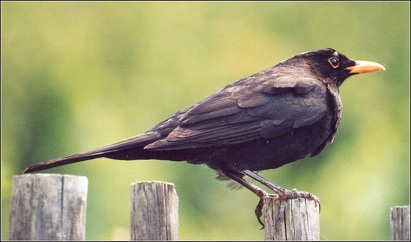
Lutosławski was the most reticent of composers when it came to acknowledging extramusical connections in his pieces, but in answer to question 2. he cites the blackbird, again in Novelette.  He says that “in the fourth movement [‘Third Event’], I have recognized the blackbird in the rhythm of the main subject as played by the violin[s] [fig.26]”.  Varga includes a reproduction of the theme (p.163), which Lutosławski wrote out for him on his Budapest hotel’s headed notepaper.  It was apparently a Norwegian blackbird!

An even more tantalising prospect is raised by Lutosławski’s second example, the opening solo flute phrases of the third movement of Jeux vénitiens (1960-61): “They do not recall the song of any particular species, yet they do make the impression of birdsong”.  The flute solo dominates this movement (written solely for the revised, Warsaw version of  Jeux vénitiens) and plays variants of nine different motifs – could its entire cantilena have some coincidental link with birdsong?  Or was a greater part or all of it an unrevealed inspiration for the composer?

This is a fascinating proposal, because all of these nine motifs also appear – again in variation, but this time superimposed – in the seven-voice woodwind texture in section A of the first movement.  Could this texture be a bird chorus?  It is surely no accident that the motif which Lutosławski picks out is the sole survivor (it’s the opening motif of the first flute part in this Warsaw version) from the discarded Venice version of section A, where it appears as the third motif in the second flute.

Bird chorus?  I am surely not the only listener to have heard echoes of Ravel’s ‘Dawn Chorus’ from Daphnis et Chloé – and even perhaps of the fantastical sylvan opening of Szymanowski’s First Violin Concerto (1916) – in the opening of Lutosławski’s Piano Concerto (1988).

This woodwind texture is also presaged in the first movement of his Trois poèmes d’Henri Michaux (1961-63) at Figs 85-89.  Listen elsewhere in this movement, to the elusive woodwind texture (again!) between Figs 35-84, and the aural equivalent of starlings flocking at dusk springs to mind.  During this section, the chorus sings of ‘Ombres de mondes infimes, ombres d’ombres, cendres d’ailes‘ (‘Shadows of infinitesimal worlds, shadows of shadows, ashes of wings’).

Such avian speculations are not as idle or as inappropriate as they might seem.  Lutosławski’s first observation in 2. is: “I do not use the sounds of nature consciously in my musical work but they must exert a subconscious influence because, when looking through the finished score, I have in the past come upon traces of them in the themes of some of my pieces”.

Which pieces might these be?  Mi-parti (1976)? Would we be looking exclusively for woodwind textures?  Not if Lutosławski’s observation about Novelette is taken into account.  So how about the String Quartet (1964)?  Or Paroles tissées (1965)?   And what of Partita (1984), Chantefleurs et Chantefables (1989-90), both composed after Lutosławski’s responses to Varga’s questions?

”Birds are sometimes genuine artists commanding respect.  Near Warsaw, around three o’clock one summer night, I heard one which possessed a breathtaking facility of variation.”

Was this Lutosławski’s epiphanic moment, akin to Szymanowski’s evocation of ‘a nightingale singing spontaneously in the fragrant May nights’?