• Lutosławski in the January pipeline

I have just been invited by the Polish Minister of Culture to join the Honorary Committee for Witold Lutosławski Year in 2013, which is an honour in itself.  I’m never quite sure what honorary committees do or are expected to do, but I promise to knuckle down and contribute as best I can.

Having just spent a few weeks preparing for last Saturday’s CD Review round-up of Lutosławski CDs on BBC Radio 3 – an hour’s discussion, live-on-air, with Andrew McGregor – I thought I’d have a few days off.  But Lutosławski continues to beckon.  So here are a few things that are coming up in the next month or so, not all of them yet accomplished.

• Around now, a German translation by Andrea Huterer of my paper ‘Lutosławski and Literature‘ (2010) will appear in ‘Witold Lutosławski. Ein Leben in der Musik’, Osteuropa 11-12 (Berlin, 2012).  This issue is being supported by the Polish Institute in Berlin.

• I’ve just written a very brief essay on ‘Lutosławski and his Performers‘ for the Polish Institute in Brussels.  It is for a Lutosławski tribute to be published in Dutch and French in January 2013 (all three versions should also be available online via www.culturepolonaise.eu).

• Also in January 2013, an interview I did a couple of months ago will appear in a centenary tribute to Lutosławski being published (in Polish) by the Wrocław Philharmonic.  The orchestra is not only named after Lutosławski but is the driving force behind the Opera Omnia series of Lutosławski CDs on the Accord label.

• On 23 January I am discussing Lutosławski’s Cello Concerto with Johannes Moser, in a pre-concert event for the Bournemouth SO, which gave the world premiere in October 1970.  This is part of the bicentenary celebrations of the Royal Philharmonic Society, which commissioned the concerto.  (The actual RPS anniversary is the next day, 24 January.)  I’m really looking forward to this encounter, at the Poole Lighthouse, between a music historian and one of the many young cellists who have taken this concerto into their repertoire.  The Lutosławski centenary falls two days later, on 25 January, when I might just pop over to Warsaw for the Polish inauguration of Witold Lutosławski Year.

• The Philharmonia Orchestra begins its Lutosławski series Woven Words on 30 January at the Royal Festival Hall in London.  Accompanying the series will be a substantial celebratory programme which includes several essays.  My ‘Parallel Lives of a Captive Muse‘ is one of them.  It’s already been published on the Woven Words website.

• Watch out for the fifth Lutosławski CD, with the BBC SO and Edward Gardner, which Chandos is releasing early in 2013 in its ‘Muzyka Polska’ series (First Symphony, Dance Preludes, Partita and Chain 2).  I’ve thoroughly enjoyed writing the booklet notes for these outstanding recordings and it’s been an(other) honour to be associated with it.

• I am currently writing a substantial profile of Lutosławski and his music for publication in late Spring 2013 (watch this space, and others!).

Well, I think those seven items are more than enough to be going on with!
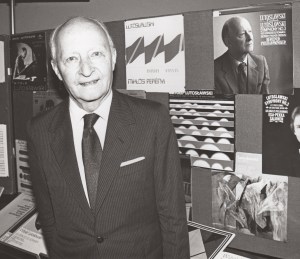
• WL100/3: Lutosławski in Belfast (gallery)

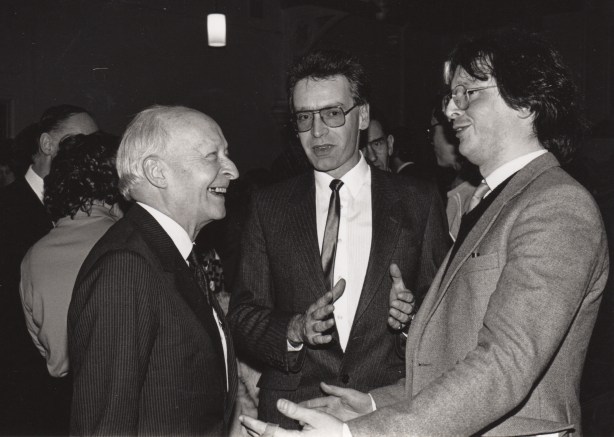
Here are a few more pictures from Lutosławski’s visit to Queen’s University, Belfast, twenty five years ago in December 1987 (see the two preceding WL100 posts).  After a concert of his chamber music on 17 December, Lutosławski spent some time looking at an exhibition of his scores and LP covers.  Lutosławski and I also had an evidently jolly discussion with my friend and colleague, the composer Piers Hellawell.

WL at QUB exhibition 17.12.87WL at QUB exhibition, with Adrian Thomas 17.12.87

WL at QUB, with Adrian Thomas and Piers Hellawell 17.12.87

• WL100/2: Lutosławski in Belfast (DMus)

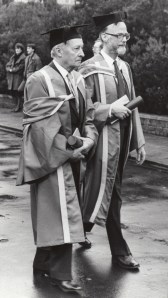
WL concert 17.12.8718 December 1987 was a grey wet day, but then it was a week before Christmas. It was, however, a special day at Queen’s University, Belfast.  My colleagues, our students and I could not have been prouder when Lutosławski stepped onto the platform of the Whitla Hall to receive an honorary DMus.  I read the citation and afterwards Lutosławski walked the short distance to the Main Building for a jovial lunch with university dignitaries.
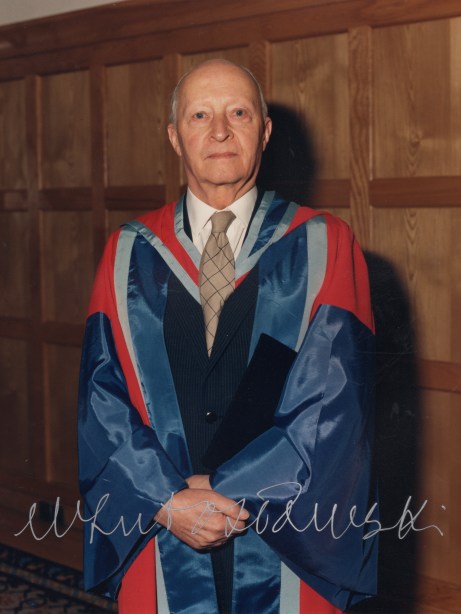
Lutosławski charmed everyone whom he met, as he always did.  The night before, he’d been present at a concert of his chamber music where relaxation and informality had been the key.  On this day, he was all robed up and solemnly posed for the camera in his doctoral garb.

When I saw him in Warsaw the following year, I took with me a host of photos from his visit which he signed for the performers and others.  I like the way he used a silver-ink pen. His was a special and distinctive handwriting, as I hope to show in other posts in 2013.

WL Hon DMus:2 18.12.87

Witold Lutosławski, Hon DMus
The Queen’s University of Belfast, 18 December 1987

• WL100/1: Lutosławski in Belfast

Twenty five years ago today, on 17 December 1987, Lutosławski paid his one and only visit to Northern Ireland.  He had come for the Winter graduation at The Queen’s University of Belfast where he was to be awarded an Honorary DMus on 18 December.  I was teaching at Queen’s at that time and the proposal that the University should recognise Lutosławski came from my colleague, the innovative social anthropologist and ethnomusicologist, John Blacking.

On the night before the degree ceremony, the Department of Music mounted a short concert of Lutosławski’s chamber music in his honour: Dance Preludes, Five Songs, Sacher Variation, Epitaph, Grave and Partita.  The performers were graduands of the University, joined by György Pauk and Roger Vignoles.  Lutosławski seemed very pleased with the occasion, and afterwards he inspected an exhibition of his scores and record sleeves (LPs in those days!) and mingled happily with the audience at a post-concert reception in his honour.

I’ll post some more pictures from the occasion in the coming days.

Witold Lutosławski at a concert of his chamber music in the Harty Room of Queen's University, Belfast, on 17 December 1987.From left to right: György Pauk (violin), Donal McCrisken (piano), Damian Frame (clarinet), Francis King (piano), Lutosławski, Colin Stark (oboe), Jacqueline Horner (mezzo-soprano), John O'Kane (cello) and Roger Vignoles (piano)

From left to right: György Pauk (violin), Donal McCrisken (piano), Damian Frame (clarinet), Francis King (piano), Lutosławski, Colin Stark (oboe), Jacqueline Horner (mezzo-soprano), John O’Kane (cello), Roger Vignoles (piano)

The programme notes for the concert may be accessed here.

• WL100

WL 17.12.87 copyToday, I’m starting a series of occasional posts to mark the centenary of the birth of Witold Lutosławski (1913-94).  These posts (also linked to a new public Facebook page Lutosławski WL100) will be an informal sequence of memories, observations and photos.  The series is intended to be both celebratory and reflective in nature, drawing together recollections, documents and images that are little known or perhaps just forgotten.
Contributions welcome – do get in touch if you have a suggestion.  

• Lutosławski: A Christmas Carol

Poland has a wonderfully rich heritage of carols.  In 1946, as the country was recovering from the devastation of World War II, Lutosławski collected together a set of Dwadzieście kolęd (Twenty Carols) for voice and piano; in 1984-89, he arranged them for soprano, female choir and chamber orchestra.

Exactly 22 years ago today (14 December 1990), in Aberdeen in Scotland, Lutosławski conducted the premiere of this second version, with Susan Hamilton, the Scottish Philharmonic Singers and the Scottish Chamber Orchestra.

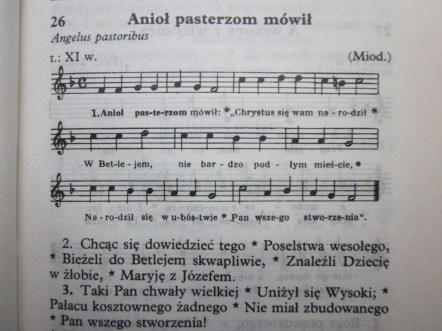
Here’s a recording of the first carol in the set, ‘Anioł pasterzom mowił’ (The Angel Said to the Shepherds).  The text is 11th-century, the music from the Śpiewnik kościelny (Church Hymnbook, 1838-53) compiled by Michał Marcin Mioduszewski.  On this recording, only verses 1 and 3 are sung.  The melody has an interesting construction of eleven bars (Lutosławski repeats the last seven).


IMG_7124 copy

• Poles launch ‘100/100 Lutosławski’

18619_437344239663934_545288166_nLutosławski year was officially launched in Warsaw yesterday under the banner ‘100/100 Lutosławski’.  A new website has been published (in Polish/English), but precise details of events are yet to be fully revealed.  I outlined the details of the Philharmonia’s splendid Woven Words website, launched in October, in an earlier post.  Here, I’ll outline what has so far emerged from Polish sources.

Websites

• http://lutoslawski.culture.pl/web/lutoslawskien  The ‘100/100 Lutosławski’ website, hosted by the Adam Mickiewicz Institute, is a companion to the one launched to mark the 75th anniversary of Szymanowski‘s death earlier this year. It currently has a three SoundCloud clips (Concerto for Orchestra, Symphonies 3 and 4), though not all the clips and the accompanying notes are credited.  There’s a short video discussion between Steven Stucky and Esa-Pekka Salonen as well as videos shared with the Woven Words website.  Its Calendar of events has still to be unveiled, and its list of Resources consists at the moment only of a short bibliography that has got as far as the letter ‘R’ (so no Stucky yet…).  No doubt the whole website will become more fully populated in the coming days and weeks.
• http://www.lutoslawski.org.pl/en/lutoslawski2013/info  This is the home of the Witold Lutosławski Society, which has existed since the late 1990s.  Like ‘100/100 Lutosławski’, it has both a Polish and an English site.  It promises details shortly.  By the way, for anyone with a short orchestral piece close to hand, the WLS is hosting a composition competition with a deadline of 25 January 2013, the 100th anniversary of the composer’s birth.  The competition’s regulations may be accessed here.

Performances

The Lutosławski components of the Warsaw Philharmonic’s forthcoming programmes have been published for some time and may be found by scrolling the Warsaw Philharmonic’s concert schedule.  Its celebrations begin on 11 January 2013.  Until the ‘100/100 Lutosławski’ Calendar is uploaded, you can find details of quite a few concerts worldwide at https://www.facebook.com/LutoslawskiCentennialCelebration, under ‘About’.

Recordings

It seems to me that it has been non-Polish ensembles and recording companies who have been taking the lead in this area of activity, notably the BBC SO under Edward Gardner for Chandos (4 CDs since 2010, a fifth on its way). Next month, Sony re-releases the Los Angeles PO/Salonen recordings of Symphonies 2-4 plus their newly-recorded version of the First Symphony.  The Polish Accord label started its Lutosławski Opera Omnia series in 2008, but there has been no further release since the third CD in 2010.  I am not privy to Polish recordings planned for release in 2013.  I am, however, very excited by the two ventures outlined below.

UnknownAs part of the official launch yesterday in the Witold Lutosławski Studio at Polish Radio and Television, the Polish National Audiovisual Institute (NInA) issued a press release (in Polish) containing the following information:

• A unique collection of recordings will be made available on the nina.gov.pl portal in the second half of 2013. All of Lutosławski’s compositions will be uploaded in at least one performance.  (As the 80th birthdays of Henryk Mikołaj Górecki (d. 2010) and Krzysztof Penderecki also fall in 2013, their music will be similarly covered by NInA next year.)  This online collection – drawn from Polish Radio archives – will be developed further in due course.  Its accompanying texts, by the late Polish Radio broadcaster and musicologist Andrzej Chłopecki, will be available in both Polish and English.

• NInA will also issue a six-disc set called ‘Lutosławski/świat’ (Lutosławski/World) – 5 CDs and a DVD – in the second half of 2013.  The vast majority of these recordings, from Polish Radio and WFDF (Documentary and Feature Film Studio), are being released for the first time.  They include archive recordings conducted by Lutosławski, and the booklet notes, many by young musicologists, promise fresh perspectives.  The project editor is Adam Suprynowicz.

What is especially interesting in the Polish context is the promise that Lutosławski’s complete output will be represented, including those works (socialist-realist pieces, film music and popular songs) which, as the press release says, ‘he himself sometimes wanted to forget’.  This promises to be a fascinating document, one which sets Lutosławski’s rich legacy of pieces and recordings in the broadest possible context.

• Jeux vénitiens: R3’s 50th Modern Classic

I’ve just caught a fine performance of Lutosławski’s Jeux vénitiens (1960-61) on BBC iPlayer (Radio).  It was from last Saturday’s Hear and Now on Radio 3, so it’ll be available for another 96 hours.  For the past year, Hear and Now has been using part of its precious hour and a half each Saturday night to highlight a composer and a work which has brought something new to music in the second half of the 20th-century.  It has been an absorbing series, with many well-known names and pieces passed over in favour of something more radical, curious or forgotten.  You can download the spoken introductions to all 50 ‘modern classics’ here.

At one stage, the producers were thinking of including Górecki’s Symphony no.3 in the roster, but in the end the only Polish piece to make it onto the list was Lutosławski’s Jeux vénitiens.  No, there wasn’t even a space for Penderecki’s Threnody, one of the iconic works from the 1960s.  Ah well.  But Jeux vénitiens is a good example of Polish experimentalism at its height (it’s contemporaneous with the Penderecki).

On the podcast, Esa-Pekka Salonen and Paul Griffiths give succinct comments, mainly on the (then new) aleatory component in his musical language, though its twelve-note harmonic aspect is not neglected.  Curiously, the words ‘aleatory’ and ‘ad libitum’ are mentioned by neither Salonen nor Griffiths (maybe ‘random’ and ‘uncoordinated’ have displaced terms which now may be thought as too unfamiliar).  Equally, ‘twelve-note’ (harmony) is notable by its absence.  It’s a pity, perhaps, that other aspects specific to the piece are given short shrift, or not mentioned at all. There is no reference to how the music develops in any of the movements (brutal intercutting in the first, accelerated superimposition in the fourth), no mention of thematic connections between the first and third movements, no notice given to the way that Lutosławski links the third and fourth movements harmonically.

It is very nice to hear Lutosławski himself talking (he, however, does mention ‘ad libitum’ and ‘aleatoric’), from an interview made with an unheard Thea Musgrave in 1973.  By that time, he had already adopted his defensive posture against being associated closely with Cage (and other ‘more radical’ composers).  He makes his point with some force in this interview, which suggests that he was already somewhat impatient with such links being made on a routine basis by commentators.  His closing comments about the future direction of avant-garde music also make for interesting listening.

The timing of this broadcast is opportune.  Not only does Jeux vénitiens complete the ’50 Modern Classics’ series, but its position looks ahead to 2013 and the centenary of Lutosławski’s birth on 25 January.  I hope he’ll receive a good hearing on Radio 3 next year, as long as Britten, Verdi and Wagner don’t hog the limelight.

• New Article (Lutosławski’s Parallel Lives)

I’ve just posted a new article – ‘Parallel Lives of a Captive Muse’ – which has been published at www.woven-words.co.uk as part of the Philharmonia Orchestra’s celebration of the centenary of Lutosławski’s birth next year.

• Lutosławski Centenary 2013: Philharmonia

We are still over two months from the actual centenary of the birth of Witold Lutosławski (25 January 2013), but things are already hotting up.  I, for one, am busy preparing copy for Belgium, Germany and the UK, and this morning I’m doing a telephone interview for the in-house magazine of the Witold Lutosławski PO in Wrocław.

But by far the most intensive preparations outside Poland – so far – have been taking place in London for the Philharmonia Orchestra’s three-concert series at the South Bank Centre in January and March next year.  The soloists are Krystian Zimerman, Truls Mørk, Jennifer Koh and Matthias Goerne.  There are also three associated chamber recitals and one orchestral concert performed by students from the Royal College of Music.  Most of the concerts place Lutosławski’s music alongside repertoire by other composers: Chopin, Szymanowski, Roussel, Ligeti and (principally) Ravel and Debussy.

And that’s not all: the Philharmonia is taking parts of its Lutosławski programme – called ‘Woven Words’ after his piece Paroles tissées (1965) – to nine other cities between February and September 2013: Tokyo, Warsaw, Modena, Oviedo, Madrid, Dresden, Vienna, Ljubljana and Berlin.  Full details of the programme and schedule may be found at http://woven-words.co.uk, but here’s a list of the pieces by Lutosławski that are being performed in London by the Philharmonia and the Royal College of Music.

Philharmonia  30 January: Musique funèbre and Piano Concerto.  7 March: Cello Concerto and Concerto for Orchestra.  21 March: Symphony no.4, Les Espaces du sommeil and Chain 2.
RCM  4 February: String Quartet.  6 February: Jeux vénitiens and Symphony no.3.  27 February: Two Studies and Bucolics.  6 March: Mini Overture, Fanfare for CUBE, Epitaph, Subito, Grave and Dance Preludes.

The Philharmonia doesn’t do things by halves.  There was a press launch in  London in late October (unfortunately while I was in Warsaw), fronted by the two men whose idea this celebration has been: the conductor Esa-Pekka Salonen, who knew Lutosławski well and has long championed his music,  and the composer Steven Stucky, the author of the eloquent Lutosławski and His Music (1981).  The Philharmonia’s website http://woven-words.co.uk is a substantial achievement in itself, with a gallery of archival photographs assembled, special films made and essays written for the occasion.

Films

Salonen and Stucky travelled to Poland in the summer of 2012.  The results may be seen in five contextually stimulating films in which they chart Lutosławski’s life and work, with archive stills and footage as well as a wealth of location shots (I liked the appearance of Blikle’s famous café in ‘World War II’!).  Some of Lutosławski’s rarely seen manuscripts are discussed (especially in ‘Stalinist Years’) and there are excerpts from the music (the main footage being of the Concerto for Orchestra).  Archive footage of the composer is also incorporated.  The widow of Władysław Szpilman (The Pianist) appears in the third film, while  Charles Bodman Rae (first two films) and Zbigniew Skowron (fourth film) also make telling contributions.

• Early Life
• World War II
• Stalinist Years
• Maturity
• In Conversation

Essays

The Philharmonia has commissioned five essays, which I understand will also appear in the programme book for the series (Steven Stucky’s insightful notes for the orchestral programmes are also presented in advance on the website).

Steven Stucky, ‘Remembering Lutosławski’
Charles Bodman Rae, ‘Lutosławski and the Scars of Wars’
Adrian Thomas, ‘Lutosławski- Parallel Lives of a Captive Muse’
Nicholas Reyland, ‘Essences and Essentials: Lutosławski’s Musical Stories’
Zbigniew Skowron, ‘Lutosławski’s Aesthetics and Their Sources’

My own essay is also available on this site here.