My preparations for and execution of my peregrinations in France prevented me from highlighting a major online resource that was launched in Poland at the end of 2013. I have been provoked into posting details now by the world premiere on 21 April of Henryk Mikołaj Górecki’s Kyrie. Although a recording has already been posted on YouTube (https://www.youtube.com/watch?v=NNuWAb_5OPk), there is also an audio file on NINATEKA: Three Composers. It can, however, take some time for the NINATEKA files to load on the in-built player, although I can’t tell if this is down to the strength or weakness of the wifi signal.
NINATEKA is hosted by Poland’s Narodowy Instytut Audiowizualny (National Audiovisual Institute) and covers a wide range of creative arts. It is a Polish-language site, with the notable exception of Trzej Kompozytorzy (Three Composers). Witold Lutosławski, Krzysztof Penderecki and Górecki all had significant anniversaries in 2013, and this initiative brings together archive recordings of their music, mostly from Polish Radio. Here you will find not only the major concert works but also smaller, less familiar pieces. There are timelines, biographies and glossaries (‘alphabet’). Tucked away is the roster of the editorial team, led by Dr Iwona Lindstedt.
The navigating tools are fairly straightforward once you have worked them out. Under ‘music’, you can pick an individual year or span of years, you can see a composer’s complete repertoire (‘all forms/genres’) or narrow it down under this same heading or in groups (scroll down ‘all categories’). You can be guided by ‘recommended’ or ‘popular’ or read the playlists suggested by musicians and family members. Or you can use ‘advanced search’ to filter by duration, instrumentation etc.. But if you want to look chronologically, you may initially be stumped. For this, you have to look higher up the page and click on ‘creative periods’.
The 2014 Presteigne Festival in mid-Wales (21-26 August) has designed a special focus on Polish music. This includes a new commission and premieres as well as sampling the music of composers such as Bacewicz, Lutosławski, Penderecki and Górecki. There is a particular emphasis on the music of Andrzej Panufnik, on the centenary of his birth. The full schedule may be found at: https://www.presteignefestival.com/PDFs/PF2014_brochure_for_web.pdf.
Here is an alphabetical-by-composer list of the Polish repertoire plus details of relevant talks and discussions (** World premiere, * UK premiere):
Grażyna Bacewicz • Concerto for String Orchestra (1948) • Two Etudes for piano (1956)
Henryk Mikołaj Górecki • Two Sacred Songs for baritone and piano (1971) • String Quartet no.1 ‘Already It Is Dusk’ (1988)
Witold Lutosławski • Dance Preludes for clarinet and piano (1954) • Grave for cello and piano (1981) • Partita for violin and piano (1984)
Paweł Łukaszewski • Piano Trio (2008) • Requiem** (2014, Festival commission)
Andrzej Panufnik • Miniature Etudes (Circle of Fifths), Book II, for piano (1947) • Landscape for string orchestra (1962/65) • Song to the VirginMary for choir(1964/69) • Sinfonia Concertante for flute, harp and strings (1973) • Love Song for mezzo-soprano and piano (1976) • String Quartet no.3 ‘Wycinanki’ (1990)
Krzysztof Penderecki • Prelude for solo clarinet (1987) • Quartet for clarinet and string trio (1993) • Serenade for string orchestra (1997)
Maciej Zieliński • Lutosławski in memoriam for oboe and piano (1999) • Trio for MB for clarinet, violin and piano (2004) • Concello* (2013)
Talks and Discussions
• Warsaw Variations (award-winning Fallingtree Production, first broadcast on BBC R4 in 2012, with contributions by Beata Bolesławska-Lewandowska, Camilla Panufnik and Adrian Thomas), followed by a discussion with Camilla and Roxanna Panufnik, radio producer Alan Hall, chaired by David Wordsworth • Pre-concert event: Roxanna Panufnik, with Stephen Johnson • Pre-concert event: Paweł Łukaszewski, with Thomas Hyde • Pre-concert event: Paweł Łukaszewski, with Adrian Thomas • Talk: Three Generations of Polish Composers (Adrian Thomas) • Pre-concert event: Maciej Zieliński, with Adrian Thomas
Last month I briefly interrupted my walk in France to return to London for the long-awaited premiere of Górecki’s Fourth Symphony (2006). I’d seen the score last year and wrote the concert programme notes before I left for France in January. I was able to sit in on the first two days of rehearsals at Henry Wood Hall, with the London PO under Andrey Boreyko. It seemed to me that Górecki’s son Mikołaj had done a superb job realising his father’s express and unspoken wishes in completing the orchestration of the work. I had a couple of very interesting conversations with the conductor, during which I pointed out some of the composer references that were in the score but which became fully apparent only during rehearsal. Yet it was impossible to form a rounded view of the work until the night of the premiere.
The audience response was fascinating. There was no tittering (as there had been at rehearsal) at the slightly strange appearance of the glockenspiel after the hammering orchestral introduction (the scoring was Górecki’s). There was total concentration throughout the symphony’s 40 minutes. And the reception at the end was enthusiastic: whoops, whistles and a standing ovation. I was particularly thrilled for Górecki’s daughter Anna, who had brought her family and friends with her from Katowice for the occasion (Górecki’s widow, Jadwiga, and his son Mikołaj, who deserved an ovation of his own, were unfortunately not able to come). I’ve not yet had a chance to read the critics’ responses, but I gather that they too have been very positive. Here’s a link to the audio:
*******
I must admit that I hadn’t been sure how it would hang together. Certainly, the ‘Tansman’ theme – extrapolated from the letters of his full name – acts as a connecting thread, but Górecki’s habit of cross-cutting between movements often blurs the boundaries. I needn’t have worried, and why should I? The strongly etched expressive contrasts carry their own weight and structures, none more so than in the ‘Trio’ section of the third movement where the attention is closely focussed on a small chamber ensemble. This substantial, yet minimised passage is the heart of the symphony and was especially telling on the night.
Where I still remain puzzled relates to the five bars towards the end of the Finale when Górecki inserts a darkly resonant reference to Siegfried’s Theme from Wagner’s Ring. As I explain in the footnote afterthoughts to my programme notes (see • (2014) Tansman, Stravinsky, Górecki), this theme does contain references to other ideas in the symphony, but they are subliminal rather than overt. The Wagner reference is given such prominence, albeit briefly, that it evidently had great significance for Górecki. Yet its function within the symphony is enigmatic, to this listener at least.
What remains with me from that night is the sheer Góreckian character of the piece. There are many familiar features as well as the unexpected ones. The forthrightness, the almost bloody-minded obstinacy, the ability to switch expressive mode dramatically, the tenderness and sense of intimacy. And that’s not to mention the sense of humour, tongue-in-cheek, daring the listener not to be po-faced.
It was terrific that The Guardian took up the suggestion to stream the video of the premiere over the following week. But where, one might ask, was BBC Radio 3 or Classic FM?
As I resumed my walk in France, the ‘Tansman’ theme kept revolving in my head, becoming my equivalent of a sea shanty, bolstering my walking rhythm as I marched onwards. A strange aftermath, I thought, but one which encapsulated the persistent strength of Górecki’s music.
Twenty years ago today I was in Warsaw preparing to present my first ever live concert, and I could hardly have chosen a more publicised event. I was at Studio S1 at Polish Radio, broadcasting to BBC Radio 3 for the opening concert of Polska!, the most extensive celebration of any nation’s culture mounted by a single BBC channel. For 18 days, from 19 November to 6 December 1993, Radio 3 broadcast over 120 separate programmes involving producers, writers, performers and broadcasters not only from the musical world but many others too: poetry, fiction, drama, art, cabaret, history, cuisine, politics.
In late 1992, I was working as Head of Music at Radio 3. I was wondering how the station might celebrate the 60th birthdays, at the end of the following year, of Krzysztof Penderecki (23 November) and Henryk Mikołaj Górecki (6 December) as well as mark the 80th birthday of Witold Lutosławski at the start of the 1993. (Little did we know that Lutosławski had already been diagnosed with cancer as Polska! began and that he would die in February 1994.) I went to discuss the idea of a festival with the Controller of Radio 3, Nicholas Kenyon, and we quickly realised that we had the resources to organise something really special, involving not only all the BBC orchestras and the BBC Singers but the other departments which contributed to the rich variety of Radio 3’s programming. If I remember correctly, it was Nicholas Kenyon who came up with the title and he was unreservedly enthusiastic and encouraging. And so Polska! was born.
Over the next 18 days, I will be posting occasionally about Polska!, its live and recorded music repertoire, its non-musical programmes, the press coverage in the UK and in Poland, and including as many direct images of press reviews etc. as possible.
Although I had left the channel at the end of June 1993, I remained deeply involved in the planning and programming of Polska! and was slated to do some of the presentation, both in Poland and the UK. Hence my ‘continuity’ presence in Warsaw on 19 November. A flavour of the musical breadth of the festival may be gathered from that evening’s five-hour opener, ‘Poland Now’ (a second blockbuster came towards the end of the festival).
The opening evening’s main feature was the live broadcast from Polish Radio 2. The first half was devoted to chamber music (I was intent on including the then-neglected Zarębski Piano Quintet, which today has a deservedly higher profile), while the second consisted of contemporary vocal repertoire (including Paweł Szymański’s recent Miserere, a commission from Polish Radio).
In the interval, for ‘A Musician’s Lot’, I talked with Szymański and two other Polish composers – Rafał Augustyn and Zygmunt Krauze – as well as to the pianist Paweł Kowalski, to Monika Strugała, one of the organisers of the choral festival Wratislavia Cantans, to Elżbieta Szczepańska, Head of Promotion at the music publisher PWM, and to Andrzej Rakowski, a professor at the Chopin Academy of Music in Warsaw and the author of a recent report on music education in Poland.
In the 45′ profile of Polish political life – still a compelling issue four years after the ‘Round Table’ conference of 1989 had restored a level of democracy to the country – Piotr Kowalczuk was joined by Krzysztof Bobiński (Financial Times), the writer and lawyer Wiktor Osiatyński and Andrzej Wróblewski (Polityka), among others.
A second recent Polish Radio commission followed – Stanisław Krupowicz’s Fin-de-siècle, introduced by the composer and performed by WOSPR (Polish Radio Great SO), conducted by Takao Ukigaya. For ‘A Composer’s Lot’, I was joined again by Augustyn, Krauze and Szymański, by three other composers, Krupowicz, Hanna Kulenty and Marta Ptaszyńska, and by Grzegorz Michalski from Polish Radio 2 and Elżbieta Szczepańska from PWM.
We were then able to draw on that year’s ‘Warsaw Autumn’ festival when Lutosławski had conducted a complete programme of his own music with the Warsaw PO (it turned out to be his last appearance on the podium in Poland). He talked with me about the Fourth Symphony to introduce the broadcast. Palester’s Adagio for Strings (1954) was performed by Sinfonia Varsovia under Jan Krenz.
The evening had begun with a specially recorded performance by Piers Lane of Chopin’s Etudes op.10 (virtually all of Chopin’s music was played during Polska! and Lane bookended the festival on 6 December with the Etudes op.25). It ended with Szymanowski’s Myths and, like every subsequent evening of the festival, the last notes were left to one or more of Szymanowski’s mazurkas.
A new collection of essays on post-war Polish music has just been published by Musica Iagellonica in Kraków. It is edited by Eva Mantzourani, who convened a conference four years ago, at the Canterbury Christ Church University in Kent, UK, under the title ‘Polish Music since 1945’. Scholars young and old came from far and wide, and this volume of 31 essays is the result of those very stimulating days in May 2009. It may be purchased at the Musica Iagellonica online shop for 85zł (c. £17/$27, plus postage). The list of contents is given below.
PART I: Polish Composers in Context
• Charles Bodman Rae: ‘The Polish musical psyche: From the Second Republic into the Third’
• Adrian Thomas: ‘Locating Polish music’
• Marek Podhajski: ‘Polish music, Polish composers 1918–2007’
• Ruth Seehaber: ‘The construction of a “Polish School”: Self-perception and foreign perception of Polish contemporary music between 1956 and 1976’
• Bogumiła Mika: ‘Between “a game with a listener” and a symbolic referral to tradition: Musical quotation in Polish art music since 1945’
• David Tompkins: ‘The Stalinist state as patron: Composers and commissioning in early Cold War Poland’
• Maja Trochimczyk: ‘1968 – Operation Danube, ISCM, and Polish music’
• Alicja Jarzębska: ‘Polish music and the problem of the cultural Cold War’
• Niall O’Loughlin: ‘Panufnik and Polishness’
• Violetta Kostka: ‘Tadeusz Kassern: Music from his American period’
• Barbara Literska: ‘The “commissioned” works of Tadeusz Baird’
• Katarzyna Naliwajek-Mazurek: ‘Paweł Szymański and the multiple narrative in music’
• Marta Szoka: ‘The music of Paweł Mykietyn: In between pastiche, deconstruction and the great narration’
• Caroline Rae: ‘Dutilleux and Lutosławski: Franco-Polish connections’
PART II: Analytical perspectives
• Beata Bolesławska-Lewandowska: ‘Lutosławski’s Second Symphony (1967) and Górecki’s Second Symphony (1972): Two concepts of the bipartite late avant-garde symphony’
• Teresa Malecka: ‘Górecki’s creative journeys between nature and culture: Around the Copernican Symphony’
• Stanisław Będkowski: ‘Wojciech Kilar’s last symphonies: Modification of a paradigm’
• Zbigniew Skowron: ‘Lutosławski at the crossroads. Three Postludes: A reappraisal of their style and compositional technique’
• Suyun Tang: ‘Lutosławski’s tonal architecture as defined by a Schenkerian tonal model’
• Aleksandra Bartos: ‘Witold Lutosławski’s Portrait of Woman 2000: New aspects of his compositional technique’
• Amanda Bayley and Neil Heyde: ‘Interpreting indeterminacy: Filming Lutosławski’s String Quartet’
• Cindy Bylander: ‘Back to the future: The interaction of form and motive in Penderecki’s middle symphonies’
• Regina Chłopicka: ‘The St Luke Passion and the Eighth Symphony Lieder der Vergänglichkeit: The key works in Penderecki’s oeuvre’
• Tim Rutherford-Johnson: ‘Theological aspects to Penderecki’s St Luke Passion’
• Agnieszka Draus: ‘Infernal and celestial circles in Paradise Lost: Milton and Penderecki’
• Tomasz Kienik: ‘The musical language of Kazimierz Serocki: Analytical aspects of his musical output’
• Iwona Lindstedt: ‘Sonoristics and serial thinking: On the distinctive features of works from the “Polish School”’.
• Anna Masłowiec: ‘The sonoristic score: Inside and outside’
PART III: Polish jazz, film music and the marketplace
• Zbigniew Granat: ‘Underground roads to new music: Walls, tunnels, and the emergence of jazz avant-garde in 1960s Poland’
• Nicholas Reyland: ‘Experiencing agapē: Preisner and Kieślowski’s Three Colours: Blue’
• Renata Pasternak-Mazur: ‘Sacropolo or Sacrum in the marketplace’
Here’s a photo taken in October 1997 (during the ‘Górecki Autumn’ festival in Los Angeles) in the house of Stefan and Wanda Wilk, the founders of the Polish Music Center at USC. I think he was trying to teach me a góral version of Chopsticks. A happy memory to soften the realisation that today is the third anniversary of his death.
Before I first went to Poland, my fellow student Jim Samson brought back from Warsaw an LP of music by Henryk Mikołaj Górecki. It blew our socks off. Released a couple of years earlier, Polskie Nagrania ‘Muza’ XL 0391 (reissued over 25 years later on Olympia OCD 385 as ‘The Essential Górecki’) contained music the like of which neither of us had heard before. There was the brief, Webernian Epitafium (1958), the explosive Scontri (Collisions, 1960), the incantatory Genesis II: Canti strumentali (1962) and the comparatively restrained Refren (Refrain, 1965). Thrilling though the first three pieces were, it was the last work that made the most profound impression. Here is that recording of 1967, by the the Great Symphony Orchestra of Polish Radio (WOSPR) conducted by Jan Krenz.
Over the summer of 2013, information emerged about the commissioning and premiere of Refren (which took place in Geneva on this date 48 years ago, Wednesday 27 October 1965, with the Orchestre de la Suisse Romande conducted by Pierre Colombo – it had been commissioned for the Centenary of the International Telecommunications Union, which was and still is based in Geneva). This little story unfolded after I was contacted in early June by the Head of the Library and Archives service of the ITU, Kristine Clara. She had come across a photograph in the October 1965 issue of the ITU’s Communication Journal and could find no further trail of the ITU’s connection with Refren. “Could I help?”.
This must be one of the strangest photographs connected with a new score. No sign of the composer, none of the conductor or orchestral musicians. Instead, there are three now-forgotten figures from the worlds of politics and the unions looking at Górecki’s manuscript (although it looks more like one of the orchestral parts than the full score). It is possible that Górecki had been invited, but I know that he was in Poland on the day that this photograph was taken and that he was ill at home on the day of the premiere six weeks later. Kristine Clara also wondered where the score was – it was not in the ITU archives. As far as I am aware, it went back to Poland, to the composer and to his publisher PWM, who brought it out in 1967. As to the commission, my guess is that it was engineered by the Polish government and its Ministry of Culture. It was a very important moment in Górecki’s life: his first foreign commission and premiere.
One piece of information that I could now furnish concerned the precise dates of Refren‘s composition. The dates that Górecki had given were May-June 1965. Having recently looked at his diaries, I was able to say that he started work on the piece on 26 April and finished it on 30 June.
As our email conversation progressed, Kristine Clara unearthed other information, this time about the premiere. The Swiss Radio listings for 27 October indicate that Refren was broadcast live.
She also came across the catalogue card for the Swiss Radio tape of the premiere, which indicated that not only was it broadcast live but, contrary to the BBC’s practice at the time, was also recorded, enabling it to be rebroadcast on New Year’s day 1966.
I have not yet been able to determine if this tape still exists. It would be fascinating to hear it, not least to verify the unexpected comment – with exclamation mark – written on the card: ‘Attention: rumeurs dans le public!’ (Warning: audience noise!).
Kristine Clara also unearthed several relevant items from the Journal de Genève – ‘de notre envoyé spécial’. This turns out to be Franz Walter, a music critic and broadcaster best known today for having interviewed the pianist Dinu Lipatti less than three months before his death in 1950 (http://www.youtube.com/watch?v=NqftMxn1PrI). Walter had been at the ‘Warsaw Autumn’ festival a few weeks before the premiere of Refren; I may come back at a later date to his two reviews of the festival in Journal de Genève (18 and 27 October). More pertinent here is his review of the Suisse Romande concert on 27 October, which appeared in Journal de Genèvethe following day (it is the only review of the premiere of which I am aware). I will pass over Walter’s enthusiastic response to the performance of Prokofiev’s First Violin Concerto by the young Claire Bernard. His response to Refren is revealing. His touchstone here was the performance he had heard in Warsaw on 23 September of Górecki’s Elementi for violin, viola and cello (1962), in a performance by Ensemble Instrumental Musiques Nouvelles de Bruxelles.
Pierre Colombo, who had shaped the concerto’s accompaniment with great care – after a Mozart symphony which I could not hear [maybe Walter was returning to the hall having just introduced the concert on air] – then presented the world premiere of a work by the Pole Henryk Górecki. The Warsaw Festival had just recently aired a string trio by this composer, a trio in which the players were induced to utter all the most incongruous and horrifying sounds that one can draw from a string instrument, yielding also to a “bruitist” mode that was very much in evidence at this recent festival. The point of such a work could only be to get on the nerves of the listener. The work which Pierre Colombo presented to us, with large orchestral forces, pursued in short the same goal, though by different means. Long chordal aggregates, tirelessly repeated and punctuated by brief… how shall I put it… gusts of wind from the brass, frantic barking from these same brass, splashes from the strings, explosions from the timpani, such is the material which furnishes Refrains [sic].
The nervous effect was produced. In the event, it found expression in laughter. But our public is not yet used to this music. Elsewhere people listen with great seriousness (and for my part with profound boredom). F.W.
There are some inconsistent aspects of Walter’s account, especially in the short second paragraph, but it is clear that he found Górecki’s new piece insupportable and gives the clue to the ‘audience noise’ mentioned on the Swiss Radio catalogue card. I wonder how widespread this laughter was. One has to marvel, though, at Walter’s response. He had heard much more rebarbative music in Warsaw a few weeks earlier, and Górecki’s Refren is not that far removed in aesthetic from Messiaen’s Les offrandes oubliées, composed 35 years earlier. It marks, as we now know, the turning point from the overt dynamism of the preceding decade to the largely contemplative mode of his subsequent music. But to contemporary ears (or at least Walter’s) it sounded as bad as the earlier pieces.
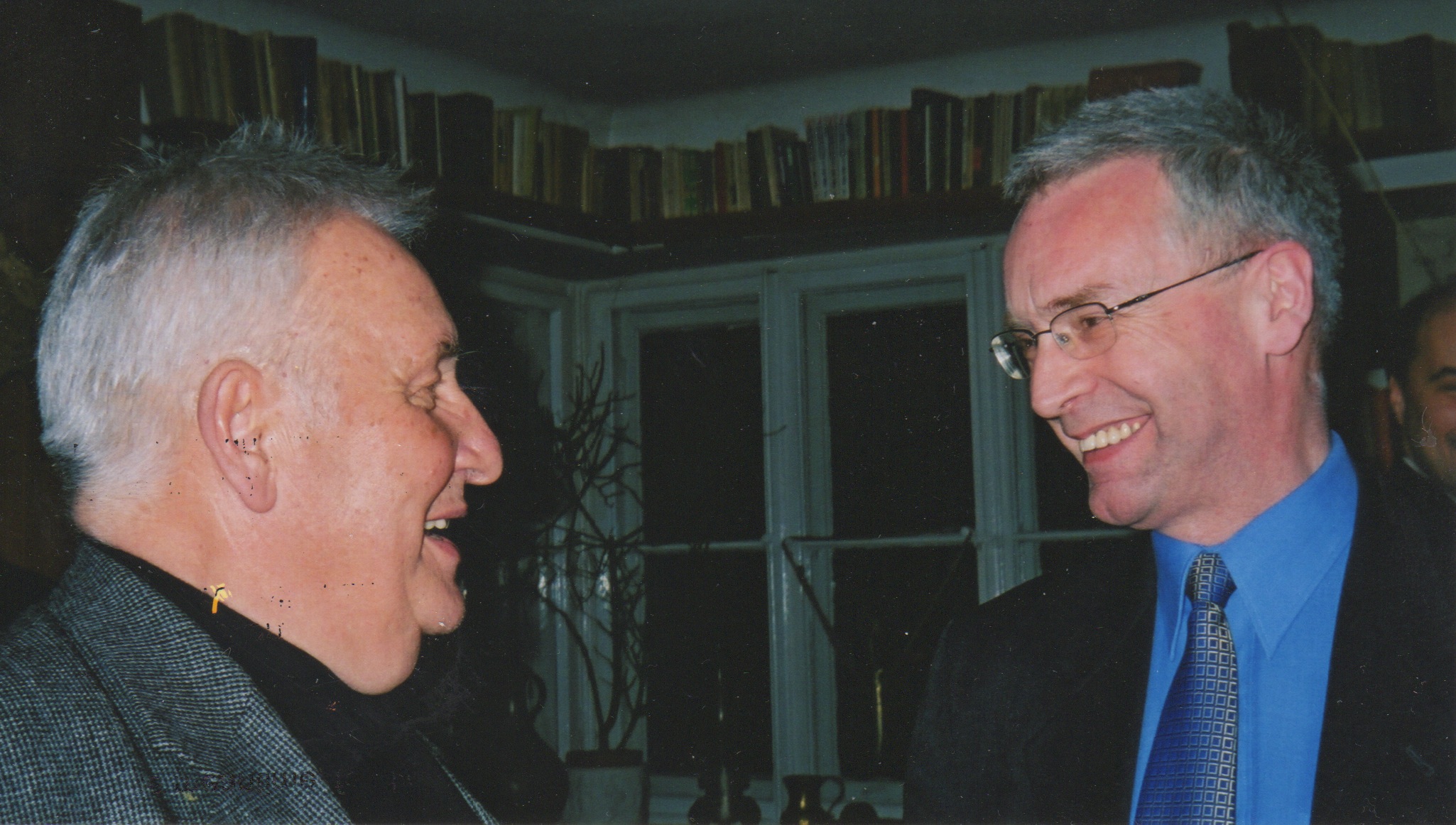
As we’re coming up to to third anniversary of Górecki’s death and the 80th of his birth, I’m going to dig out some scattered mementos over the coming weeks. Here for starters is a photograph taken in 2002, I believe, by his (then) principal contact at Boosey & Hawkes, Susan Bamert. It was taken in the Warsaw flat of a mutual friend and colleague and was used in the recently published Górecki. Portret w Pamięci. Despite some slight damage to the print in the intervening years, it captures the genuine warmth and affection that we felt for each other.
While I was in Warsaw last week, a new book was launched that goes beyond traditional reminiscences of recently departed artists. It is almost three years since Henryk Mikołaj Górecki died – he would, like Penderecki, have been 80 this year and no doubt there would have been wider celebrations of his music had he still been alive. The 2013 ‘Warsaw Autumn’, in a fit of commemoration, put on three concerts devoted to Lutosławski (Piano Concerto with Krystian Zimerman, Third Symphony), Penderecki (St Luke Passion) and Górecki (the three string quartets). This new volume on Górecki, however, is no mere commemoration. The contributors to Górecki. Portret w Pamięci (Górecki. Portrait in Memory) – all 42 of them, many of whom knew him extremely well and over many years – bring Górecki’s vivid, complex and sometimes contradictory personality back to life. Taken together, they don’t miss you and hit the wall, as the saying goes. There is a tinge of regret at the absence of his closest contemporaries, the composers Zbigniew Bujarski, Wojciech Kilar and Penderecki, and of the dedicatee and conductor of the premiere of Scontri, Jan Krenz. But the collection is nevertheless rich in telling detail.
The book’s concept and execution were down to my friend Beata Bolesławska-Lewandowska. She asks intelligent and searching questions and elicits fascinating responses, accessible to a wide range of readers. Unfortunately, it is only in Polish, so readers and contributors who do not know the language have little chance of enjoying the memories therein. An English version surely beckons.
The contributions are grouped according to the interviewees’ occupations or relationship with the composer, each section printed on different coloured paper, and each interview prefaced by a photograph of the interviewee, sometimes with Górecki. Here’s a list of the contributors and a byline on each.
• Najbliżsi (Nearest): Jadwiga Górecka (widow), Mikołaj Górecki (son, composer), Anna Górecka (daughter, pianist)
• Uczniowie (Students): Eugeniusz Knapik (composer, pianist, teacher), Rafał Augustyn (composer, critic, Polish philologist), Małgorzata Hussar (composer, teacher)
• Okiem muzykologa (In the eyes of the musicologist): Leon Markiewicz (Katowice Music Academy), Mieczysław Tomaszewski (former director of PWM, Kraków Music Academy), Teresa Malecka (Kraków Music Academy), Krzysztof Droba (Kraków Music Academy), Adrian Thomas (quite why I’m here rather than in group six I’m not sure!), Grzegorz Michalski (author, broadcaster, President of the Witold Lutosławski Society)
• Kompozytorzy i wykonawcy (Composers and performers): Włodzimierz Kotoński (composer, teacher), Zygmunt Krauze (composer, pianist), Elżbieta Chojnacka (harpsichordist), Antoni Wit (conductor), Zofia Kilanowicz (soprano), Marek Moś (conductor, former leader of the Silesian String Quartet), Father Kazimierz Szymonik (priest, conductor)
• Dania (Denmark): Louise Lerche-Lerchenborg (commissioner of Lerchenmusik), Rosalind Bevan (pianist), Teresa Waśkowska (critic)
• Wielka Brytania (Great Britain): David Atherton (conductor), Paul Crossley (pianist), Janis Susskind (publisher, Boosey & Hawkes)
• Stany Zjednoczone (United States): David Zinman (conductor), David Harrington (leader, Kronos Quartet), John Sherba (second violin, Kronos Quartet), Carol Wincenc (flautist)
• Bielsko-Biała (town south of Katowice where Górecki hosted a short festival each October; it still flourishes): Władysław Szczotka (Director, Bielsko-Biała Cultural Centre), Ewa Stojek-Lupin (pianist, portrait painter), Jacek Krywult (politician, President of Bielsko-Biała)
• Promotorzy, organizatorzy (Promoters, organisers): Andrzej Kosowski (Director of Institute for Music and Dance, former director of PWM), Joanna Wnuk-Nazarowa (MD of NOSPR – National Symphony Orchestra of Polish Radio, Katowice), Ewa B. Michalska (music manager), Andrzej Wendland (Artistic Director, Tansman Festival, Łódź)
• Interpretacje (Interpretations): Andrzej Chłopecki (✝ musicologist, broadcaster, critic), Krzysztof Zanussi (film director), Szymon Bywalec (conductor), Malgorzata and Marcin Gmys (musicologists), Mirosław Jacek Błaszczyk (conductor), Violetta Rotter-Kozera (TV documentary director)
Jadwiga Górecka unveiling the memorial to her husband.
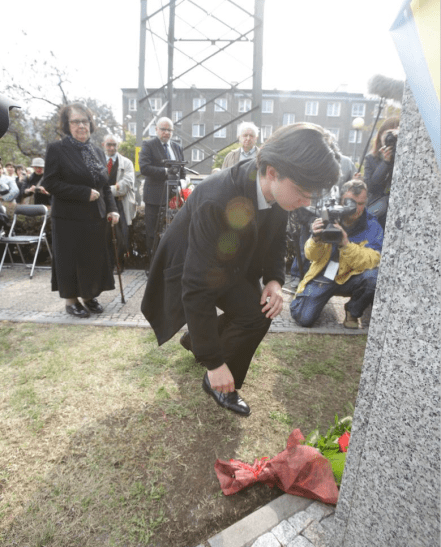
Górecki oldest grandson, after laying a bouquet at the foot of the memorial.
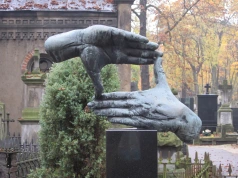
A close-up from the left side of the bas-relief – it’s a pretty good likeness!
For Arkadiusz Gola’s full online sequence of photos, you can follow this link to Katowice’s regional daily newspaper, Dziennik Zachodni. Here’s a translation of an excerpt from the accompanying report:
This year there was a choice of eleven candidates. Those nominated were Grzegorz Fitelberg – conductor and composer [one of Poland’s most significant musical figures of the last century], Andrzej Seweryn Kowalski – artist and teacher, Tadeusz Michejda – architect, Theophilus Ociepka – painter and representative of Polish naive art, Stanisław Ptak – stage and film actor and operetta singer, Bolesław Szabelski – composer, organ virtuoso and teacher [he was Górecki’s teacher too], Andrzej Szewczyk – artist, Stefan Marian Stoiński – ethnographer, conductor, composer and teacher, Witold Szalonek – outstanding composer and teacher [he also lived close by], Andrzej Urbanowicz – artist and cultural animateur, and Górecki.





 On Polish Music