• Grave matters

I’m catching up on Polish arrears, having dallied since my visit to Warsaw last month by staying in London to see Covent Garden’s Ring cycle (frankly, I might just as well have listened to it on the radio, so inept and wilfully contrary was the set design and production; the final half hour in particular was a total travesty).  And then I succumbed to a week of ‘underweatherness’ here in Cornwall, and that has meant a backlog of deadlines.

Today – 12 November 2012 – is the second anniversary of the death of Henryk Mikołaj Górecki.  Two nights ago, Polish Television broadcast a new documentary about him (Please Find, directed by Violetta Rotter-Kozera), with contributors from Europe and America, including myself.  I should have been in Katowice last Friday to see a private screening with the family, but circumstances got in the way.  I’m looking forward to seeing it in due course.

This morning, BBC Radio 3 broadcast the second movement of his Third Symphony, choosing not Dawn Upshaw’s breakthrough recording (now 20 years old), but the first ever recording, by Stefania Woytowicz with the Polish Radio Symphony Orchestra, conducted by Jerzy Katlewicz.  Upshaw and Woytowicz are two quite different singers, and I admire them both, but for me that first recording captures the excitement and extraordinary atmosphere of the late 1970s and the powerful shock that the symphony made on me and on others who were lucky enough to come across it at the time.  It was this recording, for example, that captivated the conductor David Atherton, who played a huge role in promoting it during the 1980s.

This is all a bit by-the-by.  I had intended to visit Henryk’s grave on my visit to Katowice.  Niestety, nie zdążyłem.  I did, however, manage to visit Powązki Cemetery in Warsaw last month, mainly to pay homage to particular people, but also to sample again its special atmosphere.

…….

Finding it as it was.

…….

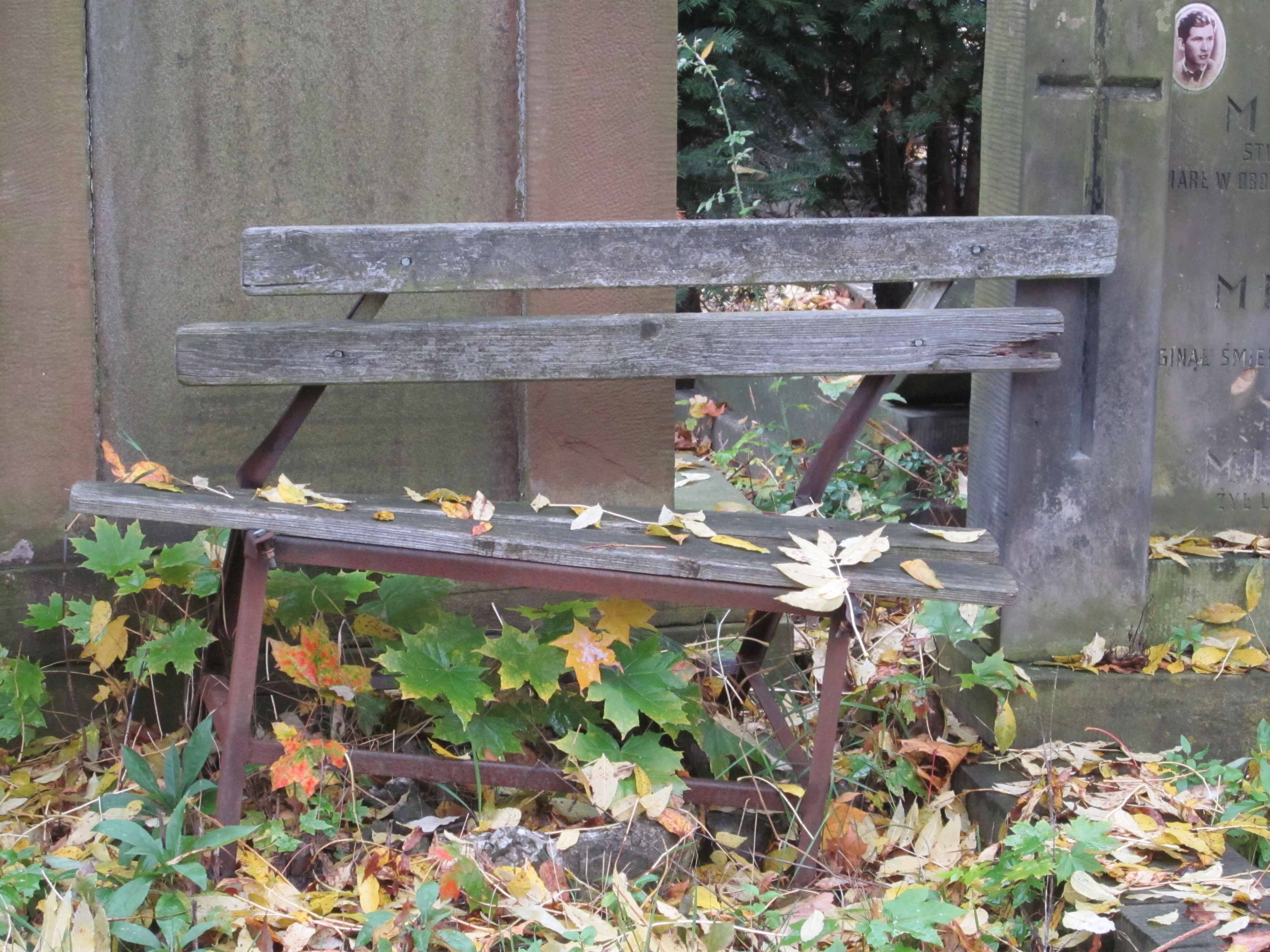
My first main port of call was the grave of my friend, the Polish musicologist and critic, Andrzej Chłopecki, who had died a month earlier.

…….

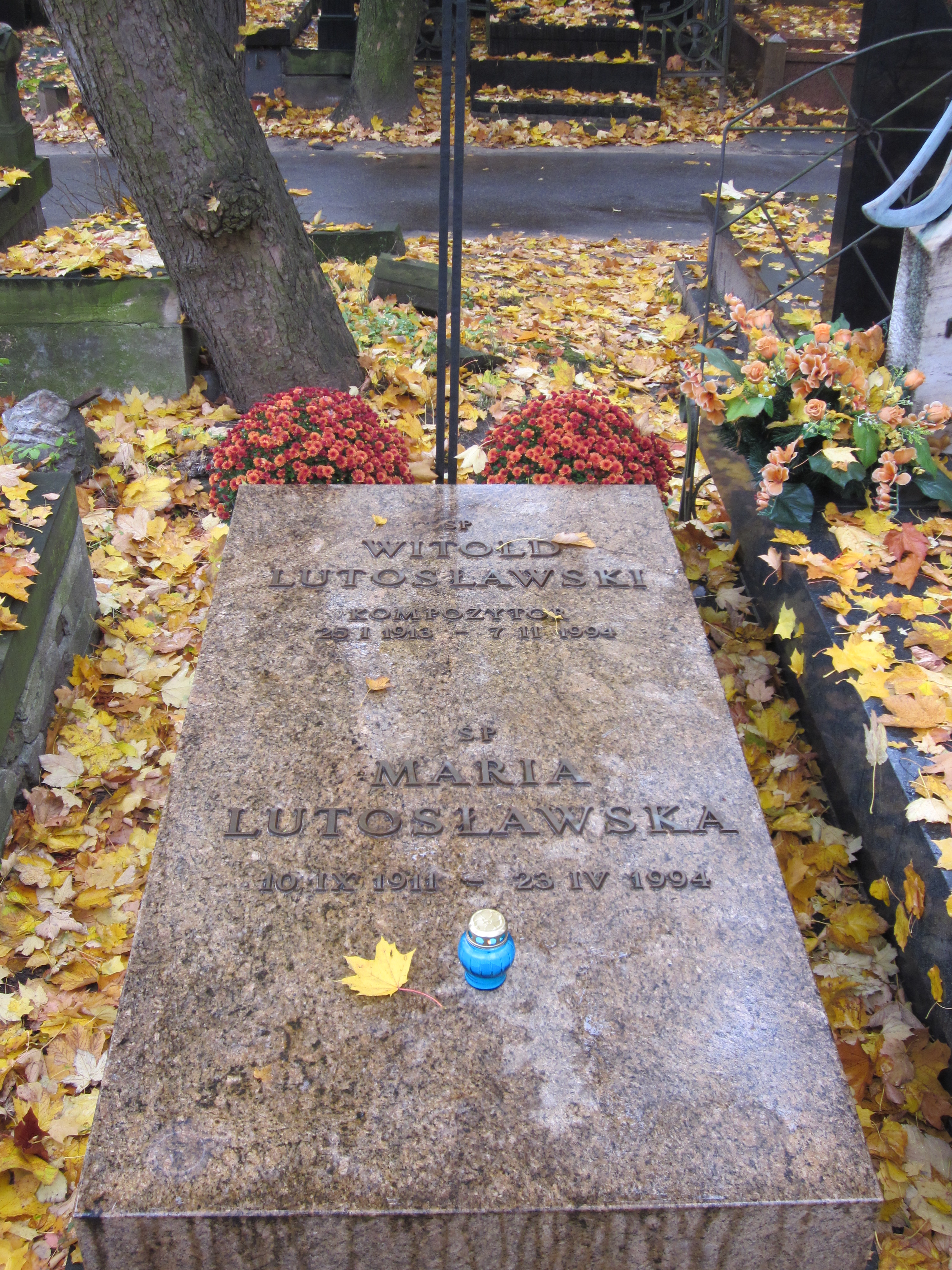
Some distance away, not far from the cemetery chapel, lie a number of composers and conductors who shaped Polish music in the second half of the twentieth century.  First and foremost, there’s the grave of Witold Lutosławski and his wife.

Here’s the grave from the rear.  I was present at his funeral and watched from this vantage point as his stepson climbed into the grave to place his urn on the floor of the chamber.  It now has a classically restrained gravestone and had evidently been attended to recently.

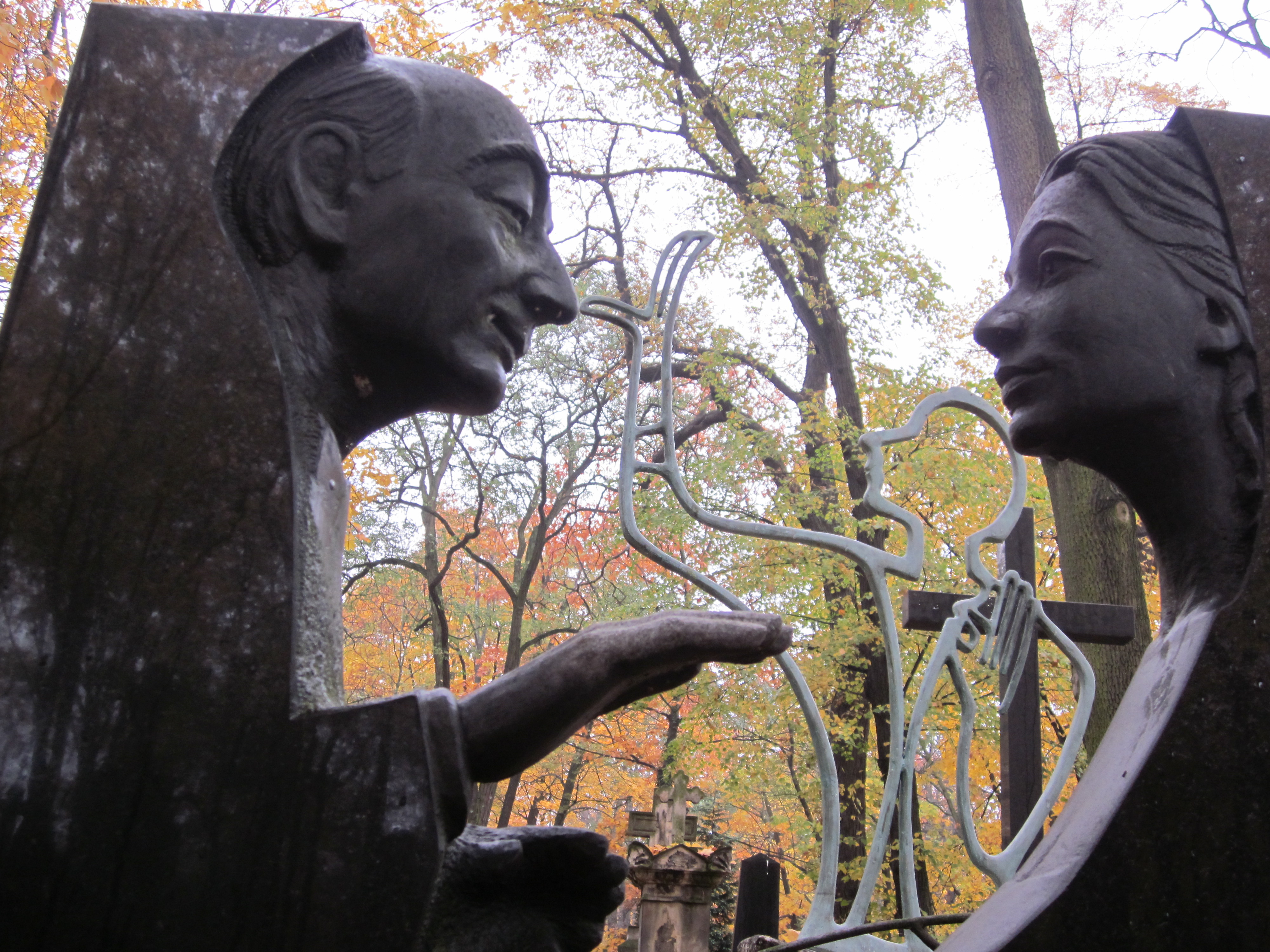
Next door lies that great champion of Polish music, the conductor Witold Rowicki. His grave is more demonstrative!

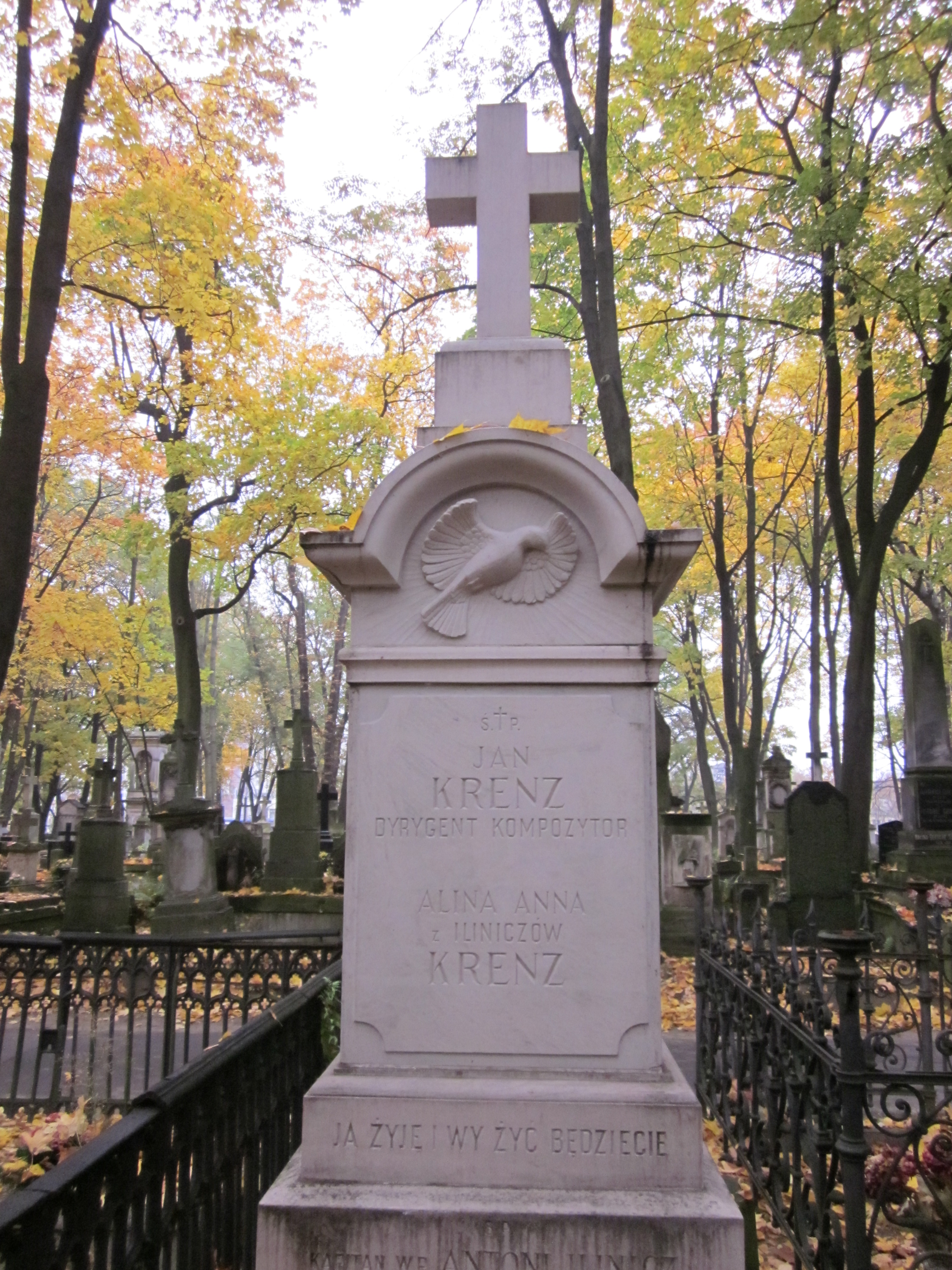
A little further to the right of Rowicki’s grave is one set aside for Jan Krenz, a champion of contemporary Polish music.  It seems strange to me (but it’s not unusual there) that such monuments are erected before death.

Behind Rowicki’s grave is that of Stefan Rachoń – a far less well-known conductor, at least outside Poland –  and his widow, the opera singer Barbara Nieman.

On the other side of the main path from these graves are several more.  Notable among them are those of Kazimierz Serocki and Tadeusz Baird, whose music deserves to be far more widely known and appreciated.  Baird, Krenz and Serocki formed ‘Grupa ’49’ as the youngest generation of composers during post-war socialist realism.

…….

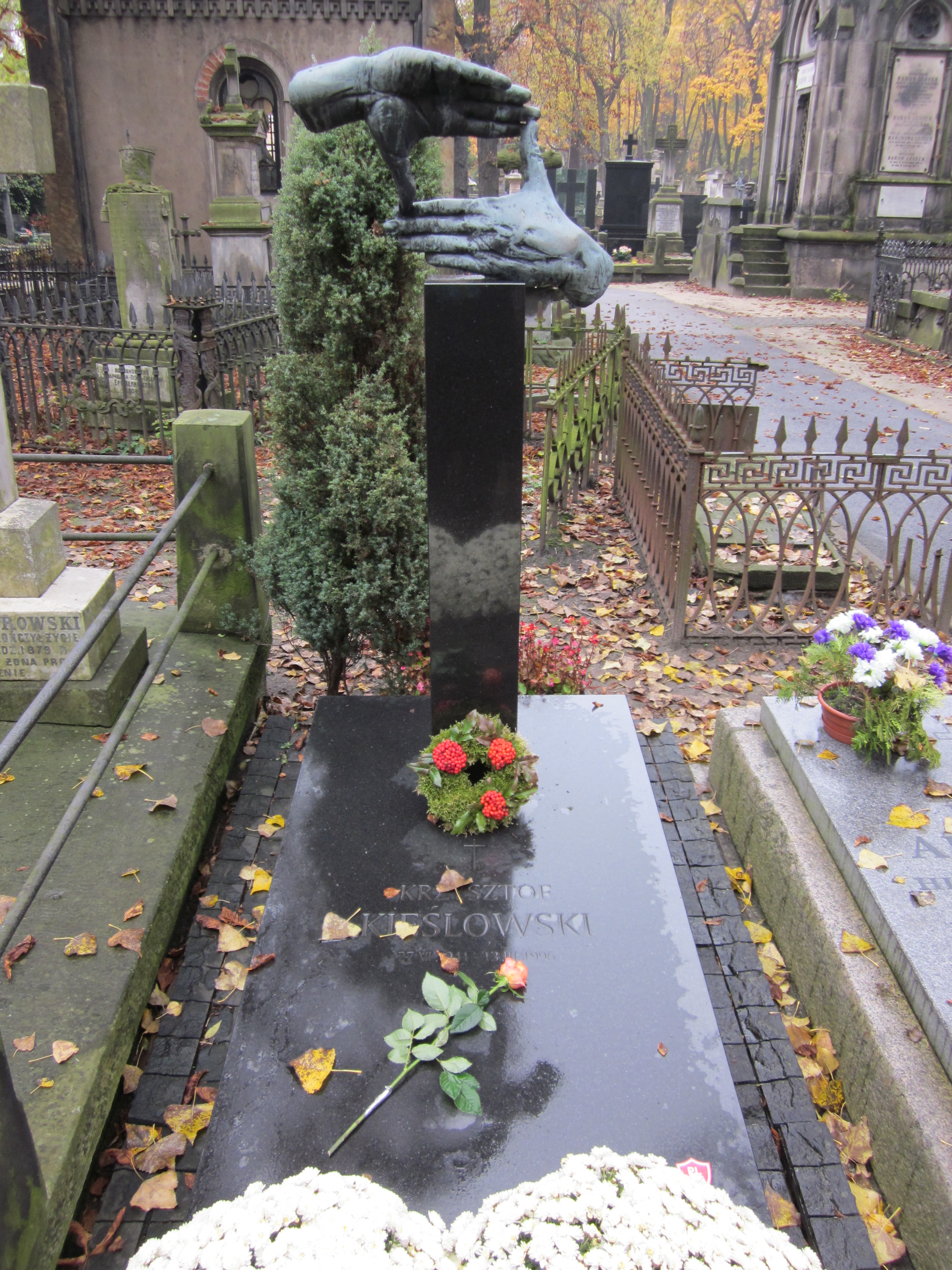
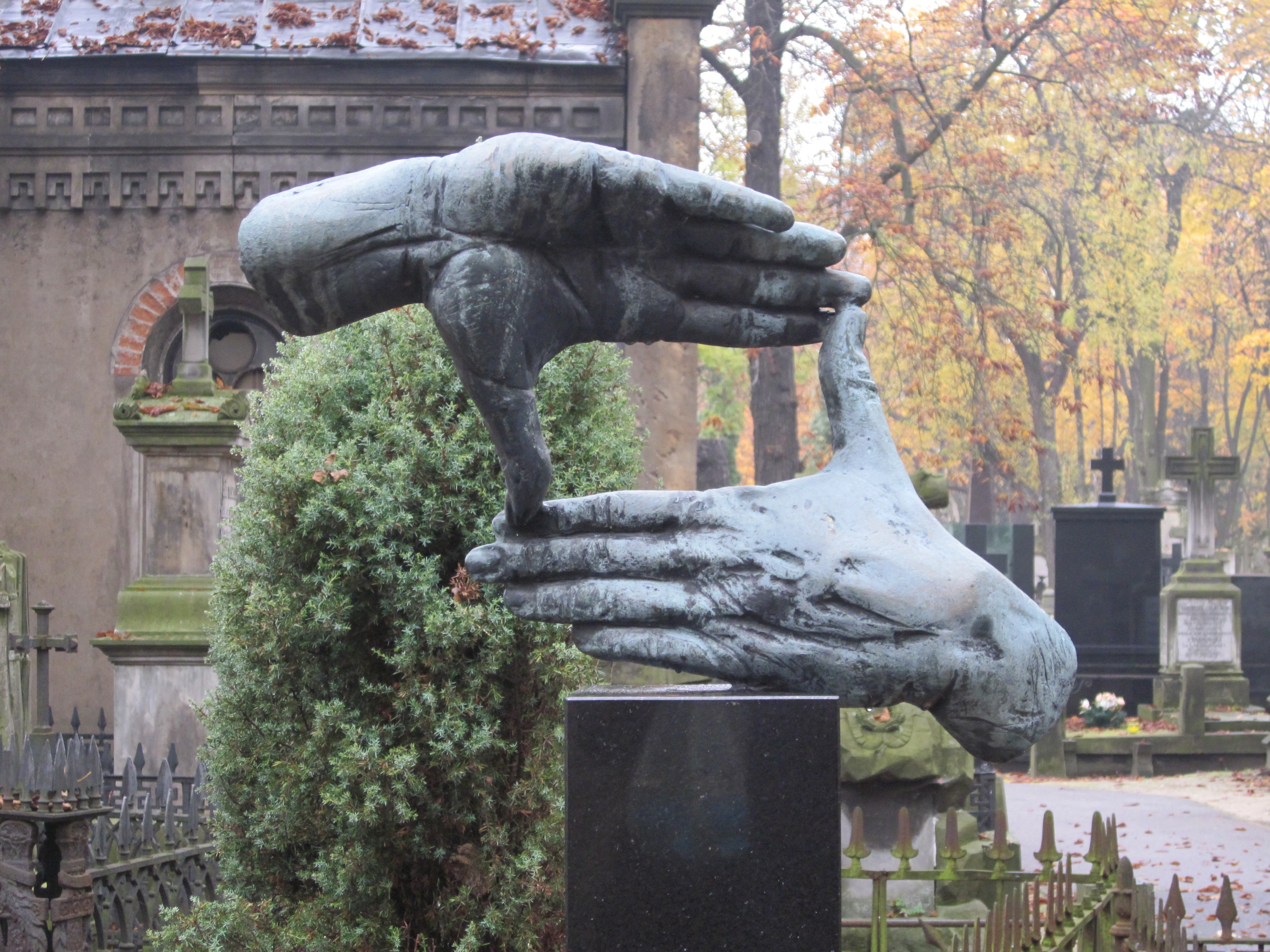
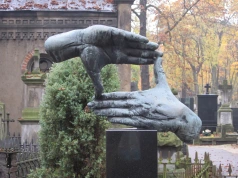
One of the most striking graves is that of the film-maker, Krzysztof Kieślowski.  If only I had his eye for framing.

• New Website for Serocki

http://www.serocki.polmic.pl

The uploading of a website devoted to the life and music of Kazimierz Serocki is hugely to be welcomed.  Serocki was one of the giants of post-war Polish music – he stood alongside Bacewicz, Baird, Górecki, Lutosławski and Penderecki.  Yet his music has languished both at home and abroad since his death in 1981 at the age of 59.  This new venture will surely do much to bring his name and output to a wider audience.  It exists in parallel English and Polish versions.

It’s hosted by the Polish Music Information Centre in Warsaw and has been brought to fruition as a partnership between the Polish Composers’ Union (ZKP) and POLMIC, facilitated by the software company Noyamundi.  The content has been created by Dr Beata Bolesławska-Lewandowska and Dr. hab. Iwona Lindstedt.  The texts have been written by Dr Lindstedt, whose most recent publication is Sonorystyka w twórczości kompozytorów polskich XX wieku [Sonoristics in the Work of Twentieth-Century Polish Composers] (Warsaw: University Institute of Musicology, 2011).

The site is easy to navigate.  There are six main sections: Biography, Timeline, Creative Output, Symphonic Frescoes, Gallery and Bibliography.  As yet, there is no Discography nor a list of recordings made or held by Polish Radio or Polish Television.  In this absence, you can find some information in one of my earlier posts, Serocki: A Severe Case of Neglect (3 March 2012).

Biography

Serocki’s biography has been broken down into four sections: Childhood and youth, In the new reality, Between Poland and the world and The composer’s personality. These are fluently written and are full of contextualised detail. There are plentiful quotations, especially in the final section’s recollections by his friends and colleagues.  It turns out the Serocki was much more of a recluse, unwilling to talk about his music, than his now more famous and younger compatriot, Górecki.

Timeline

The Timeline is divided into decades: 1922-29, 1930s, 1940s, 1950s, 1960s, 1970s and 1980-81.  While some of its material is also to be found in the Biography, there are new details, illustrations and quotes.

Creative Output

Your instincts may draw you first to the Chronological list of works. The full details of dates of composition, premiere and publication, however, and of the location of the manuscript if unpublished, are to be found under Works by genre.  The entries under Works in detail are effectively mini programme notes, but can also be unexpectedly illuminating, such as that for Swinging Music, which draws on a lecture that Serocki gave in Basel in 1976.

The main weight of this section of the website is given over to four essays: Early works (1946-56, in three parts), Intermedium: dodecaphony and pointillism (1956-60), Mature works (1961-81, in three parts) and On Kazimierz Serocki’s film music.  Those looking for analytical insight into Serocki’s music will find an entrée here.

These essays take the reader smoothly through Serocki’s career, pointing out key aspects and complementing the details held for specific pieces in Works in detail.  They provide a good foundation for anyone minded, and able, to get hold of the scores and recordings for further study (outside Poland, unfortunately, it is no easy matter to gain access to such materials).  In the essay on the early works, it is good to see that Serocki’s contribution to the genre of the mass song is addressed (this aspect of life in the early 1950s is often glossed over).  The decision to group the mature works from 1960 into ‘Notation and sound space’, ‘Poetics of sounds’ and ‘Open form’ acknowledges the three main threads in Serocki’s creative thinking.  The essay on the film music is especially welcome.

Symphonic Frescoes

This section seems incomplete at present.  The first and second movements are represented by a recording of the work’s Polish premiere (at the 1964 Warsaw Autumn) with an accompanying scrolling score.   It is a great idea that brings one of Serocki’s most brilliant works to life.  Let’s hope not only that the rest of Symphonic Frescoes will be uploaded at a future date but also that other works will be similarly treated.  This would get round the perpetual bind that is the lack of scores and recordings outside Poland.

Gallery

This has four subsections: Music, Voices, Video, Pictures.  Many of the items here appear in the earlier sections of the website.

Music: here you can listen to fragments of over 30 compositions from across Serocki’s career.  These soundbites last between one and six minutes, so you can get a good idea of not only each work but also each movement.  At some point it would be wonderful if complete pieces and movements were available.
Voices: at present, there are five friends and colleagues of Serocki whose spoken reminiscences of the composer (in Polish) have been gathered together from the archives.  The speakers are the composer Augustyn Bloch (seven extracts), the singer and author Hanna Wąsalanka, aka Sister Blanka (six), the Hungarian pianist and composer Szábolcs Esztényi (six), the composer Włodzimierz Kotoński (five) and the clarinettist Czesław Pałkowski, best known perhaps for being a member of the Music Workshop ensemble (four).  These reminiscences cover a wide range of topics, from Serocki’s famous sense of humour to recollections of Darmstadt.  There are no transcriptions or translations here, but transcriptions of excerpts from this archival sound material do appear earlier in the site, especially in Creative Output.
• Video: these are mostly short excerpts from performances at ‘Warsaw Autumn’ festivals of Episodes (1958-59), Niobe (1966), Poezje (1968-69), Fantasia elegiaca (1971-72, Ad Libitum (1973-77) and Pianophonie(1976-78).  There is also a complete performance of Continuum (1965-66), a voice-over introduction to an excerpt from Swinging Music (1970) played by Zygmunt Krauze’s Music Workshop, and a short animated filmWspaniały marsz (Splendid March, 1970) for which Serocki wrote the music.

If you want to hear complete performances of works by Serocki, several are currently on YouTube (some added quite recently), including the pieces for trombone from the early 1950s, Sinfonietta (1956), Episodes, Segmenti (1961), A piacere (1963), Symphonic Frescoes (1964), Continuum, Swinging Music, Fantasmagoria (1971) and Pianophonie.
A video of Fantasmagoria has recently been uploaded at http://www.youtube.com/watch?v=JUzWEotLN0Q, as has one of Fantasia elegiaca at http://www.youtube.com/watch?v=g4NuCcpakbU.

Pictures: these are grouped in six categories – Documents and correspondence (58), Photos (34), Printed scores (110), Music manuscripts (27), Texts (32) and Press clippings (32).  Although none of the texted items is translated here (some appear elsewhere on the site), the caption beneath each image is usefully in English. These are fascinating documents to explore, giving new insights into all periods of his public and personal life.

Bibliography

The Bibliography is almost exclusively of Polish sources, including items by the main authors on Serocki’s music, such as Tadeusz Zieliński and Tomasz Kienik, who have each published several articles.  Zieliński’s study O twórczości Kazimierza Serockiego [On Kazimierz Serocki’s Oeuvre] (Kraków: PWM, 1985) remains the only monograph on Serocki’s music.  There is also a short list of primary sources (lecture typescripts, manuscript notes) held in the Warsaw University Library (BUW).

• BBC R3 NGAs 2012: A Third Polish Quartet

A third Polish string quartet has become a member of BBC Radio 3’s New Generation Artist scheme.  The appointment of the Apollon Musagète Quartett (2012-14) follows on from the successes of the Karol Szymanowski Quartet (2001-03) and the Royal Quartet (2004-06).  Both the Szymanowski and Royal quartets have since made distinguished careers, although of the three only the Royal Quartet still seems to be based in Poland.

All three quartets are active in the recording studio.  The Royal Quartet’s CD of the three Górecki quartets (2011) has been critically acclaimed, and its follow-up CD of the quartets by Lutosławski and Penderecki is due for release early next year.  Even more imminent is the Szymanowski Quartet’s recording with Jonathan Plowright of Zarębski’s Piano Quintet and Żeleński’s Piano Quartet.  All of these recordings are on Hyperion.

I’ve not been able to find out anything about the Apollon Musagète Quartett prior to its founding in Vienna in 2006, so I don’t know what the players’ Polish roots are.  Its Polish repertoire includes works by core composers – the two Szymanowski quartets, Bacewicz’s First Piano Quintet, Lutosławski’s Quartet, Górecki’s First, Penderecki’s Der unterbrochene Gedanke and Third Quartet – and also a few surprises: Żeleński’s Variations on an Original Theme, and arrangements of a cappella choral pieces by the Renaissance composer Wacław z Szamotuł and of two piano études by Chopin.  The Apollon Musagète Quartett is due to release a CD on the Oehms Classics label next year of quartets by Lutosławski, Górecki and Penderecki.

It would be good to learn of plans by any of these quartets to take up the music of Polish composers of their own generation.  There have already been some interesting collaborations outside the standard chamber-music repertoire.  Perhaps the most intriguing venture by the Apollon Musagète Quartett has been with Tori Amos, touring with her and contributing to the Night of Hunters CD (2011).

Cue not-too-wobbly video of ‘Shattering Sea’ from a tour date at the Manchester Apollo.


• New Web Page for Marek Stachowski

A new web page for Marek Stachowski (1936-2004) has just appeared.  It’s partly in English – Biography, Works (an essay by Maciej Jabłoński), Compositions, Prizes and Awards – and partly in Polish – Kalendarium and Wspomnienie (Recollection, by Mariusz Dubaj).  Thanks to the composer and cellist Jacek Ajdinović for drawing this to my attention (his website is in Polish, but there’s an English bio at http://www.myspace.com/jacekwiktorajdinovic).

http://www.marekstachowski.pl

I have exceptionally happy memories of my meetings with Marek: at his home and at numerous concerts and festivals.  His music may have been eclipsed, like that of his fellow Cracovian Zbigniew Bujarski (b.1933), by his better-known contemporaries.  These include not only another Kraków-based composer, a certain Krzysztof Penderecki (b.1933), but also two composers from nearby Katowice, Wojciech Kilar (b.1932) and Henryk Mikołaj Górecki (1933-2010).  But Stachowski’s music is distinctive in its own right and is well worth exploring, not least for its often delicate and lyrical qualities.

This new website doesn’t (yet) have a Discography.  There is at present only one (CD-ripped) recording on YouTube, called ‘One Rose’.  It’s the concluding section from one of his first works, Pięć zmysłów i róża (The Five Senses and a Rose, 1964) for mezzo soprano, flute, xylorimba, trombone and harp, to a text by Tadeusz Kubiak.  It makes for an interesting comparison with contemporary pieces by his more famous colleagues.


• 5 Archival Polish Music Videos

Five videos of Polish music have newly been made available online.  They date from 1968-75 and are all of performances at the Philharmonic Hall in Warsaw during the annual ‘Warsaw Autumn’ festival.  There are two pieces by Lutosławski and one each by Baird, Penderecki and Serocki.  Not only can we now witness Peter Pears, Wanda Wiłkomirska and Karl-Erik Welin in action but we can also experience Lutosławski conducting his own music as well as appreciate that inspirational and tireless champion of new music, Andrzej Markowski (1924-86).  Many Polish composers owed him a huge debt of gratitude, including Baird, Penderecki and Serocki.

In chronological order of recording, these five videos are:

• Krzysztof Penderecki: Capriccio for violin and orchestra (1967).  Wanda Wiłkomirska, National Philharmonic, cond. Andrzej Markowski, 21 September 1968 (opening concert).
http://www.youtube.com/watch?v=jLYY6Knc77w
• Kazimierz Serocki: Fantasia elegiaca for organ and orchestra (1972).  Karl-Erik Welin, Sinfonie-Orchester des Hessischen Rundfunks, Frankfurt, cond. Andrzej Markowski, 28 September 1973 (Polish premiere).
Very little of Serocki’s music post-1956 is available in audio formats, let alone video, so this upload is welcome.
http://www.youtube.com/watch?v=g4NuCcpakbU
• Witold Lutosławski: Preludes and Fugue for thirteen solo strings(1972).  Chamber Ensemble of the National Philharmonic, cond. Lutosławski, 30 September 1973 (Polish premiere).
A minor frustration here: this was the first half of the concert which closed the 1973 festival.  In the second half, Lutosławski conducted Heinrich Schiff in the much-postponed Polish premiere of the Cello Concerto.  How I would love to see a video of that!
http://www.youtube.com/watch?v=Vo1pdDEeLaM
• Tadeusz Baird: Elegeia (1973).  National Philharmonic, cond. Andrzej Markowski, 21 September 1974 (opening concert).
http://www.youtube.com/watch?v=PPKxpv8gBZs
• Witold Lutosławski: Paroles tissées (1965).  Peter Pears, Chamber Ensemble of the National Philharmonic, cond. Lutosławski, 25 September 1975.
Peter Pears had been the dedicatee and first performer of this song cycle at the Aldeburgh Festival ten years earlier, on 20 June 1965This was not its Polish premiere, but it was the only time that Pears sang it there.
http://www.youtube.com/watch?v=czUDDNjwo_Q

• Yours for only £1131/$1767 …

No author likes being remaindered, but this Amazon ad (sent to me by Raymond Yiu) is absurd.  What planet are they on?  £1131/$1767?  That’s £11/$17 dollars per page.

My extremely modest little paperback study, Grażyna Bacewicz: Chamber and Orchestral Music, was published in Los Angeles in 1985, and remains the only book in English that explores Bacewicz’s music in any detail.  I’ve no idea what the print-run was, though it wouldn’t have been large.  Scarcity is one thing, but imagining that anyone would pay anything over the list price (c.£11/$17 – equivalent to a single page at this ad’s rate) is plain ridiculous.

There is another used copy on Amazon, on sale for $350, which is preposterous in itself.  If anyone interested in Bacewicz’s music would like to see what I sketched out in 1985, just get in touch and I’ll see what I can do.

…….

Another friend, Justin Geplaveid, alerted me this week to a Polish TV documentary on Bacewicz, made in 1999 to mark the 90th anniversary of her birth and the 30th of her death.  It’s an old-style, chronological account, and none the worse for that.  It is in Polish only.  Even so, much can be gleaned about her life and work.  There are plentiful excerpts from an interview with her sister Wanda and appearances by her teachers Kazimierz Sikorski and Nadia Boulanger. Keen observers will also glimpse Lutosławski, Mycielski and Serocki in company with Boulanger and Bacewicz.  There are some home movies and, most importantly, excerpts of live performances of her music.  There is a full list of performances and performers at the end of the film.

Included in these archive performances are Divertimento (1965), Witraż (1934), Violin Concerto 1 (1937), Oberek (1949, Grażyna Bacewicz, with her brother Kiejstut), Concerto for String Orchestra (1948, the first movement in a compilation of recordings, including one conducted by Yehudi Menuhin), Olympic Cantata (1948), String Quartet 4 (1951), Symphony 3 (1952), Music for Strings Trumpet and Percussion (1958), Musica sinfonica (1965, as a ballet), The Adventure of King Arthur (1959, radio opera), String Quartet 7 (1965) and Violin Concerto 7 (1965, conducted by Krzysztof Penderecki).

• Zanussi, Wajda and Michniewski on Kilar

As a little supplement to my earlier post today on Kilar at 80, here are two interviews I’ve since discovered by the film directors Krzysztof Zanussi and Andrzej Wajda.  They’re in Polish but with excellent English subtitles.  It’s interesting to observe the different ways in which Zanussi and Wajda talk about their frequent collaborations with Kilar.  Zanussi speaks touchingly and intelligently, referring to Kilar by the semi-formal ‘Pan Wojciech’ (Mr Wojciech).  Wajda is revealing in other ways, freer and more relaxed, and uses the more familiar ‘Wojtek’.

The interviews also offer glimpses of some of the films.  In Zanussi’s case, the excerpts are fairly brief: Struktura kryształu (The Structure of Crystal, 1969), Iluminacja (Illumination, 1973), Brat naszego Boga (Our God’s Brother, 1997).  The excerpts in the Wajda interview are a bit longer: Ziemia obiecana (Land of Promise, 1974), Kronika wypadków miłosnych (Chronicle of Amorous Events, 1986) and Pan Tadeusz (Mr Thaddeus, 1999).  Both accounts display Kilar’s mastery of the complementary score, sometimes in the most minimal way, an approach which often pays dividends in the cinema.

Both interviews have been recently uploaded by the Polish Music Publishers, PWM Edition, as part of its celebration of Kilar’s life and work.  There are also YouTube interviews with two Polish conductors: Antoni Wit (who has recorded several CDs of Kilar’s work for Naxos and other labels) and Wojciech Michniewski.

The interview with Michniewski, who has a background as a composer, is particularly engaging.  He gives a fascinating and anecdotally rich account of his connections with Kilar, concentrating on Orawa (1986) and Siwa mgła (Grey Mist, 1979), including the delightful inscriptions that Kilar wrote in his copies of these scores.

• Kilar at 80

Wojciech Kilar (photo from the 1970s?)

Wojciech Kilar is one of the stayers of Polish music.  He turns 80 today. Of his fellow internationally-known composers, only Witold Lutosławski (1913-94) has reached the same milestone.  Two months ago, the Polish president awarded Kilar the country’s highest honour, the Order of the White Eagle.  I hope that this is not an omen of mortality, as its conferral on both Lutosławski and Henryk Mikołaj Górecki took place when they were on their deathbeds.  Equally, I’m not anxious to mark this event with anything like an obitual ode, and I’ll draw a polite veil over Kilar’s concert music of the last twenty years or so.

Although many other Polish composers have written film music, Kilar is undoubtedly the best-known, with well over 100 film scores to his credit (his first was in 1958).  He’s worked on a wealth of Polish films, such as Kazimierz Kutz’s Sół ziemi czarnej (Salt of the Black Earth, 1969), Krzysztof Zanussi’s Struktura kryształu (The Structure of Crystal, also 1969), Andrzej Wajda’s Ziemia obiecana (The Promised Land, 1974) and Krzysztof Kieślowski’s Przypadek (Blind Chance, 1981).  Kilar became internationally famous for his work on English-language films, such as Francis Ford Coppola’s Bram Stoker’s Dracula (1992) and Jane Campion’s The Portrait of a Lady (1996).  He has a gift for a catchy melodic hook, like that which haunts his score for Roman Polański’s The Pianist (2002).

Kilar’s concert music follows a similar trajectory to those of his Polish contemporaries, at least from the 1950s through to the 1980s.  It’s not often realised, however, that he was known as an up-and-coming talent several years earlier than Krzysztof Penderecki and Górecki, who were born just a year later.  His music of the early-mid 1950s unsurprisingly shows a neoclassical bent (Horn Sonata, 1954; Little Overture, 1955).  After his Ode in memoriam Béla Bartók (1957), he seems to have taken a compositional breather, while other composers were sorting out their responses to the Western avant-garde in public at the new, ground-breaking ‘Warsaw Autumn’ festivals.  Kilar stormed back in the fourth, fifth and sixth festivals in 1961-63 with Herbsttag (1960), Riff ’62 (1962) and Générique (1963).

Although they challenged the audiences, these scores were quite different to those of Penderecki and Górecki. Kilar’s music was more febrile, less obviously unified, less closely wedded to the sonoristic movement of his contemporaries.  It was lighter than Górecki’s equivalent pieces (Elementi, 1962) and less homogenous than Penderecki’s, as the jazz and rhythmic components in Riff ’62 shows.  For a while in the late 1960s, Kilar seemed close to Górecki (they both lived and worked in Katowice) as they moved towards a more consonant idiom, but their paths started to diverge.

I once characterised their differences as Kilar preferring the major third while Górecki went for the minor.  This pat observation has a certain element of truth, in the sense that Kilar developed a sweeter compositional tooth than Górecki.  This is borne out when comparing two works from 1972: Kilar’s Przygrywka i kolęda (Prelude and Christmas Carol) and Górecki’s Second Symphony ‘Copernican’.  Kilar was the first (after Zygmunt Krauze’s Folk Music, 1972) to plunge wholeheartedly into the world of folk culture, and in 1974 he came up with a stunner that remains one of his most-performed orchestral works.


Krzesany (Sparking Dance) is a vigorous re-imagining of one of the Polish highlanders’ most characteristic dances. It’s hard to realise 40 years on how refreshing and jovial this piece was, bringing together as it did elements of sonorism and national music.  Polish folk music, which twenty years earlier had been somewhat tainted among composers for its role in promoting communist socialist realism, had been released by Krauze and Kilar.  For my money, Kilar’s Orawa for strings (1986) is a more successful and if less obviously colourful example, and I remember having great fun when conducting it many years ago, though the players had to work harder than I did!  There are two intervening symphonic poems which also draw inspiration from the Podhale region north of the Tatra Mountains – Kościelec 1909 (1976; the title refers to the mountain where the composer Mieczysław Karłowicz met his death by avalanche) and Siwa mgła (Grey Mist, 1979).

With Bogurodzica (Mother of God, 1975), Kilar got into his stride with religious contextualisation or historical memorialisation.  Subsequent pieces include Victoria (written for Pope John Paul II’s second visit to Poland), Angelus (1984), Piano Concerto (1997), Missa pro pace (2000) and September Symphony (2003, his response to 9/11).

The most notorious of these pieces was Exodus (1981).  Krzesany had created a sensation at the 1974 ‘Warsaw Autumn’, and Exodus did likewise at the 1981 festival. This was at the height of the Solidarity movement and just three months before the imposition of martial law, so Kilar’s reference to the Old Testament story accumulated contemporary symbolism.  Here, the ‘major third’ aspect of Kilar’s aesthetic came to the fore, allied to a Boléro-like structure.  And there’s no doubting the filmic aspect too – it’s as if Kilar was writing for  a Hollywood biblical epic.  I was present at the premiere in the Philharmonic Hall in Warsaw.  The audience became very excitable, provoked by the repetitious refrain (some even joining in), and as Exodus reached its final choral-orchestral flourish, someone next to me let out a loud ‘Mehhhhhhh’.

Here’s a video put up yesterday by the Polish Music Publishers, PWM Edition.  It’s a live performance of BogurodzicaAngelus (starting at 11’08”) and Exodus (starting shortly after 31’55”).  (Warning: there are virtually no gaps between pieces in this tightly edited video.)   The concert was given on 1 May this year in the presence of the composer at the monastery church at Częstochowa, where Kilar has long had a private retreat.

Whether by design or in naivety, Kilar’s music of the past 40 years has divided audiences as violently as the parting of the Red Sea.  In his pared-down, transparent pieces since 2000, some hail him as having a mystical link – through his music – to the Almighty.  Others see an updated version of the story of the Emperor’s New Clothes.  But no-one can accuse him of not following his compositional instincts, and his music continues to touch audiences and film-goers across the world.

• Górecki’s ‘Ad Matrem’ premiere on video

Once again I’m indebted to the eagle eyes of Tim Rutherford-Johnson (http://johnsonsrambler.wordpress.com/) who tweeted yesterday (https://twitter.com/#!/moderncomp) about a YouTube video he’d discovered of the premiere of Górecki’s Ad Matrem.  It’s a black and white film made by Polish Television on 24 September 1972 at the final concert of that year’s ‘Warsaw Autumn’ festival.  The venue was the National Philharmonic Hall, with Stefania Woytowicz and the National Philharmonic SO and Choir conducted by Andrzej Markowski.  It’s a bit of a shame that the film cuts out just before Górecki came onto the stage to acknowledge the applause.


The Górecki concluded the concert, and therefore crowned the festival.  Ad Matrem was preceded in the programme by a typically eclectic festival mix of repertoire: Schoenberg’s Five Orchestral Pieces, Tomasz Sikorski’s Holzwege (Paths to Nowhere, premiere), Franco Oppo’s Digressione (Polish premiere) and Penderecki’s Partita (also a Polish premiere), with soloists Felicja Blumental and Terje Rypdal.*

Woytowicz went on to give the premieres of Górecki’s second and third symphonies as well as O Domina nostra, which was dedicated to her.  (She also sang Lutosławski’s Lacrimosa at his funeral in 1994.)

Markowski was a great supporter of Górecki’s music, having given the premiere of his Epitafium at the second ‘Warsaw Autumn’, in 1958, and conducting several subsequent premieres: Little Music II (‘Warsaw Autumn’, 1967), Wratislaviae gloria (Wrocław, 1969), Old Polish Music (‘Warsaw Autumn’, 1969) and the Second Symphony with Woytowicz (Warsaw, 1973).  Markowski was a passionate advocate not only of Górecki’s music but also that of other contemporary composers from home and abroad.  Something of his character may be gleaned from the fact that he fought in the Warsaw Uprising of 1944 as a member of the Polish underground Home Army.

Górecki’s Ad Matrem (1972) is a powerful and lean work.  The chorus utters only two words (‘Mater mea’), just twice in the early stages. The music’s trajectory, from pulsing bass drums, through these interjections and on to a luminous dominant thirteenth and beyond, is very striking, not least because Górecki places these textures sparingly.  The soprano does not sing her four words (‘Mater mea, lacrimosa dolorosa’) until the closing bars.  I’ve often thought of this approach as painterly in the sense that Patrick Heron, for example, created abstract paintings with a huge swathe of one colour at one end of the canvas but very telling and contrasting colour-blocks at the other end or in isolated patches in between.

* Despite Ad Matrem being one of the most unconventionally moving and striking of Górecki’s works, it has remained largely unrecognised outside Poland, even though it won First Prize at the UNESCO Composers’ Rostrum in Paris in 1973.  In the UK, it took the initiative of the British composer John Casken to bring about the UK premiere. This took place, performed by students at Manchester University under his direction, in December 2002, a full thirty years after its premiere in Warsaw.

Serocki: A Severe Case of Neglect

If by its deeds a country disposes of or ignores its heritage, it can hardly expect that heritage to be known or appreciated abroad.  And when composers die, it’s a truism that their music often slips from the concert hall or the airwaves.  Some buck the trend: Lutosławski hasn’t done too badly since he died in 1994, and it’ll be interesting to see how much is made both in Poland and, more particularly, abroad, during the centenary of his birth in 2013.  Not that I’m that fixated on anniversaries, but they are a useful tool for the celebration, or to remind us, of somebody or something which has fallen by the wayside and been forgotten.  Such is the case with Kazimierz Serocki (1922-81).

Today – 3 March 2012 – is the 90th anniversary of Serocki’s birth.  Any sign of a commemoration in Poland?  None that I can see.*  Anywhere else?  Nope.  On the other hand, Witold Szalonek, who was born on 2 March, was accorded an 85th-anniversary concert in Katowice last night, and thoroughly deserved it was too.  But nothing for Serocki, it seems.  Even the author of the one major  book on him, Tadeusz A. Zieliński, has now gone – he died a week ago.  Symptomatic of Serocki’s disappearance from view was the total absence of his music from a large-scale American public radio festival of Polish music in January (see my post of 25.01.12).  For someone who had been at the epicentre of Polish musical life for over 30 extraordinary years, this was cruel.

* The only immediately forthcoming performance that I have been able to locate is of the orchestral Dramatic Story (1970), one of his most persuasive and inventive pieces.  It’s being played in three weeks’ time,  on 23 March 2012, in the inaugural concert of the ‘Poznań Spring’ Festival of Contemporary Music.

Serocki’s imaginative, experimental, avant-garde and often witty output from the late 1950s onwards has also been largely ignored by the record industry, even before the advent of CDs.  The pat answer for this neglect might be that he died prematurely, aged 58. Had he lived into the digital age, I am convinced that he would now be better known. A more complex response would revolve around the nature of his output, which remained wedded to the experimental ethos of the 1960s, even at the end of his life when other composers around him were moving with the times and rounding off the edges of their radicality.

Commercial CDs

• 1951: Piano Concerto, DUX 0651 (rec.1999)
• 1952: Suite of Preludes for piano, nos 2-4, OCD 316 (1973)
• 1953: Suite for four trombones, BIS CD-694 (1994)
• 1953: Trombone Concerto, BIS CD-538 (1991)
• 1954: Sonatina for trombone and piano, Crystal CD 380 (1978), BIS CD-318 (1985)
• 1956: Sinfonietta for two string orchestras PNCD 474 (1959) – the last of Serocki’s neoclassical pieces

• 1963: A piacere for piano, AP 0016 (1999) – an open-form piece
• 1966: Continuum for six percussionists, OCD 324 (1982) – a spatial anticipation of Xenakis’s Persephassa

…….

Rather than launch into a detailed account of his music, here are some links which will give you some idea of his life and music.  You can judge for yourself.  By following them, you will be contributing to the dissemination of Serocki’s dynamic and distinctive music, so thank you!

YouTube

A larger number of works both pre-1956 and afterwards has been uploaded than is available on commercial CD. (There is a choice of amateur and professional performers of the early, neoclassical-based repertoire.)  The list of uploaded music from 1956 onwards is still meagre (only one of the seven pieces below is a true video file).

• 1956: Sinfonietta http://www.youtube.com/watch?v=BIkH6Dp7m5c (see CD recording above)
• 1959: Episodes for strings and three percussion ensembles http://www.youtube.com/watch?v=UHy7sTSsI_c (unknown source, possibly LP: XL 0267) – a key work in the development of spatial music in the 1950s and 60s
• 1961: Segmenti for ensemble http://www.youtube.com/watch?v=9XhpblSJmew (unknown source, possibly LP: XL 0267)
• 1964: Symphonic Frescoes http://www.youtube.com/watch?v=u14yrb6BDGI (from LP: XL 0267) – one of his most extrovert pieces
• 1966: Continuum http://www.youtube.com/watch?v=86BE0zrQ1B4 (see CD recording above)
• 1970: Swinging Music for clarinet, trombone, cello and piano http://www.youtube.com/watch?v=4-hS4nkg-dE (this is the only video in this list: the performers are the miXte Ensemble, and it was uploaded just five weeks ago) – probably his best-known and most frequently performed piece, a send-up of the extended instrumental techniques of the time, but in a foreign idiom. I’ve performed this myself (piano), and it’s good fun.
• 1978: Pianophonie for piano, electronics and orchestra [in three uploads:] http://www.youtube.com/watch?v=t_QPPkB7lkUhttp://www.youtube.com/watch?v=RuPFPh45yx0http://www.youtube.com/watch?v=w5FF5WxoQLc, [or in a single upload:] http://www.youtube.com/watch?v=eJt5zotNk10 (from LP: SX 1850) – with electronic manipulation of the solo piano part

Online Information

• http://www.usc.edu/dept/polish_music/composer/serocki.html
• http://www.unsungcomposers.com/forum/index.php?topic=1999.0
• http://www.pytheasmusic.org/serocki.html
• http://www.culture.pl/web/english/resources-music-full-page/-/eo_event_asset_publisher/eAN5/content/kazimierz-serocki