• WL100/69: Livre, **18 November 1968

The now-neglected jewel in the crown of Lutosławski’s orchestral music was premiered on this day in 1968, by the Hagen City Orchestra, conducted by Berthold Lehmann, to whom it is dedicated.  Had Lutosławski had his way (as Nicholas Reyland has revealed), he would have changed the title from Livre pour orchestre to Symphony no.3, which undoubtedly would have placed it quite differently within his oeuvre and raised its external profile, especially today. But Lutosławski’s change of heart came too late – the publicity was already out in Hagen.

The performance and recording history of Livre is odd.  Speak to anyone who knew Lutosławski’s music during his lifetime and they are more than likely to place Livre in the top five of his orchestral pieces, if not at the pinnacle.  Yet, there have been only seven commercial recordings to date (another – the first for over 15 years – is due shortly in the Opera Omnia series from the Wrocław Philharmonic).  This compares unfavourably with the 18 accorded his next piece, the Cello Concerto.  Bizarrely, the otherwise superlative Chandos series by the BBCSO under Edward Gardner ignored Livre, which is a shame, not least because Lutosławski performed it with the BBC SO on three occasions (1975, 1982, 1983 – BBC Proms).  Lutosławski conducted Livre at least four more times in the UK (not including programme repeats), with the Philharmonia Orchestra (1981, 1989), with the Royal Academy of Music SO (1984) and with the Hallé Orchestra (1986).

This centenary year, Livre has continued to languish in the shadows when compared to the number of performances of his other major orchestral works.  His publisher, Chester Music, itemises just two performances, which is nothing short of scandalous: 30 January, Warsaw PO/Michał Dworzyński, and 17 November (yesterday), Duisberger Philharmoniker/Rüdiger Bohn.  Mind you, Chester’s list of recordings is incomplete, listing just three.  Here is the full list (giving the original record label), as far as I can ascertain.  Only the recordings by Lutosławski, Herbig and Wit seem to be available currently on digital formats.

• National PO, Warsaw/Jan Krenz (Polskie Nagrania, 1969)
• National PO, Warsaw/Witold Rowicki (Polskie Nagrania, 1976)
• WOSPR (now NOSPR)/Witold Lutosławski (EMI, 1978)
• Berlin PO/Günter Herbig (Eterna, 1979)
• Eastman Philharmonia/David Effron (Mercury, 1981)
• WOSPR (now NOSPR)/Jan Krenz (Adès, 1988)
• PRNSO/Antoni Wit (Naxos, 1998)

…….

1454688_661788100528035_2044002059_nHere is an audio recording of Livre, digitised by my friend Justin Geplaveid (who also provided the performance details), from a concert given on 16 August 1972 in Munich as part of the Olympic Games or on the following day in Augsburg.  The players were the UNESCO Jeunesses Musicales World Orchestra, and included among the violins was one Ervine Arditty [sic]….

1452253_661788107194701_1578121087_nThe original LP recording, conducted by Witold Rowicki, has some interesting orchestral balances.

…….

By far the most satisfactory YouTube offering is a video of Herbig conducting the Spanish Radio and Television Orchestra in Madrid on 11 November 2011.  It is available on Justin Geplaveid’s YouTube site (and one other: http://www.youtube.com/watch?v=ZfeDBNyZLPU).  Geplaveid’s stream also has some fascinating archival videos from the ‘Warsaw Autumn’.

…….

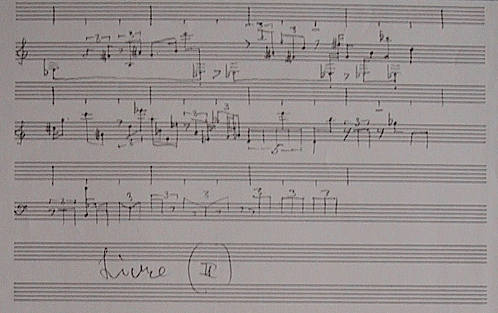
Screen Shot 2013-10-22 at 08.47.06A few weeks ago, I put up some isolated sketch pages for Mi-parti that I’d come across in Lutosławski’s house in 2002.  From that same folder “ŚCIĄGACZKI” (Crib Sheets), here are four more sketches that had not been sent on to the Lutosławski archive at the Paul Sacher Stiftung in Basle.  I hope that they are there now!  I have not looked at the Livre sketches in the Stiftung, so cannot say how these four abandoned sheets relate to the greater mass of material in Basle.

These four sheets relate to the first two chapitres.  The first three relate to the second chapitre, starting at fig. 207.

Screen Shot 2013-11-17 at 15.23.03

The top one presents a rhythmic ‘crib’ for the eleven bars from fig.207 to fig.209 (it’s enlarged below).  The notes beamed underneath present the rhythmic pattern of the piano (bb.1-4) and brass entries (bb.5-6, trumpets and trombones).  The notes with upward stems have a more complicated relationship to the score and do not always correlate to Lutosławski’s final thoughts.  On the first system below (equivalent to the six bars of fig.207), the upper stems concern the outline rhythm in the strings (no glissandi or sustained durational values are indicated).  There are discrepancies in a few places, especially in bb.3-6, where some of the triplet quavers and semiquaver entries diverge from the score.  On the lower system (the five bars of fig.208), the lower rhythm reverts to the piano while the upper notes pick out the brass entries (horns and trombones).

Screen Shot 2013-11-17 at 15.21.20

The middle sketch (they weren’t photographed in any thought-out order back in 2002!) relates to this same passage. It is a pitch reduction for the instrumental ensemble, but there are minor rhythmic variations for some of the entries and missing pitches (cf. b.6 in particular).  Bars 7-11 (the five bars of fig.208) give the rhythmic pattern for the piano, as in the example above, plus the four pinpointing rhythms and pitches on the trombones.
Screen Shot 2013-11-17 at 15.20.41

The lowest of these three sketches relates just to the six bars of fig.207.  It is a pitch and rhythmic reduction of all the instruments involved – piano, strings trumpets and trombones.

Screen Shot 2013-11-17 at 15.22.02

The last of the four sheets presents more of a conundrum.

Screen Shot 2013-11-17 at 16.08.20

Evidently, the bottom two systems are a skeletal version of the top two, but initially I could not relate these ten bars to any part of the first chapitre.  Where were these ascending semiquavers, these descending quavers?  In the end, it was the pause sign in bar 10 that gave me clue.  In the score, there are only two pause signs in the first chapitre: in b.2 and in the bar before fig.109.  The ten bars of this sketch match the ten bars immediately before fig.109, from the third bar of fig.108.  It is the passage for brass (trumpets, horns and trombones) that leads to the clatter of tom-toms, xylophone and gran cassa that initiates the ‘codetta’ of the first chapitre.  

The phrasal cadences are very similar, identical in some places (notably in the last six bars).  The direction of movement also matches.  The differences with the score suggest that the sketch is an early rhythmic attempt at this passage.  What may be Lutosławski’s shorthand here (but even for him such a shorthand is stretching the point) equates the upper stave in each pair to the phrases for trumpets and horns I & II.  The lower stave refers to the descending phrases for horns III & IV and the trombones.  But whereas this sketch has clearly defined and short-lived rhythmic movement in both staves, the fully metred section of the score stretches out the lines heterophonically, with the trombones adding glissandi between notes for good measure.  As a result, there is no pause between phrases as the two ensembles overlap, creating a more fluid texture.  I must admit to being a little mystified by the long horizontal lines between the two staves, so if anyone has an idea of their significance please say so.

• New Book: Polish Music since 1945

A new collection of essays on post-war Polish music has just been published by Musica Iagellonica in Kraków.  It is edited by Eva Mantzourani, who convened a conference four years ago, at the Canterbury Christ Church University in Kent, UK, under the title ‘Polish Music since 1945’.  Scholars young and old came from far and wide, and this volume of 31 essays is the result of those very stimulating days in May 2009.  It may be purchased at the Musica Iagellonica online shop for 85zł (c. £17/$27, plus postage).  The list of contents is given below.

Polish Music since 1945
PART I: Polish Composers in Context

• Charles Bodman Rae: ‘The Polish musical psyche: From the Second Republic into the Third’
• Adrian Thomas: ‘Locating Polish music’
• Marek Podhajski: ‘Polish music, Polish composers 1918–2007’
• Ruth Seehaber: ‘The construction of a “Polish School”: Self-perception and foreign perception of Polish contemporary music between 1956 and 1976’
• Bogumiła Mika: ‘Between “a game with a listener” and a symbolic referral to tradition: Musical quotation in Polish art music since 1945’
• David Tompkins: ‘The Stalinist state as patron: Composers and commissioning in early Cold War Poland’
• Maja Trochimczyk: ‘1968 – Operation Danube, ISCM, and Polish music’
• Alicja Jarzębska: ‘Polish music and the problem of the cultural Cold War’
• Niall O’Loughlin: ‘Panufnik and Polishness’
• Violetta Kostka: ‘Tadeusz Kassern: Music from his American period’
• Barbara Literska: ‘The “commissioned” works of Tadeusz Baird’
• Katarzyna Naliwajek-Mazurek: ‘Paweł Szymański and the multiple narrative in music’
• Marta Szoka: ‘The music of Paweł Mykietyn: In between pastiche, deconstruction and the great narration’
• Caroline Rae: ‘Dutilleux and Lutosławski: Franco-Polish connections’

PART II: Analytical perspectives

• Beata Bolesławska-Lewandowska: ‘Lutosławski’s Second Symphony (1967) and Górecki’s Second Symphony (1972): Two concepts of the bipartite late avant-garde symphony’
• Teresa Malecka: ‘Górecki’s creative journeys between nature and culture: Around the Copernican Symphony
• Stanisław Będkowski: ‘Wojciech Kilar’s last symphonies: Modification of a paradigm’
• Zbigniew Skowron: ‘Lutosławski at the crossroads. Three Postludes: A reappraisal of their style and compositional technique’
• Suyun Tang: ‘Lutosławski’s tonal architecture as defined by a Schenkerian tonal model’
• Aleksandra Bartos: ‘Witold Lutosławski’s Portrait of Woman 2000: New aspects of his compositional technique’
• Amanda Bayley and Neil Heyde: ‘Interpreting indeterminacy: Filming Lutosławski’s String Quartet’
• Cindy Bylander: ‘Back to the future: The interaction of form and motive in Penderecki’s middle symphonies’
• Regina Chłopicka: ‘The St Luke Passion and the Eighth Symphony Lieder der Vergänglichkeit: The key works in Penderecki’s oeuvre’
• Tim Rutherford-Johnson: ‘Theological aspects to Penderecki’s St Luke Passion
• Agnieszka Draus: ‘Infernal and celestial circles in Paradise Lost: Milton and Penderecki’
• Tomasz Kienik: ‘The musical language of Kazimierz Serocki: Analytical aspects of his musical output’
• Iwona Lindstedt: ‘Sonoristics and serial thinking: On the distinctive features of works from the “Polish School”’.
• Anna Masłowiec: ‘The sonoristic score: Inside and outside’

PART III: Polish jazz, film music and the marketplace

• Zbigniew Granat: ‘Underground roads to new music: Walls, tunnels, and the emergence of jazz avant-garde in 1960s Poland’
• Nicholas Reyland: ‘Experiencing agapē: Preisner and Kieślowski’s Three Colours: Blue
• Renata Pasternak-Mazur: ‘Sacropolo or Sacrum in the marketplace’

• WL100/68: Nie oczekuję dziś nikogo (1959)

While I was in Warsaw last week, I popped into an antykwariat which specialises in journals and periodicals of all types.  It also has a comparatively desultory music section, but occasionally there are interesting things to find.  This time, among large-format song sheets (mainly inter-war German popular songs), I found a much flimsier and tinier item (it measured just 15cm x 21cm): the first publication (February 1963) of one of Lutosławski’s dance songs published under his pseudonym, ‘Derwid’.

NODN cover 1963

Nie oczekuję dziś nikogo (I’m not expecting anyone today, 1959, words by Zbigniew Kaszkur and Zbirniew Zapert) was Derwid’s most popular song (he wrote some three dozen c.1957-64).  Its melody first appeared on 3 January 1960 in Radio i Świat (Radio and the World), the Polish equivalent of the British Radio Times.  The cover of this mini song sheet features the singer Rena Rolska, then in her late twenties.  I did quite a bit of research on the Derwid songs in 1994 (‘Your Song is Mine’, The Musical Times, 1830 (August 1995), 403-10) and discovered that the refrain of this ‘slowfox’ (with its C minor walking bass and sharpened 4th) bore a striking resemblance to the opening of one of Lutosławski’s politicised mass songs, Najpiękniejszy sen (The most beautiful dream, 1950).  I’m sure the similarities were coincidental!

NODN end

Rolska recorded Nie oczekuję dziś nikogo in 1960, with the Polish Radio Dance Orchestra conducted by Ryszard Damrosz:

• Tomasz Sikorski, d.13 November 1988

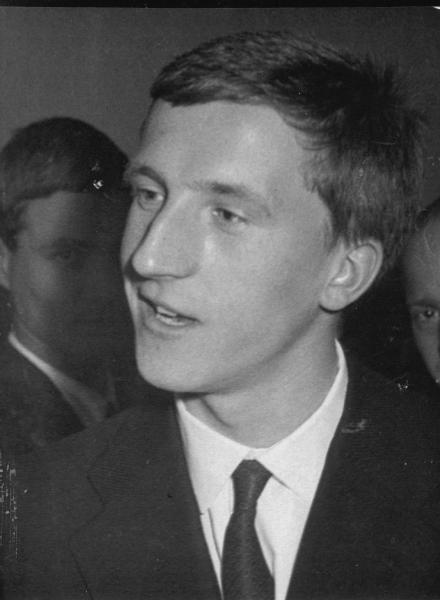
Today is  the 25th anniversary of the death of Górecki’s near-contemporary Tomasz Sikorski (1939-1988). Yesterday marked the third anniversary of Górecki’s death, but some sources (Wikipedia) also give yesterday as the date of Sikorski’s death, while others (Encyklopedia MuzykiNew Grove) give tomorrow, 14 November.  The most reliable Polish sources (Encyklopedia Muzyczna, Polish Music Information Centre POLMIC, PWM) give today, 13 November.

284_rdSikorski was and is one of the most singular voices in post-war Polish music and it is good to see that he still attracts a devoted following, not least through recent releases of his work on Bôłt Records.

When I was in Warsaw in January I went to a recital of some of his pieces by his friend and lifelong advocate of Polish piano music, the Hungarian pianist Szabolcs Esztényi.  The event marked the recent release of two Bôłt CDs, issued in partnership with several like-minded advocates such as Polish Radio 2, Polish Radio Experimental Studio, Foundation 4.99, DUX records, Bocian Records and the journal Glissando.  Sikorski’s music is/was published by PWM, Author’s Agency (Agencja Autorska), Moeck and Edition Modern.

sikorski_solitudeSolitude of Sounds. In memoriam Tomasz Sikorski (DUX 0936/0937) is a 2-CD set that also includes pieces by Esztényi (Created Music no.3 and Concerto) and Kasia Głowicka (Presence).  The Sikorski pieces are Echoes II (1963), Antiphons (1963), Solitude of Sounds for tape (1975) and Diario 87 for reciter and tape.  Sikorski himself performs on the first two of these archival recordings, and Esztényi writes a penetrating and disturbing recollection of his friend, who died in unexplained circumstances aged just 49.

sikor_tilburyThe second CD marks another, if briefer friendship, this time with forged with John Tilbury (b.1936), who met Sikorski in Zbigniew Drzewiecki’s piano class at the Higher School of Music in Warsaw in the early 1960s.  Tilbury’s CD For Tomasz Sikorski includes recent recordings that he made of his friend’s Zerstreutes Hinausschauen (1972), Autograph (1980) and Rondo (1984) plus his own Improvisation for Tomasz Sikorski (2011).

There is also, happily, a fair representation on YouTube, mostly uploaded by nocontrol696.  Jackamo Brown has created a 12-work playlist from nocontrol696’s uploads:

Monodia e Sequenza for flute and piano (1966)
Homophony for four horns, three trumpets, three trombones, gong and piano (Homofonia, 1970)
For Strings for three violins/violas (Na smyczki, 1970)
Zerstreutes Hinausschauen for piano (1972)
Holzwege for orchestra (1972)
• Music for Listening for two pianos (Muzyka Nasłuchiwania, 1973)
• Other Voices for 24 wind instruments, four gongs and bells (Inne głosy, 1975)
Sickness unto Death for two pianos, for horns and four trumpets (Choroba na śmierć, 1976)
Strings in the Earth for strings (Struny w ziemi, 1980)
• Autograph for piano (Autograf, 1980)
La Notte for strings (1984)
Diario 87 for reciter and tape

…….

For what they’re worth, here are two passages from my book Polish Music since Szymanowski (CUP, 2005), pp.213, 219-22, which discuss Sikorski and, initially, his contemporary and closest friend, Zygmunt Krauze, who happily is still very much with us (we met in Warsaw last Saturday).

If sonorism of the Pendereckian mould emanated from Kraków, Warsaw maintained a polite distance, preferring, in the music of Lutosławski, Baird, Serocki and others, to develop a closer architectonic relationship with detailed rhythmic and pitch organisation.  Of the younger Warsaw generation who graduated in the 1960s, two composers quickly became pre-eminent: Zygmunt Krauze and Tomasz Sikorski (1939-88), son of the composer Kazimierz Sikorski.  They were both his students, the latest in a line that already included Bacewicz, Baird, Kisielewski, Krenz, Palester, Panufnik and Serocki.  From the beginning, they each showed a determined individuality which defined a different stream in contemporary Polish music.

[…]

Tomasz Sikorski’s contribution to Music Workshop [Krauze’s pioneering ensemble of clarinet, trombone, cello and piano] reinforces the essentially minimal ethos not only of much of the music promoted by the ensemble but also Sikorski’s own distinctive voice.  This he established in a series of works in the mid-1960s – Antiphons and Echoes II (1963), Prologi (1964), Concerto breve (1965) and Sequenza I (1966) – in which the music proceeds by means of chains of small ad libitum fragments grouped in larger sequences.  The quasi-improvisational chordal fragments are deployed antiphonally or as live or tape playback echoes in a reiterative heterophony that is obsessive and, like some of Krauze’s pieces, achieves a disembodied, altered state, particularly in the cumulative resonances and polymorphic character of Antiphons and Echoes II.  Prologi is characterised by its mix of triadic ideas, diatonic scales and more dissonant material; his use of four-note cells, constructed from pairs of perfect fourths, is a feature of this and other compositions, where tritonal harmonies or pedals become a regular feature.

Sikorski’s pervasive nervous energy and unremitting focus on reductive processes occasionally approached the sonoristic values apparent elsewhere in Polish music (Concerto breve, Sequenza I), mainly by developing flickering, amorphous and quasi-stochastic textures.  But in the works of the late 1960s he returned to an introspective, often fractured idiom which focussed on one or two key notions.  In one of his rare comments on his compositional intentions, he described Sonant for piano (1967) in the following terms:

This work is based on the contrast between the attack and decay of sound.  The work’s construction, above all its temporal organisation (augmentation of rhythmic values, approximate values, whose duration depends each time on the timbral characteristics of the piano), as well as its ‘form’ (static aspect, repetitions of structures, etc.), are the consequences of the distribution of Sonant‘s sound material in two strata: those of attack and decay.*

By the time of Homophony (1970), Sikorski had intensified the concentration of his material: ‘It is a proposal for static, one-dimensional music.  In this work, both the sound material and its structuring are reduced to a minimum’.**

Homophony‘s instrumental forces reiterated Sikorski’s lifelong interest in specific timbres (it is scored for twelve brass, piano and gong) and he reinforced his fascination with the interface of diatonicism and dissonance in utilising a six-note bitonal chording, a combination of first-inversion G major and second-inversion B flat minor triads.  His fundamentally diatonic language is particularly evident – even exposed – in the pared-down minimal reiterations of his Music Workshop commission, Untitled (1972).  He had, by this stage, defined his musical persona as uncompromisingly austere in terms of both material and its deployment and of the timbral-expressive world which he explored (cf. Górecki in the late 1960s).  He largely eschewed the temptations of orchestral sonorism (although in Holzwege for small orchestra, 1972, he achieved an almost Messiaen-like luxuriance both texturally and harmonically), usually preferring an ascetic palette in which his intense and often bleak reiterations could be given full rein outside traditional modes of discourse.  In the 1970s and 1980s, these meditations took on a more defined existential and elegiac hue: he notably drew on the philosophical ideas of authors such as Heidegger (Holzwege), Kierkegaard (Sickness unto Death – Choroba na śmierć, 1976), Joyce (Strings in the Earth – Struny na ziemi, 1980), Beckett (Afar a Bird – W dali ptak, 1981), Nietzsche (La notte, 1984), Kafka (Das Schweigen der Sirenen, 1986) and Borges (Diario, 1987).  Aside from his connections with Krauze, however, he remained a somewhat isolated figure, tirelessly and intriguingly exploring a consistent if narrow range of compositional rituals.

* Note in 1967 ‘Warsaw Autumn’ programme book, pp.89-90.
** Note in 1970 ‘Warsaw Autumn’ programme book, p.19.

• Górecki memento/2: photo 1997

Here’s a photo taken in October 1997 (during the ‘Górecki Autumn’ festival in Los Angeles) in the house of Stefan and Wanda Wilk, the founders of the Polish Music Center at USC.  I think he was trying to teach me a góral version of Chopsticks.  A happy memory to soften the realisation that today is the third anniversary of his death.

gorthomasI also wrote a post on this day in 2011: Song of Joy and Rhythm.

• WL100/66: Overture, **9 November 1949

One of Lutosławski’s forgotten works is his Overture for strings, premiered on this day 64 years ago in Prague, by the city’s Radio Symphony Orchestra under the Polish conductor, and Lutosławski champion, Grzegorz Fitelberg.  It seems to have been the Overture’s fate to have been composed just as socialist realism was taking a firm grip on Polish music.  Yet there seems to be no record of it having been banned or criticised.  Even though it kept its distance from the simplicity apparently being required of Polish composers – it uses an octatonic scale and has some intriguing metric subtleties – it seems simply to have disappeared, perhaps regarded as irrelevant rather than dangerous by those with programming power.  Perhaps Lutosławski himself put it to one side; he appears never to have conducted it, and during his lifetime there were only seven performances (according to Witold Lutosławski. A Bio-Bibliography). There have, however, been five commercial CD recordings.

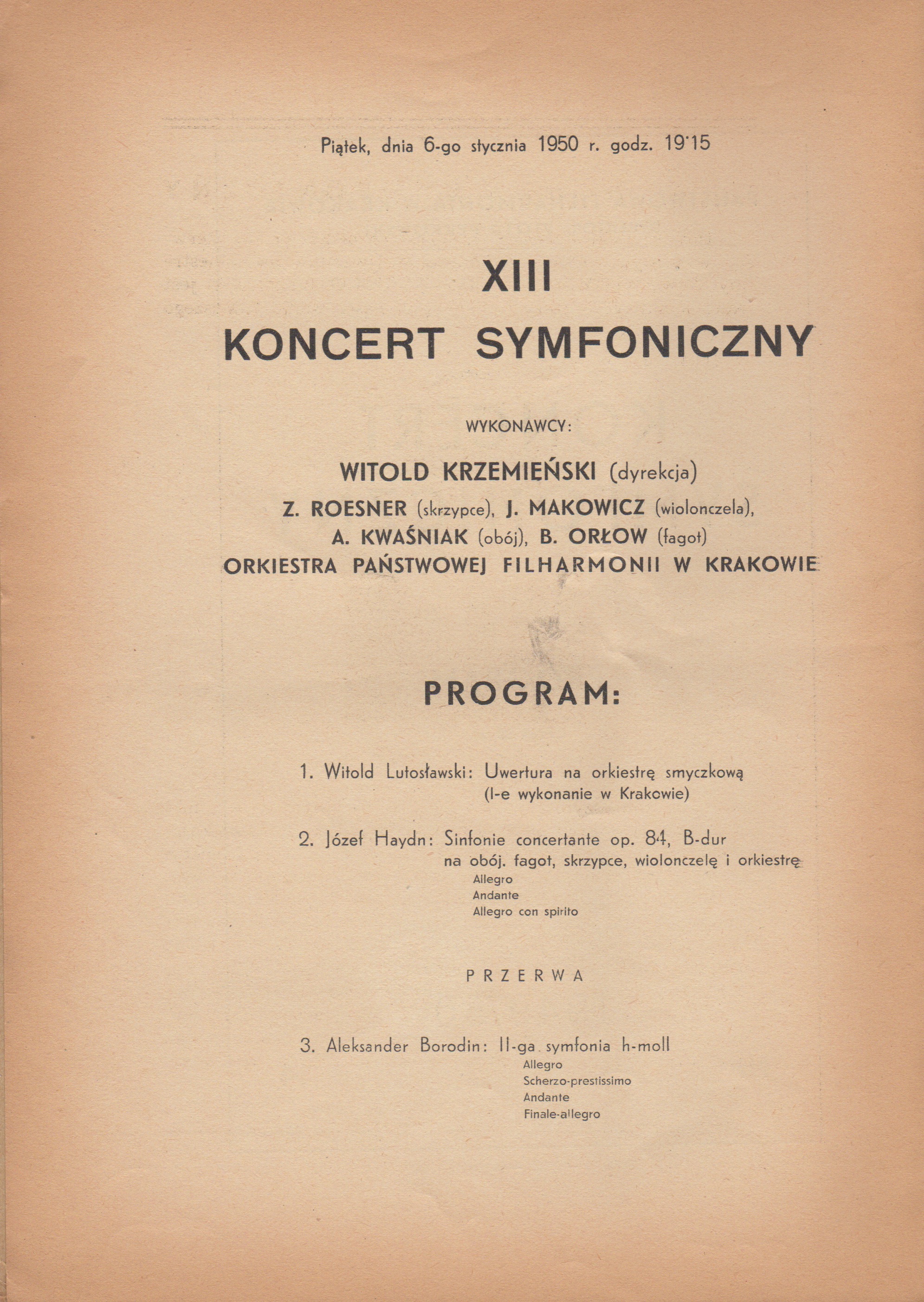
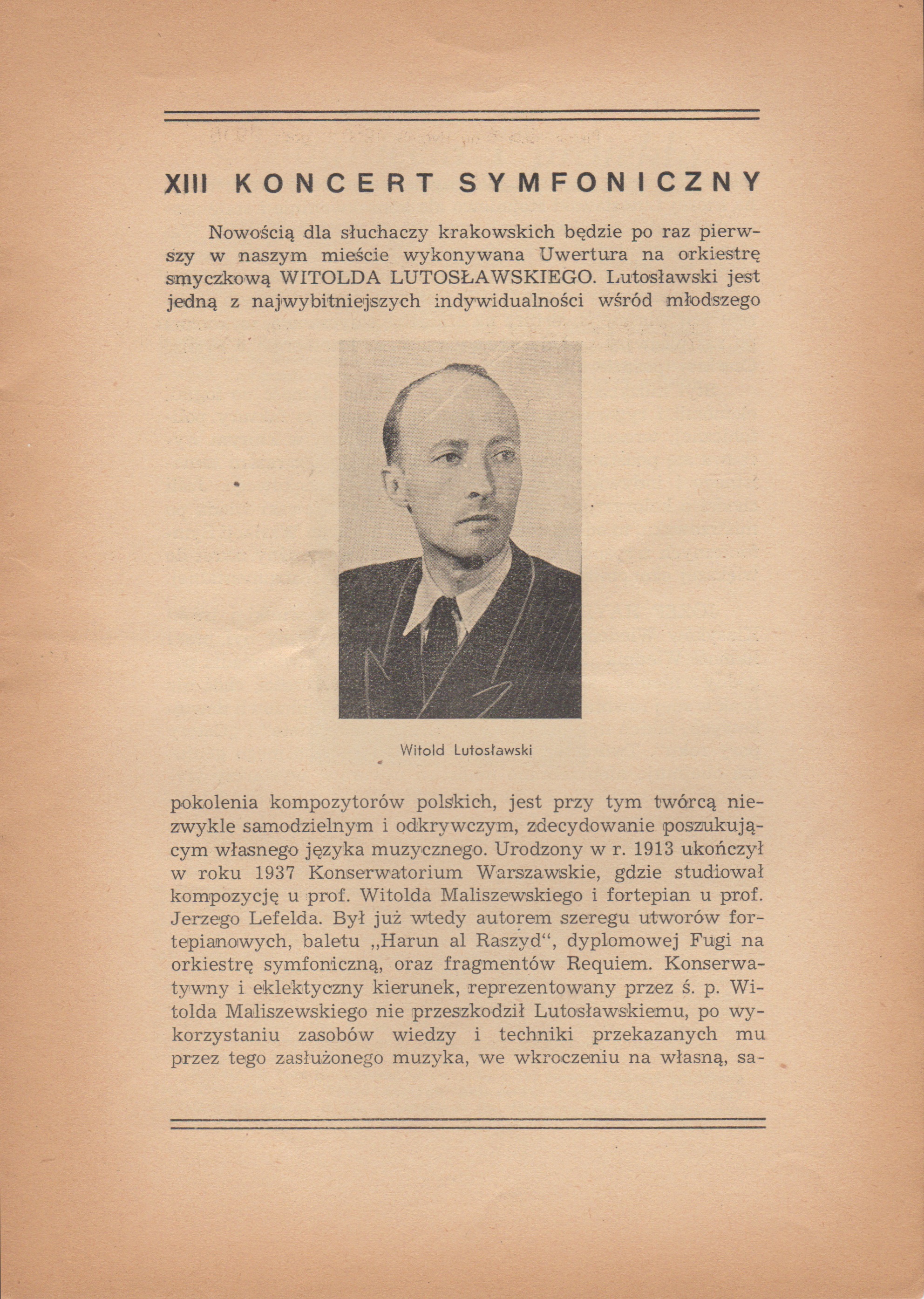
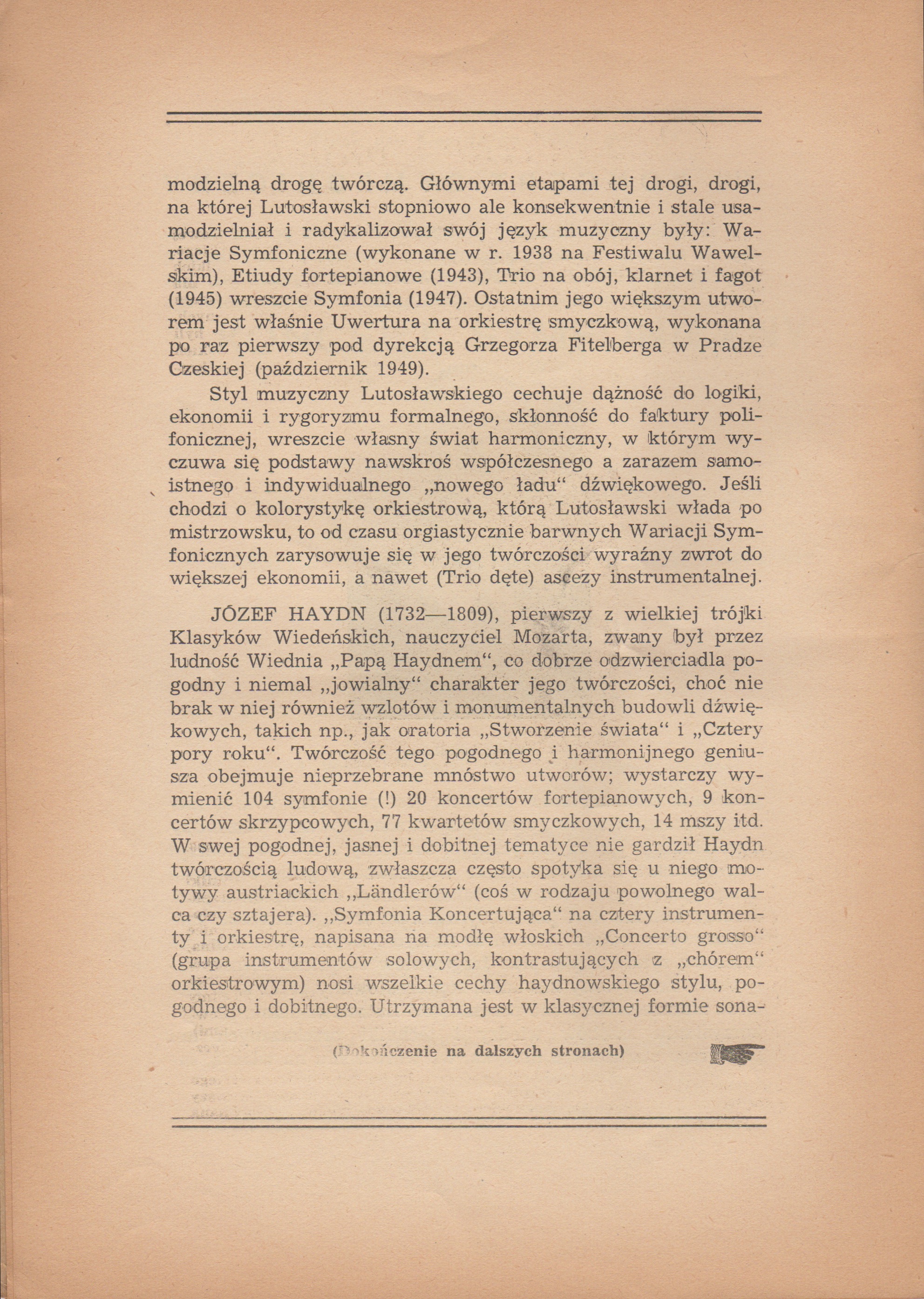
On one of my antiquarian forays in Kraków I came across the concert programme for the Overture’s first performance in the city (it looks as if it was also the Polish premiere).  It took place two months after the Prague performance, with the Kraków PO conducted by Witold Krzemieński.  The relevant pages of the programme are reproduced below, including another profile of Lutosławski – see an earlier one in WL100/54: Lutosławski and Panufnik (1945) – that sheds new light on Polish perceptions of the composer in the immediate post-war years (my translation is at the foot of this post).  There is, however, no hint in the note of state pressures for socialist-realist music, even though the concert took place just five months after the coercions unveiled at the August 1949 composers’ conference in Łagów and less than two months after official censure of his First Symphony at the Chopin Competition in Warsaw.  But Kraków was always at one remove from the capital, which is possibly why the Polish premiere took place there.

WL Overture programme 01.50

P.S.  This wasn’t the only time that a new Lutosławski piece shared the  billing with Borodin’s Second Symphony. The same was to happen in 1970 at the premiere of the Cello Concerto.

Overture 01.50 WL profile1

P.P.S.  Natty lapels!

Overture 01.50 WL profile2

New to Kraków listeners will be the first performance in our city of the Overture for string orchestra by WITOLD LUTOSŁAWSKI.  Lutosławski is one of the most outstanding personalities among the younger generation of Polish composers, through the creation of an exceptionally independent, insightful and decidedly exploratory musical language of his own.  Born in 1913, in 1937 he completed his studies at the Warsaw Conservatoire: composition with Prof. Witold Maliszewski and piano with Prof. Jerzy Lefeld.  He was by then already the composer of several pieces for piano, the ballet Harun al Rashid, a Fugue for symphony orchestra for his diploma, together with fragments of a Requiem.  The conservative and eclectic direction represented by his distinguished professor, Witold Maliszewski, did not prevent Lutosławski, after utilising the fund of knowledge and technique passed on to him by this worthy musician, from stepping out onto his own, independent artistic path.  The main stages of this path, a path on which Lutosławski gradually but consistently and steadily became independent and radicalised his musical language, were: Symphonic Variations (performed in 1938 at the Wawel Festival [it was actually in 1939: see WL100/43: Variations, **June 1939]), Etudes for piano (1943 [actually 1941]), Trio for oboe, clarinet and bassoon (1945) and finally the Symphony (1947).  His last major piece is this very Overture for string orchestra, performed for the first time under the direction of Grzegorz Fitelberg in Prague, Czechoslovakia (October 1949 [actually, November]).

Lutosławski’s musical style is characterised by a desire for logic, economy and formal rigour, an inclination towards polyphonic texture, and lastly his own harmonic world, in which one senses throughout the basis of a modern and at the same time spontaneous and individual sound of ‘the new order’.  When it comes to the orchestral palette, which Lutosławski deploys masterfully, since the orgiastically colourful Symphonic Variations there has appeared in his work a marked return to greater economy, and even instrumental asceticism (Wind Trio).

• Górecki: Refren, **27 October 1965

Before I first went to Poland, my fellow student Jim Samson brought back from Warsaw an LP of music by Henryk Mikołaj Górecki.  It blew our socks off.  Released a couple of years earlier, Polskie Nagrania ‘Muza’ XL 0391 (reissued over 25 years later on Olympia OCD 385 as ‘The Essential Górecki’) contained music the like of which neither of us had heard before.  There was the brief, Webernian Epitafium (1958), the explosive Scontri (Collisions, 1960), the incantatory Genesis II: Canti strumentali (1962) and the comparatively restrained Refren (Refrain, 1965). Thrilling though the first three pieces were, it was the last work that made the most profound impression.  Here is that recording of 1967, by the the Great Symphony Orchestra of Polish Radio (WOSPR) conducted by Jan Krenz.

Screen Shot 2013-10-26 at 11.58.47Over the summer of 2013, information emerged about the commissioning and premiere of Refren (which took place in Geneva on this date 48 years ago, Wednesday 27 October 1965, with the Orchestre de la Suisse Romande conducted by Pierre Colombo – it had been commissioned for the Centenary of the International Telecommunications Union, which was and still is based in Geneva).  This little story unfolded after I was contacted in early June by the Head of the Library and Archives service of the ITU, Kristine Clara.  She had come across a photograph in the October 1965 issue of the ITU’s Communication Journal and could find no further trail of the ITU’s connection with Refren.  “Could I help?”.

Screen Shot 2013-10-26 at 12.20.43

This must be one of the strangest photographs connected with a new score.  No sign of the composer, none of the conductor or orchestral musicians.  Instead, there are three now-forgotten figures from the worlds of politics and the unions looking at Górecki’s manuscript (although it looks more like one of the orchestral parts than the full score).  It is possible that Górecki had been invited, but I know that he was in Poland on the day that this photograph was taken and that he was ill at home on the day of the premiere six weeks later.  Kristine Clara also wondered where the score was – it was not in the ITU archives.  As far as I am aware, it went back to Poland, to the composer and to his publisher PWM, who brought it out in 1967.  As to the commission, my guess is that it was engineered by the Polish government and its Ministry of Culture.  It was a very important moment in Górecki’s life: his first foreign commission and premiere.

One piece of information that I could now furnish concerned the precise dates of Refren‘s composition.  The dates that Górecki had given were May-June 1965.  Having recently looked at his diaries, I was able to say that he started work on the piece on 26 April and finished it on 30 June.

As our email conversation progressed, Kristine Clara unearthed other information, this time about the premiere.  The Swiss Radio listings for 27 October indicate that Refren was broadcast live.

Screen Shot 2013-10-26 at 14.48.09

She also came across the catalogue card for the Swiss Radio tape of the premiere, which indicated that not only was it broadcast live but, contrary to the BBC’s practice at the time, was also recorded, enabling it to be rebroadcast on New Year’s day 1966.

Screen Shot 2013-10-26 at 14.51.48

I have not yet been able to determine if this tape still exists.  It would be fascinating to hear it, not least to verify the unexpected comment – with exclamation mark – written on the card: ‘Attention: rumeurs dans le public!’ (Warning: audience noise!).

Kristine Clara also unearthed several relevant items from the Journal de Genève – ‘de notre envoyé spécial’.  This turns out to be Franz Walter, a music critic and broadcaster best known today for having interviewed the pianist Dinu Lipatti less than three months before his death in 1950 (http://www.youtube.com/watch?v=NqftMxn1PrI).  Walter had been at the ‘Warsaw Autumn’ festival a few weeks before the premiere of Refren; I may come back at a later date to his two reviews of the festival in Journal de Genève (18 and 27 October).  More pertinent here is his review of the Suisse Romande concert on 27 October, which appeared in Journal de Genève the following day (it is the only review of the premiere of which I am aware).  I will pass over Walter’s enthusiastic response to the performance of Prokofiev’s First Violin Concerto by the young Claire Bernard.  His response to Refren is revealing.  His touchstone here was the performance he had heard in Warsaw on 23 September of Górecki’s Elementi for violin, viola and cello (1962), in a performance by Ensemble Instrumental Musiques Nouvelles de Bruxelles.

Screen Shot 2013-06-06 at 16.56.12 copy

Pierre Colombo, who had shaped the concerto’s accompaniment with great care – after a Mozart symphony which I could not hear [maybe Walter was returning to the hall having just introduced the concert on air] – then presented the world premiere of a work by the Pole Henryk Górecki.  The Warsaw Festival had just recently aired a string trio by this composer, a trio in which the players were induced to utter all the most incongruous and horrifying sounds that one can draw from a string instrument, yielding also to a “bruitist” mode that was very much in evidence at this recent festival.  The point of such a work could only be to get on the nerves of the listener.  The work which Pierre Colombo presented to us, with large orchestral forces, pursued in short the same goal, though by different means.  Long chordal aggregates, tirelessly repeated and punctuated by brief… how shall I put it… gusts of wind from the brass, frantic barking from these same brass, splashes from the strings, explosions from the timpani, such is the material which furnishes Refrains [sic].

The nervous effect was produced.  In the event, it found expression in laughter.  But our public is not yet used to this music.  Elsewhere people listen with great seriousness (and for my part with profound boredom).  F.W.

There are some inconsistent aspects of Walter’s account, especially in the short second paragraph, but it is clear that he found Górecki’s new piece insupportable and gives the clue to the ‘audience noise’ mentioned on the Swiss Radio catalogue card.  I wonder how widespread this laughter was.  One has to marvel, though, at Walter’s response.  He had heard much more rebarbative music in Warsaw a few weeks earlier, and Górecki’s Refren is not that far removed in aesthetic from Messiaen’s Les offrandes oubliées, composed 35 years earlier.  It marks, as we now know, the turning point from the overt dynamism of the preceding decade to the largely contemplative mode of his subsequent music.  But to contemporary ears (or at least Walter’s) it sounded as bad as the earlier pieces.

• WL100/64: Notebook, 24 October 1959

Lutosławski on independence and Webern

To accomplish anything reasonable, one has to be completely independent of life outside.  This is Webern’s case.   Here also lies the fundamental difference between Webern and the Webernists, who are stuck in endless confrontation, which is why none of them even attempts to focus on something more durable, consistent, long-term.  Engaging in constant dialogue with opinion is a kind of slavery.

Aby dojść do czegoś sensownego, trzeba być całkiem uniezależnionym od życia zewnętrznego.  To jest przypadek Weberna.  Tu jest też zasadnicza różnica między Webernem a webernistami, którzy są zdani na ciągle konfrontacje i dlatego żaden z nich nie próbuje nawet skupić się nad czymś bardziej trwałym, konsekwentnym, długodystansowym.  Zaangażowanie się w ustawiczny dialog z opinią jest rodzajem niewoli.

Witold Lutosławski, 24 October 1959 [my translation]

Four years later, Lutosławski wrote a short text on Webern at the request of the renowned Slovakian arts and science periodical Slovenské Pohľady, which wished to mark the 80th anniversary of Webern’s birth.  Titled ‘Webern a hudba dneška’, it was published in Polish a few years later.

Lutosławski on ‘Webern and the Music of Today’

‘The concise man makes one think, the verbose man bores’ – with these simple words Edouard Manet once expressed a truth which – contrary to what it might seem – has served only a few composers as a signpost.*  To these few, unlike his imitators, belongs first and foremost Anton Webern.  Among the many revelations made by this man, one has really made me think.  This is the discovery of a sound-world of microscopic proportions in which the shortest, instantaneous musical event can become the source of a strong experience.

Like the work of every great explorer, Webern’s output has gone through its good and bad periods.  The current one I would call ‘bad’ for Webern, because the wave of imitations – often inept, vulgar, distorting his ideas – has not yet subsided, and we are still driving ‘postwebernism’ away like a tiresome fly.  I believe, however, that – like Debussy from ‘Debussyism’ recently – the music of Webern will free itself from the besmirching and obnoxious effect of its imitators.  It will then shine in its true and pure brilliance.

“Człowiek zwięzły skłania do zastanowienia; gadatliwy nudzi…” – tymi prostymi słowami wyraził kiedyś Edouard Manet prawdę, która – wbrew temu, co mogłoby się wydawać – tylko niewielu twórcom służyła za drogowskaz.  Do tych niewielu, w odróżnieniu od swych naśladowców, należał przede wszystkim Anton Webern.  Wśród licznych odkryć, jakich dokonał ten człowiek, jedno zastanawia mnie szczególnie.  Jest to odkrycie świata dźwiękowego mikroskopijnych rozmiarów, w którym najkrótsze, migawkowe muzyczne zdarzenie może stać się źródłem silnego przeżycia.

Jak twórczość każdego wielkiego odkrywcy, tak i twórczość Weberna przeżywa swoje dobre i złe okresy.  Obecny okres nazwałbym dla Weberna ‘złym’, ponieważ fala naśladownictw – często nieudolnych, wulgarnych, wykoślawiających jego idee – jeszcze nie opadła, i wciąż jeszcze od ‘postwebernizmu’ oganiamy się jak od uprzykrzonej muchy.  Wierzę jednak, że – jak niedawno Debussy od ‘debussyzmu’ – wyzwoli się również i dzieło Weberna od zamazujących i obrzydzających je naśladownictw.  Zalśni on wtedy swym prawdziwym i czystym blaskiem.

Witold Lutosławski, ‘Webern a hudba dneška’,
Slovenské Pohľady 79 no.12 (1963), pp.92-93 [my translation]
reproduced, in Polish, in Stefan Jarociński,
Materiały do monografii (Kraków: PWM, 1967), p.42

* I don’t know where Lutosławski found this quote, but it originated in an article by Georges Jeanniot in La Grande Revue in 1907.  The full quotation, which could equally be Lutosławski’s credo, reads:

La concision en art est une nécessité et une élégance; l’homme concis fait réfléchir, l’homme verbeux ennuie; modifiez-vous toujours dans le sens de la concision.

• WQXR Q2: A new Polish marathon

The New York classical music station WQXR Q2 is about to launch another focus on Polish music.  In January last year, I reported on its intensive, week-long ‘Muzyka Nowa: A Celebration of Contemporary Polish Music’.  On that occasion, the results were mixed, as I wrote at the time: Polish Music ‘Muzyka Nowa’, WQXR ★★★✩✩.  This year, the ‘Celebrating Poland’ focus seems more selective and is split up over a longer period.

celebrating-Poland

There are three 24-hour marathons: this coming weekend (Friday 25 October), six days later (Thursday 31 October) and on Tuesday 12 November.  The first date includes a ‘live performance stream’ of music by Penderecki and there is a final event on Friday 13 December, this time a live relay of music by Lutosławski.

Friday 25 October
The first marathon promises an examination of ‘the strength and diversity of contemporary classical music from Poland’.  I certainly hope that the programmers broaden the range beyond familiar names and play more music by composers now in their 20s, 30s and 40s than the few examples that were included last year.  It will be very interesting to see how much music written in the last ten years is included to illustrate what is really happening in contemporary Polish music.  The programme of the Penderecki live relay – Cadenza for viola (1984), String Quartet no.3 (2008), Capriccio for cello (1968), Clarinet Quartet (1993) and Sextet (2000) – gives slight cause for hope in this regard.

Thursday 31 October
Polish music will form part of what is billed as a ‘Halloween Scarathon’.  Guess which pieces/composers…

Tuesday 12 November
This is the most promising of WQXR Q2’s offerings.  It will examine ‘the full spectrum of and story behind Lutosławski’s contributions to 20th-century classical music’.  Even more assuringly, it will include seven one-hour episodes curated by Steven Stucky, so real authority and insight will be brought to the proceedings.  Esa-Pekka Salonen will also make an appearance.

Friday 13 December
Steven Stucky resurfaces as a composer in the second live relay, from Symphony Space with the American Contemporary Music Ensemble.  The programme consists of Lutosławski’s Sacher Variation for cello (1975), Bukoliki in the arrangement cello for viola and cello (1952/62) and the String Quartet (1964).  Stucky’s contribution consists of Dialoghi for solo cello (2006) and Nell’ombra, nella luce for string quartet (1999-2000).

You can catch these online broadcasts by accessing any page of WQXR and clicking on the Q2 Music tab at the top (the play/pause tab is to the left).  Schedules and playlists can be accessed by selecting the relevant tabs on the next bar below.  No specific timings were available when this post was uploaded, but as NY time is 5/6 hours behind UK/European time WQXR Q2’s evening events will be in the small hours this side of the Atlantic.

• On music and the Jagiellonians

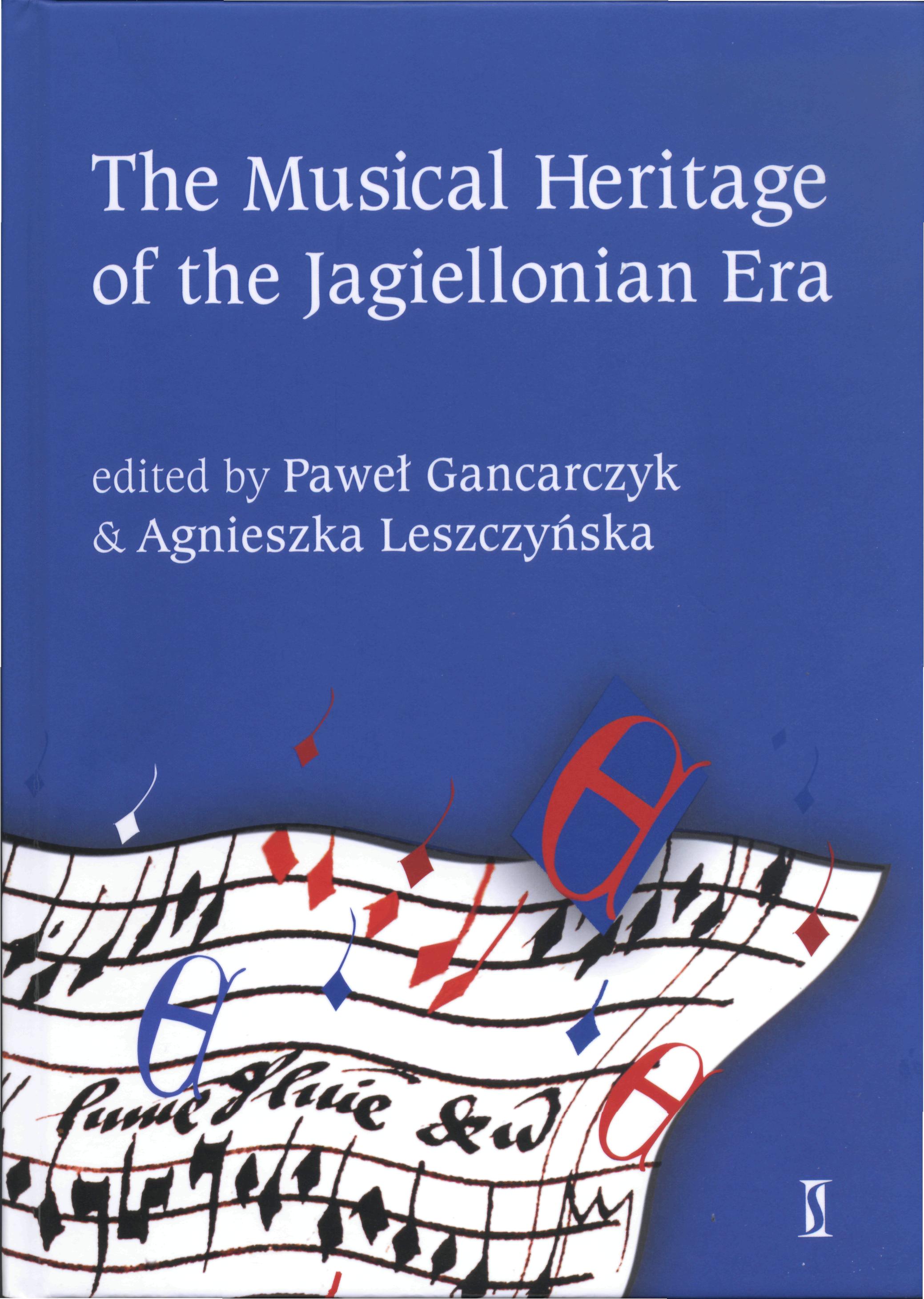
Barely had I posted about the arrival of a new collection of essays on early Polish music (New ‘Eastern European Studies’ series) than one of its editors, Paweł Gancarczyk, drew my attention to another volume that he has co-edited, with Agnieszka Leszczyńska, and which came out last year: The Musical Heritage of the Jagiellonian Era (Warsaw: Instytut Sztuki PAN, 2012).

Gancarczyk_Jagiellonian

It is, unfortunately, the case that many Polish academic publications, even when specially produced in foreign-language editions, rarely escape to wider audiences.  Yet this collection of twenty seven essays, nineteen of which are in English, eight in German, has a range and line-up deserving of international appreciation.  It shares a few authors with The Musical Culture of Silesia before 1742 (see preceding post) but it has a broader geographical and musical reach.  Together, their forty eight essays are a fascinating insight by current authorities into several centuries of Poland’s musical and cultural history.

The Musical Heritage of the Jagiellonian Era

Elżbieta Witkowska-Zaremba: Patterns of music education in Central Europe in the fifteenth century: codices with the Jagiellonian mark
Jūraté Trilupaitiené: Musical culture of the Jagiellonian dynasty in the Grand Duchy of Lithuania: between sacrum and profanum
Dominika Grabiec: Musical motifs in Christ’s Passion: the Mocking from the Holy Trinity Chapel at Lublin Castle and miniatures from the Cracovian Dominican meditations (ca. 1532)
Hrvoje Beban: Inter arma (non) silent musae.  Renaissance musical culture in Croatia during the reign of the Jagiellonian dynasty
Elżbieta Zwolińska: Einige Bemerkungen zu den musikalischen Kontakten zwischen dem Hofe der letzten Jagiellonen und dem Habsburgerhause
Eva Veselovská: Mittelalterliche Notationssysteme vom Gebiet der Slowakei aus der Wendezeit des 15. und 16. Jahrhunderts
Veronika M. Mráčková: Staff notation in sources from the convent of St George in Prague
Jan Ciglbauer: Neumarkter Cantionale: Geistliche lateinische Lieder um 1470 und ihre Vergangenheit in mitteleuropäischen Handschriften
Ian Rumbold: Austrian or Bavarian?  Hermann Pötzlinger’s music book (Munich, Bayerische Staatsbibliothek, Clm 14274): a new source of information
Katelijne Schiltz: Rosen, Lilien und Kanons: Die Anthologie Suavissimae et iucundissimae harmoniae (Nürnberg, 1567)
Christian Thomas Leitmeir: Teodoro Riccio’s Liber primus missarum (1579): a musical ambassador between Prussia and Poland
Marc Desmet: Establishing a chronology of Jacob Handl’s printed masses.  Evidence and problems
Barbara Przybyszewska-Jarmińska: An overlooked fantasia for instrumental ensemble by Francesco Maffon.  GB-Och MSS Mus. 372-376 as a vestige of Paweł Działyński’s diplomatic mission to England in 1597?
Pawel Gancarczyk: Musical culture of the Teutonic Order in Prussia reflected in the Marienburger Tresslerbuch (1399-1409)
Bartosz Awianowicz: The Graeco-Latin vocabulary of Petrus Wilhelmi de Grudencz
Gioia Filocami: The musical taste of Archbishop Ippolito I d’Este between Hungary and Italy
Thomas Napp: Upper Lusatia: cultural transfer and spatiality in early modern Central Europe
Danuta PopingisDas singende Uhrwerk zu Füßen von König Zygmunt August – ein Beitrag zur Herkunft des automatischen Glockenspiels im Rechtstädtischen Rathaus von Danzig
Janka Petőczová: Musical culture in Bardejov (Bártfa, Bartfeld, Bardiów) in the mid-sixteenth century
Agnieszka Leszczyńska: A common musical tradition: links between Upper Hungary and Prussia around 1600
Marta Hulková: Musikalische Handschriften von der Wendezeit des 16. und 17. Jahrhunderts in der Musikaliensammlung von Levoča (Leutschau/Lőcse)
Magdalena Walter-Mazure: On how the nuns sang Vespers in fractus – alternatim practice in liturgical music of Polish female Benedictines
Julia Miller: Luca Marenzio: questions of performance in Poland and Italy
Reinald Ziegler: Claudio Monteverdis Publikation einer Messe und einer Vesper 1610.  Zum transfer von Kompositionstechniken im konfessionsverschiedenen Umfeld, oder: Welche kompositorischen Impulse gingen von einem heute als epochemachend empfundenen Werk aus?
Teresa Krukowska: Wie europäisch war des musikalische Repertoire der polnischen evangelischen Kantonalien im 16. Jh. und wie europäisch ist es heute?
Anna Ryszka-Komarnicka: An episode from the reign of King Władysław II Jagiełło of Poland in Gismondo re de Polonia, a dramma per musica by Leonardo Vinci (1727)
Marco Beghelli: An imaginary Poland in nineteenth-century opera