• Panufnik in Warsaw (Aug-Sept)

Screen Shot 2014-08-16 at 10.38.26A phone call today from the director of the ‘Chopin and his Europe’ festival in Warsaw has alerted me to a raft of Panufnik performances that this imaginative festival is including this year.  Lutosławski was similarly honoured by the festival on his centenary last year.  In May I wrote a post here, Panufnik Centenary, giving some details of the worldwide coverage of his music in 2014.  Last week, BBC Music Magazine published my profile of Panufnik, ‘Poland’s Great Exile’ (its subtitle, not mine), in its regular ‘Composer of the Month’ slot.

I’ll pass over the loss, in the editing of the article, of my comment that the BBC Proms have ignored the Panufnik centenary.  And it remains the case that there are rather large repertoire gaps elsewhere in the centenary celebrations, such as the continuing absence of four of the symphonies (an improvement on the situation in May; see next paragraph).  Even the ‘Warsaw Autumn’, which reintroduced Panufnik’s music onto Polish concert platforms in 1977 (after a gap of 23 years following his escape to the UK) – and programmed eleven of his works when Panufnik visited Poland for the first and only time in 1990, is not marking the centenary.  It is a bit perplexing that it has passed up this opportunity to celebrate its key role.  It is, however, providing an umbrella for a three-day conference ‘Andrzej Panufnik i jego wizja muzyki’ (Andrzej Panufnik and his Vision of Music’, 24-26 September), which the Chopin Music University has organised.  The conference also includes a series of chamber concerts outside the ‘Warsaw Autumn’ programme.

The day after the ‘Warsaw Autumn’ ends, Polish Radio is hosting a concert of Panufnik’s orchestral music which plugs two earlier gaps in the celebrations: the orchestral Nocturne and Sinfonia rustica, both works dating from the late 1940s. The programme is completed by the Cello Concerto, played by Raphael Wallfisch.  The conductor is Łukasz Borowicz, whose recently completed 8-CD set of Panufnik recordings is a dynamic survey of the orchestral music.

It has been left to other festivals to provide audiences with cross-sections of Panufnik’s music, and two of these take place this month.  The Presteigne Festival in mid-Wales is one, and I posted on its repertoire in May: Poles in Presteigne.  The Panufnik component in Warsaw’s ‘Chopin and his Europe’ is as follows:

• Twelve Miniature Studies for piano (Cycle of Fifths) (1947)
• Piano Concerto (1961)
• Violin Concerto (1971)
• Sinfonia concertante for flute, harp and strings (Symphony no.4) (1973)
• String Quartet no. 1 (1976)
• String Quartet no.2 ‘Messages’ (1980)
• Arbor cosmica for strings (1983)
• String Sextet ‘Train of Thoughts’ (1987)
• Symphony no.10 (1988)
• String Quartet no.3 ‘Wycinanki’ (1990)
• Cello Concerto (1991)

• Bogusław Schaeffer, b. 6 June 1929

There are few Polish composers still alive who were born before 1930.  Włodzimierz Kotoński (b. 1923) and Jan Krenz (b. 1926) are two of them.  Kotoński is additionally significant as an author and as a teacher of subsequent generations of Polish composers.  Krenz is primarily known as a conductor and champion of music by his compatriots.  Bogusław Schaeffer (born on this day 85 years ago), however, has even more strings to his bow.  He is an artist, dramatist and author, as well as a composer and teacher.

Bogusław Schaeffer

I first came across Schaeffer’s music at the 1970 ‘Warsaw Autumn’ festival (the premiere of Quatuor SG by Zygmunt Krauze’s Music Workshop) and at the following year’s festival (the premiere of Heraklitiana by the harpist Urszula Mazurek).  Little did I realise when, a week or so later, I took the train to Kraków to study at the PWSM (State Higher School of Music) that I would spend seven fascinating months as his composition student.

We were like chalk and cheese in our musical tastes.  I was wet behind the ears, he was a polymath on contemporary music and performance practice.  He could not have been kinder.  He introduced me to a huge range of technical and notational devices and encouraged me to experiment, test and investigate.  His energy and restless imagination were incredibly stimulating.  Among the pieces that I wrote was a work for solo harp that Urszula Mazurek played at the 1976 ‘Warsaw Autumn’.  But in truth little else of substance emerged, not least because I was using the time also to get to know music by other Polish composers and to begin to build up my now extensive library of Polish music and, as a sideline, of Polish posters.

The main lesson for me was that there were huge positives to be gained by studying with a composer with diametrically opposite aesthetics.  It was not that I sensed no contact – far from it.  When I returned to the UK I took up a lectureship at Queen’s University, Belfast, where amongst other Polish repertoire I gave regional premieres of some of Schaeffer’s piano music, including the famous Nonstop (1960), as well as his music-theatre piece, TIS MW2 (1963). But my own compositional interests lay elsewhere, with Witold Lutosławski and Henryk Mikołaj Górecki.  And it then emerged that neither of these composers had much time for Schaeffer.  That did not in itself affect my view of or relationship with Schaeffer.  I helped him with the text of his massive tome, Introduction to Composition (1976), and met up with him on many subsequent occasions, not least at an American School seminar in Salzburg at Easter 1976.

Yet there is no hiding the fact that Schaeffer has been a controversial figure in Polish music.  He has been regarded as a charlatan by some, an error-strewn analyst of contemporary scores by others.  His custom of working on several works at the same time no doubt accounts for his enormous output of well over 1000 creations across different media. The sheer imagination of his new notational schemata beggars belief, while his ‘happenings’ and music-theatre pieces are often outlandish and/or extremely funny.  His visual art, closely linked with his graphic notation, is never less than colourful and vital, while his several dozen theatre pieces are hugely popular in Poland and reach a quite different audience than his musical works.

Although Schaeffer remains outside the mainstream of Polish musical life (he has lived in Austria for several decades), he has a devoted following there and abroad who relish the wild, unpredictable character of his creative imagination. Like a number of other figures (Cage and Kagel come to mind), his presence is felt in performance and as a challenger of norms, although the corollary of this is that it has been hard to find conventional audio examples of his music.  The exception comes from the ever-resourceful Bôłt Records, whose double CD of Schaeffer’s music, ‘Assemblage’, contains several works and a couple of others may be found elsewhere on Bôłt compilations.  The advent of YouTube, however, has given his output a new lease of life, and there is selection of his music also on last.fm.

There are also online articles (a brief selection below) and I have added two passages on Schaeffer from my book Polish Music since Szymanowski (CUP, 2005).

• Bogusław Schaeffer. Biography (2002)
• Adrian Thomas, Polish Music since Szymanowski (2005)
• Edinburgh International Conference Centre, Bogusław Schaeffer, Music and Graphics (2010, including sound files)
• Magda Romańska, Bogusław Schaeffer: Poland’s Renaissance Man (2012)
• Alena Aniskiewicz, Bogusław Schaeffer: An Anthology (2013, review of four plays in English translation)

So, on this his 85th birthday, I send my former teacher all best wishes for this significant milestone, with huge thanks for his generosity of spirit, our walks in the Planty in foggy Kraków, and great memories of invigorating composition lessons. Sto lat! Sto lat! Niech żyje, żyje nam!


• MoMA on Polish Music

moma-logo-post-new1Yet another initiative that I missed earlier this year is a series of essays and other items emanating from New York’s Museum of Modern Art.  I came across MoMA’s post – notes on modern and contemporary art around the globe while writing my preceding post about the late Bohdan Mazurek.  On 19 December 2013 MoMA published a theme called Polish Radio Experimental Studio: A Close Look, in which Mazurek features.

This really is a superb English-language introduction to one of the ground-breaking initiatives in Western and Eastern European music in the 1950s.  PRES was the brainchild of Józef Patkowski. It was a most unlikely development in communist Poland and one that had a profound impact on the sound of Polish music.  Many composers, including Penderecki, Kotoński, Schäffer and Dobrowolski, made use of its expertise (principally Bohdan Mazurek and Eugeniusz Rudnik), and soon non-Polish composers also flocked to use its facilities.

The MoMA theme includes the following:

Essays

• Daniel Muzyczuk, ‘The Future Sound of Warsaw: Introduction to PRES
• David Crowley, ‘Spatial Music: Design and the Polish Radio Experimental Studio
• Michał Libera: Alchemist Cabinet of the Polish Radio Experimental Studio: Music Scores of and for Experiments

Interview

• Daniel Muzyczuk, ‘How much Rudnik is in Penderecki, and how much Rudnik is in Nordheim?  Interview with Eugeniusz Rudnik

Scores

• PRES Music Scores 1959-1972
[browsable scores originally published by PWM]
• Kotoński Music for One Cymbal Stroke (1959)*
• Dobrowolski Music for Magnetic Tape (1963)*
• Schaeffer Symphony – Electronic Music (1964)*
• Dobrowolski Music for Magnetic Tape and Oboe Solo (1965)
• Dobrowolski Music for Strings, Two Groups of Wind Instruments and Two Loudspeakers (1966)
• Kotoński Aela. Electronic Music (1970)*
• Dobrowolski Music for Magnetic Tape and Piano Solo (1972)*

No sound files are included on the MoMA site, but there is a fascinating double CD (2013) from Bôłt Records that brings together the original realisations of the five scores marked * above, plus modern realisations of the same pieces.  The two CDs are called PRES Scores and also include then-and-now versions of Penderecki’s Psalmus (1961).

• Bohdan Mazurek (1937-2014)

kronika_3_-_mazurekThe Polish composer and sound engineer Bohdan Mazurek – a key figure in the development of electronic music in Poland – has died at the age of 76.  Alongside Eugeniusz Rudnik, Mazurek helped to develop the Polish Radio Experimental Studio after its foundation in 1957 by Józef Patkowski into a central force in Polish music in the 1960s and 70s.  He assisted many composers in realising their electronic music but was also a composer, in his own right, of both electronic and film music.  His music won prizes in several competitions (Dartmouth, Bourges) and he taught not only at the Warsaw Music Academy but at several institutions in the USA.

I knew Bohdan Mazurek early on in my involvement in Polish music.  He was a gentle giant, modest and with a selfless devotion to his metier.  He was a thoroughly decent and lovely man and I recall spending many good-spirited hours in his company.  He helped me hugely as I tried to find my way in the rich panorama of Polish music.  His own music went largely undervalued, with very little percolating abroad.  Bozzetti was, however, included in the 1970 boxed LP set ‘Electronic Panorama’ (Philips 6740 001), which profiled new electronic compositions from Paris, Tokyo, Utrecht and Warsaw.

br_es02Fortunately, in 2010  the Warsaw-based independent label Bôłt Records, in partnership with Polish Radio and Foundation 4.99, issued a double CD of Mazurek’s music, Sentinel Hypothesis’.  It includes an excellent essay and notes by Bolesław Błaszczyk. The twelve works on these discs are: Bozzetti (1967), Epitaph for Jan Palach (1969), Sinfonia Rustica (1970), Canti (1973), Ballade (1976), Children’s Dreams (1976), Daisy Story (1977-79), Six Electronic Preludes (1981), From the Notebook (1983), Letter to Friends (1986), Pennsylvania Dream (1987), Reverie (1989).

An appreciation just published (in Polish) at culture.pl includes YouTube links for Bozzetti (1967) and Canti (1973).

OBITUARY

• New Website for Panufnik

10325233_442302385905268_5695306740097370493_n

http://www.panufnik.polmic.pl

One of the most valuable initiatives of the Polish Music Information Centre (POLMIC), in conjunction with the Polish Composers’ Union (ZKP) and other institutes and publishers, is a series of composer websites.  The first, in 2012, was devoted to Kazimierz Serocki, and the second, in 2013,  to Tadeusz Baird.  Today, it is the turn of Andrzej Panufnik, in his centenary year.  With the launch last year of the threecomposers.pl website at NINATEKA (Górecki, Lutosławski, Penderecki), there are now accessible sources in English and Polish for six of Poland’s most distinctive composers of the second half of the twentieth century.

The leading light of the editorial team on the Panufnik site is Beata Bolesławska-Lewandowska (she was closely involved involved in its predecessors). The three POLMIC sites have similar formats, although the Panufnik site is more extensive.  It has eight principal sections, most with several sub-sections: Life, Timeline, Work, Musical Inspirations, Places, Gallery, Bibliography, Discography, plus a featured work, in this case Sinfonia sacra.

It looks as thorough and informative as its predecessors.  There are, for example, excerpts from most works at the top of their individual entries, which give useful background information on compositional circumstances, Panufnik’s concept and reception.  There is even information on the mass songs (with pages from the published scores).  The six entries under Musical Inspirations are useful little essays and a new feature (Places), possibly taking its cue from the mobile app released a year ago for Lutosławski’s Warsaw, explores half-a-dozen locations in each of Poland and Great Britain that were significant to Panufnik.

As one might expect, the Gallery of photos is especially rich, given Camilla Panufnik’s renown as a photographer.  The Bibliography is substantial and the CD Discography looks comprehensive.  There is the occasional navigational oddity (the audio excerpts are grouped under Gallery-Music), while the left sidebar can be a bit too sensitive to the touch of the cursor.  It would also be helpful sometime to have English translations of the documents that feature as photographs.

This new Panufnik site is an exceptional new resource, and a credit to all involved.  It is well worth investigating at leisure.  I wonder who will be next in this series?

Later on 16.05.14: Beata Bolesławska-Lewandowska has informed me that the next composer in the series will be Tomasz Sikorski – excellent news. His website will be launched at the 2014 ‘Warsaw Autumn’ festival.

• Gloria Artis, 12.04.14

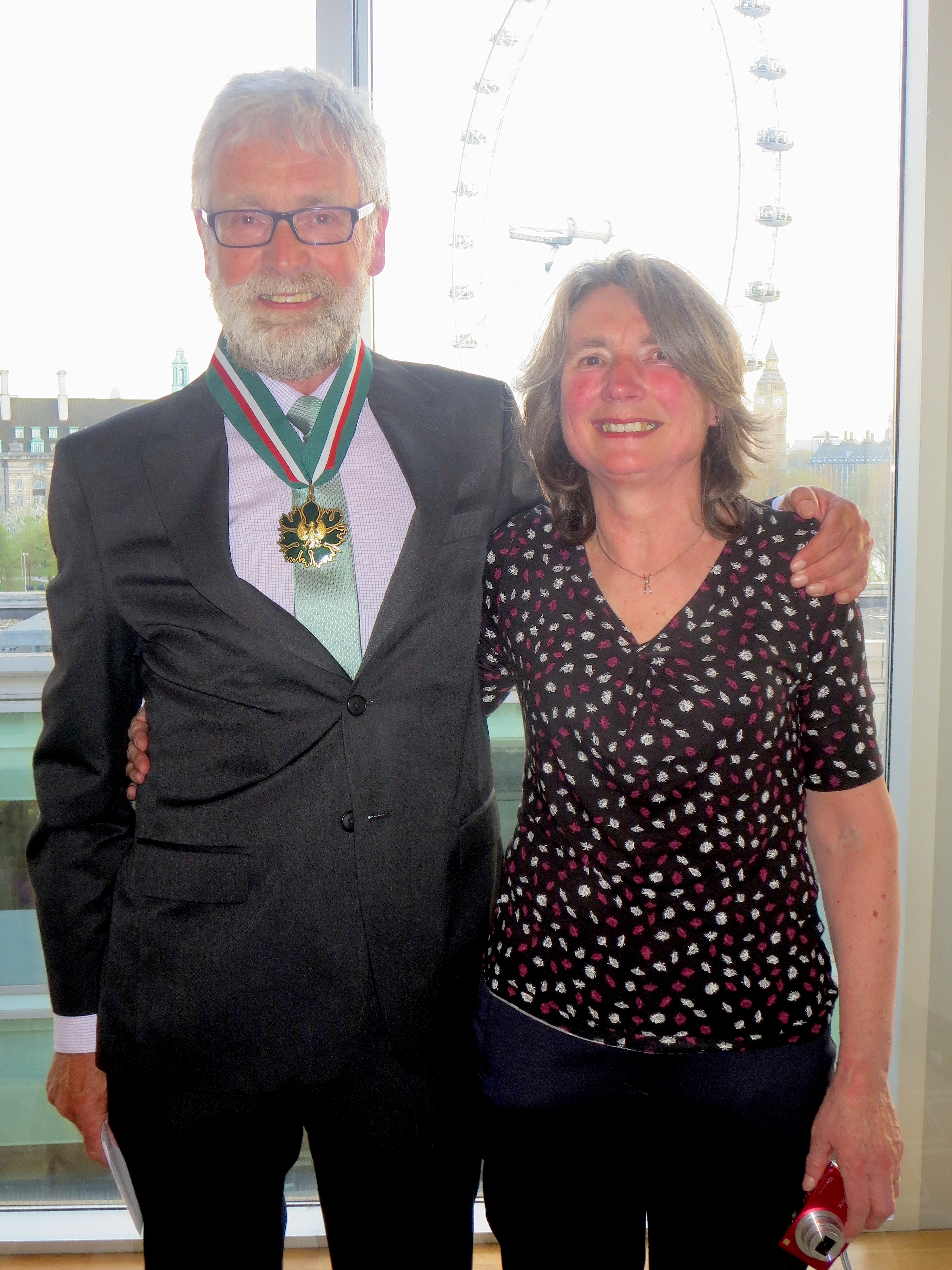
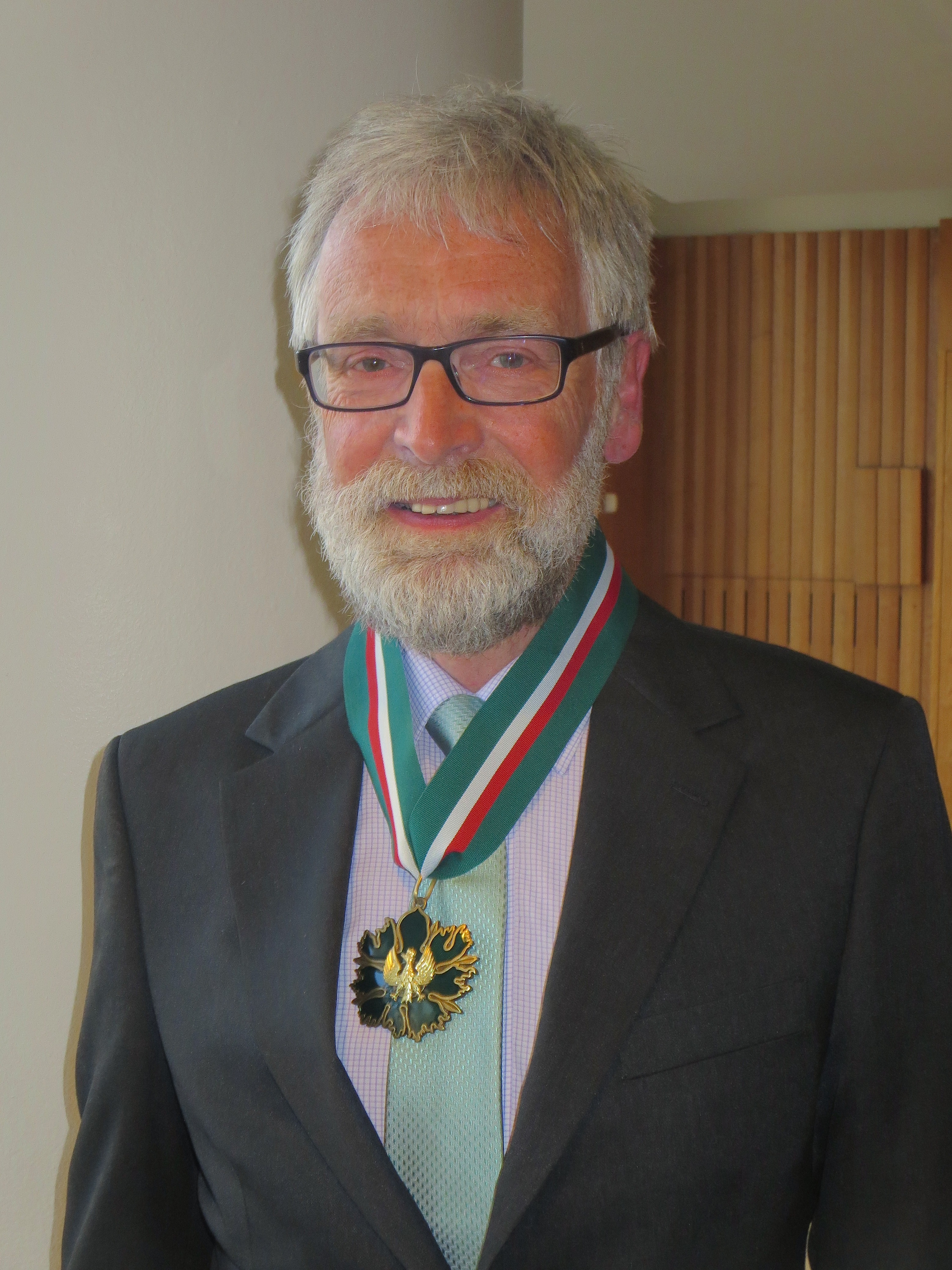
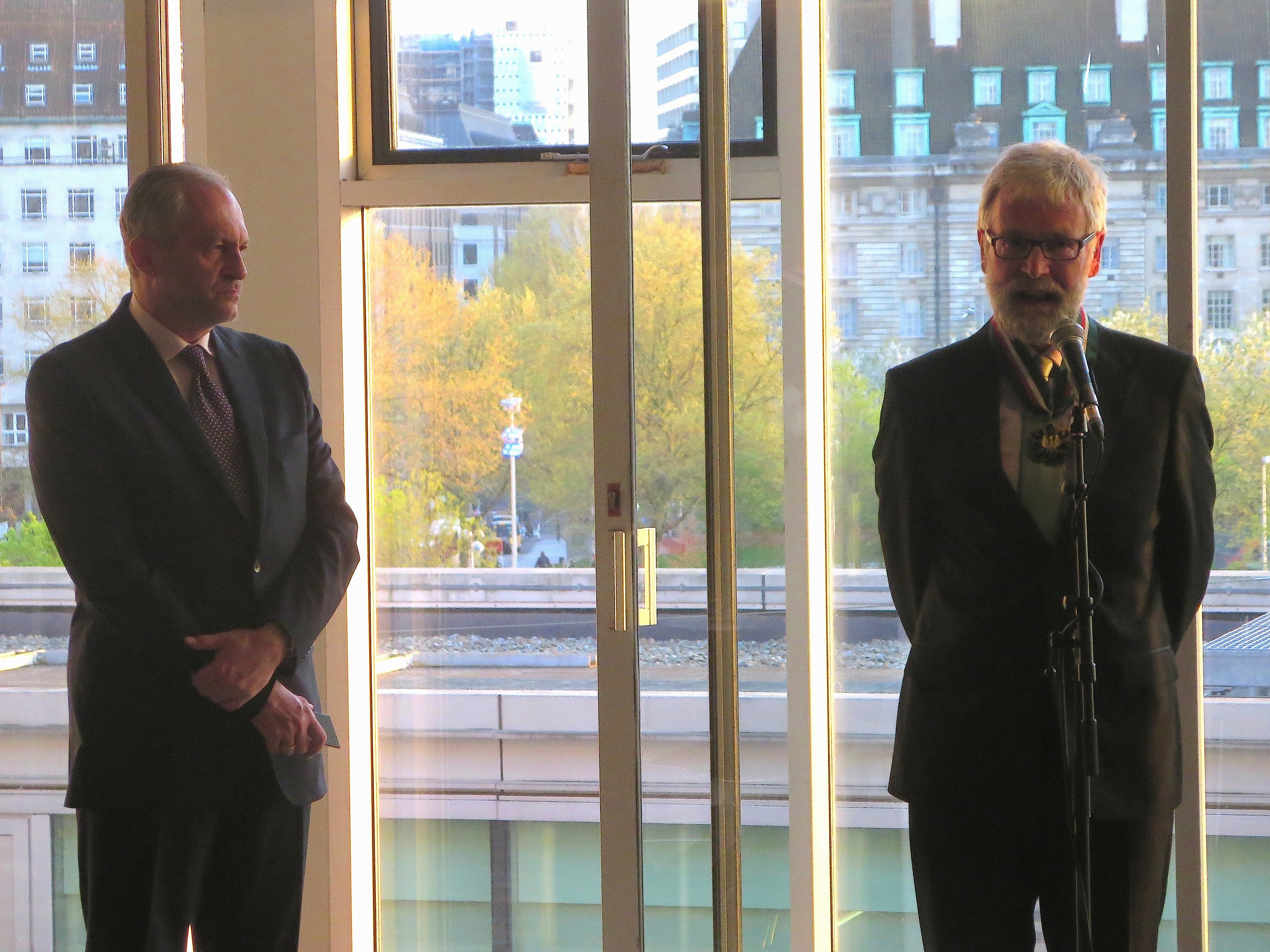
It was a sideshow to the main event of the evening (the world premiere of Henryk Mikołaj Górecki’s Fourth Symphony), but the ceremony that took place in the Thomas Beecham Room at London’s Royal Festival Hall on 12 April 2014 was very special to me.  I had learned late last year that the Polish Government, through the Ministry of Culture and National Heritage, had awarded me the Gloria Artis Gold Medal, for services to Polish music.  This was a great honour, not least because the vast majority of recipients of the bronze, silver and gold medals since the award’s creation in 2006 have been Polish creative artists, and consequently relatively few are from other countries. I gathered that Pierre Boulez and Simon Rattle and the historian Norman Davies were previous recipients of the Gold Medal.  Exalted company!

There was no immediate prospect of an award ceremony as I was off to France at the start of 2014 on a four-month walk.  I was scheduled, however, to return to London for a few days to give the pre-concert talk for the Górecki premiere and to attend rehearsals.  This turned out to suit the Polish side too.

The ceremony was carried out at a reception, between the talk and the concert, by the Polish Ambassador to the UK, Witold Sobków, who was very generous in his citation.  I gave a brief response to express my profound gratitude for the award, brief because time was running out (the clock on the tower of the Houses of Parliament was touching 19.20!).  There was still time to grab a photo opportunity with Górecki’s daughter Anna, with her husband Wojciech and their two older children, Jaś and Emi, and Janis Susskind, Górecki’s publisher at Boosey & Hawkes, and also a shot with my sister Gaynor who had come up to London especially.  Then it was into the concert for the premiere, and early the next morning I was back on the train heading for Paris and Limoges to complete my walk.

IMG_0195 copy

IMG_0210 copy

IMG_0215 copy

IMG_0218 copy

IMG_0220 copy

You can read a couple of related media reports here:

Polish Radio: http://www.thenews.pl/1/6/Artykul/168180,Top-British-music-critic-Adrian-Thomas-gets-Polish-state-honour
Cardiff University: http://www.cardiff.ac.uk/music/newsandevents/news/schoolnews/14goldmedal.html


• Panufnik Centenary (200th post)

Screen Shot 2014-05-12 at 17.44.39Another event (or, rather, series of events) that I have missed by being away is the initial celebration of the centenary of Andrzej Panufnik, who was born in Warsaw on 24 September 1914.  So far it seems to have been relatively quiet, certainly in comparison to the Lutosławski centenary last year.  Yet there is quite a bit going on.  There are conferences and focused events as well as performances within the 2013-14 and 2014-15 season.  There are over 100 concerts, principally in Poland and the UK, with a smattering in each of Austria, Germany, Latvia, Kosovo, Bulgaria, Romania, Australia and Brazil.  The gaps, though, speak for themselves.  Really, is there nothing in the USA except for Camilla Panufnik’s guest lecture at the University of Southern California? Nothing in Scandinavia, Holland, France, Spain or Italy?

Last month there was surprise, and dismay, that the BBC Proms had programmed no music by Andrzej Panufnik in 2014, although his daughter Roxanna makes a welcome appearance.  This isn’t good enough.  Just because last year’s Proms included two short works composed while Panufnik still lived in Poland – Tragic Overture and Lullaby – is no reason to ignore his substantial orchestral and chamber output composed since he settled in the UK in 1954.

But the Proms season is not alone.  Very few British orchestras have programmed Panufnik’s music this year.  The London SO is the leading light here, with performances of Lullaby and Sinfonia sacra (Symphony no.3) in February and Symphony no.10 in October in the new Polish Radio concert hall in Katowice and, the following night, in the Barbican Hall, London.  The list of performances monitored by Panufnik’s publishers, Boosey & Hawkes, shows how a wonderful opportunity has been missed.  As it stands, only half of Panufnik’s ten symphonies are being played this year.  Sinfonia sacra, arguably his most compelling symphony, has six performances overall, no.10 three, and nos 2, 4 and 5 two each.  That means that Sinfonia rustica (no.1), Sinfonia mistica (no.6), Metasinfonia (no.7), Sinfonia votiva (no.8) and Sinfonia di Speranza (no.9) are at present totally absent from concert halls around the world in this centenary year.  I find this totally mystifying.  The non-symphonic orchestral repertoire is more frequently on the bill: Tragic Overture (three), Lullaby (four), Heroic Overture (perhaps his least characteristic work, eight), Autumn Music (just one), Arbor cosmica (two) and Harmony (three).  No sign of one of his best pieces, Nocturne, which is nothing short of scandalous (I am reminded here of the rarity of Lutosławski’s masterpiece Livre during 2013).  Other notable absentees include Katyń Epitaph and Universal Prayer.

The concertos and chamber music fare better (Sinfonia concertante, no.4, should really figure in the first group).  The Piano Concerto and Piano Trio are notching up 13 performances apiece, while the Violin Concerto is being played on nine occasions and the Cello Concerto three. The string quartets and string sextet appear between three and six times each, and rising.  One of the major events is at the Presteigne Festival in Wales.  Over its six days (21-26 August), six of Panufnik’s pieces for voice(s), piano, chamber ensemble and string orchestra will be heard.  Isn’t it often the case that small or modest-scale organisations are more imaginative and flexible than big ones?

Nevertheless, most of Panufnik’s pieces are represented at some point during 2014, the vast majority in professional concerts, with a healthy sprinkling of amateur performances.  Some works have multiple hearings through tours or back-to-back concerts, and some are the repeated focus of specific performers, such as the Piano Concerto (Maciej Grzybowski). The Violin Concerto does particularly well in terms of range of soloists (Tai Murray, Maria Machowska, Tasmin Little, Aleksandra Kuls, Szymon Krzeszowiec, Alexander Sitkovetsky).

I live in hope, even at this late stage in concert planning for 2014-15, that some of the repertoire gaps will be bridged and that more of Panufnik’s music – which is distinctive, powerful, lyrical and tightly focused in an exceptional way – will be brought before the ears of the concert-going public this year.  And if not this year, then in subsequent years as a testimony to his unique creative voice.

panufnik.com

The Boosey & Hawkes list is located at the impressive panufnik.com.  This site has been up and running for a while, and includes his biography, a discography (current and past), a complete list of published works (by category and chronologically), audio excerpts, stills and a few videos from his brief film career in Poland (under the heading Extras-Unknown Panufnik) and a generous bibliography of Polish and English coverage (Extras-Further Reading). There is also a very welcome collection of Panufnik’s diagrammatic designs that are attached to eleven of his compositions.

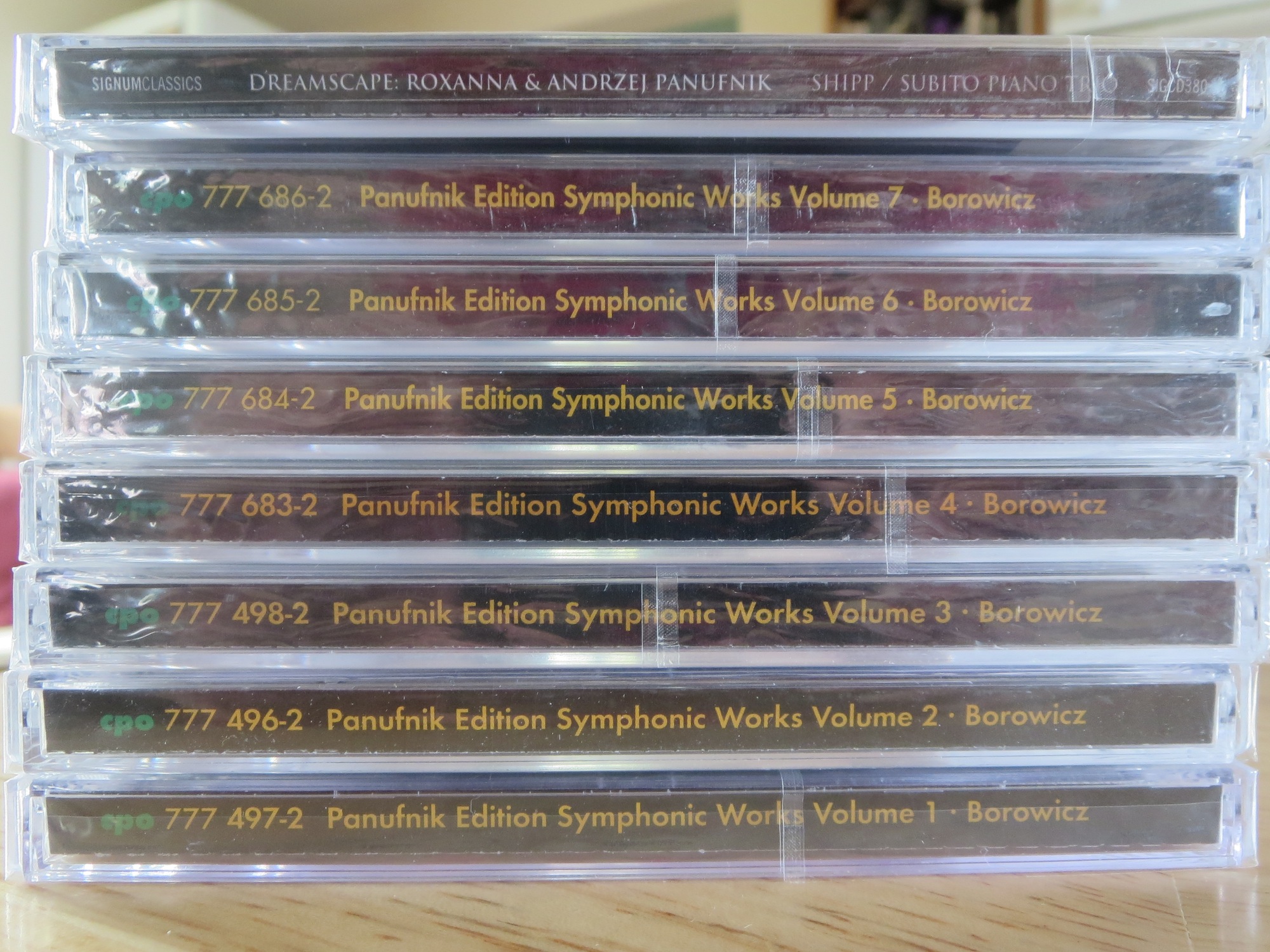
The audio excerpts are taken from the cpo series (2008-13) with the Polish Radio SO under Łukasz Borowicz.  I have just today – very belatedly – taken delivery of its seven CDs (and the just-released father-daughter double act with Roxanna’s music) and am eagerly looking forward to listening to them.  Borowicz is a persuasive conductor and, even if live performances of Panufnik’s orchestral music are unfairly patchy this year, at least there is this well-planned and comprehensive series that will last well beyond 2014.

IMG_3295 copy

Where panufnik.com is shy of being fully comprehensive is in some of the repertoire from the late 1940s and early 1950s.  Symphony of Peace (1951), although it was published in Poland, gets only a passing mention as furnishing the material for Sinfonia elegiaca (1957), and it is absent from the biography.  Also missing are the several mass songs that he wrote, and were published, in 1949-54 (no mention, for example, under Unknown Panufnik).  No-one is pretending for one moment that these minor propaganda pieces have musical importance, but they do have cultural-political significance and to imply that they never existed is unfortunate.  One only has to look at the openness with which such items were dealt with during the Lutosławski centenary to see that there are huge benefits for the understanding of the difficult life of Polish composers in those years.

In every other respect, panufnik.com is a valuable source of information, easy to navigate and handsome to look at.


• Górecki: Kyrie**

Hot on the heels of the YouTube upload of the premiere of Górecki’s Symphony no.4 (Górecki: Symphony 4**) comes another upload, this time of his Kyrie (2005), which was premiered in Warsaw, in the presence of his widow Jadwiga, on Easter Monday, 21 April 2014.  Górecki dedicated the Kyrie to Pope John Paul II, who died in 2005. This was intended to be part of a large-scale Mass that remained unrealised at Górecki’s death five years later.  Its sombre mood, underpinned by the low-register tolling, is momentarily relieved by the luminous tone of the a cappella ‘Christe elision’, but its general atmosphere is brooding.  The ending is especially haunting, where the expected return of ‘Kyrie eleison’ is replaced by Polish text.  The Kyrie also has echoes of a much earlier, and now almost forgotten work, the powerful Ad Matrem (1970).  On this evidence, the full Mass, had it been completed, would have been monumental.  You can find this recording on NINATEKA too.


• NINATEKA: WL, KP & HMG

My preparations for and execution of my peregrinations in France prevented me from highlighting a major online resource that was launched in Poland at the end of 2013.  I have been provoked into posting details now by the world premiere on 21 April of Henryk Mikołaj Górecki’s Kyrie.  Although a recording has already been posted on YouTube (https://www.youtube.com/watch?v=NNuWAb_5OPk), there is also an audio file on NINATEKA: Three Composers.  It can, however, take some time for the NINATEKA files to load on the in-built player, although I can’t tell if this is down to the strength or weakness of the wifi signal.

Screen Shot 2014-05-12 at 11.45.51

NINATEKA is hosted by Poland’s Narodowy Instytut Audiowizualny (National Audiovisual Institute) and covers a wide range of creative arts.  It is a Polish-language site, with the notable exception of Trzej Kompozytorzy (Three Composers).  Witold Lutosławski, Krzysztof Penderecki and Górecki all had significant anniversaries in 2013, and this initiative brings together archive recordings of their music, mostly from Polish Radio.  Here you will find not only the major concert works but also smaller, less familiar pieces.  There are timelines, biographies and glossaries (‘alphabet’).  Tucked away is the roster of the editorial team, led by Dr Iwona Lindstedt.

The navigating tools are fairly straightforward once you have worked them out.  Under ‘music’, you can pick an individual year or span of years, you can see a composer’s complete repertoire (‘all forms/genres’) or narrow it down under this same heading or in groups (scroll down ‘all categories’).  You can be guided by ‘recommended’ or ‘popular’ or read the playlists suggested by musicians and family members.  Or you can use ‘advanced search’ to filter by duration, instrumentation etc..  But if you want to look chronologically, you may initially be stumped.  For this, you have to look higher up the page and click on ‘creative periods’.

Happy exploration.  NINATEKA: Three Composers really is a treasure trove.

• Poles in Presteigne

UnknownThe 2014 Presteigne Festival in mid-Wales (21-26 August) has designed a special focus on Polish music.  This includes a new commission and premieres as well as sampling the music of composers such as Bacewicz, Lutosławski, Penderecki and Górecki.  There is a particular emphasis on the music of Andrzej Panufnik, on the centenary of his birth.  The full schedule may be found at: https://www.presteignefestival.com/PDFs/PF2014_brochure_for_web.pdf.

Here is an alphabetical-by-composer list of the Polish repertoire plus details of relevant talks and discussions
(** World premiere, * UK premiere):

Grażyna Bacewicz
• Concerto for String Orchestra (1948)
• Two Etudes for piano (1956)

Henryk Mikołaj Górecki
Two Sacred Songs for baritone and piano (1971)
• String Quartet no.1 ‘Already It Is Dusk’ (1988)

Witold Lutosławski
Dance Preludes for clarinet and piano (1954)
• Grave for cello and piano (1981)
• Partita for violin and piano (1984)

Paweł Łukaszewski
• Piano Trio (2008)
• Requiem** (2014, Festival commission)

Andrzej Panufnik
Miniature Etudes (Circle of Fifths), Book II, for piano (1947)
Landscape for string orchestra (1962/65)
Song to the Virgin Mary for choir (1964/69)
• Sinfonia Concertante for flute, harp and strings (1973)
• Love Song 
for mezzo-soprano and piano (1976)
• String Quartet no.3 ‘Wycinanki’ (1990)

Krzysztof Penderecki
• Prelude for solo clarinet (1987)
• Quartet for clarinet and string trio (1993)
• Serenade for string orchestra (1997)

Maciej Zieliński
• Lutosławski in memoriam for oboe and piano (1999)
Trio for MB for clarinet, violin and piano (2004)
Concello* (2013)

Talks and Discussions

• Warsaw Variations (award-winning Fallingtree Production, first broadcast on BBC R4 in 2012, with contributions by Beata Bolesławska-Lewandowska, Camilla Panufnik and Adrian Thomas), followed by a discussion with Camilla and Roxanna Panufnik, radio producer Alan Hall, chaired by David Wordsworth
• Pre-concert event: Roxanna Panufnik, with Stephen Johnson
• Pre-concert event: Paweł Łukaszewski, with Thomas Hyde
• Pre-concert event: Paweł Łukaszewski, with Adrian Thomas
• Talk: Three Generations of Polish Composers (Adrian Thomas)
• Pre-concert event: Maciej Zieliński, with Adrian Thomas