This is the third time that I have written CD booklet notes on the Górecki string quartets. Back in 1993, I wrote on no.2 ‘Quasi una fantasia’, followed 14 years later by no.3 ‘.. songs are sung’, both for Kronos on Nonesuch. In 2008, the Silesian Quartet – great friends of the composer – brought out all three quartets on EMI Poland. Now, in 2011, another Polish ensemble, the young and dynamic Royal String Quartet, has recorded these quartets for Hyperion. It has been a privilege to revisit these three masterpieces in its company.
Here’s the link to my note for this new GóreckiCD, or you can scroll the CD NOTES tab above.
It came as a shock to hear on Sunday that Andrzej Chłopecki, the Polish writer on contemporary music, had died that day, aged 62. He was a singular man with multiple attributes. He was keenly perceptive, wise, staunch, quirky, witty, impish, and never afraid to speak out whenever he came across the shallow or the hollow. He got into very hot water with the Establishment when he dared to criticise Penderecki’s Piano Concerto after its Polish premiere at the end of the 2002 ‘Warsaw Autumn’ festival. I admired him hugely for being a real critic. Above all, he was the most warm-hearted of colleagues and friends.
Others in Poland knew him much better than I did (he published almost exclusively in Polish, although his penetrating CD notes were translated into other languages for non-Polish labels). And they can verify his enormous contribution to Polish musical life over the past 40 years and more. He was for many years a key member of the Repertoire Committee of the ‘Warsaw Autumn’ and at the time of his death was the Artistic Director of the biennial ‘Musica Polonica Nova’ festival in Wrocław.
He was a brilliant broadcaster, acute in his thinking and challenging in his debates. My abiding personal memory is of when we jointly presented the live opening concert of BBC Radio 3’s Polska! festival on 19 November 1993, from the Witold Lutosławski Studio at Polish Radio in Warsaw. He, however, was in a balcony on the opposite side of the hall, with a clear view of the artists’ entrance (which I could not see) below my balcony seat. We were supposed to have a shared script and timing. But Andrzej decided that he had more to say, with the result that I, with no experience of live concert presentation, ended up scrabbling to describe the interior of the hall (in English, across the EBU network) while he continued to improvise on the merits of the programme to Polish listeners, barely one eye on the players waiting below me. I had no idea how long this was going to last. Later on, there was a party at someone’s flat (it may even have been his) and, as the photo indicates, there were no hard feelings, though perhaps my expression indicates something along the lines of “You cheeky …!” and his of “Never mind, that’s what you get with me!”. The cheeky fingers above Andrzej’s head belong to the composer Paweł Szymański.
Andrzej came from the generation whose composers succeeded Górecki, Kilar and Penderecki and brought new blood into Polish music in the late 1970s and 1980s. Among them was not only Szymański, but also Rafał Augustyn, Eugeniusz Knapik, Stanisław Krupowicz, Andrzej Krzanowski and Aleksander Lasoń. They came of age during the anti-communist protests of the 1970s and the rise and fall of Solidarity at the turn of the decade. They were activists through music, and Andrzej paid for this by losing his job at Polish Radio between 1981 and 1991. Their position has been vindicated by history.
I trawled through my photograph albums today and found a second photo, taken two years later in 1995, at a party held to mark the 25th anniversary (…) of my first visit to Warsaw and the ‘Warsaw Autumn’. Quite why I’m holding a shotgun – and pointing it at him – is a mystery, but the ever-convivial Andrzej is obligingly filling my glass. Behind me is Krupowicz, to his right Szymański, and behind/between them my longest-standing Polish friend, Michał Kubicki. We had a good evening, and no-one got shot.
Andrzej would have wanted those who knew him to have a good wake in his memory. Like all his friends and colleagues, I’m devastated that he has gone. A crumb of comfort – which may turn out to be not that small – is that a week before he died he completed a book about Lutosławski which will be published in time to mark his centenary next year. Thank you Andrzej for everything.
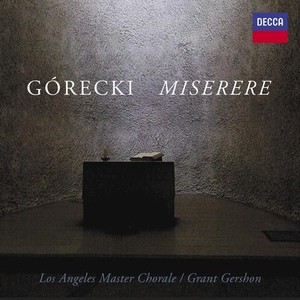
Two fine new CDs of Górecki’s choral music have appeared recently, one by British performers, one by Americans. First out was ‘Henryk Górecki: Totus Tuus’, sung by the National Youth Choir of Great Britain, conducted by Mike Brewer, on Delphian (DCD34054). Second to appear was ‘Górecki: Miserere’, sung by the Los Angeles Master Chorale, conducted by Grant Gershon, on Decca (478 3537). The NYCGB seems to be marginally the larger of the two sizeable choirs. Both are superbly blended and able to sustain the long and often quiet lines and harmonies of Górecki’s music. The two repertoires complement one another nicely, with only the previously unrecorded Lobgesang (2000) on both discs. Together, they give as representative a survey of Górecki’s sacred choral music (mostly a cappella) as you could wish for. And you can also appreciate the contrasts between young and mature voices.
The Delphian CD contains Euntes ibant et flebant (1972), Amen (1975), Totus Tuus (1987), Lobgesang and Salve, sidus Polonorum (2000). The excellent booklet note is by Ivan Moody. The full texts are included, in Latin/Polish and in English.
The Decca CD contains Miserere (1981), Five Marian Songs (1985) and Lobgesang. The full texts are included, in Latin/Polish, German, French and English.
Here’s the link to my booklet note for Górecki: Miserere, or you can scroll the CD NOTES tab above.
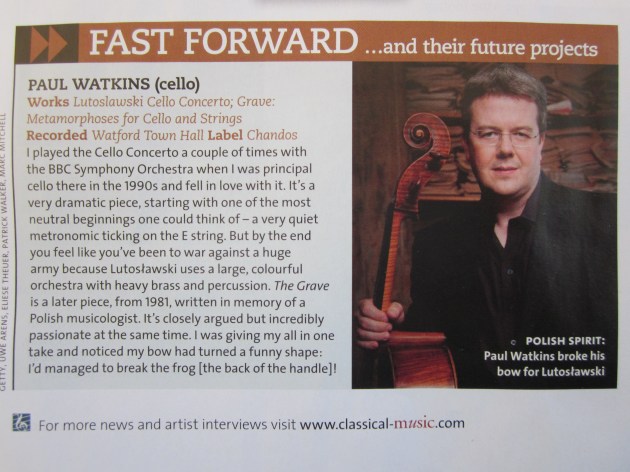
Where’s a musically literate editor when you need one? Here’s a panel from the September issue of the BBC Music Magazine, where Paul Watkins is interviewed in advance of the release of his recording with the BBC SO under Edward Gardner of Lutosławski’s Cello Concerto and Grave (Chandos CHSA 5106). I spotted the glaring transcription error (line 6), but my friend John Fallas spotted the funnier typographical one (line 9). Depressingly sloppy copy.
Five videos of Polish music have newly been made available online. They date from 1968-75 and are all of performances at the Philharmonic Hall in Warsaw during the annual ‘Warsaw Autumn’ festival. There are two pieces by Lutosławski and one each by Baird, Penderecki and Serocki. Not only can we now witness Peter Pears, Wanda Wiłkomirska and Karl-Erik Welin in action but we can also experience Lutosławski conducting his own music as well as appreciate that inspirational and tireless champion of new music, Andrzej Markowski (1924-86). Many Polish composers owed him a huge debt of gratitude, including Baird, Penderecki and Serocki.
In chronological order of recording, these five videos are:
• Krzysztof Penderecki: Capriccio for violin and orchestra (1967). Wanda Wiłkomirska, National Philharmonic, cond. Andrzej Markowski, 21 September 1968 (opening concert). http://www.youtube.com/watch?v=jLYY6Knc77w
• Kazimierz Serocki: Fantasia elegiaca for organ and orchestra (1972). Karl-Erik Welin, Sinfonie-Orchester des Hessischen Rundfunks, Frankfurt, cond. Andrzej Markowski, 28 September 1973 (Polish premiere). Very little of Serocki’s music post-1956 is available in audio formats, let alone video, so this upload is welcome. http://www.youtube.com/watch?v=g4NuCcpakbU
• Witold Lutosławski: Preludes and Fugue for thirteen solo strings(1972). Chamber Ensemble of the National Philharmonic, cond. Lutosławski, 30 September 1973 (Polish premiere). A minor frustration here: this was the first half of the concert which closed the 1973 festival. In the second half, Lutosławski conducted Heinrich Schiff in the much-postponed Polish premiere of the Cello Concerto. How I would love to see a video of that! http://www.youtube.com/watch?v=Vo1pdDEeLaM • Tadeusz Baird: Elegeia (1973). National Philharmonic, cond. Andrzej Markowski, 21 September 1974 (opening concert). http://www.youtube.com/watch?v=PPKxpv8gBZs
• Witold Lutosławski: Paroles tissées (1965). Peter Pears, Chamber Ensemble of the National Philharmonic, cond. Lutosławski, 25 September 1975. Peter Pears had been the dedicatee and first performer of this song cycle at the Aldeburgh Festival ten years earlier, on 20 June 1965. This was not its Polish premiere, but it was the only time that Pears sang it there. http://www.youtube.com/watch?v=czUDDNjwo_Q
No author likes being remaindered, but this Amazon ad (sent to me by Raymond Yiu) is absurd. What planet are they on? £1131/$1767? That’s £11/$17 dollars per page.
My extremely modest little paperback study, Grażyna Bacewicz: Chamber and Orchestral Music, was published in Los Angeles in 1985, and remains the only book in English that explores Bacewicz’s music in any detail. I’ve no idea what the print-run was, though it wouldn’t have been large. Scarcity is one thing, but imagining that anyone would pay anything over the list price (c.£11/$17 – equivalent to a single page at this ad’s rate) is plain ridiculous.
There is another used copy on Amazon, on sale for $350, which is preposterous in itself. If anyone interested in Bacewicz’s music would like to see what I sketched out in 1985, just get in touch and I’ll see what I can do.
…….
Another friend, Justin Geplaveid, alerted me this week to a Polish TV documentary on Bacewicz, made in 1999 to mark the 90th anniversary of her birth and the 30th of her death. It’s an old-style, chronological account, and none the worse for that. It is in Polish only. Even so, much can be gleaned about her life and work. There are plentiful excerpts from an interview with her sister Wanda and appearances by her teachers Kazimierz Sikorski and Nadia Boulanger. Keen observers will also glimpse Lutosławski, Mycielski and Serocki in company with Boulanger and Bacewicz. There are some home movies and, most importantly, excerpts of live performances of her music. There is a full list of performances and performers at the end of the film.
Included in these archive performances are Divertimento (1965), Witraż (1934), Violin Concerto 1 (1937), Oberek (1949, Grażyna Bacewicz, with her brother Kiejstut), Concerto for String Orchestra (1948, the first movement in a compilation of recordings, including one conducted by Yehudi Menuhin), Olympic Cantata (1948), String Quartet 4 (1951), Symphony 3 (1952), Music for Strings Trumpet and Percussion (1958), Musica sinfonica (1965, as a ballet), The Adventure of King Arthur (1959, radio opera), String Quartet 7 (1965) and Violin Concerto 7 (1965, conducted by Krzysztof Penderecki).
As a little supplement to my earlier post today on Kilar at 80, here are two interviews I’ve since discovered by the film directors Krzysztof Zanussi and Andrzej Wajda. They’re in Polish but with excellent English subtitles. It’s interesting to observe the different ways in which Zanussi and Wajda talk about their frequent collaborations with Kilar. Zanussi speaks touchingly and intelligently, referring to Kilar by the semi-formal ‘Pan Wojciech’ (Mr Wojciech). Wajda is revealing in other ways, freer and more relaxed, and uses the more familiar ‘Wojtek’.
The interviews also offer glimpses of some of the films. In Zanussi’s case, the excerpts are fairly brief: Struktura kryształu (The Structure of Crystal, 1969), Iluminacja (Illumination, 1973), Brat naszego Boga (Our God’s Brother, 1997). The excerpts in the Wajda interview are a bit longer: Ziemia obiecana (Land of Promise, 1974), Kronika wypadków miłosnych (Chronicle of Amorous Events, 1986) and Pan Tadeusz (Mr Thaddeus, 1999). Both accounts display Kilar’s mastery of the complementary score, sometimes in the most minimal way, an approach which often pays dividends in the cinema.
Both interviews have been recently uploaded by the Polish Music Publishers, PWM Edition, as part of its celebration of Kilar’s life and work. There are also YouTube interviews with two Polish conductors: Antoni Wit (who has recorded several CDs of Kilar’s work for Naxos and other labels) and Wojciech Michniewski.
The interview with Michniewski, who has a background as a composer, is particularly engaging. He gives a fascinating and anecdotally rich account of his connections with Kilar, concentrating on Orawa (1986) and Siwa mgła (Grey Mist, 1979), including the delightful inscriptions that Kilar wrote in his copies of these scores.
Wojciech Kilar is one of the stayers of Polish music. He turns 80 today. Of his fellow internationally-known composers, only Witold Lutosławski (1913-94) has reached the same milestone. Two months ago, the Polish president awarded Kilar the country’s highest honour, the Order of the White Eagle. I hope that this is not an omen of mortality, as its conferral on both Lutosławski and Henryk Mikołaj Górecki took place when they were on their deathbeds. Equally, I’m not anxious to mark this event with anything like an obitual ode, and I’ll draw a polite veil over Kilar’s concert music of the last twenty years or so.
Although many other Polish composers have written film music, Kilar is undoubtedly the best-known, with well over 100 film scores to his credit (his first was in 1958). He’s worked on a wealth of Polish films, such as Kazimierz Kutz’s Sół ziemi czarnej (Salt of the Black Earth, 1969), Krzysztof Zanussi’s Struktura kryształu (The Structure of Crystal, also 1969), Andrzej Wajda’s Ziemia obiecana (The Promised Land, 1974) and Krzysztof Kieślowski’s Przypadek (Blind Chance, 1981). Kilar became internationally famous for his work on English-language films, such as Francis Ford Coppola’s Bram Stoker’s Dracula (1992) and Jane Campion’s The Portrait of a Lady (1996). He has a gift for a catchy melodic hook, like that which haunts his score for Roman Polański’s The Pianist (2002).
Kilar’s concert music follows a similar trajectory to those of his Polish contemporaries, at least from the 1950s through to the 1980s. It’s not often realised, however, that he was known as an up-and-coming talent several years earlier than Krzysztof Penderecki and Górecki, who were born just a year later. His music of the early-mid 1950s unsurprisingly shows a neoclassical bent (Horn Sonata, 1954; Little Overture, 1955). After his Ode in memoriam Béla Bartók (1957), he seems to have taken a compositional breather, while other composers were sorting out their responses to the Western avant-garde in public at the new, ground-breaking ‘Warsaw Autumn’ festivals. Kilar stormed back in the fourth, fifth and sixth festivals in 1961-63 with Herbsttag (1960), Riff ’62 (1962) and Générique (1963).
Although they challenged the audiences, these scores were quite different to those of Penderecki and Górecki. Kilar’s music was more febrile, less obviously unified, less closely wedded to the sonoristic movement of his contemporaries. It was lighter than Górecki’s equivalent pieces (Elementi, 1962) and less homogenous than Penderecki’s, as the jazz and rhythmic components in Riff ’62 shows. For a while in the late 1960s, Kilar seemed close to Górecki (they both lived and worked in Katowice) as they moved towards a more consonant idiom, but their paths started to diverge.
I once characterised their differences as Kilar preferring the major third while Górecki went for the minor. This pat observation has a certain element of truth, in the sense that Kilar developed a sweeter compositional tooth than Górecki. This is borne out when comparing two works from 1972: Kilar’s Przygrywka i kolęda (Prelude and Christmas Carol) and Górecki’s Second Symphony ‘Copernican’. Kilar was the first (after Zygmunt Krauze’s Folk Music, 1972) to plunge wholeheartedly into the world of folk culture, and in 1974 he came up with a stunner that remains one of his most-performed orchestral works.
Krzesany (Sparking Dance) is a vigorous re-imagining of one of the Polish highlanders’ most characteristic dances. It’s hard to realise 40 years on how refreshing and jovial this piece was, bringing together as it did elements of sonorism and national music. Polish folk music, which twenty years earlier had been somewhat tainted among composers for its role in promoting communist socialist realism, had been released by Krauze and Kilar. For my money, Kilar’s Orawa for strings (1986) is a more successful and if less obviously colourful example, and I remember having great fun when conducting it many years ago, though the players had to work harder than I did! There are two intervening symphonic poems which also draw inspiration from the Podhale region north of the Tatra Mountains – Kościelec 1909 (1976; the title refers to the mountain where the composer Mieczysław Karłowicz met his death by avalanche) and Siwa mgła (Grey Mist, 1979).
With Bogurodzica (Mother of God, 1975), Kilar got into his stride with religious contextualisation or historical memorialisation. Subsequent pieces include Victoria (written for Pope John Paul II’s second visit to Poland), Angelus (1984), Piano Concerto (1997), Missa pro pace (2000) and September Symphony (2003, his response to 9/11).
The most notorious of these pieces was Exodus (1981). Krzesany had created a sensation at the 1974 ‘Warsaw Autumn’, and Exodus did likewise at the 1981 festival. This was at the height of the Solidarity movement and just three months before the imposition of martial law, so Kilar’s reference to the Old Testament story accumulated contemporary symbolism. Here, the ‘major third’ aspect of Kilar’s aesthetic came to the fore, allied to a Boléro-like structure. And there’s no doubting the filmic aspect too – it’s as if Kilar was writing for a Hollywood biblical epic. I was present at the premiere in the Philharmonic Hall in Warsaw. The audience became very excitable, provoked by the repetitious refrain (some even joining in), and as Exodus reached its final choral-orchestral flourish, someone next to me let out a loud ‘Mehhhhhhh’.
Here’s a video put up yesterday by the Polish Music Publishers, PWM Edition. It’s a live performance of Bogurodzica, Angelus (starting at 11’08”) and Exodus (starting shortly after 31’55”). (Warning: there are virtually no gaps between pieces in this tightly edited video.) The concert was given on 1 May this year in the presence of the composer at the monastery church at Częstochowa, where Kilar has long had a private retreat.
Whether by design or in naivety, Kilar’s music of the past 40 years has divided audiences as violently as the parting of the Red Sea. In his pared-down, transparent pieces since 2000, some hail him as having a mystical link – through his music – to the Almighty. Others see an updated version of the story of the Emperor’s New Clothes. But no-one can accuse him of not following his compositional instincts, and his music continues to touch audiences and film-goers across the world.
Once again I’m indebted to the eagle eyes of Tim Rutherford-Johnson (http://johnsonsrambler.wordpress.com/) who tweeted yesterday (https://twitter.com/#!/moderncomp) about a YouTube video he’d discovered of the premiere of Górecki’s Ad Matrem. It’s a black and white film made by Polish Television on 24 September 1972 at the final concert of that year’s ‘Warsaw Autumn’ festival. The venue was the National Philharmonic Hall, with Stefania Woytowicz and the National Philharmonic SO and Choir conducted by Andrzej Markowski. It’s a bit of a shame that the film cuts out just before Górecki came onto the stage to acknowledge the applause.
The Górecki concluded the concert, and therefore crowned the festival. Ad Matrem was preceded in the programme by a typically eclectic festival mix of repertoire: Schoenberg’s Five Orchestral Pieces, Tomasz Sikorski’s Holzwege (Paths to Nowhere, premiere), Franco Oppo’s Digressione (Polish premiere) and Penderecki’s Partita (also a Polish premiere), with soloists Felicja Blumental and Terje Rypdal.*
Woytowicz went on to give the premieres of Górecki’s second and third symphonies as well as O Domina nostra, which was dedicated to her. (She also sang Lutosławski’s Lacrimosa at his funeral in 1994.)
Markowski was a great supporter of Górecki’s music, having given the premiere of his Epitafium at the second ‘Warsaw Autumn’, in 1958, and conducting several subsequent premieres: Little Music II (‘Warsaw Autumn’, 1967), Wratislaviae gloria (Wrocław, 1969), Old Polish Music (‘Warsaw Autumn’, 1969) and the Second Symphony with Woytowicz (Warsaw, 1973). Markowski was a passionate advocate not only of Górecki’s music but also that of other contemporary composers from home and abroad. Something of his character may be gleaned from the fact that he fought in the Warsaw Uprising of 1944 as a member of the Polish underground Home Army.
Górecki’s Ad Matrem (1972) is a powerful and lean work. The chorus utters only two words (‘Mater mea’), just twice in the early stages. The music’s trajectory, from pulsing bass drums, through these interjections and on to a luminous dominant thirteenth and beyond, is very striking, not least because Górecki places these textures sparingly. The soprano does not sing her four words (‘Mater mea, lacrimosa dolorosa’) until the closing bars. I’ve often thought of this approach as painterly in the sense that Patrick Heron, for example, created abstract paintings with a huge swathe of one colour at one end of the canvas but very telling and contrasting colour-blocks at the other end or in isolated patches in between.
* Despite Ad Matrem being one of the most unconventionally moving and striking of Górecki’s works, it has remained largely unrecognised outside Poland, even though it won First Prize at the UNESCO Composers’ Rostrum in Paris in 1973. In the UK, it took the initiative of the British composer John Casken to bring about the UK premiere. This took place, performed by students at Manchester University under his direction, in December 2002, a full thirty years after its premiere in Warsaw.
Thanks to the eagle eye of The Rambler – thanks, Tim! – I’ve just been reading an article uploaded by Agata Pyzik on her blogsite nuitssansnuit on 21 May 2012. Published in a shorter version a year ago in The Wire (March, 2011), her article ‘Polish Radio Experimental Studio released’ gives a brief overview of PRES in order to promote a new venture by the independent Polish label, Bôłt. Bôłt has recently remastered electronic music produced at PRES since its foundation in 1957. Key works, especially from the early years of PRES, are now available in digital form, and Bôłt deserves huge congratulation for taking the trouble to sort through the studio archives.
Pyzik’s article includes links to several sound files on YouTube. Its English translation is not always ideal, unfortunately, and there are a few loose ends, but it’s worth reading as an introduction to this formative period in the careers of Andrzej Dobrowolski, Włodzimierz Kotoński, Krzysztof Penderecki and Bogusław Schaeffer, among others. You will not yet find any music by Dobrowolski or Kotoński on the Bôłt series (but Pyzik provides YouTube links to a few of their pieces). I thought it might be helpful to write a few words on each of the six PRES CDs so far issued by Bôłt (there are over a dozen other CDs in its catalogue which range more broadly both chronologically and geographically outside Poland). You can access the Bôłt CD home page at http://boltrecords.pl/en_cd.html.
The first double CD (BR ES01) shows that Bôłt’s intentions are not just to provide an historical record of a past age. The first CD consists of seven tape pieces from the PRES archives (by Bohdan Mazurek, Penderecki, Eugeniusz Rudnik and Schaeffer). The second CD consists of new ‘covers’ of these pieces, plus another of Schaeffer’s Symphony (1966), although the original realisation of this historically significant work by Mazurek is not included. It does appear, however, on the sixth disc of the series, which is devoted to Schaeffer.
The second double CD (BR ES02) is devoted to Mazurek, whose name and achievement as a composer have for too long been overshadowed. In the early years, through the 1960s and beyond, Mazurek, like Rudnik, was one of the sound engineers employed by PRES, so his own compositional output never had the space to breathe that it deserved. This neglect has now been rectified. His pieces are presented solely in their original versions.
Elsewhere, the significant aspect of this venture – and I hasten to add that I’ve not yet had the opportunity to hear any of the discs so far issued – is the revisiting of the past and the possibility for listeners to compare originals with their covers. It’s a neat and inventive idea. The third, single CD (BR ES03) consists of new versions of PRES pieces, ranging from works by Rudnik and Mazurek to later works by younger composers Krzysztof Knittel and Elżbieta Sikora, performed by Zeitkratzer.
Knittel and Sikora reappear on the fourth, triple CD (BR ES04) along with Wojciech Michniewski. Although Michniewski has since made his career as a conductor, this trio, known collectively as KEW from their first-name initials, was a driving force as an improvising ensemble in the early 1970s. This is the CD issue that excites my anticipation most, because much of it has not been heard since those years. There are three substantial group tracks, one by Michniewski, seven by Knittel and five by Sikora.
Rudnik is also given a separate, single CD of his own (BR ES05), this time reinterpreted by D J Lemar (aka Marcin Lenarczyk), who has worked with a wide range of musicians, including the Royal String Quartet (as in a 2007 recording in which Szymanowski’s Symphony 4 makes an appearance – http://www.youtube.com/watch?v=NEEpLBctesM). The CD cover, by not mentioning Rudnik by name, implies that Lenarczyk’s improvisations are somehow more significant than Rudnik’s original input.
The last of the six CDs so far issued (BR ES06) is a double CD devoted to Schaeffer. The four originals on disc 1 are reinterpreted on disc 2 (there are two new versions of Assemblage to add to the two on BR ES01). Nowhere is the Bôłt approach more appropriate. Schaeffer has been an iconoclastic figure throughout his career and much of his experimental output was intentionally open to new versions. These six CD issues, comprising eleven discs in all, uniquely combine archival and live performances which promise to bring an important repertoire of the Polish avant-garde to the attention of new audiences.
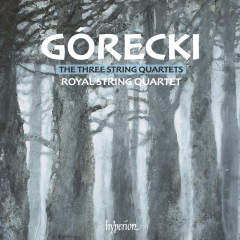 This is the third time that I have written CD booklet notes on the Górecki string quartets. Back in 1993, I wrote on no.2 ‘Quasi una fantasia’, followed 14 years later by no.3 ‘.. songs are sung’, both for Kronos on Nonesuch. In 2008, the Silesian Quartet – great friends of the composer – brought out all three quartets on EMI Poland. Now, in 2011, another Polish ensemble, the young and dynamic Royal String Quartet, has recorded these quartets for Hyperion. It has been a privilege to revisit these three masterpieces in its company.

 Five videos of Polish music have newly been made available online. They date from 1968-75 and are all of performances at the Philharmonic Hall in Warsaw during the annual ‘Warsaw Autumn’ festival. There are two pieces by Lutosławski and one each by Baird, Penderecki and Serocki. Not only can we now witness Peter Pears, Wanda Wiłkomirska and Karl-Erik Welin in action but we can also experience Lutosławski conducting his own music as well as appreciate that inspirational and tireless champion of new music, Andrzej Markowski (1924-86). Many Polish composers owed him a huge debt of gratitude, including Baird, Penderecki and Serocki.
 No author likes being remaindered, but this

 The first double CD (BR ES01) shows that Bôłt’s intentions are not just to provide an historical record of a past age. The first CD consists of seven tape pieces from the PRES archives (by Bohdan Mazurek, Penderecki, Eugeniusz Rudnik and Schaeffer). The second CD consists of new ‘covers’ of these pieces, plus another of Schaeffer’s Symphony (1966), although the original realisation of this historically significant work by Mazurek is not included. It does appear, however, on the sixth disc of the series, which is devoted to Schaeffer.
 The second double CD (BR ES02) is devoted to Mazurek, whose name and achievement as a composer have for too long been overshadowed. In the early years, through the 1960s and beyond, Mazurek, like Rudnik, was one of the sound engineers employed by PRES, so his own compositional output never had the space to breathe that it deserved. This neglect has now been rectified. His pieces are presented solely in their original versions.
 Elsewhere, the significant aspect of this venture – and I hasten to add that I’ve not yet had the opportunity to hear any of the discs so far issued – is the revisiting of the past and the possibility for listeners to compare originals with their covers. It’s a neat and inventive idea. The third, single CD (BR ES03) consists of new versions of PRES pieces, ranging from works by Rudnik and Mazurek to later works by younger composers Krzysztof Knittel and Elżbieta Sikora, performed by
  Knittel and Sikora reappear on the fourth, triple CD (BR ES04) along with Wojciech Michniewski. Although Michniewski has since made his career as a conductor, this trio, known collectively as KEW from their first-name initials, was a driving force as an improvising ensemble in the early 1970s. This is the CD issue that excites my anticipation most, because much of it has not been heard since those years. There are three substantial group tracks, one by Michniewski, seven by Knittel and five by Sikora.
 Rudnik is also given a separate, single CD of his own (BR ES05), this time reinterpreted by D J Lemar (aka Marcin Lenarczyk), who has worked with a wide range of musicians, including the Royal String Quartet (as in a 2007 recording in which Szymanowski’s Symphony 4 makes an appearance –
  The last of the six CDs so far issued (BR ES06) is a double CD devoted to Schaeffer. The four originals on disc 1 are reinterpreted on disc 2 (there are two new versions of Assemblage to add to the two on BR ES01). Nowhere is the Bôłt approach more appropriate. Schaeffer has been an iconoclastic figure throughout his career and much of his experimental output was intentionally open to new versions. These six CD issues, comprising eleven discs in all, uniquely combine archival and live performances which promise to bring an important repertoire of the Polish avant-garde to the attention of new audiences.
 On Polish Music