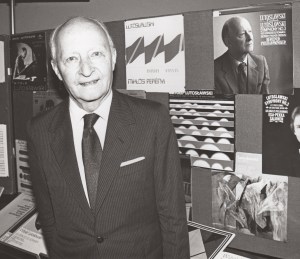
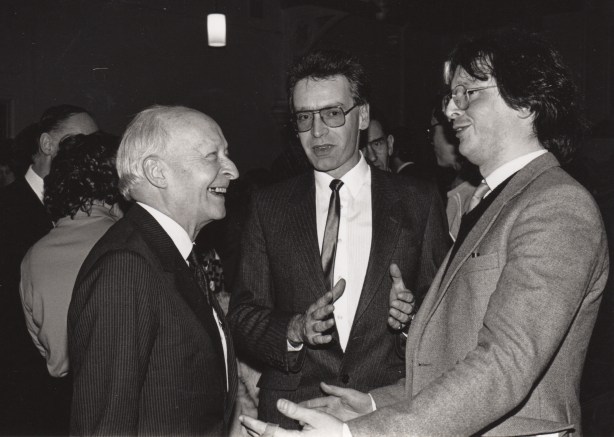
Here are a few more pictures from Lutosławski’s visit to Queen’s University, Belfast, twenty five years ago in December 1987 (see the two preceding WL100 posts). After a concert of his chamber music on 17 December, Lutosławski spent some time looking at an exhibition of his scores and LP covers. Lutosławski and I also had an evidently jolly discussion with my friend and colleague, the composer Piers Hellawell.
Twenty five years ago today, on 17 December 1987, Lutosławski paid his one and only visit to Northern Ireland. He had come for the Winter graduation at The Queen’s University of Belfast where he was to be awarded an Honorary DMus on 18 December. I was teaching at Queen’s at that time and the proposal that the University should recognise Lutosławski came from my colleague, the innovative social anthropologist and ethnomusicologist, John Blacking.
On the night before the degree ceremony, the Department of Music mounted a short concert of Lutosławski’s chamber music in his honour: Dance Preludes, Five Songs, Sacher Variation, Epitaph, Grave and Partita. The performers were graduands of the University, joined by György Pauk and Roger Vignoles. Lutosławski seemed very pleased with the occasion, and afterwards he inspected an exhibition of his scores and record sleeves (LPs in those days!) and mingled happily with the audience at a post-concert reception in his honour.
I’ll post some more pictures from the occasion in the coming days.
From left to right: György Pauk (violin), Donal McCrisken (piano), Damian Frame (clarinet), Francis King (piano), Lutosławski, Colin Stark (oboe), Jacqueline Horner (mezzo-soprano), John O’Kane (cello), Roger Vignoles (piano)
The programme notes for the concert may be accessed here.
Poland has a wonderfully rich heritage of carols. In 1946, as the country was recovering from the devastation of World War II, Lutosławski collected together a set of Dwadzieście kolęd (Twenty Carols) for voice and piano; in 1984-89, he arranged them for soprano, female choir and chamber orchestra.
Exactly 22 years ago today (14 December 1990), in Aberdeen in Scotland, Lutosławski conducted the premiere of this second version, with Susan Hamilton, the Scottish Philharmonic Singers and the Scottish Chamber Orchestra.
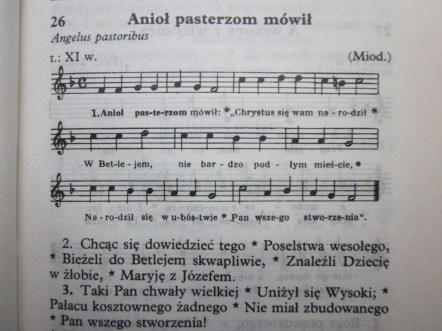
Here’s a recording of the first carol in the set, ‘Anioł pasterzom mowił’ (The Angel Said to the Shepherds). The text is 11th-century, the music from the Śpiewnik kościelny (Church Hymnbook, 1838-53) compiled by Michał Marcin Mioduszewski. On this recording, only verses 1 and 3 are sung. The melody has an interesting construction of eleven bars (Lutosławski repeats the last seven).
Lutosławski year was officially launched in Warsaw yesterday under the banner ‘100/100 Lutosławski’. A new website has been published (in Polish/English), but precise details of events are yet to be fully revealed. I outlined the details of the Philharmonia’s splendid Woven Words website, launched in October, in an earlier post. Here, I’ll outline what has so far emerged from Polish sources.
Websites
• http://lutoslawski.culture.pl/web/lutoslawskien The ‘100/100 Lutosławski’ website, hosted by the Adam Mickiewicz Institute, is a companion to the one launched to mark the 75th anniversary of Szymanowski‘s death earlier this year. It currently has a three SoundCloud clips (Concerto for Orchestra, Symphonies 3 and 4), though not all the clips and the accompanying notes are credited. There’s a short video discussion between Steven Stucky and Esa-Pekka Salonen as well as videos shared with the Woven Words website. Its Calendar of events has still to be unveiled, and its list of Resources consists at the moment only of a short bibliography that has got as far as the letter ‘R’ (so no Stucky yet…). No doubt the whole website will become more fully populated in the coming days and weeks.
• http://www.lutoslawski.org.pl/en/lutoslawski2013/info This is the home of the Witold Lutosławski Society, which has existed since the late 1990s. Like ‘100/100 Lutosławski’, it has both a Polish and an English site. It promises details shortly. By the way, for anyone with a short orchestral piece close to hand, the WLS is hosting a composition competition with a deadline of 25 January 2013, the 100th anniversary of the composer’s birth. The competition’s regulations may be accessed here.
Performances
The Lutosławski components of the Warsaw Philharmonic’s forthcoming programmes have been published for some time and may be found by scrolling the Warsaw Philharmonic’s concert schedule. Its celebrations begin on 11 January 2013. Until the ‘100/100 Lutosławski’ Calendar is uploaded, you can find details of quite a few concerts worldwide at https://www.facebook.com/LutoslawskiCentennialCelebration, under ‘About’.
Recordings
It seems to me that it has been non-Polish ensembles and recording companies who have been taking the lead in this area of activity, notably the BBC SO under Edward Gardner for Chandos (4 CDs since 2010, a fifth on its way). Next month, Sony re-releases the Los Angeles PO/Salonen recordings of Symphonies 2-4 plus their newly-recorded version of the First Symphony. The Polish Accord label started its Lutosławski Opera Omnia series in 2008, but there has been no further release since the third CD in 2010. I am not privy to Polish recordings planned for release in 2013. I am, however, very excited by the two ventures outlined below.
As part of the official launch yesterday in the Witold Lutosławski Studio at Polish Radio and Television, the Polish National Audiovisual Institute (NInA) issued a press release (in Polish) containing the following information:
• A unique collection of recordings will be made available on the nina.gov.pl portal in the second half of 2013. All of Lutosławski’s compositions will be uploaded in at least one performance. (As the 80th birthdays of Henryk Mikołaj Górecki (d. 2010) and Krzysztof Penderecki also fall in 2013, their music will be similarly covered by NInA next year.) This online collection – drawn from Polish Radio archives – will be developed further in due course. Its accompanying texts, by the late Polish Radio broadcaster and musicologist Andrzej Chłopecki, will be available in both Polish and English.
• NInA will also issue a six-disc set called ‘Lutosławski/świat’ (Lutosławski/World) – 5 CDs and a DVD – in the second half of 2013. The vast majority of these recordings, from Polish Radio and WFDF (Documentary and Feature Film Studio), are being released for the first time. They include archive recordings conducted by Lutosławski, and the booklet notes, many by young musicologists, promise fresh perspectives. The project editor is Adam Suprynowicz.
What is especially interesting in the Polish context is the promise that Lutosławski’s complete output will be represented, including those works (socialist-realist pieces, film music and popular songs) which, as the press release says, ‘he himself sometimes wanted to forget’. This promises to be a fascinating document, one which sets Lutosławski’s rich legacy of pieces and recordings in the broadest possible context.
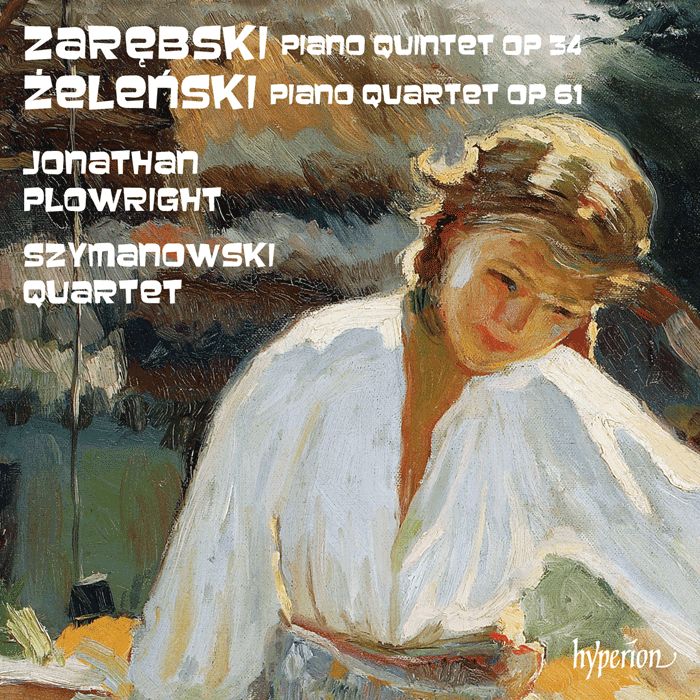
I’ve been an advocate of Juliusz Zarębski’s Piano Quintet for years and so I’m delighted that Hyperion has just released this new recording. It’s accompanied by the Piano Quartet by his slightly older compatriot, Władysław Żeleński. If you haven’t come across either composer. you’re in for a treat. Zarębski in particular is a gem largely hidden outside his native Poland, even though in his short lifetime (he died of tuberculosis aged just 31) he was renowned across Europe as a stupendous pianist. A pupil of Liszt, he wrote mostly piano music, some of it stylistically advanced for the time. He composed the Piano Quintet in the last year of his life (1885), and I don’t think that I’m overstating it when I assert that it rivals any other example of the genre. One of these days, it will be more widely recognised for the masterpiece that it is.
NEWSFLASH! In its review, the BBC Music Magazine (Christmas issue 2012, p.93) awarded the CD ✭✭✭✭✭ for Performance and ✭✭✭✭✭ for Recording and also made it its ‘Chamber Choice’. Thoroughly deserved – bravo to Jonathan Plowright and the Szymanowski Quartet. It was also nice – and unexpected – to read the last sentence: ‘With the inclusion of Adrian Thomas’s expert sleeve notes, this represents another invaluable Hyperion release’!
NEWSFLASH no.2! On Radio 3’s CD Review on 9 February 2013, Andrew McGregor gave an enthusiastic response to this CD, also drawing on what he called “Adrian Thomas’s excellent notes”. Thanks Andrew!
NEWSFLASH no.3! Jonathan Plowright has passed on to me a ✭✭✭✭✭ online review in Audiophile Audition, dated 13 February 2013. It ends: ‘Adrian Thomas’s excellent liner [notes?] tell some intriguing musical stories[.]’.
NEWSFLASH no.4 and no.5! Another great review for this CD from Steve Arloff, including several references to the notes, including ‘the excellent booklet notes’: online review on MusicWeb-International. Previously on MusicWeb-Interntional, its Classical editor Rob Barnett also posted an enthusiastic review, including the comment: ‘Adrian Thomas provides the much-needed commentary and does so with both style and sterling content’.
I’ve just caught a fine performance of Lutosławski’s Jeux vénitiens (1960-61) on BBC iPlayer (Radio). It was from last Saturday’s Hear and Now on Radio 3, so it’ll be available for another 96 hours. For the past year, Hear and Now has been using part of its precious hour and a half each Saturday night to highlight a composer and a work which has brought something new to music in the second half of the 20th-century. It has been an absorbing series, with many well-known names and pieces passed over in favour of something more radical, curious or forgotten. You can download the spoken introductions to all 50 ‘modern classics’ here.
At one stage, the producers were thinking of including Górecki’s Symphony no.3 in the roster, but in the end the only Polish piece to make it onto the list was Lutosławski’s Jeux vénitiens. No, there wasn’t even a space for Penderecki’s Threnody, one of the iconic works from the 1960s. Ah well. But Jeux vénitiens is a good example of Polish experimentalism at its height (it’s contemporaneous with the Penderecki).
On the podcast, Esa-Pekka Salonen and Paul Griffiths give succinct comments, mainly on the (then new) aleatory component in his musical language, though its twelve-note harmonic aspect is not neglected. Curiously, the words ‘aleatory’ and ‘ad libitum’ are mentioned by neither Salonen nor Griffiths (maybe ‘random’ and ‘uncoordinated’ have displaced terms which now may be thought as too unfamiliar). Equally, ‘twelve-note’ (harmony) is notable by its absence. It’s a pity, perhaps, that other aspects specific to the piece are given short shrift, or not mentioned at all. There is no reference to how the music develops in any of the movements (brutal intercutting in the first, accelerated superimposition in the fourth), no mention of thematic connections between the first and third movements, no notice given to the way that Lutosławski links the third and fourth movements harmonically.
It is very nice to hear Lutosławski himself talking (he, however, does mention ‘ad libitum’ and ‘aleatoric’), from an interview made with an unheard Thea Musgrave in 1973. By that time, he had already adopted his defensive posture against being associated closely with Cage (and other ‘more radical’ composers). He makes his point with some force in this interview, which suggests that he was already somewhat impatient with such links being made on a routine basis by commentators. His closing comments about the future direction of avant-garde music also make for interesting listening.
The timing of this broadcast is opportune. Not only does Jeux vénitiens complete the ’50 Modern Classics’ series, but its position looks ahead to 2013 and the centenary of Lutosławski’s birth on 25 January. I hope he’ll receive a good hearing on Radio 3 next year, as long as Britten, Verdi and Wagner don’t hog the limelight.
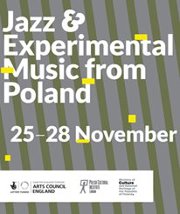
At the end of this month, Polish and British musicians are getting together in London for four nights of jazz and experimental music. If last year’s programme is anything to go by, audiences at The Forge (25.11), Vortex Jazz Club (26.11), Queen of Hoxton (27.11) and The Hackney Cut (28.11) are in for something special. The experimental music scene in Poland – across a whole range of genres and disciplines – has never been more vibrant.
Among those appearing are the Postaremczak/Kusiołek Duo (sax/accordion), three solo jazz musicians – Hubert Zemler (percussion), Rafał Mazur (acoustic bass guitar) and Marcin Masecki (piano), who made such an impression last year – the Warsaw-based band ParisTetris and the Levity trio.
Also taking part are UK musicians including Vocal Constructivists (who will be singing works by my own composition teacher, the iconoclastic Bogusław Schaeffer), Cornish-born Jim Hart (vibes) and Patrick Farmer, who’s creating a programme of installations and performances based on the ‘absent’ sounds of the city, in collaboration with Krzysztof Topolski and Kacper Ziemianin (who also appeared last year).
As a postscript to my post Ż-z-z earlier today, I’ve just discovered a recent YouTube upload of the complete Piano Quartet op.8 (1879) by Zygmunt Noskowski (1846-1909). And it comes with the score too, always a plus for little-known pieces. The recording is that by the Polish Piano Quartet, released by Olympia back in 1992 on OCD 381 alongside Żeleński’s Piano Quartet.
This really is a wonderful and joyous work, and its youthful spirit never fails to brighten the day. If I could master the piano part, I’d pay good money to find a string trio to play it with. I hope that, like the Zarębski Piano Quintet and the Żeleński Piano Quartet, it soon percolates through to non-Polish performers, CD companies and audiences. It is, frankly, a cultural scandal that it has been so neglected.
The upload is split into three: first movement; second and third movement (9’23” in); fourth movement.
How many composers do you know whose names begin with Z? Zappa, Zarlino, Zelenka, Zemlinsky, Zender, Zimmermann, Ziporyn, Zorn? There are more than you think, especially in Poland. Contemporary composers there include Artur Zagajewski, Patryk Zakrocki, Krzysztof Zarębski, Anna Zawadzka-Gołosz, Barbara Zawadzka, Lidia Zielińska, Maciej Zieliński, Agata Zubel and even a double Z: Wojciech Ziemowit Zych. There are yet more when you go back to before 1900. I’ve recently been spending a very enjoyable time in the company of three of them: Żeleński, Zarębski and Zarzycki.
In a couple of weeks’ time, Hyperion will be releasing a CD of nineteenth-century Polish chamber music with piano, played by Jonathan Plowright and the Szymanowski Quartet. The CD has two substantial pieces from the Polish Z list: the Piano Quintet by Juliusz Zarębski (1854-85) and the Piano Quartet by Władysław Żeleński (1837-1921). Look out for it. And at the weekend I was finishing off some work on Żeleński and Aleksander Zarzycki (1834-95) for a forthcoming CD of their piano concertos, again on Hyperion, with Jonathan Plowright and the BBC Scottish SO, conducted by Łukasz Borowicz. That’s due for release in 2013.
I’ve written on Zarębski before and have admired Żeleński’s Piano Quartet for a number years. But the period between the death of Chopin in 1849 and the establishment of a professional orchestra – the Warsaw Philharmonic – in 1901 remains a dark age in Polish music. That’s mainly because very few pieces survived in the repertoire into the 20th century. Paderewski has been well served, others less so. Today, much of the music remains unprinted, unperformed and unrecorded. There have been isolated modern premieres in Poland since 2000, but virtually nothing substantial on CD, though the Polish label Acte Préalable is a notable exception. It’s taken a foreign company – Hyperion – to come to the rescue (from partly later repertoire it has already recorded works by Melcer and Stojowski as part of its Romantic Piano Concerto series).
Zarębski’s Piano Quintet (1885) is a masterpiece. At long last, non-Polish performers and companies are beginning to sit up and take note. In addition to the forthcoming Hyperion CD, a DVD of a performance with Martha Argerich has been released this year. That concert took place in the Philharmonic Hall in Warsaw on 17 August 2011 as part of the festival Chopin i jego Europa (Chopin and His Europe). The recording is published by the Narodowy Instytut Fryderyka Chopina on NIFCDVD-002. Here’s an audio of the Scherzo from that performance.
Żeleński’s Piano Quartet op.61 (undated) is one of his better-known pieces, alongside his ‘characteristic overture’ W Tatrach op.27 (In the Tatras, 1868-70). Another recording, by Joanna Ławrynowicz and members of the Four Strings Quartet, was issued on Acte Préalable earlier this year. Prior to that, there was a great Olympia CD with the Polish Piano Quartet, which coupled the Żeleński with another, even more joyous piano quartet by Zygmunt Noskowski. Żeleński’s Piano Concerto op.60 dates from later in his life (according to a recent source, from 1903). Holding the fort before the CD releases of both the Piano Concerto (next year) and the Piano Quartet (next month), here’s the first movement of the latter, from the OLympia recording.
Of these three Zs, Zarzycki is by far the least known. But the forthcoming Hyperion CD of works for piano and orchestra gives an opportunity to redress the situation, not only with his Piano Concerto but also his Grande Polonaise, both dating from 1859-60 when he was studying in Paris. He gave the premieres himself. Up until now, Zarzycki’s been known for his small-scale chamber pieces. One of these, the Mazurka in G for violin and piano, has caught the attention over the years of distinguished violinists, including David Oistrakh. I don’t know when this was filmed, but Oistrakh certainly makes the case for the piece.
I’ve just posted a new article – ‘Parallel Lives of a Captive Muse’ – which has been published at www.woven-words.co.uk as part of the Philharmonia Orchestra’s celebration of the centenary of Lutosławski’s birth next year.





 On Polish Music