• WL100/28: Jazz Conversations (Lutosphere)

Having heard Agata Zubel, Andrzej Bauer and Cezary Duchnowski in conversation with Lutosławski’s alter ego ‘Derwid’ at the end of the Philharmonia’s Woven Words festival last month (Zubel Zings!), I’ve revisited an earlier set of ‘conversations with Lutosławski’.  These took place in the project Lutosphere, when Bauer teamed up with the pianist Leszek Możdżer and the DJ M.Bunio.S to explore Lutosławski’s concert music.  Among the pieces which they reference are the Intrada and Passacaglia from the Concerto for Orchestra (1954) and the Cello Concerto (1970). As I’ve written before, there’s quite a tradition of Polish jazz musicians reworking the music of major Polish composers (Chopin, Szymanowski), but this is the first time that the composer’s own voice has been included in the process!

There are currently a handful of uploads on YouTube, some with live video footage.  Here are five (two of them are short extracts), dating from 2008-10.

OFF festival, Mysłowice (8.08.2008)


Polish Radio (pre 6.11.2008, with partly English-language intro by Możdżer)


(pre 17.05.2009)


Kraków Philharmonic (31.10.2009)


Theatre on the 6th Floor, Warsaw (26.08.2010)


• New CD Note (Żeleński & Zarzycki/Hyperion)

034571179582I’ve recently been drawn into writing about nineteenth-century Polish music, mainly about composers whose surnames begin with Z or Ż.  Here are two of them: Władysław Żeleński and Aleksander Zarzycki.  Following his highly acclaimed 2012 recording of Zarębski and Żeleński chamber music with the Szymanowski Quartet on Hyperion, Jonathan Plowright performs music for piano and orchestra by Żeleński and Zarzycki on his new Hyperion CD.  It’s the 59th CD in Hyperion’s ‘Romantic Piano Concerto’ series.  Plowright’s partners on this occasion are the BBC Scottish SO and the Polish conductor Łukasz Borowicz.

Here’s the link to my booklet note for Żeleński and Zarzycki, or you can scroll the CD NOTES tab above.

NEWSFLASH!  MusicWeb-International has awarded this CD ‘Discovery of the Month’ (May, 2013).  En passant, the review by Dan Morgan comments on my ‘admirably succinct liner-notes’ (3 May 2013).  In his review in Gramophone (June, 2013, p.69), Jeremy Nicholas refers to ‘Adrian Thomas’s informative booklet’.

• Zubel Zings!

series_page_image_c_kopia tarasin jan_w238The Philharmonia’s Orchestra’s Woven Words celebration of the centenary of the birth of Witold Lutosławski has come to its end in London, although it is taking some of its repertoire abroad from time to time until September.  It has been an undeniable success, with great performances of Lutosławski’s music under Esa-Pekka Salonen.  I went to all three London concerts in the Royal Festival Hall, and the clear highlight for me was Krystian Zimerman’s superlative interpretation of the Piano Concerto in the first concert (30 January).  Jennifer Koh brought an exceptional intensity and drive to Chain 2 in the final concert (21 March) and Truls Mørk’s performance of the Cello Concerto in the second concert (7 March) was also very fine.  I wish I could be as enthusiastic about Mathias Goerne in Les espaces du sommeil, but his weak diction and exceedingly nervous manner were severe distractions.  The programming of Debussy and Ravel was inspired, especially the placing of Ma mère l’oye at the start of the third concert.  The performances of the French repertoire were, however, hit and miss: the complete Daphnis et Chlöe was riveting, La mer rather matter-of-fact, while La valse – the last piece in the series – went for absolutely nothing because of Salonen’s expression-denying, helter-skelter speed.

Less trumpeted were the complementary concerts.  Students from the Royal College of Music played a sterling role in this regard, in concerts on 4, 6 and 27 February and on 6 March.    There were also three events by young Polish musicians playing music of their contemporaries, though these events were barely evident in either the Philharmonia’s online publicity, which failed to keep up-to-date with some programme changes, or within the RFH signage itself.  This was a pity, and something of a discourtesy to the Polish side of the partnership (the Adam Mickiewicz Institute), which had brought fresh imagination to these supporting recitals.  (A full list of the Lutosławski and other Polish repertoire in the London concerts is given at the foot of this post.)

Kwartludium

The first supporting event in the RFH came before the second concert (7 March) and was given by the Polish ensemble Kwartludium (clarinet/bass clarinet, violin, percussion, piano).  The advertised repertoire of music by Wojciech Blecharz (b.1981) and Jagoda Szmytka (b.1982) was replaced by pieces by other Polish composers: Sławomir Wojciechowski (b.1971), Wojciech Ziemowit Zych (b.1976) and Dariusz Przybylski (b.1984).  Dagna Sadkowska and Piotr Nowicki began the recital with a performance of Lutosławski’s Subito, which the full ensemble followed with a ghostly ‘impression’ of the piece.  All three of the other works had great dynamism and instrumental imagination.  A fragment of Zych’s piece (in Polish: Stale obecna tęsknota) is available on the Kwartludium website: http://www.kwartludium.com/Zych.mp3.   This recital was an extremely rare opportunity in this country to hear Polish music written since 2000, and that in itself should give us pause for thought.  We are too wedded to the triumvirate of Lutosławski, Penderecki and Górecki.  There are not only many other Polish composers born before 1945 who are totally neglected in the UK, but also four decades of composers who now range in age from their mid-60s to their mid-20s and whose names are barely known, let alone their music.  Our concert repertoire – and not only with regard to Poland – remains more insular than we (are prepared to) recognise.

Cellotronicum and Cellonet

The second supporting event took place before the third concert (21 March).  The first part was given by Cellotronikum, comprising the cellist Andrzej Bauer with computer input by the composer Cezary Duchnowski (b.1971).  They gave the world premiere of For A.B. by Ryszard Osada (b.1972), followed by Duchnowski’s Broda.  In the second part, given by the Cellonet ensemble, Bauer conducted eight of his own students in Penderecki’s own arrangement of his Agnus Dei and in Octagon by the Ukrainian composer Lubawa Sydorenko (b.1979).  In both pieces, Cellonet was absolutely stunning, and you can hear the Sydorenko on the Cellonet MySpace site: http://www.myspace.com/cellonet/music/songs/lubawa-sydorenko-octagon-58524337.  This was music-making of an unusual order, and it is a measure of its quality that two of the eight cellists – Bartosz Koziak and Marcin Zdunik – have won the Lutosławski Cello Competition (in 2001 and 2007 respectively).  I heard Zdunik give an inspired performance of Lutosławski’s Grave in Warsaw in January and he told me after the RFH recital that he’s about to record the Lutosławski Cello Concerto, so that is definitely something to look out for.

El Derwid

The final supporting event, and the most neglected, came after the third Philharmonia concert and was held in the distinctly unsuitable Clore Ballroom (diabolical acoustics, nil atmosphere).  It was a reworking of eight of over thirty dance songs that Lutosławski wrote in the late 1950s and early 60s under the pseudonym ‘Derwid’.  For some unfathomable reason, the evening’s concert sheet failed to mention this rather crucial connection.  I’ve known the Derwid songs in their original recordings for over twenty years, but even I was flummoxed by the unexplained heading ‘EL DERWID’.  Had someone been reading Doctorow?  Was there some unknown Venezuelan bandit connection?  Subsequent research revealed that the ‘El’ comes from ‘Elettrovoce’, a duet comprising the composer and singer Agata Zubel (b.1978) and Duchnowski.  Somebody might have thought to explain this.  Zubel and Duchnowski (on piano as well as computer) teamed up several years ago with Bauer to perform their realisations of a selection of Derwid songs; a recording of this ‘El Derwid’ repertoire is due out on CD Accord this autumn.

Even though I caught only five of the songs (their performance must have started the minute the concert ended, as they were on song no.3 by the time I got downstairs), they were sufficient to whet my appetite for the CD.  Zubel has great stage presence and a wonderfully flexible voice.  In Czarownica (Witch), she and Bauer seemed to be having a domestic tit-for-tat, to humorous effect, while in Daleka podróż (Distant Journey) the trio brought a grating darkness to this tale of dreaming of distant, sunny climes.  In this bitterly cold March weather, I knew how they felt.  The title song for their set, Plamy na słońcu (Sunspots), delightfully and unexpectedly interlaced Derwid’s music with the Passacaglia theme from Lutosławski’s Concerto for Orchestra.  Woven works.  This fringe event brought a smile to the lips of those who had found it, and it gave the festival a properly fizzing conclusion.

Postscript

Two further aspects of Woven Words are worth mentioning.  Firstly, and more importantly, the detail and skill that have gone into the woven-words.co.uk website.  It is a model of its kind: launched well in advance of the festival (three months), it contains links to several specially commissioned films and a series of essays on Lutosławski.  This is a very valuable resource, not just for the festival but for future readers and viewers.  Secondly, there was a Lutosławski Study Day – ‘Lutosławski and the Interior Drama: The Spaces of Dream’ – held at the RFH on 16 March. There were five sessions: talks by Steven Stucky (‘Glimpsing an Ideal World’), myself (‘The Spaces of Dream: Lutosławski and Surrealism’) and Nicholas Reyland (‘The Sense of an Ending: Late Music, Enduring Concerns’), plus a workshop on the String Quartet with Steven Stucky and the Jubilee String Quartet, who then played the work complete.  The day concluded with a panel discussion by the three speakers.

Woven Words: 20th- and 21st-Century Polish Repertoire

Lutosławski/Philharmonia: Concerto for Orchestra (1954), Musique funèbre (1958), Cello Concerto (1970), Les espaces du sommeil (1975), Chain 2 (1985), Piano Concerto (1988), Symphony no.4 (1992)

• Lutosławski/RCM: Two Studies (1941), Bucolics (1952), Dance Preludes (1954), Jeux vénitiens (1961), String Quartet (1964), Epitaph (1979), Grave (1981), Mini-Overture (1982), Symphony no.3 (1983), Partita (1984), Fanfare for CUBE (1987), Subito (1992)

• Lutosławski/Kwartludium: Subito (1992)

• Lutosławski/Jubilee String Quartet: String Quartet (1964)

• ‘Derwid’/El Derwid: Cyrk jedzie (The Circus is Coming), Jeden przystanek dalej (One Stop Further), Z lat dziecinnych (From Childhood), Czarownica (Witch), Złote pantofelki (Golden Shoes), Daleka podróż (Distant Journey), W lunaparku (At the Funfair), Plamy na słońcu (Sunspots)

• Other 
Cezary Duchnowski: Broda (2005)
Ryszard Osada: For A.B. (2013?) world premiere
Krzysztof Penderecki: Agnus Dei (1981), arr. eight cellos (2007)
Dariusz Przybylski: Medeas Träume (2008)
Sławomir Wojciechowski: Rope of Sands (2009)
Wojciech Zimowit Zych: Ever-Present Longing (2005)

• 5th Festival of Premieres, Katowice

Unknown

Festiwal Prawykonań (Festival of Premieres) is a biennial celebration of new pieces by Polish composers of all generations.  This year’s event runs over the last weekend of next month, 26-28 April 2013 (the Polish website is complete but the English is still under construction).  It’s organised in Katowice by NOSPR (Narodowa Orkiestra Symfoniczna Polskiego Radia – National Symphony Orchestra of Polish Radio; or as NOSPR bizarrely prefers to translate it – Polish National Radio Symphony Orchestra).  The festival started in 2005 and a full list of previous festival concerts is available under its Archiwum tab.

There’s a mix of chamber and orchestral concerts (seven in all).  Some are free, the others have a one-price tag of 10zł (c. £2).  How’s that for a bargain?  I’m sure that most if not all of these concerts will be broadcast online by Polish Radio Dwójka (PR2), either live or delayed.  Here’s this year’s repertoire, in alphabetical order by composer:

** World premiere   * Polish premiere
• Marcin Bortnowski: Miserere for chamber choir and percussion ensemble**
• Michał Dobrzyński: Three Songs to words by Rilke**
• Ryszard Gabryś: Voyelles de Arthur Rimbaud**
• Mikołaj Górecki: Symphony no.2**
• Aleksandra Gryka: 10, 12, 13, -31 for string quartet**
• Paweł Hendrich: Ertytre for cello ensemble**?
• Rafał Janiak: Symphony no.2**
• Dobromiła Jaskot: Elferiae for string quartet**
• Krzysztof Knittel: Partita for saxophone, orchestra and electronic media**
• Benedykt Konowalski: Nowa pieśń chwały for clarinet and mixed chamber choir**
• Włodzimierz Kotoński: Arietta e i fiori for trombone and synthesized sounds**
• Justyna Kowalska-Lasoń: String Quartet no.3**
• Zygmunt Krauze: Canzona for instrumental ensemble*
• Stanisław Krupowicz: Piano Concerto**
• Hanna Kulenty: String Quartet no.5*
• Andrzej Kwieciński: Canzon de’ baci for tenor and orchestra**
• Mikołaj Majkusiak: Pulsaciones for accordion, classical guitar and string orchestra**
• Maciej Małecki: Concertino for cello and orchestra**
• Krzysztof Meyer: Piano Quartet op.112 (new version)**
• Piotr Moss: Cavafy Verses for baritone and orchestra**
• Aleksander Nowak: Z górnego piętra for violin and percussion**
• Tomasz Opałka: L.A. Concerto for violin and orchestra**
• Ryszard Osada: Double Reflection for cello octet**
• Bronisław Kazimierz Przybylski: Lofoten, Concerto-Symphony for viola and orchestra**
• Dariusz Przybylski: Cello Concerto**
• Marta Ptaszyńska: Of Time & Space, concerto for percussion, electronics and orchestra**
• Adrian Robak: Vocal Concerto ‘Camerata’**
• Marcin Rupociński: Non possumus for choir, chamber ensemble and electronics**
• Wojciech Widłak: Festivalente for orchestra**
• Sławomir Wojciechowski: Fingertrips for eight prepared cellos**
• Agata Zubel: Pomiędzy odpływem myśli a przypływem snu for voice and string orchestra**

• WL100/27: Notebook, 19 March 1961

Lutosławski and Rain

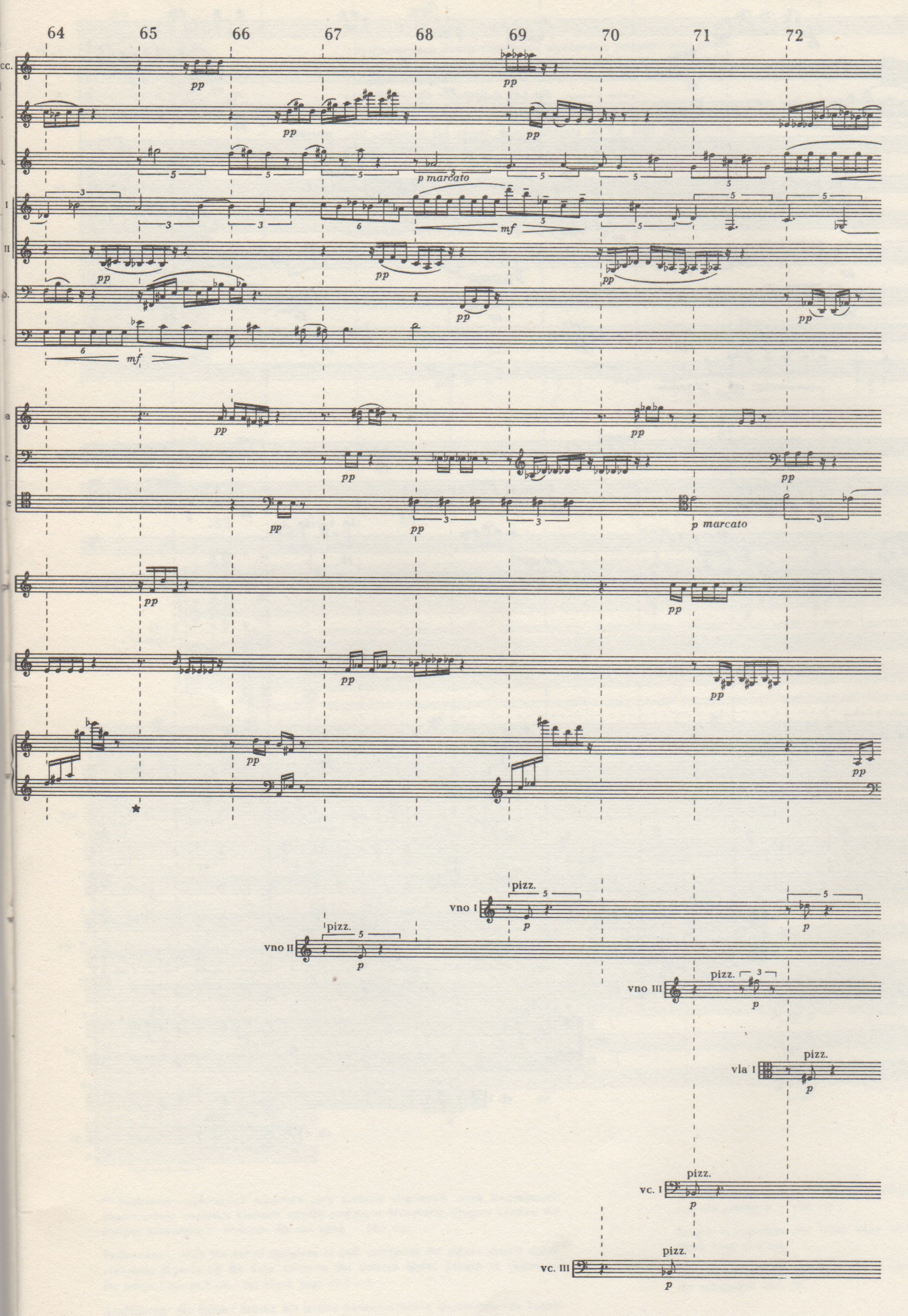
In order to justify classical rhythmic formulae, the argument has been used that this rhythm (i.e. ‘harmonic’, based on pulse) comes from nature: walking, the heartbeat.  Well, it is not correct to say that other rhythms have no counterpart in nature.  In fact, natural phenomena proceed for the most part in an irregular rhythm.  Example: the rhythm of the drops as rain begins to fall (pizz., in b.67 presto (II) from Jeux v.).

Dla uzasadnienia klasycznych formuł rytmicznych posługiwano się argumentem, że rytm ten (tzn. ‘harmoniczny’, oparty na pulsacji) pochodzi z natury: chodzenie, bicie serca.  Otóż nie jest słuszne twierdzenie, że inne rytmy nie mają odpowiedników w naturze.  Na pewno zjawiska natury przebiegają w swej większości w rytmie niepulsacyjnym.  Przykład: rytm kropel, gdy deszcz zaczyna padać (pizz., w t. 67 presto (II) z Jeux v.).

Witold Lutosławski, 19 March 1961  [my translation]

This is a rare example of Lutosławski linking extramusical observations to his music, aside from his several references to the theatre.  The passage in question (in the second movement of Jeux vénitiens, which he was writing at this very time and would complete nine days later) is interesting from a number of points of view.

For one thing, the string pizzicati are almost completely covered by a denser, more active texture in the woodwind, brass, pitched percussion and harp, so hardly of foreground interest.  For another, this is not the first but the third such passage in the movement: the first is led off by the bassoon at b.9 and the second (more briefly) by vibraphone at b.46, both against a background of scurrying muted strings played arco.  In each of these first two cases, the ‘irregular’ rhythms lead to fuller textures in the wind and pitched percussion, and it is the second of these that eventually runs in parallel with the string pizzicati cited by Lutosławski above.

This third and most developed passage extends from b.67 to b.82 and is given to the strings for the first time and marked pizzicato to make the point (the orchestration of these three sections is a good example of how Lutosławski thought of his music’s instrumentation in structural terms).  Bars 67-82 take the form of an increasingly dense rhythmic texture that is interrupted by the playing of cardboard tubes on the strings of the piano at b.83 (see WL100/24: Notebook, 11 March 1961 for details of this passage).  Given the dating of both this diary entry and of his work on the second movement, it looks highly possible that Lutosławski did have the irregular rhythm of a natural phenomenon like raindrops in mind when he composed not only bb.67-82 but also the two earlier passages to which this pizzicato section is the successor.  Incidentally, the movement is not headed Presto in the published score – it simply has the tempo indication of crotchet/quarter-note = 150.

Here’s a recording of the (unrevised) second movement from the premiere of the otherwise revised and completed version of Jeux vénitiens, given at the Warsaw Autumn on 16 September 1961, with the National Philharmonic conducted by Witold Rowicki.  The bassoon entry at b.9 is at 0’05”, while the vibraphone at b.46 is inaudible, as too is most of the string pizzicato starting at b.67 (0’46”).

WL JV:II bb.64-72

WL JV:II bb.73-81

• RSQ +1

Following its acclaimed CD of the Górecki quartets for Hyperion in 2011, the Royal String Quartet is riding high with its new Hyperion release of the quartets by Penderecki and Lutosławski.  Since its inception 15 years ago, when its members were students at the (then) Academy of Music in Warsaw, its concerts and recordings have received worldwide praise.  The RSQ has had a particularly fruitful career in the UK.  In 2004-06 it was chosen as one of the participants in BBC Radio 3’s renowned New Generation Artists scheme, and since 2012 it has been Quartet in Residence at The Queen’s University of Belfast, where I worked for the first 23 years of my own career.  I want to draw your attention, however, to the other music-making that the RSQ carries out in its native Poland which may not be so familiar to listeners elsewhere.

First and foremost are the RSQ’s ‘Kwartesencja’ festivals that it has mounted in Warsaw every year bar one since 2004.  These are designed not only to feature the RSQ but also to explore a huge range of collaborative possibilities with one or more other musicians.  Its two concerts from last year alone are excellent pointers to the versatility and imagination that the RSQ brings to its programming.

Kwartesencja 2012

I wish that I had been at the two concerts on 7 and 8 December 2012 (the programmes for this and previous Kwartesencja festivals are still online, but only in Polish).  Fortunately, the RSQ is media-savvy and excerpts from the 2012 events and follow-up recordings are now available on YouTube.

The first +1 was the actress Stanisława Celińska, well-known in Poland on stage and screen.  She performed ‘Songs about Warsaw’ with the RSQ, in arrangements by Bartek Wąsik (piano).  The concert on 7 December 2012 was a huge success and the project was encored on 4-5 January 2013.  It’s being repeated tomorrow night (19 March) in Wrocław.  Several of the songs have since appeared on YouTube and the collection has been issued on the CD Nowa Warszawa (New Warsaw).

These songs are but the most recent in a long Polish tradition of part-sung, part-declaimed lyrics with a mix of melancholic and nostalgic texts (my favourite in this regard is still the magical collaboration between Ewa Demarczyk and Zygmunt Konieczny in the 1960s).  Whether Nowa Warszawa has wider appeal outside Poland – Polish lyrics might be the sticking point – remains to be seen, but I hope it does.  Here’s the video of  ‘Warszawa’ from Kwartesencja 2012.  (It was originally recorded by the Polish ’80s band, T[eenage]. Love, whose own version is quite a contrast: http://www.youtube.com/watch?v=DCfDEusHaDw.)


Here’s a track from the Nowa Warszawa CD: Stanisław Sojka/Soyka’s ‘Tango Warszawa’:
http://www.youtube.com/watch?v=O8WeRk4wDt8

herdzinThe second +1, on 8 December 2012, was the young Polish jazz violinist, Adam Baldych.  In a move which might come across as sacrilegious, the RSQ and Baldych created a far-reaching improvisation on Lutosławski’s String Quartet.  Such an approach to their musical heritage is not entirely unknown among Polish musicians. Chopin has been the subject of attention from the Jagodziński Trio and Leszek Możdżer.  And the RSQ previously worked with the Polish jazz pianist Krzysztof Herdzin and his quartet, in Herdzin’s Fantasy on Themes from Grażyna Bacewicz’s Fourth String Quartet (CD issued in 2008, right).

See and hear for yourself what Baldych and the RSQ made of the Lutosławski quartet.  In this studio recording for Polish TV Kultura, there are some odd things going on in the background (the changing number of people sitting around the table in the shadows), plus two editing blips (at 12’31” and 16’02”), which make it hard to determine what the full performance was like.  Nevertheless, it makes an intriguing counterpart to the RSQ’s riveting performance of Lutosławski’s original quartet on its new Hyperion CD.


• New app: Lutosławski Guide to Warsaw

Unknown-1News has just come through that two of the three app. platforms (IoS and Android) are now up and running for the Witold Lutosławski Guide to Warsaw.  It’s available in Polish or English.  There’s a very helpful website which tells you all about this inventive app., which is one of the more unusual ways that the Poles have come up with to celebrate the centenary of Lutosławski’s birth.   I wonder what he’d make of it.

To obtain further information on the IoS, Android and Windows versions of the app., click on this link to Przewodnik po Warszawie.

• New CD Note (Penderecki & Lutosławski/Hyperion)

034571179438-1I have been a fan of the Royal String Quartet for several years.  I heard these superb Polish musicians play Górecki’s Third String Quartet at the St Magnus Festival on Orkney in 2010 and subsequently wrote the booklet note for their Hyperion CD of all three Górecki quartets.  Now they’ve released an equally stunning account of the three Penderecki quartets alongside Lutosławski’s sole contribution to the genre.

Here’s the link to my booklet note for Penderecki & Lutosławski String Quartets, or you can scroll the CD NOTES tab above.

• New CD Note (Lutosławski vol.5/Chandos)

CHAN 5108-1Lutosławski: Orchestral Works IV is the fifth Chandos CD in the BBCSO/Gardner series.  I hope that there will be a sixth to include Livre pour orchestre (1968) and Mi-parti (1976) and a selection from Musique funèbre (1958), Jeux vénitiens (1961), Novelette (1979) and the Double Concerto (1980).  Then the series will have included all Lutosławski’s major symphonic and vocal pieces.  It’s been a fantastic series.  The first CD included the Concerto for Orchestra, which on Polish Radio was recently voted the best recording of this popular work.  I wrote an account of the programme discussion on 20 January: Gardner/BBC SO top Polish Radio poll.

Here’s the link to my booklet note for Lutosławski: Orchestral Works IV, or you can scroll the CD NOTES tab above.

• Zarębski Piano Quintet on PR ‘Trybunał’

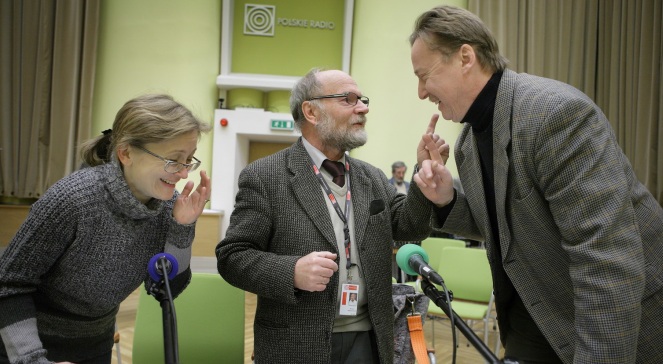
For the second time in a month, I tuned in yesterday to Polish Radio 2 ‘Dwójka’ for one of its fortnightly ‘tribunals’. The format is simple but unusual.  Three commentators – on this occasion, two critics plus a performer – whittle down a selection of six recordings of the same piece until it votes for a winner.  All six CDs are heard in the same initial section of the piece, then four in a second section, three in a third and two in a fourth.  It’s an interesting idea and draws in the listener.  One might argue, however, if the sections are always chosen in the order that the work progresses, that a recording that improves as it unfolds may lose out too soon.  The line-up for yesterday’s panel was Dorota Kozińska (critic), Kacper Miklaszewski (critic), Jacek Hawryluk (chair) and Karol Radziwonowicz (pianist).

d1a06fe4-72f6-4f8b-8df8-e16a9097513d.file

Yesterday it was the turn of the Piano Quintet (1885) by Juliusz Zarębski (1854-85).  I have enthused on this work elsewhere in these pages, almost exactly a year ago (Zarębski’s Piano Quintet).  Last February, I was especially keen on a YouTube recording by Darina Vassileva and the Quarto Quartet from Bulgaria and included links in my post, but I’ve still not been able to find a copy of its CD recording on the Arcadium label.

The schedule yesterday was:

• Round 1: Opening of first movement
• Round 2: Opening of second movement
• Round 3: Opening of third movement
• Round 4: Opening of fourth movement.

After Round 1, the panel was (almost) unanimous in eliminating CDs 3 and 4, both of which – from this opening section only – sounded untidy, messy of tempo and somewhat over-egged expressively.  They were both live performances.

• It turned out that both CD3 and CD4 had Martha Argerich at the keyboard: a CD from the Lugano Festival (2011) and a DVD from a Warsaw concert (2012).  I must admit to being surprised that two of the six slots were taken up by one major player, when in fact there are now over a dozen recordings that have been issued on CD over the past 20 years or so.  A pity, therefore, that one of these was not chosen to replace one of the Argerich recordings.

• Round 2 resulted in the elimination of another recent recording (CD6), this one by Piotr Sałajczyk and the Lasoń Ensemble (Accord, 2012) [thanks to William Hughes for pointing me in the right direction for the info on the players].

By this stage, the panel had isolated CD2 as being the least Slavonic/Romantic in tone and temperament, so the discussion seemed to be coming to a head partly on that basis.

• Round 3 used a sizeable chunk from the beginning of the Scherzo.  For my money, the only recording to live up to the title of the movement was CD2.  It was light on its feet, whereas the others – especially the pianists – chose slow, deliberate tempos and made heavy weather of an admittedly difficult movement.  After some deliberation, CD1 was lost – Wojciech Świtała with the Royal String Quartet (Bearton, 2006).  It was now down to a contest between the new, ‘non-Slavonic’ CD2 and the archival, ‘Slavonic’ CD5.

• I could tell which way Round 4 was going to go from the comments so far.  What puzzled me was that to my ears the excerpts from CD5 had severe drawbacks.  Its first movement showed little shaping of cadential phrases (they simply motored on), while the second was on the slow side, with over-emphatic rhythmic articulation and a main theme (violin) that was overcooked and pretty horrid.  The finale sounded better, though the piano playing still seemed mannered in places.  CD2, on the other hand, brought freshness and new perspectives, even if it did not have the lushness and depth of tone of CD5.

• CD2 was the runner-up: Jonathan Plowright and the Szymanowski Quartet (Hyperion, 2012).*  CD5 was the only archive recording of the six, dating (if I caught it right) from c.1963.  It featured ‘The Pianist’ Władysław Szpilman as a member of the Warsaw Piano Quintet, with Bronisław Gimpel as first violin.  Well, that’s me told, but I stick to my guns about the over-ripe tone of the theme in the second movement.  This remastered LP recording has been reisued on a 3-CD set of Szpilman’s ‘Legendary Recordings’ (Sony, 2005).

This got me thinking about the recording history of the Zarębski Piano Quintet.  For a work that was not published until the 1930s and which has never had much of a presence or reputation outside Poland, its tally of over twelve CD recordings is remarkable.  Here’s my list, with the six recordings considered yesterday in bold – if you know of any omissions or errors, please let me know.  It’s in chronological order of release (as far as I can ascertain).

Władysław Szpilman, Warsaw Piano Quintet (1963; Sony 3-CD set, 2005)
• Waldemar Malicki, Varsovia String Quartet (Pavane, 1990)
• Szábolcs Esztényi, Wilanów String Quartet (Accord, 1991)
• Jerzy Witkowski and friends (Olympia, 1992)
• Waldemar Malicki, Amar Corde String Quartet (Amar Corde, 1997)
• Paweł Kowalski, Silesian String Quartet (Polskie Nagranie, 1998)
• Krzysztof Jabłonski, Warsaw Quintet (Dux, 2005)
Wojciech Świtała, Royal String Quartet (Bearton, 2006)
• Darina Vassileva, Quarto String Quartet (Arcadium, 2010)
Martha Argerich +, live (EMI 3-CD set, 2011)
Martha Argerich +, live (Chopin Institute DVD, 2012)
Piotr Sałajczyk, Lasoń Ensemble (CD Accord, 2012)
Jonathan Plowright, Szymanowski String Quartet (Hyperion, 2012)

There is also a newly-issued CD of the quintet in an arrangement for piano and string orchestra (my thanks to Tomasz Andrzejewski for this information; see comments below).
• Ewa Pobłocka, Amadeus CO of Polish Radio, cond. Agnieszka Duczmal (Polish Radio, 2013)

If the Vassileva-Quarto recording of 2010 is anything like the live video on YouTube, it could be something really special.  I still remain true to the first recording that I heard – the Malicki-Varsovia on Pavane – even if it verges on being an archival recording.  For one thing, its pacing and sense of musical drama are hard to better and, for another, it strikes a terrific balance between expressivity and momentum.  If you can get hold of a copy, do.  If you can’t, then my undoubted winner – for its revelatory and unfettered insights – is the most recent recording, by Jonathan Plowright and the Szymanowski Quartet on Hyperion.

………..

* I must declare my interest here, although I listened with innocent ears: I wrote the booklet notes for the Plowright/Szymanowski recording.

UPDATE!  On 22 February 2013, Polish Radio 2 responded to this post by posting about it themselves: Adrian Thomas po raz drugi o werdykcie Trybunału (Adrian Thomas for the second time on the verdict of the Tribunal).  They also put up this rather jolly second photo from the recording session:

bf3f27ec-f747-40f9-8ac5-1ac5371af15d.fileMy first post had been • Gardner/BBC SO top Polish Radio poll the day after the Tribunal on 19 January 2013 for Lutosławski’s Concerto for Orchestra.  It received this response from Warsaw on 24 January: Wyroki Trybunału komentowane w Wielkiej Brytanii (Verdicts of the Tribunal commented on in Great Britain).