• Lutosławski’s Cello Concerto on YouTube
Sunday, 4 December 2011 Leave a comment
Talking with a friend the other day about his experience of a concert performance of Lutosławski’s Cello Concerto in London’s Cadogan Hall (Jacob Kullberg, RPO, conducted by Christopher Austin, 25 October 2011), I realised that it’s been a long time since I saw this concerto live. Chester Music’s website indicates that the only forthcoming performance is in Tokyo next month. So I looked again through the currently available YouTube videos (excluding the purely audio postings).
The continuing appeal of Lutosławski’s Cello Concerto (1970) is remarkable. I believe that no other cello concerto since Shostakovich’s two (1959, 1966) has had as many commercial audio recordings (17 and counting). And it is noticeable that Lutosławski’s ground-breaking concerto attracts young performers in particular. The only senior performer on YouTube is Yo-Yo Ma, who regrettably has never committed his interpretation to disc, even though he has performed the work on a number of occasions.
Yo-Yo Ma
This is just a short excerpt, taken from a performance that Yo-Yo Ma gave (with score, on which he seems to be surprisingly dependent in the closing stages) with the Los Angeles PO, conducted by Esa-Pekka Salonen. It consists of the immediate build-up to the work’s climax, which then leads on to the Coda. It has all the hallmarks of Ma’s artistry, so it is the more regrettable that there is no current access to the preceding 20′ or so.
http://www.youtube.com/watch?v=_g_ECLBvUS0 (Finale from just after fig.130 + Coda; 2’14”)
Inbal Segev
The Israeli-American cellist Inbal Segev (Inbalsegev) uploaded two excerpts on 17 June 2008. They come from her performance during the second Paulo Cello Competition in Helsinki in 1996, when she was accompanied by the Helsinki Radio SO under Petri Sakari. The first excerpt is from near the start of the central slow Cantilena, up to its middle point, while the second makes rather heavy weather of what should be the soloist’s helter-skelter ‘escape’ (as Lutosławski put it) from orchestral attacks in the Finale.
http://www.youtube.com/watch?v=U97ko6MEypU (Cantilena, figs 64d-75; 2’53”)
http://www.youtube.com/watch?v=edxiFjbfgFc (Finale, figs 104-127; 1’41”)
David Eggert

This is a name new to me. David Eggert is a Canadian in his mid-20s who is studying in Europe. His YouTube video, with the Slovenian PO, conducted by Uroš Lajovic, was posted by powertimsah on 23 September 2010. Its four-part upload is not fully in line with the four movements of Lutosławski’s concerto: Introduction, Four Episodes, Cantilena, Finale + Coda.
http://www.youtube.com/watch?v=MXS5mHUxPf4 (Introduction; 3’02” , missing c.2′)
http://www.youtube.com/watch?v=hscqZFloArI (Four Episodes, rather crudely cut before the soloist’s first pizzicato low E at fig.63; 6’14”)
http://www.youtube.com/watch?v=GO_61BvsVrs (Cantilena and Finale to fig.90; 7’11”)
http://www.youtube.com/watch?v=JEVpzrxckk0 (Finale from fig.90 + Coda; 4’50” + 40″ applause)
There are two major drawbacks, neither of them Eggert’s fault. Firstly, the recording starts halfway through the Introduction, on the high Bbs on system 11 of the first page of the score. Carelessness or misfortune, either way it ruins the performance as a whole. Secondly, the sound quality is often poor because it is plagued by high-pitched ‘twittering’. This is a great pity, because Eggert (playing from score) is a committed soloist, commanding both delicate and strong articulation. What is there of the introduction indicates that he understands the import of both his solo role and the brass interruptions (he responds subtly to the latter, both behaviourally and musically), while the Finale is one of the most urgent and dramatically shaped that I have heard.
Nicolas Altstaedt

German-born Nicolas Altstaedt is a BBC New Generation Artist and has developed an impressive career in recent years. This complete recording, first uploaded by haekueroenstoe on 6 February 2010, is with the Finnish Radio SO under Dmitri (Dima) Slobodeniouk. It appears to come from Altstaedt’s participation at the fourth Paulo Cello Competition in Helsinki in 2007. The upload separates the recording into three instalments that unfortunately cut against the grain of Lutosławski’s structure. Worse still, in the second instalment there is a time-lapse of over 1″ as the image falls behind the sound, and this time-lapse lengthens to over 7″ in the third instalment. If you close your eyes, however, there’s much to appreciate here.
UPDATE (12 June 2013)
On 9 March 2013, the technical problems were sorted out when the uploader posted this performance in a single video: http://www.youtube.com/watch?v=pIxvBjP7ld8. Great news, as this performance is riveting! Only the first of the three instalments from the original upload is still available.
http://www.youtube.com/watch?v=uvp8GF76VXQ (Introduction and Episodes 1-2; 9’46” including 1’03” arrival on stage)
http://www.youtube.com/watch?v=-w_3yE5Owbk (Episodes 3-4, Cantilena and Finale to fig.88; 8’42”)
http://www.youtube.com/watch?v=acEVBscbtH8 (Finale from fig.88 + Coda; 5’20”)
Altstaedt (playing without score) produces a fiery and exciting performance which is matched by Slobodeniouk’s tight orchestral direction. At c. 22’25” it is also one of the shortest. Only two performances, both conducted by the composer (with Roman Jabłoński and Louise Hopkins) are shorter, and then only marginally. In the Introduction, Altstaedt plays with studied intensity rather than absent-minded indifference, recalling Rostropovich’s determined approach (though Altstaedt maintains a greater timbral and rhythmic consistency). He also evinces a high degree of self-confident independence in the Episodes where others may aim for intimate rapport with the orchestra. Altstaedt’s approach emphasises the dynamism of Lutosławski’s score, even in the Cantilena, where he is especially eloquent. He dominates even the Finale, making the confrontation between soloist and orchestra more like a battle of equals whose outcome cannot be taken for granted. If that makes the cello’s vanquishment a little surprising, its subsequent resurrection is triumphant.
Oren Shevlin
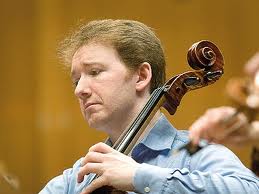
Although Oren Shevlin is another name new to me, he is British by birth. He does not appear to have his own website. He uploaded these two videos – whose division acknowledges Lutosławski’s structure – on 20 September 2011 (under the name orencello). They come from performances that he gave (without score) on 3 and 4 February this year with the WDR SO in Cologne, conducted by Jukka-Pekka Saraste.
http://www.youtube.com/watch?v=6kliW2KCYq8 (Introduction, Four Episodes; 12’15”, including 48″ arrival on stage)
http://www.youtube.com/watch?v=GdjzGN4dYxw (from after fig.64: Cantilena, Finale + Coda; 11’13” +1’31” applause)
It is a very fine performance, executed with a modesty and deceptive frailty that fits the character imagined by the composer. Lutosławski was wary of performers who over-invested the Introduction with emotion and thus ran the danger of blunting the drama that follows. Shevlin’s reaction to the marking indifferente over the repeated D naturals is to look vaguely outwards and his demeanour really does suggest the mind-lessness and whimsicality that Lutosławski was aiming for in the opening 4′ solo. Shevlin genuinely works with the orchestra in the Episodes that follow, seeking the common ground, with subtlety and apparent extemporaneity, that is periodically thwarted by interruptive brass.
If Shevlin’s tone is not as robust as those of some other performers of this work, his empathy with the strings in the Cantilena, as the section moves towards the ringing unison, is persuasive. Here is the cellist as Everyman, emotionally open and vulnerable. This pays dividends in the Finale, where the orchestra attempts to quash his voice. At fig.88, Shevlin plays the cello’s response to the orchestra’s battery in a way which emphasises the survival instinct of the downtrodden and their sense of irony, even humour, at such moments. And this was precisely what Lutosławski wanted here. I’ve never heard the phrase at fig.88 uttered with such wry poignancy. The ‘escape’ that follows is raw. Shevlin plays as if he is fleeing and pleading for his life. When he emerges with weeping cello sobs and then climbs to the heights of those strong, almost desperate A naturals at the very end, one can believe that he has survived the ordeal, but only just and, as Lutosławski said, ‘in another world’.
Shevlin has also uploaded the Introduction separately (on 22 July 2010 – he calls it the Cadenza). Here he is younger and beardless, and I’ve identified the occasion as an excerpt from his performance during the second Paulo Cello Competition (1996). The conductor is Petri Sakari with the Helsinki Radio SO (as for Segev’s excerpts, above).
http://www.youtube.com/watch?v=pojl2C3KTCI (Introduction, up to fig.9; 4’52”)
Coda
What is striking about the performers of the videos detailed above is the strong level of participation by Finnish musicians: the Finnish Radio SO features on three videos (Segev, Altstaedt, and the Shevlin excerpt from 1996) and three Finnish conductors take the helm on four: Salonen (Yo-Yo Ma), Sakari (Segev and Shevlin excerpts) and Saraste (Shevlin complete). The (usually) triennial Paulo Cello Competition in Finland’s capital has evidently played a key role for several of these players. There is also a strong Eastern European showing: the Slovenian PO and Lajovic (Eggert) and the Russian conductor Slobodeniouk (Altstaedt). The nationalities of the soloists, however, are more broad (American, Israeli, Canadian, German and British).
Yo-Yo Ma, Inbal Segev and Oren Shevlin (1996) give only excerpts, so these are unable to provide substantial insights. It is interesting, however, to be able to compare the two Shevlin Introductions, performed 15 years apart. It is enormously frustrating that David Eggert’s perceptive account is marred by the missing first 2′ and its poor sound quality, but I am keen to hear his interpretation under better circumstances. Equally, I eagerly await a proper chance to hear Altstaedt in concert as it is impossible to watch most of this clumsily divided upload because of the time-lapses in the second and third instalments. The first instalment gives a good idea of Altstaedt’s firm grasp of Lutosławski’s score, and it is of course possible to listen to the rest with eyes closed. It is a performance to savour for its muscularity and momentum.
So that leaves only Shevlin’s complete performance (2011) with the WDR SO under Saraste. As indicated above, I think that this is a truly insightful interpretation and one that repays listening and deserves wide recognition. It also bears repeated viewings for the TV direction, with its imaginative camera angles (including a hidden floor-camera in front of the soloist) and variety of split-screen shots which highlight key orchestral participants and textures.


 On Polish Music