• Poles launch ‘100/100 Lutosławski’

18619_437344239663934_545288166_nLutosławski year was officially launched in Warsaw yesterday under the banner ‘100/100 Lutosławski’.  A new website has been published (in Polish/English), but precise details of events are yet to be fully revealed.  I outlined the details of the Philharmonia’s splendid Woven Words website, launched in October, in an earlier post.  Here, I’ll outline what has so far emerged from Polish sources.

Websites

• http://lutoslawski.culture.pl/web/lutoslawskien  The ‘100/100 Lutosławski’ website, hosted by the Adam Mickiewicz Institute, is a companion to the one launched to mark the 75th anniversary of Szymanowski‘s death earlier this year. It currently has a three SoundCloud clips (Concerto for Orchestra, Symphonies 3 and 4), though not all the clips and the accompanying notes are credited.  There’s a short video discussion between Steven Stucky and Esa-Pekka Salonen as well as videos shared with the Woven Words website.  Its Calendar of events has still to be unveiled, and its list of Resources consists at the moment only of a short bibliography that has got as far as the letter ‘R’ (so no Stucky yet…).  No doubt the whole website will become more fully populated in the coming days and weeks.
• http://www.lutoslawski.org.pl/en/lutoslawski2013/info  This is the home of the Witold Lutosławski Society, which has existed since the late 1990s.  Like ‘100/100 Lutosławski’, it has both a Polish and an English site.  It promises details shortly.  By the way, for anyone with a short orchestral piece close to hand, the WLS is hosting a composition competition with a deadline of 25 January 2013, the 100th anniversary of the composer’s birth.  The competition’s regulations may be accessed here.

Performances

The Lutosławski components of the Warsaw Philharmonic’s forthcoming programmes have been published for some time and may be found by scrolling the Warsaw Philharmonic’s concert schedule.  Its celebrations begin on 11 January 2013.  Until the ‘100/100 Lutosławski’ Calendar is uploaded, you can find details of quite a few concerts worldwide at https://www.facebook.com/LutoslawskiCentennialCelebration, under ‘About’.

Recordings

It seems to me that it has been non-Polish ensembles and recording companies who have been taking the lead in this area of activity, notably the BBC SO under Edward Gardner for Chandos (4 CDs since 2010, a fifth on its way). Next month, Sony re-releases the Los Angeles PO/Salonen recordings of Symphonies 2-4 plus their newly-recorded version of the First Symphony.  The Polish Accord label started its Lutosławski Opera Omnia series in 2008, but there has been no further release since the third CD in 2010.  I am not privy to Polish recordings planned for release in 2013.  I am, however, very excited by the two ventures outlined below.

UnknownAs part of the official launch yesterday in the Witold Lutosławski Studio at Polish Radio and Television, the Polish National Audiovisual Institute (NInA) issued a press release (in Polish) containing the following information:

• A unique collection of recordings will be made available on the nina.gov.pl portal in the second half of 2013. All of Lutosławski’s compositions will be uploaded in at least one performance.  (As the 80th birthdays of Henryk Mikołaj Górecki (d. 2010) and Krzysztof Penderecki also fall in 2013, their music will be similarly covered by NInA next year.)  This online collection – drawn from Polish Radio archives – will be developed further in due course.  Its accompanying texts, by the late Polish Radio broadcaster and musicologist Andrzej Chłopecki, will be available in both Polish and English.

• NInA will also issue a six-disc set called ‘Lutosławski/świat’ (Lutosławski/World) – 5 CDs and a DVD – in the second half of 2013.  The vast majority of these recordings, from Polish Radio and WFDF (Documentary and Feature Film Studio), are being released for the first time.  They include archive recordings conducted by Lutosławski, and the booklet notes, many by young musicologists, promise fresh perspectives.  The project editor is Adam Suprynowicz.

What is especially interesting in the Polish context is the promise that Lutosławski’s complete output will be represented, including those works (socialist-realist pieces, film music and popular songs) which, as the press release says, ‘he himself sometimes wanted to forget’.  This promises to be a fascinating document, one which sets Lutosławski’s rich legacy of pieces and recordings in the broadest possible context.

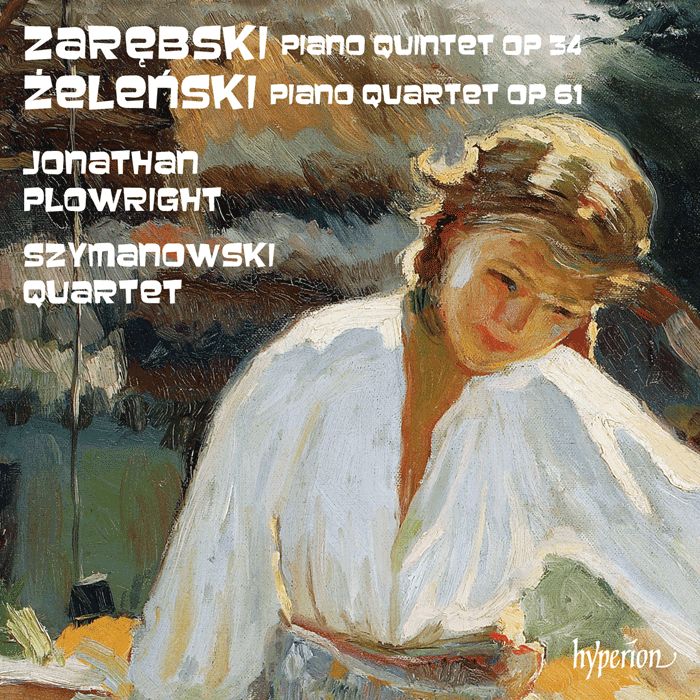
• New CD Note (Zarębski & Żeleński/Hyperion)

I’ve been an advocate of Juliusz Zarębski’s Piano Quintet for years and so I’m delighted that Hyperion has just released this new recording. It’s accompanied by the Piano Quartet by his slightly older compatriot, Władysław Żeleński. If you haven’t come across either composer. you’re in for a treat.  Zarębski in particular is a gem largely hidden outside his native Poland, even though in his short lifetime (he died of tuberculosis aged just 31) he was renowned across Europe as a stupendous pianist. A pupil of Liszt, he wrote mostly piano music, some of it stylistically advanced for the time. He composed the Piano Quintet in the last year of his life (1885), and I don’t think that I’m overstating it when I assert that it rivals any other example of the genre.  One of these days, it will be more widely recognised for the masterpiece that it is.

Here’s the link to my booklet note for Zarębski and Żeleński, or you can scroll the CD NOTES tab above.  Here’s another link, this time to an earlier post about the Zarębski Quintet, plus one I wrote a few weeks ago on Zarębski, Zarzycki and Żeleński.

NEWSFLASH!  In its review, the BBC Music Magazine (Christmas issue 2012, p.93) awarded the CD ✭✭✭✭✭ for Performance and ✭✭✭✭✭ for Recording and also made it its ‘Chamber Choice’.  Thoroughly deserved – bravo to Jonathan Plowright and the Szymanowski Quartet.  It was also nice – and unexpected – to read the last sentence: ‘With the inclusion of Adrian Thomas’s expert sleeve notes, this represents another invaluable Hyperion release’!

NEWSFLASH no.2!  On Radio 3’s CD Review on 9 February 2013, Andrew McGregor gave an enthusiastic response to this CD, also drawing on what he called “Adrian Thomas’s excellent notes”.  Thanks Andrew!

NEWSFLASH no.3!  Jonathan Plowright has passed on to me a ✭✭✭✭✭ online review in Audiophile Audition, dated 13 February 2013.  It ends: ‘Adrian Thomas’s excellent liner [notes?] tell some intriguing musical stories[.]’.

NEWSFLASH no.4 and no.5!  Another great review for this CD from Steve Arloff, including several references to the notes, including ‘the excellent booklet notes’: online review on MusicWeb-International.  Previously on MusicWeb-Interntional, its Classical editor Rob Barnett also posted an enthusiastic review, including the comment: ‘Adrian Thomas provides the much-needed commentary and does so with both style and sterling content’.

• Not Forgetting Noskowski

As a postscript to my post Ż-z-z earlier today, I’ve just discovered a recent YouTube upload of the complete Piano Quartet op.8 (1879) by Zygmunt Noskowski (1846-1909).  And it comes with the score too, always a plus for little-known pieces.  The recording is that by the Polish Piano Quartet, released by Olympia back in 1992 on OCD 381 alongside Żeleński’s Piano Quartet.

This really is a wonderful and joyous work, and its youthful spirit never fails to brighten the day.  If I could master the piano part, I’d pay good money to find a string trio to play it with.  I hope that, like the Zarębski Piano Quintet and the Żeleński Piano Quartet, it soon percolates through to non-Polish performers, CD companies and audiences.  It is, frankly, a cultural scandal that it has been so neglected.

The upload is split into three: first movement; second and third movement (9’23” in); fourth movement.


• Ż-z-z

How many composers do you know whose names begin with Z?  Zappa, Zarlino, Zelenka, Zemlinsky, Zender, Zimmermann, Ziporyn, Zorn?  There are more than you think, especially in Poland.  Contemporary composers there include Artur Zagajewski, Patryk Zakrocki, Krzysztof Zarębski, Anna Zawadzka-Gołosz, Barbara Zawadzka, Lidia Zielińska, Maciej Zieliński, Agata Zubel and even a double Z: Wojciech Ziemowit Zych.  There are yet more when you go back to before 1900.  I’ve recently been spending a very enjoyable time in the company of three of them: Żeleński, Zarębski and Zarzycki.

In a couple of weeks’ time, Hyperion will be releasing a CD of nineteenth-century Polish chamber music with piano, played by Jonathan Plowright and the Szymanowski Quartet.  The CD has two substantial pieces from the Polish Z list: the Piano Quintet by Juliusz Zarębski (1854-85) and the Piano Quartet by Władysław Żeleński (1837-1921).  Look out for it.  And at the weekend I was finishing off some work on Żeleński and Aleksander Zarzycki (1834-95) for a forthcoming CD of their piano concertos, again on Hyperion, with Jonathan Plowright and the BBC Scottish SO, conducted by Łukasz Borowicz.  That’s due for release in 2013.

I’ve written on Zarębski before and have admired Żeleński’s Piano Quartet for a number years.  But the period between the death of Chopin in 1849 and the establishment of a professional orchestra – the Warsaw Philharmonic – in 1901 remains a dark age in Polish music.  That’s mainly because very few pieces survived in the repertoire into the 20th century.  Paderewski has been well served, others less so.  Today, much of the music remains unprinted, unperformed and unrecorded.  There have been isolated modern premieres in Poland since 2000, but virtually nothing substantial on CD, though the Polish label Acte Préalable is a notable exception.  It’s taken a foreign company – Hyperion – to come to the rescue (from partly later repertoire it has already recorded works by Melcer and Stojowski as part of its Romantic Piano Concerto series).

Zarębski’s Piano Quintet (1885) is a masterpiece.  At long last, non-Polish performers and companies are beginning to sit up and take note.  In addition to the forthcoming Hyperion CD, a DVD of a performance with Martha Argerich has been released this year.  That concert took place in the Philharmonic Hall in Warsaw on 17 August 2011 as part of the festival Chopin i jego Europa (Chopin and His Europe).  The recording is published by the Narodowy Instytut Fryderyka Chopina on NIFCDVD-002.  Here’s an audio of the Scherzo from that performance.


Żeleński’s Piano Quartet op.61 (undated) is one of his better-known pieces, alongside his ‘characteristic overture’ W Tatrach op.27 (In the Tatras, 1868-70).  Another recording, by Joanna Ławrynowicz and members of the Four Strings Quartet, was issued on Acte Préalable earlier this year.  Prior to that, there was a great Olympia CD with the Polish Piano Quartet, which coupled the Żeleński with another, even more joyous piano quartet by Zygmunt Noskowski. Żeleński’s Piano Concerto op.60 dates from later in his life (according to a recent source, from 1903).  Holding the fort before the CD releases of both the Piano Concerto (next year) and the Piano Quartet (next month), here’s the first movement of the latter, from the OLympia recording.


Of these three Zs, Zarzycki is by far the least known.  But the forthcoming Hyperion CD of works for piano and orchestra gives an opportunity to redress the situation, not only with his Piano Concerto but also his Grande Polonaise, both dating from 1859-60 when he was studying in Paris.  He gave the premieres himself.  Up until now, Zarzycki’s been known for his small-scale chamber pieces.  One of these, the Mazurka in G for violin and piano, has caught the attention over the years of distinguished violinists, including David Oistrakh.  I don’t know when this was filmed, but Oistrakh certainly makes the case for the piece.


• New CD Note (Lutosławski vol.4/Chandos)

It’s been ten months since the release of the third volume of Edward Gardner’s Lutosławski series with the BBC Symphony Orchestra.  Now volume four has appeared, and it’s a cracker (for the first time in the series, the cover illustration comes from outside Warsaw – it’s Wrocław).  The preceding CDs were:

Orchestral Works: Concerto for Orchestra, Symphony 3, Chain 3
Vocal Works: Lacrimosa, Silesian Triptych, Sleep, sleep, Paroles tissées, Les Espaces du sommeil, Chantefleurs et Chantefables
Orchestral Works II: Symphonic Variations, Paganini Variations, Piano Concerto, Symphony 4

Lutosławski: Orchestral Works III opens with Little Suite (1950), a work whose spirited nature masks the subtlety of its language when most other Polish composers were buckling under the weight of socialist-realist expectations.  A decade and a half later, Lutosławski was wrestling with large-scale form in his Second Symphony (1965-67), which is given an exceptionally persuasive reading here.  The soloist on this CD is Paul Watkins, who not only plays the Cello Concerto (1970) – which must have easily surpassed any other concerto written since then in its number of CD recordings – but also Lutosławski’s orchestration of Grave for cello and piano (1981/82).

Here’s the link to my booklet note for Lutosławski: Orchestral Works III, or you can scroll the CD NOTES tab above.

• New Website for Serocki

http://www.serocki.polmic.pl

The uploading of a website devoted to the life and music of Kazimierz Serocki is hugely to be welcomed.  Serocki was one of the giants of post-war Polish music – he stood alongside Bacewicz, Baird, Górecki, Lutosławski and Penderecki.  Yet his music has languished both at home and abroad since his death in 1981 at the age of 59.  This new venture will surely do much to bring his name and output to a wider audience.  It exists in parallel English and Polish versions.

It’s hosted by the Polish Music Information Centre in Warsaw and has been brought to fruition as a partnership between the Polish Composers’ Union (ZKP) and POLMIC, facilitated by the software company Noyamundi.  The content has been created by Dr Beata Bolesławska-Lewandowska and Dr. hab. Iwona Lindstedt.  The texts have been written by Dr Lindstedt, whose most recent publication is Sonorystyka w twórczości kompozytorów polskich XX wieku [Sonoristics in the Work of Twentieth-Century Polish Composers] (Warsaw: University Institute of Musicology, 2011).

The site is easy to navigate.  There are six main sections: Biography, Timeline, Creative Output, Symphonic Frescoes, Gallery and Bibliography.  As yet, there is no Discography nor a list of recordings made or held by Polish Radio or Polish Television.  In this absence, you can find some information in one of my earlier posts, Serocki: A Severe Case of Neglect (3 March 2012).

Biography

Serocki’s biography has been broken down into four sections: Childhood and youth, In the new reality, Between Poland and the world and The composer’s personality. These are fluently written and are full of contextualised detail. There are plentiful quotations, especially in the final section’s recollections by his friends and colleagues.  It turns out the Serocki was much more of a recluse, unwilling to talk about his music, than his now more famous and younger compatriot, Górecki.

Timeline

The Timeline is divided into decades: 1922-29, 1930s, 1940s, 1950s, 1960s, 1970s and 1980-81.  While some of its material is also to be found in the Biography, there are new details, illustrations and quotes.

Creative Output

Your instincts may draw you first to the Chronological list of works. The full details of dates of composition, premiere and publication, however, and of the location of the manuscript if unpublished, are to be found under Works by genre.  The entries under Works in detail are effectively mini programme notes, but can also be unexpectedly illuminating, such as that for Swinging Music, which draws on a lecture that Serocki gave in Basel in 1976.

The main weight of this section of the website is given over to four essays: Early works (1946-56, in three parts), Intermedium: dodecaphony and pointillism (1956-60), Mature works (1961-81, in three parts) and On Kazimierz Serocki’s film music.  Those looking for analytical insight into Serocki’s music will find an entrée here.

These essays take the reader smoothly through Serocki’s career, pointing out key aspects and complementing the details held for specific pieces in Works in detail.  They provide a good foundation for anyone minded, and able, to get hold of the scores and recordings for further study (outside Poland, unfortunately, it is no easy matter to gain access to such materials).  In the essay on the early works, it is good to see that Serocki’s contribution to the genre of the mass song is addressed (this aspect of life in the early 1950s is often glossed over).  The decision to group the mature works from 1960 into ‘Notation and sound space’, ‘Poetics of sounds’ and ‘Open form’ acknowledges the three main threads in Serocki’s creative thinking.  The essay on the film music is especially welcome.

Symphonic Frescoes

This section seems incomplete at present.  The first and second movements are represented by a recording of the work’s Polish premiere (at the 1964 Warsaw Autumn) with an accompanying scrolling score.   It is a great idea that brings one of Serocki’s most brilliant works to life.  Let’s hope not only that the rest of Symphonic Frescoes will be uploaded at a future date but also that other works will be similarly treated.  This would get round the perpetual bind that is the lack of scores and recordings outside Poland.

Gallery

This has four subsections: Music, Voices, Video, Pictures.  Many of the items here appear in the earlier sections of the website.

Music: here you can listen to fragments of over 30 compositions from across Serocki’s career.  These soundbites last between one and six minutes, so you can get a good idea of not only each work but also each movement.  At some point it would be wonderful if complete pieces and movements were available.
Voices: at present, there are five friends and colleagues of Serocki whose spoken reminiscences of the composer (in Polish) have been gathered together from the archives.  The speakers are the composer Augustyn Bloch (seven extracts), the singer and author Hanna Wąsalanka, aka Sister Blanka (six), the Hungarian pianist and composer Szábolcs Esztényi (six), the composer Włodzimierz Kotoński (five) and the clarinettist Czesław Pałkowski, best known perhaps for being a member of the Music Workshop ensemble (four).  These reminiscences cover a wide range of topics, from Serocki’s famous sense of humour to recollections of Darmstadt.  There are no transcriptions or translations here, but transcriptions of excerpts from this archival sound material do appear earlier in the site, especially in Creative Output.
• Video: these are mostly short excerpts from performances at ‘Warsaw Autumn’ festivals of Episodes (1958-59), Niobe (1966), Poezje (1968-69), Fantasia elegiaca (1971-72, Ad Libitum (1973-77) and Pianophonie(1976-78).  There is also a complete performance of Continuum (1965-66), a voice-over introduction to an excerpt from Swinging Music (1970) played by Zygmunt Krauze’s Music Workshop, and a short animated filmWspaniały marsz (Splendid March, 1970) for which Serocki wrote the music.

If you want to hear complete performances of works by Serocki, several are currently on YouTube (some added quite recently), including the pieces for trombone from the early 1950s, Sinfonietta (1956), Episodes, Segmenti (1961), A piacere (1963), Symphonic Frescoes (1964), Continuum, Swinging Music, Fantasmagoria (1971) and Pianophonie.
A video of Fantasmagoria has recently been uploaded at http://www.youtube.com/watch?v=JUzWEotLN0Q, as has one of Fantasia elegiaca at http://www.youtube.com/watch?v=g4NuCcpakbU.

Pictures: these are grouped in six categories – Documents and correspondence (58), Photos (34), Printed scores (110), Music manuscripts (27), Texts (32) and Press clippings (32).  Although none of the texted items is translated here (some appear elsewhere on the site), the caption beneath each image is usefully in English. These are fascinating documents to explore, giving new insights into all periods of his public and personal life.

Bibliography

The Bibliography is almost exclusively of Polish sources, including items by the main authors on Serocki’s music, such as Tadeusz Zieliński and Tomasz Kienik, who have each published several articles.  Zieliński’s study O twórczości Kazimierza Serockiego [On Kazimierz Serocki’s Oeuvre] (Kraków: PWM, 1985) remains the only monograph on Serocki’s music.  There is also a short list of primary sources (lecture typescripts, manuscript notes) held in the Warsaw University Library (BUW).

• BBC R3 NGAs 2012: A Third Polish Quartet

A third Polish string quartet has become a member of BBC Radio 3’s New Generation Artist scheme.  The appointment of the Apollon Musagète Quartett (2012-14) follows on from the successes of the Karol Szymanowski Quartet (2001-03) and the Royal Quartet (2004-06).  Both the Szymanowski and Royal quartets have since made distinguished careers, although of the three only the Royal Quartet still seems to be based in Poland.

All three quartets are active in the recording studio.  The Royal Quartet’s CD of the three Górecki quartets (2011) has been critically acclaimed, and its follow-up CD of the quartets by Lutosławski and Penderecki is due for release early next year.  Even more imminent is the Szymanowski Quartet’s recording with Jonathan Plowright of Zarębski’s Piano Quintet and Żeleński’s Piano Quartet.  All of these recordings are on Hyperion.

I’ve not been able to find out anything about the Apollon Musagète Quartett prior to its founding in Vienna in 2006, so I don’t know what the players’ Polish roots are.  Its Polish repertoire includes works by core composers – the two Szymanowski quartets, Bacewicz’s First Piano Quintet, Lutosławski’s Quartet, Górecki’s First, Penderecki’s Der unterbrochene Gedanke and Third Quartet – and also a few surprises: Żeleński’s Variations on an Original Theme, and arrangements of a cappella choral pieces by the Renaissance composer Wacław z Szamotuł and of two piano études by Chopin.  The Apollon Musagète Quartett is due to release a CD on the Oehms Classics label next year of quartets by Lutosławski, Górecki and Penderecki.

It would be good to learn of plans by any of these quartets to take up the music of Polish composers of their own generation.  There have already been some interesting collaborations outside the standard chamber-music repertoire.  Perhaps the most intriguing venture by the Apollon Musagète Quartett has been with Tori Amos, touring with her and contributing to the Night of Hunters CD (2011).

Cue not-too-wobbly video of ‘Shattering Sea’ from a tour date at the Manchester Apollo.


• Stokowski on Chopin

This extraordinary track popped up this morning as one of Simon Callow’s choices on R3’s ‘Essential Classics’ (how I still loathe this programme title, one year on). Callow is culturally literate but even he underplayed the mind-blowing chutzpah of this arrangement.  Even harder to understand today is the milieu in which a transcription such as this was both artistically acceptable and regarded as worthy of audio recording by the LSO in the early 1970s.  But I’m glad it survives, even if only as a curiosity, one whose un-mazurka-like tempo is a rival to Bernstein’s ‘Nimrod’…


It’s almost tempting (but not quite!) to see connections in the light of today’s revelation that the ‘signer’ on Rothko’s painting at Tate Modern at the weekend is also of Polish origin.

http://www.thenews.pl/1/11/Artykul/114815,Polish-artist-charged-with-damaging-Rothko-mural-at-Tate-Modern

• New CD Note (Górecki/Hyperion)

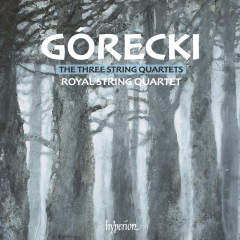
hmg-hyperion-2011This is the third time that I have written CD booklet notes on the Górecki string quartets. Back in 1993, I wrote on no.2 ‘Quasi una fantasia’, followed 14 years later by no.3 ‘.. songs are sung’, both for Kronos on Nonesuch.  In 2008, the Silesian Quartet – great friends of the composer – brought out all three quartets on EMI Poland.  Now, in 2011, another Polish ensemble, the young and dynamic Royal String Quartet, has recorded these quartets for Hyperion.  It has been a privilege to revisit these three masterpieces in its company.


Here’s the link to my note for this new Górecki CDor you can scroll the CD NOTES tab above.

• New CD Note (Górecki/Decca)

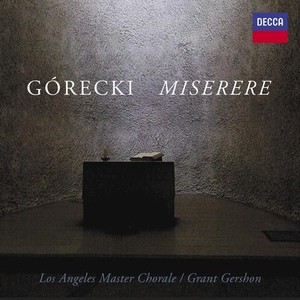
Two fine new CDs of Górecki’s choral music have appeared recently, one by British performers, one by Americans. First out was ‘Henryk Górecki: Totus Tuus’, sung by the National Youth Choir of Great Britain, conducted by Mike Brewer, on Delphian (DCD34054).  Second to appear was ‘Górecki: Miserere’, sung by the Los Angeles Master Chorale, conducted by Grant Gershon, on Decca (478 3537).  The NYCGB seems to be marginally the larger of the two sizeable choirs.  Both are superbly blended and able to sustain the long and often quiet lines and harmonies of Górecki’s music.  The two repertoires complement one another nicely, with only the previously unrecorded Lobgesang (2000) on both discs.  Together, they give as representative a survey of Górecki’s sacred choral music (mostly a cappella) as you could wish for.  And you can also appreciate the contrasts between young and mature voices.

The Delphian CD contains Euntes ibant et flebant (1972), Amen (1975), Totus Tuus (1987), Lobgesang and Salve, sidus Polonorum (2000).  The excellent booklet note is by Ivan Moody.  The full texts are included, in Latin/Polish and in English.

The Decca CD contains Miserere (1981), Five Marian Songs (1985) and Lobgesang. The full texts are included, in Latin/Polish, German, French and English.

Here’s the link to my booklet note for Górecki: Miserere, or you can scroll the CD NOTES tab above.