• WL100/27: Notebook, 19 March 1961

Lutosławski and Rain

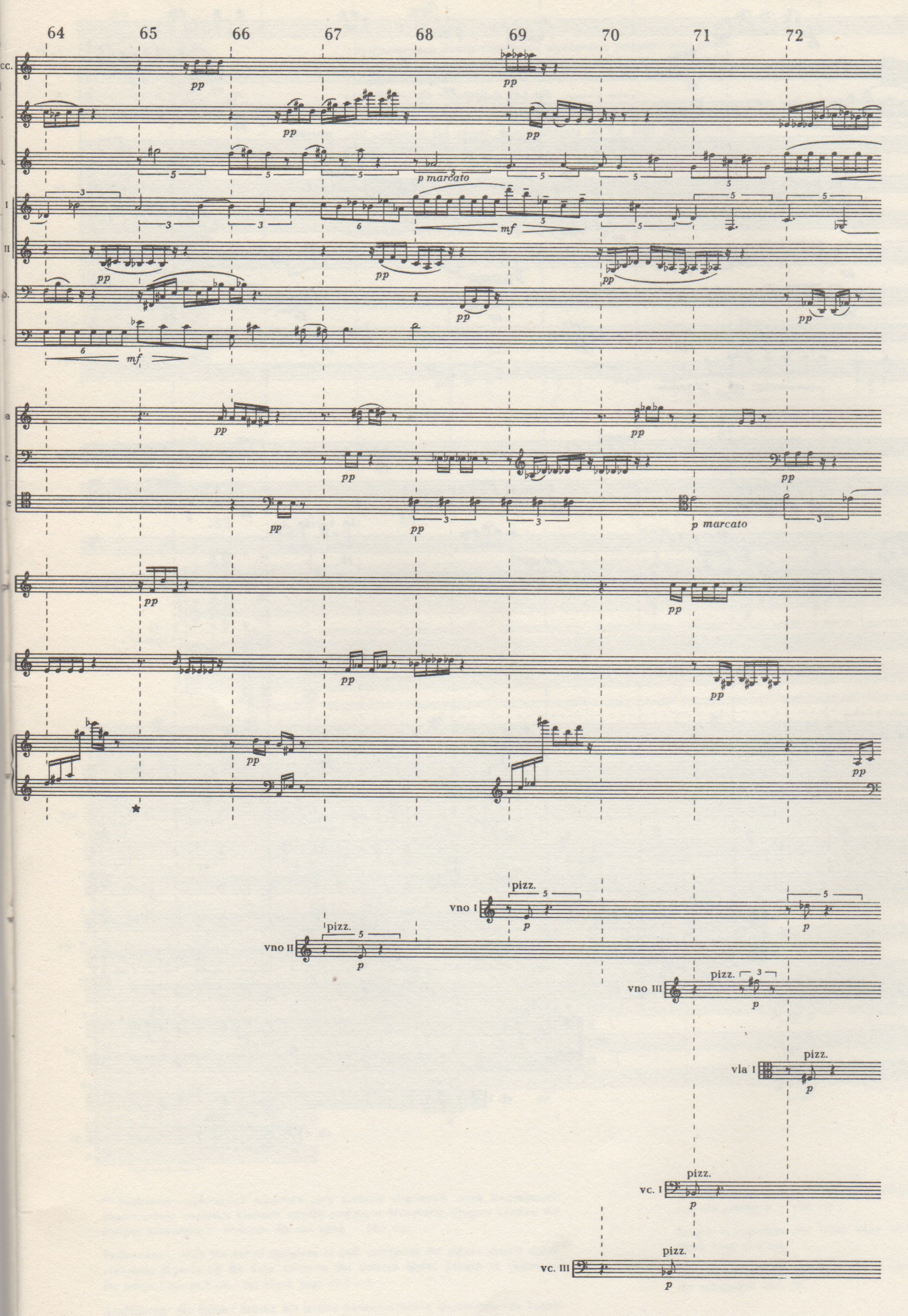
In order to justify classical rhythmic formulae, the argument has been used that this rhythm (i.e. ‘harmonic’, based on pulse) comes from nature: walking, the heartbeat.  Well, it is not correct to say that other rhythms have no counterpart in nature.  In fact, natural phenomena proceed for the most part in an irregular rhythm.  Example: the rhythm of the drops as rain begins to fall (pizz., in b.67 presto (II) from Jeux v.).

Dla uzasadnienia klasycznych formuł rytmicznych posługiwano się argumentem, że rytm ten (tzn. ‘harmoniczny’, oparty na pulsacji) pochodzi z natury: chodzenie, bicie serca.  Otóż nie jest słuszne twierdzenie, że inne rytmy nie mają odpowiedników w naturze.  Na pewno zjawiska natury przebiegają w swej większości w rytmie niepulsacyjnym.  Przykład: rytm kropel, gdy deszcz zaczyna padać (pizz., w t. 67 presto (II) z Jeux v.).

Witold Lutosławski, 19 March 1961  [my translation]

This is a rare example of Lutosławski linking extramusical observations to his music, aside from his several references to the theatre.  The passage in question (in the second movement of Jeux vénitiens, which he was writing at this very time and would complete nine days later) is interesting from a number of points of view.

For one thing, the string pizzicati are almost completely covered by a denser, more active texture in the woodwind, brass, pitched percussion and harp, so hardly of foreground interest.  For another, this is not the first but the third such passage in the movement: the first is led off by the bassoon at b.9 and the second (more briefly) by vibraphone at b.46, both against a background of scurrying muted strings played arco.  In each of these first two cases, the ‘irregular’ rhythms lead to fuller textures in the wind and pitched percussion, and it is the second of these that eventually runs in parallel with the string pizzicati cited by Lutosławski above.

This third and most developed passage extends from b.67 to b.82 and is given to the strings for the first time and marked pizzicato to make the point (the orchestration of these three sections is a good example of how Lutosławski thought of his music’s instrumentation in structural terms).  Bars 67-82 take the form of an increasingly dense rhythmic texture that is interrupted by the playing of cardboard tubes on the strings of the piano at b.83 (see WL100/24: Notebook, 11 March 1961 for details of this passage).  Given the dating of both this diary entry and of his work on the second movement, it looks highly possible that Lutosławski did have the irregular rhythm of a natural phenomenon like raindrops in mind when he composed not only bb.67-82 but also the two earlier passages to which this pizzicato section is the successor.  Incidentally, the movement is not headed Presto in the published score – it simply has the tempo indication of crotchet/quarter-note = 150.

Here’s a recording of the (unrevised) second movement from the premiere of the otherwise revised and completed version of Jeux vénitiens, given at the Warsaw Autumn on 16 September 1961, with the National Philharmonic conducted by Witold Rowicki.  The bassoon entry at b.9 is at 0’05”, while the vibraphone at b.46 is inaudible, as too is most of the string pizzicato starting at b.67 (0’46”).

WL JV:II bb.64-72

WL JV:II bb.73-81

• New CD Note (Penderecki & Lutosławski/Hyperion)

034571179438-1I have been a fan of the Royal String Quartet for several years.  I heard these superb Polish musicians play Górecki’s Third String Quartet at the St Magnus Festival on Orkney in 2010 and subsequently wrote the booklet note for their Hyperion CD of all three Górecki quartets.  Now they’ve released an equally stunning account of the three Penderecki quartets alongside Lutosławski’s sole contribution to the genre.

Here’s the link to my booklet note for Penderecki & Lutosławski String Quartets, or you can scroll the CD NOTES tab above.

• New CD Note (Lutosławski vol.5/Chandos)

CHAN 5108-1Lutosławski: Orchestral Works IV is the fifth Chandos CD in the BBCSO/Gardner series.  I hope that there will be a sixth to include Livre pour orchestre (1968) and Mi-parti (1976) and a selection from Musique funèbre (1958), Jeux vénitiens (1961), Novelette (1979) and the Double Concerto (1980).  Then the series will have included all Lutosławski’s major symphonic and vocal pieces.  It’s been a fantastic series.  The first CD included the Concerto for Orchestra, which on Polish Radio was recently voted the best recording of this popular work.  I wrote an account of the programme discussion on 20 January: Gardner/BBC SO top Polish Radio poll.

Here’s the link to my booklet note for Lutosławski: Orchestral Works IV, or you can scroll the CD NOTES tab above.

• Zarębski Piano Quintet on PR ‘Trybunał’

For the second time in a month, I tuned in yesterday to Polish Radio 2 ‘Dwójka’ for one of its fortnightly ‘tribunals’. The format is simple but unusual.  Three commentators – on this occasion, two critics plus a performer – whittle down a selection of six recordings of the same piece until it votes for a winner.  All six CDs are heard in the same initial section of the piece, then four in a second section, three in a third and two in a fourth.  It’s an interesting idea and draws in the listener.  One might argue, however, if the sections are always chosen in the order that the work progresses, that a recording that improves as it unfolds may lose out too soon.  The line-up for yesterday’s panel was Dorota Kozińska (critic), Kacper Miklaszewski (critic), Jacek Hawryluk (chair) and Karol Radziwonowicz (pianist).

d1a06fe4-72f6-4f8b-8df8-e16a9097513d.file

Yesterday it was the turn of the Piano Quintet (1885) by Juliusz Zarębski (1854-85).  I have enthused on this work elsewhere in these pages, almost exactly a year ago (Zarębski’s Piano Quintet).  Last February, I was especially keen on a YouTube recording by Darina Vassileva and the Quarto Quartet from Bulgaria and included links in my post, but I’ve still not been able to find a copy of its CD recording on the Arcadium label.

The schedule yesterday was:

• Round 1: Opening of first movement
• Round 2: Opening of second movement
• Round 3: Opening of third movement
• Round 4: Opening of fourth movement.

After Round 1, the panel was (almost) unanimous in eliminating CDs 3 and 4, both of which – from this opening section only – sounded untidy, messy of tempo and somewhat over-egged expressively.  They were both live performances.

• It turned out that both CD3 and CD4 had Martha Argerich at the keyboard: a CD from the Lugano Festival (2011) and a DVD from a Warsaw concert (2012).  I must admit to being surprised that two of the six slots were taken up by one major player, when in fact there are now over a dozen recordings that have been issued on CD over the past 20 years or so.  A pity, therefore, that one of these was not chosen to replace one of the Argerich recordings.

• Round 2 resulted in the elimination of another recent recording (CD6), this one by Piotr Sałajczyk and the Lasoń Ensemble (Accord, 2012) [thanks to William Hughes for pointing me in the right direction for the info on the players].

By this stage, the panel had isolated CD2 as being the least Slavonic/Romantic in tone and temperament, so the discussion seemed to be coming to a head partly on that basis.

• Round 3 used a sizeable chunk from the beginning of the Scherzo.  For my money, the only recording to live up to the title of the movement was CD2.  It was light on its feet, whereas the others – especially the pianists – chose slow, deliberate tempos and made heavy weather of an admittedly difficult movement.  After some deliberation, CD1 was lost – Wojciech Świtała with the Royal String Quartet (Bearton, 2006).  It was now down to a contest between the new, ‘non-Slavonic’ CD2 and the archival, ‘Slavonic’ CD5.

• I could tell which way Round 4 was going to go from the comments so far.  What puzzled me was that to my ears the excerpts from CD5 had severe drawbacks.  Its first movement showed little shaping of cadential phrases (they simply motored on), while the second was on the slow side, with over-emphatic rhythmic articulation and a main theme (violin) that was overcooked and pretty horrid.  The finale sounded better, though the piano playing still seemed mannered in places.  CD2, on the other hand, brought freshness and new perspectives, even if it did not have the lushness and depth of tone of CD5.

• CD2 was the runner-up: Jonathan Plowright and the Szymanowski Quartet (Hyperion, 2012).*  CD5 was the only archive recording of the six, dating (if I caught it right) from c.1963.  It featured ‘The Pianist’ Władysław Szpilman as a member of the Warsaw Piano Quintet, with Bronisław Gimpel as first violin.  Well, that’s me told, but I stick to my guns about the over-ripe tone of the theme in the second movement.  This remastered LP recording has been reisued on a 3-CD set of Szpilman’s ‘Legendary Recordings’ (Sony, 2005).

This got me thinking about the recording history of the Zarębski Piano Quintet.  For a work that was not published until the 1930s and which has never had much of a presence or reputation outside Poland, its tally of over twelve CD recordings is remarkable.  Here’s my list, with the six recordings considered yesterday in bold – if you know of any omissions or errors, please let me know.  It’s in chronological order of release (as far as I can ascertain).

Władysław Szpilman, Warsaw Piano Quintet (1963; Sony 3-CD set, 2005)
• Waldemar Malicki, Varsovia String Quartet (Pavane, 1990)
• Szábolcs Esztényi, Wilanów String Quartet (Accord, 1991)
• Jerzy Witkowski and friends (Olympia, 1992)
• Waldemar Malicki, Amar Corde String Quartet (Amar Corde, 1997)
• Paweł Kowalski, Silesian String Quartet (Polskie Nagranie, 1998)
• Krzysztof Jabłonski, Warsaw Quintet (Dux, 2005)
Wojciech Świtała, Royal String Quartet (Bearton, 2006)
• Darina Vassileva, Quarto String Quartet (Arcadium, 2010)
Martha Argerich +, live (EMI 3-CD set, 2011)
Martha Argerich +, live (Chopin Institute DVD, 2012)
Piotr Sałajczyk, Lasoń Ensemble (CD Accord, 2012)
Jonathan Plowright, Szymanowski String Quartet (Hyperion, 2012)

There is also a newly-issued CD of the quintet in an arrangement for piano and string orchestra (my thanks to Tomasz Andrzejewski for this information; see comments below).
• Ewa Pobłocka, Amadeus CO of Polish Radio, cond. Agnieszka Duczmal (Polish Radio, 2013)

If the Vassileva-Quarto recording of 2010 is anything like the live video on YouTube, it could be something really special.  I still remain true to the first recording that I heard – the Malicki-Varsovia on Pavane – even if it verges on being an archival recording.  For one thing, its pacing and sense of musical drama are hard to better and, for another, it strikes a terrific balance between expressivity and momentum.  If you can get hold of a copy, do.  If you can’t, then my undoubted winner – for its revelatory and unfettered insights – is the most recent recording, by Jonathan Plowright and the Szymanowski Quartet on Hyperion.

………..

* I must declare my interest here, although I listened with innocent ears: I wrote the booklet notes for the Plowright/Szymanowski recording.

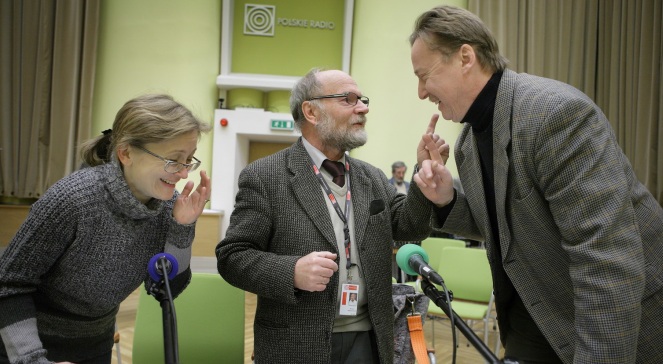
UPDATE!  On 22 February 2013, Polish Radio 2 responded to this post by posting about it themselves: Adrian Thomas po raz drugi o werdykcie Trybunału (Adrian Thomas for the second time on the verdict of the Tribunal).  They also put up this rather jolly second photo from the recording session:

bf3f27ec-f747-40f9-8ac5-1ac5371af15d.fileMy first post had been • Gardner/BBC SO top Polish Radio poll the day after the Tribunal on 19 January 2013 for Lutosławski’s Concerto for Orchestra.  It received this response from Warsaw on 24 January: Wyroki Trybunału komentowane w Wielkiej Brytanii (Verdicts of the Tribunal commented on in Great Britain).
• WL100/14: Lutosławski at Polish Radio

WL w Polskim RadiuPolish Radio’s new website Witold Lutosławski w Polskim Radiu looks like being one of the most interesting archival sources on the composer so far.  There are audio files and photo galleries connected with Lutosławski’s work at Polish Radio in the 1940s and 50s as well as a host of radio interviews made with and about him over the years. The initial on-screen teething problems have now been sorted, although the promised English-language transcripts of some of the items have yet to materialise.

The contents are already of considerable interest, and I hope they will be added to in the coming weeks and months. Currently the contents include:

• over thirty radio reminiscences and interviews
• two examples of incidental music for Polish Radio Theatre unheard since the mid-1950s
• three photo galleries: Witold Lutosławski and His Time (52 items), From the Family Album (22) and Documents from Polish Radio (17)

For those who don’t understand Polish, the second and third groups above may be of the greatest interest.

Incidental Music

Polish Radio has unearthed two sequences of Lutosławski’s incidental music for Polish Radio Theatre.  This activity was one which he pursued from the late 1940s until 1960.  Little has been written on his incidental music because it was thought that it existed, if at all, almost exclusively in score form.  Polish Radio has now released these two audio compilations from its sound archives.

The earlier of the two is called Anccasin ef Nocolette on the PR website.  I must admit that I cannot rationalise the language nor find any source for this title.  Martina Homma has identified the item as Okassen i Mikołajka, which seems linguistically more reliable.  She dates the broadcast of this authorless text to 8 November 1954 (eighteen days before the premiere of the Concerto for Orchestra).  Although the PR site gives the duration of the music as 5’39”, it lasts for 11’17”.  The music is Baroque pastiche, the fragments up until 08’50” for harpsichord alone. Thereafter, a flute and violin join in.  I wonder if Lutosławski was himself playing the keyboard.  The recording is rather basic and the performance is not without the occasional fluff.

The second of the two sequences was broadcast almost three months later, on 30 January 1955.  It was composed for one of the Arabic folk tales from Klechdy sezamowe (Tales of Sesame, 1913) by Stanisław Leśmian, who is better known by his first forename, Bolesław.  The music for Zeklęty rumak (PR site), or O zaklętym rumaku (Homma), is more fantastic and richly scored, for chamber ensemble, than the frankly boring music for the earlier piece.  It lasts for 10’27” (the PR site says 5’14”).  Let’s hope there are more riches in the sound archives from Lutosławski’s prolific period as a composer of incidental music.

Photo Galleries

There are many unfamiliar items here, so these three sections present new windows into the past.  The third section of documents is perhaps the least interesting as it draws on administrative paperwork from the post-war decade. The second section of family photographs consists almost entirely of old images of the Lutosławski family rather than of the composer.  His likeness to his brother Jerzy and his father Józef is very striking.

It is the first section that brings Lutosławski really to life, with photographs dating from after the Second World War up until 1993.  I was thrilled to see the sequence of photos from the rehearsals and concert for the full premiere of the Second Symphony, which Lutosławski conducted in Katowice in 1967.  There are also black and white stills from the documentary film made by Krzysztof Zanussi in 1990 for the BBC (see my post WL100/13: In Conversation with Zanussi).

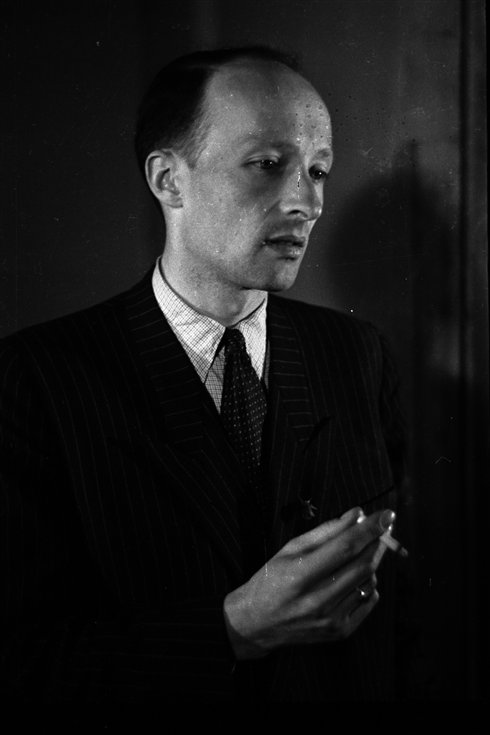
But for me it’s the first two photographs which I find utterly compelling.  They were evidently taken during the same photo shoot (PR indicates that this was in January 1946) as another image used on the front cover of Polish Radio’s listings magazine Radio i Świat in April 1948 (see the top illustration in Panel 2: 1946-49 Music for Radio from my exhibition ‘The Hidden Composer’).  Of these two new images, which are technically much better than the one reproduction that I found, it is the first which I find almost unbearably haunting.

WL, January 1946

• Gardner/BBC SO top Polish Radio poll

Yesterday afternoon (19 January), a Polish Radio panel chose Edward Gardner’s recording of Lutosławski’s Concerto for Orchestra, with the BBC SO on Chandos, as its top recommendation for CDs of this much-recorded work.  This was no ordinary ‘Building a Library’ type of format, however.  This was an elimination contest based purely on listening, with no foreknowledge of who the performers were.

UnknownRadio Dwójka (PR 2) is Polish Radio’s cultural channel.  Every fortnight on Płytowy Tribunał Dwójki, a panel of three sits down to debate and vote on the best recorded interpretation of a selected work.  There is also a studio audience which gets its own vote.  It’s an intriguing format, one in which the panel puts its reputation on the line.  Last night, it consisted of the music critics and broadcasters Dorota Kozińska and Kacper Miklaszewski, and the conductor Wojciech Michniewski.  Jacek Hawryluk was in the chair.  Michniewski knew Lutosławski well, has conducted his music frequently, including sharing the conducting of Trois poèmes d’Henri Michaux with the composer on the 6-LP boxed set of Lutosławski’s music issued by EMI in 1978.  He was a key figure in the Breaking Chains festival in London in 1997 and in 2001 recorded a CD of Lutosławski’s music on Accord.  But I digress.

The schedule for yesterday’s ‘tribunal’ on the Concerto for Orchestra was as follows:

• Round 1: Opening of I ‘Intrada’
• Round 2: Opening of II ‘Capriccio notturno ed Arioso’
• Round 3: Opening of III ‘Passacaglia’
• Round 4: Continuation of III ‘Toccata e Corale’

After listening to the ‘Intrada’ from all six unidentified recordings, two were eliminated at the end of Round 1, then one more each round until two were left in Round 4. The results were:

• After Round 1: the two recordings eliminated were both of recordings by the Warsaw Philharmonic.  The earlier recording was conducted by the man who commissioned the Concerto for Orchestra in 1950 and gave the premiere four years later, Witold Rowicki (Philips, 1964, first released on LP).  The second recording was more recent, conducted by Antoni Wit (Dux, 2005)

• After Round 2, the composer’s own recording from 1976/77 was eliminated (EMI, first released on LP in 1978).

• After Round 3, Mariss Jansons’s new recording with the Bavarian Radio SO (BR Klassik, 2011) got the chop.

That left just two recordings.  The panel had proved itself pretty much of one mind during the earlier eliminations, and so it proved here too.

• In Round 4, the runner-up was Jukka-Pekka Saraste’s recording with the London PO (LPO label, recorded live in 2008 at the Royal Festival Hall, London, released 2011).

• The winner was Edward Gardner’s recording with the BBC SO, recorded and released in 2010 on the first of Chandos’s much-acclaimed series devoted to Lutosławski (for which I’ve had the privilege of writing the booklet notes).

wl-chandos-2010

The studio audience also agreed with the panel about the top recording, but chose Lutosławski’s recording as the runner-up.  While the panel preferred the three recent versions to the older ones, I was pleased to see that Lutosławski’s powerful interpretation still made an impact.

…….

If you’ve come across Hyperion’s recent release of Juliusz Zarębski’s wonderful Piano Quintet – played by Jonathan Plowright and the Szymanowski Quartet – you may be interested that Zarębski’s work also comes up before the Polish Radio 2 ‘tribunal’ in four weeks’ time, on Saturday 16 February.  Of course, no-one knows if the Hyperion CD will be among those under discussion (my guess is that it will), but I’ll keep you posted!

…….

UPDATE! On 24 January 2013, Polish Radio 2 responded to this post with one of its own: Wyroki Trybunału komentowane w Wielkiej Brytanii (Verdicts of the Tribunal commented on in Great Britain).  When I posted on the Tribunal’s deliberations on Zarębski’s Piano Quintet, Polish Radio 2 responded again: Adrian Thomas po raz drugi o werdykcie Trybunału (Adrian Thomas for the second time on the verdict of the Tribunal).

• WL100/10: ‘Breaking Chains’, GSMD 1997

Possibly the most intense and wide-ranging survey of the life and works of Witold Lutosławski that has ever taken place was that at the Barbican, London, in January 1997.  The climax was three days of concerts, organised by the BBC under the banner Breaking Chains on 17-19 January.  I’ll return to these events in a future post.

Preparatory to these concerts, the Guildhall School of Music and Drama, in a different part of the Barbican complex, organised five days of complementary events under the Breaking Chains umbrella, 13-17 January 1997. These included concerts, workshops, talks and discussions, as well as an exhibition.  The participants included the GSMD SO and CO, student chamber ensembles and soloists, and several speakers: Steven Stucky, Józef Patkowski, Charles Bodman Rae, John Casken and myself.

WL Breaking Chains, GSMD 13-17.01.97

The GSMD Breaking Chains repertoire included: Symphonic Variations (1938), Symphony no.1 (1947),  Little Suite (1950/51), Straw Chain (1951), Silesian Triptych (1951), children’s song cycles Autumn and Spring (1951) and four other children’s songs (1953-54), Jeux vénitiens (1961), String Quartet (1964), Symphony no.2 (1967), Livre pour orchestre (1968), Variations on a Theme by Paganini for piano and orchestra (1941/78), Novelette (1979), Chain 1 (1983), Fanfare for Louisville (1986), Prelude for GSMD (1989).  In pre-concert and afternoon events during the BBC part of Breaking Chains, GSMD students also performed Overture for Strings (1949), Five Folk Melodies (1945/52), Preludes and Fugue (1972), Partita for violin and piano (1984), songs and music for piano, as well as Chain 1 for the second time.

There were some fantastic student performances during this GSMD week.  Indeed, Symphony no.2, Novelette and Fanfare for Louisville were issued on the SOMM label (SOMMCD 219) in 1999, alongside performances of two works conducted by the composer on his visit to GSMD on 11 May 1989: Prelude for GSMD and the Cello Concerto (1970), in which the soloist was Louise Hopkins.  My strongest recollection is of the performance of the Second Symphony under the dynamic direction of Wojciech Michniewski.

Lutosławski: Symphony no.2

• Movement 1: ‘Hésitant’  

• Movement 2: ‘Direct’ (the track begins c.15″ too early with two brief events for trombones/tuba and bassoons from the end of ‘Hésitant’; ‘Direct’ begins with ppp double basses, partly masked by a final bassoon utterance)  

My own involvement also included directing a workshop performance of Jeux vénitiens and putting together an exhibition called The Hidden Composer: Witold Lutosławski and Polish Radio, of which more anon.

• WL100/6: Epitaph, **3 January 1980

Epitaph (1979) is virtually alone in Lutosławski’s output in being a duet that he never orchestrated.  There are orchestral versions of Dance PreludesGrave and Partita, and through these arrangements his chamber music has reached a wider audience in the concert hall and on disc.  Epitaph has not been so lucky, and there has been less than a handful of CD recordings.

Craxton_JanetYet Epitaph was the work which spurred Lutosławski’s late flowering of small chamber compositions, which included other duets with piano: Grave for cello (1981), Partita for violin (1984) and Subito for violin (1992), whose material was intended for an unfinished violin concerto for Anne-Sophie Mutter.  Lutosławski wrote Epitaph when he was 66, at the request of the British oboist Janet Craxton to commemorate her late husband, Alan Richardson.  With the pianist Ian Brown, Craxton premiered Epitaph at the Wigmore Hall in London on 3 January 1980.

At the time, Epitaph had a huge impact for its small size.  The musical world had become used to Lutosławski the composer of impressive works for orchestra (Second Symphony, LivreMi-partiNovelette) or for soloist with orchestra (Cello Concerto, Les espaces du sommeil).  Here all of a sudden was this melodic and gutsy gem of a duet, and his music was within reach of chamber musicians (to add to the  String Quartet of 1964).

It is more than likely that Lutosławski wrote Epitaph as a trial run en route to the Double Concerto (1979-80), which was premiered eight months later by the oboist Heinz Holliger and his wife, the harpist Ursula Holliger, with the Collegium Musicum conducted by Paul Sacher.  There is no specific material shared between the two pieces, but Sacher had been asking Lutosławski for something for Heinz Holliger for over a decade, so it is quite possible that the two works were interlinked in Lutosławski’s creative processes at some stage.

…….

In May 1968, and again in a chasing letter dated 19 March 1969, Sacher pressed Lutosławski for a concerto for Holliger.  Lutosławski, who by then was engrossed in writing a cello concerto for Rostropovich, replied on 2 April in conciliatory tone, but his projected timescale was to be dislodged by a further nine years:

‘Une telle oeuvre est toujours dans mes plans, mais, comme cela arrive bien souvent, les dates où je m’attendais de terminer les compositions sur lesquelles je travaille maintenant se déplacent et je serais très vraisemblablement en retard.  J’envisage, que je serais prêt de commencer le travail sur l’oeuvre en question seulement en 1971.’

…….

It is perhaps appropriate that Holliger (with the pianist Szabolcs Esztényi) gave the Polish premiere of Epitaph on 24 September 1980 at the 24th ‘Warsaw Autumn’, exactly a month after he had premiered the Double Concerto:

• New CD Note (Szymanowski/Chandos)

CHAN 5115After four volumes of Lutosławski in its ‘Muzyka Polska’ series, with a fifth to follow shortly, Chandos has begun a new Polish strand.  New Year’s Day 2013 marks the issue of its first Szymanowski CD in the series.  The principal forces remain the BBC Symphony Orchestra under Edward Gardner.
I heard Louis Lortie’s recording of Szymanowski’s Symphony no.4 ‘Symphonie Concertante’ when it was broadcast on Radio 3 last November.  It fairly zinged along and the finale was the best that I’ve heard.  Also on this new CD are the early Concert Overture and Symphony no.2.

The front cover, if I’m not mistaken, shows the Tatra Mountains from the southern, Slovakian side rather than from a Polish vantage point that Szymanowski might have known.  The lake is Štrbské Pleso.

Here’s the link to my booklet note for this new Szymanowski CDor you can scroll the CD NOTES tab above.

• Lutosławski in the January pipeline

I have just been invited by the Polish Minister of Culture to join the Honorary Committee for Witold Lutosławski Year in 2013, which is an honour in itself.  I’m never quite sure what honorary committees do or are expected to do, but I promise to knuckle down and contribute as best I can.

Having just spent a few weeks preparing for last Saturday’s CD Review round-up of Lutosławski CDs on BBC Radio 3 – an hour’s discussion, live-on-air, with Andrew McGregor – I thought I’d have a few days off.  But Lutosławski continues to beckon.  So here are a few things that are coming up in the next month or so, not all of them yet accomplished.

• Around now, a German translation by Andrea Huterer of my paper ‘Lutosławski and Literature‘ (2010) will appear in ‘Witold Lutosławski. Ein Leben in der Musik’, Osteuropa 11-12 (Berlin, 2012).  This issue is being supported by the Polish Institute in Berlin.

• I’ve just written a very brief essay on ‘Lutosławski and his Performers‘ for the Polish Institute in Brussels.  It is for a Lutosławski tribute to be published in Dutch and French in January 2013 (all three versions should also be available online via www.culturepolonaise.eu).

• Also in January 2013, an interview I did a couple of months ago will appear in a centenary tribute to Lutosławski being published (in Polish) by the Wrocław Philharmonic.  The orchestra is not only named after Lutosławski but is the driving force behind the Opera Omnia series of Lutosławski CDs on the Accord label.

• On 23 January I am discussing Lutosławski’s Cello Concerto with Johannes Moser, in a pre-concert event for the Bournemouth SO, which gave the world premiere in October 1970.  This is part of the bicentenary celebrations of the Royal Philharmonic Society, which commissioned the concerto.  (The actual RPS anniversary is the next day, 24 January.)  I’m really looking forward to this encounter, at the Poole Lighthouse, between a music historian and one of the many young cellists who have taken this concerto into their repertoire.  The Lutosławski centenary falls two days later, on 25 January, when I might just pop over to Warsaw for the Polish inauguration of Witold Lutosławski Year.

• The Philharmonia Orchestra begins its Lutosławski series Woven Words on 30 January at the Royal Festival Hall in London.  Accompanying the series will be a substantial celebratory programme which includes several essays.  My ‘Parallel Lives of a Captive Muse‘ is one of them.  It’s already been published on the Woven Words website.

• Watch out for the fifth Lutosławski CD, with the BBC SO and Edward Gardner, which Chandos is releasing early in 2013 in its ‘Muzyka Polska’ series (First Symphony, Dance Preludes, Partita and Chain 2).  I’ve thoroughly enjoyed writing the booklet notes for these outstanding recordings and it’s been an(other) honour to be associated with it.

• I am currently writing a substantial profile of Lutosławski and his music for publication in late Spring 2013 (watch this space, and others!).

Well, I think those seven items are more than enough to be going on with!