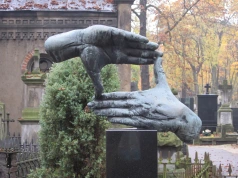
• ‘onpolishmusic’ is back!

Thanks to all who continue to visit onpolishmusic!  If you’ve been wondering why the site has been silent since December 2013 it’s because I have been otherwise preoccupied with planning and then pursuing a four-month walk through France.  Now I am back, and new Polish posts and pages are in the offing.  As ever, if you have any suggestions for improving the site and its contents, I’ll be delighted to receive them.  Happy reading!

COMPETITION
Which author links the three composers Tomasz Sikorski, Lidia Zielińska and Agata Zubel?

682.01.ma,13362_zubel_coverI have a copy of Zubel’s new CD for the first person who can identify him/her and can name one work by each of these three composers that has a connection with this well-known writer.

Answers please via the CONTACT page.  I’ll post the solution below once the first correct answer comes in.  The prize was claimed within an hour of posting (see Comments, below)!

• New CD Appreciation (Krauze/Bôłt)

Krauze-1The Polish independent CD label, Bôłt Records, is one of the most inventive both inside and outside Poland.  Not only has it reissued recordings of key experimental works from the 1960s and 1970s but it has also given recording opportunities to current composers and performers to revisit such pieces.  One of the composers on whom Bôłt has focused is Zygmunt Krauze, five years younger than Penderecki and Górecki and just as distinctive a figure.  This CD, for which I wrote a short appreciation of Krauze’s music, presents archive recordings of four works from 1975-80, a significant period in Polish musical and cultural life.

Here’s the link to my appreciation for this new Krauze CDor you can scroll the CD NOTES tab above.

• WL100/69: Livre, **18 November 1968

The now-neglected jewel in the crown of Lutosławski’s orchestral music was premiered on this day in 1968, by the Hagen City Orchestra, conducted by Berthold Lehmann, to whom it is dedicated.  Had Lutosławski had his way (as Nicholas Reyland has revealed), he would have changed the title from Livre pour orchestre to Symphony no.3, which undoubtedly would have placed it quite differently within his oeuvre and raised its external profile, especially today. But Lutosławski’s change of heart came too late – the publicity was already out in Hagen.

The performance and recording history of Livre is odd.  Speak to anyone who knew Lutosławski’s music during his lifetime and they are more than likely to place Livre in the top five of his orchestral pieces, if not at the pinnacle.  Yet, there have been only seven commercial recordings to date (another – the first for over 15 years – is due shortly in the Opera Omnia series from the Wrocław Philharmonic).  This compares unfavourably with the 18 accorded his next piece, the Cello Concerto.  Bizarrely, the otherwise superlative Chandos series by the BBCSO under Edward Gardner ignored Livre, which is a shame, not least because Lutosławski performed it with the BBC SO on three occasions (1975, 1982, 1983 – BBC Proms).  Lutosławski conducted Livre at least four more times in the UK (not including programme repeats), with the Philharmonia Orchestra (1981, 1989), with the Royal Academy of Music SO (1984) and with the Hallé Orchestra (1986).

This centenary year, Livre has continued to languish in the shadows when compared to the number of performances of his other major orchestral works.  His publisher, Chester Music, itemises just two performances, which is nothing short of scandalous: 30 January, Warsaw PO/Michał Dworzyński, and 17 November (yesterday), Duisberger Philharmoniker/Rüdiger Bohn.  Mind you, Chester’s list of recordings is incomplete, listing just three.  Here is the full list (giving the original record label), as far as I can ascertain.  Only the recordings by Lutosławski, Herbig and Wit seem to be available currently on digital formats.

• National PO, Warsaw/Jan Krenz (Polskie Nagrania, 1969)
• National PO, Warsaw/Witold Rowicki (Polskie Nagrania, 1976)
• WOSPR (now NOSPR)/Witold Lutosławski (EMI, 1978)
• Berlin PO/Günter Herbig (Eterna, 1979)
• Eastman Philharmonia/David Effron (Mercury, 1981)
• WOSPR (now NOSPR)/Jan Krenz (Adès, 1988)
• PRNSO/Antoni Wit (Naxos, 1998)

…….

1454688_661788100528035_2044002059_nHere is an audio recording of Livre, digitised by my friend Justin Geplaveid (who also provided the performance details), from a concert given on 16 August 1972 in Munich as part of the Olympic Games or on the following day in Augsburg.  The players were the UNESCO Jeunesses Musicales World Orchestra, and included among the violins was one Ervine Arditty [sic]….

1452253_661788107194701_1578121087_nThe original LP recording, conducted by Witold Rowicki, has some interesting orchestral balances.

…….

By far the most satisfactory YouTube offering is a video of Herbig conducting the Spanish Radio and Television Orchestra in Madrid on 11 November 2011.  It is available on Justin Geplaveid’s YouTube site (and one other: http://www.youtube.com/watch?v=ZfeDBNyZLPU).  Geplaveid’s stream also has some fascinating archival videos from the ‘Warsaw Autumn’.

…….

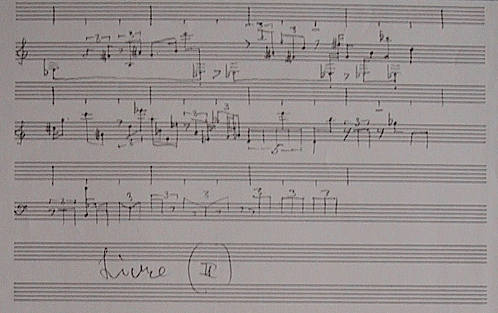
Screen Shot 2013-10-22 at 08.47.06A few weeks ago, I put up some isolated sketch pages for Mi-parti that I’d come across in Lutosławski’s house in 2002.  From that same folder “ŚCIĄGACZKI” (Crib Sheets), here are four more sketches that had not been sent on to the Lutosławski archive at the Paul Sacher Stiftung in Basle.  I hope that they are there now!  I have not looked at the Livre sketches in the Stiftung, so cannot say how these four abandoned sheets relate to the greater mass of material in Basle.

These four sheets relate to the first two chapitres.  The first three relate to the second chapitre, starting at fig. 207.

Screen Shot 2013-11-17 at 15.23.03

The top one presents a rhythmic ‘crib’ for the eleven bars from fig.207 to fig.209 (it’s enlarged below).  The notes beamed underneath present the rhythmic pattern of the piano (bb.1-4) and brass entries (bb.5-6, trumpets and trombones).  The notes with upward stems have a more complicated relationship to the score and do not always correlate to Lutosławski’s final thoughts.  On the first system below (equivalent to the six bars of fig.207), the upper stems concern the outline rhythm in the strings (no glissandi or sustained durational values are indicated).  There are discrepancies in a few places, especially in bb.3-6, where some of the triplet quavers and semiquaver entries diverge from the score.  On the lower system (the five bars of fig.208), the lower rhythm reverts to the piano while the upper notes pick out the brass entries (horns and trombones).

Screen Shot 2013-11-17 at 15.21.20

The middle sketch (they weren’t photographed in any thought-out order back in 2002!) relates to this same passage. It is a pitch reduction for the instrumental ensemble, but there are minor rhythmic variations for some of the entries and missing pitches (cf. b.6 in particular).  Bars 7-11 (the five bars of fig.208) give the rhythmic pattern for the piano, as in the example above, plus the four pinpointing rhythms and pitches on the trombones.

Screen Shot 2013-11-17 at 15.20.41

The lowest of these three sketches relates just to the six bars of fig.207.  It is a pitch and rhythmic reduction of all the instruments involved – piano, strings trumpets and trombones.

Screen Shot 2013-11-17 at 15.22.02

The last of the four sheets presents more of a conundrum.

Screen Shot 2013-11-17 at 16.08.20

Evidently, the bottom two systems are a skeletal version of the top two, but initially I could not relate these ten bars to any part of the first chapitre.  Where were these ascending semiquavers, these descending quavers?  In the end, it was the pause sign in bar 10 that gave me clue.  In the score, there are only two pause signs in the first chapitre: in b.2 and in the bar before fig.109.  The ten bars of this sketch match the ten bars immediately before fig.109, from the third bar of fig.108.  It is the passage for brass (trumpets, horns and trombones) that leads to the clatter of tom-toms, xylophone and gran cassa that initiates the ‘codetta’ of the first chapitre.  

The phrasal cadences are very similar, identical in some places (notably in the last six bars).  The direction of movement also matches.  The differences with the score suggest that the sketch is an early rhythmic attempt at this passage.  What may be Lutosławski’s shorthand here (but even for him such a shorthand is stretching the point) equates the upper stave in each pair to the phrases for trumpets and horns I & II.  The lower stave refers to the descending phrases for horns III & IV and the trombones.  But whereas this sketch has clearly defined and short-lived rhythmic movement in both staves, the fully metred section of the score stretches out the lines heterophonically, with the trombones adding glissandi between notes for good measure.  As a result, there is no pause between phrases as the two ensembles overlap, creating a more fluid texture.  I must admit to being a little mystified by the long horizontal lines between the two staves, so if anyone has an idea of their significance please say so.

• WL100/68: Nie oczekuję dziś nikogo (1959)

While I was in Warsaw last week, I popped into an antykwariat which specialises in journals and periodicals of all types.  It also has a comparatively desultory music section, but occasionally there are interesting things to find.  This time, among large-format song sheets (mainly inter-war German popular songs), I found a much flimsier and tinier item (it measured just 15cm x 21cm): the first publication (February 1963) of one of Lutosławski’s dance songs published under his pseudonym, ‘Derwid’.

NODN cover 1963

Nie oczekuję dziś nikogo (I’m not expecting anyone today, 1959, words by Zbigniew Kaszkur and Zbirniew Zapert) was Derwid’s most popular song (he wrote some three dozen c.1957-64).  Its melody first appeared on 3 January 1960 in Radio i Świat (Radio and the World), the Polish equivalent of the British Radio Times.  The cover of this mini song sheet features the singer Rena Rolska, then in her late twenties.  I did quite a bit of research on the Derwid songs in 1994 (‘Your Song is Mine’, The Musical Times, 1830 (August 1995), 403-10) and discovered that the refrain of this ‘slowfox’ (with its C minor walking bass and sharpened 4th) bore a striking resemblance to the opening of one of Lutosławski’s politicised mass songs, Najpiękniejszy sen (The most beautiful dream, 1950).  I’m sure the similarities were coincidental!

NODN end

Rolska recorded Nie oczekuję dziś nikogo in 1960, with the Polish Radio Dance Orchestra conducted by Ryszard Damrosz:

• Tomasz Sikorski, d.13 November 1988

Today is  the 25th anniversary of the death of Górecki’s near-contemporary Tomasz Sikorski (1939-1988). Yesterday marked the third anniversary of Górecki’s death, but some sources (Wikipedia) also give yesterday as the date of Sikorski’s death, while others (Encyklopedia MuzykiNew Grove) give tomorrow, 14 November.  The most reliable Polish sources (Encyklopedia Muzyczna, Polish Music Information Centre POLMIC, PWM) give today, 13 November.
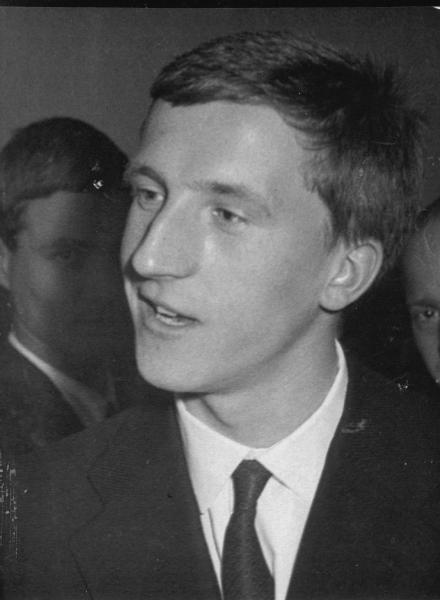
284_rdSikorski was and is one of the most singular voices in post-war Polish music and it is good to see that he still attracts a devoted following, not least through recent releases of his work on Bôłt Records.

When I was in Warsaw in January I went to a recital of some of his pieces by his friend and lifelong advocate of Polish piano music, the Hungarian pianist Szabolcs Esztényi.  The event marked the recent release of two Bôłt CDs, issued in partnership with several like-minded advocates such as Polish Radio 2, Polish Radio Experimental Studio, Foundation 4.99, DUX records, Bocian Records and the journal Glissando.  Sikorski’s music is/was published by PWM, Author’s Agency (Agencja Autorska), Moeck and Edition Modern.

sikorski_solitudeSolitude of Sounds. In memoriam Tomasz Sikorski (DUX 0936/0937) is a 2-CD set that also includes pieces by Esztényi (Created Music no.3 and Concerto) and Kasia Głowicka (Presence).  The Sikorski pieces are Echoes II (1963), Antiphons (1963), Solitude of Sounds for tape (1975) and Diario 87 for reciter and tape.  Sikorski himself performs on the first two of these archival recordings, and Esztényi writes a penetrating and disturbing recollection of his friend, who died in unexplained circumstances aged just 49.

sikor_tilburyThe second CD marks another, if briefer friendship, this time with forged with John Tilbury (b.1936), who met Sikorski in Zbigniew Drzewiecki’s piano class at the Higher School of Music in Warsaw in the early 1960s.  Tilbury’s CD For Tomasz Sikorski includes recent recordings that he made of his friend’s Zerstreutes Hinausschauen (1972), Autograph (1980) and Rondo (1984) plus his own Improvisation for Tomasz Sikorski (2011).

There is also, happily, a fair representation on YouTube, mostly uploaded by nocontrol696.  Jackamo Brown has created a 12-work playlist from nocontrol696’s uploads:

Monodia e Sequenza for flute and piano (1966)
Homophony for four horns, three trumpets, three trombones, gong and piano (Homofonia, 1970)
For Strings for three violins/violas (Na smyczki, 1970)
Zerstreutes Hinausschauen for piano (1972)
Holzwege for orchestra (1972)
• Music for Listening for two pianos (Muzyka Nasłuchiwania, 1973)
• Other Voices for 24 wind instruments, four gongs and bells (Inne głosy, 1975)
Sickness unto Death for two pianos, for horns and four trumpets (Choroba na śmierć, 1976)
Strings in the Earth for strings (Struny w ziemi, 1980)
• Autograph for piano (Autograf, 1980)
La Notte for strings (1984)
Diario 87 for reciter and tape

…….

For what they’re worth, here are two passages from my book Polish Music since Szymanowski (CUP, 2005), pp.213, 219-22, which discuss Sikorski and, initially, his contemporary and closest friend, Zygmunt Krauze, who happily is still very much with us (we met in Warsaw last Saturday).

If sonorism of the Pendereckian mould emanated from Kraków, Warsaw maintained a polite distance, preferring, in the music of Lutosławski, Baird, Serocki and others, to develop a closer architectonic relationship with detailed rhythmic and pitch organisation.  Of the younger Warsaw generation who graduated in the 1960s, two composers quickly became pre-eminent: Zygmunt Krauze and Tomasz Sikorski (1939-88), son of the composer Kazimierz Sikorski.  They were both his students, the latest in a line that already included Bacewicz, Baird, Kisielewski, Krenz, Palester, Panufnik and Serocki.  From the beginning, they each showed a determined individuality which defined a different stream in contemporary Polish music.

[…]

Tomasz Sikorski’s contribution to Music Workshop [Krauze’s pioneering ensemble of clarinet, trombone, cello and piano] reinforces the essentially minimal ethos not only of much of the music promoted by the ensemble but also Sikorski’s own distinctive voice.  This he established in a series of works in the mid-1960s – Antiphons and Echoes II (1963), Prologi (1964), Concerto breve (1965) and Sequenza I (1966) – in which the music proceeds by means of chains of small ad libitum fragments grouped in larger sequences.  The quasi-improvisational chordal fragments are deployed antiphonally or as live or tape playback echoes in a reiterative heterophony that is obsessive and, like some of Krauze’s pieces, achieves a disembodied, altered state, particularly in the cumulative resonances and polymorphic character of Antiphons and Echoes II.  Prologi is characterised by its mix of triadic ideas, diatonic scales and more dissonant material; his use of four-note cells, constructed from pairs of perfect fourths, is a feature of this and other compositions, where tritonal harmonies or pedals become a regular feature.

Sikorski’s pervasive nervous energy and unremitting focus on reductive processes occasionally approached the sonoristic values apparent elsewhere in Polish music (Concerto breve, Sequenza I), mainly by developing flickering, amorphous and quasi-stochastic textures.  But in the works of the late 1960s he returned to an introspective, often fractured idiom which focussed on one or two key notions.  In one of his rare comments on his compositional intentions, he described Sonant for piano (1967) in the following terms:

This work is based on the contrast between the attack and decay of sound.  The work’s construction, above all its temporal organisation (augmentation of rhythmic values, approximate values, whose duration depends each time on the timbral characteristics of the piano), as well as its ‘form’ (static aspect, repetitions of structures, etc.), are the consequences of the distribution of Sonant‘s sound material in two strata: those of attack and decay.*

By the time of Homophony (1970), Sikorski had intensified the concentration of his material: ‘It is a proposal for static, one-dimensional music.  In this work, both the sound material and its structuring are reduced to a minimum’.**

Homophony‘s instrumental forces reiterated Sikorski’s lifelong interest in specific timbres (it is scored for twelve brass, piano and gong) and he reinforced his fascination with the interface of diatonicism and dissonance in utilising a six-note bitonal chording, a combination of first-inversion G major and second-inversion B flat minor triads.  His fundamentally diatonic language is particularly evident – even exposed – in the pared-down minimal reiterations of his Music Workshop commission, Untitled (1972).  He had, by this stage, defined his musical persona as uncompromisingly austere in terms of both material and its deployment and of the timbral-expressive world which he explored (cf. Górecki in the late 1960s).  He largely eschewed the temptations of orchestral sonorism (although in Holzwege for small orchestra, 1972, he achieved an almost Messiaen-like luxuriance both texturally and harmonically), usually preferring an ascetic palette in which his intense and often bleak reiterations could be given full rein outside traditional modes of discourse.  In the 1970s and 1980s, these meditations took on a more defined existential and elegiac hue: he notably drew on the philosophical ideas of authors such as Heidegger (Holzwege), Kierkegaard (Sickness unto Death – Choroba na śmierć, 1976), Joyce (Strings in the Earth – Struny na ziemi, 1980), Beckett (Afar a Bird – W dali ptak, 1981), Nietzsche (La notte, 1984), Kafka (Das Schweigen der Sirenen, 1986) and Borges (Diario, 1987).  Aside from his connections with Krauze, however, he remained a somewhat isolated figure, tirelessly and intriguingly exploring a consistent if narrow range of compositional rituals.

* Note in 1967 ‘Warsaw Autumn’ programme book, pp.89-90.
** Note in 1970 ‘Warsaw Autumn’ programme book, p.19.

• Górecki: Refren, **27 October 1965

Before I first went to Poland, my fellow student Jim Samson brought back from Warsaw an LP of music by Henryk Mikołaj Górecki.  It blew our socks off.  Released a couple of years earlier, Polskie Nagrania ‘Muza’ XL 0391 (reissued over 25 years later on Olympia OCD 385 as ‘The Essential Górecki’) contained music the like of which neither of us had heard before.  There was the brief, Webernian Epitafium (1958), the explosive Scontri (Collisions, 1960), the incantatory Genesis II: Canti strumentali (1962) and the comparatively restrained Refren (Refrain, 1965). Thrilling though the first three pieces were, it was the last work that made the most profound impression.  Here is that recording of 1967, by the the Great Symphony Orchestra of Polish Radio (WOSPR) conducted by Jan Krenz.

Screen Shot 2013-10-26 at 11.58.47Over the summer of 2013, information emerged about the commissioning and premiere of Refren (which took place in Geneva on this date 48 years ago, Wednesday 27 October 1965, with the Orchestre de la Suisse Romande conducted by Pierre Colombo – it had been commissioned for the Centenary of the International Telecommunications Union, which was and still is based in Geneva).  This little story unfolded after I was contacted in early June by the Head of the Library and Archives service of the ITU, Kristine Clara.  She had come across a photograph in the October 1965 issue of the ITU’s Communication Journal and could find no further trail of the ITU’s connection with Refren.  “Could I help?”.

Screen Shot 2013-10-26 at 12.20.43

This must be one of the strangest photographs connected with a new score.  No sign of the composer, none of the conductor or orchestral musicians.  Instead, there are three now-forgotten figures from the worlds of politics and the unions looking at Górecki’s manuscript (although it looks more like one of the orchestral parts than the full score).  It is possible that Górecki had been invited, but I know that he was in Poland on the day that this photograph was taken and that he was ill at home on the day of the premiere six weeks later.  Kristine Clara also wondered where the score was – it was not in the ITU archives.  As far as I am aware, it went back to Poland, to the composer and to his publisher PWM, who brought it out in 1967.  As to the commission, my guess is that it was engineered by the Polish government and its Ministry of Culture.  It was a very important moment in Górecki’s life: his first foreign commission and premiere.

One piece of information that I could now furnish concerned the precise dates of Refren‘s composition.  The dates that Górecki had given were May-June 1965.  Having recently looked at his diaries, I was able to say that he started work on the piece on 26 April and finished it on 30 June.

As our email conversation progressed, Kristine Clara unearthed other information, this time about the premiere.  The Swiss Radio listings for 27 October indicate that Refren was broadcast live.

Screen Shot 2013-10-26 at 14.48.09

She also came across the catalogue card for the Swiss Radio tape of the premiere, which indicated that not only was it broadcast live but, contrary to the BBC’s practice at the time, was also recorded, enabling it to be rebroadcast on New Year’s day 1966.

Screen Shot 2013-10-26 at 14.51.48

I have not yet been able to determine if this tape still exists.  It would be fascinating to hear it, not least to verify the unexpected comment – with exclamation mark – written on the card: ‘Attention: rumeurs dans le public!’ (Warning: audience noise!).

Kristine Clara also unearthed several relevant items from the Journal de Genève – ‘de notre envoyé spécial’.  This turns out to be Franz Walter, a music critic and broadcaster best known today for having interviewed the pianist Dinu Lipatti less than three months before his death in 1950 (http://www.youtube.com/watch?v=NqftMxn1PrI).  Walter had been at the ‘Warsaw Autumn’ festival a few weeks before the premiere of Refren; I may come back at a later date to his two reviews of the festival in Journal de Genève (18 and 27 October).  More pertinent here is his review of the Suisse Romande concert on 27 October, which appeared in Journal de Genève the following day (it is the only review of the premiere of which I am aware).  I will pass over Walter’s enthusiastic response to the performance of Prokofiev’s First Violin Concerto by the young Claire Bernard.  His response to Refren is revealing.  His touchstone here was the performance he had heard in Warsaw on 23 September of Górecki’s Elementi for violin, viola and cello (1962), in a performance by Ensemble Instrumental Musiques Nouvelles de Bruxelles.

Screen Shot 2013-06-06 at 16.56.12 copy

Pierre Colombo, who had shaped the concerto’s accompaniment with great care – after a Mozart symphony which I could not hear [maybe Walter was returning to the hall having just introduced the concert on air] – then presented the world premiere of a work by the Pole Henryk Górecki.  The Warsaw Festival had just recently aired a string trio by this composer, a trio in which the players were induced to utter all the most incongruous and horrifying sounds that one can draw from a string instrument, yielding also to a “bruitist” mode that was very much in evidence at this recent festival.  The point of such a work could only be to get on the nerves of the listener.  The work which Pierre Colombo presented to us, with large orchestral forces, pursued in short the same goal, though by different means.  Long chordal aggregates, tirelessly repeated and punctuated by brief… how shall I put it… gusts of wind from the brass, frantic barking from these same brass, splashes from the strings, explosions from the timpani, such is the material which furnishes Refrains [sic].

The nervous effect was produced.  In the event, it found expression in laughter.  But our public is not yet used to this music.  Elsewhere people listen with great seriousness (and for my part with profound boredom).  F.W.

There are some inconsistent aspects of Walter’s account, especially in the short second paragraph, but it is clear that he found Górecki’s new piece insupportable and gives the clue to the ‘audience noise’ mentioned on the Swiss Radio catalogue card.  I wonder how widespread this laughter was.  One has to marvel, though, at Walter’s response.  He had heard much more rebarbative music in Warsaw a few weeks earlier, and Górecki’s Refren is not that far removed in aesthetic from Messiaen’s Les offrandes oubliées, composed 35 years earlier.  It marks, as we now know, the turning point from the overt dynamism of the preceding decade to the largely contemplative mode of his subsequent music.  But to contemporary ears (or at least Walter’s) it sounded as bad as the earlier pieces.

• WL100/63: Mi-parti, **22 October 1976

Screen Shot 2013-10-22 at 08.47.06

One of the strangest aspects of this centenary year, and indeed of the performance and recording history since Lutosławski’s death almost twenty years ago, is the neglect of some works which during his lifetime were held in high regard.  The most notorious injustice relates to Livre pour orchestre, which I will return to in a later post.  Another example is Mi-parti, which Lutosławski wrote in 1975-76 and whose premiere he conducted with the Concertgebouw Orchestra in Amsterdam 37 years ago today.

During his lifetime, Lutosławski was the person who conducted Mi-parti most frequently.  His domination of its performance history is also true of many of his other orchestral and concertante works, which made for composer-authentic concert experiences but in the long run delayed much of his music’s entry into the repertoire of a broad range of career conductors.

As to professional concert performances over the past ten years, there have been only seven (excluding immediate repeat concerts), including just three in 2013, the third and most recent being by the Berlin Staatskapelle under Daniel Barenboim.  There have been five commercial recordings:

• WOSPR (NOSPR)/Lutosławski (EMI, rec. 1976; LP, reissued several times on CD)
• Prague Radio SO/Jacek Kasprzyk (Supraphon, rec. 1980; LP only)
• BBC PO/Yan Pascal Tortelier (Chandos, rec. 1993; CD)
• WOSPR (NOSPR)/Antoni Wit (Naxos, rec. 1997; CD)
• Warsaw National PO/Antoni Wit (CD Accord, rec. 2002; CD).

Chandos, with its magnificent 5-CD set of Lutosławski’s music, has inexplicably left out both works.  At least the Opera Omnia CD series by the Wrocław PO under Jacek Kaspszyk and Benjamin Shwartz will release both pieces in the near future.  On YouTube, Mi-parti has the thinnest of presences, with Lutosławski’s own recording accompanied by photographic artwork by the uploader: http://www.youtube.com/watch?v=laFCR96RPO4.

I would be very interested to hear what readers have to say about Mi-parti.  For me, it has a magical first section (although Lutosławski sometimes expressed doubts about it) whose essential idea he seems to have had in mind when composing the first section of the Fourth Symphony sixteen years later.  The second section is one of his most pulsating, the climax interrupted by trumpets (echoes of the Cello Concerto).  The coda is especially haunting. Perhaps the trouble is that it isn’t a ‘symphony’ so, like Livre, it is being left on the sidelines in the age of convenience programming.

…….

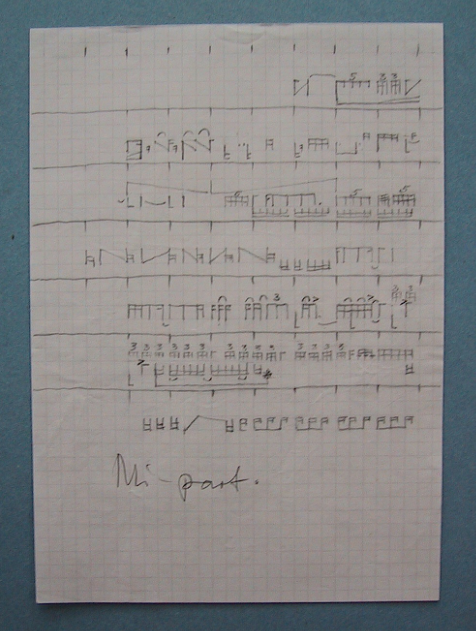
When I was researching in Lutosławski’s house in 2002, I came across many fascinating items: marked-up books, his conducting scores, a folder of folk-tune materials and a particular folder headed “ŚCIĄGACZKI” (Crib Sheets). Inside were separate pieces of MS paper connected with his work on LivreLes espaces du sommeilMi-parti and the Fourth Symphony.  Here are the two relating to Mi-parti.  They come from the second, fast section (apologies for the slightly fuzzy images).

The first is a ‘short-score’ reduction for the first eight bars of fig. 28.  The two lines represent the trumpets and trombones, whose individual purchase on the melodic line is fully worked out in the score (07’59”-08’09” on the accompanying YouTube video).

Screen Shot 2013-10-22 at 08.41.56

The second is more sketchy.  Indeed, it consists only of a (sometimes biforcated) rhythmic line.  It tracks the score from fig. 29 (i.e., two bars after the first ‘crib sheet’ stops short) as far as the third bar of fig. 35.  Although at times the link between sketch and score may seem tenuous, the sketch is consistent with the final product even if Lutosławski does use notational shorthand at times and darts from one instrumental group to another.  Effectively, this ‘crib sheet’ presents the main rhythmic template, an aide-mémoire as he worked the idea up into this extrovert, hocketing passage that leads shortly afterwards to the work’s climax (08’12”-09’09” on the accompanying YouTube video).

Screen Shot 2013-10-22 at 08.41.36

• WL100/60: Cello Concerto, **14 October 1970

On this day in 1970, Lutosławski’s Cello Concerto was premiered in London’s Royal Festival Hall by Mstislav Rostropovich and the Bournemouth Symphony Orchestra under Edward Downes.  The work was commissioned by the Royal Philharmonic Society (the first post-war commission to a foreign composer) with funds from the Gulbenkian Foundation.  The work was repeated on the following nights in Bournemouth and Exeter.

The first half of the programme consisted of Balakirev’s symphonic poem Tamara and Lutosławski’s Cello Concerto, followed in the second half by Borodin’s Second Symphony and Tchaikovsky’s Variations on a Rococo Theme. Lutosławski wrote in the RPS’s copy of the programme: ‘with my warmest thanks for this unforgettable experience’. In a letter to his Danish publisher, he wrote: ‘Rostropovich is unique and played it as if it were his own work’.

Homma 1993 4

Lutosławski’s Cello Concerto is now the most recorded post-war cello concerto after the two by Shostakovich.  At the latest count, there have been 16 commercial recordings (11 of them since Lutosławski’s death), with at least two more in the pipeline.  There is also more than a handful of recent concert performances available on YouTube and other platforms.  In this centenary year, it looks as if the Cello Concerto will be his most frequently performed work.  It is a remarkable compliment to Lutosławski’s extraordinary music.

Here are the links to the current uploads of complete professional performances:

• Felix Fan/RTVE SO/Adrian Leaper (2002)
http://www.youtube.com/watch?v=qdoW0q81F24
• Nicolas Altstaedt/Finnish Radio SO/Dmitri Slobodeniuk (2007)
http://www.youtube.com/watch?v=pIxvBjP7ld8
• Silver Ainomäe/Finnish Radio SO/Dmitri Slobodeniuk (2007)
http://www.youtube.com/watch?v=ZVqx2uUls54
• Oren Shevlin/WDR SO/Jukka-Pekka Saraste (2011)
http://www.youtube.com/watch?v=6kliW2KCYq8http://www.youtube.com/watch?v=GdjzGN4dYxw
• Alexander Baillie/Boston PO/Benjamin Zander (2012)
http://vimeo.com/40106492http://vimeo.com/40153844http://vimeo.com/40113484
• Kian Soltani/Helsinki PO/John Storgårds (2013; link broken by mid-December 2013)
http://areena.yle.fi/tv/1907455
• Paul Watkins/BBC SO/Thomas Adès (2013)
http://www.youtube.com/watch?v=Se-S8iEMWI8

• Polish ‘Awangarda’ CDs

For years, I’ve been bewailing the lack of CD representation of post-war Polish composers other than ‘the big three’. And there are still notable gaps, especially in the coverage of the music of Kazimierz Serocki: Musica concertanteSymphonic Frescoes (played at this year’s ‘Warsaw Autumn’), Forte e PianoPoezjeDramatic Story, Swinging MusicPianophonie.  But over the past couple of years the Polskie Nagranie company, in conjunction variously with the publishers PWM, Ricordi and the Polish Music Information Centre, has begun to issue and reissue archive recordings (from 1959 onwards) of some of the early figures of the Polish avant-garde.

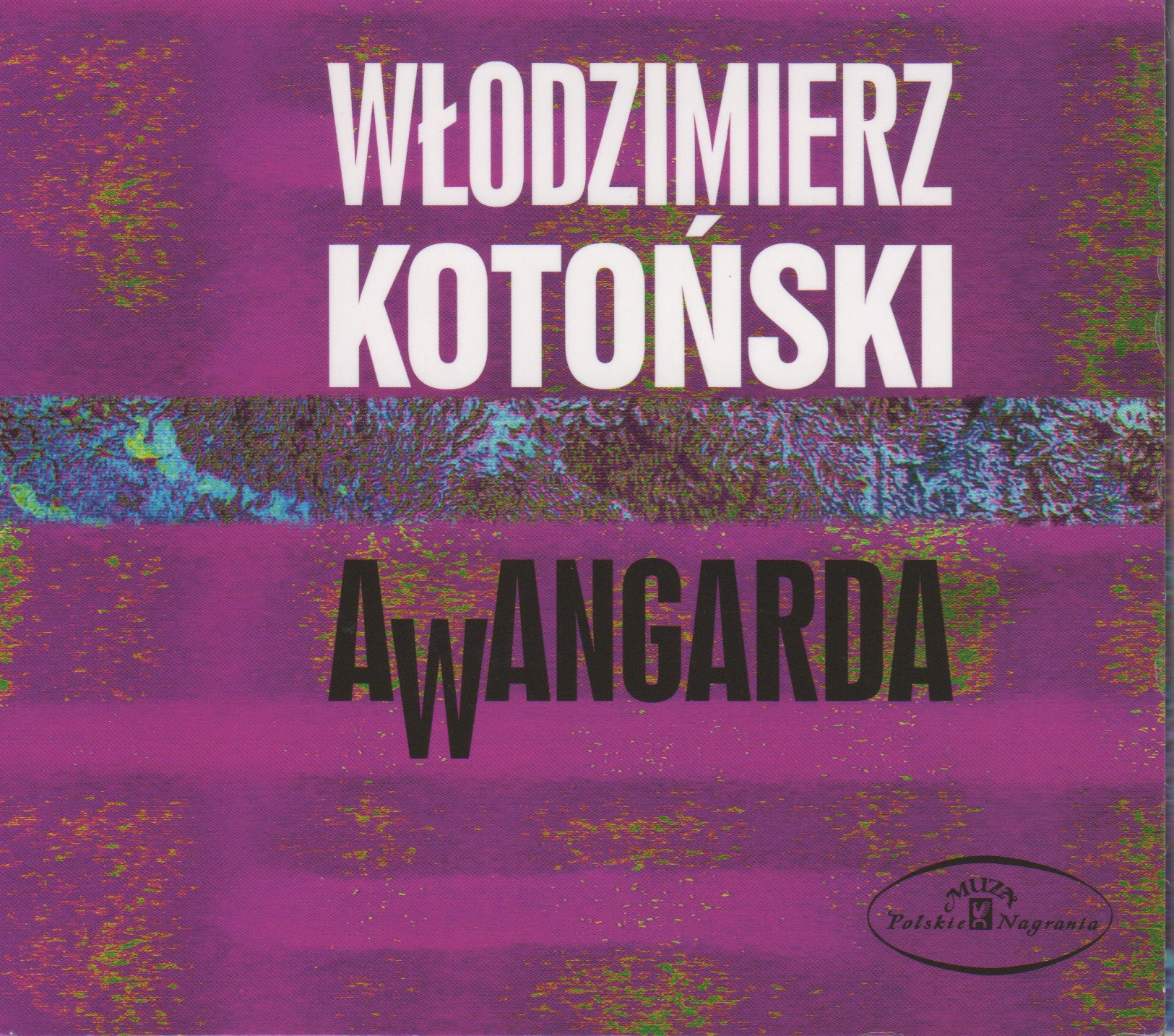
Three CDs have appeared so far in the ‘Awantgarda’ series: Krzysztof Penderecki conducted by Andrzej Markowski (2011) – and it’s the Markowski connection that makes this CD interesting (Penderecki does not want for coverage!), Serocki (2012) and Włodzimierz Kotoński (2013).  A similar project, but outside the ‘Awantgarda’ sequence, was that of the music of Tadeusz Baird, in a double CD package (2011).  For anyone wanting to hear their music, these CDs are a great place to start, not least because there are some recordings never released on CD before and others never heard beyond the confines of the ‘Warsaw Autumn’ Chronicle recordings whose circulation was extremely limited.  There are one or two never released on any format before.  Any performance dates in the second half of September are from the ‘Warsaw Autumn’ festival.  ** = first performance, * = Polish premiere.

Tadeusz Baird. Selected Works (PNCD 1399, two CDs)

This double CD was first issued in 2003 (PNCD 525A/B).

Baird.m3404 Love Sonnets (second version, 1969): Andrzej Hiolski/Kraków PRO/Jan Krenz (July 1978)
Colas Breugnon (1951): WOSPR/Krenz (May 1955)
Trouvère Songs (1963): Krystyna Szostek-Radkowa/National PO, Warsaw/Witold Rowicki (24 June 1968)
• 5 Songs (1968): Szostek-Radkowa/Wrocław PO/Andrzej Markowski (June 1974)
Psychodrama (1972): WOSPR/Wojciech Michniewski (1 February 1979)
…….
Erotyki (1961): Stefania Woytowicz/National PO/Rowicki (21 April 1963)
• Symphony 3 (1969): National PO/Krenz (10-11 June 1969)
Elegeia (1973): WOSPR/Michniewski (1 February 1979)
Concerto Lugubre (1975): Stefan Kamasa/Kraków PRO/Jacek Kaspszyk (10 April 1977)
Voices from Afar (1981): Jerzy Artysz/National PO/Rowicki (**, 22 January 1982)

Krzysztof Penderecki conducted by Andrzej Markowski (PNCD 1373)

Markowski was an extraordinary champion of new Polish music, and especially of Penderecki’s ground-breaking early scores.  This selection spans 1958-61, and only Emanations, the First String Quartet and Fonogrammi are missing from these years.

AWANGARDA_M.m340Psalms of David (1958): National PO (8 January 1966)
Strophes (1959): Silesian Philharmonic CO (**, 17 September 1959)
Anaklasis (1959-60): National PO (8 January 1966)
Dimensions of Time and Silence (1960): National PO and Choir (24 June 1972)
Threnody (1961): Kraków PO (22 September 1961)
Fluorescences (1962): National PO (8 January 1966)
Polymorphia (1961): Kraków PO (*, 26 September 1963)

Kazimierz Serocki (PNCD 1441)

It is terrific to have two early pieces on this CD, formative for both Serocki and Polish music around 1960, as well as the three ‘Warsaw Autumn’ performances.

Serocki_awangarda.m340Episodes (1958-59): WOSPR/Krenz (24 March 1965)
Segmenti (1960-61): WOSPR/Krenz (24 March 1965)
Continuum (1965-66): Warsaw Percussion Group (28 February 1980)
Fantasmagoria (1970-71): Roger Woodward/Hubert Rutkowski (23 September 1976)
Fantasia elegiaca (1971-72): Karl-Erik Welin, Hesse RSO/Markowski (*, 28 September 1973)
Arrangements for four recorders (1975-76): (20 September 1978)

Włodzimierz Kotoński (PNCD 1521/polmic 099)

Kotónski, now 88, has languished in the shadows of his contemporaries.  His early tape pieces especially were key to the development of the Polish avant-garde.  Less than a handful of his works had been commercially released on any format prior to this CD.  (There’s no Kotoński web-page yet on the Polskie Nagrania site.)

Homma 1993Study on One Cymbal Stroke (1959): (Polish Radio Experimental Studio, 1960)
Microstructures (1963): (PRES, 1963)
Aela (1970): (PRES, 1977)
Les ailes (1975): (Bourges, 1977)
Aeolian Harp (1974): Rozwitha Trexler and four instrumentalists (*, 21 September 1975)
Musique en relief (1959): National PO/Stanisław Wisłocki (*, 25 September 1960)
Musica per fiati e timpani (1964): National PO/Rowicki (1966)
Music for 16 Cymbals and Strings (1966): WOSPR/Jerzy Maksymiuk (1977)

• WL100/58: ‘old’ Derwid CDs

It’s all happening at once for Derwid, or so it seems.  Polskie Nagrania has announced a new CD of original recordings of Lutosławski’s pseudonymous popular songs from 1957-63, just as Agata Zubel’s CD of modern interpretations has arrived in the shops (see yesterday’s post WL100/57).  Yet PN’s new CD is, apart from two of its 14 tracks, a reissue of another CD that was produced in 2010 and which can be listened to online for free. Confused?  Here’s a run-down of the Derwid discography so far.

ap01342005: Derwid. Lutosławski’s Concealed Portrait (Acte Prealable, APO134).  New arrangements of twelve songs, sung by Mariusz Klimek and an instrumental quartet (keyboards, tenor sax, bass guitar, percussion).

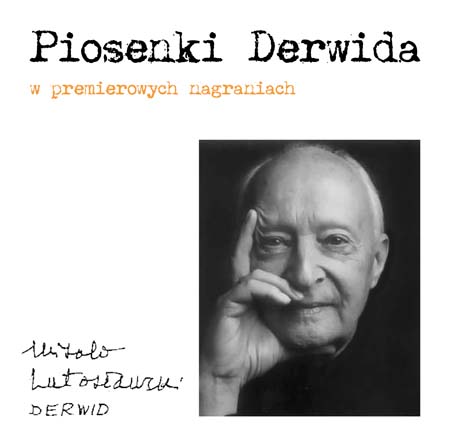
Derwid_L2010: Piosenki Derwida (Studio MTS).  Remastering of twelve recordings published in the 1950s and 1960s on the Muza and Pronit labels.  It somewhat bizarrely includes a bonus track, Le fiacre de Varsovie, a French-language version of Warszawski dorożkarz, sung by the Greek singer Yovanna at the 1962 Sopot Festival in northern Poland.

image_gallery-1

2013 (PNCD): Piosenki Derwida / Witolda Lutosławskiego. Warszawski Dorożkarz (Polskie Nagrania, PNCD 1503).  A reissue of Studio MTS’s remastering (2010), plus two other period tracks.

Derwid-obwoluta

2013 (ACD): el Derwid (CD Accord, ACD 192).  New arrangements of eleven songs, sung by Agata Zubel, with Andrzej Bauer (cello) and Cezary Duchnowski (keyboards, computer).

According to the Studio MTS website, its set of twelve period recordings was issued, though I can find no record of its CD number.  In fact, it was never issued commercially, but was available for educational purposes only.  So it is very good that it has now resurfaced – in a different track order – under the PN label.  At the time of writing, the Studio MTS recordings are still available to listen for free online: http://studiomts.pl/NewFiles/Opisy_plyt/Derwid.html.

Here’s an alphabetical list of which tracks you can find on which CDs.  These 20 songs represent just over half of Derwid’s output and there remain some gems yet to be recorded (for a full list of songs and English translations of the titles, see WL100/42: 33 ‘Derwid’ songs published).  I know that in the mid-1990s there still were tapes in Polish Radio of period broadcasts of many of these songs, some in different versions, and also of others not in this list, so perhaps some day they too will be aired again.

Cyrk jedzie: 2005, 2010 + 2013 (PNCD), 2013 (ACD)
Czarownica: 2005, 2010 + 2013 (PNCD), 2013 (ACD)
Daleka podróż: 2010 + 2013 (PNCD), 2013 (ACD)
Filipince nudno: 2013 (PNCD)
Jak zdobywać serduszka: 2010 + 2013 (PNCD
Jeden przystanek dalej: 2005, 2013 (ACD)
Kapitańska ballada: 2013 (PNCD)
Milczące serce: 2005 (twice), 2010 + 2013 (PNCD)
Miłość i świat: 2005, 2013 (ACD)
Nie oczekuję dziś nikogo: 2005, 2010 + 2013 (PNCD), 2013 (ACD)
Plamy na słońcu: 2010 + 2013 (PNCD), 2013 (ACD)
Po co śpiewać piosenki: 2005
Tabu: 2010 + 2013 (PNCD)
Tylko to słowo: 2010 + 2013 (PNCD)
W lunaparku: 2005, 2013 (ACD)
W naszym pustym pokoju hula wiatr: 2010 + 2013 (PNCD)
Warszawski dorożkarz: 2005, 2010 + 2013 (PNCD)
(Le fiacre de Varsovie): 2010 + 2013 (PNCD)
Z lat dziecinnych: 2005, 2013 (ACD)
Złote pantofelki: 2013 (ACD)
Znajdziesz mnie wszędzie: 2005, 2013 (ACD)